Ezekiel 41:3

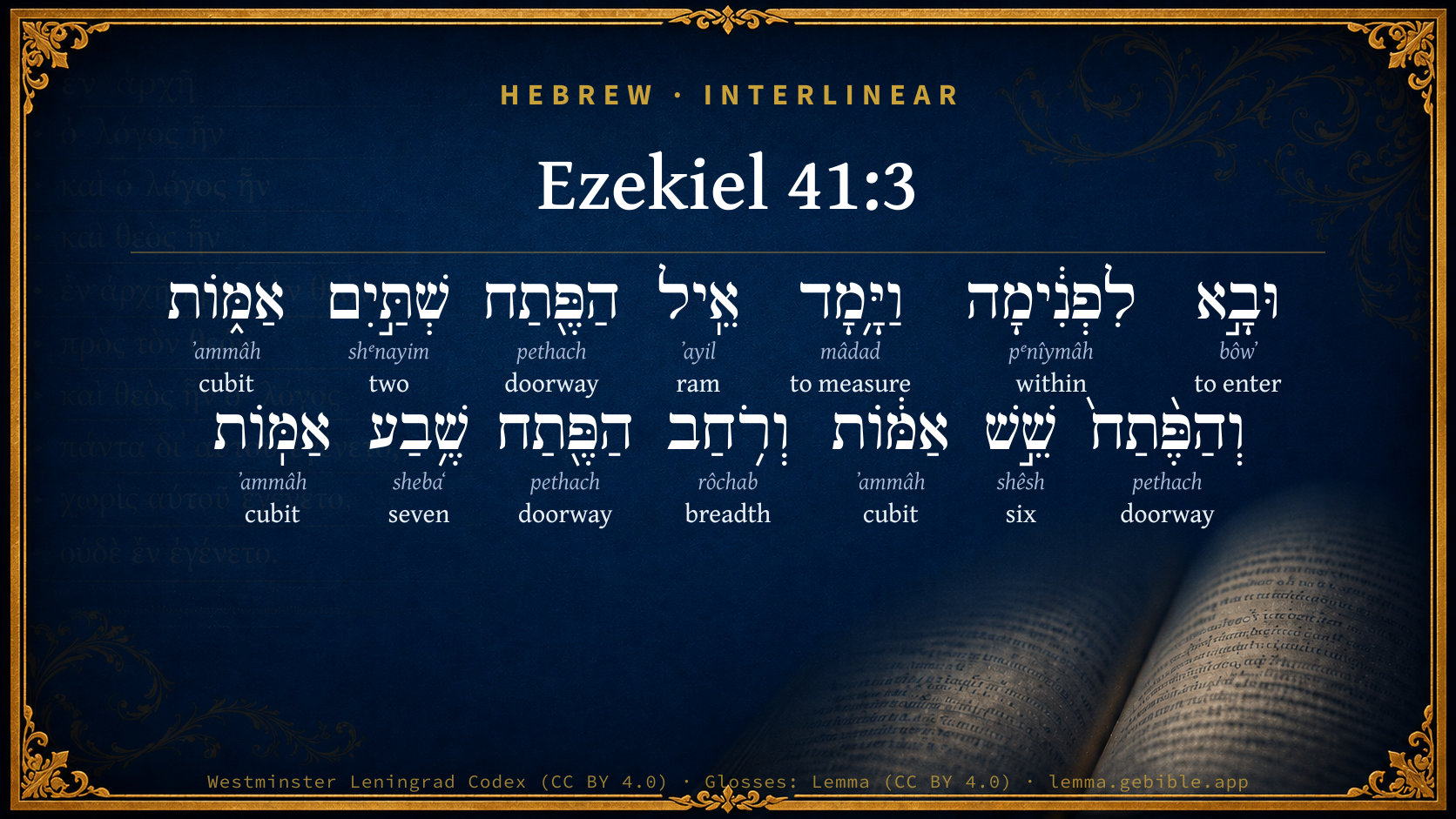
Hebrew (Westminster Leningrad Codex) Ezekiel 41:3 appears in the Hebrew Old Testament. The text above is from the Westminster Leningrad Codex. Each word links to its Strong’s number, a concise gloss, and parsing drawn from the Open Scriptures Hebrew Bible morphology. Click any word for its full Brown-Driver-Briggs (BDB) entry.
Download image
Cite this verse

Ezekiel 41:3 (World English Bible). Public Domain. Lemma interlinear Bible study tool, https://lemma.gebible.app/v/ezekiel/41/3.

Show BibTeX & RIS
BibTeX
RIS
English Translation
Then went he inward, and measured each post of the entrance, two cubits; and the entrance, six cubits; and the breadth of the entrance, seven cubits.
World English Bible · Public Domain
Download a study sheet

One document with this verse’s original text, its word-by-word gloss line, the meaning frame, cross-references with their text, attributed commentary, and full source and license credits — printable, and it pastes into notes with its structure intact.

This verse Autodidact and up

Study sheet (.html) Plain text (.txt)

A passage Seminary Student

Up to 50 verses in one chapter. A passage sheet keeps up to 6 commentary sources and 12 cross-references per verse, in the order this page ranks them, and says so on the sheet whenever that leaves anything out. Ask for a single verse and you get the Autodidact verse sheet above.

Everything on this page stays free to read, with no account — the sheet is a download of what is already on screen, not access to it.

Want to remove ads? Support Godless Engineer
Compare translations 3

The same verse in 3 English versions, stacked beneath the original-language interlinear above. Click any original word for its lexicon entry.

Each is an independent rendering of the whole verse — the interlinear is not word-aligned to these translations.

Highlighted words mark where these versions differ — a whole-verse word diff, not a word-by-word alignment.

  • World English Bible Public Domain
    Then went he inward, and measured each post of the entrance, two cubits; and the entrance, six cubits; and the breadth of the entrance, seven cubits.
  • King James Version Public Domain
    Then went he inward, and measured the post of the door, two cubits; and the door, six cubits; and the breadth of the door, seven cubits.
  • unfoldingWord Literal Text CC BY-SA 4.0
    Then the man went into the very holy place and measured the posts of the doorway—two cubits, and the doorway was six cubits in width. The walls on either side were seven cubits in width.

unfoldingWord Literal Text — © unfoldingWord, licensed CC BY-SA 4.0. Word-aligned USFM3 via Door43 (git.door43.org/unfoldingWord/en_ult).

Versions to compare (up to 4)

3 of 4 selected

Show all 18 translations

Every available English version of this verse, each an independent rendering of the whole verse.

  • World English Bible Public Domain
    Then went he inward, and measured each post of the entrance, two cubits; and the entrance, six cubits; and the breadth of the entrance, seven cubits.
  • Berean Standard Bible Public Domain
    And he went into the inner sanctuary and measured the side pillars at the entrance to be two cubits wide. The entrance was six cubits wide, and the walls on each side were seven cubits wide.
  • Majority Standard Bible Public Domain
    And he went into the inner sanctuary and measured the side pillars at the entrance to be two cubits wide. The entrance was six cubits wide, and the walls on each side were seven cubits wide.
  • King James Version Public Domain
    Then went he inward, and measured the post of the door, two cubits; and the door, six cubits; and the breadth of the door, seven cubits.
  • American Standard Version (1901) Public Domain
    Then went he inward, and measured each post of the entrance, two cubits; and the entrance, six cubits; and the breadth of the entrance, seven cubits.
  • Revised Version (1885) Public Domain
    Then went he inward, and measured each post of the entrance, two cubits: and the entrance, six cubits; and the breadth of the entrance, seven cubits.
  • Geneva Bible (1599) Public Domain
    Then went hee in, and measured the postes of the entrie two cubites, and the entrie sixe cubites, and the breadth of the entrie seuen cubites.
  • Douay-Rheims (1899) Public Domain
    Then going inward he measured the front of the gate two cubits: and the gate six cubits, and the breadth of the gate seven cubits.
  • Young's Literal Translation Public Domain
    And he hath gone inward, and measureth the post of the opening two cubits, and the opening six cubits, and the breadth of the opening seven cubits.
  • Literal Standard Version CC BY-SA 4.0
    And he has gone inward, and measures the post of the opening—two cubits, and the opening—six cubits, and the breadth of the opening—seven cubits.
  • Unlocked Literal Bible CC BY-SA 4.0
    Then the man went into the very holy place and measured the posts of the doorway—two cubits, and the doorway was six cubits in width. The walls on either side were seven cubits in width.
  • unfoldingWord Literal Text CC BY-SA 4.0
    Then the man went into the very holy place and measured the posts of the doorway—two cubits, and the doorway was six cubits in width. The walls on either side were seven cubits in width.
  • Darby Bible Public Domain
    And he went inwards, and measured the post of the entry, two cubits; and the entry, six cubits; and the breadth of the entry, seven cubits.
  • World Messianic Bible Public Domain
    Then he went inward and measured each post of the entrance, two cubits; and the entrance, six cubits; and the width of the entrance, seven cubits.
  • Webster's Bible Public Domain
    Then he went inward, and measured the post of the door, two cubits; and the door, six cubits; and the breadth of the door, seven cubits.
  • Free Bible Version CC BY-SA 4.0
    He went into the inner sanctuary and measured the entrance posts as two cubits wide. The entrance was six cubits wide, and the walls on both sides were seven cubits wide.
  • Bible in Basic English Public Domain
    And he went inside and took the measure of the uprights of the door-opening, two cubits: and the door-opening, six cubits; and the side-walls of the door-opening were seven cubits on one side and seven cubits on the other.
  • JPS Tanakh (1917) Public Domain
    Then went he inward, and measured each post of the entrance, two cubits; and the entrance, six cubits; and the breadth of the entrance, seven cubits.

Literal Standard Version (2020), Covenant Press — licensed CC BY-SA 4.0. Text via the HelloAO Bible API (eBible.org). Unlocked Literal Bible (unfoldingWord) — licensed CC BY-SA 4.0. Text via the HelloAO Bible API (eBible.org). unfoldingWord Literal Text — © unfoldingWord, licensed CC BY-SA 4.0. Word-aligned USFM3 via Door43 (git.door43.org/unfoldingWord/en_ult). Free Bible Version, Dr. Jonathan Gallagher — licensed CC BY-SA 4.0. Text via the HelloAO Bible API (eBible.org).

Word by word

More ways to search: Search by grammar → Find every occurrence → Compare this word →

Practice this passage: Drill this verse → Learn its vocabulary →

לִפְנִ֔ימָה
pᵉnîymâh
H6441
“to/for · within”
Preposition + Adverb
Part of Speech
Preposition + Adverb
Full BDB Definition

Origin: from H6440 with directive enclitic

TWOT: 1782c

toward the inside, within, faceward
  1. וּבָ֣א bôwʼ H935 “and · to enter” Conjunction + Verb, Qal, Sequential Perfect, 3rd Person, Masculine, Singular
  2. וַיָּ֥מָד mâdad H4058 “and · to measure” Conjunction + Verb, Qal, Sequential Imperfect, 3rd Person, Masculine, Singular
  3. אֵֽיל ʼayil H352 “ram of” Noun, Common, Masculine, Singular, Construct
  4. הַפֶּ֖תַח pethach H6607 “the · doorway” Particle, Definite Article + Noun, Common, Masculine, Singular, Absolute
  5. שְׁתַּ֣יִם shᵉnayim H8147 “two” Adjective, Cardinal number, Feminine, Dual, Absolute
  6. אַמּ֑וֹת ʼammâh H520 “cubits” Noun, Common, Feminine, Plural, Absolute
  7. וְהַפֶּ֨תַח֙ pethach H6607 “and · the · doorway” Conjunction + Particle, Definite Article + Noun, Common, Masculine, Singular, Absolute
  8. שֵׁ֣שׁ shêsh H8337 “six” Adjective, Cardinal number, Feminine, Singular, Absolute
  9. אַמּ֔וֹת ʼammâh H520 “cubits” Noun, Common, Feminine, Plural, Absolute
  10. וְרֹ֥חַב rôchab H7341 “and · breadth of” Conjunction + Noun, Common, Masculine, Singular, Construct
  11. הַפֶּ֖תַח pethach H6607 “the · doorway” Particle, Definite Article + Noun, Common, Masculine, Singular, Absolute
  12. שֶׁ֥בַע shebaʻ H7651 “seven” Adjective, Cardinal number, Feminine, Singular, Absolute
  13. אַמּֽוֹת ʼammâh H520 “cubits” Noun, Common, Feminine, Plural, Absolute

About this verse

These counts appear in no published source. They are computed here, from the morphology-tagged text and Lemma’s own curated glosses. What Lemma adds →

14
words
10
distinct lemmas
Prophets
section

Notable vocabulary

The rarest word here is לִפְנִ֔ימָה within H6441 — appearing just 13 times in the whole Hebrew Bible.

Shared distinctive vocabulary

לִפְנִ֔ימָה within H6441 occurs in 12 verses of the Hebrew Bible. Also found in:

Grammatical profile

  • 2 verbs
  • 8 nouns
  • 3 adjectives
  • 1 adverb

Verb forms

  • וּבָ֣א Qal · Sequential Perfect
  • וַיָּ֥מָד Qal · Sequential Imperfect

Repetition

Words recur within this verse — often emphatic in Hebrew:

  • הַפֶּ֖תַח doorway H6607 ×3
  • אַמּ֑וֹת cubit H520 ×3

Hebrew & Septuagint length

In English translation the verse runs 26 words from the Hebrew and 39 from the Septuagint (LXX English) — the Septuagint runs noticeably longer here. See the side-by-side →

A rough comparison of the two English renderings, which tokenize alike — not a word-level alignment.

Word counts can differ between the Hebrew and the Greek without any difference in meaning — e.g. the Hebrew direct-object marker אֵת has no separate Greek word, and Greek often adds the article ὁ.

Cross-references

1

Topical passages linked to Ezekiel 41:3 in the Treasury of Scripture Knowledge — connected by theme and wording, ordered by reader-vote popularity; previews shown in the World English Bible.

  • Ezekiel 40:16 There were closed windows to the lodges, and to their posts within the gate round about, and likewise to the arches; and windows were round about inward; and on [each] post were palm trees.

Cross-references courtesy of OpenBible.info (CC BY 4.0).

Hebrew and Greek witnesses Masoretic Hebrew ↔ Greek Septuagint

The same verse in the two great witnesses to the Old Testament, shown verse-for-verse.

Here the Septuagint runs noticeably longer than the Hebrew — LXX2012 (modern English Septuagint) 39 words vs World English Bible 26. A rough length comparison of the two English translations, not a word-level alignment — read both below.

These are two independent witnesses, not word-aligned to each other, and the Septuagint is shown in lemma (dictionary) form.

Hebrew Ezekiel 41:3 Masoretic · Westminster Leningrad Codex

וּבָ֣א לִפְנִ֔ימָה וַיָּ֥מָד אֵֽיל הַפֶּ֖תַח שְׁתַּ֣יִם אַמּ֑וֹת וְהַפֶּ֨תַח֙ שֵׁ֣שׁ אַמּ֔וֹת וְרֹ֥חַב הַפֶּ֖תַח שֶׁ֥בַע אַמּֽוֹת

Then went he inward, and measured each post of the entrance, two cubits; and the entrance, six cubits; and the breadth of the entrance, seven cubits.

World English Bible · Public Domain

Greek LXX Ezekiel 41:3 Septuagint · lemma form

καί εἰςἔρχομαι εἰς ὁ αὐλή ὁ ἐσώτερος καί διαμετρέω ὁ αιλ ὁ θύρωμα πηχύς δύο καί ὁ θύρωμα πηχύς ἕξ καί ὁ ἐπωμίς ὁ θύρωμα πηχύς ἑπτά ἔνθεν καί πηχύς ἑπτά ἔνθεν

And he went into the inner court, and measured the post of the door, two cubits; and the door, six cubits; and the side-pieces of the door, seven cubits on one side, and seven cubits on the other side.

LXX2012 (modern English Septuagint) · Public Domain

On this verse, The Cambridge Bible for Schools and Colleges discusses the Septuagint’s reading. Read the note in Commentary ↓

Hebrew: Westminster Leningrad Codex (CC BY 4.0). Greek: Septuagint (public domain); English from LXX2012 (modern English Septuagint) (Public Domain). How the Septuagint differs from the Hebrew →

Targum (Aramaic paraphrase)

1

The Targum is the ancient Jewish Aramaic paraphrase of the Hebrew Scriptures — an interpretive translation, not the Hebrew text itself. Onkelos (literal) and Pseudo-Jonathan (expansive) render the Torah, and Jonathan the Prophets. Coverage is partial: where no permissively-licensed English translation exists for a verse, only the Aramaic is shown. This is verse-level text, not a word-by-word alignment to the Hebrew.

  1. Targum Jonathan Prophets (Joshua–Malachi)
    וְעַל לְגָיו וּמְשַׁח אֵילָא דְתַרְעָא תַּרְתֵּין אַמִין וְתַרְעָא שִׁית אַמִין וּפוּתְיָא דְתַרְעָא שְׁבַע אַמִין:

    (no public-domain English translation for this verse)

    Targum Jonathan — Aramaic: “Mikraot Gedolot” (public domain). English: “Sefaria Community Translation” (CC0 1.0 (public-domain dedication)); “London "Chaldee Paraphrase," 1871” (public domain). Text via Sefaria.

Commentary

Notes on Ezekiel 41:3 from classic Christian and Jewish commentators (each source and its license shown beneath its notes). The classic Christian expositions comment on the surrounding passage and are grouped to its opening verse, so a note may address several verses; the Jewish commentaries on the Tanakh (Rashi and others) are per-verse, so they appear only where the commentator wrote on this verse.

Lemma curates 59 commentaries, every one of them public domain or Creative Commons licensed, each selected and text-cleaned for this edition rather than reprinted as found. About our sources →

Trapp's Complete Commentary

John Trapp

Eze 41:3 Then went he inward, and measured the post of the door, two cubits; and the door, six cubits; and the breadth of the door, seven cubits.

Ver. 3. Then went he inward.] Toward the Holy of holies.

And the door.] Which in the second temple was but a veil, and rent at Christ’s passion.

John Trapp, A Commentary or Exposition upon All the Books of the Old and New Testament (1647–1656) — public domain. Text from a community e-Sword module.

The Biblical Illustrator

Joseph S. Exell

Eze_41:3

And the door, six cubits.

A wide way to God

The porch, at which was an ascent to the temple, had a gate belonging to it. This gate was six cubits. Now, some may object, and say, Since the way to God by these doors was so wide, why doth Christ say the way and gate is narrow? Answer. The straitness, the narrowness, must not be understood of the gate simply, but because of that cumber that some men carry with them, that pretend to be going to heaven. Six cubits! What is sixteen cubits to him who would enter in here with all the world on his back? (John Bunyan.)

The Biblical Illustrator, edited by Joseph S. Exell (c. 1880s–1900s) — public domain. Text from a community e-Sword module.

Joseph Benson's Commentary

Eze 41:3-4. Then went he inward — From the outward sanctuary he went forward toward the holy of holies, and measured the thickness of the partition wall to be two cubits, the entrance itself six cubits, and breadth of the wall, on each side of the door, seven cubits: see Eze 40:48; where the breadth of the gate is taken in the same sense. The breadth of the wall, thus computed, making up fourteen cubits, and being added to the breadth of the entrance itself, makes up twenty cubits; the breadth of the inner sanctuary, as it is set down in the next verse. So he measured the length thereof — Of the holy of holies twenty cubits, and the breadth twenty cubits — It was an exact cube, of the same dimensions in length, breadth, and height: see 1Ki 6:20; before the temple — Or rather, as the words should be rendered, according to the temple; that is, the breadth of it.

Joseph Benson's Commentary on the Old and New Testaments (1811–1818) — public domain. Text from a community e-Sword module.

Tyndale Open Study Notes

Tyndale Open Resources

41:3-4 The inner room was the Most Holy Place, the only square space within the Temple. It was reached by passing through three openings of decreasing width—access was increasingly restricted as one approached God. The entrance to the entry room was 24½ feet wide (40:48), and the doorway into the sanctuary was 17½ feet wide (41:2), but the entrance to the Most Holy Place was only 10½ feet wide. Ezekiel did not enter the Most Holy Place, but waited outside while the angel went in alone and measured it.

Tyndale Open Study Notes — © Tyndale Open Resources, licensed CC BY-SA 4.0. Text via the HelloAO Bible API.

Jamieson, Fausset & Brown

Robert Jamieson, A. R. Fausset & David Brown

inward--towards the most holy place.

Jamieson, Fausset & Brown — Commentary Critical and Explanatory on the Whole Bible (1871) — public domain (CC PDM 1.0). Text via the HelloAO Bible API.

Ellicott's Commentary for English Readers

(3) Went he inward.—There is here a noticeable change in the usual expression; in all other cases the angel had brought the prophet to the places to be measured, but as he is here entering the Holy of Holies, into which, under the law, Ezekiel might not enter, the angel goes in alone. The prophetic vision was not yet sufficiently clear to speak of the way into the true Holy of Holies as at length opened to all (Heb_9:8; Heb_9:12; Heb_10:19).

The door, six cubits.—Door is here used for doorway, the clear space between the posts. The “breadth of the door” itself is immediately said to be seven cubits, the door overlapping the posts in a shoulder half a cubit on each side.

A Bible Commentary for English Readers, edited by Charles John Ellicott (1878–1897) — public domain. Text from a community e-Sword module.

The Cambridge Bible for Schools and Colleges

gen. ed. J. J. S. Perowne

3, 4. The most holy place, Fig. 2, C

3. The wall was 2 cubits thick, Fig. 2, ef.

breadth of the door, seven cubits] The actual door or entrance Fig. 2, ee, ff, was 6 cubits (preceding clause); the present statement, therefore, refers to the walls on either side of the entrance (N. to S.). LXX. read or rightly interpreted: and the entrance six cubits; and the side pieces of the entrance seven cubits on one side and seven cubits on the other. Fig. 2, fk. That is 6 + 7 + 7 = 20, breadth of the house as before (Eze_41:4). It is to be observed that while Ez., being a priest, enters the holy place along with the guide he refrains from entering the most holy place, which the angel alone enters.

The Cambridge Bible for Schools and Colleges (gen. ed. J. J. S. Perowne; Cambridge University Press, 1878–1918) — public domain. Text from a community e-Sword module.

John Gill's Exposition

Then went he inward,.... Through the temple or holy place he had measured, to the holy of holies:

and measured the post of the door two cubits; this was the door into the most holy place; there was one in Solomon's temple; but in the second temple there was none; but two rails instead of it, which were rent at the death of Christ; and two cubits was the thickness of the post, on which this door was shut:

and the door six cubits, and the breadth of the door seven cubits; this door was a two leaved one; each leaf consisted of three cubits broad, and the post in the middle on which they shut one cubit broad, which made seven: though some think that the side walls of the door are meant, as in Eze 41:2, which were each seven cubits; and the breadth of the door, six cubits, made twenty cubits; which was the breadth of the most holy place, as answering to the breadth of the holy place, as in the next verse.

John Gill's Exposition of the Whole Bible (1746–1763) — public domain (CC PDM 1.0). Text via the HelloAO Bible API.

Albert Barnes' Notes on the Bible

Went he inward - Toward the holy of holies. It is not said, “he brought me in,” but “he went in,” because the holy of holies was not to be entered even by a priest like Ezekiel, but only by the high priest once a year. So the “angel” enters and announces: the measurements.

The post of the door - On either side of the entrance was a pillar, the two together making up two cubits. The first measurement of the door was from “post to post,” six cubits; and the second measurement, the “breadth of the door,” was the breadth of the actual doors which shut off the holy of holies Eze 41:23, and which may have been so, hung that each of the “posts” projected half a cubit beyond the hinge of the door (which opened inwards), so as to secure the complete closure of the holy of holies.

Albert Barnes' Notes on the Bible (1834–1885) — public domain. Text from a community e-Sword/MySword module.

Haydock's Catholic Bible Commentary

Front, or door-posts. The temple was 20 cubits broad.

George Leo Haydock (1774–1849), Haydock's Catholic Family Bible and Commentary, 1859 edition — public domain. Excludes Psalms (Douay-Rheims chapter numbering differs from Protestant) and Deuterocanonical books (Catholic canon only).

Matthew Poole's English Annotations

Inward; from the porch through the body of the temple, to the partition between the body of the temple and the holy of holies, or the oracle.

The post; either the thickness of that partition wall, or of the pilasters, which stood one on one side and the other on the other side of the door.

The door, or entrance out of the temple into the oracle. This door was

six cubits high, say some, but, more likely, it was six cubits broad, and an upright bar or post on which the leaves did meet, and which was of one cubit’s breadth, make out the seven cubits mentioned in the last words of this verse.

Matthew Poole's English Annotations on the Holy Bible (1683–1685) — public domain. Text from a community e-Sword/MySword module.

The Pulpit Commentary

Then went he inward; i.e. into the most holy place. As this could not be entered even by a priest, but only by the high priest once (Exo_30:10; Lev_16:17; Heb_9:7) Ezekiel was left without, while "the man" announced to him in succession the measurements of the adytum, as these were taken. First, that of the post of the door (the singular for the plural, meaning the post on either side of the doorway) two cubits. Next, that of the door itself, which is given first as six and second as seven cubits. Kliefoth and Keil take the six as the height and the seven as the breadth of the entrance into the holy of holies; but as no other measurement of height occurs throughout this description, Dr. Currey regards "six" as the distance from "pest" to "post," and "seven" as the actual width of the door, each post projecting half a cubit beyond the hinge of the door, which opened inward. Ewald and Villalpandus, after the LXX, read, "the entrance six cubits and the flanks of the entrance seven cubits;" and these figures, 7 + 6 4- 7, certainly make up the breadth of the interior; only it is impossible to extract this meaning from the Hebrew without tampering with the text.

The Pulpit Commentary (1880–1919), ed. H.D.M. Spence-Jones & Joseph S. Exell — public domain. Text from a community e-Sword module.

John Wesley's Explanatory Notes

Went he - From the porch thro' the body of the temple, to the partition between the body of the temple and the holy of holies. Measured - Either the thickness of that partition wall, or of the pilasters, which stood one on the one side, and the other on the other side of the door. Of the door - Or entrance out of the temple into the oracle. And the door - This door was six cubits broad, and an upright bar or post on which the leaves met, and which was of one cubit's breadth, make out seven cubits.

John Wesley, Explanatory Notes Upon the Whole Bible (1754–1765) — public domain. Text via the GEBible commentary corpus.

unfoldingWord translationNotes

Door43 World Missions Community

two cubits

about 1.1 meter (See: Biblical Distance)

cubits

Each long cubit was about 54 centimeters. See how you translated this in Ezekiel 40:05. (See: Biblical Distance)

six cubits

about 3.2 meters (See: Biblical Distance)

seven cubits

about 3.8 meters (See: Biblical Distance)

twenty cubits

about 11 meters (See: Biblical Distance)

translationWords

holy place

unfoldingWord translationNotes — © Distant Shores Media and the Door43 World Missions Community, licensed CC BY-SA 4.0. Source: git.door43.org/Door43/en_tn.

Rashi

Rabbi Shlomo Yitzchaki (Rashi)

And he came to the interior to the wall that separated the Heichal from the Holy of Holies.

and measured the pillar of the entrance Its thickness was two cubits. This was not equal to the cubit for the partition.

and the entrance six cubits I cannot explain this except as a reference to its height.

Rashi on the Tanakh — English translations: “The Judaica Press complete Tanach with Rashi, translated by A. J. Rosenberg” (CC BY 4.0); “Pentateuch with Rashi's commentary by M. Rosenbaum and A.M. Silbermann, 1929-1934” (public domain); “The Metsudah Tanach series, Lakewood, N.J” (CC BY 4.0); and “The Book of Joshua, Metsudah Publications, 1997” (CC BY 4.0). Text via Sefaria.

Lesson kit

Teaching starters — assembled from the data on this page, not authored interpretation. Every prompt links to the verse data it draws on. Edit before teaching.

Ezekiel, in the Prophets, opens this verse with 14 words (10 distinct Hebrew lemmas). Its most distinctive word is pᵉnîymâh (“within”). The Greek Septuagint runs longer here. A historical commentator’s framing appears above. Read the whole chapter for the surrounding context.

Discussion questions

  1. How does “within” (pᵉnîymâh) shape what this verse is saying?
  2. How does Leviticus 10:18, which shares the word «within», read alongside this verse?
  3. What does the repetition of “doorway” (3× in this one verse) do in this verse?
  4. The Septuagint runs longer here than the Hebrew. What might account for the difference?
  5. The translations on this page render this verse differently — a whole-verse word diff, not a word-by-word alignment. What might account for the different wordings?
  6. «וּבָ֣א» is a Qal Sequential Perfect verb. How does that grammatical form shape the action described?
  7. Compare how Trapp's Complete Commentary and The Biblical Illustrator read this verse. Where do they agree or differ?

Things to notice

Reading settings

Reading text

Shown beneath each verse's original-language words.

Old Testament
Old Testament edition

Read the OT as the Masoretic Hebrew (MT) or the Greek Septuagint (LXX).

English shown for the Greek Septuagint (in the Hebrew ↔ Greek comparison).

Comparing translations? Open the Compare panel on any verse page to stack up to four side by side.