
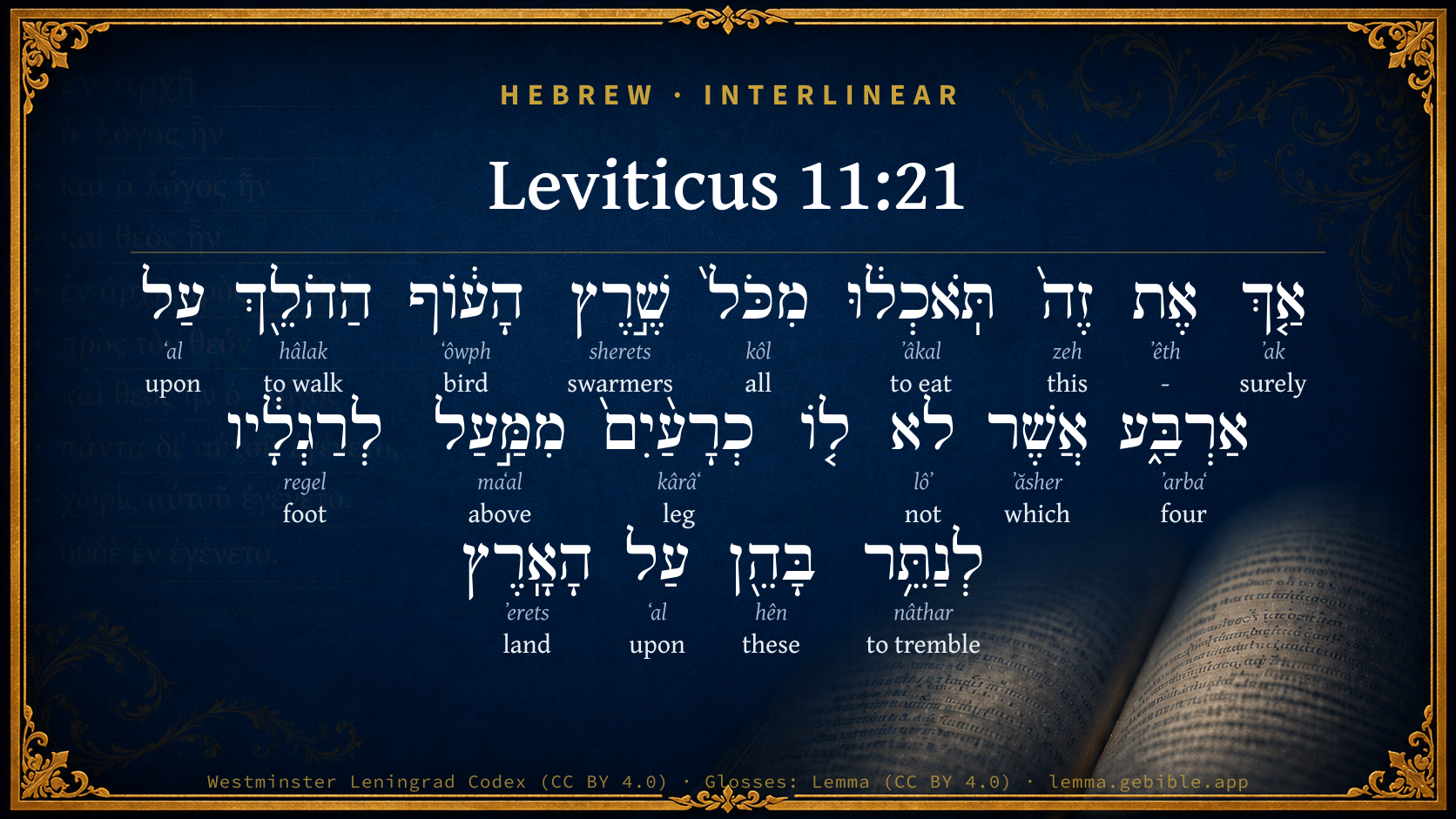
Leviticus 11:21

Hebrew (Westminster Leningrad Codex) Leviticus 11:21 appears in the Hebrew Old Testament. The text above is from the Westminster Leningrad Codex. Each word links to its Strong’s number, a concise gloss, and parsing drawn from the Open Scriptures Hebrew Bible morphology. Click any word for its full Brown-Driver-Briggs (BDB) entry.
Download image
Cite this verse

Leviticus 11:21 (World English Bible). Public Domain. Lemma interlinear Bible study tool, https://lemma.gebible.app/v/leviticus/11/21.

Show BibTeX & RIS
BibTeX
RIS
English Translation
Yet you may eat these: of all winged creeping things that go on all fours, which have legs above their feet, with which to hop on the earth.
World English Bible · Public Domain
Highlights
  • 1 first appearance in the Hebrew Bible
Full analysis ↓
Download a study sheet

One document with this verse’s original text, its word-by-word gloss line, the meaning frame, cross-references with their text, attributed commentary, and full source and license credits — printable, and it pastes into notes with its structure intact.

This verse Autodidact and up

Study sheet (.html) Plain text (.txt)

A passage Seminary Student

Up to 50 verses in one chapter. A passage sheet keeps up to 6 commentary sources and 12 cross-references per verse, in the order this page ranks them, and says so on the sheet whenever that leaves anything out. Ask for a single verse and you get the Autodidact verse sheet above.

Everything on this page stays free to read, with no account — the sheet is a download of what is already on screen, not access to it.

Want to remove ads? Support Godless Engineer
Compare translations 3

The same verse in 3 English versions, stacked beneath the original-language interlinear above. Click any original word for its lexicon entry.

Each is an independent rendering of the whole verse — the interlinear is not word-aligned to these translations.

Highlighted words mark where these versions differ — a whole-verse word diff, not a word-by-word alignment.

  • World English Bible Public Domain
    Yet you may eat these: of all winged creeping things that go on all fours, which have legs above their feet, with which to hop on the earth.
  • King James Version Public Domain
    Yet these may ye eat of every flying creeping thing that goeth upon all four, which have legs above their feet, to leap withal upon the earth;
  • unfoldingWord Literal Text CC BY-SA 4.0
    However, this you shall eat from every swarming thing of the wing, the one walking on four: that which to it legs from above to its feet to jump with them on the earth.

unfoldingWord Literal Text — © unfoldingWord, licensed CC BY-SA 4.0. Word-aligned USFM3 via Door43 (git.door43.org/unfoldingWord/en_ult).

Versions to compare (up to 4)

3 of 4 selected

Show all 18 translations

Every available English version of this verse, each an independent rendering of the whole verse.

  • World English Bible Public Domain
    Yet you may eat these: of all winged creeping things that go on all fours, which have legs above their feet, with which to hop on the earth.
  • Berean Standard Bible Public Domain
    However, you may eat the following kinds of flying insects that walk on all fours: those having jointed legs above their feet for hopping on the ground.
  • Majority Standard Bible Public Domain
    However, you may eat the following kinds of flying insects that walk on all fours: those having jointed legs above their feet for hopping on the ground.
  • King James Version Public Domain
    Yet these may ye eat of every flying creeping thing that goeth upon all four, which have legs above their feet, to leap withal upon the earth;
  • American Standard Version (1901) Public Domain
    Yet these may ye eat of all winged creeping things that go upon all fours, which have legs above their feet, wherewith to leap upon the earth.
  • Revised Version (1885) Public Domain
    Yet these may ye eat of all winged creeping things that go upon all four, which have legs above their feet, to leap withal upon the earth;
  • Geneva Bible (1599) Public Domain
    Yet these shall ye eate: of euery foule that creepeth, and goeth vpon all foure which haue their feete and legs all of one to leape withal vpon the earth,
  • Douay-Rheims (1899) Public Domain
    But whatsoever walketh upon four feet, but hath the legs behind longer, wherewith it hoppeth upon the earth,
  • Young's Literal Translation Public Domain
    `Only -- this ye do eat of any teeming thing which is flying, which is going on four, which hath legs above its feet, to move with them on the earth;
  • Literal Standard Version CC BY-SA 4.0
    Only, this you eat of any teeming thing which is flying, which is going on four, which has legs above its feet, to move with them on the earth;
  • Unlocked Literal Bible CC BY-SA 4.0
    Yet you may eat any of the flying insects that also walk on four legs if they have jointed legs for hopping on the ground.
  • unfoldingWord Literal Text CC BY-SA 4.0
    However, this you shall eat from every swarming thing of the wing, the one walking on four: that which to it legs from above to its feet to jump with them on the earth.
  • Darby Bible Public Domain
    Yet these shall ye eat of every winged crawling thing that goeth upon all four: those which have legs above their feet with which to leap upon the earth.
  • World Messianic Bible Public Domain
    Yet you may eat these: of all winged creeping things that go on all fours, which have long, jointed legs for hopping on the earth.
  • Webster's Bible Public Domain
    Yet these may ye eat, of every flying creeping animal that goeth upon all four, which have legs above their feet, to leap with upon the earth;
  • Free Bible Version CC BY-SA 4.0
    But you can eat the following kinds of flying insects that crawl: those that have jointed legs they use to jump.
  • Bible in Basic English Public Domain
    But of the winged four-footed things, those which have long legs for jumping on the earth you may have for food;
  • JPS Tanakh (1917) Public Domain
    Yet these may ye eat of all winged swarming things that go upon all fours, which have jointed legs above their feet, wherewith to leap upon the earth;

Literal Standard Version (2020), Covenant Press — licensed CC BY-SA 4.0. Text via the HelloAO Bible API (eBible.org). Unlocked Literal Bible (unfoldingWord) — licensed CC BY-SA 4.0. Text via the HelloAO Bible API (eBible.org). unfoldingWord Literal Text — © unfoldingWord, licensed CC BY-SA 4.0. Word-aligned USFM3 via Door43 (git.door43.org/unfoldingWord/en_ult). Free Bible Version, Dr. Jonathan Gallagher — licensed CC BY-SA 4.0. Text via the HelloAO Bible API (eBible.org).

Word by word

More ways to search: Search by grammar → Find every occurrence → Compare this word →

Practice this passage: Drill this verse → Learn its vocabulary →

לְנַתֵּ֥ר
nâthar
H5425
“to tremble”
Preposition + Verb, Piel, Infinitive Construct
Part of Speech
Preposition + Verb
Stem
Piel
Form
Infinitive Construct
Full BDB Definition

Origin: a primitive root

TWOT: 1448 , 1449

to start up, tremble, shake, spring up - (Qal) to start up - (Piel) to leap - (Hiphil) to cause to start up - to loose, let loose, undo, be free, be loose - (Hiphil) - to unfasten, loosen - to set free, unbind
  1. אַ֤ךְ ʼak H389 “surely” Particle, Accusative
  2. אֶת ʼêth H853 “-” Particle, Direct Object
  3. זֶה֙ zeh H2088 “this” Pronoun, Demonstrative, Masculine, Singular
  4. תֹּֽאכְל֔וּ ʼâkal H398 “to eat” Verb, Qal, Imperfect, 2nd Person, Masculine, Plural
  5. מִכֹּל֙ kôl H3605 “from · all of” Preposition + Noun, Common, Masculine, Singular, Construct
  6. שֶׁ֣רֶץ sherets H8318 “swarmers of” Noun, Common, Masculine, Singular, Construct
  7. הָע֔וֹף ʻôwph H5775 “the · bird” Particle, Definite Article + Noun, Common, Masculine, Singular, Absolute
  8. הַהֹלֵ֖ךְ hâlak H1980 “the · walking” Particle, Definite Article + Verb, Qal, Participle Active, Masculine, Singular, Absolute
  9. עַל ʻal H5921 “upon” Preposition
  10. אַרְבַּ֑ע ʼarbaʻ H702 “four” Adjective, Cardinal number, Feminine, Singular, Absolute
  11. אֲשֶׁר ʼăsher H834 “which” Particle, Relative
  12. לא lôʼ H3808 “not” Particle, Negative
  13. כְרָעַ֨יִם֙ kârâʻ H3767 “legs” Noun, Common, Both, Dual, Absolute
  14. מִמַּ֣עַל maʻal H4605 “from · above” Preposition + Adverb
  15. לְרַגְלָ֔יו regel H7272 “to/for · feet · his” Preposition + Noun, Common, Feminine, Dual, Construct + Suffix, Personal, 3rd Person, Masculine, Singular
  16. בָּהֵ֖ן hên H2004 “in/at · them” Preposition + Suffix, Personal, 3rd Person, Feminine, Plural
  17. עַל ʻal H5921 “upon” Preposition
  18. הָאָֽרֶץ ʼerets H776 “the · land” Particle, Definite Article + Noun, Common, Both, Singular, Absolute

About this verse

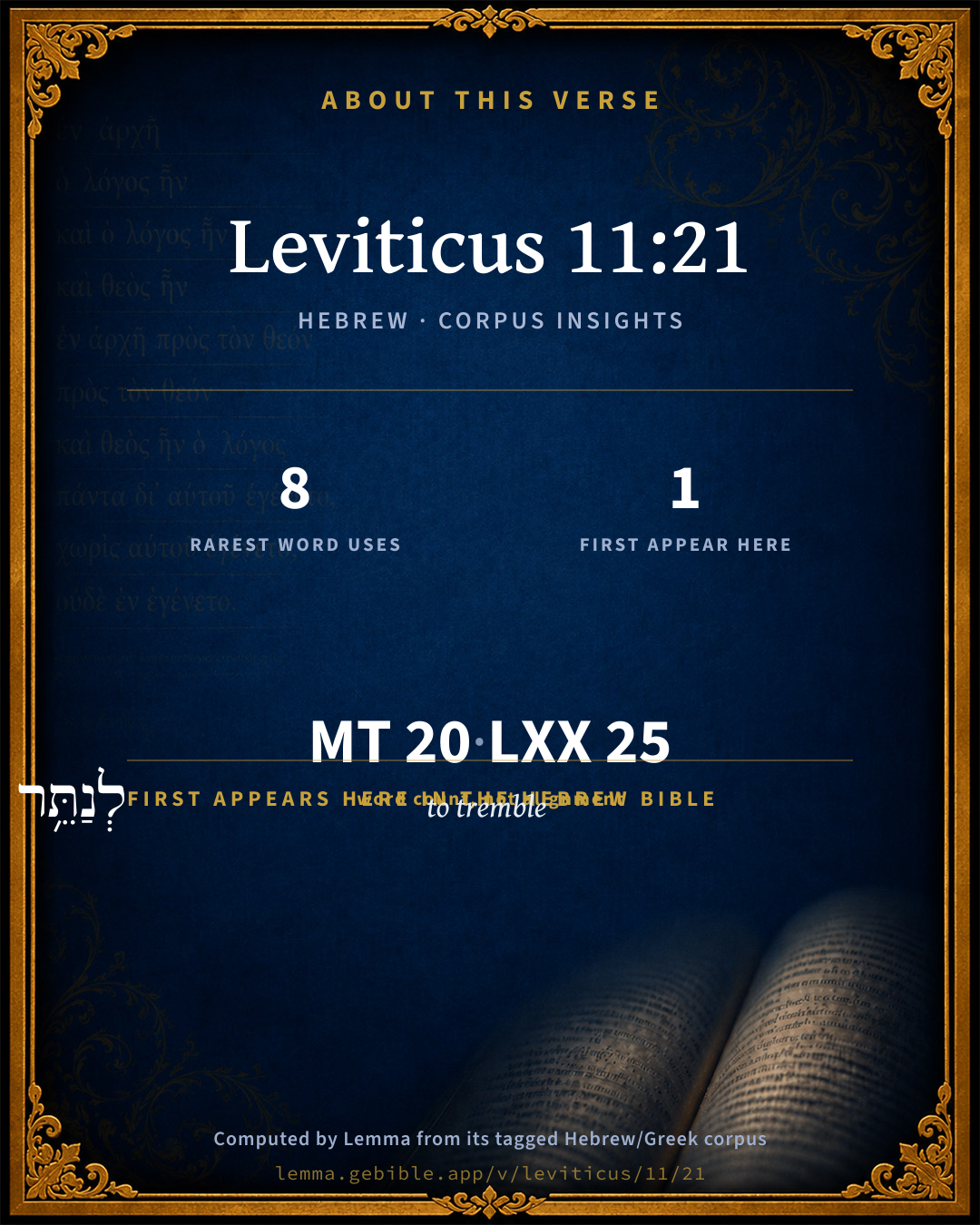
These counts appear in no published source. They are computed here, from the morphology-tagged text and Lemma’s own curated glosses. What Lemma adds →

20
words
18
distinct lemmas
Pentateuch
section

Notable vocabulary

The rarest word here is לְנַתֵּ֥ר to tremble H5425 — appearing just 8 times in the whole Hebrew Bible.

First appearance in Scripture

This word makes its first canonical appearance in the Hebrew Bible here:

  • לְנַתֵּ֥ר to tremble H5425

Shared distinctive vocabulary

לְנַתֵּ֥ר to tremble H5425 occurs in 8 verses of the Hebrew Bible. Also found in:

Grammatical profile

  • 3 verbs
  • 6 nouns
  • 1 adjective
  • 1 pronoun
  • 4 prepositions
  • 1 adverb
  • 4 particles

Verb forms

  • תֹּֽאכְל֔וּ Qal · Imperfect
  • הַהֹלֵ֖ךְ Qal · Participle Active
  • לְנַתֵּ֥ר Piel · Infinitive Construct

Repetition

A word recurs within this verse — often emphatic in Hebrew:

Hebrew & Septuagint length

In English translation the verse runs 28 words from the Hebrew and 27 from the Septuagint (LXX English) — closely comparable.

A rough comparison of the two English renderings, which tokenize alike — not a word-level alignment.

Word counts can differ between the Hebrew and the Greek without any difference in meaning — e.g. the Hebrew direct-object marker אֵת has no separate Greek word, and Greek often adds the article ὁ.

In the original languages it is 20 Hebrew tokens and 25 Greek tokens — but the two are counted differently (Hebrew bundles its prefixes and suffixes into one token; the Greek is in lemma form), so that isn’t a like-for-like length.

Hebrew and Greek witnesses Masoretic Hebrew ↔ Greek Septuagint

The same verse in the two great witnesses to the Old Testament, shown verse-for-verse.

These are two independent witnesses, not word-aligned to each other, and the Septuagint is shown in lemma (dictionary) form.

Hebrew Leviticus 11:21 Masoretic · Westminster Leningrad Codex

אַ֤ךְ אֶת זֶה֙ תֹּֽאכְל֔וּ מִכֹּל֙ שֶׁ֣רֶץ הָע֔וֹף הַהֹלֵ֖ךְ עַל אַרְבַּ֑ע אֲשֶׁר לא ל֤וֹ כְרָעַ֨יִם֙ מִמַּ֣עַל לְרַגְלָ֔יו לְנַתֵּ֥ר בָּהֵ֖ן עַל הָאָֽרֶץ

Yet you may eat these: of all winged creeping things that go on all fours, which have legs above their feet, with which to hop on the earth.

World English Bible · Public Domain

Greek LXX Leviticus 11:21 Septuagint · lemma form

ἀλλά οὗτος ἐσθίω ἀπό ὁ ἑρπετόν ὁ πετεινόν ὅς πορεύομαι ἐπί τέσσαρες ὅς ἔχω σκέλος ἄνω ὁ πούς αὐτός πηδάω ἐν αὐτός ἐπί ὁ γῆ

But these you⌃ shall eat of the creeping winged animals, which go upon four feet, which have legs above their feet, to leap with on the earth.

LXX2012 (modern English Septuagint) · Public Domain

Hebrew: Westminster Leningrad Codex (CC BY 4.0). Greek: Septuagint (public domain); English from LXX2012 (modern English Septuagint) (Public Domain). How the Septuagint differs from the Hebrew →

Targum (Aramaic paraphrase)

2

The Targum is the ancient Jewish Aramaic paraphrase of the Hebrew Scriptures — an interpretive translation, not the Hebrew text itself. Onkelos (literal) and Pseudo-Jonathan (expansive) render the Torah, and Jonathan the Prophets. Coverage is partial: where no permissively-licensed English translation exists for a verse, only the Aramaic is shown. This is verse-level text, not a word-by-word alignment to the Hebrew.

  1. Targum Onkelos Torah (Genesis–Deuteronomy)
    בְּרַם יָת דֵין תֵּיכְלוּן מִכֹּל רִחֲשָׁא דְעוֹפָא דִמְהַלֵךְ עַל אַרְבַּע דִי לֵהּ קַרְצוּלִין מֵעִלַוֵי רַגְלוֹהִי לְקַפָּצָא בְהוֹן עַל אַרְעָא

    (no public-domain English translation for this verse)

    Targum Onkelos — Aramaic: “Onkelos Genesis” (public domain); “Onkelos Exodus” (public domain); “Onkelos Leviticus” (public domain); “Onkelos Numbers” (public domain); “Onkelos Deuteronomy” (public domain). English: “Sefaria Community Translation” (CC0 1.0 (public-domain dedication)); “J.W. Etheridge. The Targums of Onkelos and Jonathan Ben Uzziel on the Pentateuch. London: Longmans, Green, 1862” (public domain). Text via Sefaria.

  2. Targum Pseudo-Jonathan Torah (Genesis–Deuteronomy)
    בְּרַם יַת דֵין תֵּיכְלוּן מִן כָּל רִיחֲשָׁא דְעוֹפָא דִמְהַלֵךְ עַל אַרְבַּע כָּל דְאִית לֵיהּ קַרְסוּלִין מִלְעֵיל לְרִיגְלוֹי לְמֵישְׁרָג בְּהוֹן עַל אַרְעָא

    So also of these you may eat, of every flying reptile that goeth upon four; every one that hath joints above his feet to leap therewith upon the ground.

    Targum Pseudo-Jonathan — Aramaic: “Targum Jonathan on Genesis” (public domain); “Targum Jonathan on Exodus” (public domain); “Targum Jonathan on Leviticus” (public domain); “Targum Jonathan on Numbers” (public domain); “Targum Jonathan on Deuteronomy” (public domain). English: “The Targum of Jonathan ben Uzziel, trans. J. W. Etheridge, London, 1862” (public domain). Text via Sefaria.

Commentary

Notes on Leviticus 11:21 from classic Christian and Jewish commentators (each source and its license shown beneath its notes). The classic Christian expositions comment on the surrounding passage and are grouped to its opening verse, so a note may address several verses; the Jewish commentaries on the Tanakh (Rashi and others) are per-verse, so they appear only where the commentator wrote on this verse.

Lemma curates 59 commentaries, every one of them public domain or Creative Commons licensed, each selected and text-cleaned for this edition rather than reprinted as found. About our sources →

Trapp's Complete Commentary

John Trapp

Lev 11:21 Yet these may ye eat of every flying creeping thing that goeth upon [all] four, which have legs above their feet, to leap withal upon the earth;

Ver. 21. Which have legs above their feet,] i.e., Which have the hinder feet longer, whereby they may leap. Whereas those that have all four feet equal, as Lev 11:23, may not be eaten.

John Trapp, A Commentary or Exposition upon All the Books of the Old and New Testament (1647–1656) — public domain. Text from a community e-Sword module.

Tyndale Open Study Notes

Tyndale Open Resources

11:21-22 insects that walk along the ground and have jointed legs: This phrase eliminates creatures that creep or crawl low to the ground (11:27). Leviticus 11:42 indicates that multi-legged creatures, such as centipedes, are unclean. Locusts and grasshoppers are examples of clean insects (see Matt 3:4).

Tyndale Open Study Notes — © Tyndale Open Resources, licensed CC BY-SA 4.0. Text via the HelloAO Bible API.

Geneva Bible (1599)

Geneva Bible translators

Or, have no bowings on their feet.

Geneva Bible (1599) marginal notes — public domain. Text via Bolls.life.

Jamieson, Fausset & Brown

Robert Jamieson, A. R. Fausset & David Brown

Yet these may ye eat of every flying creeping thing that goeth upon all four, which have legs above their feet--Nothing short of a scientific description could convey more accurately the nature "of the locust after its kind." They were allowed as lawful food to the Israelites, and they are eaten by the Arabs, who fry them in olive oil. When sprinkled with salt, dried, smoked, and fried, they are said to taste not unlike red herrings.

Jamieson, Fausset & Brown — Commentary Critical and Explanatory on the Whole Bible (1871) — public domain (CC PDM 1.0). Text via the HelloAO Bible API.

Adam Clarke's Commentary

Verse 21. Which have legs above their feet] This appears to refer to the different kinds of locusts and grasshoppers, which have very remarkable hind legs, long, and with high joints, projecting above their backs, by which they are enabled to spring up from the ground, and leap high and far.

Adam Clarke's Commentary on the Bible (1810–1826) — public domain. Text from a community e-Sword/MySword module.

Ellicott's Commentary for English Readers

(21) Of every flying creeping thing.—Rather, of all winged creeping things. Having laid down the general rule that those creatures which creep along upon their feet in the manner of quadrupeds, and which have also wings, must not be eaten, the Lawgiver now mentions those which form an exception.

Which have legs above their feet.—Better, which have knees above their hinder legs, that is, those which have the third or hindmost pair of legs much longer and stronger than ordinary insects. Those insects, therefore, in whose hindermost legs the second joint is much larger and stronger, whereby they are enabled to leap or raise themselves up with great force and leap a great distance upon the earth, are excepted. These are the locusts. The canonical law which obtained during the second Temple defines more minutely the characteristics of clean locusts. A clean locust we are told has (1) four front feet, (2) four wings, (3) two springing feet, and (4) the wings so long and broad that they cover the greater portion of the back body of the insect. If it possesses these four characteristics it is clean, whether it is with a tail or without it, and whether it has an oblong or round head.

A Bible Commentary for English Readers, edited by Charles John Ellicott (1878–1897) — public domain. Text from a community e-Sword module.

The Cambridge Bible for Schools and Colleges

gen. ed. J. J. S. Perowne

21–23. Four kinds of these swarming things which may be eaten are mentioned. The first and last of these occur frequently in the O.T., the second and third only here.

The first is ’arbeh, the general term for a locust, and from the passages in which it occurs (e.g. Exo_10:4, of the plague of locusts, Jdg_6:5; Jdg_7:12, of invading troops) is clearly a highly destructive insect.

The fourth, ḥâgâb, is translated ‘grasshopper’ except in 2Ch_7:13, where both R.V. and A.V. render ‘locust.’ From the words which follow, ‘to devour the land,’ it is clear the grasshopper is not meant, but one of the locust family. The rendering ‘beetle’ of A.V. for the third is certainly wrong. The Heb. word probably means a galloper, and the characteristic of the four kinds is that they ‘have legs … to leap withal.’

That they were actually eaten appears from Mat_3:4; Mar_1:6.

The Cambridge Bible for Schools and Colleges (gen. ed. J. J. S. Perowne; Cambridge University Press, 1878–1918) — public domain. Text from a community e-Sword module.

John Gill's Exposition

Yet these may ye eat,.... Which are after described and named:

of every flying creeping thing that goeth upon all four; even though it is a creeping thing that flies and goes upon four feet, provided they be such:

which have legs above their feet, to leap withal upon the earth; there is a double reading of this clause; the textual reading is, "which have not legs", and is followed by several interpreters and translators; and the marginal reading, which we follow, is, "which have legs"; and both are to be regarded as true, and written by Moses, as Ainsworth observes; for locusts are born without legs, and yet creep low, as Pliny asserts (z), and they have them afterwards; and it is a canon of the Jews, that what have not legs or wings now, or have not wings to cover the greatest part of them, but shall have after a time when grown up, these are as free (to eat) now, as when grown up (a). Dr. Shaw thinks (b) the words may bear this construction, "which have knees upon" or "above their hinder legs, to leap withal upon the earth"; and applying this to the locust afterwards, and only instanced in, he observes, that this has the two hindermost of its legs and feet much stronger, larger, and longer than any of the foremost. In them the knee, or the articulation of the leg and thigh, is distinguished by a remarkable bending or curvature, whereby it is able, whenever prepared, to jump, to spring, or raise itself up with great force and activity. And these Aristotle (c) calls the leaping parts; and though he attributes to the locust six feet, as does also Pliny (d), yet he takes the two leaping parts into the account; whereas Moses distinguishes those two from the four feet; and so Austin (e) observes, that Moses does not reckon among the feet the two hinder thighs with which locusts leap, which he calls clean, and thereby distinguishes them from such unclean flying creatures which do not leap with their thighs, such as beetles; and so the Jewish writers always describe a clean locust as having four feet, and two legs, thighs, or knees. Maimonides (f) gives three signs of them, which are these, whatsoever has four feet and four wings, which cover the greatest part of its body in length, and the greatest part of the compass of it, and has two thighs or knees to leap with, they are of the clean kind; and although its head is long, and it hath a tail, if its name is "chagob" (a locust) it is clean.

(z) Nat. Hist. l. 11. c. 29. (a) Maimon. ib. c. 1. sect. 23. (b) Travels, p. 420. (c) De Part. Animal. l. 4. c. 6. (d) Nat. Hist. l. 11. c. 48. (e) Retract. l. 2. c. 15. (f) Maacolot Asurot, c. 1. sect. 22.

John Gill's Exposition of the Whole Bible (1746–1763) — public domain (CC PDM 1.0). Text via the HelloAO Bible API.

Albert Barnes' Notes on the Bible

Legs above their feet, to leap withal upon the earth - The families of the Saltatoria, of which the common cricket, the common grasshopper, and the migratory locust, may be taken as types.

Albert Barnes' Notes on the Bible (1834–1885) — public domain. Text from a community e-Sword/MySword module.

Haydock's Catholic Bible Commentary

Walketh. Hebrew adds lo, "not." But the Massorets read lu, "to it," agreeably to the Vulgate. (Calmet) --- Protestant version, "Yet these may ye eat, of every flying creeping thing that goeth upon all four, which have legs above their feet, to leap withal upon the earth."

George Leo Haydock (1774–1849), Haydock's Catholic Family Bible and Commentary, 1859 edition — public domain. Excludes Psalms (Douay-Rheims chapter numbering differs from Protestant) and Deuterocanonical books (Catholic canon only).

Matthew Poole's English Annotations

Which have legs above their feet. The truth of this translation may seem evident, both from the following clause, to

leap withal, and especially from the next verse, where one of this kind is the locusts, which, as it is manifest, have two legs wherewith they leap, besides the four feet upon which they walk. The adverb lo is here put for the pronoun lo, as it is also 1Ch 11:20, compared with 2Sa 23:18. Others take the words as they lie, and read them negatively, which have not legs upon their feet, and so the sense may be this, That they might eat the locusts, grasshoppers, &c. when they were very young, and therefore more wholesome for food; for they are born without legs, Plin. Nat. Hist. 11.29, or their legs at first are very small, and scarce to be discerned, and in effect none. And the canon of the Jews in this matter is this, Those which yet have not wings and legs may be eaten, though they be such as afterward would have them.

Matthew Poole's English Annotations on the Holy Bible (1683–1685) — public domain. Text from a community e-Sword/MySword module.

Whedon's Commentary on the Bible

Daniel D. Whedon

CONCERNING WINGED INSECTS, Lev_11:20-25.

These, as a class, are all forbidden, with a few exceptions.

21. Legs above their feet — These are a pair of hind legs to spring with, in addition to the four for walking. The word above indicates the upward projection of these distinct springing legs, as seen in the grasshopper at rest. The prohibition of every creeping thing that flieth, Deu_14:19, is thus harmonized with this verse by Keil: “The edible locusts are passed over because it was not the intention of Moses to repeat every particular of the earlier laws in these addresses.” Deuteronomy is synoptical.

89504e470d0a1a0a0000000d49484452000000910000006b0803000000400f906e00000300504c54450000000101010202020303030404040505050606060707070808080909090a0a0a0b0b0b0c0c0c0d0d0d0e0e0e0f0f0f1010101111111212121313131414141515151616161717171818181919191a1a1a1b1b1b1c1c1c1d1d1d1e1e1e1f1f1f2020202020202222222323232424242424242626262727272828282828282a2a2a2b2b2b2c2c2c2c2c2c2e2e2e2f2f2f3030303030303232323333333434343434343636363737373838383838383a3a3a3b3b3b3c3c3c3c3c3c3e3e3e3f3f3f4040404141414141414343434444444545454646464747474848484949494949494b4b4b4c4c4c4d4d4d4e4e4e4f4f4f5050505151515151515353535454545555555656565757575858585959595959595b5b5b5c5c5c5d5d5d5e5e5e5f5f5f6060606161616161616363636464646565656666666767676868686969696969696b6b6b6c6c6c6d6d6d6e6e6e6f6f6f7070707171717171717373737474747575757676767777777878787979797979797b7b7b7c7c7c7d7d7d7e7e7e7f7f7f8080808181818282828383838383838585858686868787878888888989898a8a8a8b8b8b8c8c8c8d8d8d8e8e8e8f8f8f9090909191919292929393939393939595959696969797979898989999999a9a9a9b9b9b9c9c9c9d9d9d9e9e9e9f9f9fa0a0a0a1a1a1a2a2a2a3a3a3a3a3a3a5a5a5a6a6a6a7a7a7a8a8a8a9a9a9aaaaaaabababacacacadadadaeaeaeafafafb0b0b0b1b1b1b2b2b2b3b3b3b3b3b3b5b5b5b6b6b6b7b7b7b8b8b8b9b9b9babababbbbbbbcbcbcbdbdbdbebebebfbfbfc0c0c0c1c1c1c2c2c2c3c3c3c3c3c3c5c5c5c6c6c6c7c7c7c8c8c8c9c9c9cacacacbcbcbcccccccdcdcdcecececfcfcfd0d0d0d1d1d1d2d2d2d3d3d3d3d3d3d5d5d5d6d6d6d7d7d7d8d8d8d9d9d9dadadadbdbdbdcdcdcdddddddedededfdfdfe0e0e0e1e1e1e2e2e2e3e3e3e3e3e3e5e5e5e6e6e6e7e7e7e8e8e8e9e9e9eaeaeaebebebecececedededeeeeeeefefeff0f0f0f1f1f1f2f2f2f3f3f3f3f3f3f5f5f5f6f6f6f7f7f7f8f8f8f9f9f9fafafafbfbfbfcfcfcfdfdfdfefefeffffff0e79e2e400000001624b47440088051d48000000097048597300000ec400000ec401952b0e1b00001779494441546881e55b075854c7da1e1490264bef0b082cd2418aa02002165444419a05b1c75eb081c6de30e84d62c7deb0b7683416a25124183531dcd87bc182485bb69cb3a77dffcc621213810b5c35f779fed9077659f6ccbce7abeff7cd2c82ffb581fe6900ef8dff4f882825288163544073405efee3882810982a4101c035f2c28fac35412e5000aca2a2e1977c34443c4151816504e54a1e43fbe711712054e3df72e019a0b8ca865ff8f1b426a381ab02e5f127f86563aefb78887810548aeb120b1b97c7505dfdbf800814f03a62247b4d6168846c2ba5ff1c221aff2889a22aa0c26d1cb432f4f80e21d442db69af0254586e3840e1c1a93e1d2260641479aa06ce70e22d8916b2ed6965dbce5f17d9a6092c0844563c27d4e37a1f1c91fae695521a2a57f62ef54381faf6d7d95d71436c6c91e623e0b18dd30cd41b363f3822bc96820512809ca5601466927d5175580ff874ab44e43203c70110941cb6fa4f8808481ec3f90c9ef690828b487a54d3c9743d7e436833c6c23a102b957c84824f6847423506a464811df542a6026ed352916d864a4503cf86f618e7b04bc608e50055f54cf0e165a40201e70f599456fb8ca70093bb257da60246ada69c76a6063d237cc34e03090d9f0e1116930a2ef9b4b97bc85380d7e93ed77140a8c2fe25bfecb7f3424ee1e55834a194ade7ea0f88a80a143c3613017865b2b5ff929b5aa58f63ac6692682d60a204933c2f17a7388bb59c422df7413d01f3832192d3188d8ce0924d334f7e74d5b2d9a92ceb2c20f1a91a47cc6ded7f8308d70b4ab9d12be07679b529faf888302639a61f382a7bd8697ebe47cfcaec8db32b8e3da5583c7ce5d02e0061bab7c3d37af9130b1a1b96fdf11149b1b13ec7f6a194742ca72723bba45166d677899dbf814a701d08ec147dd40a259e12e9eb24720f53267d7c444c358e7b4ac8b55ad5f28a5febd49ec93b4dc288b9d0342f8fca3ec9c1e084e9678674f0db939661013052f2f111117150cc6dfb5c5669dd72c2918eaf5cb48b715c7c0d901b74fed437addf005d9836a4d3f2388003918c53ab4f80488a0da61055adfbc12a7c583bc7d703cc22b15103dc8a4f183d496430a7a2bd51629788ee1a81a73841acb031f8f88870c2971d7619c6cc356d1b11259edc162165250b4f522372db6c2f6c3e6fa4e1aefd6bcf6d4d9c691f04b4981aa8550f221ea80a6c0038dfc8a1e2c49e823dcf49aa94828a156ab20fc94472a10c3a9a2777483dfa5045de288315ae0983bec5d7a9a90766d3f8ddc1be2ff744d868a576f0e22c6de29c71aa48755ae7d1f9cb07b9bf1e34bf45ca11ce65bd435f60130fcf366741ce620a4ed78288ac4aabe0d07089a9ab181920134b7bf151922ac9785df51afe0d345e7687116a698ccc350d9181df4fb92e3ac84414828cbbfc088c944cf1fc972fb5d0b6ccc860bb9519661bfb759d3bec292c73da93d676f1d91f22f34f8bf22e3f3b7ffa3b58e8a4db62095c897d8408b713a0e686fe8688a5a5fbe62734d3d2d441465e0e2231d2d4b5308df74a249748bf3733b040da3e9bc11d210d7de4dfc51ab98c166b623f167768b762c6a8e61a9d8a0f843bba206d3d6d2353d3b834b7e48cb88939634337acb1e97872827d3ccc868eebdadbdfbc937fffe8ed6b67bf5c3d615ce867b33b03ba8905abac8d7e23904fee133531eb5b92fbe82aba4607f10ea825b2cd7f2d4248f3d2428d1d06a8c522fb53d37c4c6223b5d1f856fdcce6f9f4ce5cb0fc7455cb6f9a3797f4dedcc35957cbca2d73eca25573661e5e55787a5ecff863eb63d6cd5f7aac170c5bd55f83faf5a78b9bf79f3a74e35a7e71ceb1f9e946959ad17d5aaf87da8a6f04340e1ae5588097f7650def979699fb822299b9d8c672280a30d4b4cafeeefe130cafb556c0be23da1e77178ada57dd8eecbf79d5f97b790c8e3efa9116a2a499df6cec601a1e915971707771c1fd87a9cef3ef261a47048f07e548fed8b00bfdf399fca7c511bd976f3992b7efe0ad675f27a582f9c60a4e3cfc2d29f82b22394e46f4a92e9696e6362d8dec8d0d8cc52e6e49eb3125fe315362dbfa3e7a1022da7c08856839e0f0628da83b3608eeba8e5f7303df49f4b266be61dd560d193c6dfbbcc569cbcf153d795c222d2fb2cfa818636d39ba35a8e4b3204bf2d439045b7d4998cfec6bb23b2fc775cbb836f7de2a6547adf43bd0ea422db52eb1b0f2e89e3da6973e28a16497f6fdd236c00885e94b66b37cae9908b9b88498766831c15d74402fd07cc3a288230716a4ffe2e6726e793ecf06a74ba6db23e49e3a0eee9dcc1c31acdbea0d47f30a2277c29d88d049bdf603add80b270daf8479744b7a7c1dfc7c53be38b6220ff9856f3bba6d59febe982ceba5c7c4b5fa5a4acc8537355c53492a083c1e247a88c3f55bdb35f796a0364e8fbf45a830dcc3a0e8ebb1fd9b1934d7363b65b075c78f2f0b8f20a4879cb7eedc3272d38903a386cedef583aee5f4c15b010606ba6fbdb81dd85dcf60b8ded717b4bf43c1f3b6ed77f235f0bf9e355ed3a37f6c66fff859bf5927b96b4e8bb9539b1dfd7df0c051f068a04b1af4f31ba0e51475aa6d345ae2a3853a632bd7d1da50a66c89a64eddb27c9c16d2427a5d1e8fd6097e7db305f2f869f148ed163acbe1daac4ed119ddf1dd1d00f0d6b7918936e875779dbef45a48b4e9a09b9bbba2b9fec1ed32568582cea014a453deb901881452e26ca090adec145eb0d11ccdb83e354e7f94e901ff49fe4f9ee99856fb2b1ca277142f5968815a203429f37856687181869ec3bf9e945921b41fce8d3633e95a8a23d4d745d2a059cd6fbd0e37f608f7bf7ba6b87fc6aafc9b95bff438307553ffa9e1fde4e8c8c641e88837d3001909a4d302c0aa2012a1109d5f0fae28406d349ded93b767671b443385d5a66d362d19b31317aa737b173edd70b928a4994e185a713317996d8187edf5d74a309764264985f513b2b2147a7d4225667dab55f75aa1ee6b145404b2757978fc49db3e74ab730bdcf40ebad76ad97f0744637b62b1a494c791047914241ce965b326728e966ec41b66ca806fd7769e86fa2c3efee2209467a6daa44cbbb4efaae265c9d4ed0762d12af6ae4d80e3c2d558f1e3018abb5b87c39ed9d9d612176dafa8d98e5a715f159cf852a77dcfec5d37bdb7c997966ec975908734406b5863529258582ccf5601467686d201f19e307d190aa34a6f8d43cdbed771f05a7ffcca6a1113034f80bd6f6ed5fd51c9de2c55bbb687e0d870c32edfe22936fccc722bfdf41ce03412cd4648629ad26ffa60dbe1593cc3ccf21dbd6ce5900e876f975ac93d479446d596456a1b9c0a937529d8cf881d2f2a599092f793b68e08fd7adccd57747ab99bb77ef4e4be6d47ed0e21f06970b046694be79cb1580e3fdb86d8bde0a06cbf148487b3bc0d803539989361df23c676f317cf40346c3ea3bc90b5fbc8aef999eb3bc472e810079d1e3740468c544e9e309180f2f0e43dc851f4335c356d16901cb6f1ab1d91cea21923a3fda3e286b9733e5e00be386cfc6a36d62b7a3b72044ecf7ee7345c3ef6c7dc76445480d523f06f6ba8896cccdd502e9cfa29674ef296af4f480b8a464527740f76e05c294889af451ab5ca0817a3a4cb0ab9fa576d36f6d0dcddd2c5c369afe5425470a525a8863a87f99e3c99f3748b44d7a26d0928471df2c9415a5172ba4d8ce831ae652762c9657c16a1df1112661730df5e5716ddbc5121abbcf6acead6e94b374edf7b83a3de7dbe2b1717d82d4780f72bb77a181b26a4a883e19e7541f9c12ddbb41a836e064d716e797af594ee393b7ebbbd347eade329edddc93cdc35f5d96663dc46c873be988b453655006a4dc2ec19968af6c92db2cf23d18b2e1edb2a426c8f42a96b5ad90bc9166e4fbb51b320931928c62487656b7a00525053250a3b569d8878ec974afdad687f61d2561f3f0327337d889ee4ae7ffeb4917df6daa713cf241d7a23de976ef3bd0cfafe18a4ed540c2e03a772f0720c0bd59f751e37c0fec6235323f3e73f485c618f4d47b06d97a3822f47c0add53f5f393377f080a327cf3f36a9209186ade678398f93c51350c988b5d423234e09e2eebaab7f9044fcecaf8b74be3a6eb7a870d1c1596bbf79f3bdc2ffd225b4db68ef807c8955d24f2669c8841282c73295b05ca9e2fa5ab630302800cb31f393be4a8ef92c3b71e9b86e3d238f750c708c1ad8cbdac7cbb9db64bc72f7c7cec67da91a93c55c4350bf9073f5c888c53ca17a9bb5cdc83c57bdc7d211ad8e72633d6738e62fde77eac5e58be65ffa5dd869d7dc64f4987656e7a7b87d9ea807a373d96bc2b00a253df8fed238a79b6028d6e83720212e2a3cbcdfe2dcb3ebce4f7dda6d0a09bbdc83f5f9fb820e43af4a831939983aabca09fbc05543a9ba63580f22029a164456cddc866a2cf19cfe184efc822ec58acffcb6e160bc63f896e4e0bddb2f88728a7c228b0cafddb346272c2a583ef30d088b8f0f72d4baffc0ddc6dac1fe5f63bc3fff66643bff83bb87743ef06293be819c0862fff959380c8b217e7239e0fa1268565aeee75484e3aa8a90fa7ab446e19cdba3458bd9f75bf052c83ed6f58cc7ac2077fdd9079d4688e78857673b8c1e927eff5ad057ddccc2fd7d34e02428e7e30a22a2e7894391d7c1db3db5799c7fc1b20dce57f7a4e99d5b121a7c723242816aeda414bae2903e1a068d6ee5890d887036eb117a1e328651a78a3a11c915845acaad620f9f34b62cb0f5b43fd013df0232f344bafe9d1684263d4958b4c3392b3cfb50d00d23a7bd831fd0f86e9943ed13c59b5ede8d1ce068879081a315324581b1e6367a4e060e0feeadf82ec8a9a38a2f6b7d58b780a1abbe7f9053d38f8347b1da31773c7b012b237fd52d239e840a26296b661e32beb47bb04520f651daf2e21b43d302bbf4595f77bc3d046223366d5f975ad6ac8f469917d1f306bb00bb23ca73e2b816c850b339b2d1d16e9ebb24af2772f9da55ab6bd6e6be1e6677f19443530cc9caa1f0e35905bc4cef6219683e8762f991586d52fca81391926438194803458382865a647499ec8b8b34de36f282ae7d89719cced982158cd0e78b50eb96ed0b7a9d193b26a82bd04933a774aafa553622cf504b6f532ca6538668bd69d6fe6cf34df91117e6c427a7a160d25d2af9c1642b7e765059ebfa7aeced2ff18d8a5c29fb936fd76747d8037079e9e26e37f9cacad58f551c2b081aba093e27c1ceb1cf64c51296893c7560fdce9c9d92ce9ed66b3b891c1d163cdee1d1efa83bd2441aeec8dad4d3ce1d53b9834e48afe366bb7b8981eee17978d2b2ed0909ce6e81337b8287eadea255aa0a9ef8bfd000442c71c6ea6ab0402183c73b0cbb48faf494b6dfd96d20c4b4399d6ae678d6e39bed77a74d4fd44c5f9433c060c4343debb09be59bc59838b9d948bacf6bdbcc4abb5704eaba7293668a28a0bd6674317671ec5de0323f3e7278d7bcd3e08df1914d1c0684772840dd88f067294cbb7bd842b699a6a61a22243747a80a4f5b76f76ca7e49ddec1bb477ada6a4a06f75dd1f3415490a6becbd865e9628770d4c7b267336d7d1d84acf4b40c12fc906596adf33da54229d00c3616b7921c4911ae82f323fc9e1038bcea6d4ff93f20229fc180668af0b51bbc404ec920cb2a7287e9c89a3a540965b28a6867537da4832cbd133293faccedbcb4458857afd9926608795a0f303731d4eeb14adbb9a5a9898b67d4057573099ba61c14b6749e19997ad977deb60fe56f15f2674d5277cc064ac580cc7301713905f0e7ba382c8def1a5d8e8b1e81842a92f7ca60477a441b2353cfe629760b5641d75948c3da27d8d1d7d6cac9d1d4ae5f9077dcb40389d34a14a0e040c9f202a917ab21ed663bef3b3c0da1cfed88cef032b2773725ead69a12c32f13aa8061817915d171d599454bcc3f97929b53f240d3c415a18407a104f6b96925b7d698a034d0e677e59fc0d2a0a190f80e05af88b7e2a04c80e0696860d46b579706b2a0f202bf9fab48f60778b72351b7d6de72178e9be83ee4c6b56f07855b043fe0c93e9e1c2ad43214280a6b028b4ace167a87c4a7c4687c4e910d0825892b98152b81b4ff19720facda58d4f3c9c90d4127fc89006588df0c75a1f1976ddcbad908ce32bc5280f6d1572674f78b33ef7a8ddce0fb25e8efe3908e69d42bb75a18589d63b022f732459a85f45f3a12f5f5d8301e6192b6ad89a687d534e27a747d9b071474eabd2ea2e15b8d2f6113ffcc338fe5c89cef6ebed789a8825c5455ed681593fa80561f6fa852d5b775089c8f41f708ba11326278565f320a4ba7928777aeab5b460227c820b68d1754602597127721aaac7345067e34fce2623dbb54ef8dea85746fb99a8fc0bbd65037220e7ff456abd0b3a0b64ab5a259a86f438317b5deb9b6c17830796b078bdf40959adabef38f7a32ad4a00d724679ef81c8baf92c9987a552283e176036ae92cd4399e7a54c50c98864d1b973ed080084902443f07afc1a0764daa265e50751f91c16167a081b363230e8884886cdbfaeecf4cb902f0ee36693dfc88e1ec968da0499950730358cef56db0caab0b350c031a8c87e65a5b151a51bd7b3c5a6f1f30707b2d8854444f5845441a1c070276cb3dfaada31abc820a6482a9e3f0b711f8fd72feef8307ef9e45ee0a288f997c5538a16f555a85cb00b2f43b32aa2201195704c48a050107dea01ce7060322bb22b056d35f2967381283eb0e5cbf0f267bdc8dee64b587e9c11dadf57bfbbb0e53dfce9f88d49d7cf24cea270c4a153158f2a0e18838f2104936901954b5b685dfbf0378083c57b3e6f34e17fcdc7cb4755b05ff8948464c585a0d55356708609499653434e2048a8083aad8ab1df103c5fb9db3f7ef4089cd93250b9442cd5eaa4248b335f617bd23a31ab8184f65392fbfd3c35c1422abefa4c0df07be50e169edc690ee13db9003504c45cd8de0c1530abc168676d9c0fc0f44f83f1cab04054da6fe77aa8bd78a087c130d3f39c492eb161a63cba3186840e8aec00f159463b550744d882c21fb432e567f20e2d4d5d0f340b14fd2d06043cf113cce80aa270d3fa3c7814a09257686b21a3edc900be45059731881582dd978a6780aa6fe818828083b888519720bb05b400ebfd4cd3c6a1d6aecb6c62bcb898ffc675723a069b530d5b6c1b238450824e3bee3fdb40025f3ac0d1d30e96d8065bebf00a94fc50681241d4b1b9371ff36fe40c4809a602ac5716aff6aa480404d3a41a935dd135359ac92c65fff1ea2df0d26ef259ead114effc7906311d19e4b9c48334cdef0c3867523021eeb505029e4e40411d518b7ff7dd0387c6c71b72d57ffd108e65617229c36d4cd07397ec101d3683b10d4e6cc3abb9ea005b684ff008868226846a9d67f2328c59f43851151b0dd307e2af00df1b5ff88a8866da8f71f9aa2b29aa04801ffb2af6f80b2aade334f0d4444621a5fa37f157e345aeaa44823b50ebfc638ec607de4b7c1883ed4a0409ed8ea0c5430a40e5735c1e73ec6c9ba2f5cfcbfc2d2263c896f7ca4fcf0882a587835d5258d94324c634e417f3444eadeb4b0e933e7d4d720a7e58d9fe0239cf553502cd9347ca176bdff01ad71353f1524335634258e7c78199192936c27a87964032a808f8e8823f6cc909c44d39fd6fbc992e4d8bc3a96920e05a324ad1341ae3e354b222443f86de399569311bd65e094ba15cfd4b4282a49534fa6ce46d52c85c5d50072fbe11091a160896a5e619b21598d273c0433670547ab0bb64a417d72eb9321aa20ddf20ae06ace5929f89a9a90f077d27924a5310894d084acfd5fc888a3796cb94aa068c25e1414f966082b153097547bd84bf299b2c64fdb74440243b894424d8530c1c33576390345bf01fcabea064c4f4f9c114c5536854a361951afce33b131f3e7e6f479f41ce64e4d0e832bd19d5eadc8e07c1f25c5540573aef991c488de7c3a447cdbd7d8dffaa75310063be201b214e0584e9a65a1538b47625fb3ab1428286fc2c44d46c4b52bc1bf9d760215c0f688ad26a5956b3531ecb14976c1384c05ec27e552a3bf2bf6dfd8515011542ac267c9c04dd1a1af54f5ea842cf0013c016a18c68801fa8d01c1aff7a7b423702c60e7165f1d0d9523401a08d444805da98a4b1c38dd860816e6751d2dc0808c26ccdb6444c3223fff722d0ffc9a1c4e0aca275759d27df9597dc8ff258b2d8c844696651b1fb59b2e239cb4481dcce224c2090a9c5a05e0d4675f55348edc7ccdf9b3c69bd17f9369492092b1145db38144f810d9c921b95f8a4b121589d6cca7ccfd2a6068b54a38a8228d20b53448ba9557e1f7090d514af9a6947e4dd71af67029ab12989aef8611d194ab81ca81e7c9f74384b7c01b3bfe0fe5ec0c95ec62805e0000000049454e44ae426082

Daniel D. Whedon (gen. ed.), Commentary on the Old and New Testaments (1874–1909) — public domain. Text from a community e-Sword module.

Rashi

Rabbi Shlomo Yitzchaki (Rashi)

על ארבע means UPON FOUR legs.

ממעל לרגליו ABOVE ITS FEET — Quite close to its neck it has something like two feet, in addition to its real feet; when it wants to fly and to spring off the ground it presses itself strongly on the ground with those two knees and so it flies. There are many of these, such, as those which we call longouste (sea-locusts), but we are not expert in regard to them, — as to which we are not permitted as food, — because four characteristic marks of cleanness are mentioned by our Rabbis in respect to them, viz., four feet, four wings, and קרסולים, i. e. the כרעים mentioned here, and that their wings cover the greater part of them. All these characteristics are present in these which are found amongst us, but there are some of them which have a long head and there are some which have no tail, matters which do not affect the question of cleanness (Chullin 59a). It is, however, necessary in order that they shall belong to the clean species that they should bear the name חגב (Chullin 55b), and in this respect we do not know how to distinguish one from another [i. e. we have no tradition as regards to these locusts whether they belong to the species which was in olden (Talmudic) times called חגב or not, and consequently in spite of the other four marks of cleanness we cannot distinguish them from unclean locusts which also show the same marks but are unclean because they do not bear the name חגב].

Rashi on the Tanakh — English translations: “The Judaica Press complete Tanach with Rashi, translated by A. J. Rosenberg” (CC BY 4.0); “Pentateuch with Rashi's commentary by M. Rosenbaum and A.M. Silbermann, 1929-1934” (public domain); “The Metsudah Tanach series, Lakewood, N.J” (CC BY 4.0); and “The Book of Joshua, Metsudah Publications, 1997” (CC BY 4.0). Text via Sefaria.

Lesson kit

Teaching starters — assembled from the data on this page, not authored interpretation. Every prompt links to the verse data it draws on. Edit before teaching.

Leviticus, in the Pentateuch, opens this verse with 20 words (18 distinct Hebrew lemmas). Its most distinctive word is nâthar (“to tremble”). A historical commentator’s framing appears above. Read the whole chapter for the surrounding context.

Discussion questions

  1. The word nâthar carries the sense “to tremble.” How does it shape the verse?
  2. This is the first place “to tremble” appears in Scripture (first appears here). What does its debut here establish?
  3. How does 2 Samuel 22:33, which shares the word «to tremble», read alongside this verse?
  4. What does the repetition of “upon” (2× in this one verse) do in this verse?
  5. The translations on this page render this verse differently — a whole-verse word diff, not a word-by-word alignment. What might account for the different wordings?
  6. «תֹּֽאכְל֔וּ» is a Qal Imperfect verb. How does that grammatical form shape the action described?
  7. Compare how Trapp's Complete Commentary and Tyndale Open Study Notes read this verse. Where do they agree or differ?

Things to notice

Reading settings

Reading text

Shown beneath each verse's original-language words.

Old Testament
Old Testament edition

Read the OT as the Masoretic Hebrew (MT) or the Greek Septuagint (LXX).

English shown for the Greek Septuagint (in the Hebrew ↔ Greek comparison).

Comparing translations? Open the Compare panel on any verse page to stack up to four side by side.