
Jeremiah 31:37

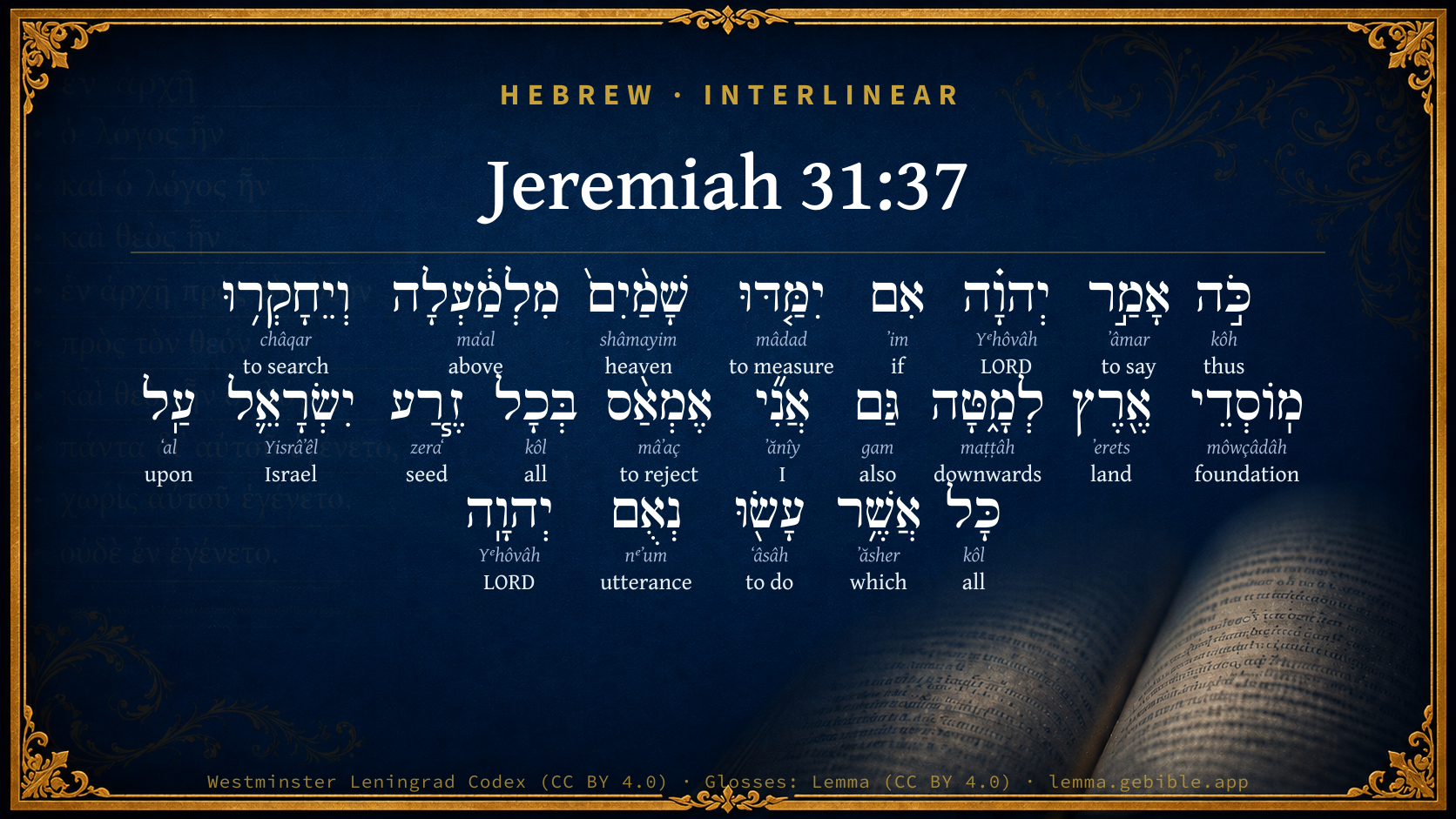
Hebrew (Westminster Leningrad Codex) Jeremiah 31:37 appears in the Hebrew Old Testament. The text above is from the Westminster Leningrad Codex. Each word links to its Strong’s number, a concise gloss, and parsing drawn from the Open Scriptures Hebrew Bible morphology. Click any word for its full Brown-Driver-Briggs (BDB) entry.
Download image
Cite this verse

Jeremiah 31:37 (World English Bible). Public Domain. Lemma interlinear Bible study tool, https://lemma.gebible.app/v/jeremiah/31/37.

Show BibTeX & RIS
BibTeX
RIS
English Translation
Thus says Yahweh: If heaven above can be measured, and the foundations of the earth searched out beneath, then will I also cast off all the seed of Israel for all that they have done, says Yahweh.
World English Bible · Public Domain
Download a study sheet

One document with this verse’s original text, its word-by-word gloss line, the meaning frame, cross-references with their text, attributed commentary, and full source and license credits — printable, and it pastes into notes with its structure intact.

This verse Autodidact and up

Study sheet (.html) Plain text (.txt)

A passage Seminary Student

Up to 50 verses in one chapter. A passage sheet keeps up to 6 commentary sources and 12 cross-references per verse, in the order this page ranks them, and says so on the sheet whenever that leaves anything out. Ask for a single verse and you get the Autodidact verse sheet above.

Everything on this page stays free to read, with no account — the sheet is a download of what is already on screen, not access to it.

Want to remove ads? Support Godless Engineer
Compare translations 3

The same verse in 3 English versions, stacked beneath the original-language interlinear above. Click any original word for its lexicon entry.

Each is an independent rendering of the whole verse — the interlinear is not word-aligned to these translations.

Highlighted words mark where these versions differ — a whole-verse word diff, not a word-by-word alignment.

  • World English Bible Public Domain
    Thus says Yahweh: If heaven above can be measured, and the foundations of the earth searched out beneath, then will I also cast off all the seed of Israel for all that they have done, says Yahweh.
  • King James Version Public Domain
    Thus saith the LORD; If heaven above can be measured, and the foundations of the earth searched out beneath, I will also cast off all the seed of Israel for all that they have done, saith the LORD.
  • unfoldingWord Literal Text CC BY-SA 4.0
    Yahweh says this, “Only if the highest heavens can be measured, and only if the earth’s foundation below can be discovered, will I reject all of Israel’s descendants because of all that they have done—this is Yahweh’s declaration.”

unfoldingWord Literal Text — © unfoldingWord, licensed CC BY-SA 4.0. Word-aligned USFM3 via Door43 (git.door43.org/unfoldingWord/en_ult).

Versions to compare (up to 4)

3 of 4 selected

Show all 18 translations

Every available English version of this verse, each an independent rendering of the whole verse.

  • World English Bible Public Domain
    Thus says Yahweh: If heaven above can be measured, and the foundations of the earth searched out beneath, then will I also cast off all the seed of Israel for all that they have done, says Yahweh.
  • Berean Standard Bible Public Domain
    This is what the LORD says: “Only if the heavens above could be measured and the foundations of the earth below searched out would I reject all of Israel’s descendants because of all they have done,” declares the LORD.
  • Majority Standard Bible Public Domain
    This is what the LORD says: “Only if the heavens above could be measured and the foundations of the earth below searched out would I reject all of Israel’s descendants because of all they have done,” declares the LORD.
  • King James Version Public Domain
    Thus saith the LORD; If heaven above can be measured, and the foundations of the earth searched out beneath, I will also cast off all the seed of Israel for all that they have done, saith the LORD.
  • American Standard Version (1901) Public Domain
    Thus saith Jehovah: If heaven above can be measured, and the foundations of the earth searched out beneath, then will I also cast off all the seed of Israel for all that they have done, saith Jehovah.
  • Revised Version (1885) Public Domain
    Thus saith the LORD: If heaven above can be measured, and the foundations of the earth searched out beneath, then will I also cast off all the seed of Israel for all that they have done, saith the LORD.
  • Geneva Bible (1599) Public Domain
    Thus saith the Lord, If the heauens can be measured, or the fundations of the earth be searched out beneath, then wil I cast off all the seed of Israel, for all that they haue done, saith the Lord.
  • Douay-Rheims (1899) Public Domain
    Thus saith the Lord, who giveth the sun for the light of the day, the order of the moon and of the stars, for the light of the night: who stirreth up the sea, and the waves thereof roar, the Lord of hosts is his name.
  • Young's Literal Translation Public Domain
    Thus said Jehovah: If the heavens above be measured, And the foundations of earth below searched, Even I kick against all the seed of Israel, For all that they have done, An affirmation of Jehovah.
  • Literal Standard Version CC BY-SA 4.0
    Thus said YHWH: “If the heavens above can be measured, || And the foundations of earth searched below, || Even I kick against all the seed of Israel, || For all that they have done,” || A declaration of YHWH.
  • Unlocked Literal Bible CC BY-SA 4.0
    Yahweh says this, “Only if the highest heavens can be measured, and only if the earth's foundation below can be discovered, will I reject all of Israel's descendants because of all that they have done—this is Yahweh's declaration.”
  • unfoldingWord Literal Text CC BY-SA 4.0
    Yahweh says this, “Only if the highest heavens can be measured, and only if the earth’s foundation below can be discovered, will I reject all of Israel’s descendants because of all that they have done—this is Yahweh’s declaration.”
  • Darby Bible Public Domain
    Thus saith Jehovah: If the heavens above can be measured, and the foundations of the earth searched out beneath, I will also cast off the whole seed of Israel, for all that they have done, saith Jehovah.
  • World Messianic Bible Public Domain
    The LORD says: “If heaven above can be measured, and the foundations of the earth searched out beneath, then I will also cast off all the offspring of Israel for all that they have done,” says the LORD.
  • Webster's Bible Public Domain
    Thus saith the LORD; If heaven above can be measured, and the foundations of the earth searched out beneath, I will also cast off all the seed of Israel for all that they have done, saith the LORD.
  • Free Bible Version CC BY-SA 4.0
    This is what the Lord says: Only if the heavens above could be measured, and the foundations of the earth below could be investigated, would I reject all of Israel's descendants because of everything they've done, declares the Lord.
  • Bible in Basic English Public Domain
    This is what the Lord has said: If the heavens on high may be measured, and the bases of the earth searched out, then I will give up the seed of Israel, because of all they have done, says the Lord.
  • JPS Tanakh (1917) Public Domain
    Thus saith the LORD: If heaven above can be measured, and the foundations of the earth searched out beneath, then will I also cast off all the seed of Israel for all that they have done, saith the LORD.

Literal Standard Version (2020), Covenant Press — licensed CC BY-SA 4.0. Text via the HelloAO Bible API (eBible.org). Unlocked Literal Bible (unfoldingWord) — licensed CC BY-SA 4.0. Text via the HelloAO Bible API (eBible.org). unfoldingWord Literal Text — © unfoldingWord, licensed CC BY-SA 4.0. Word-aligned USFM3 via Door43 (git.door43.org/unfoldingWord/en_ult). Free Bible Version, Dr. Jonathan Gallagher — licensed CC BY-SA 4.0. Text via the HelloAO Bible API (eBible.org).

Word by word

More ways to search: Search by grammar → Find every occurrence → Compare this word →

Practice this passage: Drill this verse → Learn its vocabulary →

מֽוֹסְדֵי
môwçâdâh
H4146
“foundations of”
Noun, Common, Both, Plural, Construct
Part of Speech
Noun
Type
Common
Gender
Both
Number
Plural
State
Construct
Full BDB Definition

Origin: from H4144

TWOT: 875f

foundation
  1. כֹּ֣ה kôh H3541 “thus” Adverb
  2. אָמַ֣ר ʼâmar H559 “to say” Verb, Qal, Perfect, 3rd Person, Masculine, Singular
  3. יְהוָ֗ה Yᵉhôvâh H3068 “LORD” Noun, Proper
  4. אִם ʼim H518 “if” Conjunction
  5. יִמַּ֤דּוּ mâdad H4058 “to measure” Verb, Niphal, Imperfect, 3rd Person, Masculine, Plural
  6. שָׁמַ֨יִם֙ shâmayim H8064 “heaven(s)” Noun, Common, Masculine, Plural, Absolute
  7. מִלְמַ֔עְלָה maʻal H4605 “from · to/for · above · toward” Preposition + Preposition + Adverb + Suffix, Demonstrative
  8. וְיֵחָקְר֥וּ châqar H2713 “and · to search” Conjunction + Verb, Niphal, Imperfect, 3rd Person, Masculine, Plural
  9. אֶ֖רֶץ ʼerets H776 “land” Noun, Common, Both, Singular, Absolute
  10. לְמָ֑טָּה maṭṭâh H4295 “to/for · downwards” Preposition + Adverb
  11. גַּם gam H1571 “also” Particle, Accusative
  12. אֲנִ֞י ʼănîy H589 “I” Pronoun, Personal, 1st Person, Common, Singular
  13. אֶמְאַ֨ס mâʼaç H3988 “to reject” Verb, Qal, Imperfect, 1st Person, Common, Singular
  14. בְּכָל kôl H3605 “in/at · all of” Preposition + Noun, Common, Masculine, Singular, Construct
  15. זֶ֧רַע zeraʻ H2233 “seed of” Noun, Common, Masculine, Singular, Construct
  16. יִשְׂרָאֵ֛ל Yisrâʼêl H3478 “Israel” Noun, Proper
  17. עַֽל ʻal H5921 “upon” Preposition
  18. כָּל kôl H3605 “all of” Noun, Common, Masculine, Singular, Construct
  19. אֲשֶׁ֥ר ʼăsher H834 “which” Particle, Relative
  20. עָשׂ֖וּ ʻâsâh H6213 “to do” Verb, Qal, Perfect, 3rd Person, Common, Plural
  21. נְאֻם nᵉʼum H5002 “utterance of” Noun, Common, Masculine, Singular, Construct
  22. יְהוָֽה Yᵉhôvâh H3068 “LORD” Noun, Proper

About this verse

These counts appear in no published source. They are computed here, from the morphology-tagged text and Lemma’s own curated glosses. What Lemma adds →

23
words
21
distinct lemmas
Prophets
section

Notable vocabulary

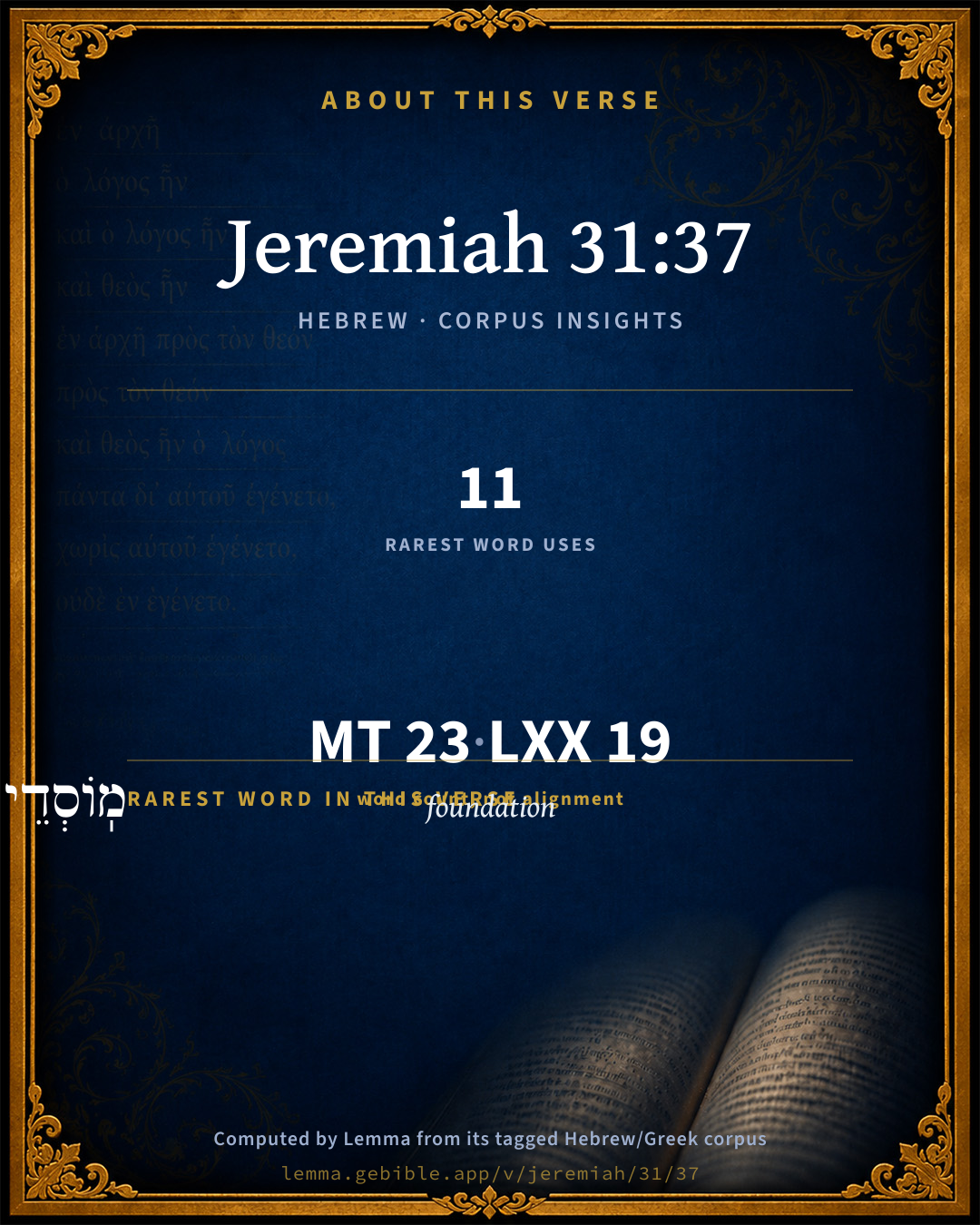
The rarest word here is מֽוֹסְדֵי foundation H4146 — appearing just 11 times in the whole Hebrew Bible.

Shared distinctive vocabulary

מֽוֹסְדֵי foundation H4146 occurs in 11 verses of the Hebrew Bible. Also found in:

Grammatical profile

  • 5 verbs
  • 10 nouns
  • 1 pronoun
  • 1 preposition
  • 1 conjunction
  • 3 adverbs
  • 2 particles

Verb forms

  • אָמַ֣ר Qal · Perfect
  • יִמַּ֤דּוּ Niphal · Imperfect
  • וְיֵחָקְר֥וּ Niphal · Imperfect
  • אֶמְאַ֨ס Qal · Imperfect
  • עָשׂ֖וּ Qal · Perfect

Repetition

Words recur within this verse — often emphatic in Hebrew:

  • יְהוָ֗ה LORD H3068 ×2
  • בְּכָל all H3605 ×2

Hebrew & Septuagint length

In the original languages it is 23 Hebrew tokens and 19 Greek tokens — but the two are counted differently (Hebrew bundles its prefixes and suffixes into one token; the Greek is in lemma form), so that isn’t a like-for-like length.

Cross-references

10

Topical passages linked to Jeremiah 31:37 in the Treasury of Scripture Knowledge — connected by theme and wording, ordered by reader-vote popularity; previews shown in the World English Bible.

  • Jeremiah 33:24–26 Don't you consider what this people has spoken, saying, The two families which Yahweh did choose, he has cast them off? thus do they despise my people, that they should be no more a nation before them.
  • Isaiah 40:12 Who has measured the waters in the hollow of his hand, and meted out the sky with the span, and comprehended the dust of the earth in a measure, and weighed the mountains in scales, and the hills in a balance?
  • Jeremiah 33:22 As the host of the sky can't be numbered, neither the sand of the sea measured; so will I multiply the seed of David my servant, and the Levites who minister to me.
  • Romans 11:1–5 I ask then, Did God reject his people? May it never be! For I also am an Israelite, a descendant of Abraham, of the tribe of Benjamin.
  • Romans 11:26–29 and so all Israel will be saved. Even as it is written, "There will come out of Zion the Deliverer, And he will turn away ungodliness from Jacob.
  • Job 11:7–9 "Can you fathom the mystery of God? Or can you probe the limits of the Almighty?
  • Jeremiah 46:28 Don't be afraid you, O Jacob my servant, says Yahweh; for I am with you: for I will make a full end of all the nations where I have driven you; but I will not make a full end of you, but I will correct you in measure, and will in no way leave you unpunished.
  • Psalms 89:2 I indeed declare, "Love stands firm forever. You established the heavens. Your faithfulness is in them."
  • Proverbs 30:4 Who has ascended up into heaven, and descended? Who has gathered the wind in his fists? Who has bound the waters in his garment? Who has established all the ends of the earth? What is his name, and what is his son's name, if you know?
  • Jeremiah 30:11 For I am with you, says Yahweh, to save you: for I will make a full end of all the nations where I have scattered you, but I will not make a full end of you; but I will correct you in measure, and will in no way leave you unpunished.

Cross-references courtesy of OpenBible.info (CC BY 4.0).

Hebrew and Greek witnesses Masoretic Hebrew ↔ Greek Septuagint

The same verse in the two great witnesses to the Old Testament, shown verse-for-verse.

These are two independent witnesses, not word-aligned to each other, and the Septuagint is shown in lemma (dictionary) form.

Hebrew Jeremiah 31:37 Masoretic · Westminster Leningrad Codex

כֹּ֣ה אָמַ֣ר יְהוָ֗ה אִם יִמַּ֤דּוּ שָׁמַ֨יִם֙ מִלְמַ֔עְלָה וְיֵחָקְר֥וּ מֽוֹסְדֵי אֶ֖רֶץ לְמָ֑טָּה גַּם אֲנִ֞י אֶמְאַ֨ס בְּכָל זֶ֧רַע יִשְׂרָאֵ֛ל עַֽל כָּל אֲשֶׁ֥ר עָשׂ֖וּ נְאֻם יְהוָֽה

Thus says Yahweh: If heaven above can be measured, and the foundations of the earth searched out beneath, then will I also cast off all the seed of Israel for all that they have done, says Yahweh.

World English Bible · Public Domain

Greek LXX Structure differs

In the Septuagint, Jeremiah is about an eighth shorter than the Hebrew and arranges its material differently — the Oracles Against the Nations (Hebrew chapters 46–51) appear in the middle of the Greek book, after 25:13. Because the chapter and verse boundaries do not line up, a verse-for-verse comparison with the Hebrew is not shown.

A verse-for-verse comparison isn’t shown here because the chapters and verses don’t line up. Switch to the LXX edition with the MT / LXX toggle above to read the Greek directly.

On this verse, Haydock's Catholic Bible Commentary discusses the Septuagint’s reading. Read the note in Commentary ↓

Hebrew: Westminster Leningrad Codex (CC BY 4.0). Greek: Septuagint (public domain); English from a public-domain English Septuagint. How the Septuagint differs from the Hebrew →

Targum (Aramaic paraphrase)

1

The Targum is the ancient Jewish Aramaic paraphrase of the Hebrew Scriptures — an interpretive translation, not the Hebrew text itself. Onkelos (literal) and Pseudo-Jonathan (expansive) render the Torah, and Jonathan the Prophets. Coverage is partial: where no permissively-licensed English translation exists for a verse, only the Aramaic is shown. This is verse-level text, not a word-by-word alignment to the Hebrew.

  1. Targum Jonathan Prophets (Joshua–Malachi)
    כִּדְנַן אֲמַר יְיָ כְּמָה דְלֵית אֶפְשַׁר דִידַע אֱנַשׁ מִשְׁחַת שְׁמַיָא מִלְעֵילָא וְאַף לָא לְמִבְדַק יְסוֹדֵי אַרְעָא מִלְרַע אַף מֵימְרִי לָא יְרַחֵיק בְּכָל זַרְעָא דְיִשְׂרָאֵל עַל כָּל דַעֲבָדוּ קָדָמַי אֲמַר יְיָ:

    Thus says the Lord, how can anyone understand the secrets of heaven from above, or even investigate the foundations of the earth from below? But I will not cast off the seed of Israel for all that they have done, says the Lord.

    Targum Jonathan — Aramaic: “Mikraot Gedolot” (public domain). English: “Sefaria Community Translation” (CC0 1.0 (public-domain dedication)); “London "Chaldee Paraphrase," 1871” (public domain). Text via Sefaria.

Commentary

Notes on Jeremiah 31:37 from classic Christian and Jewish commentators (each source and its license shown beneath its notes). The classic Christian expositions comment on the surrounding passage and are grouped to its opening verse, so a note may address several verses; the Jewish commentaries on the Tanakh (Rashi and others) are per-verse, so they appear only where the commentator wrote on this verse.

Lemma curates 59 commentaries, every one of them public domain or Creative Commons licensed, each selected and text-cleaned for this edition rather than reprinted as found. About our sources →

Trapp's Complete Commentary

John Trapp

Jer 31:37 Thus saith the LORD; If heaven above can be measured, and the foundations of the earth searched out beneath, I will also cast off all the seed of Israel for all that they have done, saith the LORD.

Ver. 37. If heaven above can be measured.] By man; for God measureth it with his span. {Isa 40:12}

And the foundations of the earth be searched out.] If any man can dig or dive to the centre.

John Trapp, A Commentary or Exposition upon All the Books of the Old and New Testament (1647–1656) — public domain. Text from a community e-Sword module.

MacLaren's Expositions of Holy Scripture

Alexander MacLaren

Jeremiah

WHAT THE IMMENSE CREATION TEACHES

Jer 31:37.

In the former sermon we considered the previous verse as presenting the stability of creation as a guarantee of the firmness of God’s gracious covenant. Now we have to consider these grand closing words which bring before us another aspect of the universe as a guarantee for another side of God’s gracious character. The immensity of creation is a symbol of the inexhaustibleness of the forgiving love of God.

I. A word or two as to the fact here used as a symbol of the divine long-suffering.

The prophet had very likely no idea at all beyond the ordinary one that presents itself to the senses-a boundless vault above an endless plain on which we stand, deep, sunless foundations, the Titanic substructions on which all rests, going down who knows where, resting on who knows what. We may smile at the rude conception, but it will be well for us if we can get as vivid an impression of the fact as He had.

We thankfully avail ourselves of modern science to tell us something about the dimensions of this awful universe of ours. We learn to know that there are millions of miles between these neighbour orbs, that light which has been travelling for thousands of years may not yet have fallen on some portion of the mighty whole, that the planetary masses of our system are but tiny specks in the whole, that every fresh stride which astronomical observation takes but opens up new nebulae to be resolved, where suns and constellations and systems are dwarfed by distance into hazy brightness which hardly deserves the name of light. We know all this, and can find all about the distances in any book. So much for space. Then the geologist comes to bewilder us still more, with extension in time.

But while all this may serve to give definiteness to the impression, after all, perhaps, it is the eye alone, as it gazes, that really feels the impression. Astronomy is really a very prosaic science.

II. The effects which this immensity often produces on men.

Very commonly in old days it led to actual idolatry, bowing down before these calm, unreachable brightnesses. In our days it too often leads to forgetting God altogether, and not seldom to disbelief that man can be of any account in such a universe. We are told that the notions of a covenant, a redemption, or that God cares about us are presumptuous. We all know the talk of men who are so modestly conscious of their own insignificance that they rebuke God for saying that He loves us, and Christians for believing Him.

III. The true lesson.

The immensity of the material universe is for us a symbol of the infinity of God’s long-suffering love.

The creation proceeds from a greater Creator. That gigantic and overwhelming magnitude, that hoary and immemorial age, that complicated and innumerable multitude of details, what less can they show than ONE Eternal and Infinite?

The immense suggests the infinite.

Granted that you cannot from the immense creation rise logically to the Infinite Creator, still the facts that the soul conceives that there is an infinite God, and is conscious of the spontaneous evoking of that thought by the contemplation of the immeasurable, are strong reasons for believing that it is a legitimate process of thought which hears the name of God thundered from the far-off depths of the silent heavens. The heavens cannot be measured, no plummet can reach to the deep foundations of the earth. We are surrounded by a universe which to our apprehensions is boundless. How much more so from expansions of our conceptions of celestial magnitudes since Jeremiah’s days, and what is to be the lesson from that? That we are insignificant atoms in this mighty whole? that God is far away from us? that the material stretches so far that perhaps there is nothing beyond?

The thought of faith is that the material immensity teaches me my God’s infinity, and especially His inexhaustible patience with us sinners. It teaches us the unfathomed depths of His gracious heart, and the abysses of His mysterious providence, and the unbounded sweep of His long-suffering forgiveness. His forgiving forbearance reaches further than the limits of the heavens. Not till these can be measured will it be exhausted, and the seed of Israel cast off for what they have done.

He, the Infinite Father, above all creation, mightier than it, is our true home, and living in Him we have an abode which can never be ‘dissolved,’ and above us stretch far-shining glories, unapproached masses of brightness, nebulae of blessedness, spaces where the eye fails and the imagination faints. All is ours, our eternal possession, the inexhaustible source of our joy. Astronomers tell of light which has been travelling for millenniums and has not yet reached this globe; but what is that to the flashing glories which through eternity shall pour on us from Him? So, then, our confidence should be firm and inexhaustible.

God has written wondrous lessons in His creation. But they are hieroglyphs, of which the key is lost, till we hear Christ and learn of Him. God has set His glories in the heavens and the earth is full of His mercy, but these are lesser gifts than that which contains them all and transcends them all, even His Son by whom He made the worlds, and- mightier still-by whom He redeemed man. God has written His mercy in the heavens and His faithfulness in the clouds, but His mercy and His faithfulness are more commended to us in Him who was before all things, and of whom it is written: ‘As a vesture shalt Thou fold them up, but Thou art the same and Thy years shall not fail.’ God has confirmed the covenant of His love to us by the faithful witnesses in the heavens, but the love shall abide when they have perished. The heavens bend above us all, and over the head of every man the zenith stands. Every spot of this low earth is smiled upon by that serene apocalypse of the loving will of God. No lane is so narrow and foul in the great city, no spot is so bare and lonely in the waste desert, but that thither the sunlight comes, and there some patch of blue above beckons the downcast eye to look up. The day opens its broad bosom bathed in light, and shows the sun in the heavens, the Lord of light, to preach to us of the true light. The night opens deeper abysses and fills them with stars, to preach to us how fathomless and immense His loving kindnesses and tender mercy are. They are witnesses to thee, dear friend, whatsoever thy heart, whatsoever thy sins, whatsoever thy memories. No iniquity can shut out God’s forgiving love. You cannot build out the heavens. He will not be sent away; you cannot measure, you cannot conceive, you cannot exhaust, His pardoning love. No storms disturb that serene sky. It is always there, blazing down upon us unclouded with all its orbs. Trust Christ; and then as years roll on, you will find that infinite love growing ever greater to your loving eyes, and through eternity will move onwards in the happy atmosphere and boundless heaven of the inexhaustible, deep heart and changeless love of God.

Alexander MacLaren, Expositions of Holy Scripture (1904–1910) — public domain. Text from a community e-Sword module.

Geneva Bible (1599)

Geneva Bible translators

The one and the other is impossible.

Geneva Bible (1599) marginal notes — public domain. Text via Bolls.life.

Jamieson, Fausset & Brown

Robert Jamieson, A. R. Fausset & David Brown

(Compare Jer 33:22).

for all that they have done--namely, all the sins. God will regard His own covenant promise, rather than their merits.

Jamieson, Fausset & Brown — Commentary Critical and Explanatory on the Whole Bible (1871) — public domain (CC PDM 1.0). Text via the HelloAO Bible API.

John Calvin's Commentaries

He confirms the same thing by another comparison, even that it would be impossible for God wholly to forget his covenant, but that he would again gather his people. Exile might indeed appear as a permanent death; and thus the truth of God might have been brought to nothing; and the covenant could not have been made void without giving the people a sort of right to complain, that they had been deceived. For we know, that though a condition was added to the covenant, yet it was not founded on the integrity of men; and hence it is said, that God is not a liar, though all the Jews were perfidious. (Romans 3:3, 4) Then the Prophet teaches us here, that though God had severely punished the sins of the people, and had resolved to punish them in future, even so as to destroy their city, there would yet be a place for mercy after the people had been chastised.

He had said before that God’s covenant with Abraham’s children could no more fail than the laws of nature: he now says, that if any could measure the heaven, and investigate the foundations of the earth, that is, penetrate into the very center of the earth, then, he says, I will reject the seed of Israel But God brings before us these strange and impossible things, that we may know that he will at length be reconciled to his people after having justly punished them. And this promise could not have afforded any consolation to hypocrites, because God does not include the whole seed of Abraham, but says, that he would not allow the whole seed of Abraham to perish, for some remnant would continue, according to what is said by Isaiah,

“Though thy people were as the sand of the sea, a remnant shall be saved.” (Isaiah 10:22)

God then does not here affirm that he would be merciful to all, but that there would be still some remaining, so that the name of the people would continue immortal: in short, he promises that the Church would be saved, but that the number would be small.

We now perceive the design of the Prophet: he doubtless had regard to the faithful, who might have been overwhelmed with despair, on seeing themselves driven far away from their own country, and having no hope of a return. Then he testifies that God had such a care for the safety of the faithful, that he would gather the scattered seed.

But we must bear in mind what we have said, that this promise is to be confined to the elect alone, for they were alone capable of receiving this favor. As to the unbelieving, who were perverse in their wickedness, God might have wholly cut them off, and yet save the remnants of grace.

Now there is no need here to enter into a subtle discussion, whether the center of the earth can be found out. The philosophers do indeed bring some probable reasons as to the extent of the heavens, and the dimension of the earth is also conjectured by them. But the Prophet’s purpose was to declare, according to the common and popular mode of speaking, that God’s mercy would be perpetual and immeasurable towards the children of Abraham, like the immensity of the earth and the heavens, which exceeds the comprehension of the human mind.

He adds, On account of all the things which they have done; that is, though they have deserved to die eternally a hundred times, I will yet have a regard to my covenant and my mercy. The Prophet then designedly sets before us here the sins of the people, that we may know that God’s mercy would be very great, as that the whole mass of so many evils would not hinder God to forgive them. This is the reason why he says, on account of all the things which they have done. It now follows, —

John Calvin's Commentaries (1540-1563) — public domain. Text from the Calvin Translation Society English edition (1840s-50s) via the Christian Classics Ethereal Library (ccel.org). Calvin's coverage is partial (roughly two-thirds of the Bible); uncommented books and verses are honest gaps, never fabricated. The 19th-century editor's footnotes and remarks are omitted so the notes are faithfully Calvin's own voice.

Ellicott's Commentary for English Readers

(37) If heaven above can be measured . . .—The thought of the preceding verse is reproduced with a slight modification of meaning. Over and above the idea, as stated above, that the stability of nature is a parable of the steadfastness of God’s laws and purposes in the spiritual world, there is implied a feeling, like that of Rom_11:33, that man’s finite intellect cannot fathom His modes of working out that purpose any more than it can measure what to the prophet’s mind were the illimitable heaven and the unfathomable earth.

A Bible Commentary for English Readers, edited by Charles John Ellicott (1878–1897) — public domain. Text from a community e-Sword module.

John Gill's Exposition

Thus saith the Lord, if heaven above can be measured,.... Either the space between the highest heavens and the earth; or the extent of the heavens, from one end of them to the other, which cannot be done by man; so the Targum,

"as it is impossible that man should know the measure of the heavens above;''

otherwise it is measured by the Lord, for he hath "meted out heaven with a span", Isa 40:12;

and the foundations of the earth searched out beneath: so as to be known what they are, or on what they are fastened, since the earth is hung upon nothing, Job 38:6;

I will also cast off all the seed of Israel for all that they have done, saith the Lord; as the former cannot be, so neither the latter; when there was a very great rejection of the Jews for their disbelief of the Messiah, they were not all cast off; the Apostle Paul was an instance to the contrary, and so were others: "the remnant according to the election of grace"; and there is a time coming when all Israel shall be saved, Rom 11:5; nor shall any of the spiritual Israel be cast off by him, or cast away from him, so as to perish; the Israel, whom God foreknew, is chosen, redeemed, and whom he calls by his grace; no, not for all the sins and transgressions they have been guilty of, however they may deserve it. The reasons are, because of his unchangeable love to them; his unalterable covenant with them; the satisfaction his son has made for them; and the free and full pardon of their sins, which he has granted to them.

John Gill's Exposition of the Whole Bible (1746–1763) — public domain (CC PDM 1.0). Text via the HelloAO Bible API.

Albert Barnes' Notes on the Bible

All the seed - Unworthy members of Israel may be cast away, but the race shall never entirely cease to exist.

Albert Barnes' Notes on the Bible (1834–1885) — public domain. Text from a community e-Sword/MySword module.

Haydock's Catholic Bible Commentary

Out, experimentally, and not by philosophical hypotheses, which were little known in the days of Jeremias. (Calmet) --- Septuagint, "if it be made lower." (Haydock) --- This is impossible; so it is that I should abandon Israel. (Theodoret) --- All was not faithless. (Calmet) --- The Israel of God embraced the gospel. (Haydock)

George Leo Haydock (1774–1849), Haydock's Catholic Family Bible and Commentary, 1859 edition — public domain. Excludes Psalms (Douay-Rheims chapter numbering differs from Protestant) and Deuterocanonical books (Catholic canon only).

Matthew Poole's English Annotations

That is, I will never cast off all the seed of Israel, (which promise the apostle, Rom 11:1,2, proveth to have been by God made good, notwithstanding the rejection of the great body of that people,) for none but God can either measure the heavens, or pierce to the centre of the earth.

Matthew Poole's English Annotations on the Holy Bible (1683–1685) — public domain. Text from a community e-Sword/MySword module.

Whedon's Commentary on the Bible

Daniel D. Whedon

37. If heaven above can be measured, etc. — The illimitableness of the material universe is a type of God’s inexhaustible and boundless love.

Daniel D. Whedon (gen. ed.), Commentary on the Old and New Testaments (1874–1909) — public domain. Text from a community e-Sword module.

The Pulpit Commentary

Thus saith the Lord. "It is not without meaning that the prophet so frequently repeats: "Thus saith the Lord." This formed the A and W ; his word was the sole ground of hope for Israel. Apart from it, despair was as reasonable as now it was unreasonable" (Hengstenberg).

The Pulpit Commentary (1880–1919), ed. H.D.M. Spence-Jones & Joseph S. Exell — public domain. Text from a community e-Sword module.

John Wesley's Explanatory Notes

I will cast off - That is, I will never cast off all the seed of Israel.

John Wesley, Explanatory Notes Upon the Whole Bible (1754–1765) — public domain. Text via the GEBible commentary corpus.

unfoldingWord translationNotes

Door43 World Missions Community

Only if the highest heavens can be measured, and only if the earth's foundation below can be discovered, will I reject all of Israel's descendants

This is a hypothetical situation that Yahweh never expects to truly happen. AT: "The highest heavens can never be measured, and the earth's foundation below can never be discovered, and I will never reject all of Israel's descendants" (See: Hypothetical Situations)

the highest heavens ... earth's foundation

These phrases refer to the whole of creation. (See: Merism)

the earth's foundation below can be discovered

This can be translated in active form. AT: "someone can dig all the way down to the earth's foundation" (See: Active or Passive)

foundation below

"deepest part." The "foundation" is the part of a house on which every other part rests.

reject

throw away or refuse to take

this is Yahweh's declaration

Yahweh speaks of himself by name to express the certainty of what he is declaring. See how you translated this in Jeremiah 1:8. AT: "this is what Yahweh has declared" or "this is what I, Yahweh, have declared" (See: First, Second, or Third Person)

translationWords

heaven

earth

found

reject

Israel

descend

unfoldingWord translationNotes — © Distant Shores Media and the Door43 World Missions Community, licensed CC BY-SA 4.0. Source: git.door43.org/Door43/en_tn.

Rashi

Rabbi Shlomo Yitzchaki (Rashi)

If the heavens... will be measured How much is their altitude.

I too will reject...Israel That is to say that just as they can neither be measured nor fathomed so will Israel not be rejected because of all that they sinned.

Rashi on the Tanakh — English translations: “The Judaica Press complete Tanach with Rashi, translated by A. J. Rosenberg” (CC BY 4.0); “Pentateuch with Rashi's commentary by M. Rosenbaum and A.M. Silbermann, 1929-1934” (public domain); “The Metsudah Tanach series, Lakewood, N.J” (CC BY 4.0); and “The Book of Joshua, Metsudah Publications, 1997” (CC BY 4.0). Text via Sefaria.

Lesson kit

Teaching starters — assembled from the data on this page, not authored interpretation. Every prompt links to the verse data it draws on. Edit before teaching.

Jeremiah, in the Prophets, opens this verse with 23 words (21 distinct Hebrew lemmas). Its most distinctive word is môwçâdâh (“foundation”). A historical commentator’s framing appears above. Read the whole chapter for the surrounding context.

Discussion questions

  1. How does “foundation” (môwçâdâh) shape what this verse is saying?
  2. How does Deuteronomy 32:22, which shares the word «foundation», read alongside this verse?
  3. What does the repetition of “LORD” (2× in this one verse) do in this verse?
  4. These translations render this verse differently. What is at stake in choosing one wording over another?
  5. «אָמַ֣ר» is a Qal Perfect verb. How does that grammatical form shape the action described?
  6. Compare how Trapp's Complete Commentary and MacLaren's Expositions of Holy Scripture read this verse. Where do they agree or differ?

Things to notice

Reading settings

Reading text

Shown beneath each verse's original-language words.

Old Testament
Old Testament edition

Read the OT as the Masoretic Hebrew (MT) or the Greek Septuagint (LXX).

English shown for the Greek Septuagint (in the Hebrew ↔ Greek comparison).

Comparing translations? Open the Compare panel on any verse page to stack up to four side by side.