
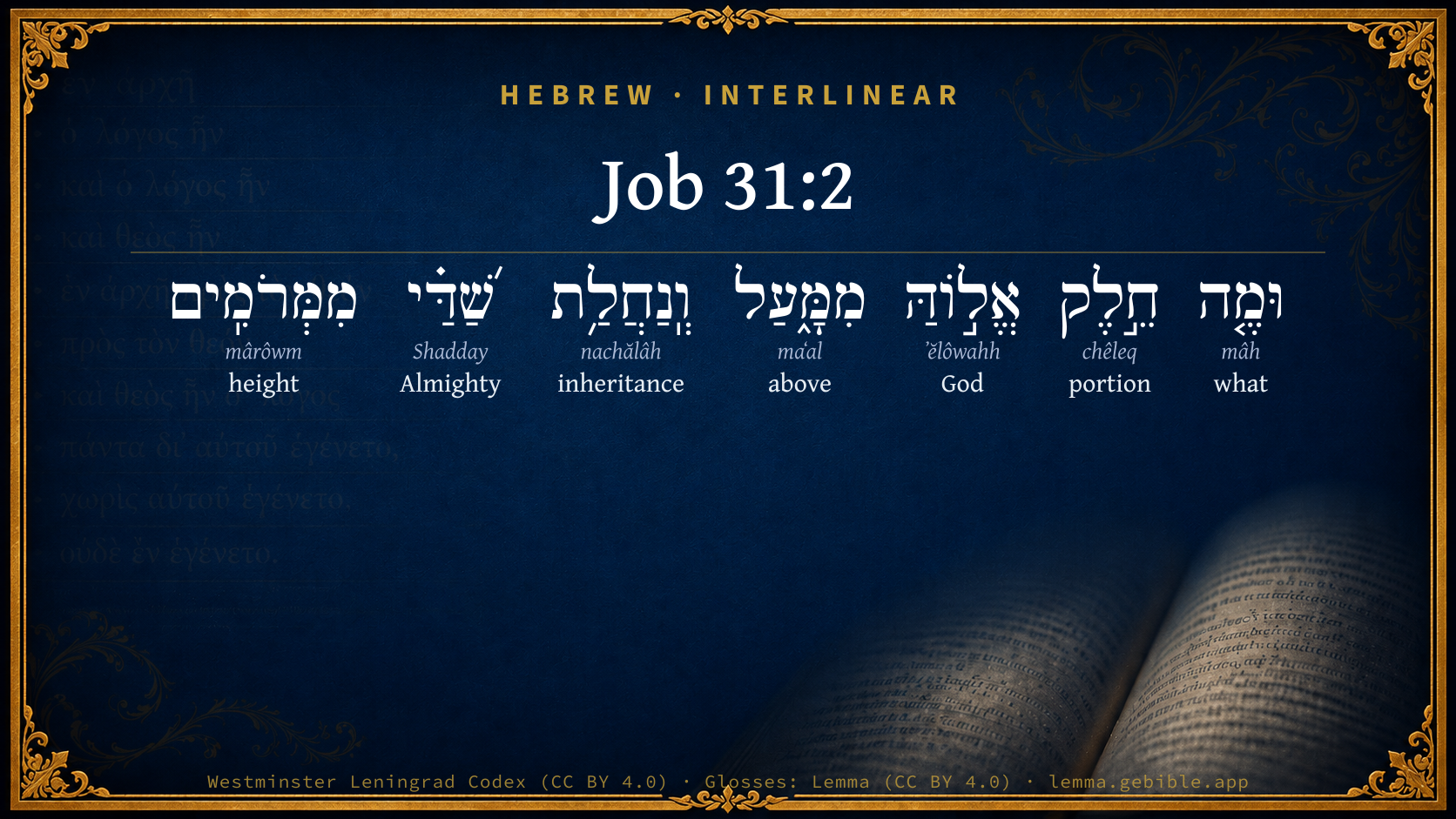
Job 31:2

Hebrew (Westminster Leningrad Codex) Job 31:2 appears in the Hebrew Old Testament. The text above is from the Westminster Leningrad Codex. Each word links to its Strong’s number, a concise gloss, and parsing drawn from the Open Scriptures Hebrew Bible morphology. Click any word for its full Brown-Driver-Briggs (BDB) entry.
Download image
Cite this verse

Job 31:2 (World English Bible). Public Domain. Lemma interlinear Bible study tool, https://lemma.gebible.app/v/job/31/2.

Show BibTeX & RIS
BibTeX
RIS
English Translation
For what is the portion from God above, And the heritage from the Almighty on high?
World English Bible · Public Domain
Download a study sheet

One document with this verse’s original text, its word-by-word gloss line, the meaning frame, cross-references with their text, attributed commentary, and full source and license credits — printable, and it pastes into notes with its structure intact.

This verse Autodidact and up

Study sheet (.html) Plain text (.txt)

A passage Seminary Student

Up to 50 verses in one chapter. A passage sheet keeps up to 6 commentary sources and 12 cross-references per verse, in the order this page ranks them, and says so on the sheet whenever that leaves anything out. Ask for a single verse and you get the Autodidact verse sheet above.

Everything on this page stays free to read, with no account — the sheet is a download of what is already on screen, not access to it.

Want to remove ads? Support Godless Engineer
Compare translations 3

The same verse in 3 English versions, stacked beneath the original-language interlinear above. Click any original word for its lexicon entry.

Each is an independent rendering of the whole verse — the interlinear is not word-aligned to these translations.

Highlighted words mark where these versions differ — a whole-verse word diff, not a word-by-word alignment.

  • World English Bible Public Domain
    For what is the portion from God above, And the heritage from the Almighty on high?
  • King James Version Public Domain
    For what portion of God is there from above? and what inheritance of the Almighty from on high?
  • unfoldingWord Literal Text CC BY-SA 4.0
    For what the portion from God above, or the inheritance from the Almighty in the heights?

unfoldingWord Literal Text — © unfoldingWord, licensed CC BY-SA 4.0. Word-aligned USFM3 via Door43 (git.door43.org/unfoldingWord/en_ult).

Versions to compare (up to 4)

3 of 4 selected

Show all 18 translations

Every available English version of this verse, each an independent rendering of the whole verse.

  • World English Bible Public Domain
    For what is the portion from God above, And the heritage from the Almighty on high?
  • Berean Standard Bible Public Domain
    For what is the allotment of God from above, or the heritage from the Almighty on high?
  • Majority Standard Bible Public Domain
    For what is the allotment of God from above, or the heritage from the Almighty on high?
  • King James Version Public Domain
    For what portion of God is there from above? and what inheritance of the Almighty from on high?
  • American Standard Version (1901) Public Domain
    For what is the portion from God above, And the heritage from the Almighty on high?
  • Revised Version (1885) Public Domain
    For what is the portion of God from above, and the heritage of the Almighty from on high?
  • Geneva Bible (1599) Public Domain
    For what portion should I haue of God from aboue? and what inheritance of the Almightie from on hie?
  • Douay-Rheims (1899) Public Domain
    For what part should God from above have in me, and what inheritance the Almighty from on high?
  • Young's Literal Translation Public Domain
    And what `is' the portion of God from above? And the inheritance of the Mighty from the heights?
  • Literal Standard Version CC BY-SA 4.0
    And what [is] the portion of God from above? And the inheritance of the Mighty from the heights?
  • Unlocked Literal Bible CC BY-SA 4.0
    For what is the portion from God above, the inheritance from the Almighty on high?
  • unfoldingWord Literal Text CC BY-SA 4.0
    For what the portion from God above, or the inheritance from the Almighty in the heights?
  • Darby Bible Public Domain
    For what would have been [my] portion of +God from above, and what the heritage of the Almighty from on high?
  • World Messianic Bible Public Domain
    For what is the portion from God above, and the heritage from the Almighty on high?
  • Webster's Bible Public Domain
    For what portion of God is there from above? and what inheritance of the Almighty from on high?
  • Free Bible Version CC BY-SA 4.0
    What should people expect to receive from God? What reward should the Almighty on high give them?
  • Bible in Basic English Public Domain
    For what is God's reward from on high, or the heritage given by the Ruler of all from heaven?
  • JPS Tanakh (1917) Public Domain
    For what would be the portion of God from above, and the heritage of the Almighty from on high?

Literal Standard Version (2020), Covenant Press — licensed CC BY-SA 4.0. Text via the HelloAO Bible API (eBible.org). Unlocked Literal Bible (unfoldingWord) — licensed CC BY-SA 4.0. Text via the HelloAO Bible API (eBible.org). unfoldingWord Literal Text — © unfoldingWord, licensed CC BY-SA 4.0. Word-aligned USFM3 via Door43 (git.door43.org/unfoldingWord/en_ult). Free Bible Version, Dr. Jonathan Gallagher — licensed CC BY-SA 4.0. Text via the HelloAO Bible API (eBible.org).

Word by word

More ways to search: Search by grammar → Find every occurrence → Compare this word →

Practice this passage: Drill this verse → Learn its vocabulary →

About this verse

These counts appear in no published source. They are computed here, from the morphology-tagged text and Lemma’s own curated glosses. What Lemma adds →

7
words
7
distinct lemmas
Wisdom
section

Shared distinctive vocabulary

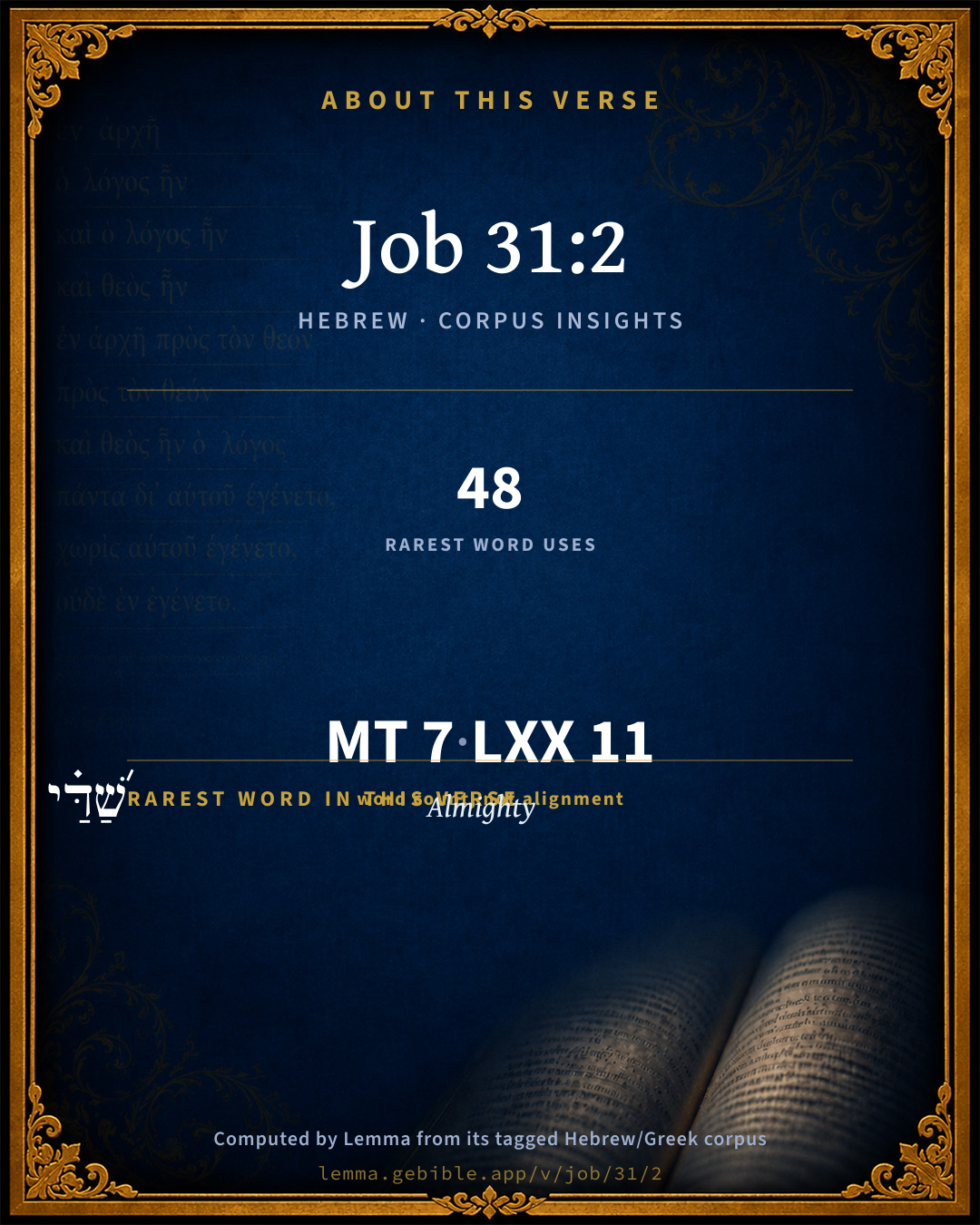
שַׁ֝דַּ֗י Almighty H7706 occurs in 48 verses of the Hebrew Bible. Also found in:

Grammatical profile

  • 5 nouns
  • 1 adverb
  • 1 particle

Hebrew & Septuagint length

In English translation the verse runs 16 words from the Hebrew and 21 from the Septuagint (LXX English) — closely comparable.

A rough comparison of the two English renderings, which tokenize alike — not a word-level alignment.

Word counts can differ between the Hebrew and the Greek without any difference in meaning — e.g. the Hebrew direct-object marker אֵת has no separate Greek word, and Greek often adds the article ὁ.

In the original languages it is 7 Hebrew tokens and 11 Greek tokens — but the two are counted differently (Hebrew bundles its prefixes and suffixes into one token; the Greek is in lemma form), so that isn’t a like-for-like length.

Cross-references

3

Topical passages linked to Job 31:2 in the Treasury of Scripture Knowledge — connected by theme and wording, ordered by reader-vote popularity; previews shown in the World English Bible.

  • Job 20:29 This is the portion of a wicked man from God, The heritage appointed to him by God."
  • Job 27:13 "This is the portion of a wicked man with God, The heritage of oppressors, which they receive from the Almighty.
  • Hebrews 13:4 Let marriage be held in honor among all, and let the bed be undefiled: but God will judge the sexually immoral and adulterers.

Cross-references courtesy of OpenBible.info (CC BY 4.0).

Hebrew and Greek witnesses Masoretic Hebrew ↔ Greek Septuagint

The same verse in the two great witnesses to the Old Testament, shown verse-for-verse.

These are two independent witnesses, not word-aligned to each other, and the Septuagint is shown in lemma (dictionary) form.

Hebrew Job 31:2 Masoretic · Westminster Leningrad Codex

וּמֶ֤ה חֵ֣לֶק אֱל֣וֹהַּ מִמָּ֑עַל וְֽנַחֲלַ֥ת שַׁ֝דַּ֗י מִמְּרֹמִֽים

For what is the portion from God above, And the heritage from the Almighty on high?

World English Bible · Public Domain

Greek LXX Job 31:2 Septuagint · lemma form

καί τίς μερίζω ὁ θεός ἀπάνωθεν καί κληρονομία ἱκανός ἐκ ὕψιστος

Now what portion has God given from above? and is there an inheritance given of the Mighty One from the highest?

LXX2012 (modern English Septuagint) · Public Domain

Hebrew: Westminster Leningrad Codex (CC BY 4.0). Greek: Septuagint (public domain); English from LXX2012 (modern English Septuagint) (Public Domain). How the Septuagint differs from the Hebrew →

Commentary

Notes on Job 31:2 from classic Christian and Jewish commentators (each source and its license shown beneath its notes). The classic Christian expositions comment on the surrounding passage and are grouped to its opening verse, so a note may address several verses; the Jewish commentaries on the Tanakh (Rashi and others) are per-verse, so they appear only where the commentator wrote on this verse.

Lemma curates 59 commentaries, every one of them public domain or Creative Commons licensed, each selected and text-cleaned for this edition rather than reprinted as found. About our sources →

Trapp's Complete Commentary

John Trapp

Job 31:2 For what portion of God [is there] from above? and [what] inheritance of the Almighty from on high?

Ver. 2. For what portion of God is there from above?] What but a portion with the devil and hypocrites? The unjust are reserved unto the day of judgment to be punished, saith Peter; but chiefly, they that walk after the flesh, in the lust of uncleanness, 2Pe 2:9-10. Such shall have a specialty of punishment, even the hottest fire in hell; and hereby Job frighted his conscience from this foul sin; and well he might: did men but consider what sin would cost them, they durst not but be innocent; but the hope of impunity hardeneth them, and so hasteneth their destruction. Hac, tanquam lena, semper usus est antiquus ille serpens, this hope, as a bawd, that old manslayer hath ever made use of to allure men into wickedness (Merlin). But set the threats of God’s word (such as are 1Co 6:9 Heb 13:3 Eph 5:3) against this sin, and the sin is laid. Satan can no more abide by it than an owl by the shining of the sun. A man will be loth to fetch gold out of a fiery crucible.

Or, What inheritance of the Almighty from on high?] God, and Almighty, and from above, and from on high. By all these expressions Job affecteth himself with the due apprehension of the Divine majesty, that he may be wise, and beware how he fall into the punishing hands of this living God. "The Lord your God," saith Moses to the people, "is God of gods, and Lord of lords, a great God, a mighty, and a terrible," &c., Deu 10:16-17. "Circumcise therefore the foreskin of your hearts"; cut off and cast away that filthy foreskin; shave your eyebrows (as the leper was to do), pull out your right eyes, &c. So Joshua; God, saith he, "is an holy God; he is a jealous God; he will not forgive your transgressions nor your sins," sc. unless you will part with them, though never so dear or delicious, Jos 24:19.

John Trapp, A Commentary or Exposition upon All the Books of the Old and New Testament (1647–1656) — public domain. Text from a community e-Sword module.

Joseph Benson's Commentary

Job 31:2. For what portion of God is there, &c. — What recompense may be expected from God for those who do otherwise? From above — How secretly soever unchaste persons carry the matter, so that men cannot reprove them, yet there is one who stands upon a higher place, whence he seeth in what manner they act.

Joseph Benson's Commentary on the Old and New Testaments (1811–1818) — public domain. Text from a community e-Sword module.

Jamieson, Fausset & Brown

Robert Jamieson, A. R. Fausset & David Brown

Had I let my senses tempt me to sin, "what portion (would there have been to me, that is, must I have expected) from (literally, of) God above, and what inheritance from (literally, of) the Almighty," &c. [MAURER] (Job 20:29; Job 27:13).

Jamieson, Fausset & Brown — Commentary Critical and Explanatory on the Whole Bible (1871) — public domain (CC PDM 1.0). Text via the HelloAO Bible API.

Adam Clarke's Commentary

Verse 2. For what portion of God is there from above?] Though I have not, in this or in any other respect, wickedly departed from God, yet what reward have I received?

Adam Clarke's Commentary on the Bible (1810–1826) — public domain. Text from a community e-Sword/MySword module.

Ellicott's Commentary for English Readers

(2) What portion of God is there from above?—Comp. the remonstrance of Joseph (Gen_39:9).

A Bible Commentary for English Readers, edited by Charles John Ellicott (1878–1897) — public domain. Text from a community e-Sword module.

The Cambridge Bible for Schools and Colleges

gen. ed. J. J. S. Perowne

2–4. The considerations that restrained him from such a sin. These are recited as they then influenced his mind.

2. And what is the portion from God above?

And what the heritage from the Almighty on high?

3. Is it not destruction to the wicked,

And calamity to the workers of iniquity?

The Cambridge Bible for Schools and Colleges (gen. ed. J. J. S. Perowne; Cambridge University Press, 1878–1918) — public domain. Text from a community e-Sword module.

John Gill's Exposition

For what portion of God is there from above?.... What good portion, as the Targum paraphrases it, can impure persons expect from God? such who indulge themselves, and live in the sin of uncleanness, cannot hope to have any part in God, or a portion of good things from him; he is above, and in the highest heavens, and every good thing comes from thence, and from him there; and particularly the spiritual blessings, wherewith he blesses his people, are in heavenly places in Christ, and from thence come to them; and here a special respect may be had to God himself, who is the portion of his people, both in life and at death, and to all eternity; but men that live a vicious course of life cannot conclude they have any part in God and Christ, nor in the grace of God, and the blessings of it, nor enjoy communion with him:

and what inheritance of the Almighty from on high? heaven is an inheritance which belongs to the children of God, and he, as their heavenly Father, has bequeathed it unto then; this is from the almighty God, God all sufficient; he has chosen this inheritance for them, and appointed them unto it; this is laid up by him and reserved in heaven for them; and he gives both a right unto it, and a meetness for it, and will put them into the possession of it: but then impure persons, as fornicators and adulterers, have no inheritance in the kingdom of God and of Christ, Eph 5:5; and this was a reason with Job, and what had an influence on him, to be careful to avoid the sin of uncleanness. Some understand the words as a question concerning what would be the portion and heritage of a wicked man, a corrupter of virgins; the answer to which is given in the next verse, destruction and a strange punishment; this is their portion from God, and the heritage appointed to them by him; see Job 20:29.

John Gill's Exposition of the Whole Bible (1746–1763) — public domain (CC PDM 1.0). Text via the HelloAO Bible API.

Albert Barnes' Notes on the Bible

For what portion of God is there from above? - Or, rather, “What portion should I then have from God who reigns above?” Job asks with emphasis, what portion or reward he should expect from God who reigns on high, if he had not made such a covenant with his eyes, and if he had given the reins to loose and wanton thoughts? This question he himself answers in the following verse, and says, that he could have expected only destruction from the Almighty.

Albert Barnes' Notes on the Bible (1834–1885) — public domain. Text from a community e-Sword/MySword module.

Haydock's Catholic Bible Commentary

High, if I should give way to such unchaste thoughts. (Menochius)

George Leo Haydock (1774–1849), Haydock's Catholic Family Bible and Commentary, 1859 edition — public domain. Excludes Psalms (Douay-Rheims chapter numbering differs from Protestant) and Deuterocanonical books (Catholic canon only).

Matthew Poole's English Annotations

The reason of my continency and chastity was, the consideration of God’s presence, and providence, and judgments.

What portion of God; what fruit or recompence might be expected from God for those who do such things? Nothing but destruction, as it follows, Job 31:3. I considered, that though these practices might at first please me, yet they would be bitterness in the latter end. From above; an emphatical phrase, to note, that how secretly and slily soever unchaste persons carry the matter, so as men cannot reprove or reproach them; yet there is one who stands upon a higher place, whence he hath the better prospect, who seeth both when, and in what manner, and with what design they do these things.

Matthew Poole's English Annotations on the Holy Bible (1683–1685) — public domain. Text from a community e-Sword/MySword module.

Whedon's Commentary on the Bible

Daniel D. Whedon

2. What portion of God — In the sense of retribution. These questions are answered by the questions of verses three and four.

Daniel D. Whedon (gen. ed.), Commentary on the Old and New Testaments (1874–1909) — public domain. Text from a community e-Sword module.

The Pulpit Commentary

For what portion of God is there from above? The meaning seems to be, "For what portion in God would there be to me from above, if I were so to act?" i.e. if I were secretly to nurse and indulge my lusts. Impurity, perhaps, more than any other sin, cuts off from God, who is "of purer eyes than to behold iniquity". (Hab_1:13) And what inheritance of the Almighty from on high! What should I inherit, i.e. what should I receive, from on high, if I were so sinful? The next verse gives the answer,

The Pulpit Commentary (1880–1919), ed. H.D.M. Spence-Jones & Joseph S. Exell — public domain. Text from a community e-Sword module.

John Wesley's Explanatory Notes

For - What recompence may be expected from God for those who do otherwise. Above - How secretly soever unchaste persons carry the matter, so that men cannot reprove them, yet there is one who stands upon an higher place, whence he seeth in what manner they act.

John Wesley, Explanatory Notes Upon the Whole Bible (1754–1765) — public domain. Text via the GEBible commentary corpus.

Rashi

Rabbi Shlomo Yitzchaki (Rashi)

Now what is the portion etc. that He recompensed me so?

Rashi on the Tanakh — English translations: “The Judaica Press complete Tanach with Rashi, translated by A. J. Rosenberg” (CC BY 4.0); “Pentateuch with Rashi's commentary by M. Rosenbaum and A.M. Silbermann, 1929-1934” (public domain); “The Metsudah Tanach series, Lakewood, N.J” (CC BY 4.0); and “The Book of Joshua, Metsudah Publications, 1997” (CC BY 4.0). Text via Sefaria.

Lesson kit

Teaching starters — assembled from the data on this page, not authored interpretation. Every prompt links to the verse data it draws on. Edit before teaching.

Job, in the Wisdom, opens this verse with 7 words (7 distinct Hebrew lemmas). Its most distinctive word is Shadday (“Almighty”). A historical commentator’s framing appears above. Read the whole chapter for the surrounding context.

Discussion questions

  1. How does “Almighty” (Shadday) shape what this verse is saying?
  2. How does Genesis 17:1, which shares the word «Almighty», read alongside this verse?
  3. These translations render this verse differently; the difference is in the English rendering, not the original. What questions does that raise?
  4. Compare how Trapp's Complete Commentary and Joseph Benson's Commentary read this verse. Where do they agree or differ?

Things to notice

Reading settings

Reading text

Shown beneath each verse's original-language words.

Old Testament
Old Testament edition

Read the OT as the Masoretic Hebrew (MT) or the Greek Septuagint (LXX).

English shown for the Greek Septuagint (in the Hebrew ↔ Greek comparison).

Comparing translations? Open the Compare panel on any verse page to stack up to four side by side.