
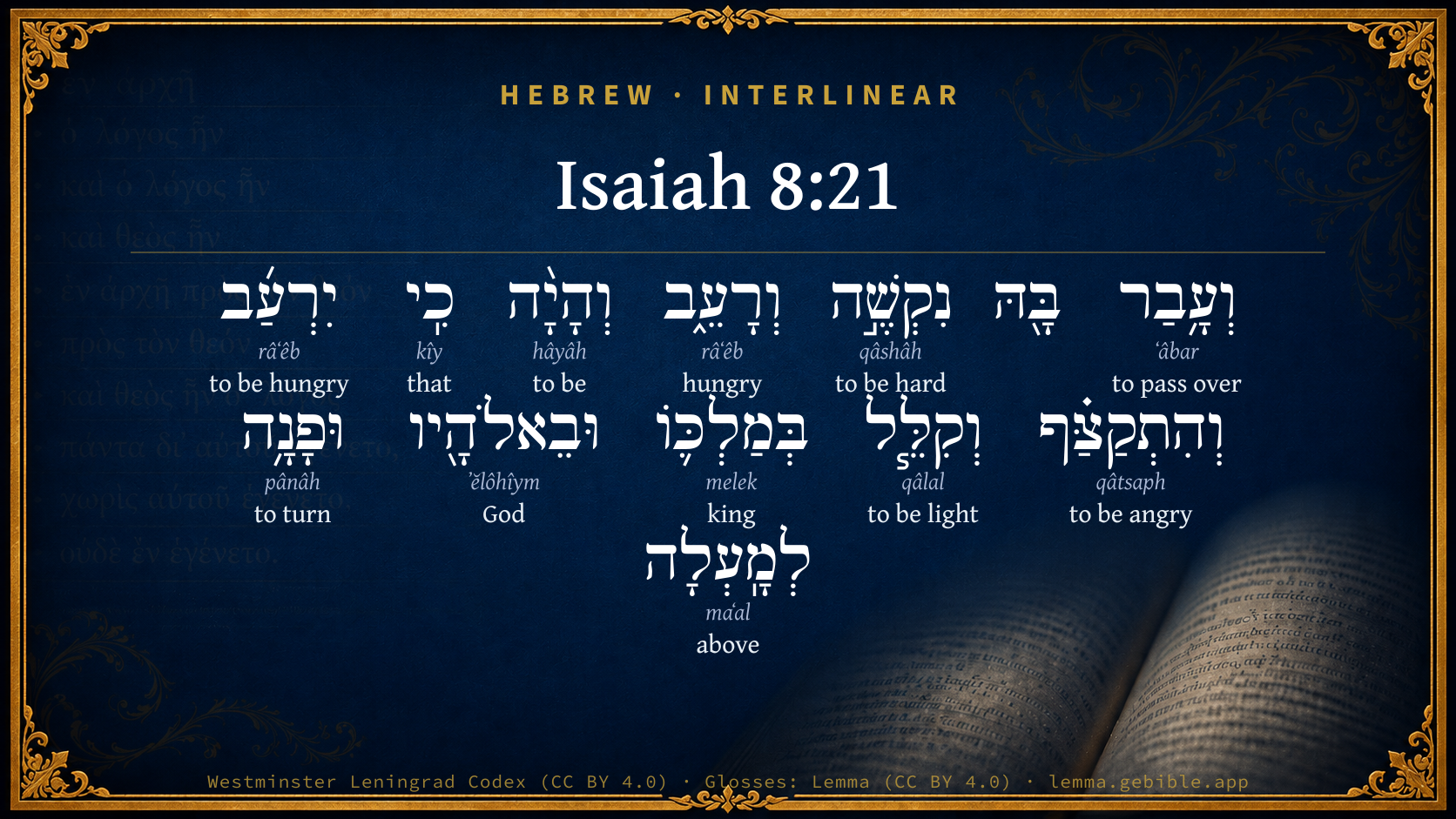
Isaiah 8:21

Hebrew (Westminster Leningrad Codex) Isaiah 8:21 appears in the Hebrew Old Testament. The text above is from the Westminster Leningrad Codex. Each word links to its Strong’s number, a concise gloss, and parsing drawn from the Open Scriptures Hebrew Bible morphology. Click any word for its full Brown-Driver-Briggs (BDB) entry.
Download image
Cite this verse

Isaiah 8:21 (World English Bible). Public Domain. Lemma interlinear Bible study tool, https://lemma.gebible.app/v/isaiah/8/21.

Show BibTeX & RIS
BibTeX
RIS
English Translation
They shall pass through it, sore distressed and hungry; and it shall happen that when they shall be hungry, they shall fret themselves, and curse by their king and by their God, and turn their faces upward:
World English Bible · Public Domain
Download a study sheet

One document with this verse’s original text, its word-by-word gloss line, the meaning frame, cross-references with their text, attributed commentary, and full source and license credits — printable, and it pastes into notes with its structure intact.

This verse Autodidact and up

Study sheet (.html) Plain text (.txt)

A passage Seminary Student

Up to 50 verses in one chapter. A passage sheet keeps up to 6 commentary sources and 12 cross-references per verse, in the order this page ranks them, and says so on the sheet whenever that leaves anything out. Ask for a single verse and you get the Autodidact verse sheet above.

Everything on this page stays free to read, with no account — the sheet is a download of what is already on screen, not access to it.

Want to remove ads? Support Godless Engineer
Compare translations 3

The same verse in 3 English versions, stacked beneath the original-language interlinear above. Click any original word for its lexicon entry.

Each is an independent rendering of the whole verse — the interlinear is not word-aligned to these translations.

Highlighted words mark where these versions differ — a whole-verse word diff, not a word-by-word alignment.

  • World English Bible Public Domain
    They shall pass through it, sore distressed and hungry; and it shall happen that when they shall be hungry, they shall fret themselves, and curse by their king and by their God, and turn their faces upward:
  • King James Version Public Domain
    And they shall pass through it, hardly bestead and hungry: and it shall come to pass, that when they shall be hungry, they shall fret themselves, and curse their king and their God, and look upward.
  • unfoldingWord Literal Text CC BY-SA 4.0
    And one will pass through it, distressed and hungry. And it will happen when he is hungry that he will become angry and curse his king and his God. And he will look upward,

unfoldingWord Literal Text — © unfoldingWord, licensed CC BY-SA 4.0. Word-aligned USFM3 via Door43 (git.door43.org/unfoldingWord/en_ult).

Versions to compare (up to 4)

3 of 4 selected

Show all 18 translations

Every available English version of this verse, each an independent rendering of the whole verse.

  • World English Bible Public Domain
    They shall pass through it, sore distressed and hungry; and it shall happen that when they shall be hungry, they shall fret themselves, and curse by their king and by their God, and turn their faces upward:
  • Berean Standard Bible Public Domain
    They will roam the land, dejected and hungry. When they are famished, they will become enraged; and looking upward, they will curse their king and their God.
  • Majority Standard Bible Public Domain
    They will roam the land, dejected and hungry. When they are famished, they will become enraged; and looking upward, they will curse their king and their God.
  • King James Version Public Domain
    And they shall pass through it, hardly bestead and hungry: and it shall come to pass, that when they shall be hungry, they shall fret themselves, and curse their king and their God, and look upward.
  • American Standard Version (1901) Public Domain
    And they shall pass through it, sore distressed and hungry; and it shall come to pass that, when they shall be hungry, they shall fret themselves, and curse by their king and by their God, and turn their faces upward:
  • Revised Version (1885) Public Domain
    And they shall pass through it, hardly bestead and hungry: and it shall come to pass that, when they shall be hungry, they shall fret themselves, and curse by their king and by their God, and turn their faces upward.
  • Geneva Bible (1599) Public Domain
    Then he that is afflicted and famished, shall go to and from in it: and when he shalbe hungry, he shall euen freat himselfe, and curse his King and his gods, and shall looke vpward.
  • Douay-Rheims (1899) Public Domain
    And they shall pass by it, they shall fall, and be hungry: and when they shall be hungry, they will be angry, and curse their king, and their God, and look upwards.
  • Young's Literal Translation Public Domain
    -- And it hath passed over into it, hardened and hungry, And it hath come to pass, That it is hungry, and hath been wroth, And made light of its king, and of its God, And hath looked upwards.
  • Literal Standard Version CC BY-SA 4.0
    And it has passed over into it, hardened and hungry, || And it has come to pass, || That it is hungry, and has been angry, || And made light of its king, and of its God, || And has looked upwards.
  • Unlocked Literal Bible CC BY-SA 4.0
    They will pass through the land greatly distressed and hungry. When they are hungry, they will become angry and curse their king and their God, as they turn their faces upward.
  • unfoldingWord Literal Text CC BY-SA 4.0
    And one will pass through it, distressed and hungry. And it will happen when he is hungry that he will become angry and curse his king and his God. And he will look upward,
  • Darby Bible Public Domain
    And they shall pass through it, hard pressed and hungry; and it shall come to pass when they are hungry, they will fret themselves, and curse their king and their God, and will gaze upward:
  • World Messianic Bible Public Domain
    They will pass through it, very distressed and hungry. It will happen that when they are hungry, they will worry, and curse their king and their God. They will turn their faces upward,
  • Webster's Bible Public Domain
    And they shall pass through it, distressed and hungry: and it shall come to pass, that when they shall be hungry, they shall fret themselves, and curse their king and their God, and look upward.
  • Free Bible Version CC BY-SA 4.0
    They will wander around the country, depressed and hungry. When they are starving they will become furious, and looking up they will curse their king and their God.
  • Bible in Basic English Public Domain
    And he will go through the land in bitter trouble and in need of food; and when he is unable to get food, he will become angry, cursing his king and his God, and his eyes will be turned to heaven on high;
  • JPS Tanakh (1917) Public Domain
    And they shall pass this way that are sore bestead and hungry; and it shall come to pass that, when they shall be hungry, they shall fret themselves, and curse by their king and by their God, and, whether they turn their faces upward,

Literal Standard Version (2020), Covenant Press — licensed CC BY-SA 4.0. Text via the HelloAO Bible API (eBible.org). Unlocked Literal Bible (unfoldingWord) — licensed CC BY-SA 4.0. Text via the HelloAO Bible API (eBible.org). unfoldingWord Literal Text — © unfoldingWord, licensed CC BY-SA 4.0. Word-aligned USFM3 via Door43 (git.door43.org/unfoldingWord/en_ult). Free Bible Version, Dr. Jonathan Gallagher — licensed CC BY-SA 4.0. Text via the HelloAO Bible API (eBible.org).

Word by word

More ways to search: Search by grammar → Find every occurrence → Compare this word →

Practice this passage: Drill this verse → Learn its vocabulary →

יִרְעַ֜ב
râʻêb
H7456
“to be hungry”
Verb, Qal, Imperfect, 3rd Person, Masculine, Singular
Part of Speech
Verb
Stem
Qal
Form
Imperfect
Person
3rd Person
Gender
Masculine
Number
Singular
Full BDB Definition

Origin: a primitive root

TWOT: 2183

to be hungry, be voracious - (Qal) to be hungry - (Hiphil) to allow one to be hungry, allow to hunger
  1. וְעָ֥בַר ʻâbar H5674 “and · to pass over” Conjunction + Verb, Qal, Sequential Perfect, 3rd Person, Masculine, Singular
  2. נִקְשֶׁ֣ה qâshâh H7185 “being hard” Verb, Niphal, Participle Active, Masculine, Singular, Absolute
  3. וְרָעֵ֑ב râʻêb H7457 “and · hungry” Conjunction + Adjective, Adjective, Masculine, Singular, Absolute
  4. וְהָיָ֨ה hâyâh H1961 “and · to be” Conjunction + Verb, Qal, Sequential Perfect, 3rd Person, Masculine, Singular
  5. כִֽי kîy H3588 “that” Conjunction
  6. וְהִתְקַצַּ֗ף qâtsaph H7107 “and · to be angry” Conjunction + Verb, Hithpael, Sequential Perfect, 3rd Person, Masculine, Singular
  7. וְקִלֵּ֧ל qâlal H7043 “and · to be light” Conjunction + Verb, Piel, Sequential Perfect, 3rd Person, Masculine, Singular
  8. בְּמַלְכּ֛וֹ melek H4428 “in/at · king · his” Preposition + Noun, Common, Masculine, Singular, Construct + Suffix, Personal, 3rd Person, Masculine, Singular
  9. וּבֵאלֹהָ֖יו ʼĕlôhîym H430 “and · in/at · God(s) · his” Conjunction + Preposition + Noun, Common, Masculine, Plural, Construct + Suffix, Personal, 3rd Person, Masculine, Singular
  10. וּפָנָ֥ה pânâh H6437 “and · to turn” Conjunction + Verb, Qal, Sequential Perfect, 3rd Person, Masculine, Singular
  11. לְמָֽעְלָה maʻal H4605 “to/for · above · toward” Preposition + Adverb + Suffix, Demonstrative

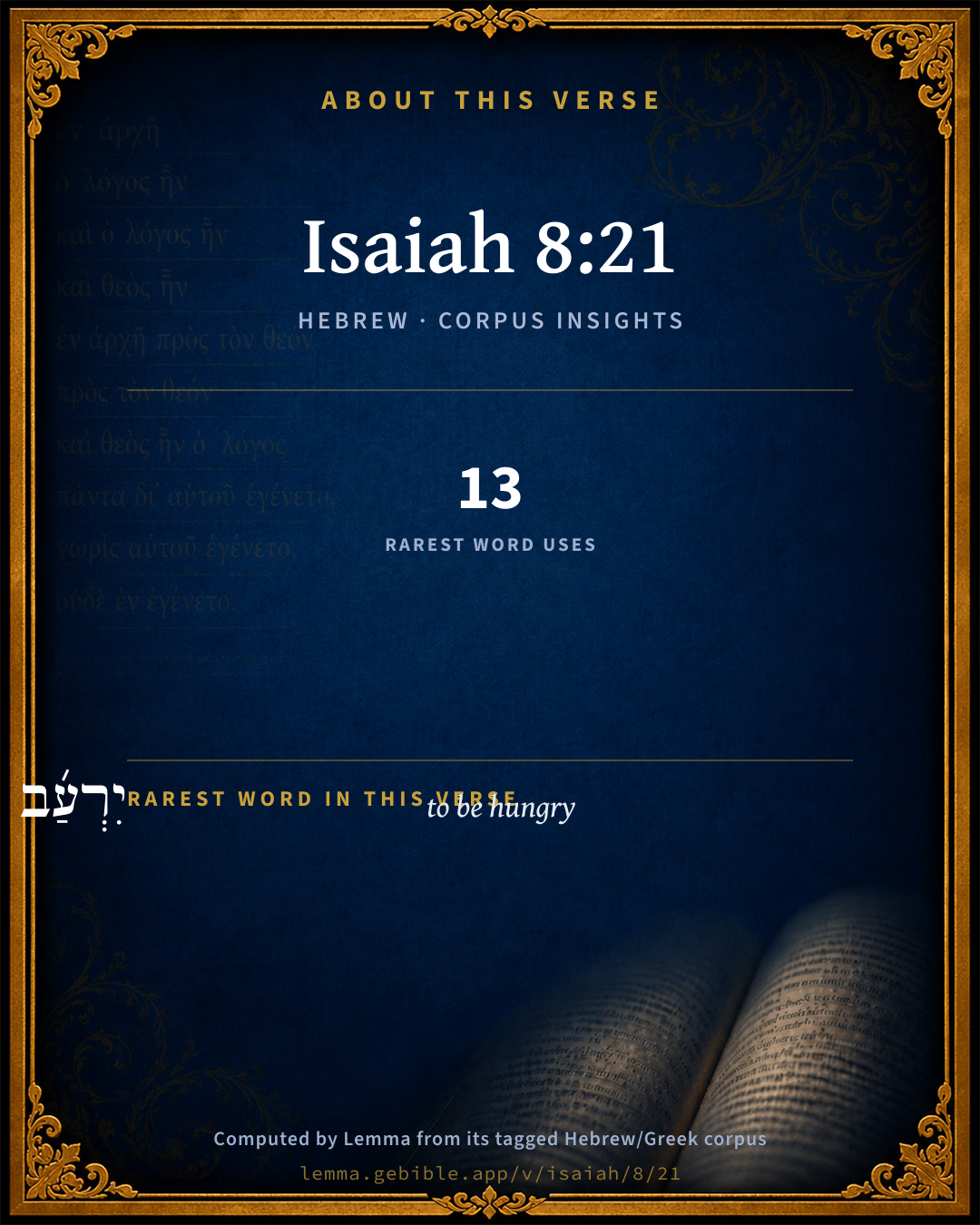
About this verse

These counts appear in no published source. They are computed here, from the morphology-tagged text and Lemma’s own curated glosses. What Lemma adds →

13
words
12
distinct lemmas
Prophets
section

Notable vocabulary

The rarest word here is יִרְעַ֜ב to be hungry H7456 — appearing just 13 times in the whole Hebrew Bible.

Shared distinctive vocabulary

יִרְעַ֜ב to be hungry H7456 occurs in 13 verses of the Hebrew Bible. Also found in:

Grammatical profile

  • 7 verbs
  • 2 nouns
  • 1 adjective
  • 1 preposition
  • 1 conjunction
  • 1 adverb

Verb forms

  • וְעָ֥בַר Qal · Sequential Perfect
  • נִקְשֶׁ֣ה Niphal · Participle Active
  • וְהָיָ֨ה Qal · Sequential Perfect
  • יִרְעַ֜ב Qal · Imperfect
  • וְהִתְקַצַּ֗ף Hithpael · Sequential Perfect
  • וְקִלֵּ֧ל Piel · Sequential Perfect
  • וּפָנָ֥ה Qal · Sequential Perfect

Hebrew & Septuagint length

In English translation the verse runs 37 words from the Hebrew and 43 from the Septuagint (LXX English) — closely comparable.

A rough comparison of the two English renderings, which tokenize alike — not a word-level alignment.

Word counts can differ between the Hebrew and the Greek without any difference in meaning — e.g. the Hebrew direct-object marker אֵת has no separate Greek word, and Greek often adds the article ὁ.

Cross-references

17

Topical passages linked to Isaiah 8:21 in the Treasury of Scripture Knowledge — connected by theme and wording, ordered by reader-vote popularity; previews shown in the World English Bible.

  • Proverbs 19:3 The foolishness of man subverts his way; His heart rages against Yahweh.
  • Isaiah 9:20 One shall snatch on the right hand, and be hungry; and he shall eat on the left hand, and they shall not be satisfied: they shall eat every man the flesh of his own arm:
  • Exodus 22:28 "You shall not blaspheme God, nor curse a ruler of your people.
  • Deuteronomy 28:33–34 The fruit of your ground, and all your labors, shall a nation which you don't know eat up; and you shall be only oppressed and crushed always;
  • Deuteronomy 28:53–57 You shall eat the fruit of your own body, the flesh of your sons and of your daughters, whom Yahweh your God has given you, in the siege and in the distress with which your enemies shall distress you.
  • 2 Kings 25:3 On the ninth day of the [fourth] month the famine was sore in the city, so that there was no bread for the people of the land.
  • Job 1:11 But put forth your hand now, and touch all that he has, and he will renounce you to your face."
  • Job 2:5 But put forth your hand now, and touch his bone and his flesh, and he will renounce you to your face."
  • Job 2:9 Then his wife said to him, "Do you still maintain your integrity? Renounce God, and die."
  • Isaiah 8:7–8 now therefore, behold, the Lord brings up on them the waters of the River, strong and many, [even] the king of Assyria and all his glory: and it shall come up over all its channels, and go over all its banks;
  • Jeremiah 14:18 If I go forth into the field, then, behold, the slain with the sword! and if I enter into the city, then, behold, those who are sick with famine! for both the prophet and the priest go about in the land, and have no knowledge.
  • Jeremiah 52:6 In the fourth month, in the ninth day of the month, the famine was sore in the city, so that there was no bread for the people of the land.
  • Lamentations 4:4–5 The tongue of the sucking child cleaves to the roof of his mouth for thirst: The young children ask bread, and no man breaks it to them.
  • Lamentations 4:9–10 Those who are killed with the sword are better than those who are killed with hunger; For these pine away, stricken through, for want of the fruits of the field.
  • Revelation 9:20–21 The rest of mankind, who were not killed with these plagues, didn't repent of the works of their hands, that they wouldn't worship demons, and the idols of gold, and of silver, and of brass, and of stone, and of wood; which can neither see, nor hear, nor walk.
  • Revelation 16:9–11 People were scorched with great heat, and people blasphemed the name of God who has the power over these plagues. They didn't repent and give him glory.
  • 2 Kings 6:33 While he was yet talking with them, behold, the messenger came down to him: and he said, Behold, this evil is of Yahweh; why should I wait for Yahweh any longer?

Cross-references courtesy of OpenBible.info (CC BY 4.0).

Hebrew and Greek witnesses Masoretic Hebrew ↔ Greek Septuagint

The same verse in the two great witnesses to the Old Testament, shown verse-for-verse.

These are two independent witnesses, not word-aligned to each other, and the Septuagint is shown in lemma (dictionary) form.

Hebrew Isaiah 8:21 Masoretic · Westminster Leningrad Codex

וְעָ֥בַר בָּ֖הּ נִקְשֶׁ֣ה וְרָעֵ֑ב וְהָיָ֨ה כִֽי יִרְעַ֜ב וְהִתְקַצַּ֗ף וְקִלֵּ֧ל בְּמַלְכּ֛וֹ וּבֵאלֹהָ֖יו וּפָנָ֥ה לְמָֽעְלָה

They shall pass through it, sore distressed and hungry; and it shall happen that when they shall be hungry, they shall fret themselves, and curse by their king and by their God, and turn their faces upward:

World English Bible · Public Domain

Greek LXX Isaiah 8:21 Septuagint · lemma form

καί ἥκω ἐπί σύ σκληρός λιμός καί εἰμί ὡς ἄν πεινάω λυπέω καί κακῶς εἶπον ὁ ἄρχων καί ὁ παταχρον καί ἀναβλέπω εἰς ὁ οὐρανός ἄνω

And famine shall come sorely upon you, and it shall come to pass, that when you⌃ shall be hungry, you⌃ shall be grieved, and you⌃ shall speak ill of the prince and your fathers' ordinances: and they shall look up to heaven above,

LXX2012 (modern English Septuagint) · Public Domain

Hebrew: Westminster Leningrad Codex (CC BY 4.0). Greek: Septuagint (public domain); English from LXX2012 (modern English Septuagint) (Public Domain). How the Septuagint differs from the Hebrew →

Targum (Aramaic paraphrase)

1

The Targum is the ancient Jewish Aramaic paraphrase of the Hebrew Scriptures — an interpretive translation, not the Hebrew text itself. Onkelos (literal) and Pseudo-Jonathan (expansive) render the Torah, and Jonathan the Prophets. Coverage is partial: where no permissively-licensed English translation exists for a verse, only the Aramaic is shown. This is verse-level text, not a word-by-word alignment to the Hebrew.

  1. Targum Jonathan Prophets (Joshua–Malachi)
    וְיַעֲדֵי תַקְלָא בְּאַרְעָא וִיהֵי עָקָא וּכְפַן וִיהֵי אֲרֵי יֶחֱזֵי כְפַן וְסִיגוּף וְיִלוּט וְיִבְזֵי שׁוּם פְּתַכְרֵיהּ וְטַעֲוָתֵיהּ וְיִתְפְּנֵי לְעֵילָא לְמִיבְעֵי פּוּרְקַן בָּתַר דְתִתְחַתֵּם גְזֵירָתָא וְלָא יִכּוֹל:

    And one shall pass through the land, stumbling along, and there shall be oppression and famine. And it shall come to pass, when he shall see famine and affliction, he shall curse and despise the name of his Moloch and his idolatry: and he shall look upwards to seek deliverance after the decree has been sealed, and he shall not be able to obtain it.

    Targum Jonathan — Aramaic: “Mikraot Gedolot” (public domain). English: “Sefaria Community Translation” (CC0 1.0 (public-domain dedication)); “London "Chaldee Paraphrase," 1871” (public domain). Text via Sefaria.

Commentary

Notes on Isaiah 8:21 from classic Christian and Jewish commentators (each source and its license shown beneath its notes). The classic Christian expositions comment on the surrounding passage and are grouped to its opening verse, so a note may address several verses; the Jewish commentaries on the Tanakh (Rashi and others) are per-verse, so they appear only where the commentator wrote on this verse.

Lemma curates 59 commentaries, every one of them public domain or Creative Commons licensed, each selected and text-cleaned for this edition rather than reprinted as found. About our sources →

Trapp's Complete Commentary

John Trapp

Isa 8:21 And they shall pass through it, hardly bestead and hungry: and it shall come to pass, that when they shall be hungry, they shall fret themselves, and curse their king and their God, and look upward.

Ver. 21. And they shall pass through it.] To and again, as uncertain of their way, and even at their wit’s end.

When they shall be hungry.] Cum esurierit et efferbuerit, as a pot boiling casteth up scum.

And curse their king.] Ahaz, say some; Zedekiah, say others.

And their God.] As those Antichristians. {Rev 16:9} The Chinese whip their gods when they please them not.

And look upward.] As the hunger bitten wolf howls against heaven.

John Trapp, A Commentary or Exposition upon All the Books of the Old and New Testament (1647–1656) — public domain. Text from a community e-Sword module.

The Biblical Illustrator

Joseph S. Exell

Isa_8:21-22

And they shall pass through it, hardly bestead and hungry

Unsanctified suffering

I.

SIN LEADS TO SUFFERING.

II. THERE IS IN SUFFERING NO SANCTIFYING POWER. It may harden men in iniquity.

III. SUFFERING DOES NOTHING IN ITSELF TO ABATE GODS ANGER AGAINST SINNERS. Nothing will turn away that anger but a genuine repentance Isa_9:13). (R. A. Bertram.)

Nemesis

He reads the doom of those that seek to familiar spirits, and regard not Gods law and testimony. There shall not only be no light to them, no comfort; or prosperity, but they may expect all horror and misery.

1. The trouble they feared shall come upon them. They shall pass to and fro in the land, unfixed, unsettled, and driven from place to place by the threatening power of an invading enemy.

2. They shall be very uneasy to themselves, by their discontent and impatience under their trouble.

3. They shall be very provoking to all about them, nay, to all above them. When they find all their measures broken, and themselves at their wits end, they will forget all the rules of duty and decency, and will treasonably curse their king, and blasphemously curse their God.

4. They shall abandon themselves to despair, and, which way soever they look, shall see no probability of relief. They shall look upward, out heaven shall frown upon them; they shall look to the earth, but what comfort can that yield to those whom God is at war with? (M. Henry.)

Hardly bestead

Embarrassed with difficulties, oppressed with anxieties, distressed with bitter reflections and desponding thoughts, not knowing what to do or whither to go. (R. Macculloch.)

Hungry

Destitute not only of necessary provision |or their personal support, but of the Word of the Lord, which is the nourishment of the soul Amo_8:11-12). (R. Macculloch.)

Fretfulness

Through hunger and poverty is indeed a great calamity, yet fretfulness of spirit is a still greater one; and when both are united, it is evident that the mind is as empty of spiritual good as the body is of necessary provision. (R. Macculloch.)

No good without God

Them that go away from God, go out of the way of all good. (M. Henry.)

.

The Biblical Illustrator, edited by Joseph S. Exell (c. 1880s–1900s) — public domain. Text from a community e-Sword module.

Joseph Benson's Commentary

Isa 8:21-22. And they — The idolatrous and apostate Israelites; shall pass through it — Namely, their own land, into captivity; or, as עבר בה may be rendered, shall pass to and fro, or wander hither and thither, in it, like distracted men, not knowing whither to go, or what to do; whereas, if they had not forsaken God, they might have had a quiet and settled abode in it. Hardly bestead and hungry — Hebrew, נקשׁה ורעב, distressed and famished, as Bishop Lowth translates the words: they shall fret themselves, &c. — Shall be impatient under their pressures, and, in the rage of their despair, curse their king — To whose ill conduct they impute a great part of their miseries; and their God — Their idol, to whom they trusted, and whom now, too late, they find to be unable to help them; and look upward — To heaven for help, as men of all nations and religions, in great calamities, are wont to do. And they shall look unto the earth — Finding no help from heaven, they turn their eyes downward, looking hither and thither for comfort; and behold trouble and darkness, &c. — Many words, expressing the same thing, are put together, to signify the variety, and extremity, and continuance of their miseries. Bishop Lowth, who connects with this verse the last clause of the twenty-first, renders the passage thus: “He shall cast his eyes upward, and look down to the earth; and lo! distress and darkness! gloom, tribulation, and accumulated darkness!”

Joseph Benson's Commentary on the Old and New Testaments (1811–1818) — public domain. Text from a community e-Sword module.

The Preacher's Complete Homiletical Commentary

Joseph S. Exell (gen. ed.)

UNSANCTIFIED SUFFERING

Isa_8:21, and Isa_9:13. And they shall pass through it, &c.

I. Sin leads to suffering.

1. This is true of individuals (H. E. I. 4603–4612). But because there is another life and a future retribution, the full results of sin are frequently not seen in this life. Nay, the sinner often appears prosperous even to the end (Psa_73:3-5).

2. But in the case of nations, which as such have no immortality, it is otherwise (P. D. 2544); it is more prompt; it is often exceedingly terrible. This fact should make those who have any love for their children hostile to any national policy that is unrighteous, however politically “expedient” it may seem.

II. There is in suffering no sanctifying power. God may use it as a means of arresting the careless, or of making good men better, but there is in it no certain reformative energy. On the contrary, it may harden men in iniquity [887]

[887] See outline: MORAL OBDURACY, p. 16.

III. Suffering does nothing in itself to abate God’s anger against sinners. We, when we are wronged, often yield to a passion of vindictiveness, which is sated when we have succeeded in inflicting a certain amount of pain on the wrong-doer. But God’s anger is not vindictive, but righteous (H. E. I. 2288–2294); hence its terribleness. As it does not thirst for suffering, it is not satisfied by suffering. As long as the sinner holds to his sin, God’s anger will burn against him, irrespective altogether of the suffering he may have endured. Nothing will turn away that anger but a genuine repentance (Isa_9:13).

1. In the hour of temptation, let us think of sin not as it then presents itself to us, but as it will certainly appear to us when its results are manifested (H. E. I. 4673–4676).

2. When suffering has come upon us, let us regard it as God’s summons to repentance (H. E. I. 56–59); and let us obey it with thankfulness that God is willing to deal with us in the way of mercy.

THE REMEDY OF THE WORLD’S MISERY

(Missionary Sermon.)

Isa_9:2-7. The people that walked in darkness, &c.

The prophecies contained in this text are of a mixed kind; they are partly fulfilled and partly unfulfilled. We have the authority of the Evangelists to apply the passage to Gospel times, and to prevent it from being restricted to the Jews (Mat_4:14-16; Luk_1:79; Luk_2:32). Let us consider—

I. The view taken by the Prophet of the moral state of the world previous to the glorious change which makes the subject of his prophecy.

1. The people are represented as walking in darkness. Darkness is an emblem of ignorance and error; and an emblem the most striking [890]

2. But darkness alone appears to the mind of the Prophet only a faint emblem of the state of the heathen: he adds, therefore, “the shadow of death.” In Scripture this expression is used for the darkness of that subterranean mansion into which the Jews supposed the souls of men went after death. Figuratively, the expression is used for great distress; a state of danger and terror. It is an amplification, therefore, of the Prophet’s thought. The predominant idea is that of a sense of insecurity, accompanied by fear. Darkness increases danger and fear at the same time. Such is the state of the heathen. The religion of the heathen has ever been gloomy and horrible.

3. The Prophet adds another note of the state of the heathen: Thou hast multiplied the nation, and not increased the joy [893] He beholdeth them increasing in number only to multiply their misery [896] Universal experience proves that misery is multiplied when God and truth are unknown. In this case there is no redeeming principle; the remedy is lost; despair completes the wretchedness of the people, and were it not for the prospects opened by the Gospel, that despair would be final and absolute. Here, however, the text breaks upon us with a glorious and cheering view. The Prophet beholds a light rising in obscurity; a great light dispels the heavy gloom; comfort, joy, and salvation dawn upon the earth (Isa_8:2).

[890] As the pall of darkness is drawn over the world, the fair face of nature fades from the sight; every object becomes indistinct, or is wholly obscured, and all that can cheer the sight or direct the steps of man vanishes. So the gradual accumulation of religious errors, thickening with every age, banished the knowledge of God and His truth from the understandings of men, till all that was sublime in speculation, cheering to the heart, supporting to the hopes, or directive to the actions of men, passed away from the soul, and left the intellectual world like that of nature when deprived of light. The heaven of the soul was hung with blackness, and “their foolish heart was darkened.”—Watson.

[893] Alexander and several other modern scholars read: “Thou hast enlarged the nation, Thou hast increased its joy,” understanding the Prophet to mean that the true Israel had been increased by the calling of the Gentiles, and that this increase had been a cause of great gladness.

[896] If the Prophet speaks of the Jewish people, he declares a fact remarkably striking. One of the blessings promised to their founder, Abraham, was, that his seed should be multiplied as the stars of heaven and the sands of the sea-shore. But that which was designed as a blessing, and is described as such in the promise, was made a curse by the wickedness of the Jews. For what end, in the former periods of their history, did they multiply, but to furnish food for captives, slaughter, and oppression? In later times, they have multiplied, and spread themselves over the world; but their joy has not been increased. Degraded in character, and despised by the nations where they sojourn, without a country, a temple, or a sacrifice, they bear, like Cain, the marks of God’s curse, are vagabonds in the earth, preserved to warn us of the just severity of God.

There is nothing, however, in the connection to induce us to suppose that the Prophet particularly contemplated the Jewish nation. The same thing must be affirmed of every nation that abandons itself to wickedness. When nations are multiplied, their political strength is increased; and happiness would be multiplied too, were it not for sin. But in wicked nations the “joy is not increased.” This negative expression signifies the misery is increased. God has not added His blessing; and there is no joy.—Watson.

II. On this blessed visitation we would now fix your attention.

1. As darkness is an emblem of the religious sorrow which had overcast the world, so light is an emblem of the truth of the Gospel. The Gospel is “light.”

(1.) This marks its origin from heaven.

(2.) This notes its truth. It is fitting that what is truth, without mixture of error, should be compared to what is the most simple substance in nature.

(3.) It is called “light” because of its penetrating and subtle nature.

(4.) Because of the discoveries which it makes.

(5.) Because it is life and health to the world.

2. As in the vision light succeeds to darkness, so also joy succeeds to fear and misery (Isa_8:3). The joy here described is no common feeling; it is the joy of harvest, the joy of victory. The effect of the diffusion of the Gospel in producing joy is a constant theme of prophecy (chap. Isa_24:16; Psa_98:8; Luk_2:10). True joy, as yet, there is none upon a large scale; of sorrow and sighing the world has ever been full; and as long as it remains in this state, even sighs might fail rather than cause to sigh. Even that which is called joy is mockery and unreal, an effort to divert a pained and wounded mind; it gleams like a transient light, only to make men more sensible of the darkness. As long as the world is wicked it must be miserable. All attempts to increase happiness, except by diminishing wickedness and strengthening the moral principle, are vain. The Gospel is the grand cure of human woe. When it has spread to the extent seen by the Prophet, a sorrowing world shall dry up its tears, and complaint give place to praise (Isa_45:8; Isa_32:17). They shall joy as in victory, for the rod of the grand oppressor shall be broken; Satan shall fall, his reign be terminated; and one universal, transporting “Hallelujah” ascend from every land, to the honour of Him by whom the victory is achieved.

III. So vast a change must be produced by causes proportionably powerful; and to the means by which this astonishing revolution is effected, the Prophet next directs our attention (Isa_8:4-5). These words speak of resistance and a struggle. He that expects the conversion of the world without the most zealous application and perseverance among God’s agents, and opposition from His enemies, has not counted the cost. In the conduct of this battle two things distinguish it from every other contest: The absolute weakness and insufficiency of the assailants [899] and their miraculous success. A remembrance of these things encourages us in our missionary operations. If our plans had been applauded by the wisdom of this world, there would have been too much of man in them, and we might have doubted the result (Jdg_7:2). The victory shall be eminently of God. For the battle shall be, not “with confused noise, and garments rolled in blood, but with burning and fuel of fire.” The demonstration of the Spirit, the power of God, is here compared to fire. The Spirit, in His saving operations, is always in Scripture compared to the most powerful principles in nature—to the rain and dew, to wind, to thunder, to fire. All these images denote His efficiency and the suddenness of the success; and the extent of the benefit shall proclaim the victory to be the Lord’s. We have seen the effect of this vital influence at home; and we may, in some degree, conjecture what will be done abroad. Yet perhaps something very remarkable may take place, as is intimated in the text; some peculiar exertion of the Divine power upon the mind of the world.

[899] The weakness and insignificance of the instruments used in breaking the rod and yoke of the oppressor is sufficiently marked by the allusion to the destruction of the host of Midian by Gideon and his three hundred men. The family of Gideon was poor in Manasseh, and he was the least of his father’s house; the number of men assigned him was contemptible; their weapons were no better than an earthen pitcher, a torch, and a trumpet; the men who dreamed of Gideon dreamed of him under the image of a barley-cake. All this meanness was adopted that the deliverance of Israel might appear to be the work of God; and this is the manner in which He has ever wrought in the revival and spread of godliness in the world. Who were the instruments of spreading true religion in the Apostolic age, we know; they were the despised fishermen of Galilee. Feeble and unpromising instruments have also been employed in subsequent revivals; and from the conformity of the present missionary system of this model we augur well of future success.—Watson.

IV. But it may be said, “Is not all this a splendid vision? You speak of weak instruments effecting a miraculous success; of the display and operation of a supernatural power touching the hearts of men and changing the moral state of the world, but what is the ground of this expectation? This natural and very proper question our text answers (Isa_8:6-7). In these verses we have the grounds of that expectation of success which we form as to missionary efforts. The plan of Christianising the world is not ours; it was laid in the mind of God before the world was. The principal arrangements of the scheme are not left to us, but are already fixed by the infinite wisdom of God. The part we fill is very subordinate; and we expect success, not for the wisdom or the fitness of the means themselves, but because they are connected with mightier motives, whose success is rapid, and whose direction is divine; because God has formed a scheme of universal redemption, to be gradually but fully developed; because He has given gifts to the world, the value of which is in every age to be more fully demonstrated; and because He has established offices in the person of Christ, which He is qualified to fill to the full height of the Divine idea (text).

Our text has set before us the moral misery of the human race; the purpose of God to remove it by the diffusion of His truth and grace; the means chosen for this purpose; and the ground of that certain success which must attend the application of the prescribed means under the Divine blessing. It now only remains for me to invite you to such a co-operation in this great work as your own ability and the importance of the enterprise demand.—Richard Watson, “Works,” vol. iv. pp. 206–224.

The Preacher's Complete Homiletical Commentary (gen. ed. Joseph S. Exell; Funk & Wagnalls, c. 1892) — public domain (pre-1929). A full-Bible homiletical/sermon-outline anthology covering 65 of 66 books (2 John is absent from the source module). Text from a community e-Sword module.

Keil & Delitzsch

C. F. Keil & F. Delitzsch

The night of despair to which the unbelieving nation would be brought, is described in Isa 8:21, Isa 8:22 : "And it goes about therein hard pressed and hungry: and it comes to pass, when hunger befals it, it frets itself, and curses by its king and by its God, and turns its face upward, and looks to the earth, and beyond distress and darkness, benighting with anguish, and thrust out into darkness." The singulars attach themselves to the לו in Isa 8:19, which embraces all the unbelievers in one mass; "therein" (bâh) refers to the self-evident land ('eretz). The people would be brought to such a plight in the approaching Assyrian oppressions, that they would wander about in the land pressed down by their hard fate (niksheh) and hungry (râ'eb), because all provisions would be gone and the fields and vineyards would be laid waste. As often as it experienced hunger afresh, it would work itself into a rage (v'hithkazzaqph with Vav apod. and pathach, according to Ges. 54, Anm.), and curse by its king and God, i.e., by its idol. This is the way in which we must explain the passage, in accordance with Sa1 14:43, where killel bēholim is equivalent to killel b'shēm elohim, and with Zep 1:5, where a distinction is made between an oath layehovâh, and an oath b'malcâm; if we would adhere to the usage of the language, in which we never find a בּ קלל corresponding to the Latin execrari in aliquem (Ges.), but on the contrary the object cursed is always expressed in the accusative. We must therefore give up Psa 5:3 and Psa 68:25 as parallels to b'malco and b'lohâi: they curse by the idol, which passes with them for both king and God, curse their wretched fate with this as they suppose the most effectual curse of all, without discerning in it the just punishment of their own apostasy, and humbling themselves penitentially under the almighty hand of Jehovah. Consequently all this reaction of their wrath would avail them nothing: whether they turned upwards, to see if the black sky were not clearing, or looked down to the earth, everywhere there would meet them nothing but distress and darkness, nothing but a night of anguish all around (me‛ūph zūkâh is a kind of summary; mâ‛ūph a complete veiling, or eclipse, written with ū instead of the more usual ō of this substantive form: Ewald, 160, a). The judgment of God does not convert them, but only heightens their wickedness; just as in Rev 16:11, Rev 16:21, after the pouring out of the fifth and seventh vials of wrath, men only utter blasphemies, and do not desist from their works. After stating what the people see, whether they turn their eyes upwards or downwards, the closing participial clause of Isa 8:22 describes how they see themselves "thrust out into darkness' (in caliginem propulsum). There is no necessity to supply הוּא; but out of the previous hinnēh it is easy to repeat hinno or hinnennu (en ipsum). "Into darkness:" ăphēlâh (acc. loci) is placed emphatically at the head, as in Jer 23:12.

Keil & Delitzsch — Biblical Commentary on the Old Testament (1861–1891) — public domain (CC PDM 1.0). Text via the HelloAO Bible API. (Old Testament only.)

Geneva Bible (1599)

Geneva Bible translators

In whom afore they put their trust.

That is, in Judah, where they should have had rest, if they had not thus grievously offended God.

Geneva Bible (1599) marginal notes — public domain. Text via Bolls.life.

Jamieson, Fausset & Brown

Robert Jamieson, A. R. Fausset & David Brown

More detailed description of the despair, which they shall fall into, who sought necromancy instead of God; Isa 8:20 implies that too late they shall see how much better it would have been for them to have sought "to the law," &c. (Deu 32:31). But now they are given over to despair. Therefore, while seeing the truth of God, they only "curse their King and God"; foreshadowing the future, like conduct of those belonging to the "kingdom of the beast," when they shall be visited with divine plagues (Rev 16:11; compare Jer 18:12).

through it--namely, the land.

hardly bestead--oppressed with anxiety.

hungry--a more grievous famine than the temporary one in Ahaz' time, owing to Assyria; then there was some food, but none now (Isa 7:15, Isa 7:22; Lev 26:3-5, Lev 26:14-16, Lev 26:20).

their king . . . God--Jehovah, King of the Jews (Psa 5:2; Psa 68:24).

look upward . . . unto the earth--Whether they look up to heaven, or down towards the land of Judea, nothing but despair shall present itself.

dimness of anguish--darkness of distress (Pro 1:27).

driven to darkness--rather, "thick darkness" (Jer 23:12). Driven onward, as by a sweeping storm. The Jewish rejection of "their King and God," Messiah, was followed by all these awful calamities.

Next: Isaiah Chapter 9

Jamieson, Fausset & Brown — Commentary Critical and Explanatory on the Whole Bible (1871) — public domain (CC PDM 1.0). Text via the HelloAO Bible API.

Adam Clarke's Commentary

Verse 21. Hardly bestead - "Distressed"] Instead of נקשה niksheh, distressed, the Vulgate, Chaldee, and Symmachus manifestly read נכשל nichshal, stumbling, tottering through weakness, ready to fall; a sense which suits very well with the place.

And look upward - "And he shall cast his eyes upward."] The learned professor Michaelis, treating of this place (Not. in de Sacr. Poes. Hebr. Prael. ix.) refers to a passage in the Koran which is similar to it. As it is a very celebrated passage, and on many accounts remarkable, I shall give it here at large, with the same author's farther remarks upon it in another place of his writings. It must be noted here that the learned professor renders נבט nibbat, הביט hibbit, in this and the parallel place, Isa 5:30, which I translate he looketh by it thundereth, from Schultens, Orig. Ling. Hebr. Lib. i. cap. 2, of the justness of which rendering I much doubt. This brings the image of Isaiah more near in one circumstance to that of Mohammed than it appears to be in my translation: -

"Labid, contemporary with Mohammed, the last of the seven Arabian poets who had the honour of having their poems, one of each, hung up in the entrance of the temple of Mecca, struck with the sublimity of a passage in the Koran, became a convert to Mohammedism; for he concluded that no man could write in such a manner unless he were Divinely inspired.

"One must have a curiosity to examine a passage which had so great an effect upon Labid. It is, I must own, the finest that I know in the whole Koran: but I do not think it will have a second time the like effect, so as to tempt any one of my readers to submit to circumcision. It is in the second chapter, where he is speaking of certain apostates from the faith. 'They are like,' saith he, 'to a man who kindles a light. As soon as it begins to shine, God takes from them the light, and leaves them in darkness that they see nothing. They are deaf, dumb, and blind; and return not into the right way. Or they fare as when a cloud, full of darkness, thunder, and lightning, covers the heaven. When it bursteth, they stop their ears with their fingers, with deadly fear; and God hath the unbelievers in his power. The lightning almost robbeth them of their eyes: as often as it flasheth they go on by its light; and when it vanisheth in darkness, they stand still. If God pleased, they would retain neither hearing nor sight.' That the thought is beautiful, no one will deny; and Labid, who had probably a mind to flatter Mohammed, was lucky in finding a passage in the Koran so little abounding in poetical beauties, to which his conversion might with any propriety be ascribed. It was well that he went no farther; otherwise his taste for poetry might have made him again an infidel." Michaelis, Erpenii Arabische Grammatik abgekurzt, Vorrede, s. 32.

Adam Clarke's Commentary on the Bible (1810–1826) — public domain. Text from a community e-Sword/MySword module.

Ellicott's Commentary for English Readers

(21) And they shall pass through it . . .—i.e., through the land over which hangs the sunless gloom. The abruptness with which the verse opens, the absence of any noun to which the pronoun “it” may refer, has led some critics (Cheyne) to transpose the two verses. So arranged, the thought of the people for whom there is no dawning passes naturally into the picture of their groping in that thick darkness. and then the misery of that midnight wandering is aggravated by the horrors of starvation. The words may point to the horrors of a literal famine (Isa_2:11); but as the darkness is clearly figurative, so probably is the hunger—not a famine of bread, but of hearing the word of the Lord. The Authorised version rightly translates the indefinite singular by the plural.

When they shall be hungry, they shall fret themselves.—The faithful who waited for the Lord might bear even that darkness and that hunger, as soldiers bear their night-march fasting before the battle. Not so with the panic-stricken and superstitious crowd. With them despair would show itself in curses. (Comp. Rev_16:11; Rev_16:21.) They would curse at once the king who had led them to destruction, and the God whom they had neglected. Possibly the words may mean, “the king who is also their God,” as in Amo_5:26 (Heb.) and Zep_1:5; but the analogy of 1Ki_21:13 is in favour of the more literal meaning. The “upward” look is, we must remember, that of despair and defiance, not of hope. Upwards, downwards, behind, before, there is nothing for them but the darkness in which they are driven, or drifting onward. All seems utterly hopeless. Like Dante, they find themselves in a land “where silent is the sun.”

A Bible Commentary for English Readers, edited by Charles John Ellicott (1878–1897) — public domain. Text from a community e-Sword module.

The Cambridge Bible for Schools and Colleges

gen. ed. J. J. S. Perowne

21. they shall pass through it] Obviously, the land; but something must have fallen out before this verse, to account for the reference of the pronoun. Throughout this and the following verse, “they,” “their,” “themselves,” should be “he,” “his,” “himself.” The subject is either the whole nation or an individual Israelite. He wanders through the land, perhaps seeking an oracle (Amo_8:12).

they shall fret themselves] Better: he shall break out in anger (the form is used only here).

curse his king and his God] Not “his king and God” whether Jehovah or a false god; but the king because he cannot, and God because He will not, help. Cf. 2Ki_6:26 f. (see also 1Ki_21:10). This gives a much better sense than “curse by his king and his God,” although the parallel passages are in favour of the latter translation.

21, 22. Another scene, representing the utter desolation of the land, and the miseries of the survivors.

The Cambridge Bible for Schools and Colleges (gen. ed. J. J. S. Perowne; Cambridge University Press, 1878–1918) — public domain. Text from a community e-Sword module.

John Gill's Exposition

And they shall pass through it,.... The land, as the Targum and Kimchi supply it; that is, the land of Judea, as Aben Ezra interprets it. Here begins an account of the punishment that should be inflicted on the Jews, for their neglect of the prophecies of the Old Testament, and their rejection of the Messiah:

hardly bestead and hungry; put to the greatest difficulty to get food to eat, and famishing for want of it; which some understand of the time when Sennacherib's army was before Jerusalem, as Aben Ezra; but it seems better, with others, to refer it to the times of Zedekiah, when there was a sore famine, Jer 52:6 though best of all to the besieging of Jerusalem, by the Romans, and the times preceding it, Mat 24:7 and it may also be applied to the famine of hearing the word before that, when the Gospel, the kingdom of heaven, was taken from them, for their contempt of it:

and it shall come to pass, when they shall be hungry: either in a temporal sense, having no food for their bodies; or in a mystical sense, being hungry often and earnestly desirous of the coming of their vainly expected Messiah, as a temporal Saviour of them:

they shall fret themselves; for want of food for their bodies, to satisfy their hunger; or because their Messiah does not come to help them:

and curse their King, and their God; the true Messiah, who is the King of Israel, and God manifest in the flesh; whom the unbelieving Jews called accursed, and blasphemed:

and look upwards; to heaven, for the coming of another Messiah, but in vain; or for food to eat.

John Gill's Exposition of the Whole Bible (1746–1763) — public domain (CC PDM 1.0). Text via the HelloAO Bible API.

Albert Barnes' Notes on the Bible

And they shall pass - The people who have been consulting necromancers. This represents the condition of these who have sought for counsel and direction, and who have not found it. They shall be conscious of disappointment, and shall wander perplexed and alarmed through the land.

Through it - Through the land. They shall wander in it from one place to another, seeking direction and relief.

Hardly bestead - Oppressed, borne down, agitated. The meaning is, that the people would wander about, oppressed by the calamities that were coming upon the nation, and unalleviated by all that soothsayers and necromancers could do.

And hungry - Famished; as one effect of the great calamities that would afflict the nation.

They shall fret themselves - They shall be irritated at their own folly and weakness, and shall aggravate their sufferings by self-reproaches for having trusted to false gods.

Their king and their God - The Hebrew interpreters understand this of the false gods which they bad consulted, and in which they had trusted. But their looking upward, and the connection, seem to imply that they would rather curse the true God - the ‘king and the God’ of the Jewish people. They would be subjected to the proofs of his displeasure, and would vent their malice by reproaches and curses.

And look upward - For relief. This denotes the condition of those in deep distress, instinctively casting their eyes to heaven for aid. Yet it is implied that they would do it with no right feeling, and that they would see there only the tokens of their Creator’s displeasure.

Albert Barnes' Notes on the Bible (1834–1885) — public domain. Text from a community e-Sword/MySword module.

Haydock's Catholic Bible Commentary

By it. The word of God. (Haydock) --- God. Elohim means also princes or idols. (Calmet) --- Whether they seek God unwillingly, or the aid of men, (ver. 22.) they shall perish. (Worthington)

George Leo Haydock (1774–1849), Haydock's Catholic Family Bible and Commentary, 1859 edition — public domain. Excludes Psalms (Douay-Rheims chapter numbering differs from Protestant) and Deuterocanonical books (Catholic canon only).

Matthew Poole's English Annotations

And they, the idolatrous and apostatical Israelites,

shall pass through it, or, in it, to wit, their own land, which is easily understood out of the context, and from the phrase itself; the pronoun relative being put without an antecedent, as it is in other places, which have been formerly noted. They shall either pass through it into captivity, or wander hither and thither in it, like distracted men, not knowing whither to go, nor what to do; whereas if they had not forsaken God, they might have had a quiet and settled abode in it.

Hardly bestead; sorely distressed, as this word is used, Gen 35:16; Job 30:25; and hungry; destitute of food, and of all necessaries, which are oft signified by food. Curse their king; either because he doth not relieve them, or because by his foolish counsels and courses he brought them into these miseries.

Their God; either,

1. The true God; or rather,

2. Their idols, to whom they trusted, and whom they now find too late unable to help them.

Look upward to heaven for help, as men of all nations and religions in great calamities use to do.

Matthew Poole's English Annotations on the Holy Bible (1683–1685) — public domain. Text from a community e-Sword/MySword module.

Whedon's Commentary on the Bible

Daniel D. Whedon

21. They shall pass through it — “They” — the king, the court, and their supporters among the people, who have gone to necromancers for light.

Hardly bestead — In great straits — disappointed, oppressed with anxiety.

Hungry — As the effect of calamity from not looking to God, “to the law and to the testimony.” A moral famine befalls them, more grievous than the temporary one in Ahaz’s time.

Look upward — Seeing no light they look to heaven in vain. They despised the true God, and he is shut off from their view.

Daniel D. Whedon (gen. ed.), Commentary on the Old and New Testaments (1874–1909) — public domain. Text from a community e-Sword module.

The Pulpit Commentary

Vers. 21, 22 are supposed by some to be cut of place, and to belong properly to the description of the Assyrian invasion, given in vers. 7, 8. But this bold solution of a difficulty is scarcely to be commended, there being no limit to its use. An order followed in all the manuscripts should not be disturbed, if it gives any tolerable sense. Such a sense can, it is thought, be found here by regarding the two verses as exegetical of the last clause of ver. 20 there is no dawn for them.

They shall pass through it. "It," which is feminine, must mean "the land." The Jews left in it shall wander about it, (comp. Isa_7:21-25) seeking pasture for the remnant of their cattle. They shall fret themselves; rather, they shall be deeply angered (Cheyne). And curse their king and their God. As the causes of their sufferings. And look upward. Not in hope, but in rage and defiance.

The Pulpit Commentary (1880–1919), ed. H.D.M. Spence-Jones & Joseph S. Exell — public domain. Text from a community e-Sword module.

John Wesley's Explanatory Notes

It - Their own land. Hungry - Sorely distressed, and destitute of food, and all necessaries. Their king - Either because he doth not relieve them; or because by his foolish counsels, he brought them into these miseries. God - Their idol, to whom they trusted, and whom they now find unable to help them. Look - To heaven for help.

John Wesley, Explanatory Notes Upon the Whole Bible (1754–1765) — public domain. Text via the GEBible commentary corpus.

J. A. Alexander on Isaiah

Joseph Addison Alexander

“And they (the people) shall pass through it (the land) hardly bestead (i.e., distressed) and hungry; and it shall be (or come to pass) that when they are hungry they shall fret themselves, and curse their king and their God, and shall look upward.” His king is Jehovah considered as the king of Israel. The last clause is really in close connection with the first of the next verse, and both together must be understood as indicating utter perplexity and absolute despair of help from God or man, from heaven or earth, from above or below.

Joseph Addison Alexander, The Prophecies of Isaiah (1846–1847; New York: Scribner, 1870–1878) — public domain. Text from a community e-Sword module.

unfoldingWord translationNotes

Door43 World Missions Community

oppressive gloom

"terrible sadness"

They will be driven into a land of darkness

This can be stated in active form. AT: "Yahweh will drive them out into complete darkness" (See: Active or Passive)

translationWords

anger

curse

face

darkness

oppress

unfoldingWord translationNotes — © Distant Shores Media and the Door43 World Missions Community, licensed CC BY-SA 4.0. Source: git.door43.org/Door43/en_tn.

Rashi

Rabbi Shlomo Yitzchaki (Rashi)

And the one who passes therein shall suffer hardships and hunger This refers to the above. What is mentioned at the beginning of the section? “And He admonished me from going in the way of this people.” And he explained what that way is, viz. “You shall not call a band...” the union of the ten tribes, who will unite with the kings of Egypt, and he delineated their punishment: “And it shall be for a portent, and they shall stumble on them,” and the entire section.

and shall pass therein [i.e.,] the one who passes on that way in abandoning the Holy One, blessed be He and relying upon the kings of Egypt.

shall suffer hardships Difficult circumstances.

He shall be wearied by hardships and hunger For the harshness of the siege and the oppression shall come upon them during the siege, the three years that Sennacherib besieged Samaria.

and it shall come to pass, when he is hungry and wroth, he shall curse the calves and the baalim that they worshipped.

and he will turn to Heaven to beseech the Holy One, blessed be He, and He will not listen, for the verdict will have been sealed. Jonathan, too, rendered it in this manner.

Rashi on the Tanakh — English translations: “The Judaica Press complete Tanach with Rashi, translated by A. J. Rosenberg” (CC BY 4.0); “Pentateuch with Rashi's commentary by M. Rosenbaum and A.M. Silbermann, 1929-1934” (public domain); “The Metsudah Tanach series, Lakewood, N.J” (CC BY 4.0); and “The Book of Joshua, Metsudah Publications, 1997” (CC BY 4.0). Text via Sefaria.

Ibn Ezra

Rabbi Abraham ibn Ezra

And they shall pass through it, etc. Some explain this verse in the following way: Days will come when he that is travelling in Judah, and being himself of the tribe of Judah, will be hardly bestead and hungry through the host of Sennacherib; and when he sees that neither his king nor his idol will help him, then he will turn upwards to pray to God in heaven. I think it refers to the host of Sennacherib when marching through the land of Judah; for when the army is large, it is frequently exposed to hunger.

Their king; that is, the King of Assyria.

And look upward. Wherever they will turn, upward or downward, only darkness shall meet them.

Ibn Ezra on the Tanakh — English translations: “Sefaria Community Translation” (CC0 1.0 (public-domain dedication)); “Yalkut, Sifsei Chachomim Chumash, Metsudah Publications, 2009” (CC BY 4.0); and “Commentary of Ibn Ezra on Isaiah - trans. by M. Friedlander, 1873” (public domain). Text via Sefaria.

Lesson kit

Teaching starters — assembled from the data on this page, not authored interpretation. Every prompt links to the verse data it draws on. Edit before teaching.

Isaiah, in the Prophets, opens this verse with 13 words (12 distinct Hebrew lemmas). Its most distinctive word is râʻêb (“to be hungry”). A historical commentator’s framing appears above. Read the whole chapter for the surrounding context.

Discussion questions

  1. The word râʻêb carries the sense “to be hungry.” How does it shape the verse?
  2. Genesis 41:55 shares the word «to be hungry» with this verse. How do the two illuminate each other?
  3. These translations render this verse differently; the difference is in the English rendering, not the original. What questions does that raise?
  4. The verb «וְעָ֥בַר» is Qal Sequential Perfect. How does its form color the action?
  5. Reading how Trapp's Complete Commentary and The Biblical Illustrator read this verse, where do the two commentators agree and where do they part?

Things to notice

Reading settings

Reading text

Shown beneath each verse's original-language words.

Old Testament
Old Testament edition

Read the OT as the Masoretic Hebrew (MT) or the Greek Septuagint (LXX).

English shown for the Greek Septuagint (in the Hebrew ↔ Greek comparison).

Comparing translations? Open the Compare panel on any verse page to stack up to four side by side.