
Jeremiah 35:4

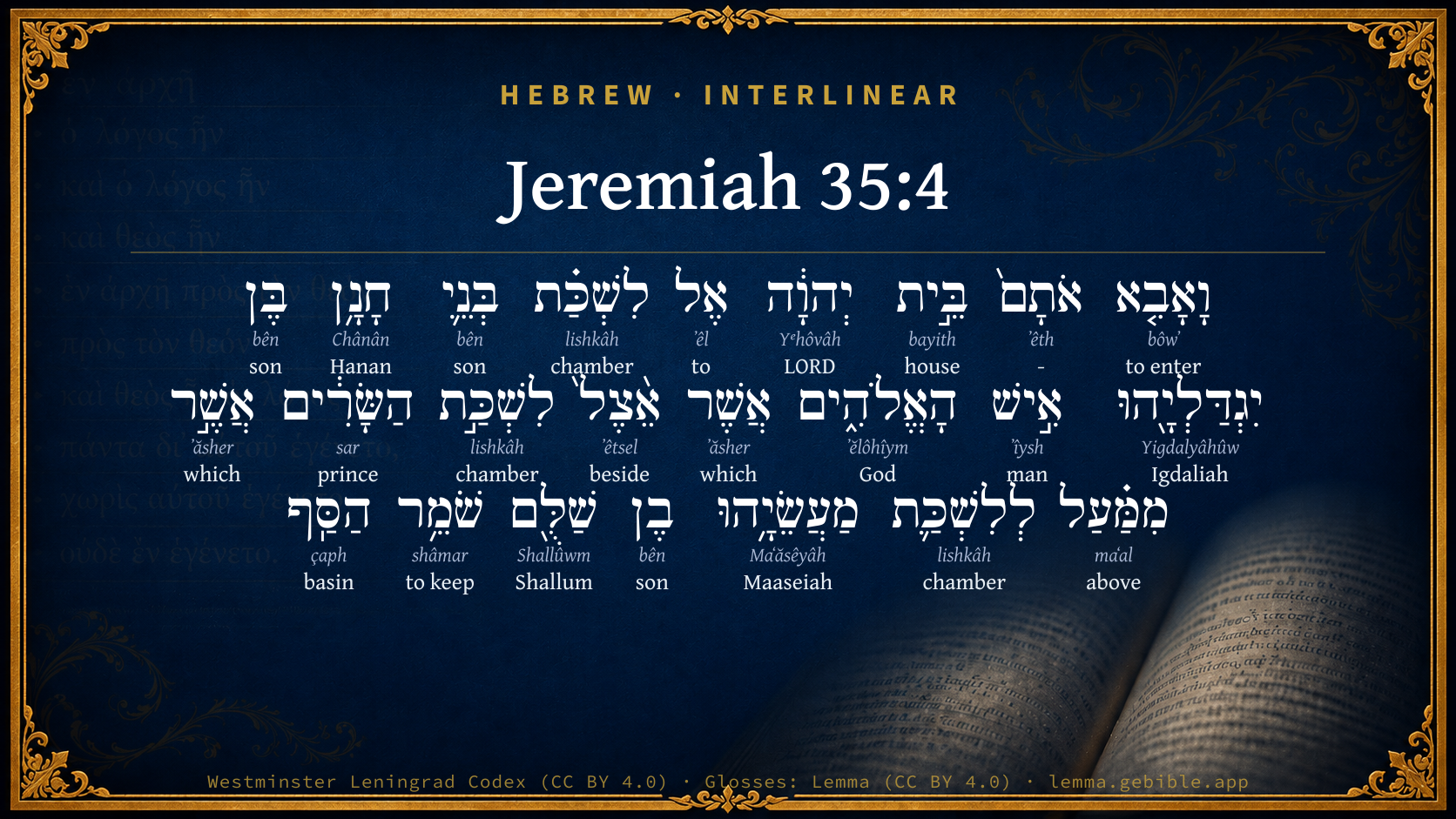
Hebrew (Westminster Leningrad Codex) Jeremiah 35:4 appears in the Hebrew Old Testament. The text above is from the Westminster Leningrad Codex. Each word links to its Strong’s number, a concise gloss, and parsing drawn from the Open Scriptures Hebrew Bible morphology. Click any word for its full Brown-Driver-Briggs (BDB) entry.
Download image
Cite this verse

Jeremiah 35:4 (World English Bible). Public Domain. Lemma interlinear Bible study tool, https://lemma.gebible.app/v/jeremiah/35/4.

Show BibTeX & RIS
BibTeX
RIS
English Translation
and I brought them into the house of Yahweh, into the chamber of the sons of Hanan the son of Igdaliah, the man of God, which was by the chamber of the princes, which was above the chamber of Maaseiah the son of Shallum, the keeper of the threshold.
World English Bible · Public Domain
Highlights
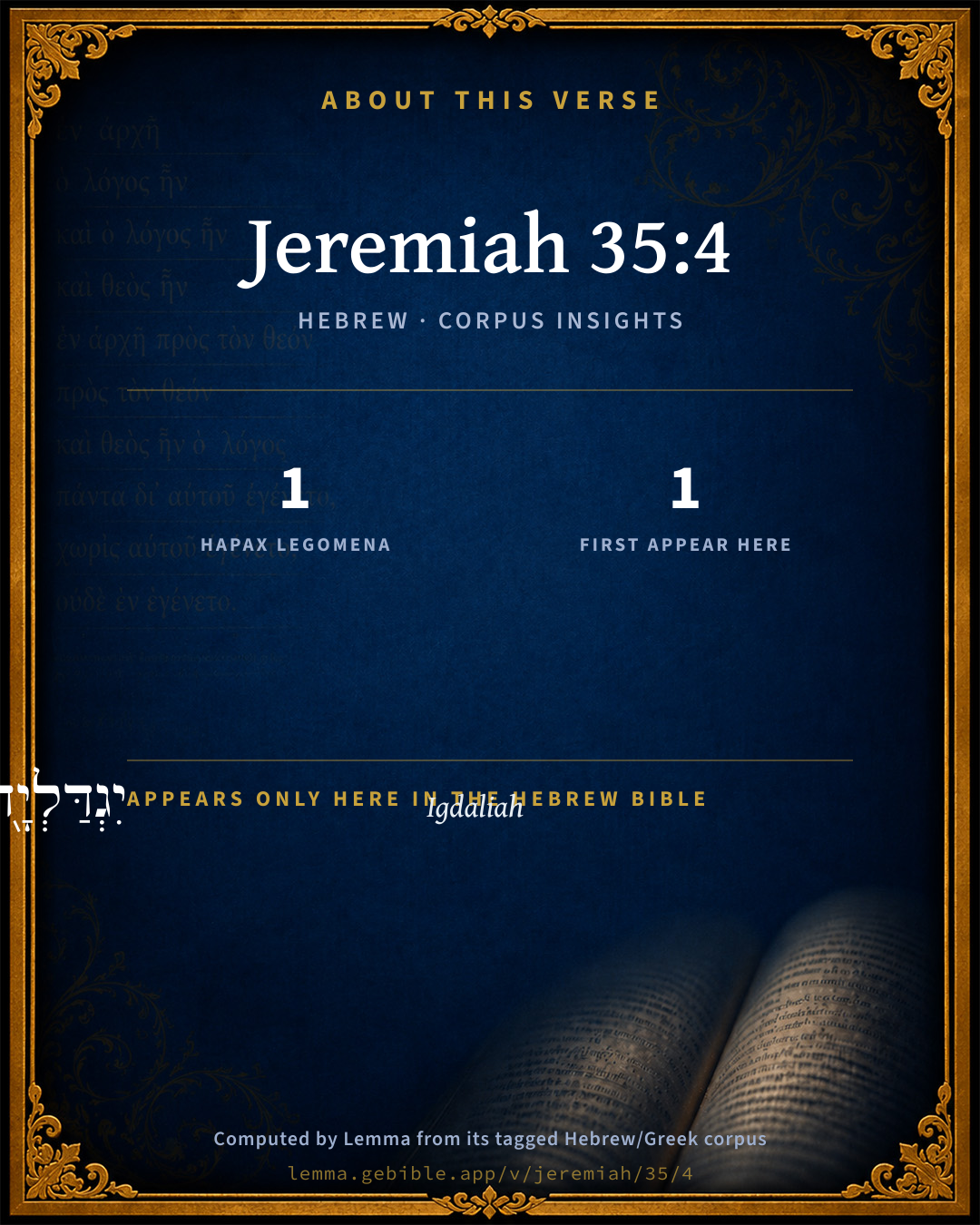
  • 1 hapax legomenon — only here in the Hebrew Bible
  • 1 first appearance in the Hebrew Bible
Full analysis ↓
Download a study sheet

One document with this verse’s original text, its word-by-word gloss line, the meaning frame, cross-references with their text, attributed commentary, and full source and license credits — printable, and it pastes into notes with its structure intact.

This verse Autodidact and up

Study sheet (.html) Plain text (.txt)

A passage Seminary Student

Up to 50 verses in one chapter. A passage sheet keeps up to 6 commentary sources and 12 cross-references per verse, in the order this page ranks them, and says so on the sheet whenever that leaves anything out. Ask for a single verse and you get the Autodidact verse sheet above.

Everything on this page stays free to read, with no account — the sheet is a download of what is already on screen, not access to it.

Want to remove ads? Support Godless Engineer
Compare translations 3

The same verse in 3 English versions, stacked beneath the original-language interlinear above. Click any original word for its lexicon entry.

Each is an independent rendering of the whole verse — the interlinear is not word-aligned to these translations.

Highlighted words mark where these versions differ — a whole-verse word diff, not a word-by-word alignment.

  • World English Bible Public Domain
    and I brought them into the house of Yahweh, into the chamber of the sons of Hanan the son of Igdaliah, the man of God, which was by the chamber of the princes, which was above the chamber of Maaseiah the son of Shallum, the keeper of the threshold.
  • King James Version Public Domain
    And I brought them into the house of the LORD, into the chamber of the sons of Hanan, the son of Igdaliah, a man of God, which was by the chamber of the princes, which was above the chamber of Maaseiah the son of Shallum, the keeper of the door:
  • unfoldingWord Literal Text CC BY-SA 4.0
    I took them to the house of Yahweh, into the rooms of the sons of Hanan son of Igdaliah, the man of God. These rooms were beside the room of the leaders, which was above the room of Maaseiah son of Shallum, the gatekeeper.

unfoldingWord Literal Text — © unfoldingWord, licensed CC BY-SA 4.0. Word-aligned USFM3 via Door43 (git.door43.org/unfoldingWord/en_ult).

Versions to compare (up to 4)

3 of 4 selected

Show all 18 translations

Every available English version of this verse, each an independent rendering of the whole verse.

  • World English Bible Public Domain
    and I brought them into the house of Yahweh, into the chamber of the sons of Hanan the son of Igdaliah, the man of God, which was by the chamber of the princes, which was above the chamber of Maaseiah the son of Shallum, the keeper of the threshold.
  • Berean Standard Bible Public Domain
    and I brought them into the house of the LORD, to a chamber occupied by the sons of Hanan son of Igdaliah, a man of God. This room was near the chamber of the officials, which was above the chamber of Maaseiah son of Shallum the doorkeeper.
  • Majority Standard Bible Public Domain
    and I brought them into the house of the LORD, to a chamber occupied by the sons of Hanan son of Igdaliah, a man of God. This room was near the chamber of the officials, which was above the chamber of Maaseiah son of Shallum the doorkeeper.
  • King James Version Public Domain
    And I brought them into the house of the LORD, into the chamber of the sons of Hanan, the son of Igdaliah, a man of God, which was by the chamber of the princes, which was above the chamber of Maaseiah the son of Shallum, the keeper of the door:
  • American Standard Version (1901) Public Domain
    and I brought them into the house of Jehovah, into the chamber of the sons of Hanan the son of Igdaliah, the man of God, which was by the chamber of the princes, which was above the chamber of Maaseiah the son of Shallum, the keeper of the threshold.
  • Revised Version (1885) Public Domain
    and I brought them into the house of the LORD, into the chamber of the sons of Hanan the son of Igdaliah, the man of God, which was by the chamber of the princes, which was above the chamber of Maaseiah the son of Shallum, the keeper of the door:
  • Geneva Bible (1599) Public Domain
    And I brought them into the House of the Lord, into the chamber of the sonnes of Hanan, the sonne of Igdaliah a man of God, which was by the chamber of the princes, which was aboue the chamber of Maaseiah the sonne of Shallum, the keeper of the treasure.
  • Douay-Rheims (1899) Public Domain
    And I brought them into the house of the Lord, to the treasure house of the sons of Hanan, the son of Jegedelias the man of God, which was by the treasure house of the princes, above the treasure of Maasias the son of Sellum, who was keeper of the entry.
  • Young's Literal Translation Public Domain
    and bring them into the house of Jehovah, unto the chamber of the sons of Hanan son of Igdaliah, a man of God, that `is' near to the chamber of the princes, that `is' above the chamber of Maaseiah son of Shallum, keeper of the threshold;
  • Literal Standard Version CC BY-SA 4.0
    and bring them into the house of YHWH, to the chamber of the sons of Hanan son of Igdaliah, a man of God, that [is] near to the chamber of the princes, that [is] above the chamber of Maaseiah son of Shallum, keeper of the threshold;
  • Unlocked Literal Bible CC BY-SA 4.0
    I took them to the house of Yahweh, into the rooms of the sons of Hanan son of Igdaliah, the man of God. These rooms were beside the room of the leaders, which was above the room of Maaseiah son of Shallum, the gatekeeper.
  • unfoldingWord Literal Text CC BY-SA 4.0
    I took them to the house of Yahweh, into the rooms of the sons of Hanan son of Igdaliah, the man of God. These rooms were beside the room of the leaders, which was above the room of Maaseiah son of Shallum, the gatekeeper.
  • Darby Bible Public Domain
    and I brought them into the house of Jehovah, into the chamber of the sons of Hanan the son of Igdaliah, the man of God, which was by the chamber of the princes, which was above the chamber of Maaseiah the son of Shallum, the keeper of the threshold.
  • World Messianic Bible Public Domain
    and I brought them into the LORD’s house, into the room of the sons of Hanan the son of Igdaliah, the man of God, which was by the room of the princes, which was above the room of Maaseiah the son of Shallum, the keeper of the threshold.
  • Webster's Bible Public Domain
    And I brought them into the house of the LORD, into the chamber of the sons of Hanan, the son of Igdaliah, a man of God, who was by the chamber of the princes, which was above the chamber of Maaseiah the son of Shallum, the keeper of the door:
  • Free Bible Version CC BY-SA 4.0
    Then I took them into the Lord's Temple, to a room used by the sons of Hanan, son of Igdaliah, a man of God. It was next to the one used by the officials, which was above the room of Maaseiah son of Shallum, who was the Temple doorkeeper.
  • Bible in Basic English Public Domain
    And I took them into the house of the Lord, into the room of the sons of Hanan, the son of Igdaliah, the man of God, which was near the rulers' room, which was over the room of Maaseiah, the son of Shallum, the keeper of the door;
  • JPS Tanakh (1917) Public Domain
    and I brought them into the house of the LORD, into the chamber of the sons of Hanan the son of Igdaliah, the man of God, which was by the chamber of the princes, which was above the chamber of Maaseiah the son of Shallum, the keeper of the door;

Literal Standard Version (2020), Covenant Press — licensed CC BY-SA 4.0. Text via the HelloAO Bible API (eBible.org). Unlocked Literal Bible (unfoldingWord) — licensed CC BY-SA 4.0. Text via the HelloAO Bible API (eBible.org). unfoldingWord Literal Text — © unfoldingWord, licensed CC BY-SA 4.0. Word-aligned USFM3 via Door43 (git.door43.org/unfoldingWord/en_ult). Free Bible Version, Dr. Jonathan Gallagher — licensed CC BY-SA 4.0. Text via the HelloAO Bible API (eBible.org).

Word by word

More ways to search: Search by grammar → Find every occurrence → Compare this word →

Practice this passage: Drill this verse → Learn its vocabulary →

יִגְדַּלְיָ֖הוּ
Yigdalyâhûw
H3012
“Igdaliah”
Noun, Proper
Part of Speech
Noun
Type
Proper
Full BDB Definition

Origin: from H1431 and H3050

TWOT: None

Igdaliah = "Jehovah is great" - a prophet or holy man and father of Hanan in the time of Josiah
  1. וָאָבִ֤א bôwʼ H935 “and · to enter” Conjunction + Verb, Hiphil, Sequential Imperfect, 1st Person, Common, Singular
  2. אֹתָם֙ ʼêth H853 “- · them” Particle, Direct Object + Suffix, Personal, 3rd Person, Masculine, Plural
  3. בֵּ֣ית bayith H1004 “house of” Noun, Common, Masculine, Singular, Construct
  4. יְהוָ֔ה Yᵉhôvâh H3068 “LORD” Noun, Proper
  5. אֶל ʼêl H413 “to” Preposition
  6. לִשְׁכַּ֗ת lishkâh H3957 “chamber of” Noun, Common, Feminine, Singular, Construct
  7. בְּנֵ֛י bên H1121 “sons of” Noun, Common, Masculine, Plural, Construct
  8. חָנָ֥ן Chânân H2605 “Hanan” Noun, Proper
  9. בֶּן bên H1121 “son of” Noun, Common, Masculine, Singular, Construct
  10. אִ֣ישׁ ʼîysh H376 “man of” Noun, Common, Masculine, Singular, Construct
  11. הָאֱלֹהִ֑ים ʼĕlôhîym H430 “the · God(s)” Particle, Definite Article + Noun, Common, Masculine, Plural, Absolute
  12. אֲשֶׁר ʼăsher H834 “which” Particle, Relative
  13. אֵ֨צֶל֙ ʼêtsel H681 “beside” Preposition
  14. לִשְׁכַּ֣ת lishkâh H3957 “chamber of” Noun, Common, Feminine, Singular, Construct
  15. הַשָּׂרִ֔ים sar H8269 “the · princes” Particle, Definite Article + Noun, Common, Masculine, Plural, Absolute
  16. אֲשֶׁ֣ר ʼăsher H834 “which” Particle, Relative
  17. מִמַּ֗עַל maʻal H4605 “from · above” Preposition + Adverb
  18. לְלִשְׁכַּ֛ת lishkâh H3957 “to/for · chamber of” Preposition + Noun, Common, Feminine, Singular, Construct
  19. מַעֲשֵׂיָ֥הוּ Maʻăsêyâh H4641 “Maaseiah” Noun, Proper
  20. בֶן bên H1121 “son of” Noun, Common, Masculine, Singular, Construct
  21. שַׁלֻּ֖ם Shallûwm H7967 “Shallum” Noun, Proper
  22. שֹׁמֵ֥ר shâmar H8104 “keeping” Verb, Qal, Participle Active, Masculine, Singular, Construct
  23. הַסַּֽף çaph H5592 “the · basin” Particle, Definite Article + Noun, Common, Masculine, Singular, Absolute

About this verse

These counts appear in no published source. They are computed here, from the morphology-tagged text and Lemma’s own curated glosses. What Lemma adds →

24
words
19
distinct lemmas
Prophets
section

Notable vocabulary

1 hapax legomenon — a word that appears only here in the entire Hebrew Bible:

  • יִגְדַּלְיָ֖הוּ Igdaliah H3012

First appearance in Scripture

This word makes its first canonical appearance in the Hebrew Bible here:

  • יִגְדַּלְיָ֖הוּ Igdaliah H3012

Shared distinctive vocabulary

חָנָ֥ן Hanan H2605 occurs in 12 verses of the Hebrew Bible. Also found in:

Grammatical profile

  • 2 verbs
  • 16 nouns
  • 2 prepositions
  • 1 adverb
  • 3 particles

Verb forms

  • וָאָבִ֤א Hiphil · Sequential Imperfect
  • שֹׁמֵ֥ר Qal · Participle Active

Repetition

Words recur within this verse — often emphatic in Hebrew:

  • לִשְׁכַּ֗ת chamber H3957 ×3
  • בְּנֵ֛י son H1121 ×3
  • אֲשֶׁר which H834 ×2

Cross-references

32

Topical passages linked to Jeremiah 35:4 in the Treasury of Scripture Knowledge — connected by theme and wording, ordered by reader-vote popularity; previews shown in the World English Bible.

  • Deuteronomy 33:1 This is the blessing, with which Moses the man of God blessed the children of Israel before his death.
  • 2 Kings 12:9 But Jehoiada the priest took a chest, and bored a hole in the lid of it, and set it beside the altar, on the right side as one comes into the house of Yahweh: and the priests who kept the threshold put therein all the money that was brought into the house of Yahweh.
  • 2 Chronicles 8:14 He appointed, according to the ordinance of David his father, the divisions of the priests to their service, and the Levites to their offices, to praise, and to minister before the priests, as the duty of every day required; the doorkeepers also by their divisions at every gate: for so had David the man of God commanded.
  • Joshua 14:6 Then the children of Judah drew near to Joshua in Gilgal: and Caleb the son of Jephunneh the Kenizzite said to him, You know the thing that Yahweh spoke to Moses the man of God concerning me and concerning you in Kadesh-barnea.
  • 1 Kings 12:22 But the word of God came to Shemaiah the man of God, saying,
  • 2 Kings 1:9 Then [the king] sent to him a captain of fifty with his fifty. He went up to him: and, behold, he was sitting on the top of the hill. He spoke to him, man of God, the king has said, Come down.
  • 2 Kings 1:11–13 Again he sent to him another captain of fifty and his fifty. He answered him, man of God, thus has the king said, Come down quickly.
  • 2 Kings 25:18 The captain of the guard took Seraiah the chief priest, and Zephaniah the second priest, and the three keepers of the threshold:
  • 1 Chronicles 9:18–19 who hitherto [waited] in the king's gate eastward: they were the porters for the camp of the children of Levi.
  • 1 Samuel 2:27 There came a man of God to Eli, and said to him, Thus says Yahweh, Did I reveal myself to the house of your father, when they were in Egypt [in bondage] to Pharaoh's house?
  • 1 Samuel 9:6–8 He said to him, See now, there is in this city a man of God, and he is a man who is held in honor; all that he says comes surely to pass: now let us go there; peradventure he can tell us concerning our journey whereon we go.
  • 1 Kings 13:1 Behold, there came a man of God out of Judah by the word of Yahweh to Beth El: and Jeroboam was standing by the altar to burn incense.
  • 1 Kings 13:26 When the prophet who brought him back from the way heard of it, he said, It is the man of God, who was disobedient to the mouth of Yahweh: therefore Yahweh has delivered him to the lion, which has torn him, and slain him, according to the word of Yahweh, which he spoke to him.
  • 1 Kings 17:18 She said to Elijah, What have I to do with you, you man of God? You have come to me to bring my sin to memory, and to kill my son!
  • 1 Kings 17:24 The woman said to Elijah, Now I know that you are a man of God, and that the word of Yahweh in your mouth is truth.
  • 1 Kings 20:28 A man of God came near and spoke to the king of Israel, and said, Thus says Yahweh, Because the Syrians have said, Yahweh is a god of the hills, but he is not a god of the valleys; therefore will I deliver all this great multitude into your hand, and you shall know that I am Yahweh.
  • 2 Kings 5:14 Then went he down, and dipped [himself] seven times in the Jordan, according to the saying of the man of God; and his flesh came again like the flesh of a little child, and he was clean.
  • 2 Kings 5:20 But Gehazi the servant of Elisha the man of God, said, Behold, my master has spared this Naaman the Syrian, in not receiving at his hands that which he brought: as Yahweh lives, I will run after him, and take somewhat of him.
  • 2 Kings 6:10 The king of Israel sent to the place which the man of God told him and warned him of; and he saved himself there, not once nor twice.
  • 2 Kings 7:2 Then the captain on whose hand the king leaned answered the man of God, and said, Behold, if Yahweh should make windows in heaven, might this thing be? He said, Behold, you shall see it with your eyes, but shall not eat of it.
  • 2 Kings 7:17 The king appointed the captain on whose hand he leaned to have the charge of the gate: and the people trod on him in the gate, and he died as the man of God had said, who spoke when the king came down to him.
  • 2 Kings 8:2–8 The woman arose, and did according to the word of the man of God; and she went with her household, and sojourned in the land of the Philistines seven years.
  • 2 Kings 23:16–17 As Josiah turned himself, he spied the tombs that were there in the mountain; and he sent, and took the bones out of the tombs, and burned them on the altar, and defiled it, according to the word of Yahweh which the man of God proclaimed, who proclaimed these things.
  • 1 Chronicles 9:27 They lodged round about the house of God, because the charge [of it] was on them; and to them pertained the opening of it morning by morning.
  • 2 Chronicles 25:7–9 But there came a man of God to him, saying, O king, don't let the army of Israel go with you; for Yahweh is not with Israel, [to wit], with all the children of Ephraim.
  • Psalms 84:10 For a day in your courts is better than a thousand. I would rather be a doorkeeper in the house of my God, Than to dwell in the tents of wickedness.
  • Jeremiah 26:10 When the princes of Judah heard these things, they came up from the king's house to the house of Yahweh; and they sat in the entry of the new gate of Yahweh's [house].
  • Jeremiah 36:10–12 Then read Baruch in the book the words of Jeremiah in the house of Yahweh, in the chamber of Gemariah the son of Shaphan, the scribe, in the upper court, at the entry of the new gate of Yahweh's house, in the ears of all the people.
  • Jeremiah 52:24 The captain of the guard took Seraiah the chief priest, and Zephaniah the second priest, and the three keepers of the threshold:
  • Ezekiel 43:8 in their setting of their threshold by my threshold, and their door-post beside my door-post, and there was [but] the wall between me and them; and they have defiled my holy name by their abominations which they have committed: therefore I have consumed them in my anger.
  • 1 Timothy 6:11 But you, man of God, flee these things, and follow after righteousness, godliness, faith, love, patience, and gentleness.
  • 2 Timothy 3:17 that the man of God may be complete, thoroughly equipped for every good work.

Cross-references courtesy of OpenBible.info (CC BY 4.0).

Hebrew and Greek witnesses Masoretic Hebrew ↔ Greek Septuagint

The same verse in the two great witnesses to the Old Testament, shown verse-for-verse.

These are two independent witnesses, not word-aligned to each other, and the Septuagint is shown in lemma (dictionary) form.

Hebrew Jeremiah 35:4 Masoretic · Westminster Leningrad Codex

וָאָבִ֤א אֹתָם֙ בֵּ֣ית יְהוָ֔ה אֶל לִשְׁכַּ֗ת בְּנֵ֛י חָנָ֥ן בֶּן יִגְדַּלְיָ֖הוּ אִ֣ישׁ הָאֱלֹהִ֑ים אֲשֶׁר אֵ֨צֶל֙ לִשְׁכַּ֣ת הַשָּׂרִ֔ים אֲשֶׁ֣ר מִמַּ֗עַל לְלִשְׁכַּ֛ת מַעֲשֵׂיָ֥הוּ בֶן שַׁלֻּ֖ם שֹׁמֵ֥ר הַסַּֽף

and I brought them into the house of Yahweh, into the chamber of the sons of Hanan the son of Igdaliah, the man of God, which was by the chamber of the princes, which was above the chamber of Maaseiah the son of Shallum, the keeper of the threshold.

World English Bible · Public Domain

Greek LXX Structure differs

In the Septuagint, Jeremiah is about an eighth shorter than the Hebrew and arranges its material differently — the Oracles Against the Nations (Hebrew chapters 46–51) appear in the middle of the Greek book, after 25:13. Because the chapter and verse boundaries do not line up, a verse-for-verse comparison with the Hebrew is not shown.

A verse-for-verse comparison isn’t shown here because the chapters and verses don’t line up. Switch to the LXX edition with the MT / LXX toggle above to read the Greek directly.

Hebrew: Westminster Leningrad Codex (CC BY 4.0). Greek: Septuagint (public domain); English from a public-domain English Septuagint. How the Septuagint differs from the Hebrew →

Targum (Aramaic paraphrase)

1

The Targum is the ancient Jewish Aramaic paraphrase of the Hebrew Scriptures — an interpretive translation, not the Hebrew text itself. Onkelos (literal) and Pseudo-Jonathan (expansive) render the Torah, and Jonathan the Prophets. Coverage is partial: where no permissively-licensed English translation exists for a verse, only the Aramaic is shown. This is verse-level text, not a word-by-word alignment to the Hebrew.

  1. Targum Jonathan Prophets (Joshua–Malachi)
    וְאָעֲלֵית יַתְהוֹן לְבֵית מַקְדְשָׁא דַייָ לְלִשְׁכַּת בַּר חָנָן בַּר יִגְדַלְיָהוּ נְבִיָא דַייָ דְבִסְטַר לִשְׁכַּת מַעֲשֵׂיָה בַר שַׁלֻם אַמַרְכְּלָא:

    (no public-domain English translation for this verse)

    Targum Jonathan — Aramaic: “Mikraot Gedolot” (public domain). English: “Sefaria Community Translation” (CC0 1.0 (public-domain dedication)); “London "Chaldee Paraphrase," 1871” (public domain). Text via Sefaria.

Commentary

Notes on Jeremiah 35:4 from classic Christian and Jewish commentators (each source and its license shown beneath its notes). The classic Christian expositions comment on the surrounding passage and are grouped to its opening verse, so a note may address several verses; the Jewish commentaries on the Tanakh (Rashi and others) are per-verse, so they appear only where the commentator wrote on this verse.

Lemma curates 59 commentaries, every one of them public domain or Creative Commons licensed, each selected and text-cleaned for this edition rather than reprinted as found. About our sources →

Trapp's Complete Commentary

John Trapp

Jer 35:4 And I brought them into the house of the LORD, into the chamber of the sons of Hanan, the son of Igdaliah, a man of God, which [was] by the chamber of the princes, which [was] above the chamber of Maaseiah the son of Shallum, the keeper of the door:

Ver. 4. And I brought them into the house of the Lord.] That it might be made a public business, and so the better work upon all that should hear of it.

The son of Igdaliah, a man of God.] A priest and prophet or teacher of the people. So in the New Testament others are called God’s children, his servants, and his people, but ministers only are called God’s men. {1Ti 6:11 2Ti 3:17}

Which was by the chamber of the princes.] Or, Of the prefects of the temple, that were next under the high priests.

John Trapp, A Commentary or Exposition upon All the Books of the Old and New Testament (1647–1656) — public domain. Text from a community e-Sword module.

Tyndale Open Study Notes

Tyndale Open Resources

35:4 Jeremiah the prophet carefully described the location of the room in the Temple, taking note that Hanan, the man in charge, was a man of God. During this idolatrous time in Judah’s history, the prophet had some friends in high places who remained believers in the one true God.

Tyndale Open Study Notes — © Tyndale Open Resources, licensed CC BY-SA 4.0. Text via the HelloAO Bible API.

Geneva Bible (1599)

Geneva Bible translators

Or, door.

That is, a Prophet.

Geneva Bible (1599) marginal notes — public domain. Text via Bolls.life.

Jamieson, Fausset & Brown

Robert Jamieson, A. R. Fausset & David Brown

man of God--a prophet (Deu 33:1; Sa1 2:27; Kg1 12:22; Kg2 4:7), also "a servant of God" in general (Ti1 6:11), one not his own, but God's; one who has parted with all right in himself to give himself wholly to God (Ti2 3:17). He was so reverenced that none would call in question what was transacted in his chamber.

keeper of the door--Hebrew, "of the vessel." Probably the office meant is that of the priest who kept in charge the capitation money paid for the use of the temple and the votive offerings, such as silver vessels, &c. There were seven such keepers [GROTIUS]. Compare Kg2 12:9; Kg2 25:18; Ch1 9:18-19, which support English Version.

I said . . . Drink--Jeremiah does not say, The Lord saith, Drink: for then they would have been bound to obey. Contrast the case in 1Ki. 13:7-26.

Jamieson, Fausset & Brown — Commentary Critical and Explanatory on the Whole Bible (1871) — public domain (CC PDM 1.0). Text via the HelloAO Bible API.

Adam Clarke's Commentary

Verse 4. Igdaliah, a man of God] A prophet or holy man, having some office in the temple.

Adam Clarke's Commentary on the Bible (1810–1826) — public domain. Text from a community e-Sword/MySword module.

Ellicott's Commentary for English Readers

(4) I brought them into the house of the Lord . . .—The Temple of Solomon appears from 1Ki_6:5 to have had, like a cathedral, apartments constructed in its precincts which were assigned, by special favour, for the residence of conspicuous priests or prophets. Huldah the prophetess seems to have dwelt in some such apartments known as “the college” (see 2Ki_22:14). In this case the chamber was occupied by the sons of Hanan. He, or Igdaliah (the Hebrew punctuation is decisive in favour of Hanan), is described as “a man of God—i.e., as a prophet—and therefore sympathising, we may believe, with Jeremiah’s work (Deu_33:1; 1Sa_2:27; 1Ki_13:1; 1Ki_20:28; 2Ki_4:7; 2Ki_4:9; 1Ch_23:14; 2Ch_11:2). It would seem, from the narrative, that Jeremiah had no chamber of his own. Here also “the sons of Hanan” are probably a company of scholars under the training of the prophet, Jeremiah introducing as it were the two religious orders to each other. The “princes,” as in Jer_26:10; Jer_36:12, were probably official persons who, though not priests, were entitled to residence in the precincts, as we see in the case of Gemariah in Jer_36:10. The “keeper of the door,” as in Jer_52:24, was probably one of the higher section of the priesthood. The stress laid on all these details was probably intended to show that the memorable dramatic scene that followed, daring as it seemed, was acted in the presence of representatives of the priestly, prophetic, and official orders. The name of Maaseiah has, however, a special interest attached to it. Shallum, the name of his father, is found in 2Ki_22:14 as that of the husband of Huldah the prophetess of the reign of Josiah, and he is described as the “keeper of the wardrobe,” i.e., probably of the vestments of the priests, and as dwelling in the “college” (literally, the “second” part, or annexe of some other building). It is hardly possible to resist the inference that in the Maaseiah who now appears as receiving Jeremiah and the Rechabites, we have the son of the prophetess who had taken so active a part in the work of reformation in the reign of Josiah, whose influence had coloured the whole of the prophet’s life, who had brought up her son within the precincts of the Temple. We are brought as it were into the innermost circle of the prophetic company of Jerusalem, and are reminded of Simeon and Anna, and those who waited for the consolation, for the redemption of Israel (Luk_2:25; Luk_2:38). The influence of Shallum may, perhaps, be traced in the fact that the king who appears in history as Jehoahaz had probably been named by Josiah after him (2Ki_23:30; 1Ch_3:15), as David named one of his sons after Nathan (2Sa_5:14). It is, perhaps, from this point of view, characteristic of Jeremiah that he adheres in Jer_22:1 to the old name given on his birth, and not to that which he had apparently adopted upon his accession to the throne. The name Shallum, it may be noted, means “retribution,” whether for good or for evil.

A Bible Commentary for English Readers, edited by Charles John Ellicott (1878–1897) — public domain. Text from a community e-Sword module.

The Cambridge Bible for Schools and Colleges

gen. ed. J. J. S. Perowne

4. The particularity in description points to the narrative being contemporary with the events it describes.

and I brought them into the house of the Lord] that so what was to follow might be made most prominent and be most widely known.

Maaseiah] probably father of the Zephaniah (Jer_21:1, Jer_29:25, Jer_37:3) who is mentioned as “second priest” in Jer_52:24.

keeper of the door] lit. threshold. There were three of these officers (Jer_52:24; 2Ki_25:18). They seem to have stood next in rank after the high-priest and his deputy (ib.), and were charged with the care of the money contributed for the restoration of the Temple (2Ki_12:9).

The Cambridge Bible for Schools and Colleges (gen. ed. J. J. S. Perowne; Cambridge University Press, 1878–1918) — public domain. Text from a community e-Sword module.

John Gill's Exposition

And I brought them into the house of the Lord,.... Into the temple, as he was ordered; that is, he invited them thither, and they came along with him, having, no doubt, a respect for him as a prophet; and the rather, as it is highly probable he came in the name of the Lord to them:

into the chamber of the sons of Hanan, the son of Igdaliah, a man of God; a prophet, as the Targum and Syriac version; and so Jarchi and Kimchi interpret it. This must be understood of Hanan, and not Igdaliah, as the accents show: he is thought by some to be the same with Hanani the seer, in the times of Asa, Ch2 16:7;

which was by the chamber of the princes; these were not the princes of the blood, the sons of Jehoiachim; their chambers or apartments were not in the temple, but in the royal palace; but these were the princes or rulers of the people, as they are called, Act 4:8; the sanhedrim, whose this chamber was, as Dr. Lightfoot (d) has observed:

which was above the chamber of Maaseiah the son of Shallum, the keeper of the door: a porter, whose chamber or lodge was under that in which the sanhedrim sat. The Targum calls him a treasurer; one of the seven "amarcalim", who had the keys of several chambers, where the vessels of the sanctuary and other things were put; and Kimchi observes, the word we render door comprehends the vessels of the sanctuary, and the vessels of wine, and other things.

(d) Temple-Service, c. 9. p. 1063.

John Gill's Exposition of the Whole Bible (1746–1763) — public domain (CC PDM 1.0). Text via the HelloAO Bible API.

Albert Barnes' Notes on the Bible

The title man of God, i. e., prophet, belongs to Hanan, identified by many with Hanani 2Ch 16:7. The sons of Hanan were probably his disciples. If so, we find a religious school or sect, regularly established in the precincts of the temple, of whose views and modes of interpretation we know nothing. Plainly however, the Hananites were friendly to Jeremiah, and lent him their hall for his purpose.

The chamber of the princes - Probably the council-chamber in which the great officers of state met for the despatch of business.

The keeper of the door - There were three of these keepers, answering to the outer and inner courts of the temple, and the entrance to the temple itself. They were officers of high rank, having precedence next to the high priest and his deputy.

Albert Barnes' Notes on the Bible (1834–1885) — public domain. Text from a community e-Sword/MySword module.

Haydock's Catholic Bible Commentary

Of God. Prophets are generally thus designated, 4 Kings iv. 7. We know nothing more of this holy man. --- Princes of the priests; or where princes made their offerings, or assembled to judge, chap. xxvi. 10. --- Entry. He was not removeable like the other Levites, 1 Paralipomenon ix. 19, 34. (Calmet)

George Leo Haydock (1774–1849), Haydock's Catholic Family Bible and Commentary, 1859 edition — public domain. Excludes Psalms (Douay-Rheims chapter numbering differs from Protestant) and Deuterocanonical books (Catholic canon only).

Matthew Poole's English Annotations

This term,

the man of God, doth in Scripture signify a prophet sometimes; but whether it so signifieth here, and if it doth, whether it relateth to Igdaliah or Hanan, is a question. Probably by the

chamber of the princes is meant some chamber where the princes were wont to meet in a court, or for counsel. Thither Jeremiah brings these Rechabites, and sets vessels of wine before them, not commanding them to drink it, but only inviting them.

Matthew Poole's English Annotations on the Holy Bible (1683–1685) — public domain. Text from a community e-Sword/MySword module.

Whedon's Commentary on the Bible

Daniel D. Whedon

4. The sons of Hanan were probably not his children, but his followers, and so we seem to have suggested a religious sect, though of their principles and history we know nothing.

A man of God — This appellation belongs probably to Hanan, and not to Igdaliah, this being the usual mode of construing this Hebrew idiom.

Chamber of the princes — Probably an office or council-room where public business was attended to. Jer_26:10, seems to belong with this verse.

Keeper of the door — Literally, of the threshold; as Keil suggests, “overseer of the watchmen of the temple gates,” of which, according to Jer_52:24, and 2Ki_25:18, there were three, who are there mentioned along with the high priest and his substitute. Maaseiah is probably the same whose son Zephaniah was “priest of the repetition,” or second priest. Jer_52:24.

Daniel D. Whedon (gen. ed.), Commentary on the Old and New Testaments (1874–1909) — public domain. Text from a community e-Sword module.

The Pulpit Commentary

A man of God. The title, according to Hebrew usage, belongs to Hanan, not to his father, and means "prophet"; (see e.g. Jer_12:2) comp. Plumptre"There the chamber stands Where Hanan"s followers gather up the words Their master speaks.

The chamber of the princes; i.e. the room "where the princes," i.e. the most distinguished laymen, especially the "elders of the people," assembled before the temple services. Maaseiah the son of Shallum. Probably the father of Zephaniah, "the second or, "deputy priest", (Jer_52:24) himself a functionary of high rank, as he is called a keeper of the door (or rather, threshold). There were three of these "keepers," corresponding to the number of the gates of the temple, and they ranked immediately after the high priest and his deputy; (Jer_52:24) comp." I had rather be a doorkeeper," etc., in one of the Korahite psalms. (Psa_84:10)

The Pulpit Commentary (1880–1919), ed. H.D.M. Spence-Jones & Joseph S. Exell — public domain. Text from a community e-Sword module.

John Wesley's Explanatory Notes

Igdaliah - A prophet. The princes - The chamber were the princes were wont to meet.

John Wesley, Explanatory Notes Upon the Whole Bible (1754–1765) — public domain. Text via the GEBible commentary corpus.

Rashi

Rabbi Shlomo Yitzchaki (Rashi)

the man of God The prophet of the Lord.

the keeper of the vessels Heb. שמר הסף. Jonathan renders: אמרכּלא (tresorier in French,) a treasurer.

Rashi on the Tanakh — English translations: “The Judaica Press complete Tanach with Rashi, translated by A. J. Rosenberg” (CC BY 4.0); “Pentateuch with Rashi's commentary by M. Rosenbaum and A.M. Silbermann, 1929-1934” (public domain); “The Metsudah Tanach series, Lakewood, N.J” (CC BY 4.0); and “The Book of Joshua, Metsudah Publications, 1997” (CC BY 4.0). Text via Sefaria.

Lesson kit

Teaching starters — assembled from the data on this page, not authored interpretation. Every prompt links to the verse data it draws on. Edit before teaching.

Jeremiah, in the Prophets, opens this verse with 24 words (19 distinct Hebrew lemmas). Its most distinctive word is Yigdalyâhûw (“Igdaliah”). A historical commentator’s framing appears above. Read the whole chapter for the surrounding context.

Discussion questions

  1. The word Yigdalyâhûw carries the sense “Igdaliah.” How does it shape the verse?
  2. 1 word here appears nowhere else in the Hebrew Bible. Why might the author reach for such rare wording?
  3. This is the first place “Igdaliah” appears in Scripture (first appears here). What does its debut here establish?
  4. How does 1 Chronicles 8:23, which shares the word «Hanan», read alongside this verse?
  5. What does the repetition of “chamber” (3× in this one verse) do in this verse?
  6. These translations render this verse differently; the difference is in the English rendering, not the original. What questions does that raise?
  7. «וָאָבִ֤א» is a Hiphil Sequential Imperfect verb. How does that grammatical form shape the action described?
  8. Compare how Trapp's Complete Commentary and Tyndale Open Study Notes read this verse. Where do they agree or differ?

Things to notice

  • 1 word in this verse appears nowhere else in the Hebrew Bible.
  • 1 word makes its first canonical appearance in Scripture here.
  • These translations choose different wording for 14 words in this verse.
  • “chamber” occurs 3× in this single verse.
  • 19 distinct Hebrew lemmas span 24 words in this verse.

Reading settings

Reading text

Shown beneath each verse's original-language words.

Old Testament
Old Testament edition

Read the OT as the Masoretic Hebrew (MT) or the Greek Septuagint (LXX).

English shown for the Greek Septuagint (in the Hebrew ↔ Greek comparison).

Comparing translations? Open the Compare panel on any verse page to stack up to four side by side.