Numbers 26:4

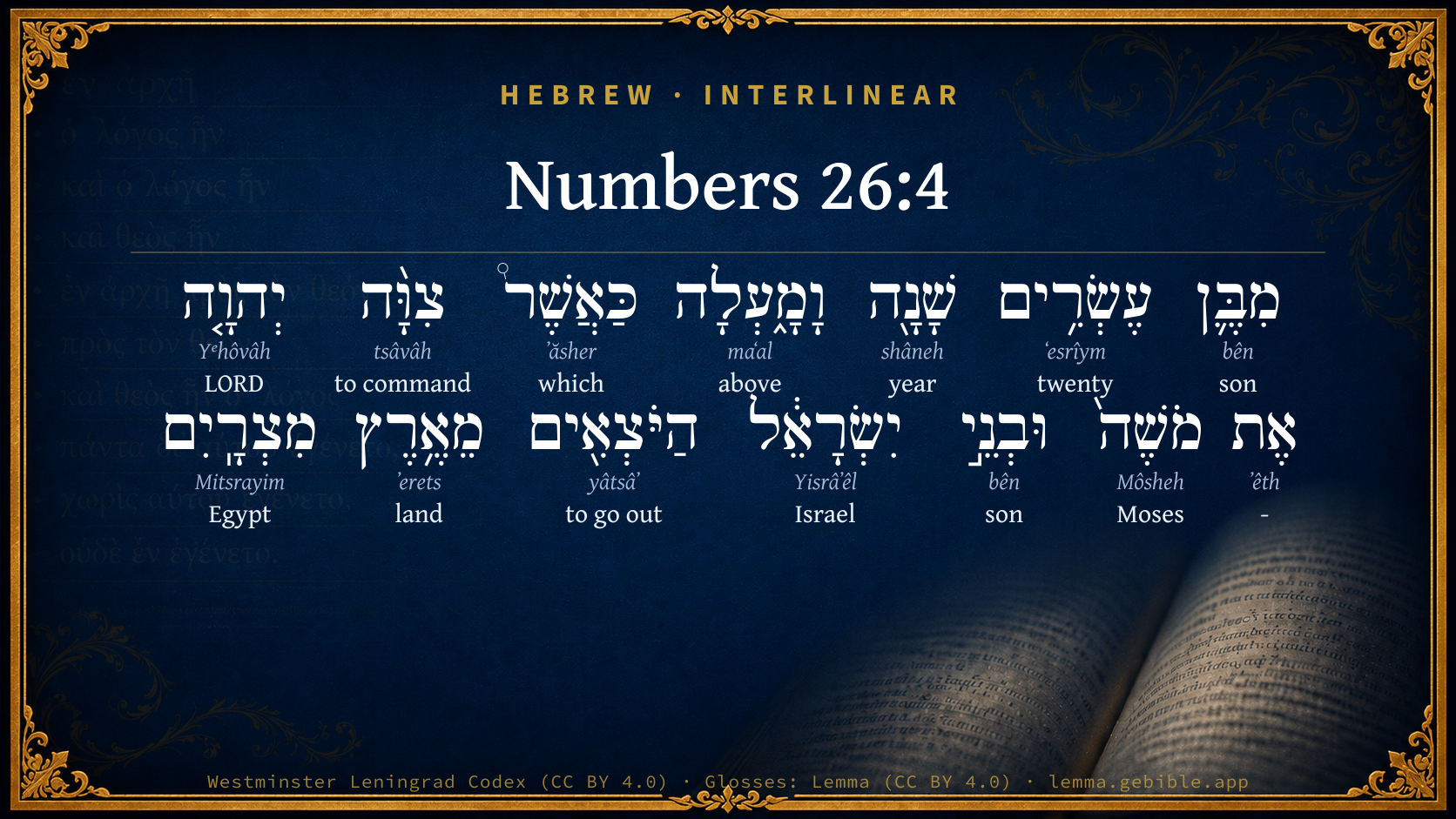
Hebrew (Westminster Leningrad Codex) Numbers 26:4 appears in the Hebrew Old Testament. The text above is from the Westminster Leningrad Codex. Each word links to its Strong’s number, a concise gloss, and parsing drawn from the Open Scriptures Hebrew Bible morphology. Click any word for its full Brown-Driver-Briggs (BDB) entry.
Download image
Cite this verse

Numbers 26:4 (World English Bible). Public Domain. Lemma interlinear Bible study tool, https://lemma.gebible.app/v/numbers/26/4.

Show BibTeX & RIS
BibTeX
RIS
English Translation
[Take the sum of the people], from twenty years old and upward; as Yahweh commanded Moses and the children of Israel, that came forth out of the land of Egypt.
World English Bible · Public Domain
Download a study sheet

One document with this verse’s original text, its word-by-word gloss line, the meaning frame, cross-references with their text, attributed commentary, and full source and license credits — printable, and it pastes into notes with its structure intact.

This verse Autodidact and up

Study sheet (.html) Plain text (.txt)

A passage Seminary Student

Up to 50 verses in one chapter. A passage sheet keeps up to 6 commentary sources and 12 cross-references per verse, in the order this page ranks them, and says so on the sheet whenever that leaves anything out. Ask for a single verse and you get the Autodidact verse sheet above.

Everything on this page stays free to read, with no account — the sheet is a download of what is already on screen, not access to it.

Want to remove ads? Support Godless Engineer
Compare translations 3

The same verse in 3 English versions, stacked beneath the original-language interlinear above. Click any original word for its lexicon entry.

Each is an independent rendering of the whole verse — the interlinear is not word-aligned to these translations.

Highlighted words mark where these versions differ — a whole-verse word diff, not a word-by-word alignment.

  • World English Bible Public Domain
    [Take the sum of the people], from twenty years old and upward; as Yahweh commanded Moses and the children of Israel, that came forth out of the land of Egypt.
  • King James Version Public Domain
    Take the sum of the people, from twenty years old and upward; as the LORD commanded Moses and the children of Israel, which went forth out of the land of Egypt.
  • unfoldingWord Literal Text CC BY-SA 4.0
    “From a son of 20 years and upward, just as Yahweh commanded Moses and the sons of Israel, the ones who came out from the land of Egypt.”

unfoldingWord Literal Text — © unfoldingWord, licensed CC BY-SA 4.0. Word-aligned USFM3 via Door43 (git.door43.org/unfoldingWord/en_ult).

Versions to compare (up to 4)

3 of 4 selected

Show all 18 translations

Every available English version of this verse, each an independent rendering of the whole verse.

  • World English Bible Public Domain
    [Take the sum of the people], from twenty years old and upward; as Yahweh commanded Moses and the children of Israel, that came forth out of the land of Egypt.
  • Berean Standard Bible Public Domain
    “Take a census of the men twenty years of age or older, as the LORD has commanded Moses.” And these were the Israelites who came out of the land of Egypt:
  • Majority Standard Bible Public Domain
    “Take a census of the men twenty years of age or older, as the LORD has commanded Moses.” And these were the Israelites who came out of the land of Egypt:
  • King James Version Public Domain
    Take the sum of the people, from twenty years old and upward; as the LORD commanded Moses and the children of Israel, which went forth out of the land of Egypt.
  • American Standard Version (1901) Public Domain
    `Take the sum of the people', from twenty years old and upward; as Jehovah commanded Moses and the children of Israel, that came forth out of the land of Egypt.
  • Revised Version (1885) Public Domain
    Take the sum of the people, from twenty years old and upward; as the LORD commanded Moses and the children of Israel, which came forth out of the land of Egypt.
  • Geneva Bible (1599) Public Domain
    From twentie yeere olde and aboue ye shall nomber the people, as the Lord had commanded Moses, and the childre of Israel, when they came out of the land of Egypt.
  • Douay-Rheims (1899) Public Domain
    From twenty years old and upward, as the Lord had commanded: and this is the number of them:
  • Young's Literal Translation Public Domain
    `From a son of twenty years and upward,' as Jehovah hath commanded Moses and the sons of Israel who are coming out from the land of Egypt.
  • Literal Standard Version CC BY-SA 4.0
    “From a son of twenty years and upward,” as YHWH has commanded Moses and the sons of Israel who are coming out from the land of Egypt.
  • Unlocked Literal Bible CC BY-SA 4.0
    “Count the people, from twenty years old and up, as Yahweh commanded Moses and the people of Israel, who came out of the land of Egypt.”
  • unfoldingWord Literal Text CC BY-SA 4.0
    “From a son of 20 years and upward, just as Yahweh commanded Moses and the sons of Israel, the ones who came out from the land of Egypt.”
  • Darby Bible Public Domain
    From twenty years old and upward...; as Jehovah had commanded Moses and the children of Israel, who went forth out of the land of Egypt.
  • World Messianic Bible Public Domain
    “Take a census, from twenty years old and upward, as the LORD commanded Moses and the children of Israel.” These are those who came out of the land of Egypt.
  • Webster's Bible Public Domain
    Take the sum of the people, from twenty years old and upward; as the LORD commanded Moses and the children of Israel, who went forth from the land of Egypt.
  • Free Bible Version CC BY-SA 4.0
    “Census the men twenty years of age or older, following the instructions the Lord gave to Moses.” The following is the genealogical record of those who left the land of Egypt.
  • Bible in Basic English Public Domain
    Let all the people of twenty years old and over be numbered, as the Lord has given orders to Moses and the children of Israel who have come out of Egypt.
  • JPS Tanakh (1917) Public Domain
    'Take the sum of the people, from twenty years old and upward, as the LORD commanded Moses and the children of Israel, that came forth out of the land of Egypt.'

Literal Standard Version (2020), Covenant Press — licensed CC BY-SA 4.0. Text via the HelloAO Bible API (eBible.org). Unlocked Literal Bible (unfoldingWord) — licensed CC BY-SA 4.0. Text via the HelloAO Bible API (eBible.org). unfoldingWord Literal Text — © unfoldingWord, licensed CC BY-SA 4.0. Word-aligned USFM3 via Door43 (git.door43.org/unfoldingWord/en_ult). Free Bible Version, Dr. Jonathan Gallagher — licensed CC BY-SA 4.0. Text via the HelloAO Bible API (eBible.org).

Word by word

More ways to search: Search by grammar → Find every occurrence → Compare this word →

Practice this passage: Drill this verse → Learn its vocabulary →

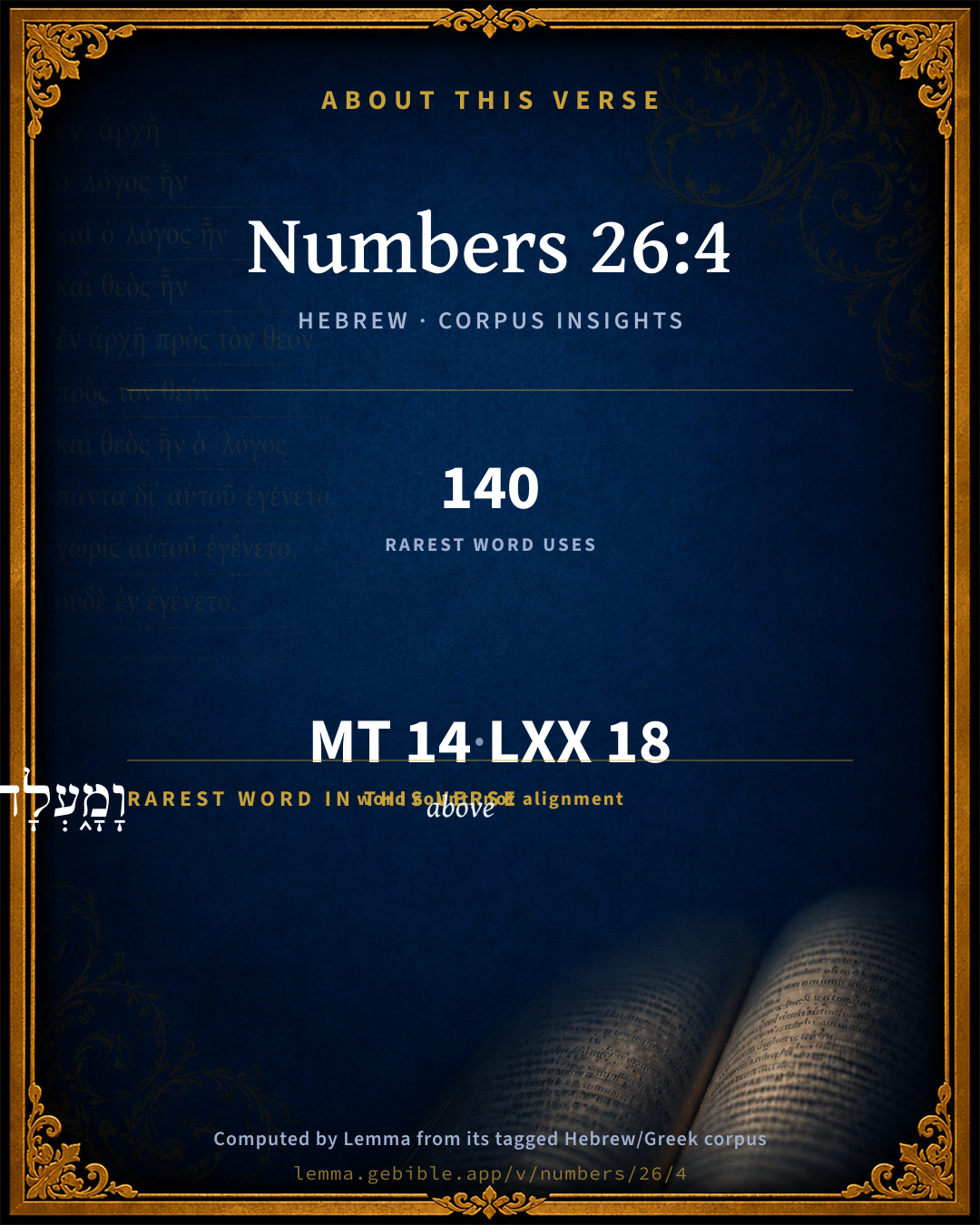
וָמָ֑עְלָה
maʻal
H4605
“and · above · toward”
Conjunction + Adverb + Suffix, Demonstrative
Part of Speech
Conjunction + Adverb
Full BDB Definition

Origin: from H5927

TWOT: 1624k

higher part, upper part (substantive) - above (adverb) - on the top of, above, on higher ground than (preposition) - upwards, higher, above (with locative)
  1. מִבֶּ֛ן bên H1121 “from · son of” Preposition + Noun, Common, Masculine, Singular, Construct
  2. עֶשְׂרִ֥ים ʻesrîym H6242 “twenty” Adjective, Cardinal number, Both, Plural, Absolute
  3. שָׁנָ֖ה shâneh H8141 “year” Noun, Common, Feminine, Singular, Absolute
  4. כַּאֲשֶׁר֩ ʼăsher H834 “like/as · which” Preposition + Particle, Relative
  5. צִוָּ֨ה tsâvâh H6680 “to command” Verb, Piel, Perfect, 3rd Person, Masculine, Singular
  6. יְהוָ֤ה Yᵉhôvâh H3068 “LORD” Noun, Proper
  7. אֶת ʼêth H853 “-” Particle, Direct Object
  8. מֹשֶׁה֙ Môsheh H4872 “Moses” Noun, Proper
  9. וּבְנֵ֣י bên H1121 “and · sons of” Conjunction + Noun, Common, Masculine, Plural, Construct
  10. יִשְׂרָאֵ֔ל Yisrâʼêl H3478 “Israel” Noun, Proper
  11. הַיֹּצְאִ֖ים yâtsâʼ H3318 “the · going out” Particle, Definite Article + Verb, Qal, Participle Active, Masculine, Plural, Absolute
  12. מֵאֶ֥רֶץ ʼerets H776 “from · land of” Preposition + Noun, Common, Both, Singular, Construct
  13. מִצְרָֽיִם Mitsrayim H4714 “Egypt” Noun, Proper

About this verse

These counts appear in no published source. They are computed here, from the morphology-tagged text and Lemma’s own curated glosses. What Lemma adds →

14
words
13
distinct lemmas
Pentateuch
section

Grammatical profile

  • 2 verbs
  • 8 nouns
  • 1 adjective
  • 1 adverb
  • 2 particles

Verb forms

  • צִוָּ֨ה Piel · Perfect
  • הַיֹּצְאִ֖ים Qal · Participle Active

Repetition

A word recurs within this verse — often emphatic in Hebrew:

  • מִבֶּ֛ן son H1121 ×2

Hebrew & Septuagint length

In English translation the verse runs 30 words from the Hebrew and 28 from the Septuagint (LXX English) — closely comparable.

A rough comparison of the two English renderings, which tokenize alike — not a word-level alignment.

Word counts can differ between the Hebrew and the Greek without any difference in meaning — e.g. the Hebrew direct-object marker אֵת has no separate Greek word, and Greek often adds the article ὁ.

In the original languages it is 14 Hebrew tokens and 18 Greek tokens — but the two are counted differently (Hebrew bundles its prefixes and suffixes into one token; the Greek is in lemma form), so that isn’t a like-for-like length.

Cross-references

2

Topical passages linked to Numbers 26:4 in the Treasury of Scripture Knowledge — connected by theme and wording, ordered by reader-vote popularity; previews shown in the World English Bible.

  • Numbers 1:1 Yahweh spoke to Moses in the wilderness of Sinai, in the Tent of Meeting, on the first day of the second month, in the second year after they had come out of the land of Egypt, saying,
  • 1 Chronicles 21:1 Satan stood up against Israel, and moved David to number Israel.

Cross-references courtesy of OpenBible.info (CC BY 4.0).

Hebrew and Greek witnesses Masoretic Hebrew ↔ Greek Septuagint

The same verse in the two great witnesses to the Old Testament, shown verse-for-verse.

These are two independent witnesses, not word-aligned to each other, and the Septuagint is shown in lemma (dictionary) form.

Hebrew Numbers 26:4 Masoretic · Westminster Leningrad Codex

מִבֶּ֛ן עֶשְׂרִ֥ים שָׁנָ֖ה וָמָ֑עְלָה כַּאֲשֶׁר֩ צִוָּ֨ה יְהוָ֤ה אֶת מֹשֶׁה֙ וּבְנֵ֣י יִשְׂרָאֵ֔ל הַיֹּצְאִ֖ים מֵאֶ֥רֶץ מִצְרָֽיִם

[Take the sum of the people], from twenty years old and upward; as Yahweh commanded Moses and the children of Israel, that came forth out of the land of Egypt.

World English Bible · Public Domain

Greek LXX Numbers 26:4 Septuagint · lemma form

ἀπό εἰκοσαετής καί ἐπάνω ὅς τρόπος συντάσσω κύριος ὁ μωυσῆς καί ὁ υἱός ἰσραήλ ὁ ἐκἔρχομαι ἐκ αἴγυπτος

This is the numbering from twenty years old and upward as the Lord commanded Moses. And the sons of Israel that came out of Egypt are as follows:

LXX2012 (modern English Septuagint) · Public Domain

On this verse, The Pulpit Commentary discusses the Septuagint’s reading. Read the note in Commentary ↓

Hebrew: Westminster Leningrad Codex (CC BY 4.0). Greek: Septuagint (public domain); English from LXX2012 (modern English Septuagint) (Public Domain). How the Septuagint differs from the Hebrew →

Targum (Aramaic paraphrase)

2

The Targum is the ancient Jewish Aramaic paraphrase of the Hebrew Scriptures — an interpretive translation, not the Hebrew text itself. Onkelos (literal) and Pseudo-Jonathan (expansive) render the Torah, and Jonathan the Prophets. Coverage is partial: where no permissively-licensed English translation exists for a verse, only the Aramaic is shown. This is verse-level text, not a word-by-word alignment to the Hebrew.

  1. Targum Onkelos Torah (Genesis–Deuteronomy)
    מִבַּר עַשְׂרִין שְׁנִין וּלְעֵילָא כְּמָא דְפַקֵיד יְיָ יָת משֶׁה וּבְנֵי יִשְׂרָאֵל דִנְפָקוּ מֵאַרְעָא דְמִצְרָיִם

    (no public-domain English translation for this verse)

    Targum Onkelos — Aramaic: “Onkelos Genesis” (public domain); “Onkelos Exodus” (public domain); “Onkelos Leviticus” (public domain); “Onkelos Numbers” (public domain); “Onkelos Deuteronomy” (public domain). English: “Sefaria Community Translation” (CC0 1.0 (public-domain dedication)); “J.W. Etheridge. The Targums of Onkelos and Jonathan Ben Uzziel on the Pentateuch. London: Longmans, Green, 1862” (public domain). Text via Sefaria.

  2. Targum Pseudo-Jonathan Torah (Genesis–Deuteronomy)
    מִבַּר עַשְרִין שְׁנִין וּלְעֵילָא הֵיכְמָא דְפַקֵיד יְיָ יַת משֶׁה וּבְנֵי יִשְרָאֵל דְנָפְקוּ מֵאַרְעָא דְמִצְרָיִם

    (You are to number them) from a son of twenty years and upward, as the Lord commanded Mosheh and the sons of Israel when they came out of the land of Mizraim.

    Targum Pseudo-Jonathan — Aramaic: “Targum Jonathan on Genesis” (public domain); “Targum Jonathan on Exodus” (public domain); “Targum Jonathan on Leviticus” (public domain); “Targum Jonathan on Numbers” (public domain); “Targum Jonathan on Deuteronomy” (public domain). English: “The Targum of Jonathan ben Uzziel, trans. J. W. Etheridge, London, 1862” (public domain). Text via Sefaria.

Commentary

Notes on Numbers 26:4 from classic Christian and Jewish commentators (each source and its license shown beneath its notes). The classic Christian expositions comment on the surrounding passage and are grouped to its opening verse, so a note may address several verses; the Jewish commentaries on the Tanakh (Rashi and others) are per-verse, so they appear only where the commentator wrote on this verse.

Lemma curates 59 commentaries, every one of them public domain or Creative Commons licensed, each selected and text-cleaned for this edition rather than reprinted as found. About our sources →

Ellicott's Commentary for English Readers

(4, 5) Take the sum of the people . . . —The verses may be rendered thus: From twenty years old and upward, as the Lord commanded Moses. And the children of Israel which went forth out of the land of Egypt were these: Reuben, the eldest son of Israel, &c. The expression “as the Lord commanded Moses” is one of very frequent occurrence in this book. The command was given to Moses, not to the children of Israel generally. The form of enumeration is concise. The omissions may be supplied thus:—Reuben—he was the eldest son of Israel. The sons of Reuben were—Hanoch—of him, the family of the Hanochites, &c. (Comp. Gen_46:9; Exo_6:14; 1Ch_5:3.)

A Bible Commentary for English Readers, edited by Charles John Ellicott (1878–1897) — public domain. Text from a community e-Sword module.

The Cambridge Bible for Schools and Colleges

gen. ed. J. J. S. Perowne

4. Take the sum of the people] This is added conjecturally in E.VV. [Note: .VV. The English Versions, i.e. Authorised and Revised.] , the opening words of the verse having been lost.

The Cambridge Bible for Schools and Colleges (gen. ed. J. J. S. Perowne; Cambridge University Press, 1878–1918) — public domain. Text from a community e-Sword module.

John Gill's Exposition

Take the sum of the people, from twenty years old and upward,.... At the same age at which the sum was taken before, Num 1:3 so that there could not be one that was more than sixty years of age, of all those that went into the land of Canaan, except Joshua and Caleb, and besides some few in the tribe of Levi, which did not come into either of these musters:

and the Lord commanded Moses, and the children of Israel, which went forth out of the land of Egypt; as Moses had a command to number the people before, so he had now. The sin of David was, that he numbered the people when he had no command for it; Moses, when he brought the people out of Egypt, had them committed to him by number; and now being about to die, he delivers them up as it were by number again, as Jarchi observes.

John Gill's Exposition of the Whole Bible (1746–1763) — public domain (CC PDM 1.0). Text via the HelloAO Bible API.

Haydock's Catholic Bible Commentary

Them. Hebrew, "commanded Moses and the children of Israel, who came forth out of the land of Egypt." The same plan was now to be pursued as formerly.

George Leo Haydock (1774–1849), Haydock's Catholic Family Bible and Commentary, 1859 edition — public domain. Excludes Psalms (Douay-Rheims chapter numbering differs from Protestant) and Deuterocanonical books (Catholic canon only).

Matthew Poole's English Annotations

Take the sum of the people: these words are easily supplied and necessarily to be understood from Num 26:2.

Matthew Poole's English Annotations on the Holy Bible (1683–1685) — public domain. Text from a community e-Sword/MySword module.

Whedon's Commentary on the Bible

Daniel D. Whedon

4. As the Lord commanded — Num_1:1-2; 2 Samuel 24, notes.

Daniel D. Whedon (gen. ed.), Commentary on the Old and New Testaments (1874–1909) — public domain. Text from a community e-Sword module.

The Pulpit Commentary

Take the sum of the people. These words are not in the text, but axe borrowed from verse 2. Nothing is set down in the original but the brief instruction given to the census-takers twenty years old and upward, as on the former occasion." And the children of Israel which went forth out of the land of Egypt. This is the punctuation of the Targums and most of the versions. The Septuagint, however, detaches these words from the previous sentence and makes them a general heading for the catalogue which follows. It may be objected to this that the people now numbered did not come out of Egypt, a full half having been born in the wilderness, but see on Num_23:22 Num_24:8.

The Pulpit Commentary (1880–1919), ed. H.D.M. Spence-Jones & Joseph S. Exell — public domain. Text from a community e-Sword module.

Rashi

Rabbi Shlomo Yitzchaki (Rashi)

מבן עשרים שנה ומעלה כאשר צוה וגו׳ FROM TWENTY YEARS OLD AND ONWARDS, EVEN AS [THE LORD] HAS COMMANDED [MOSES AND THE CHILDREN OF ISRAEL, WHO CAME FORTH FROM EGYPT] that the counting of them (of those who came out from Egypt) should be from twenty years old and upwards, as it is said. (Exodus 30:14): “Every one that passeth amongst them that are numbered [shall be from twenty years old and upwards]”.

Rashi on the Tanakh — English translations: “The Judaica Press complete Tanach with Rashi, translated by A. J. Rosenberg” (CC BY 4.0); “Pentateuch with Rashi's commentary by M. Rosenbaum and A.M. Silbermann, 1929-1934” (public domain); “The Metsudah Tanach series, Lakewood, N.J” (CC BY 4.0); and “The Book of Joshua, Metsudah Publications, 1997” (CC BY 4.0). Text via Sefaria.

Lesson kit

Teaching starters — assembled from the data on this page, not authored interpretation. Every prompt links to the verse data it draws on. Edit before teaching.

Numbers, in the Pentateuch, opens this verse with 14 words (13 distinct Hebrew lemmas). Its most distinctive word is maʻal (“above”). A historical commentator’s framing appears above. Read the whole chapter for the surrounding context.

Discussion questions

  1. What does “above” (maʻal) contribute to the verse as a whole?
  2. Numbers 1:1 shares this passage’s theme. How do the two illuminate each other?
  3. “son” occurs 2× in this one verse. What is the effect of the repetition?
  4. The translations on this page render this verse differently — a whole-verse word diff, not a word-by-word alignment. What might account for the different wordings?
  5. The verb «צִוָּ֨ה» is Piel Perfect. How does its form color the action?
  6. Reading how Ellicott's Commentary for English Readers and The Cambridge Bible for Schools and Colleges read this verse, where do the two commentators agree and where do they part?

Things to notice

Reading settings

Reading text

Shown beneath each verse's original-language words.

Old Testament
Old Testament edition

Read the OT as the Masoretic Hebrew (MT) or the Greek Septuagint (LXX).

English shown for the Greek Septuagint (in the Hebrew ↔ Greek comparison).

Comparing translations? Open the Compare panel on any verse page to stack up to four side by side.