Numbers 5:12

Hebrew (Westminster Leningrad Codex) Numbers 5:12 appears in the Hebrew Old Testament. The text above is from the Westminster Leningrad Codex. Each word links to its Strong’s number, a concise gloss, and parsing drawn from the Open Scriptures Hebrew Bible morphology. Click any word for its full Brown-Driver-Briggs (BDB) entry.
Download image
Cite this verse

Numbers 5:12 (World English Bible). Public Domain. Lemma interlinear Bible study tool, https://lemma.gebible.app/v/numbers/5/12.

Show BibTeX & RIS
BibTeX
RIS
English Translation
"Speak to the children of Israel, and tell them: If any man's wife goes astray, and is unfaithful to him,
World English Bible · Public Domain
Highlights
  • 1 first appearance in the Hebrew Bible
Full analysis ↓
Download a study sheet

One document with this verse’s original text, its word-by-word gloss line, the meaning frame, cross-references with their text, attributed commentary, and full source and license credits — printable, and it pastes into notes with its structure intact.

This verse Autodidact and up

Study sheet (.html) Plain text (.txt)

A passage Seminary Student

Up to 50 verses in one chapter. A passage sheet keeps up to 6 commentary sources and 12 cross-references per verse, in the order this page ranks them, and says so on the sheet whenever that leaves anything out. Ask for a single verse and you get the Autodidact verse sheet above.

Everything on this page stays free to read, with no account — the sheet is a download of what is already on screen, not access to it.

Want to remove ads? Support Godless Engineer
Compare translations 3

The same verse in 3 English versions, stacked beneath the original-language interlinear above. Click any original word for its lexicon entry.

Each is an independent rendering of the whole verse — the interlinear is not word-aligned to these translations.

Highlighted words mark where these versions differ — a whole-verse word diff, not a word-by-word alignment.

  • World English Bible Public Domain
    "Speak to the children of Israel, and tell them: If any man's wife goes astray, and is unfaithful to him,
  • King James Version Public Domain
    Speak unto the children of Israel, and say unto them, If any man's wife go aside, and commit a trespass against him,
  • unfoldingWord Literal Text CC BY-SA 4.0
    “Speak to the sons of Israel and say to them, ‘A man, a man, when his wife turns aside and is unfaithful against him unfaithfulness,

unfoldingWord Literal Text — © unfoldingWord, licensed CC BY-SA 4.0. Word-aligned USFM3 via Door43 (git.door43.org/unfoldingWord/en_ult).

Versions to compare (up to 4)

3 of 4 selected

Show all 18 translations

Every available English version of this verse, each an independent rendering of the whole verse.

  • World English Bible Public Domain
    "Speak to the children of Israel, and tell them: If any man's wife goes astray, and is unfaithful to him,
  • Berean Standard Bible Public Domain
    “Speak to the Israelites and tell them that if any man’s wife goes astray and is unfaithful to him
  • Majority Standard Bible Public Domain
    “Speak to the Israelites and tell them that if any man’s wife goes astray and is unfaithful to him
  • King James Version Public Domain
    Speak unto the children of Israel, and say unto them, If any man's wife go aside, and commit a trespass against him,
  • American Standard Version (1901) Public Domain
    Speak unto the children of Israel, and say unto them, If any man's wife go aside, and commit a trespass against him,
  • Revised Version (1885) Public Domain
    Speak unto the children of Israel, and say unto them, If any man’s wife go aside, and commit a trespass against him,
  • Geneva Bible (1599) Public Domain
    Speake vnto the children of Israel, and say vnto them, If any mans wife turne to euill, and commit a trespasse against him,
  • Douay-Rheims (1899) Public Domain
    Speak to the children of Israel, and thou shalt say to them: The man whose wife shall have gone astray, and contemning her husband,
  • Young's Literal Translation Public Domain
    `Speak unto the sons of Israel, and thou hast said unto them, When any man's wife turneth aside, and hath committed against him a trespass,
  • Literal Standard Version CC BY-SA 4.0
    “Speak to the sons of Israel, and you have said to them: When any man’s wife turns aside, and has committed a trespass against him,
  • Unlocked Literal Bible CC BY-SA 4.0
    “Speak to the people of Israel. Say to them, 'Suppose that a man's wife turns away and sins against her husband.
  • unfoldingWord Literal Text CC BY-SA 4.0
    “Speak to the sons of Israel and say to them, ‘A man, a man, when his wife turns aside and is unfaithful against him unfaithfulness,
  • Darby Bible Public Domain
    Speak unto the children of Israel, and say unto them, If any man's wife go astray, and commit unfaithfulness against him,
  • World Messianic Bible Public Domain
    “Speak to the children of Israel, and tell them: ‘If any man’s wife goes astray and is unfaithful to him,
  • Webster's Bible Public Domain
    Speak to the children of Israel, and say to them, If any man's wife shall go astray, and commit a trespass against him,
  • Free Bible Version CC BY-SA 4.0
    “Tell the Israelites that these are the instructions to follow if a man's wife has an affair, being unfaithful to him
  • Bible in Basic English Public Domain
    Say to the children of Israel, If any man's wife does wrong, sinning against him
  • JPS Tanakh (1917) Public Domain
    Speak unto the children of Israel, and say unto them: If any man's wife go aside, and act unfaithfully against him,

Literal Standard Version (2020), Covenant Press — licensed CC BY-SA 4.0. Text via the HelloAO Bible API (eBible.org). Unlocked Literal Bible (unfoldingWord) — licensed CC BY-SA 4.0. Text via the HelloAO Bible API (eBible.org). unfoldingWord Literal Text — © unfoldingWord, licensed CC BY-SA 4.0. Word-aligned USFM3 via Door43 (git.door43.org/unfoldingWord/en_ult). Free Bible Version, Dr. Jonathan Gallagher — licensed CC BY-SA 4.0. Text via the HelloAO Bible API (eBible.org).

Word by word

More ways to search: Search by grammar → Find every occurrence → Compare this word →

Practice this passage: Drill this verse → Learn its vocabulary →

תִשְׂטֶ֣ה
sâṭâh
H7847
“to turn aside”
Verb, Qal, Imperfect, 3rd Person, Feminine, Singular
Part of Speech
Verb
Stem
Qal
Form
Imperfect
Person
3rd Person
Gender
Feminine
Number
Singular
Full BDB Definition

Origin: a primitive root

TWOT: 2250

to turn aside, go aside, turn, decline - (Qal) to turn aside
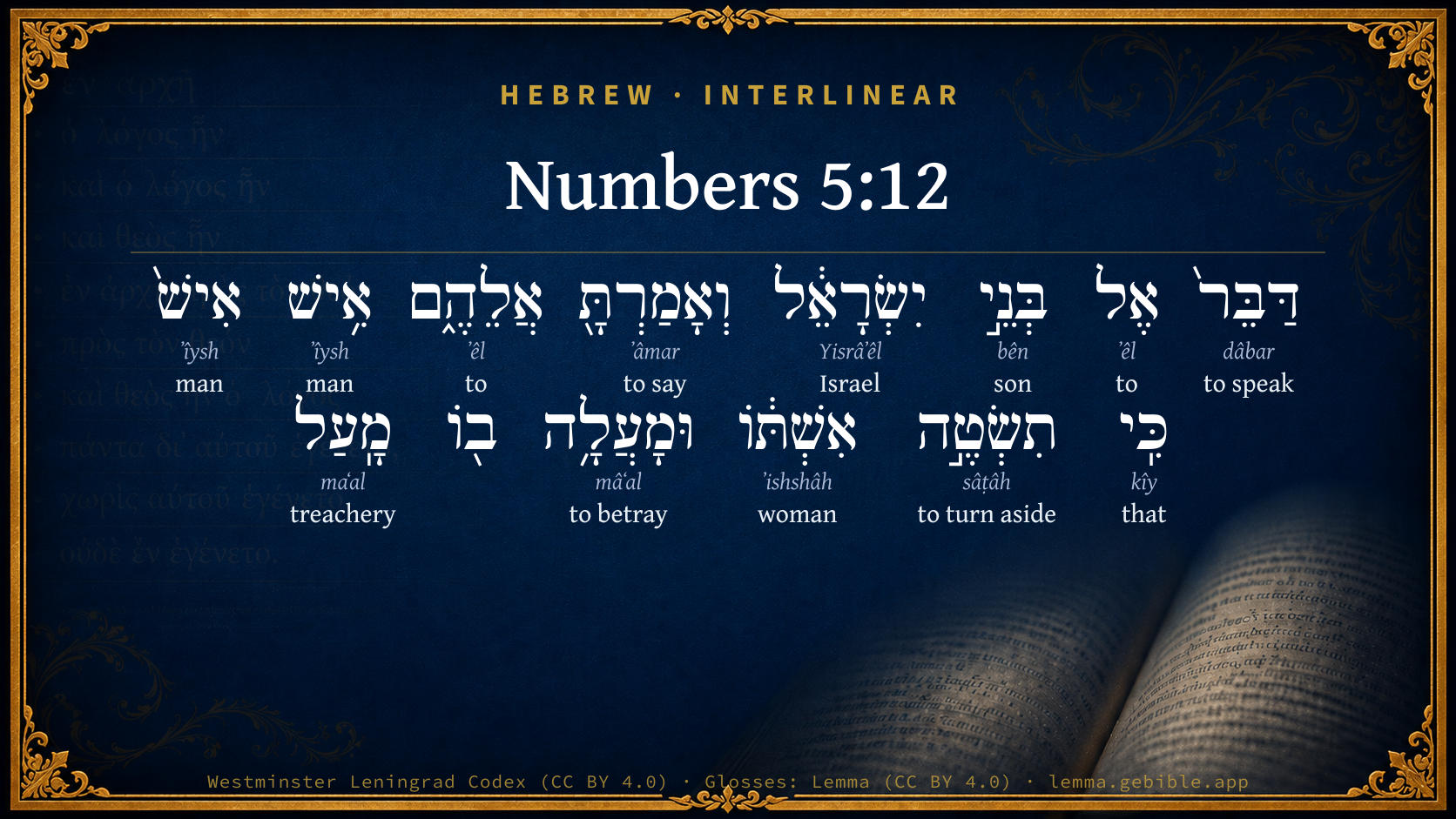
  1. דַּבֵּר֙ dâbar H1696 “speak” Verb, Piel, Imperative, 2nd Person, Masculine, Singular
  2. אֶל ʼêl H413 “to” Preposition
  3. בְּנֵ֣י bên H1121 “sons of” Noun, Common, Masculine, Plural, Construct
  4. יִשְׂרָאֵ֔ל Yisrâʼêl H3478 “Israel” Noun, Proper
  5. וְאָמַרְתָּ֖ ʼâmar H559 “and · to say” Conjunction + Verb, Qal, Sequential Perfect, 2nd Person, Masculine, Singular
  6. אֲלֵהֶ֑ם ʼêl H413 “to · them” Preposition + Suffix, Personal, 3rd Person, Masculine, Plural
  7. אִ֥ישׁ ʼîysh H376 “man” Noun, Common, Masculine, Singular, Absolute
  8. אִישׁ֙ ʼîysh H376 “man” Noun, Common, Masculine, Singular, Absolute
  9. כִּֽי kîy H3588 “that” Conjunction
  10. אִשְׁתּ֔וֹ ʼishshâh H802 “woman · his” Noun, Common, Feminine, Singular, Construct + Suffix, Personal, 3rd Person, Masculine, Singular
  11. וּמָעֲלָ֥ה mâʻal H4603 “and · to betray” Conjunction + Verb, Qal, Sequential Perfect, 3rd Person, Feminine, Singular
  12. מָֽעַל maʻal H4604 “treachery” Noun, Common, Masculine, Singular, Absolute

About this verse

These counts appear in no published source. They are computed here, from the morphology-tagged text and Lemma’s own curated glosses. What Lemma adds →

14
words
11
distinct lemmas
Pentateuch
section

Notable vocabulary

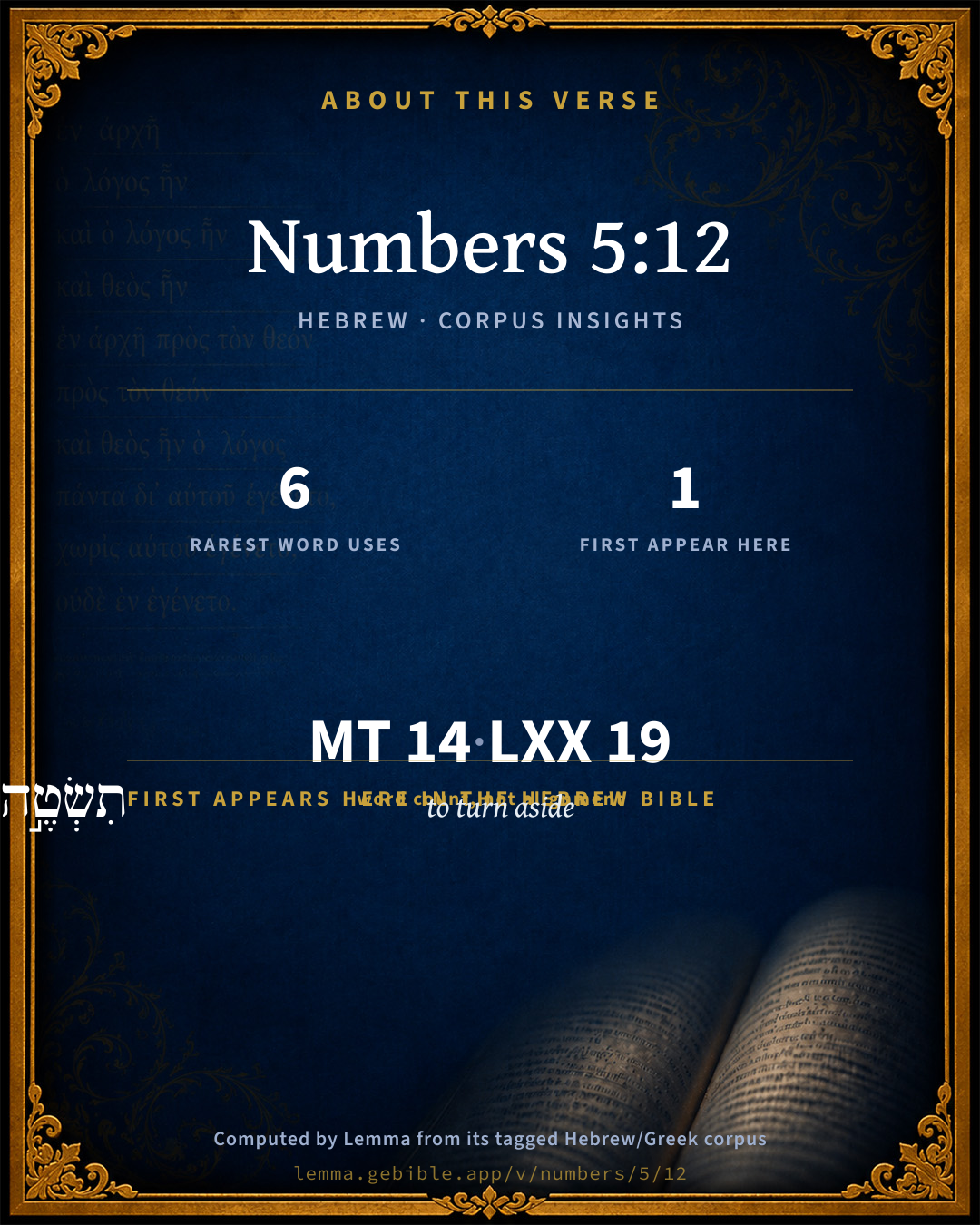
The rarest word here is תִשְׂטֶ֣ה to turn aside H7847 — appearing just 6 times in the whole Hebrew Bible.

First appearance in Scripture

This word makes its first canonical appearance in the Hebrew Bible here:

  • תִשְׂטֶ֣ה to turn aside H7847

Shared distinctive vocabulary

תִשְׂטֶ֣ה to turn aside H7847 occurs in 6 verses of the Hebrew Bible. Also found in:

Grammatical profile

  • 4 verbs
  • 6 nouns
  • 3 prepositions
  • 1 conjunction

Verb forms

  • דַּבֵּר֙ Piel · Imperative
  • וְאָמַרְתָּ֖ Qal · Sequential Perfect
  • תִשְׂטֶ֣ה Qal · Imperfect
  • וּמָעֲלָ֥ה Qal · Sequential Perfect

Repetition

Words recur within this verse — often emphatic in Hebrew:

  • אִ֥ישׁ man H376 ×2
  • אֶל to H413 ×2

Hebrew & Septuagint length

In English translation the verse runs 20 words from the Hebrew and 23 from the Septuagint (LXX English) — closely comparable.

A rough comparison of the two English renderings, which tokenize alike — not a word-level alignment.

Word counts can differ between the Hebrew and the Greek without any difference in meaning — e.g. the Hebrew direct-object marker אֵת has no separate Greek word, and Greek often adds the article ὁ.

In the original languages it is 14 Hebrew tokens and 19 Greek tokens — but the two are counted differently (Hebrew bundles its prefixes and suffixes into one token; the Greek is in lemma form), so that isn’t a like-for-like length.

Cross-references

2

Topical passages linked to Numbers 5:12 in the Treasury of Scripture Knowledge — connected by theme and wording, ordered by reader-vote popularity; previews shown in the World English Bible.

  • Numbers 5:19–20 The priest shall cause her to swear, and shall tell the woman, 'If no man has lain with you, and if you haven't gone aside to uncleanness, being under your husband, be free from this water of bitterness that brings a curse.
  • Proverbs 2:16–17 To deliver you from the strange woman, Even from the foreigner who flatters with her words;

Cross-references courtesy of OpenBible.info (CC BY 4.0).

Hebrew and Greek witnesses Masoretic Hebrew ↔ Greek Septuagint

The same verse in the two great witnesses to the Old Testament, shown verse-for-verse.

These are two independent witnesses, not word-aligned to each other, and the Septuagint is shown in lemma (dictionary) form.

Hebrew Numbers 5:12 Masoretic · Westminster Leningrad Codex

דַּבֵּר֙ אֶל בְּנֵ֣י יִשְׂרָאֵ֔ל וְאָמַרְתָּ֖ אֲלֵהֶ֑ם אִ֥ישׁ אִישׁ֙ כִּֽי תִשְׂטֶ֣ה אִשְׁתּ֔וֹ וּמָעֲלָ֥ה ב֖וֹ מָֽעַל

"Speak to the children of Israel, and tell them: If any man's wife goes astray, and is unfaithful to him,

World English Bible · Public Domain

Greek LXX Numbers 5:12 Septuagint · lemma form

λαλέω ὁ υἱός ἰσραήλ καί εἶπον πρός αὐτός ἀνήρ ἀνήρ ἐάν παραβαίνω ὁ γυνή αὐτός καί παραὁράω αὐτός ὑπερὁράω

Speak to the children of Israel, and you shall say to them, Whosesoever wife shall transgress against him, and slight and despise him,

LXX2012 (modern English Septuagint) · Public Domain

Hebrew: Westminster Leningrad Codex (CC BY 4.0). Greek: Septuagint (public domain); English from LXX2012 (modern English Septuagint) (Public Domain). How the Septuagint differs from the Hebrew →

Targum (Aramaic paraphrase)

2

The Targum is the ancient Jewish Aramaic paraphrase of the Hebrew Scriptures — an interpretive translation, not the Hebrew text itself. Onkelos (literal) and Pseudo-Jonathan (expansive) render the Torah, and Jonathan the Prophets. Coverage is partial: where no permissively-licensed English translation exists for a verse, only the Aramaic is shown. This is verse-level text, not a word-by-word alignment to the Hebrew.

  1. Targum Onkelos Torah (Genesis–Deuteronomy)
    מַלֵל עִם בְּנֵי יִשְׂרָאֵל וְתֵימַר לְהוֹן גְבַר גְבַר אֲרֵי תִסְטֵי אִתְּתֵהּ וּתְשַׁקֵר בֵּהּ שְׁקָר

    (no public-domain English translation for this verse)

    Targum Onkelos — Aramaic: “Onkelos Genesis” (public domain); “Onkelos Exodus” (public domain); “Onkelos Leviticus” (public domain); “Onkelos Numbers” (public domain); “Onkelos Deuteronomy” (public domain). English: “Sefaria Community Translation” (CC0 1.0 (public-domain dedication)); “J.W. Etheridge. The Targums of Onkelos and Jonathan Ben Uzziel on the Pentateuch. London: Longmans, Green, 1862” (public domain). Text via Sefaria.

  2. Targum Pseudo-Jonathan Torah (Genesis–Deuteronomy)
    מַלֵיל עִם בְּנֵי יִשְרָאֵל וְתֵימַר לְהוֹן גְבַר גְבַר אֲרוּם תִסְטֵי אִנְתְּתֵיהּ וּתְשַׁקֵר בֵּיהּ שְׁקָר

    Speak with the sons of Israel, and say to them: If the wife of any man go astray and commit wrongness against him,

    Targum Pseudo-Jonathan — Aramaic: “Targum Jonathan on Genesis” (public domain); “Targum Jonathan on Exodus” (public domain); “Targum Jonathan on Leviticus” (public domain); “Targum Jonathan on Numbers” (public domain); “Targum Jonathan on Deuteronomy” (public domain). English: “The Targum of Jonathan ben Uzziel, trans. J. W. Etheridge, London, 1862” (public domain). Text via Sefaria.

Commentary

Notes on Numbers 5:12 from classic Christian and Jewish commentators (each source and its license shown beneath its notes). The classic Christian expositions comment on the surrounding passage and are grouped to its opening verse, so a note may address several verses; the Jewish commentaries on the Tanakh (Rashi and others) are per-verse, so they appear only where the commentator wrote on this verse.

Lemma curates 59 commentaries, every one of them public domain or Creative Commons licensed, each selected and text-cleaned for this edition rather than reprinted as found. About our sources →

Trapp's Complete Commentary

John Trapp

Num 5:12 Speak unto the children of Israel, and say unto them, If any man’s wife go aside, and commit a trespass against him,

Ver. 12. If any man’s wife go aside.] Ad alterum, vel ad alterius torum; unde dicitur adulterium. If, as a naughty woman, she want one, when she hath her own. But how naughty are the Lithuanians, who give way to their wives to have their gallants, if Maginus belie them not, and call such connubii adiutores, prizing them far above all their acquaintances!

John Trapp, A Commentary or Exposition upon All the Books of the Old and New Testament (1647–1656) — public domain. Text from a community e-Sword module.

Joseph Benson's Commentary

Num 5:12. If a man’s wife go aside — From the way of piety and virtue, and that either in truth or in her husband’s opinion. This law was given partly to deter wives from adulterous practices, and partly to secure them against the rage of their hard-hearted husbands, who otherwise might, upon mere suspicion, have effected their destruction, or at least put them away. There was not the like fear of inconveniences to husbands from the jealousy of their wives, who had not that authority and power, and opportunity for the putting away or killing their husbands, which the husbands had with respect to their wives.

Joseph Benson's Commentary on the Old and New Testaments (1811–1818) — public domain. Text from a community e-Sword module.

Geneva Bible (1599)

Geneva Bible translators

By breaking the band of marriage, and playing the harlot.

Geneva Bible (1599) marginal notes — public domain. Text via Bolls.life.

Jamieson, Fausset & Brown

Robert Jamieson, A. R. Fausset & David Brown

THE TRIAL OF JEALOUSY. (Num. 5:11-31)

if any man's wife go aside, and commit a trespass against him--This law was given both as a strong discouragement to conjugal infidelity on the part of a wife, and a sufficient protection of her from the consequences of a hasty and groundless suspicion on the part of the husband. His suspicions, however, were sufficient in the absence of witnesses (Lev 20:10) to warrant the trial described; and the course of proceeding to be followed was for the jealous husband to bring his wife unto the priest with an offering of barley meal, because none were allowed to approach the sanctuary empty handed (Exo 23:15). On other occasions, there were mingled with the offering, oil which signified joy, and frankincense which denoted acceptance (Psa 141:2). But on the occasion referred to, both these ingredients were to be excluded, partly because it was a solemn appeal to God in distressing circumstances, and partly because it was a sin offering on the part of the wife, who came before God in the character of a real or suspected offender.

Jamieson, Fausset & Brown — Commentary Critical and Explanatory on the Whole Bible (1871) — public domain (CC PDM 1.0). Text via the HelloAO Bible API.

John Gill's Exposition

Speak unto the children of Israel, and say unto them,.... It being an affair which concerned them:

if any man's wife go aside, and commit a trespass against him; the sin of adultery, which is a going aside out of the way of virtue and chastity, and a trespass against an husband, a breach of the marriage covenant with him, a defiling his bed, doing an injury and dishonour to him, bringing confusion into his family, and a spurious offspring to possess his substance: though this is to be understood, not of certain adultery, of which there is plain and full proof, for then there would be no occasion of such a trial, as is afterwards directed to; besides, her husband, in such a case, might put her away, and even, according to the law, she was to be put to death, Lev 20:10; but of her having committed it in the opinion of her husband, he having some ground of suspicion, though he could not be certain of it; and therefore, by this law, was allowed to make trial, that he might find it out, it at present only a suspected case, and a doubtful one; and the Jews (k) say,"they never gave the waters drink but in a doubtful case:''and so this may interpreted of her declining and departing from her husband's house, not keeping at home to mind the affairs of her family, but gadding abroad, and keeping company with another man, or other men; and that after she had been warned and charged by her husband to the contrary, and so had disobeyed him, and acted contrary to his will; and in that sense had committed a trespass, and so had given him suspicion of her unchastity, for which he might have some reason; if, as it is said in the Misnah (l), he gave her an admonition before two witnesses, saying, have no talk with such a man, and yet she talks with him; or, as the commentators add (m), be not secretly or in private with such an one, and yet goes into a private place with him, and stays so long with him that she may be defiled; this with them rendered her suspected.

(k) Bemidbar Rabba, sect. 9. fol. 195. 2. (l) Sotah, c. 1. sect. 1, 2. (m) Maimon. & Bartenora in Misn. Bava Kama, c. 9. sect. 11.

John Gill's Exposition of the Whole Bible (1746–1763) — public domain (CC PDM 1.0). Text via the HelloAO Bible API.

Matthew Poole's English Annotations

This law was given partly to deter wives from adulterous practices, and partly to secure wives against the rage of their hard-hearted husbands, who otherwise might upon mere suspicions destroy them, or at least put them away.

Quest. Why was there not the same law for the trial of the husband, when the wife was jealous of him?

Answ. This might be either,

1. Because the woman’s sin is greater, because there is not only filthiness and falseness in it, which is also in the man’s sin, but also peculiar unrighteousness in dishonouring his name and family, and transferring his estate to strangers and other men’s children. Or,

2. Because there was not like fear of inconveniences to the husband from the jealousy of the wife, who had not that authority, and power, and opportunity for the putting away or killing of the husband as the husband had over the wive. Or,

3. Because being the inferior and the weaker sex, and more subject to jealousies and groundless suspicions, it was not thought expedient to trust them with such a power or privilege.

Go aside, from the way of religion and justice, or from her faith given to her husband, or to the by-paths of falsehood and filthiness, and that either in truth, or in appearance, and in her husband’s opinion.

Matthew Poole's English Annotations on the Holy Bible (1683–1685) — public domain. Text from a community e-Sword/MySword module.

Whedon's Commentary on the Bible

Daniel D. Whedon

12-14. If… wife go aside — Be faithless to her marriage vow.

No witness — If the crime could be proven by witnesses the adulteress was to be put to death. Lev_18:20; Lev_20:10.

Taken with the manner — This means taken in the very act, as in Joh_8:4. The Authorized Version very properly puts all these words in italics except taken, for they are not in the Hebrew. The phrase comes from an old English law term long obsolete, implying taken with the evidence of guilt fresh upon him: thus a thief was said to be taken with the mainor (Latin, in manu) when he was caught with the thing stolen upon his person, that is, in his hand.

The spirit of jealousy come upon him — This form of expression would indicate that the affection did not arise within the heart, but came upon the man as an objective force. But jealousy cannot be a personality, though it may be inspired by the evil spirit. We prefer to view the phrase as a Hebraism for the strong and vehement feeling of jealousy, which frequently gains as complete a mastery over the mind as did the demons in the time of Christ. The study of Shakspeare’s impersonations of jealousy will justify the Hebrew strength of expression.

Daniel D. Whedon (gen. ed.), Commentary on the Old and New Testaments (1874–1909) — public domain. Text from a community e-Sword module.

The Pulpit Commentary

If any man"s wife... commit a trespass against him. The adultery of the wife is here regarded only from a social point of view; the injury to the husband, the destruction of his peace of mind, even by the bare suspicion, and the consequent troubling of Israel, is the thing dwelt upon. The punishment of adultery as a sin had been already prescribed. (Lev_20:10)

The Pulpit Commentary (1880–1919), ed. H.D.M. Spence-Jones & Joseph S. Exell — public domain. Text from a community e-Sword module.

John Wesley's Explanatory Notes

If a man's wife - This law was given partly to deter wives from adulterous practices, and partly to secure wives against the rage of their hard-hearted husbands, who otherwise might upon mere suspicions destroy them, or at least put them away. There was not like fear of inconveniences to the husband from the jealousy, of the wife, who had not that authority and power, and opportunity for the putting away or killing the husband, as the husband had over the wife. Go aside - From the way of religion and justice, and that either in truth, or in her husband's opinion.

John Wesley, Explanatory Notes Upon the Whole Bible (1754–1765) — public domain. Text via the GEBible commentary corpus.

Rashi

Rabbi Shlomo Yitzchaki (Rashi)

איש איש כי תשטה אשתו IF ANY MAN’S WIFE GO ASIDE [AND ACT DECEITFULLY AGAINST HIM] — What is stated above, immediately before this section? ואיש את קדשיו לו יהיו: If you withhold the gifts due to the priest (cf. Rashi on v. 10), by your life, you will have to come to him in order to bring him your faithless wife for the ordeal by the waters (Berakhot 63a). (The translation therefore is: “A man who remains with his holy things, not giving them to the priest, לו יהיו they — the man and his wife — will become subject to him [require his services])”.

איש איש — The double expression איש איש is employed to teach you that she (the faithless wife) deals treacherously in two respects — against Him above Who bears the appelation of איש, as in the text "[the Lord is] a Man of the war” (Exodus 15:3), and against her husband (אישה) here below (Midrash Tanchuma, Vaetchanan 5).

כי תשטה — Our Rabbis have taught (Midrash Tanchuma, Nasso 5): “Adulterers do never sin until a spirit of madness enters into them”, as it written, of her כי תשטה “if she becomes mad” (taking תִשְׂטֶה in the sense of תִשְׂטֶה, i.e. to become a שׁוֹטֶה, and so, too, of him Scripture writes, (Proverbs 6:32) “Whoso committeth adultery with a woman lacketh understanding”. — But the plain sense of the verse is that כי תשטה means: if she deviates from the path of modesty and thereby becomes suspect in his eyes. The word is similar to, (Proverbs 4:15) “turn away (שְׂטֵה) from it, and pass by”; (Proverbs 7:25) “Let not your heart turn (יַשְׂטְ) to her ways”.

ומעלה בו מעל AND SHE ACTS UNFAITHFULLY AGAINST HIM — Wherein consists this infidelity? ושכב איש אתה THAT A MAN LIETH WITH HER.

Rashi on the Tanakh — English translations: “The Judaica Press complete Tanach with Rashi, translated by A. J. Rosenberg” (CC BY 4.0); “Pentateuch with Rashi's commentary by M. Rosenbaum and A.M. Silbermann, 1929-1934” (public domain); “The Metsudah Tanach series, Lakewood, N.J” (CC BY 4.0); and “The Book of Joshua, Metsudah Publications, 1997” (CC BY 4.0). Text via Sefaria.

Lesson kit

Teaching starters — assembled from the data on this page, not authored interpretation. Every prompt links to the verse data it draws on. Edit before teaching.

Numbers, in the Pentateuch, opens this verse with 14 words (11 distinct Hebrew lemmas). Its most distinctive word is sâṭâh (“to turn aside”). A historical commentator’s framing appears above. Read the whole chapter for the surrounding context.

Discussion questions

  1. How does “to turn aside” (sâṭâh) shape what this verse is saying?
  2. The word “to turn aside” first appears here in Scripture. What is being introduced at this debut?
  3. Numbers 5:19 shares the word «to turn aside» with this verse. How do the two illuminate each other?
  4. “man” occurs 2× in this one verse. What is the effect of the repetition?
  5. These translations render this verse differently. What is at stake in choosing one wording over another?
  6. The verb «דַּבֵּר֙» is Piel Imperative. How does its form color the action?
  7. Reading how Trapp's Complete Commentary and Joseph Benson's Commentary read this verse, where do the two commentators agree and where do they part?

Things to notice

Reading settings

Reading text

Shown beneath each verse's original-language words.

Old Testament
Old Testament edition

Read the OT as the Masoretic Hebrew (MT) or the Greek Septuagint (LXX).

English shown for the Greek Septuagint (in the Hebrew ↔ Greek comparison).

Comparing translations? Open the Compare panel on any verse page to stack up to four side by side.