
1 Kings 7:20

Hebrew (Westminster Leningrad Codex) 1 Kings 7:20 appears in the Hebrew Old Testament. The text above is from the Westminster Leningrad Codex. Each word links to its Strong’s number, a concise gloss, and parsing drawn from the Open Scriptures Hebrew Bible morphology. Click any word for its full Brown-Driver-Briggs (BDB) entry.
Download image
Cite this verse

1 Kings 7:20 (World English Bible). Public Domain. Lemma interlinear Bible study tool, https://lemma.gebible.app/v/1-kings/7/20.

Show BibTeX & RIS
BibTeX
RIS
English Translation
There were capitals above also on the two pillars, close by the belly which was beside the network: and the pomegranates were two hundred, in rows round about on the other capital.
World English Bible · Public Domain
Download a study sheet

One document with this verse’s original text, its word-by-word gloss line, the meaning frame, cross-references with their text, attributed commentary, and full source and license credits — printable, and it pastes into notes with its structure intact.

This verse Autodidact and up

Study sheet (.html) Plain text (.txt)

A passage Seminary Student

Up to 50 verses in one chapter. A passage sheet keeps up to 6 commentary sources and 12 cross-references per verse, in the order this page ranks them, and says so on the sheet whenever that leaves anything out. Ask for a single verse and you get the Autodidact verse sheet above.

Everything on this page stays free to read, with no account — the sheet is a download of what is already on screen, not access to it.

Want to remove ads? Support Godless Engineer
Compare translations 3

The same verse in 3 English versions, stacked beneath the original-language interlinear above. Click any original word for its lexicon entry.

Each is an independent rendering of the whole verse — the interlinear is not word-aligned to these translations.

Highlighted words mark where these versions differ — a whole-verse word diff, not a word-by-word alignment.

  • World English Bible Public Domain
    There were capitals above also on the two pillars, close by the belly which was beside the network: and the pomegranates were two hundred, in rows round about on the other capital.
  • King James Version Public Domain
    And the chapiters upon the two pillars had pomegranates also above, over against the belly which was by the network: and the pomegranates were two hundred in rows round about upon the other chapiter.
  • unfoldingWord Literal Text CC BY-SA 4.0
    And the capitals on the two pillars also from above, from near the belly that was on the other side of the network, and the pomegranates 200, rows all around on the second capital.

unfoldingWord Literal Text — © unfoldingWord, licensed CC BY-SA 4.0. Word-aligned USFM3 via Door43 (git.door43.org/unfoldingWord/en_ult).

Versions to compare (up to 4)

3 of 4 selected

Show all 18 translations

Every available English version of this verse, each an independent rendering of the whole verse.

  • World English Bible Public Domain
    There were capitals above also on the two pillars, close by the belly which was beside the network: and the pomegranates were two hundred, in rows round about on the other capital.
  • Berean Standard Bible Public Domain
    On the capitals of both pillars, just above the rounded projection next to the network, were the two hundred pomegranates in rows encircling each capital.
  • Majority Standard Bible Public Domain
    On the capitals of both pillars, just above the rounded projection next to the network, were the two hundred pomegranates in rows encircling each capital.
  • King James Version Public Domain
    And the chapiters upon the two pillars had pomegranates also above, over against the belly which was by the network: and the pomegranates were two hundred in rows round about upon the other chapiter.
  • American Standard Version (1901) Public Domain
    And there were capitals above also upon the two pillars, close by the belly which was beside the network: and the pomegranates were two hundred, in rows round about upon the other capital.
  • Revised Version (1885) Public Domain
    And there were chapiters above also upon the two pillars, close by the belly which was beside the network: and the pomegranates were two hundred, in rows round about upon the other chapiter.
  • Geneva Bible (1599) Public Domain
    And the chapiters vpon the two pillars had also aboue, ouer against the belly within the networke pomegranates: for two hudreth pomegranates were in the two rankes about vpon either of the chapiters.
  • Douay-Rheims (1899) Public Domain
    And again other chapiters in the top of the pillars above, according to the measure of the pillar over against the network: and of pomegranates there were two hundred in rows round about the other chapiter.
  • Young's Literal Translation Public Domain
    and the chapiters on the two pillars also above, over-against the protuberance that `is' beside the net; and the pomegranates `are' two hundred, in rows round about on the second chapiter.
  • Literal Standard Version CC BY-SA 4.0
    and the chapiters on the two pillars also [have pomegranates] above, close by the protuberance that [is] beside the net; and the pomegranates [are] two hundred, in rows around on the second capital.
  • Unlocked Literal Bible CC BY-SA 4.0
    The capitals on these two pillars also included, close to their very top, two hundred pomegranates in rows all around.
  • unfoldingWord Literal Text CC BY-SA 4.0
    And the capitals on the two pillars also from above, from near the belly that was on the other side of the network, and the pomegranates 200, rows all around on the second capital.
  • Darby Bible Public Domain
    And the capitals upon the two pillars, above also, close to the enlargement which was behind the network, had two hundred pomegranates in rows round about, [also] on the other capital.
  • World Messianic Bible Public Domain
    There were capitals above also on the two pillars, close by the belly which was beside the network. There were two hundred pomegranates in rows around the other capital.
  • Webster's Bible Public Domain
    And the capitals upon the two pillars had pomegranates also above, over against the belly which was by the net-work: and the pomegranates were two hundred in rows around upon the other capital.
  • Free Bible Version CC BY-SA 4.0
    On the capitals of both columns were the two hundred pomegranates in rows that encircled them, just above the rounded part that was next to the chain network.
  • Bible in Basic English Public Domain
    And there were crowns on the two pillars near the round part by the network, and there were two hundred apples in lines round every crown.
  • JPS Tanakh (1917) Public Domain
    And there were capitals above also upon the two pillars, close by the belly which was beside the network; and the pomegranates were two hundred, in rows round about upon each capital.

Literal Standard Version (2020), Covenant Press — licensed CC BY-SA 4.0. Text via the HelloAO Bible API (eBible.org). Unlocked Literal Bible (unfoldingWord) — licensed CC BY-SA 4.0. Text via the HelloAO Bible API (eBible.org). unfoldingWord Literal Text — © unfoldingWord, licensed CC BY-SA 4.0. Word-aligned USFM3 via Door43 (git.door43.org/unfoldingWord/en_ult). Free Bible Version, Dr. Jonathan Gallagher — licensed CC BY-SA 4.0. Text via the HelloAO Bible API (eBible.org).

Word by word

More ways to search: Search by grammar → Find every occurrence → Compare this word →

Practice this passage: Drill this verse → Learn its vocabulary →

שבכה
sᵉbâkâh
H7639
“network”
Noun, Common, Feminine, Singular, Absolute
Part of Speech
Noun
Type
Common
Gender
Feminine
Number
Singular
State
Absolute
Full BDB Definition

Origin: from H7638

TWOT: 2230b

network, lattice-work, net, netting - lattice - net-ornament (on pillars) - network, toils (for catching animals)
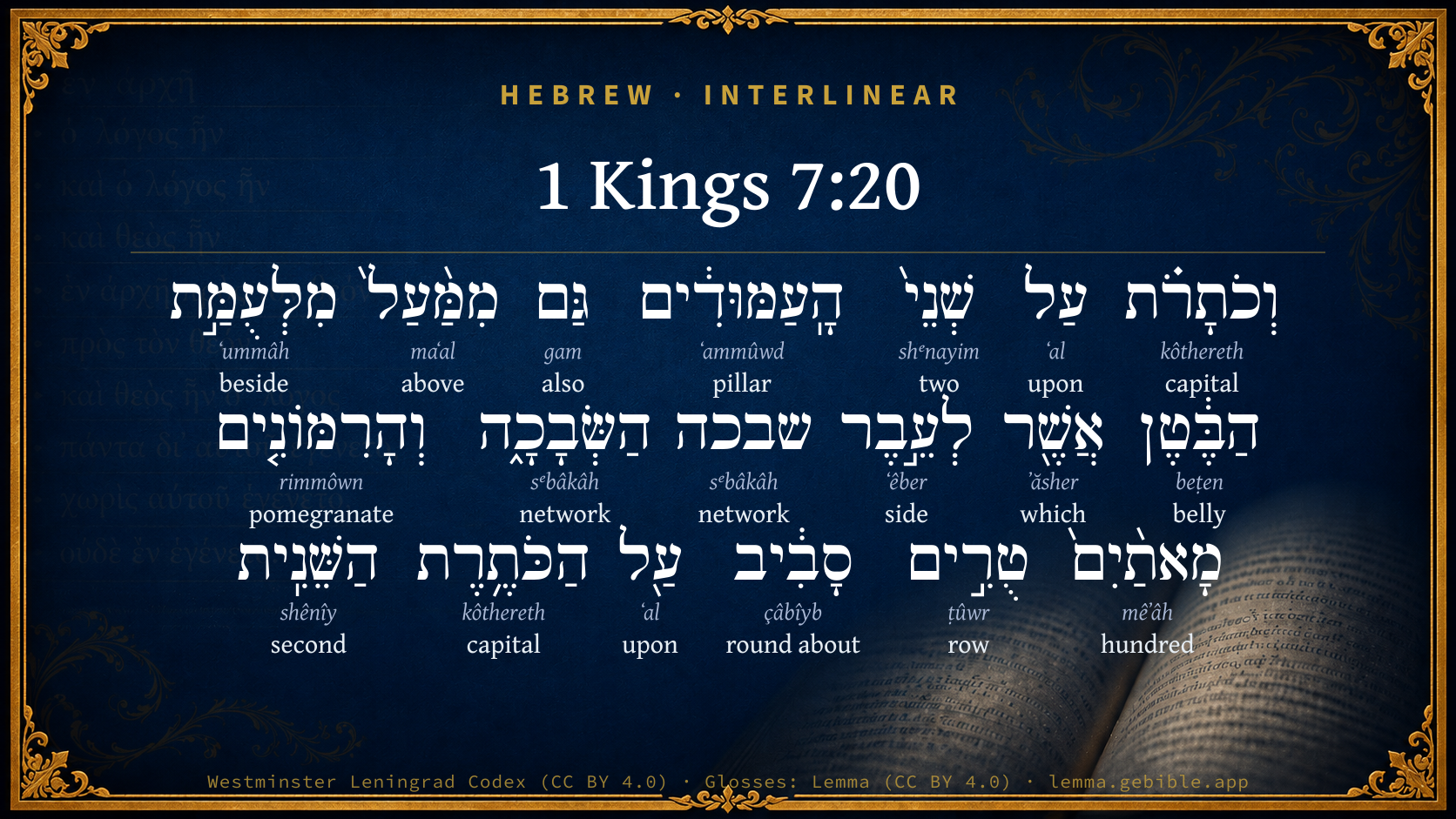
  1. וְכֹתָרֹ֗ת kôthereth H3805 “and · capitals” Conjunction + Noun, Common, Feminine, Plural, Absolute
  2. עַל ʻal H5921 “upon” Preposition
  3. שְׁנֵי֙ shᵉnayim H8147 “two” Adjective, Cardinal number, Masculine, Dual, Construct
  4. הָֽעַמּוּדִ֔ים ʻammûwd H5982 “the · pillars” Particle, Definite Article + Noun, Common, Masculine, Plural, Absolute
  5. גַּם gam H1571 “also” Particle, Accusative
  6. מִמַּ֨עַל֙ maʻal H4605 “from · above” Preposition + Adverb
  7. מִלְּעֻמַּ֣ת ʻummâh H5980 “from · to/for · beside of” Preposition + Preposition + Noun, Common, Feminine, Singular, Construct
  8. הַבֶּ֔טֶן beṭen H990 “the · belly” Particle, Definite Article + Noun, Common, Feminine, Singular, Absolute
  9. אֲשֶׁ֖ר ʼăsher H834 “which” Particle, Relative
  10. לְעֵ֣בֶר ʻêber H5676 “to/for · side of” Preposition + Noun, Common, Masculine, Singular, Construct
  11. הַשְּׂבָכָ֑ה sᵉbâkâh H7639 “the · network” Particle, Definite Article + Noun, Common, Feminine, Singular, Absolute
  12. וְהָרִמּוֹנִ֤ים rimmôwn H7416 “and · the · pomegranates” Conjunction + Particle, Definite Article + Noun, Common, Masculine, Plural, Absolute
  13. מָאתַ֨יִם֙ mêʼâh H3967 “hundred” Adjective, Cardinal number, Both, Dual, Absolute
  14. טֻרִ֣ים ṭûwr H2905 “rows” Noun, Common, Masculine, Plural, Absolute
  15. סָבִ֔יב çâbîyb H5439 “round about” Noun, Common, Both, Singular, Absolute
  16. עַ֖ל ʻal H5921 “upon” Preposition
  17. הַכֹּתֶ֥רֶת kôthereth H3805 “the · capital” Particle, Definite Article + Noun, Common, Feminine, Singular, Absolute
  18. הַשֵּׁנִֽית shênîy H8145 “the · second” Particle, Definite Article + Adjective, Ordinal number, Feminine, Singular, Absolute

About this verse

These counts appear in no published source. They are computed here, from the morphology-tagged text and Lemma’s own curated glosses. What Lemma adds →

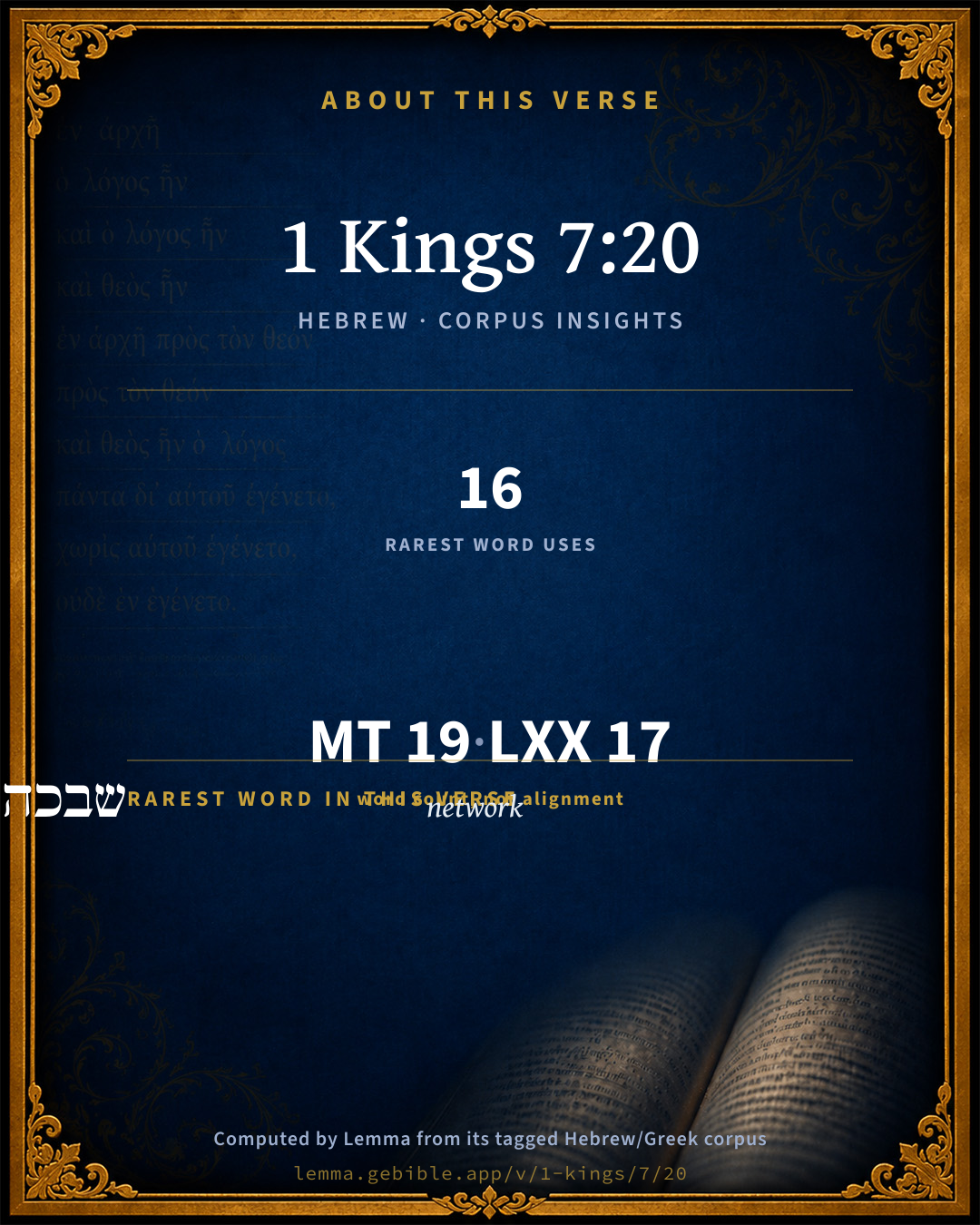
19
words
16
distinct lemmas
Historical
section

Notable vocabulary

The rarest word here is שבכה network H7639 — appearing just 16 times in the whole Hebrew Bible.

Shared distinctive vocabulary

שבכה network H7639 occurs in 12 verses of the Hebrew Bible. Also found in:

Grammatical profile

  • 11 nouns
  • 3 adjectives
  • 2 prepositions
  • 1 adverb
  • 2 particles

Repetition

Words recur within this verse — often emphatic in Hebrew:

  • וְכֹתָרֹ֗ת capital H3805 ×2
  • עַל upon H5921 ×2
  • שבכה network H7639 ×2

Hebrew & Septuagint length

In English translation the verse runs 32 words from the Hebrew and 19 from the Septuagint (LXX English) — the Septuagint runs noticeably shorter here. See the side-by-side →

A rough comparison of the two English renderings, which tokenize alike — not a word-level alignment.

Word counts can differ between the Hebrew and the Greek without any difference in meaning — e.g. the Hebrew direct-object marker אֵת has no separate Greek word, and Greek often adds the article ὁ.

In the original languages it is 19 Hebrew tokens and 17 Greek tokens — but the two are counted differently (Hebrew bundles its prefixes and suffixes into one token; the Greek is in lemma form), so that isn’t a like-for-like length.

Cross-references

5

Topical passages linked to 1 Kings 7:20 in the Treasury of Scripture Knowledge — connected by theme and wording, ordered by reader-vote popularity; previews shown in the World English Bible.

  • 2 Chronicles 3:16 He made chains in the oracle, and put [them] on the tops of the pillars; and he made one hundred pomegranates, and put them on the chains.
  • 2 Chronicles 4:13 and the four hundred pomegranates for the two networks; two rows of pomegranates for each network, to cover the two bowls of the capitals that were on the pillars.
  • 1 Kings 7:42 and the four hundred pomegranates for the two networks; two rows of pomegranates for each network, to cover the two bowls of the capitals that were on the pillars;
  • 2 Kings 25:17 The height of the one pillar was eighteen cubits, and a capital of brass was on it; and the height of the capital was three cubits, with network and pomegranates on the capital round about, all of brass: and like to these had the second pillar with network.
  • Jeremiah 52:22–23 A capital of brass was on it; and the height of the one capital was five cubits, with network and pomegranates on the capital round about, all of brass: and the second pillar also had like these, and pomegranates.

Cross-references courtesy of OpenBible.info (CC BY 4.0).

Hebrew and Greek witnesses Masoretic Hebrew ↔ Greek Septuagint

The same verse in the two great witnesses to the Old Testament, shown verse-for-verse.

Here the Septuagint runs noticeably shorter than the Hebrew — LXX2012 (modern English Septuagint) 19 words vs World English Bible 32. A rough length comparison of the two English translations, not a word-level alignment — read both below.

These are two independent witnesses, not word-aligned to each other, and the Septuagint is shown in lemma (dictionary) form.

Hebrew 1 Kings 7:20 Masoretic · Westminster Leningrad Codex

וְכֹתָרֹ֗ת עַל שְׁנֵי֙ הָֽעַמּוּדִ֔ים גַּם מִמַּ֨עַל֙ מִלְּעֻמַּ֣ת הַבֶּ֔טֶן אֲשֶׁ֖ר לְעֵ֣בֶר שבכה הַשְּׂבָכָ֑ה וְהָרִמּוֹנִ֤ים מָאתַ֨יִם֙ טֻרִ֣ים סָבִ֔יב עַ֖ל הַכֹּתֶ֥רֶת הַשֵּׁנִֽית

There were capitals above also on the two pillars, close by the belly which was beside the network: and the pomegranates were two hundred, in rows round about on the other capital.

World English Bible · Public Domain

Greek LXX 1 Kings 7:20 Septuagint · lemma form

ὁ τέσσαρες ὠμία ἐπί ὁ τέσσαρες γωνία ὁ μεχωνωθ ὁ εἷς ἐκ ὁ μεχωνωθ ὁ ὤμοι αὐτός

and a chamber over both the pillars, and above the sides an addition equal to the chamber in width.

LXX2012 (modern English Septuagint) · Public Domain

On this verse, Haydock's Catholic Bible Commentary discusses the Septuagint’s reading. Read the note in Commentary ↓

Hebrew: Westminster Leningrad Codex (CC BY 4.0). Greek: Septuagint (public domain); English from LXX2012 (modern English Septuagint) (Public Domain). How the Septuagint differs from the Hebrew →

Targum (Aramaic paraphrase)

1

The Targum is the ancient Jewish Aramaic paraphrase of the Hebrew Scriptures — an interpretive translation, not the Hebrew text itself. Onkelos (literal) and Pseudo-Jonathan (expansive) render the Torah, and Jonathan the Prophets. Coverage is partial: where no permissively-licensed English translation exists for a verse, only the Aramaic is shown. This is verse-level text, not a word-by-word alignment to the Hebrew.

  1. Targum Jonathan Prophets (Joshua–Malachi)
    וּקְרוֹנְתְּוָן עַל תְּרֵין עַמוּדַיָא אַף מִלְעֵלָא מִלְקָבֵל דִבְקָא דִי לְעִבַּר סְרִיגְתָּא וְרִמוֹנַיָא מָאתָן סִדְרִין עֲבִידִין לֵיהּ סְחוֹר סְחוֹר עַל קְרוֹנְתָּא תִנְיָתָא:

    (no public-domain English translation for this verse)

    Targum Jonathan — Aramaic: “Mikraot Gedolot” (public domain). English: “Sefaria Community Translation” (CC0 1.0 (public-domain dedication)); “London "Chaldee Paraphrase," 1871” (public domain). Text via Sefaria.

Commentary

Notes on 1 Kings 7:20 from classic Christian and Jewish commentators (each source and its license shown beneath its notes). The classic Christian expositions comment on the surrounding passage and are grouped to its opening verse, so a note may address several verses; the Jewish commentaries on the Tanakh (Rashi and others) are per-verse, so they appear only where the commentator wrote on this verse.

Lemma curates 59 commentaries, every one of them public domain or Creative Commons licensed, each selected and text-cleaned for this edition rather than reprinted as found. About our sources →

Trapp's Complete Commentary

John Trapp

1Ki 7:20 And the chapiters upon the two pillars [had pomegranates] also above, over against the belly which [was] by the network: and the pomegranates [were] two hundred in rows round about upon the other chapiter.

Ver. 20. And the pomegranates were two hundred.] On each side a hundred, hanging down front the rows or borders upon the networks, which yet they hid not. {2Ch 3:16 Jer 52:23} This might signify the strengthening of our faith by the two sacraments, unto holiness and fruitfulness in good works; but especially by Christ, who is a double pillar unto his Church.

John Trapp, A Commentary or Exposition upon All the Books of the Old and New Testament (1647–1656) — public domain. Text from a community e-Sword module.

Joseph Benson's Commentary

1Ki 7:20. Over against the belly — So he calls the middle part of the chapiter, which jetted farthest out. The pomegranates were two hundred — They are said to be ninety and six on the side of a pillar, in one row, and in all a hundred, (Jer 52:23,) four pomegranates between the several checker-works being added to the first ninety-six. And it must needs be granted that there were as many on the other side of the pillar, or in the other row, which makes them two hundred upon a pillar, as is here said, and four hundred upon both pillars, as they are numbered, 2Ch 4:13.

Joseph Benson's Commentary on the Old and New Testaments (1811–1818) — public domain. Text from a community e-Sword module.

Geneva Bible (1599)

Geneva Bible translators

Or, round about the midst.

Or, bound.

Hebrew, the second.

Geneva Bible (1599) marginal notes — public domain. Text via Bolls.life.

Ellicott's Commentary for English Readers

(20) Over against (or rather, close to) the belly which was by the network.—The “belly” here (like the “bowls” or “globes” of the chapiters in 1Ki_7:41-42) seems to signify the rounded form of the capital, where it comes down to join the shaft. At this junction the bands of pomegranate ornament ran round the shaft. In this verse it is obvious that there is an omission in the text. It should be, “were two hundred in rows round about the one chapiter, and two hundred in rows round about the other chapiter.” Hence the “four hundred” of 1Ki_7:42 and 2Ch_4:13.

A Bible Commentary for English Readers, edited by Charles John Ellicott (1878–1897) — public domain. Text from a community e-Sword module.

The Cambridge Bible for Schools and Colleges

gen. ed. J. J. S. Perowne

20. And the chapiters upon the two pillars had pomegranates also above] The italics are without justification. The R.V. gives the sense; ‘And there were chapiters also above upon the two pillars.’ What is now being described is that portion of the capital which was below the lily work. But the writer uses ‘chapiter’ for the part, as well as for the whole capital.

over against the belly which was by the network] R.V. close by the belly which was beside the network.’ The prepositions make the difficulty here. The first has something of the idea of ‘all along’ and describes the way in which the pomegranates went close up to the bellying portion of the capital. Probably the two rows ran round the pillar, one just above, the other just below the enlarged part. Then the network appears to have been over the belly. The preposition intimates that if you could have looked from the woodwork, the metal nets and chains were just in front of you. So that in the ‘beside’ of the R.V. we must understand the notion of overlying.

two hundred, in rows] As we have taken 1Ki_7:18 the rows were two for each capital, so that 100 pomegranates were in each row. Apparently in 2Ch_3:16 the number specified is only for one single row. In the parallel passage of Jeremiah (Jer_52:23) this appears more clearly. For the pomegranates are said to have been arranged one at each of the four cardinal points and the other 96 used to complete the circuit. This can only be a description of a single row.

round about upon the other chapiter] Here there is the same sort of omission, be it intentional or not, as in 1Ki_7:15. What is meant, we should express by ‘round about (upon the one chapiter as) upon the other chapiter.’

The Cambridge Bible for Schools and Colleges (gen. ed. J. J. S. Perowne; Cambridge University Press, 1878–1918) — public domain. Text from a community e-Sword module.

John Gill's Exposition

And he set up the pillars in the porch of the temple,.... Not at the door or entrance into the temple, as Jarchi, but at the entrance into the porch:

and he set up the right pillar; or the pillar on the right hand as you went in, which was on the north, the front being east:

and called the name thereof Jachin; which signifies "he will establish", i.e. the house to which here was an entrance, so long as the pure worship of God should continue in it:

and he set up the left pillar; or the pillar on the left hand, which was to the south, unless the position of them was as you come out:

and called the name thereof Boaz; which signifies "in him", or "it is strength", namely, in the Lord that dwelt there; for this has no respect to Boaz, a prince of the house of Judah, from whom all its kings sprung, as the Targum, in Ch2 3:17 suggests. These names were given them not by Hiram the artificer, but by Solomon, and which were very expressive; not so much of the nobility of the kingdom of the house of David, as the Targum intimates; or of the church of God, the pillar and ground of truth; as of Christ himself, and the two natures in him, and of his royal dignity, signified by the crowns or chapiters on them, decorated as they were, whose legs are as pillars of marble, and in whom are righteousness and strength; which is no small encouragement to those who are entering into the church of God the temple was a type of; who, should they fear, being feeble and weak, that they should totter and fall, here stands Jachin, to let them know the Lord will establish and settle them; or that they should never hold out to the end, here is Boaz to direct them to Christ, in whom their strength lies, see Sol 4:15. Allusion is had to these, Rev 3:12.

John Gill's Exposition of the Whole Bible (1746–1763) — public domain (CC PDM 1.0). Text via the HelloAO Bible API.

Albert Barnes' Notes on the Bible

In this verse also a portion of the original text is supposed to have fallen out in consequence of the repetition of words. The full phrase of the original has been retained in 1Ki 7:16-17. It may be restored thus: “And the pomegranates were two hundred in rows round about upon the one chapiter, and two hundred in rows round about upon the other chapiter.” The “four hundred” 1Ki 7:42; 2Ch 4:13, are obtained by counting the pomegranates of both pillars together. In Jer 52:23, is an account of the arrangement of a single row of pomegranates, whereof each pillar had two.

Albert Barnes' Notes on the Bible (1834–1885) — public domain. Text from a community e-Sword/MySword module.

Haydock's Catholic Bible Commentary

Chapiter, (capitelli secundi.) (Haydock) --- Villalpand thinks this "second chapiter," is rather the cornice, round which the pomegranates hung. (Menochius) --- Septuagint, "and of roses, five rows, all round, upon the second circle." (Haydock)

George Leo Haydock (1774–1849), Haydock's Catholic Family Bible and Commentary, 1859 edition — public domain. Excludes Psalms (Douay-Rheims chapter numbering differs from Protestant) and Deuterocanonical books (Catholic canon only).

Matthew Poole's English Annotations

Over against the belly; so he calls the middle part of the chapiter, and that which jetted furthest out.

The pomegranates were two hundred: these pomegranates are variously accounted in Scriptures. They are said to be ninety and six on a side of a pillar, i.e. in one row, and in all an hundred, Jer 52:23; four great pomegranates between the several checker-works being added to the first ninety-six. And it must needs be granted that there were as many on the other side of the pillar, or in the other row, which makes them two hundred upon a pillar, as is here said, and four hundred upon both pillars, as they are numbered 2Ch 4:13.

Matthew Poole's English Annotations on the Holy Bible (1683–1685) — public domain. Text from a community e-Sword/MySword module.

Whedon's Commentary on the Bible

Daniel D. Whedon

20. Had pomegranates — There is nothing corresponding to these words in the Hebrew, and their insertion by our translators was an error. This verse is a repetitious explanation of the preceding, and defines more particularly the position of the lily work part of the capitals. It should be rendered: And the capitals upon the two pillars were also above in immediate connexion with the belly, which was beyond the network.

The belly which was by the network — That is, the oval shaped form of the capital at the place upon which the network was wrought, (literally, beyond, that is, behind the network,) called bowls in 1Ki_7:41, and pommels in 2Ch_4:13.

Two hundred in rows — Two hundred in both rows of each pillar, making four hundred for the two networks of both pillars, (1Ki_7:42; 2Ch_4:13,) and one hundred for each row or chain. 2Ch_3:16; Jer_52:23.

Daniel D. Whedon (gen. ed.), Commentary on the Old and New Testaments (1874–1909) — public domain. Text from a community e-Sword module.

The Pulpit Commentary

And the chapiters upon the two pillars had pomegranates Instead of the italics, Keil would supply Hiram made, but it is doubtful whether this is any improvement. We have already heard more than once that he made the chapiters. It is better to supply projected or were, as in the preceding verse. This verse is extremely obscure; but its design appears to be to explain how the bowl of the chapiter projected above its base also above i.e., above the neck, or lowest cubit, on which was the net and chain work, over against tMuLmi with two prefixes is a rare form the belly or "bowl (ver. 41) which was by Heb. beyond, on the other side of, i.e., as it appeared to a spectator standing below the network: and the pomegranates were two hundred in rows This agrees with the total of four hundred, as given in ver. 42, and in 2 Chronicles, and with the "hundred round about" (i.e., the number in each row) mentioned in Jer_52:23. We gather from this latter passage that ninety-six out of the hundred faced the four quarters, for this is apparently the meaning of hjWr, windwards; see Eze_42:16-18, not that the pomegranates could be "set in motion by the play of the wind," as Ewald confidently affirms. The remaining four pomegranates, of course, occupied the four corners. The necessary inference from this statement, viz., that this part of the capital was foursquare, seems to have escaped the notice of the commentators round about upon the other chapiter. Some words have evidently dropped out of the Hebrew here, as in ver. 15. The text, no doubt, originally stood "two hundred in rows round about the one chapiter, and two hundred in rows round about upon the other chapiter." There has been no intentional compression that is not the genius of the Semitic languages but an accidental omission, occasioned by the recurrence of almost identical words.

The Pulpit Commentary (1880–1919), ed. H.D.M. Spence-Jones & Joseph S. Exell — public domain. Text from a community e-Sword module.

John Wesley's Explanatory Notes

The belly - So he calls the middle part of the chapiter, which jetted farthest out. Two hundred - They are said to be ninety and six on a side of a pillar; in one row and in all an hundred, Jer. lii, 23, four great pomegranates between the several checker-works being added to the first ninety six. And it must needs be granted, that there were as many on the other side of the pillar, or in the other row, which makes them two hundred upon a pillar, as is here said, and four hundred upon both pillars, as they are numbered, 2 Chron. iv, 13.

John Wesley, Explanatory Notes Upon the Whole Bible (1754–1765) — public domain. Text via the GEBible commentary corpus.

unfoldingWord translationNotes

Door43 World Missions Community

two hundred pomegranates

"200 pomegranates." A pomegranate is a fruit with a hard, red rind and many juicy seeds inside. See how you translated this in 1 Kings 7:18 (See: Numbers)

He raised up

Huram would have commanded his workers to do this work. AT: "They raised up" (See: Metonymy)

The pillar on the right was named Jakin

This can be stated in active form. AT: "The name of the pillar on the right side was Jakin" (See: How to Translate Names and Active or Passive)

the pillar on the left was named Boaz

This can be stated in active form. AT: "The name of the pillar on the left side was Boaz" (See: Active or Passive)

The fashioning of the pillars was done

This can be stated in active form. AT: "Huram fashioned the pillars" or "Huram's men fashioned the pillars" (See: Active or Passive)

translationWords

raise

temple

unfoldingWord translationNotes — © Distant Shores Media and the Door43 World Missions Community, licensed CC BY-SA 4.0. Source: git.door43.org/Door43/en_tn.

Rashi

Rabbi Shlomo Yitzchaki (Rashi)

Above [on the two columns] opposite the belly. Which is beyond the net [mesh] work at the end of the net [mesh] work, at its rim, that is at the middle, at the place where it is connected, (upon the upper net [mesh] work) (The proper text: Because the net [mesh] work) is attached to the bowl which is beneath it.

And two hundred pomegranates. Pomegranates made in two rows around, strung together on a chain and encircling the net [mesh] work.

On each crown. This, too, is an abbreviated sentence, meaning, “On the one [crown], and likewise, on the second.”

Rashi on the Tanakh — English translations: “The Judaica Press complete Tanach with Rashi, translated by A. J. Rosenberg” (CC BY 4.0); “Pentateuch with Rashi's commentary by M. Rosenbaum and A.M. Silbermann, 1929-1934” (public domain); “The Metsudah Tanach series, Lakewood, N.J” (CC BY 4.0); and “The Book of Joshua, Metsudah Publications, 1997” (CC BY 4.0). Text via Sefaria.

Lesson kit

Teaching starters — assembled from the data on this page, not authored interpretation. Every prompt links to the verse data it draws on. Edit before teaching.

1 Kings, in the Historical, opens this verse with 19 words (16 distinct Hebrew lemmas). Its most distinctive word is sᵉbâkâh (“network”). The Greek Septuagint runs shorter here. A historical commentator’s framing appears above. Read the whole chapter for the surrounding context.

Discussion questions

  1. The word sᵉbâkâh carries the sense “network.” How does it shape the verse?
  2. 1 Kings 7:17 shares the word «network» with this verse. How do the two illuminate each other?
  3. “capital” occurs 2× in this one verse. What is the effect of the repetition?
  4. Compared with the Hebrew, the Septuagint runs shorter here. What questions does that raise?
  5. These translations render this verse differently. What is at stake in choosing one wording over another?
  6. Reading how Trapp's Complete Commentary and Joseph Benson's Commentary read this verse, where do the two commentators agree and where do they part?

Things to notice

Reading settings

Reading text

Shown beneath each verse's original-language words.

Old Testament
Old Testament edition

Read the OT as the Masoretic Hebrew (MT) or the Greek Septuagint (LXX).

English shown for the Greek Septuagint (in the Hebrew ↔ Greek comparison).

Comparing translations? Open the Compare panel on any verse page to stack up to four side by side.