
Psalms 78:23

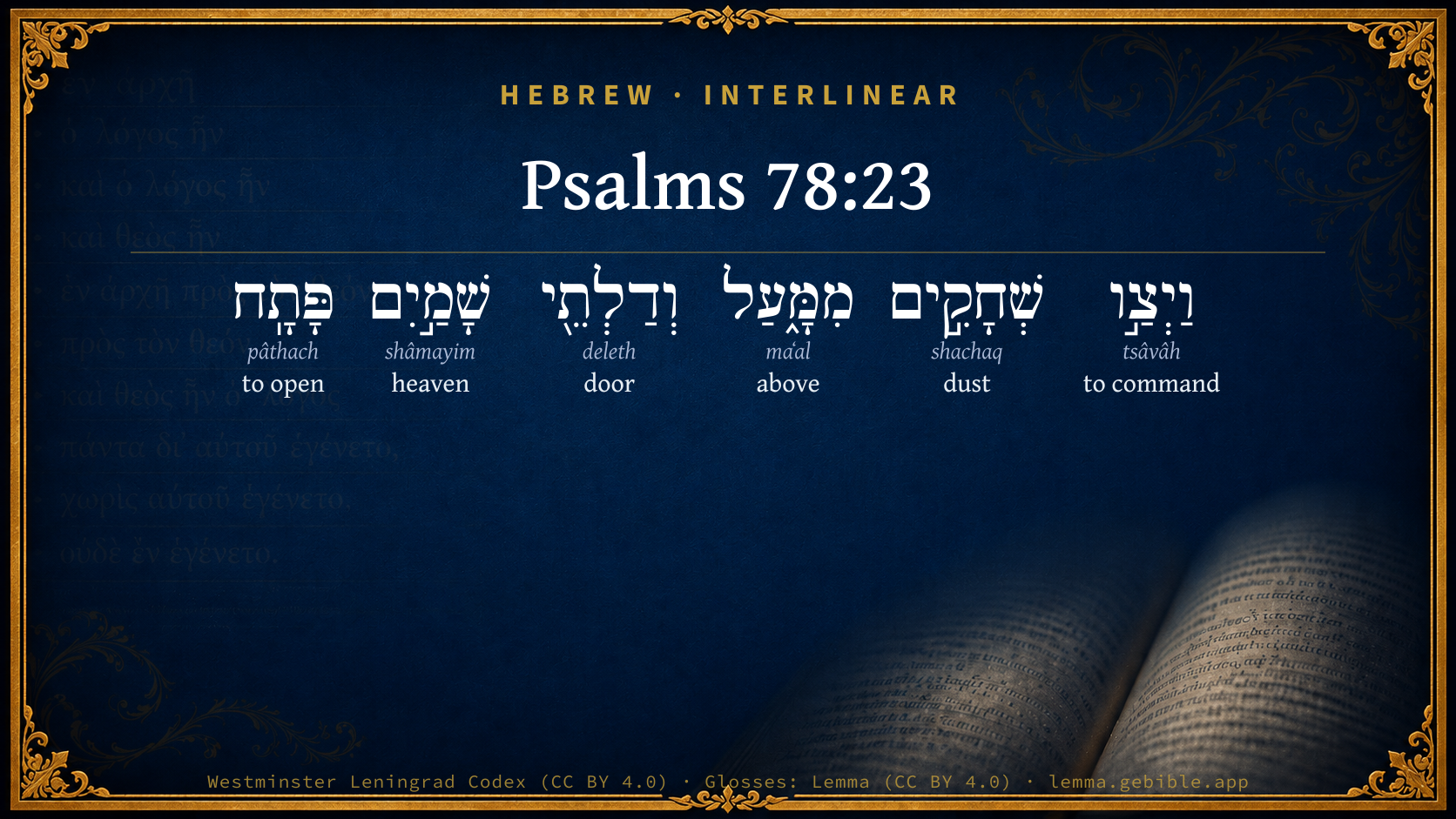
Hebrew (Westminster Leningrad Codex) Psalms 78:23 appears in the Hebrew Old Testament. The text above is from the Westminster Leningrad Codex. Each word links to its Strong’s number, a concise gloss, and parsing drawn from the Open Scriptures Hebrew Bible morphology. Click any word for its full Brown-Driver-Briggs (BDB) entry.
Download image
Cite this verse

Psalms 78:23 (World English Bible). Public Domain. Lemma interlinear Bible study tool, https://lemma.gebible.app/v/psalms/78/23.

Show BibTeX & RIS
BibTeX
RIS
English Translation
Yet he commanded the skies above, And opened the doors of heaven.
World English Bible · Public Domain
Download a study sheet

One document with this verse’s original text, its word-by-word gloss line, the meaning frame, cross-references with their text, attributed commentary, and full source and license credits — printable, and it pastes into notes with its structure intact.

This verse Autodidact and up

Study sheet (.html) Plain text (.txt)

A passage Seminary Student

Up to 50 verses in one chapter. A passage sheet keeps up to 6 commentary sources and 12 cross-references per verse, in the order this page ranks them, and says so on the sheet whenever that leaves anything out. Ask for a single verse and you get the Autodidact verse sheet above.

Everything on this page stays free to read, with no account — the sheet is a download of what is already on screen, not access to it.

Want to remove ads? Support Godless Engineer
Compare translations 3

The same verse in 3 English versions, stacked beneath the original-language interlinear above. Click any original word for its lexicon entry.

Each is an independent rendering of the whole verse — the interlinear is not word-aligned to these translations.

Highlighted words mark where these versions differ — a whole-verse word diff, not a word-by-word alignment.

  • World English Bible Public Domain
    Yet he commanded the skies above, And opened the doors of heaven.
  • King James Version Public Domain
    Though he had commanded the clouds from above, and opened the doors of heaven,
  • unfoldingWord Literal Text CC BY-SA 4.0
    Yet he commanded the clouds from above and opened the doors of the sky.

unfoldingWord Literal Text — © unfoldingWord, licensed CC BY-SA 4.0. Word-aligned USFM3 via Door43 (git.door43.org/unfoldingWord/en_ult).

Versions to compare (up to 4)

3 of 4 selected

Show all 18 translations

Every available English version of this verse, each an independent rendering of the whole verse.

  • World English Bible Public Domain
    Yet he commanded the skies above, And opened the doors of heaven.
  • Berean Standard Bible Public Domain
    Yet He commanded the clouds above and opened the doors of the heavens.
  • Majority Standard Bible Public Domain
    Yet He commanded the clouds above and opened the doors of the heavens.
  • King James Version Public Domain
    Though he had commanded the clouds from above, and opened the doors of heaven,
  • American Standard Version (1901) Public Domain
    Yet he commanded the skies above, And opened the doors of heaven;
  • Revised Version (1885) Public Domain
    Yet he commanded the skies above, and opened the doors of heaven;
  • Geneva Bible (1599) Public Domain
    Yet he had comanded the clouds aboue, and had opened the doores of heauen,
  • Douay-Rheims (1899) Public Domain
    And he had commanded the clouds from above, and had opened the doors of heaven.
  • Young's Literal Translation Public Domain
    And He commandeth clouds from above, Yea, doors of the heavens He hath opened.
  • Literal Standard Version CC BY-SA 4.0
    And He commands clouds from above, || Indeed, He has opened doors of the heavens.
  • Unlocked Literal Bible CC BY-SA 4.0
    Yet he commanded the skies above and opened the doors of the sky.
  • unfoldingWord Literal Text CC BY-SA 4.0
    Yet he commanded the clouds from above and opened the doors of the sky.
  • Darby Bible Public Domain
    Though he had commanded the clouds from above, and had opened the doors of the heavens,
  • World Messianic Bible Public Domain
    Yet he commanded the skies above, and opened the doors of heaven.
  • Webster's Bible Public Domain
    Though he had commanded the clouds from above, and opened the doors of heaven,
  • Free Bible Version CC BY-SA 4.0
    Even so he commanded the skies above and the doors of heaven to open,
  • Bible in Basic English Public Domain
    And he gave orders to the clouds on high, and the doors of heaven were open;
  • JPS Tanakh (1917) Public Domain
    And He commanded the skies above, and opened the doors of heaven;

Literal Standard Version (2020), Covenant Press — licensed CC BY-SA 4.0. Text via the HelloAO Bible API (eBible.org). Unlocked Literal Bible (unfoldingWord) — licensed CC BY-SA 4.0. Text via the HelloAO Bible API (eBible.org). unfoldingWord Literal Text — © unfoldingWord, licensed CC BY-SA 4.0. Word-aligned USFM3 via Door43 (git.door43.org/unfoldingWord/en_ult). Free Bible Version, Dr. Jonathan Gallagher — licensed CC BY-SA 4.0. Text via the HelloAO Bible API (eBible.org).

Word by word

More ways to search: Search by grammar → Find every occurrence → Compare this word →

Practice this passage: Drill this verse → Learn its vocabulary →

About this verse

These counts appear in no published source. They are computed here, from the morphology-tagged text and Lemma’s own curated glosses. What Lemma adds →

6
words
6
distinct lemmas
Wisdom
section

Notable vocabulary

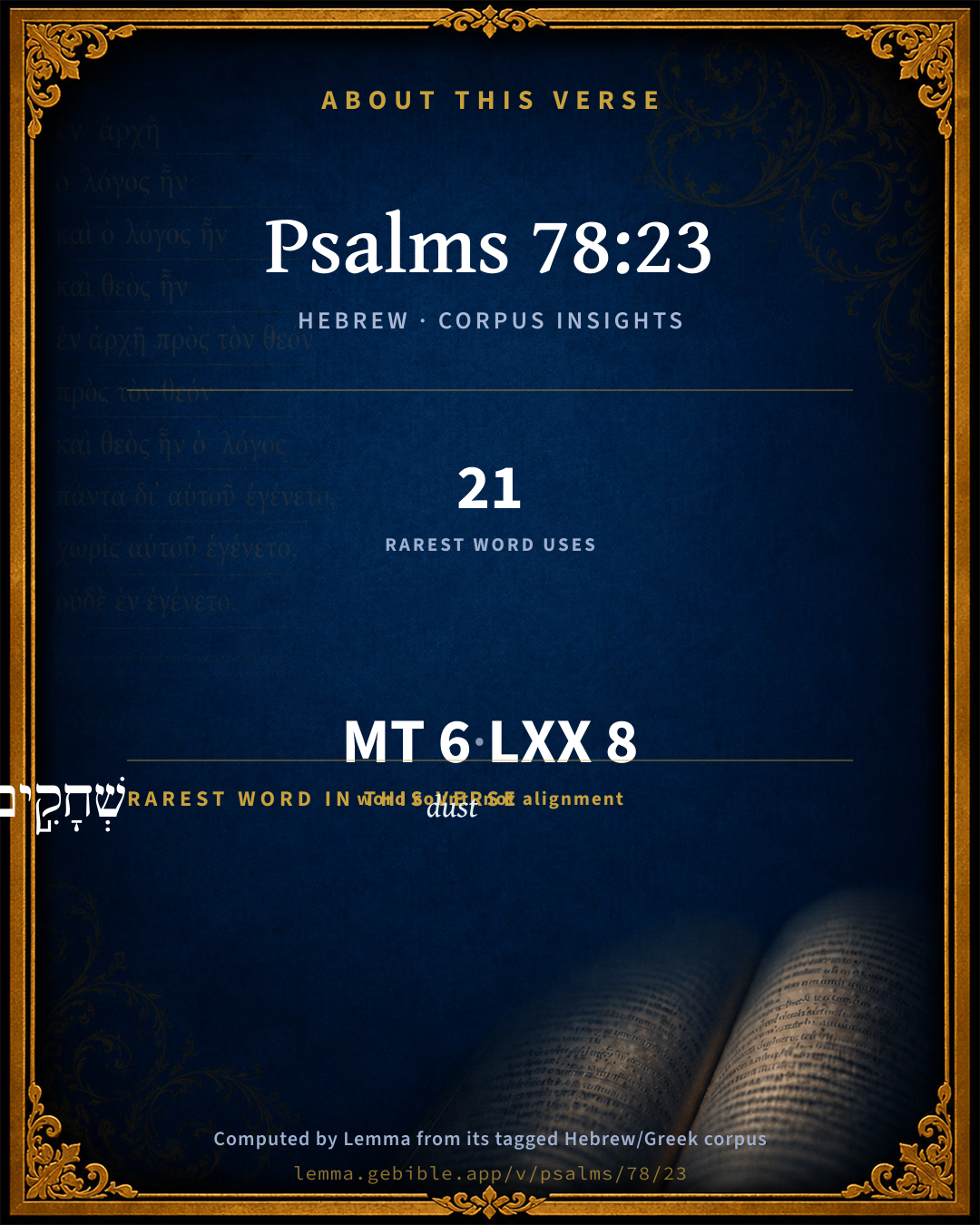
The rarest word here is שְׁחָקִ֣ים dust H7834 — appearing just 21 times in the whole Hebrew Bible.

Shared distinctive vocabulary

שְׁחָקִ֣ים dust H7834 occurs in 21 verses of the Hebrew Bible. Also found in:

Grammatical profile

  • 2 verbs
  • 3 nouns
  • 1 adverb

Verb forms

  • וַיְצַ֣ו Piel · Sequential Imperfect
  • פָּתָֽח Qal · Perfect

Hebrew & Septuagint length

In English translation the verse runs 12 words from the Hebrew and 13 from the Septuagint (LXX English) — closely comparable.

A rough comparison of the two English renderings, which tokenize alike — not a word-level alignment.

Word counts can differ between the Hebrew and the Greek without any difference in meaning — e.g. the Hebrew direct-object marker אֵת has no separate Greek word, and Greek often adds the article ὁ.

In the original languages it is 6 Hebrew tokens and 8 Greek tokens — but the two are counted differently (Hebrew bundles its prefixes and suffixes into one token; the Greek is in lemma form), so that isn’t a like-for-like length.

Cross-references

6

Topical passages linked to Psalms 78:23 in the Treasury of Scripture Knowledge — connected by theme and wording, ordered by reader-vote popularity; previews shown in the World English Bible.

  • Genesis 7:11 In the six hundredth year of Noah's life, in the second month, on the seventeenth day of the month, on the same day all the fountains of the great deep were burst open, and the sky's windows were opened.
  • Malachi 3:10 Bring the whole tithe into the store-house, that there may be food in my house, and test me now in this," says Yahweh of hosts, "if I will not open you the windows of heaven, and pour you out a blessing, that there shall not be room enough for.
  • 2 Kings 7:19 and that captain answered the man of God, and said, Now, behold, if Yahweh should make windows in heaven, might such a thing be? and he said, Behold, you shall see it with your eyes, but shall not eat of it:
  • Psalms 33:9 For he spoke, and it was done. He commanded, and it stood firm.
  • 2 Kings 7:2 Then the captain on whose hand the king leaned answered the man of God, and said, Behold, if Yahweh should make windows in heaven, might this thing be? He said, Behold, you shall see it with your eyes, but shall not eat of it.
  • Isaiah 5:6 I will lay it a wasteland. It won't be pruned nor hoed, But it will grow briers and thorns. I will also command the clouds that they rain no rain on it."

Cross-references courtesy of OpenBible.info (CC BY 4.0).

Hebrew and Greek witnesses Masoretic Hebrew ↔ Greek Septuagint

The same verse in the two great witnesses to the Old Testament, shown verse-for-verse.

You’re reading Greek Psalm 77 (Hebrew Psalm 78). The Septuagint counts the superscription, so verse numbers can differ from the Hebrew — chapter-level alignment, not verse-by-verse. Numbering follows Rahlfs.

These are two independent witnesses, not word-aligned to each other, and the Septuagint is shown in lemma (dictionary) form.

Hebrew Psalms 78:23 Masoretic · Westminster Leningrad Codex

וַיְצַ֣ו שְׁחָקִ֣ים מִמָּ֑עַל וְדַלְתֵ֖י שָׁמַ֣יִם פָּתָֽח

Yet he commanded the skies above, And opened the doors of heaven.

World English Bible · Public Domain

Greek LXX Greek Psalm 77:23 Septuagint · lemma form

καί ἐντέλλομαι νεφέλη ὑπεράνωθεν καί θύρα οὐρανός ἀναοἴγω

Yet he commanded the clouds from above, and opened the doors of heaven,

LXX2012 (modern English Septuagint) · Public Domain

Hebrew: Westminster Leningrad Codex (CC BY 4.0). Greek: Septuagint (public domain); English from LXX2012 (modern English Septuagint) (Public Domain). How the Septuagint differs from the Hebrew →

Commentary

Notes on Psalms 78:23 from classic Christian and Jewish commentators (each source and its license shown beneath its notes). The classic Christian expositions comment on the surrounding passage and are grouped to its opening verse, so a note may address several verses; the Jewish commentaries on the Tanakh (Rashi and others) are per-verse, so they appear only where the commentator wrote on this verse.

Lemma curates 59 commentaries, every one of them public domain or Creative Commons licensed, each selected and text-cleaned for this edition rather than reprinted as found. About our sources →

Trapp's Complete Commentary

John Trapp

Psa 78:23 Though he had commanded the clouds from above, and opened the doors of heaven,

Ver. 23. Though he had commanded the clouds] Though he had served them as never prince was served in his greatest state, yet all served not turn.

And opened the doors of heaven] Rupturas nubium, raining down upon them plenty of manna; so that it was not hunger, but humour, that set them a lusting.

John Trapp, A Commentary or Exposition upon All the Books of the Old and New Testament (1647–1656) — public domain. Text from a community e-Sword module.

Joseph Benson's Commentary

Psa 78:23-24. Though he commanded the clouds, &c. — It was a great aggravation of their unbelief and distrust, that they had had great experience of his power and goodness to them. For he had given them undeniable proofs of both, and those not only from earth beneath, but from the heaven above, having commanded the clouds, as one that had given being to, and created them, to serve him and his people, and supply their wants. Ordinarily by their showers they contribute to the earth’s producing corn; but now, when God so commanded them, they showered down corn themselves, which is therefore called here the corn of heaven. And opened the doors of heaven — In these words he compares heaven to a granary, or store-house, whereof God keeps the key, and either shuts or opens the doors of it, either gives or withholds provisions, as he sees fit.

Joseph Benson's Commentary on the Old and New Testaments (1811–1818) — public domain. Text from a community e-Sword module.

J. A. Alexander on Psalms

Joseph Addison Alexander

23. (Psa 78:23) And he commanded the cloud above, and the doors of heaven he opened. The connection of the sentences is correctly although freely given in the common version, though he had commanded, etc. Above, literally from above, but see on Psa 1:4. The whole verse expresses the idea of a copious supply from heaven . In the last clause there seems to be a reference to the opening of the windows of heaven at the deluge. Compare Gen 7:11, and see above on Psa 78:15.

Joseph Addison Alexander, The Psalms Translated and Explained (1850) — public domain. Text from a community e-Sword module.

Tyndale Open Study Notes

Tyndale Open Resources

78:23-25 Abundance comes through the doors of heaven (Gen 8:2; 2 Kgs 7:2; Mal 3:10). • Israel ate manna for forty years in the wilderness (Exod 16:31-36; John 6:31).

Tyndale Open Study Notes — © Tyndale Open Resources, licensed CC BY-SA 4.0. Text via the HelloAO Bible API.

Geneva Bible (1599)

Geneva Bible translators

So that they had that, which was necessary and sufficient: but their lust made them to covet that which they knew God had denied them.

Geneva Bible (1599) marginal notes — public domain. Text via Bolls.life.

John Calvin's Commentaries

23. But he had commanded the clouds from above. It is a mistake to suppose that this miracle is related merely in the way of history. The prophet rather censures the Israelites the more severely from the consideration, that although fed to the full with manna, they ceased not to lust after the dainties which they knew God had denied them. It was the basest ingratitude to scorn and reject the heavenly food, which, so to speak, associated them with angels. Were a man who dwells in France or Italy to grieve and fret that he has not the bread of Egypt to eat, nor the wine of Asia to drink, would he not make war against God and nature, after the manner of the giants of old? Much less excusable was the inordinate lust of the Israelites, whom God not only furnished with earthly provision in rich abundance, but to whom he also gave the bread of heaven for their support. Had they even endured hunger for a lengthened period, propriety and duty would have required them to ask food with more humility. Had they been supplied with only bran and chaff to eat, it would have been their bounden duty to have acknowledged that in the place where they were — in the wilderness — this was no ordinary boon of Heaven. Had only coarse bread been granted them, they would have had sufficient reason for thanksgiving. But how much stronger were their obligations to God, when he created a new kind of food, with which, by stretching out, as it were, his hand from heaven, he supplied them richly and in great abundance? This is the reason why the manna is called corn of heaven, and bread of the mighty Some explain the Hebrew word אבירים, abbirim, as denoting the heavens, an opinion which I do not altogether reject. I, however, prefer taking it for angels, as it is understood by the Chaldee interpreter, and some others who have followed him. The miracle is celebrated in high terms, to present the impiety of the people in a more detestable light; for it was a much more striking display of divine power for manna to be rained down from heaven, than if they had been fed either with herbs or fruits, or with other increase of the earth. Paul, in 1 Corinthians 10:3, calls the manna spiritual meat, in a different sense — because it was a figure and symbol of Christ. But here the design of the prophet is to reprove the twofold ingratitude of the people, who despised not only the common food which was produced from the ground, but also the bread of angels. Some have translated the verbs in the past tense, He commanded the clouds — he opened the doors of heaven — he rained down manna, etc But to remove all ambiguity, I have thought it preferable to translate the verbs in the preterpluperfect tense, He had commanded, he had opened, he had rained, to enable my readers the better to understand that the prophet does not here simply relate this history, but recalls it to remembrance for another purpose, as a thing which happened long ago.

John Calvin's Commentaries (1540-1563) — public domain. Text from the Calvin Translation Society English edition (1840s-50s) via the Christian Classics Ethereal Library (ccel.org). Calvin's coverage is partial (roughly two-thirds of the Bible); uncommented books and verses are honest gaps, never fabricated. The 19th-century editor's footnotes and remarks are omitted so the notes are faithfully Calvin's own voice.

The Cambridge Bible for Schools and Colleges

gen. ed. J. J. S. Perowne

23. Yet he commanded the skies above,

And opened the doors of heaven;

The Cambridge Bible for Schools and Colleges (gen. ed. J. J. S. Perowne; Cambridge University Press, 1878–1918) — public domain. Text from a community e-Sword module.

John Gill's Exposition

And had rained down manna upon them to eat,.... So called, either from "manah", which signifies to prepare, appoint, and distribute, because this was food prepared of God for the Israelites without them, and was their provision, their appointed portion, and which was daily distributed to them in measure; or from the words , "man hu", what is it? which they used at first sight of the manna, they not knowing what it was, and hence called it "man"; or "manna"; this the Lord rained down from heaven, as he promised he would, that they might have food to eat; see Exo 16:4.

and had given them of the corn of heaven; bread corn springs out of the earth, but this was corn from heaven, very unusual and wonderful; this greatly aggravated the unbelief of the Israelites, and shows their great ingratitude, that after all this they should disbelieve the Lord, and not trust in his salvation; the manna was a type of Christ, who is called the hidden manna, Co1 10:3; see Gill on Joh 6:32.

John Gill's Exposition of the Whole Bible (1746–1763) — public domain (CC PDM 1.0). Text via the HelloAO Bible API.

Albert Barnes' Notes on the Bible

Though he had commanded the clouds from above - Though he had showed that he had absolute control over the clouds, and had only to command them and they would furnish rain in abundance. Compare the notes at Isa 5:6.

And opened the doors of heaven - As he had done at the deluge, Gen 7:11. The idea is, that he had rained down manna upon them in such abundance that it might be compared with the waters that had been sent down at the deluge.

Albert Barnes' Notes on the Bible (1834–1885) — public domain. Text from a community e-Sword/MySword module.

Matthew Poole's English Annotations

Which he compares to a granary or store-house, where God keeps the key, and either shuts or opens the doors it, either gives or withholds provisions, as he sees fit.

Matthew Poole's English Annotations on the Holy Bible (1683–1685) — public domain. Text from a community e-Sword/MySword module.

The Treasury of David

Charles H. Spurgeon

Ver. 23. Though he had commanded the clouds from above. Such a marvel ought to have rendered unbelief impossible: when clouds become granaries, seeing should be believing, and doubts should dissolve.

And opened the doors of heaven. The great storehouse doors were set wide open, and the corn of heaven poured out in heaps. Those who would not believe in such a case were hardened indeed; and yet our own position is very similar, for the Lord has wrought for us great deliverances, quite as memorable and undeniable, and yet suspicions and forebodings haunt us. He might have shut the gates of hell upon us, instead of which he has opened the doors of heaven; shall we not both believe in him and magnify him for this?

Ver. 23. Opened the doors of heaven. There is an allusion here to the flood, as in Ps 78:15. A. R. Fausset.

Ver. 23. Opened the doors of heaven. God, who has the key of the clouds, opened the doors of heaven, that is more than opening the windows, which yet is spoken of as a great blessing, Mal 3:19. Matthew Henry.

Ver. 23. Opened the doors of heaven. This is a metaphor taken from a granary, from which corn is brought; and by opening the doors is signified, that the manna fell very plentifully. Compare Ge 7:11. Thomas Fenton.

None.

Psalms 78:24*

Charles H. Spurgeon's The Treasury of David (1869–1885) — public domain. Psalms only. Text from a community e-Sword/MySword module.

The Pulpit Commentary

Though he had commanded the clouds from above; rather, and he commanded (Hengstenberg, Cheyne, Revised Version). The command was subsequent, not previous, to the want of faith. (see Num_11:4-31) And opened the doors of heaven. (comp. Gen_7:11, "The windows of heaven were opened The expressions are, of course, poetical. (see also 2Ki_7:2)

The Pulpit Commentary (1880–1919), ed. H.D.M. Spence-Jones & Joseph S. Exell — public domain. Text from a community e-Sword module.

John Wesley's Explanatory Notes

Heaven - Which he compares to a store-house, whereof God shuts or opens the doors, as he sees fit.

John Wesley, Explanatory Notes Upon the Whole Bible (1754–1765) — public domain. Text via the GEBible commentary corpus.

unfoldingWord translationNotes

Door43 World Missions Community

he commanded the skies

Asaph speaks of the skies as if they were a person who could hear and obey God's commands. AT: "he spoke to the sky" (See: Personification)

skies

Possible meanings are 1) "sky" or 2) "clouds."

opened the doors of the sky

Asaph speaks of the sky as if it were a storeroom with doors. AT: "opened the sky as if it were a storeroom" (See: Metaphor)

He rained down manna for them to eat, and gave them the grain from heaven

These two lines speak of the same event.

He rained down manna

"He caused manna to fall from the sky like rain"

the bread of angels

This refers to the manna that God provided for the people. The word "bread" represents food in general. AT: "the same kind of food that angels eat" (See: Synecdoche)

food in abundance

The abstract noun "abundance" can be translated with an adjective. AT: "abundant food" or "a large amount of food" (See: Abstract Nouns)

translationWords

command

heaven

manna

grain

bread

angel

send

unfoldingWord translationNotes — © Distant Shores Media and the Door43 World Missions Community, licensed CC BY-SA 4.0. Source: git.door43.org/Door43/en_tn.

Lesson kit

Teaching starters — assembled from the data on this page, not authored interpretation. Every prompt links to the verse data it draws on. Edit before teaching.

Psalms, in the Wisdom, opens this verse with 6 words (6 distinct Hebrew lemmas). Its most distinctive word is shachaq (“dust”). A historical commentator’s framing appears above. Read the whole chapter for the surrounding context.

Discussion questions

  1. How does “dust” (shachaq) shape what this verse is saying?
  2. Deuteronomy 33:26 shares the word «dust» with this verse. How do the two illuminate each other?
  3. These translations render this verse differently; the difference is in the English rendering, not the original. What questions does that raise?
  4. The verb «וַיְצַ֣ו» is Piel Sequential Imperfect. How does its form color the action?
  5. Reading how Trapp's Complete Commentary and Joseph Benson's Commentary read this verse, where do the two commentators agree and where do they part?

Things to notice

Reading settings

Reading text

Shown beneath each verse's original-language words.

Old Testament
Old Testament edition

Read the OT as the Masoretic Hebrew (MT) or the Greek Septuagint (LXX).

English shown for the Greek Septuagint (in the Hebrew ↔ Greek comparison).

Comparing translations? Open the Compare panel on any verse page to stack up to four side by side.