Daniel 12:6

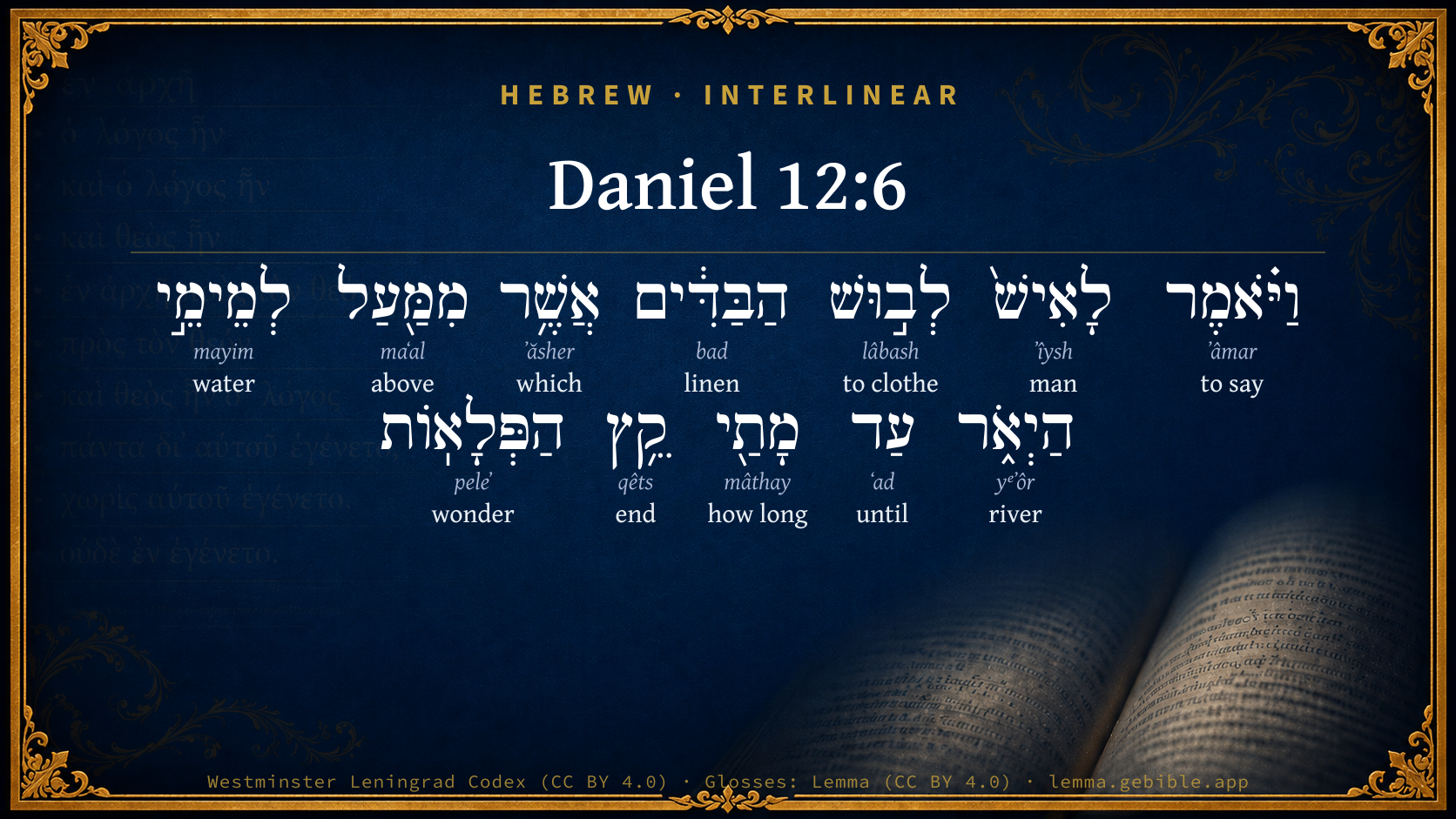
Hebrew (Westminster Leningrad Codex) Daniel 12:6 appears in the Hebrew Old Testament. The text above is from the Westminster Leningrad Codex. Each word links to its Strong’s number, a concise gloss, and parsing drawn from the Open Scriptures Hebrew Bible morphology. Click any word for its full Brown-Driver-Briggs (BDB) entry.
Download image
Cite this verse

Daniel 12:6 (World English Bible). Public Domain. Lemma interlinear Bible study tool, https://lemma.gebible.app/v/daniel/12/6.

Show BibTeX & RIS
BibTeX
RIS
English Translation
One said to the man clothed in linen, who was above the waters of the river, How long shall it be to the end of these wonders?
World English Bible · Public Domain
Download a study sheet

One document with this verse’s original text, its word-by-word gloss line, the meaning frame, cross-references with their text, attributed commentary, and full source and license credits — printable, and it pastes into notes with its structure intact.

This verse Autodidact and up

Study sheet (.html) Plain text (.txt)

A passage Seminary Student

Up to 50 verses in one chapter. A passage sheet keeps up to 6 commentary sources and 12 cross-references per verse, in the order this page ranks them, and says so on the sheet whenever that leaves anything out. Ask for a single verse and you get the Autodidact verse sheet above.

Everything on this page stays free to read, with no account — the sheet is a download of what is already on screen, not access to it.

Want to remove ads? Support Godless Engineer
Compare translations 3

The same verse in 3 English versions, stacked beneath the original-language interlinear above. Click any original word for its lexicon entry.

Each is an independent rendering of the whole verse — the interlinear is not word-aligned to these translations.

Highlighted words mark where these versions differ — a whole-verse word diff, not a word-by-word alignment.

  • World English Bible Public Domain
    One said to the man clothed in linen, who was above the waters of the river, How long shall it be to the end of these wonders?
  • King James Version Public Domain
    And one said to the man clothed in linen, which was upon the waters of the river, How long shall it be to the end of these wonders?
  • unfoldingWord Literal Text CC BY-SA 4.0
    One said to the man clothed in linen, who was above the waters of the stream, “How long will it be until the end of these wonders?”

unfoldingWord Literal Text — © unfoldingWord, licensed CC BY-SA 4.0. Word-aligned USFM3 via Door43 (git.door43.org/unfoldingWord/en_ult).

Versions to compare (up to 4)

3 of 4 selected

Show all 18 translations

Every available English version of this verse, each an independent rendering of the whole verse.

  • World English Bible Public Domain
    One said to the man clothed in linen, who was above the waters of the river, How long shall it be to the end of these wonders?
  • Berean Standard Bible Public Domain
    One of them said to the man dressed in linen, who was above the waters of the river, “How long until the fulfillment of these wonders?”
  • Majority Standard Bible Public Domain
    One of them said to the man dressed in linen, who was above the waters of the river, “How long until the fulfillment of these wonders?”
  • King James Version Public Domain
    And one said to the man clothed in linen, which was upon the waters of the river, How long shall it be to the end of these wonders?
  • American Standard Version (1901) Public Domain
    And one said to the man clothed in linen, who was above the waters of the river, How long shall it be to the end of these wonders?
  • Revised Version (1885) Public Domain
    And one said to the man clothed in linen, which was above the waters of the river, How long shall it be to the end of these wonders?
  • Geneva Bible (1599) Public Domain
    And one saide vnto the man clothed in linen, which was vpon ye waters of the riuer, When shalbe the ende of these wonders?
  • Douay-Rheims (1899) Public Domain
    And I said to the man that was clothed In linen, that stood upon the waters of the river: How long shall it be to the end of these wonders?
  • Young's Literal Translation Public Domain
    and he saith to the one clothed in linen, who `is' upon the waters of the flood, `Till when `is' the end of these wonders?'
  • Literal Standard Version CC BY-SA 4.0
    and he says to the one clothed in linen, who [is] on the waters of the flood, Until when [is] the end of these wonders?
  • Unlocked Literal Bible CC BY-SA 4.0
    One of them said to the man clothed in linen, the one who was upstream along the river, “How long will it be to the end of these amazing events?”
  • unfoldingWord Literal Text CC BY-SA 4.0
    One said to the man clothed in linen, who was above the waters of the stream, “How long will it be until the end of these wonders?”
  • Darby Bible Public Domain
    And he said to the man clothed in linen, who was above the waters of the river, How long [is it to] the end of these wonders?
  • World Messianic Bible Public Domain
    One said to the man clothed in linen, who was above the waters of the river, “How long will it be to the end of these wonders?”
  • Webster's Bible Public Domain
    And one said to the man clothed in linen, who was upon the waters of the river, How long shall it be to the end of these wonders?
  • Free Bible Version CC BY-SA 4.0
    One of them asked the man dressed in linen who was above the river's waters, “How long before these outrageous things come to an end?”
  • Bible in Basic English Public Domain
    And I said to the man clothed in linen, who was over the waters of the river, How long will it be to the end of these wonders?
  • JPS Tanakh (1917) Public Domain
    And one said to the man clothed in linen, who was above the waters of the river: 'How long shall it be to the end of the wonders?'

Literal Standard Version (2020), Covenant Press — licensed CC BY-SA 4.0. Text via the HelloAO Bible API (eBible.org). Unlocked Literal Bible (unfoldingWord) — licensed CC BY-SA 4.0. Text via the HelloAO Bible API (eBible.org). unfoldingWord Literal Text — © unfoldingWord, licensed CC BY-SA 4.0. Word-aligned USFM3 via Door43 (git.door43.org/unfoldingWord/en_ult). Free Bible Version, Dr. Jonathan Gallagher — licensed CC BY-SA 4.0. Text via the HelloAO Bible API (eBible.org).

Word by word

More ways to search: Search by grammar → Find every occurrence → Compare this word →

Practice this passage: Drill this verse → Learn its vocabulary →

הַפְּלָאֽוֹת
peleʼ
H6382
“the · wonders”
Particle, Definite Article + Noun, Common, Masculine, Plural, Absolute
Part of Speech
Particle + Noun
Type
Common
Gender
Masculine
Number
Plural
State
Absolute
Full BDB Definition

Origin: from H6381

TWOT: 1768a

wonder, marvel - wonder (extraordinary, hard to understand thing) - wonder (of God's acts of judgment and redemption)
  1. וַיֹּ֗אמֶר ʼâmar H559 “and · to say” Conjunction + Verb, Qal, Sequential Imperfect, 3rd Person, Masculine, Singular
  2. לָאִישׁ֙ ʼîysh H376 “to/for the · man” Preposition, Determined + Noun, Common, Masculine, Singular, Absolute
  3. לְב֣וּשׁ lâbash H3847 “clothed” Verb, Qal, Participle Passive, Masculine, Singular, Construct
  4. הַבַּדִּ֔ים bad H906 “the · linen” Particle, Definite Article + Noun, Common, Masculine, Plural, Absolute
  5. אֲשֶׁ֥ר ʼăsher H834 “which” Particle, Relative
  6. מִמַּ֖עַל maʻal H4605 “from · above” Preposition + Adverb
  7. לְמֵימֵ֣י mayim H4325 “to/for · water(s) of” Preposition + Noun, Common, Masculine, Plural, Construct
  8. הַיְאֹ֑ר yᵉʼôr H2975 “the · river” Particle, Definite Article + Noun, Common, Masculine, Singular, Absolute
  9. עַד ʻad H5704 “until” Preposition
  10. מָתַ֖י mâthay H4970 “how long” Particle, Interrogative
  11. קֵ֥ץ qêts H7093 “end of” Noun, Common, Masculine, Singular, Construct

About this verse

These counts appear in no published source. They are computed here, from the morphology-tagged text and Lemma’s own curated glosses. What Lemma adds →

12
words
12
distinct lemmas
Prophets
section

Notable vocabulary

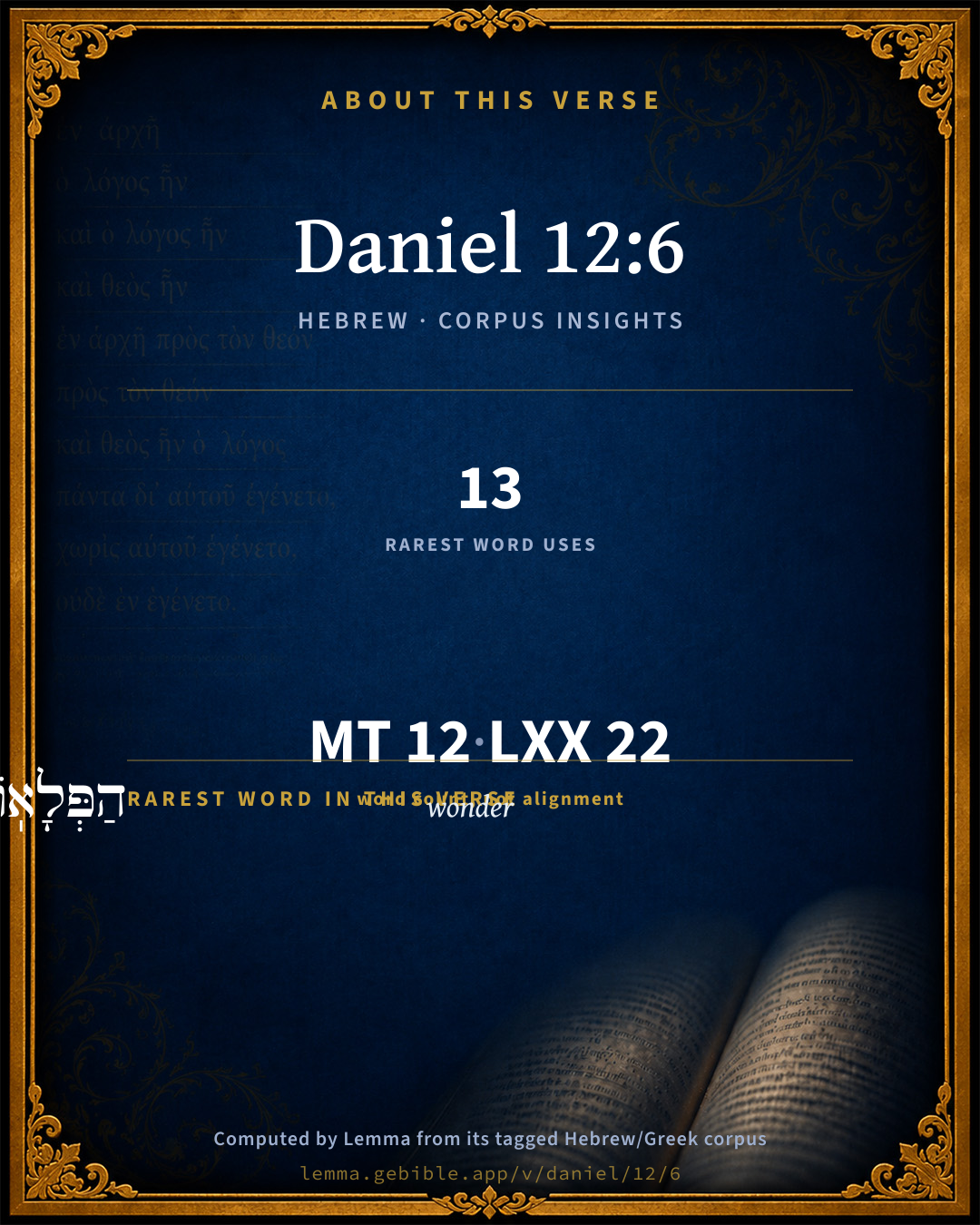
The rarest word here is הַפְּלָאֽוֹת wonder H6382 — appearing just 13 times in the whole Hebrew Bible.

Shared distinctive vocabulary

הַפְּלָאֽוֹת wonder H6382 occurs in 13 verses of the Hebrew Bible. Also found in:

Grammatical profile

  • 2 verbs
  • 6 nouns
  • 1 preposition
  • 1 adverb
  • 2 particles

Verb forms

  • וַיֹּ֗אמֶר Qal · Sequential Imperfect
  • לְב֣וּשׁ Qal · Participle Passive

Hebrew & Septuagint length

In English translation the verse runs 27 words from the Hebrew and 29 from the Septuagint (LXX English) — closely comparable.

A rough comparison of the two English renderings, which tokenize alike — not a word-level alignment.

Word counts can differ between the Hebrew and the Greek without any difference in meaning — e.g. the Hebrew direct-object marker אֵת has no separate Greek word, and Greek often adds the article ὁ.

In the original languages it is 12 Hebrew tokens and 22 Greek tokens — but the two are counted differently (Hebrew bundles its prefixes and suffixes into one token; the Greek is in lemma form), so that isn’t a like-for-like length.

Cross-references

12

Topical passages linked to Daniel 12:6 in the Treasury of Scripture Knowledge — connected by theme and wording, ordered by reader-vote popularity; previews shown in the World English Bible.

  • Ezekiel 9:2 Behold, six men came from the way of the upper gate, which lies toward the north, every man with his slaughter weapon in his hand; and one man in the midst of them clothed in linen, with a writer's inkhorn by his side. They went in, and stood beside the brazen altar.
  • Daniel 8:13 Then I heard a holy one speaking; and another holy one said to that certain one who spoke, How long shall be the vision [concerning] the continual [burnt-offering], and the disobedience that makes desolate, to give both the sanctuary and the host to be trodden under foot?
  • Zechariah 1:12–13 Then the angel of Yahweh replied, "O Yahweh of Hosts, how long will you not have mercy on Jerusalem and on the cities of Judah, against which you have had indignation these seventy years?"
  • Daniel 8:16 I heard a man's voice between [the banks of] the Ulai, which called, and said, Gabriel, make this man to understand the vision.
  • Daniel 10:5–6 I lifted up my eyes, and looked, and, behold, a man clothed in linen, whose loins were girded with pure gold of Uphaz:
  • Psalms 74:9 We see no miraculous signs. There is no longer any prophet, Neither is there among us anyone who knows how long.
  • Ephesians 3:10 to the intent that now through the assembly the manifold wisdom of God might be made known to the principalities and the powers in the heavenly places,
  • 1 Peter 1:12 To them it was revealed, that not to themselves, but to you, did they minister these things, which now have been announced to you through those who preached the Gospel to you by the Holy Spirit sent out from heaven; which things angels desire to look into.
  • Revelation 6:10 They cried with a loud voice, saying, "How long, Master, the holy and true, until you judge and avenge our blood on those who dwell on the earth?"
  • Revelation 10:2–5 He had in his hand a little open book. He set his right foot on the sea, and his left on the land.
  • Revelation 15:6 The seven angels who had the seven plagues came out, clothed with pure, bright linen, and wearing golden sashes around their breasts.
  • Revelation 19:14 The armies which are in heaven followed him on white horses, clothed in white, pure, fine linen.

Cross-references courtesy of OpenBible.info (CC BY 4.0).

Hebrew and Greek witnesses Masoretic Hebrew ↔ Greek Septuagint

The same verse in the two great witnesses to the Old Testament, shown verse-for-verse.

These are two independent witnesses, not word-aligned to each other, and the Septuagint is shown in lemma (dictionary) form.

Hebrew Daniel 12:6 Masoretic · Westminster Leningrad Codex

וַיֹּ֗אמֶר לָאִישׁ֙ לְב֣וּשׁ הַבַּדִּ֔ים אֲשֶׁ֥ר מִמַּ֖עַל לְמֵימֵ֣י הַיְאֹ֑ר עַד מָתַ֖י קֵ֥ץ הַפְּלָאֽוֹת

One said to the man clothed in linen, who was above the waters of the river, How long shall it be to the end of these wonders?

World English Bible · Public Domain

Greek LXX Daniel 12:6 Septuagint · lemma form

καί εἶπον ὁ εἷς ὁ περιβάλλω ὁ βύσσινος ὁ ἐπάνω πότε οὖν συντέλεια ὅς εἶπον ἐγώ ὁ θαυμαστός καί ὁ καθαρισμός οὗτος

And one said to the man clothed in linen, who was over the water of the river, When will be the end of the wonders which you have mentioned?

LXX2012 (modern English Septuagint) · Public Domain

On this verse, Ellicott's Commentary for English Readers discusses the Septuagint’s reading. Read the note in Commentary ↓

Hebrew: Westminster Leningrad Codex (CC BY 4.0). Greek: Septuagint (public domain); English from LXX2012 (modern English Septuagint) (Public Domain). How the Septuagint differs from the Hebrew →

Commentary

Notes on Daniel 12:6 from classic Christian and Jewish commentators (each source and its license shown beneath its notes). The classic Christian expositions comment on the surrounding passage and are grouped to its opening verse, so a note may address several verses; the Jewish commentaries on the Tanakh (Rashi and others) are per-verse, so they appear only where the commentator wrote on this verse.

Lemma curates 59 commentaries, every one of them public domain or Creative Commons licensed, each selected and text-cleaned for this edition rather than reprinted as found. About our sources →

Trapp's Complete Commentary

John Trapp

Dan 12:6 And [one] said to the man clothed in linen, which [was] upon the waters of the river, How long [shall it be to] the end of these wonders?

Ver. 6. And one said,] i.e., An angel inquisitive about the affairs of the Church, for Daniel’s further information.

To the man clothed in linen.] Of whom see Dan 10:5.

Which was upon the waters.] See Dan 8:16.

How long shall it be to the end of these wonders?] i.e., The forementioned mysteries, viz., concerning the saints’ sufferings, the end of the world, the coming of Christ, the resurrection of the dead, life and death everlasting.

John Trapp, A Commentary or Exposition upon All the Books of the Old and New Testament (1647–1656) — public domain. Text from a community e-Sword module.

The Biblical Illustrator

Joseph S. Exell

Dan_12:6

How long shall it be to the end of these wonders?

The Philosophy of Wonders

There are many things at which we need not wonder. There are marvellous things in the kingdom of nature at which we continue to wonder. Man himself, as fearfully and wonderfully made, is as much a source of wonder to the greatest of modern philosophers as he was to the sages of Greece. But what are all the wonders of the material universe in comparison with the more sublime and complicated wonders of Divine grace and providence? These are especially the wonders that will never cease. No man can read the Bible without seeing a very large number of strange historical facts in it, and coincidences.

1. Wonders have an educational value. Coleridge says, In wonder all philosophy began, in wonder it ends, and admiration fills up the interspace; but the first wonder is the offspring of ignorance, and the last is the parent of devotion. To a child everything is wonderful. Its sense of wonder is the spring of its desire to know. If it be possible to find a man, or a community, who has ceased to wonder, then you have a man--or a community--in a state of mental decay or mortification, for without the sense of wonder and the desire to know, mental, moral, and spiritual progress is impossible.

2. Wonders are Gods voice in mans soul against materialism. They speak to us of things unseen and eternal. They rouse us to thought and action. Wonders for the mind and heart are as much needed as bread and water for our bodies.

3. Wonders are a kind of protest against rationalism. We are helped by reason in a thousand different ways. But there is something above and beyond reason. Reason has its limits as well as its laws.

4. Wonders are helps to faith. We may wonder at that chemistry in the field of nature by which God gives seed to the sower and bread to the eater, or how He makes the grass to grow for the cattle; but enough that we know whom we have believed, and can pray as children, Give us this day our daily bread. (J. Kerr Campbell.)

The Biblical Illustrator, edited by Joseph S. Exell (c. 1880s–1900s) — public domain. Text from a community e-Sword module.

Keil & Delitzsch

C. F. Keil & F. Delitzsch

Besides these two now first seen by Daniel, he who was "clothed in linen" is named as standing above the waters of the river; but when we take into view the whole scene, he is by no means to be regarded as now for the first time coming into view. The use of the article (לאישׁ), and the clothing that characterized him, point him out as the person spoken of in Dan 10:5. Hence our view developed in p. 768 is confirmed, viz., that previously the man clothed in linen was visible to Daniel alone, and announced to him the future. He also in the sequel alone speaks with Daniel. One of the other two makes inquiry regarding the end of the wonderful things, so as to give occasion to him (as in Dan 8:13 and Dan 8:14) to furnish an answer. With this the question presses itself upon us, For what purpose do the two angels appear, since only one of them speaks - the other neither does anything nor speaks? Leaving out of view the opinion of Jerome, Grotius, Studlin, and Ewald, that the two angels were the guardian spirits of Persia and Greece, and other conceits, such e.g., as that they represent the law and the prophets (after a gloss in the Cod. Chis.), which Geier has rejected as figmenta hominum textus auctoritate destituta, we confine ourselves to a consideration of the views of Hitzig and Kliefoth.

Hitzig thinks that the two angels appear as witnesses of the oath, and that for that reason there are two; cf. Deu 19:15 with Deu 31:28. But these passage do not prove that for the ratification of an oath witnesses are necessary. The testimony of two or three witnesses was necessary only for the attestation of an accusation laid before a judge. Add to this also that in Dan 8:13. two angels appear along with him whose voice came from the Ulai (Dan 8:16), without any oath being there given. It is true that there the two angels speak, but only the utterance of one of them is communicated. Hence the conjecture is natural, that here also both of the angels spake, the one calling to the other the question that was addressed to the Angel of the Lord hovering over the water, as Theodot. and Ephrem Syrus appear to have thought, and as Klief. regards as probable. In any case the appearance of the angels on the two banks of the river stands in actual connection with the hovering of the man clothed in linen above the waters of this river, in which the circumstance merits consideration that the river, according to Dan 10:4 the Tigris, is here called יאר, as besides the Nile only is called in the O.T. The hovering above the stream can represent only the power or dominion over it. But Kliefoth is inclined to regard the river as an emblem of time flowing on to eternity; but there is no support in Scripture for such a representation. Besides, by this the appellation יאר is not taken into consideration, by which, without doubt, the river over which the Angel of the Lord hovers is designated as a Nile; i.e., it is indicated that as the Angel of the Lord once smote the waters of the Nile to ransom his people out of Egypt, so in the future shall he calm and suppress the waves of the river which in Daniel's time represented the might of the world-kingdom.

(Note: C. B. Michaelis has similarly interpreted the standing (or hovering) over the waters of the river as symbolum potestatis atque dominii supremi, quo non solum terram continentem et aridam, sed etiam aquas pedibus quasi suis subjectas habet, et ea quae aquarum instar tumultuantur, videlicet gentes, adversus ecclesiam Dei insurgentes atque frementes, compescere et coercere potest. Only he has not in this regard to the name יאר.)

The river Hiddekel (Tigris) was thus a figure of the Persian world-power, through whose territory it flowed (cf. for this prophetic type, Isa 8:6-7; Psa 124:3-4), and the designation of the river as יאר, Nile, contains an allusion to the deliverance of Israel from the power of Egypt, which in its essence shall be repeated in the future. Two other angels stand as servants by the side of the Angel of the Lord, the ruler over the Hiddekel, prepared to execute his will. Thus interpreted, all the features of the vision gain an interpretation corresponding with the contents of the prophecy.

But the significance of the whole scene, which presents itself to the prophet after he received the announcement, at the same time shows that the Dan 12:5-12 form no mere supplementary communication, which is given to Daniel before he is wholly dismissed for his prophetical office, regarding the question that lay upon his heart as to the duration of the severe tribulation that was announced, but that this disclosure constitutes an integral part of the foregoing revelation, and is placed at the end of the angel's message only because a change of scene was necessary for the giving prominence to the import of this disclosure.

Thus, to give the prophet the firm certainty that the oppression of his people spoken of, on the part of the ungodly world-rulers, when it has gained its end, viz., The purification of the people, shall bring about, along with the destruction of the enemy of the last time, the salvation of those who are truly the people of God in their advancement to eternal life in glory, the Angel of the Lord standing above the waters of the river presents himself to view as the guide and ruler of the affairs of the nations, and announces with a solemn oath the duration and the end of the time of tribulation. This announcement is introduced by the question of the angel standing by the river: "Till when the end, i.e., how long continues the end, of these wonderful things?" not: "When shall the end of these things be?" (Kran.) הפּלאות are, according to the context, the extraordinary things which the prophecy had declared, particularly the unheard-of oppressions described in Dan 11:30.; cf. with פּלאות the synonym נפּלאות, Dan 11:36 and Dan 8:24. But the question is not: "How long shall all these פּלאות themselves continue?" but: "How long shall הפּלאות קץ, the end of these wonderful things, continue?" The end of these things is the time of the end prophesied of from Dan 11:40 to Dan 12:3, with all that shall happen in it. To this the man clothed with linen answers with a solemn oath for the confirmation of his statement. The lifting up of his hands to heaven indicates the solemnity of the oath. Commonly he who swears lifts up only one hand; cf. Deu 32:40; Eze 20:5, and the remark under Exo 6:8; but here with greater solemnity both hands are lifted up, and he swears העולם בּחי, by Him that liveth for ever. This predicate of God, which we have already heard from the mouth of Nebuchadnezzar, Dan 4:31, here points back to Deu 32:40, where God swears, "I lift up my hand to heaven, and say, I live for ever," and is quoted from this verse before us in Rev 10:6, and there further expanded. This solemn form of swearing shows that the question and answer must refer not to the duration of the period of the persecution under Antiochus, but to that under the last enemy, the Antichrist. The definition of time given in the answer leads us also to this conclusion: a time, two times, and half a time; which accurately agrees with the period of time named in Dan 7:25 as that of the duration of the actions of the enemy of God who would arise out of the fourth world-kingdom. The כּי serves, as ὅτι frequently, only for the introducing of the statement or the answer. ל before מועד does not signify till (= עד, Dan 7:25), but to or upon, at. In both of the clauses of the answer, "space of time and point of time, duration and final end, are connected, and this relation is indicated by an interchange of the prepos. ל and כ" (Hitzig). In וגו למועד (for a time, etc.) is given the space of time on or over which the פּלאות קץ (the end of these wonders) stretches itself, and in the following clause, וגו וּככלּות (and when he shall have accomplished, etc.), the point of time in which the wonderful things reach their end. Thus the two expressions of the oath are related to one another.

In the second clause יד נפּץ are differently expounded. Ancient and very wide-spread is the exposition of נפּץ by to scatter. Theodotion has translated the words thus: ἐν τῷ συντελεσθῆναι διασκορπισμόν; and Jerome (Vulg.): cum completa fuerit dispersio manus populi sancti. Hvernick, v. Lengerke, Gesenius, de Wette, Hitzig: when at the end of the dispersion of a portion of the holy people, which Hv., v. Leng., and others understand of the dispersion of Israel into the different countries of the world, which dispersion shall be brought to an end, according to the prophetic view, at the time of the Messianic final victory; Joe 3:5. (Dan 2:32.); Amo 9:11. Hitzig, however, refers this to the circumstance that Simon and Judas Maccabaeus brought back their people to Judea who were living scattered among the heathen in Galilee and Gilead (1 Macc. 5:23, 45, 53, 54). But against such an interpretation of the word נפּץ, Hofmann (Weiss. u. Erf. i. p. 314) has with justice replied, that the reference to the reunion of Israel, which is nowhere else presented in Daniel, would enter very unexpectedly into this connection, besides that נפּץ does not agree with its object יד, though we should translate this by "might," or altogether improperly by "part." יד has not the meaning "part," which is attributed to it only on the ground of an incorrect interpretation of certain passages. נפּץ signifies to beat to pieces, to shatter; cf. Psa 2:9; Psa 137:9, and in the Pu. Isa 27:9. This is the primary meaning of the word, from which is attempted to be derived the meaning, to burst asunder, to scatter. This primary meaning of the word, however, Hengstenberg, Maurer, Auberlen, Kranichfeld, Kliefoth, and Ewald have rightly maintained in this place. Only we may not, with them, translate כּלּות by: to have an end, for then the answer would be tautological, since the breaking to pieces of the might of the people is identical with their scattering, but it has the meaning to make perfect, to accomplish, so that nothing more remains to be done. יד, hand, is the emblem of active power; the shattering of the hand is thus the complete destruction of power to work, the placing in a helpless and powerless condition, such as Moses has described in the words יד אזלת כּי (for the hand is gone), Deu 32:36, and announced that when this state of things shall arise, then "the Lord shall judge His people, and repent Himself for His servants." With this harmonizes the conclusion of the oath: then all these things shall be finished, or shall complete themselves. כּל־אלּה (all these things) are the פּלאות, Dan 12:6. To these "wonderful things" belong not merely the crushing of the holy people in the tribulation such as never was before, but also their deliverance by the coming of the angel-prince Michael, the resurrection of the dead, and the eternal separation of the righteous from the wicked (Dan 12:1-3). This last designation of the period of time goes thus, beyond a doubt, to the end of all things, or to the consummation of the kingdom of God by the resurrection of the dead and the final judgment. With this also agrees with expression קדשׁ עם, which is not to be limited to the converted Jews. The circumstance that in Daniel's time the Israel according to the flesh constituted the "holy people," does not necessitate our understanding this people when the people of God are spoken of in the time of the end, since then the faithful from among all nations shall be the holy people of God.

But by the majority of modern interpreters the designation of time, three and a half times, is referred to the duration of the oppression of the Jews under Antiochus Epiphanes; whence Bleek, v. Lengerke, Maurer, Hitzig, Ewald, and others conclude that the Maccabean pseudo-Daniel placed together as synchronous the death of Antiochus and the beginning of the Messianic salvation. Hvernick finds in the answer two different designations of time, but has said nothing as to the relation they bear to each other; Hofmann (Weiss. u. Erf. i. p. 314) finds an obscurity in this, that the end of all things is simply placed in connection with the end of the oppressor Antiochus (see under Dan 12:1). But, thus Kliefoth rightly asks, on the contrary, "How is it only possible that the catastrophe of Antiochus, belonging to the middle of the times, and the time of the end lying in the distant future, are so comprehended in one clause in an answer to a question regarding a point of time? How as it possible that to the question, How long continues the end of the wonders? it could be answered: For three and a half years shall Antiochus carry on his work; and when it comes to an end in the breaking of the people, then all shall come to an end? Thus the last only would be an answer to the question, and the first an addition not appertaining to it. Or how were it possible that for the expression, 'all shall be ended,' two characteristics were given, one of which belonged to the time of Antiochus and the other to the time of the end?" And, we must further ask, are we necessitated by the statement to make such an unnatural supposition? Certainly not. The two clauses do not give two different definitions of time, i.e., refer to different periods of time, but only two definitions of one period of time, the first of which describes its course according to a symbolical measure of time, the second its termination according to an actual characteristic. None of these definitions of time has any reference to the oppression of the holy people by Antiochus, but the one as well as the other refers to the tribulation of the time of the end. The measure of time: time, times, and half a time, does not indeed correspond to the duration of the dominion of the little horn proceeding from the Javanic world-kingdom (spoken of in Daniel 8) = 2300 evening-mornings (Dan 8:14), but literally (for מועד corresponds with the Chald. עדּן) agrees with that in Dan 7:25, for the dominion of the hostile king, the Antichrist, rising out of the ten kingdoms of the fourth or last world-kingdom. יד נפּץ כּכלּות also refers to this enemy; for of him it is said, Dan 7:21, Dan 7:25, that he shall prevail against and destroy the saints of the Most High (יבלּא, Dan 7:25).

The reference of both the statements in the oath to the history of the end, or the time of Antichrist, has therefore been recognised by Auberlen and Zndel, although the latter understands also, with Hofmann, Dan 11:36-45 of the oppression of Israel by Antiochus. To the question, how long the end of the terrible things prophesied of in Daniel 11:40-12:1 shall continue, the Angel of the Lord hovering over the waters answered with a solemn oath: Three and a half times, which, according to the prophecy of Dan 7:25 and Dan 9:26-27, are given for the fullest unfolding of the power of the last enemy of God till his destruction; and when in this time of unparalleled oppression the natural strength of the holy people shall be completely broken to piece, then shall these terrible things have reached their end. Regarding the definition of time, cf. The exposition under Dan 7:25.

Keil & Delitzsch — Biblical Commentary on the Old Testament (1861–1891) — public domain (CC PDM 1.0). Text via the HelloAO Bible API. (Old Testament only.)

Jamieson, Fausset & Brown

Robert Jamieson, A. R. Fausset & David Brown

one--namely, of the two (Dan 12:5).

man . . . in linen--who had spoken up to this point. God impelled the angel to ask in order to waken us out of our torpor, seeing that the very "angels desire to look into" the things affecting man's redemption (Pe1 1:12), as setting forth the glory of their Lord and ours (Eph 3:10).

How long . . . to the end of these wonders--This question of the angel refers to the final dealings of God in general, Antichrist's overthrow, and the resurrection. Daniel's question (Dan 12:8) refers to the more immediate future of his nation [AUBERLEN].

Jamieson, Fausset & Brown — Commentary Critical and Explanatory on the Whole Bible (1871) — public domain (CC PDM 1.0). Text via the HelloAO Bible API.

Adam Clarke's Commentary

Verse 6. The man clothed in linen] Gabriel, in a human form. Thus he is represented, Da 10:5.

Adam Clarke's Commentary on the Bible (1810–1826) — public domain. Text from a community e-Sword/MySword module.

Ellicott's Commentary for English Readers

(6) And one said.—The speaker is evidently one of the persons just mentioned, but the LXX. and St. Jerome suppose Daniel to address the man clothed in white linen, who is obviously the same person who has already spoken (Dan_10:5, &c.). The position which he occupies is striking. He appears “upon” or (see margin) from above, i.e., hovering over the waters of the Tigris. If, as is frequently the case in the symbolical language of Scripture (see Isa_8:6-7, Psa_93:4), waters or streams are the emblems of nationalities, the Hiddekel will represent the Persian Empire, in the third year of which Daniel had this vision, and the position of the person implies his power to protect his people from all the assaults of the Persians. But at the same time, the remarkable word used for “river” recalls the Nile, and seems to be employed for the purpose of assuring the readers of the book that “He who smote the waters of the Nile” will restrain all earthly powers which war against His people.

How long . . . end.—The end is that which has been frequently spoken of (Dan_11:40 to Dan_12:3). The question asks, “How long will the end of these wonders continue? The end always appears to be at hand, yet it never comes. How long will this continue?”

A Bible Commentary for English Readers, edited by Charles John Ellicott (1878–1897) — public domain. Text from a community e-Sword module.

The Cambridge Bible for Schools and Colleges

gen. ed. J. J. S. Perowne

6. And one] i.e. one of the angels just mentioned, whom Daniel hears speaking (cf. Dan_8:13).

the man clothed in linen] The glorious figure described more fully in Dan_10:5-6.

upon] above, i.e. hovering in the air, above the stream; cf. Dan_8:16.

the wonders] or extraordinary things, viz. the extraordinary trials and sufferings described in Dan_11:31-36 (cf. the same expression, with regard to the deeds, or words, of Antiochus, in Dan_8:24 and Dan_11:36).

The Cambridge Bible for Schools and Colleges (gen. ed. J. J. S. Perowne; Cambridge University Press, 1878–1918) — public domain. Text from a community e-Sword module.

John Gill's Exposition

And one said to the man clothed with linen,.... One of the angels on one side of the bank of the river spoke to Christ, who appeared in a human form, as a presage of his future incarnation; and as clothed in linen, expressive of his priestly office, and of his purity and holiness, which qualified him for it; See Gill on Dan 10:6. Which of the angels it was that spake is not said, or on which side of the river he stood; very probably each of them spake in their turn, and joined: in the same request to Christ:

which was upon the waters of the river: or above (m) them; denoting his power and dominion over men, kingdoms, and nations, sometimes signified by waters, and even over those the most tumultuous and raging:

how long shall it be to the end of these wonders, these wonderful things before predicted, concerning the state and condition of the people of God, their troubles and afflictions, the fall and ruin of antichrist, and the glorious things that shall follow upon that: angels, as they are inquisitive creatures, and pry into the mysteries of grace, so into those of Providence; especially such as concern the church of God, for whom they have a great regard; of the secrets of which they have no knowledge until revealed unto them; though this question seems to be put not so much for their own sakes as for the sake of Daniel, who was present, but had not that courage and presence of mind as they had; nor could use that freedom with Christ as they did, at least at first, till encouraged by their example.

(m) "super aquas", Pagninus; "desuper aquas", Montanus; "supra aquas", Calvin, Cocceius, Michaelis.

John Gill's Exposition of the Whole Bible (1746–1763) — public domain (CC PDM 1.0). Text via the HelloAO Bible API.

Albert Barnes' Notes on the Bible

And one said - One of these angels. It would seem that, though before unseen by Daniel, they had been present, and had listened with deep interest to the communication respecting the future which the angel had made to him. Feeling a deep concern in the issue of these wonderful events - thus evincing the interest which we are taught to believe the heavenly beings take in human affairs (see the notes at 1Pe 1:12) - one of them now addressed him who had been endowed with so much ability to disclose the future, as to the termination of these events. Such an inquiry was natural, and accords with what we should suppose an angel would make on an occasion like this.

To the man clothed in linen - The angel. See the notes at Dan 10:5.

Which was upon the waters of the river - Margin, from above. So the Hebrew. The meaning is, the man seemed to stand over the river. Compare Dan 8:16. Lengerke supposes that by this was intimated the fact that the Divine control was over the waters as well as over the land - in other words, over the whole earth.

How long shall it be to the end of these wonders? - Nothing had been said on this point that could determine it. The angel had detailed a succession of remarkable events which must, from the nature of the case, extend far into future years; he had repeatedly spoken of an end, and had declared that that series of events would terminate, and had thus given the assurance to Daniel that these troubles would be succeeded by brighter and happier times, but he had said nothing by which it could be determined when this would be. It was natural to start this inquiry, and as well for the sake of Daniel as himself, the angel here puts the question when this would be.

Albert Barnes' Notes on the Bible (1834–1885) — public domain. Text from a community e-Sword/MySword module.

Haydock's Catholic Bible Commentary

I. Hebrew: "He." Theod., Syriac and Arabic: "they said" to Gabriel. (Chap. x. 5.) Angels ask questions of each other. (Chap. viii. 13.) --- Wonders. How long shall this be in the dark, and the misery continue?

George Leo Haydock (1774–1849), Haydock's Catholic Family Bible and Commentary, 1859 edition — public domain. Excludes Psalms (Douay-Rheims chapter numbering differs from Protestant) and Deuterocanonical books (Catholic canon only).

Matthew Poole's English Annotations

To the man clothed in linen; to Michael, Dan 10:5; Christ, who seemed to stand between the banks, i.e. in the air above the waters, or upon them, Mat 14:25; upon many people, say some, Rev 10:2.

How long shall it be to the end of these wonders? the angels themselves inquire into these things, for they do not know all, yea, they are ignorant of many things, Mat 24:36; Eph 3:10.

Matthew Poole's English Annotations on the Holy Bible (1683–1685) — public domain. Text from a community e-Sword/MySword module.

The Pulpit Commentary

And one said to the man clothed in linen, which was upon the waters of the river, How long shall it be to the end of these wonders? The Septuagint renderingis, "And I said reading rma instead of rmay one clothed in fair linen (bussina), which is above the water of the river the last five words being omitted from the Syriac of Paulus Tellensis then, shall the end be of these marvels which thou hast told me, and their purification?" The last clause, which does not represent anything in the Massoretic, is due to a confusion between mva, with which the next verse begins, and a. Theodotion"s rendering is, as usual, closer to the Massoretic, "and he said to the man clothed in baddin, who was upon the waters of the river, When shall be the end of those marvels of which thou speakest?" Both the Greek versions insert "of which thou speakest." The rendering of the Peshitta differs slightly, "And they said a reading that one would be wishful to adopt if it had any probability in its favour the man clothed in beautiful apparel, who was standing above the waters of the river, Until when shall the end of these things be?" The omission of "wonders" is to be observed. The Vulgate follows the Septuagint in making Daniel the speaker, "And I said to the man clothed in linen, who was standing over the waters of the river, When shall be the end of these marvels?" And one said. Aben Ezra makes this one of the two who spoke. This suggestion is the most natural, only the sentence is singularly abrupt, and favours the idea that there is an omission here. The LXX and Vulgate, as we have seen, read, "I said. " While the reading is an easy one, it is, as Professor Bevan remarks, against the analogy of Dan_8:13. To the man clothed in linen. This man is mentioned in Dan_10:5, presumably Gabriel. Which was upon the waters of the river. The reference may be to Dan_8:16, where a voice comes to him from between the banks of the river Ulai. Here, not upon the waters of the river Tigris, but over them, was the appearance of the angel Gabriel. How long shall it be to the end of these wonders? One difficulty that strikes one is that there are no wonders foretold. That the rulers of Syria should war against the possessors of Egypt was not a marvellous thing. Professor Bevan, who holds that the marvels referred to are the events foretold, quotes Isa_29:14 as aparallel instance, but, though marvels are there mentioned, such marvels that all the wisdom of the wise should fail, etc., yet here nothing is told of the nature of these marvels. Had there been visions of symbolic animals, as in the seventh and eighth chapters, we could have understood these things being spoken of as marvels. The probability, then, is heightened that there have been omissions as well as insertions here. The time contemplated is the end, when judgment and resurrection are passed. It is, in fact, the question of the apostles, (Mat_24:3) "Tell us, when shall these things be? and what shall be the sign of thy coming, and of the end of the world?"

The Pulpit Commentary (1880–1919), ed. H.D.M. Spence-Jones & Joseph S. Exell — public domain. Text from a community e-Sword module.

John Wesley's Explanatory Notes

To the man - To Christ, who seemed to stand in the air above the waters, or upon them.

John Wesley, Explanatory Notes Upon the Whole Bible (1754–1765) — public domain. Text via the GEBible commentary corpus.

Lesson kit

Teaching starters — assembled from the data on this page, not authored interpretation. Every prompt links to the verse data it draws on. Edit before teaching.

Daniel, in the Prophets, opens this verse with 12 words (12 distinct Hebrew lemmas). Its most distinctive word is peleʼ (“wonder”). A historical commentator’s framing appears above. Read the whole chapter for the surrounding context.

Discussion questions

  1. How does “wonder” (peleʼ) shape what this verse is saying?
  2. Exodus 15:11 shares the word «wonder» with this verse. How do the two illuminate each other?
  3. These translations render this verse differently. What is at stake in choosing one wording over another?
  4. The verb «וַיֹּ֗אמֶר» is Qal Sequential Imperfect. How does its form color the action?
  5. Reading how Trapp's Complete Commentary and The Biblical Illustrator read this verse, where do the two commentators agree and where do they part?

Things to notice

Reading settings

Reading text

Shown beneath each verse's original-language words.

Old Testament
Old Testament edition

Read the OT as the Masoretic Hebrew (MT) or the Greek Septuagint (LXX).

English shown for the Greek Septuagint (in the Hebrew ↔ Greek comparison).

Comparing translations? Open the Compare panel on any verse page to stack up to four side by side.