
2 Chronicles 31:17

Hebrew (Westminster Leningrad Codex) 2 Chronicles 31:17 appears in the Hebrew Old Testament. The text above is from the Westminster Leningrad Codex. Each word links to its Strong’s number, a concise gloss, and parsing drawn from the Open Scriptures Hebrew Bible morphology. Click any word for its full Brown-Driver-Briggs (BDB) entry.
Download image
Cite this verse

2 Chronicles 31:17 (World English Bible). Public Domain. Lemma interlinear Bible study tool, https://lemma.gebible.app/v/2-chronicles/31/17.

Show BibTeX & RIS
BibTeX
RIS
English Translation
and those who were reckoned by genealogy of the priests by their fathers' houses, and the Levites from twenty years old and upward, in their offices by their divisions;
World English Bible · Public Domain
Download a study sheet

One document with this verse’s original text, its word-by-word gloss line, the meaning frame, cross-references with their text, attributed commentary, and full source and license credits — printable, and it pastes into notes with its structure intact.

This verse Autodidact and up

Study sheet (.html) Plain text (.txt)

A passage Seminary Student

Up to 50 verses in one chapter. A passage sheet keeps up to 6 commentary sources and 12 cross-references per verse, in the order this page ranks them, and says so on the sheet whenever that leaves anything out. Ask for a single verse and you get the Autodidact verse sheet above.

Everything on this page stays free to read, with no account — the sheet is a download of what is already on screen, not access to it.

Want to remove ads? Support Godless Engineer
Compare translations 3

The same verse in 3 English versions, stacked beneath the original-language interlinear above. Click any original word for its lexicon entry.

Each is an independent rendering of the whole verse — the interlinear is not word-aligned to these translations.

Highlighted words mark where these versions differ — a whole-verse word diff, not a word-by-word alignment.

  • World English Bible Public Domain
    and those who were reckoned by genealogy of the priests by their fathers' houses, and the Levites from twenty years old and upward, in their offices by their divisions;
  • King James Version Public Domain
    Both to the genealogy of the priests by the house of their fathers, and the Levites from twenty years old and upward, in their charges by their courses;
  • unfoldingWord Literal Text CC BY-SA 4.0
    and the genealogy of the priests by the house of their fathers and the Levites from a son of 20 years and upward by their charges according to their divisions,

unfoldingWord Literal Text — © unfoldingWord, licensed CC BY-SA 4.0. Word-aligned USFM3 via Door43 (git.door43.org/unfoldingWord/en_ult).

Versions to compare (up to 4)

3 of 4 selected

Show all 18 translations

Every available English version of this verse, each an independent rendering of the whole verse.

  • World English Bible Public Domain
    and those who were reckoned by genealogy of the priests by their fathers' houses, and the Levites from twenty years old and upward, in their offices by their divisions;
  • Berean Standard Bible Public Domain
    and to the priests enrolled according to their families in the genealogy, as well as to the Levites twenty years of age or older, according to their duties and divisions.
  • Majority Standard Bible Public Domain
    and to the priests enrolled according to their families in the genealogy, as well as to the Levites twenty years of age or older, according to their responsibilities and divisions.
  • King James Version Public Domain
    Both to the genealogy of the priests by the house of their fathers, and the Levites from twenty years old and upward, in their charges by their courses;
  • American Standard Version (1901) Public Domain
    and them that were reckoned by genealogy of the priests by their fathers' houses, and the Levites from twenty years old and upward, in their offices by their courses;
  • Revised Version (1885) Public Domain
    and them that were reckoned by genealogy of the priests by their fathers’ houses, and the Levites from twenty years old and upward, in their charges by their courses;
  • Geneva Bible (1599) Public Domain
    Both to the generation of the Priestes after the house of their fathers, and to the Leuites from twentie yeere olde and aboue, according to their charge in their courses:
  • Douay-Rheims (1899) Public Domain
    To the priests by their families, and to the Levites from the twentieth year and upward, by their classes and companies.
  • Young's Literal Translation Public Domain
    and the genealogy of the priests by the house of their fathers, and of the Levites, from a son of twenty years and upward, in their charges, in their courses;
  • Literal Standard Version CC BY-SA 4.0
    and the genealogy of the priests by the house of their fathers, and of the Levites, from a son of twenty years and upward, in their charges, in their divisions;
  • Unlocked Literal Bible CC BY-SA 4.0
    They distributed to the priests according to the records of their ancestors, and the same to the Levites twenty years old and more, according to their offices and their divisions.
  • unfoldingWord Literal Text CC BY-SA 4.0
    and the genealogy of the priests by the house of their fathers and the Levites from a son of 20 years and upward by their charges according to their divisions,
  • Darby Bible Public Domain
    -- both to the priests enregistered according to their fathers' houses, and to the Levites from twenty years old and upward, in their charges, by their divisions;
  • World Messianic Bible Public Domain
    and those who were listed by genealogy of the priests by their fathers’ houses, and the Levites from twenty years old and upward, in their offices by their divisions;
  • Webster's Bible Public Domain
    Both to the genealogy of the priests by the house of their fathers, and the Levites from twenty years old and upward, in their charges, by their courses;
  • Free Bible Version CC BY-SA 4.0
    They also gave allowances to the priests listed by family in the genealogy, and to the Levites twenty years of age or older, according to the responsibilities of their divisions.
  • Bible in Basic English Public Domain
    And the families of the priests were listed by their fathers' names, but the Levites, of twenty years old and over, were listed in relation to their work in their divisions;
  • JPS Tanakh (1917) Public Domain
    and them that were reckoned by genealogy of the priests by their fathers' houses, and the Levites from twenty years old and upward, in their charges by their courses;

Literal Standard Version (2020), Covenant Press — licensed CC BY-SA 4.0. Text via the HelloAO Bible API (eBible.org). Unlocked Literal Bible (unfoldingWord) — licensed CC BY-SA 4.0. Text via the HelloAO Bible API (eBible.org). unfoldingWord Literal Text — © unfoldingWord, licensed CC BY-SA 4.0. Word-aligned USFM3 via Door43 (git.door43.org/unfoldingWord/en_ult). Free Bible Version, Dr. Jonathan Gallagher — licensed CC BY-SA 4.0. Text via the HelloAO Bible API (eBible.org).

Word by word

More ways to search: Search by grammar → Find every occurrence → Compare this word →

Practice this passage: Drill this verse → Learn its vocabulary →

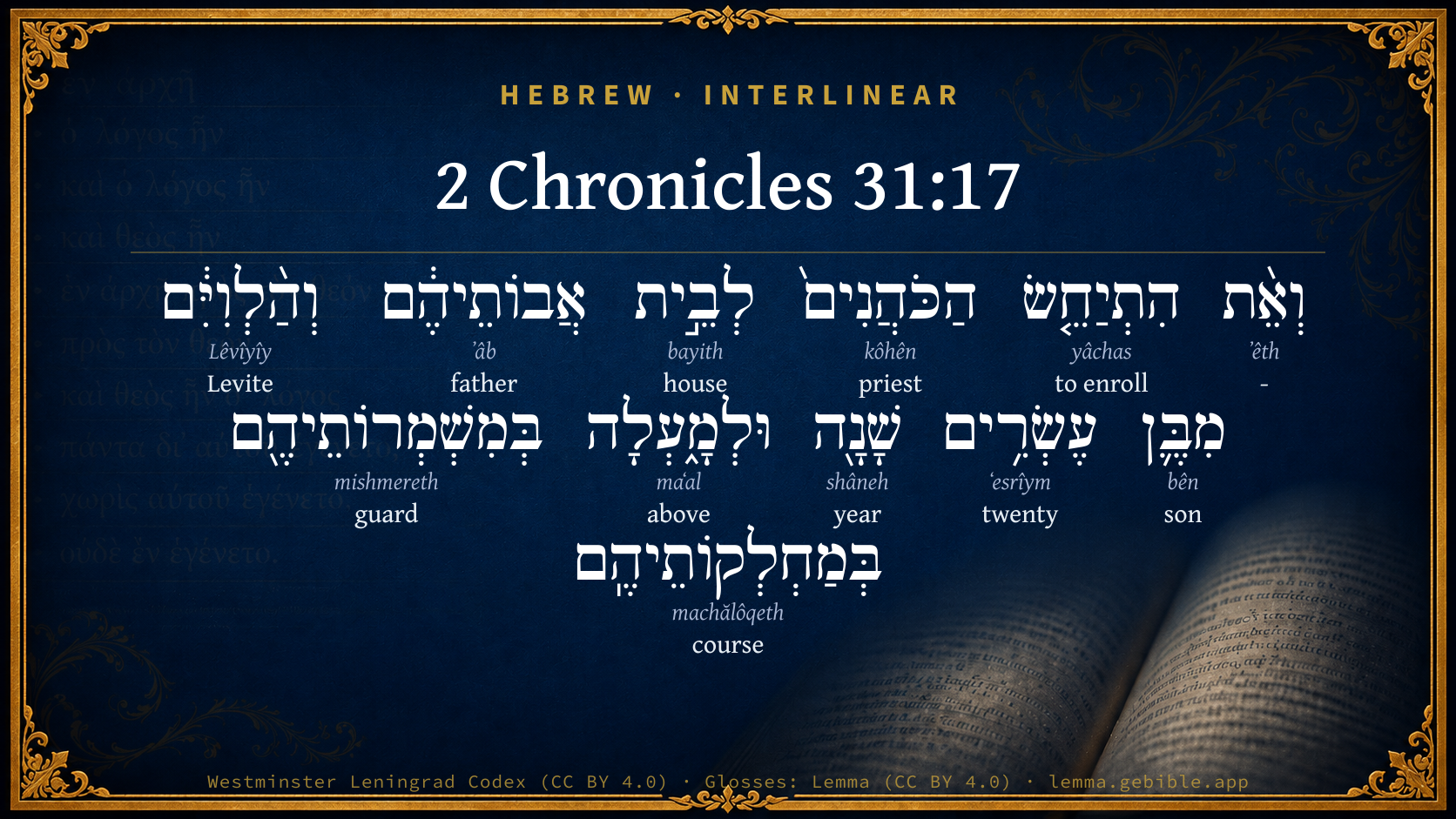
הִתְיַחֵ֤שׂ
yâchas
H3187
“to enroll”
Verb, Hithpael, Infinitive Construct
Part of Speech
Verb
Stem
Hithpael
Form
Infinitive Construct
Full BDB Definition

Origin: a primitive root

TWOT: 862

(Hithpael) to reckon genealogically, enroll on a genealogy, enroll, be enrolled
  1. וְאֵ֨ת ʼêth H853 “and · -” Conjunction + Particle, Direct Object
  2. הַכֹּהֲנִים֙ kôhên H3548 “the · priests” Particle, Definite Article + Noun, Common, Masculine, Plural, Absolute
  3. לְבֵ֣ית bayith H1004 “to/for · house of” Preposition + Noun, Common, Masculine, Singular, Construct
  4. אֲבוֹתֵיהֶ֔ם ʼâb H1 “fathers · their” Noun, Common, Masculine, Plural, Construct + Suffix, Personal, 3rd Person, Masculine, Plural
  5. וְהַ֨לְוִיִּ֔ם Lêvîyîy H3881 “and · the · Levites” Conjunction + Particle, Definite Article + Noun, Gentilic, Masculine, Plural, Absolute
  6. מִבֶּ֛ן bên H1121 “from · son of” Preposition + Noun, Common, Masculine, Singular, Construct
  7. עֶשְׂרִ֥ים ʻesrîym H6242 “twenty” Adjective, Cardinal number, Both, Plural, Absolute
  8. שָׁנָ֖ה shâneh H8141 “year” Noun, Common, Feminine, Singular, Absolute
  9. וּלְמָ֑עְלָה maʻal H4605 “and · to/for · above · toward” Conjunction + Preposition + Adverb + Suffix, Demonstrative
  10. בְּמִשְׁמְרוֹתֵיהֶ֖ם mishmereth H4931 “in/at · guards · their” Preposition + Noun, Common, Feminine, Plural, Construct + Suffix, Personal, 3rd Person, Masculine, Plural
  11. בְּמַחְלְקוֹתֵיהֶֽם machălôqeth H4256 “in/at · courses · their” Preposition + Noun, Common, Feminine, Plural, Construct + Suffix, Personal, 3rd Person, Masculine, Plural

About this verse

These counts appear in no published source. They are computed here, from the morphology-tagged text and Lemma’s own curated glosses. What Lemma adds →

12
words
12
distinct lemmas
Historical
section

Notable vocabulary

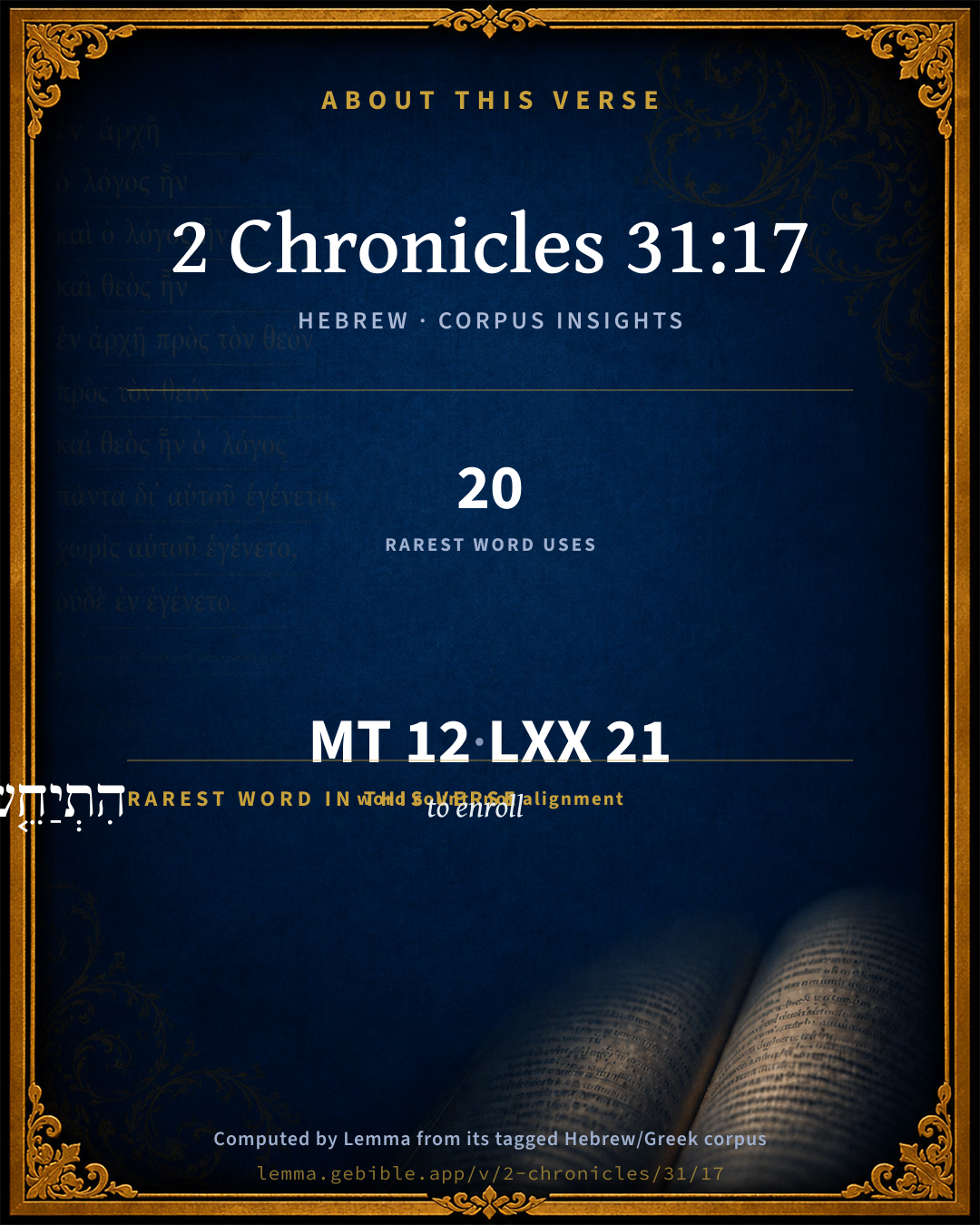
The rarest word here is הִתְיַחֵ֤שׂ to enroll H3187 — appearing just 20 times in the whole Hebrew Bible.

Shared distinctive vocabulary

הִתְיַחֵ֤שׂ to enroll H3187 occurs in 20 verses of the Hebrew Bible. Also found in:

Grammatical profile

  • 1 verb
  • 8 nouns
  • 1 adjective
  • 1 adverb
  • 1 particle

Verb forms

  • הִתְיַחֵ֤שׂ Hithpael · Infinitive Construct

Hebrew & Septuagint length

In English translation the verse runs 29 words from the Hebrew and 31 from the Septuagint (LXX English) — closely comparable.

A rough comparison of the two English renderings, which tokenize alike — not a word-level alignment.

Word counts can differ between the Hebrew and the Greek without any difference in meaning — e.g. the Hebrew direct-object marker אֵת has no separate Greek word, and Greek often adds the article ὁ.

In the original languages it is 12 Hebrew tokens and 21 Greek tokens — but the two are counted differently (Hebrew bundles its prefixes and suffixes into one token; the Greek is in lemma form), so that isn’t a like-for-like length.

Cross-references

13

Topical passages linked to 2 Chronicles 31:17 in the Treasury of Scripture Knowledge — connected by theme and wording, ordered by reader-vote popularity; previews shown in the World English Bible.

  • 1 Chronicles 23:24 These were the sons of Levi after their fathers' houses, even the heads of the fathers' [houses] of those of those who were counted, in the number of names by their polls, who did the work for the service of the house of Yahweh, from twenty years old and upward.
  • 1 Chronicles 23:27 For by the last words of David the sons of Levi were numbered, from twenty years old and upward.
  • Numbers 3:15 "Number the children of Levi by their fathers' houses, by their families: every male from a month old and upward shall you number."
  • Numbers 3:20 The sons of Merari by their families: Mahli and Mushi. These are the families of the Levites according to their fathers' houses.
  • Numbers 4:3 from thirty years old and upward even until fifty years old, all who enter into the service, to do the work in the Tent of Meeting.
  • Numbers 4:38 Those who were numbered of the sons of Gershon, their families, and by their fathers' houses,
  • Numbers 4:42 Those who were numbered of the families of the sons of Merari, by their families, by their fathers' houses,
  • Numbers 4:46 All those who were numbered of the Levites, whom Moses and Aaron and the princes of Israel numbered, by their families, and by their fathers' houses,
  • Numbers 8:24 "This is that which belongs to the Levites: from twenty-five years old and upward they shall go in to wait on the service in the work of the Tent of Meeting;
  • Numbers 17:2–3 Speak to the children of Israel, and take of them rods, one for each fathers' house, of all their princes according to their fathers' houses, twelve rods: write you every man's name on his rod.
  • 1 Chronicles 24:20–25:26 Of the rest of the sons of Levi: of the sons of Amram, Shubael; of the sons of Shubael, Jehdeiah.
  • 2 Chronicles 31:2 Hezekiah appointed the divisions of the priests and the Levites after their divisions, every man according to his service, both the priests and the Levites, for burnt offerings and for peace-offerings, to minister, and to give thanks, and to praise in the gates of the camp of Yahweh.
  • Ezra 2:59 These were those who went up from Tel-melah, Tel Harsha, Cherub, Addan, [and] Immer; but they could not show their fathers' houses, and their seed, whether they were of Israel:

Cross-references courtesy of OpenBible.info (CC BY 4.0).

Hebrew and Greek witnesses Masoretic Hebrew ↔ Greek Septuagint

The same verse in the two great witnesses to the Old Testament, shown verse-for-verse.

These are two independent witnesses, not word-aligned to each other, and the Septuagint is shown in lemma (dictionary) form.

Hebrew 2 Chronicles 31:17 Masoretic · Westminster Leningrad Codex

וְאֵ֨ת הִתְיַחֵ֤שׂ הַכֹּהֲנִים֙ לְבֵ֣ית אֲבוֹתֵיהֶ֔ם וְהַ֨לְוִיִּ֔ם מִבֶּ֛ן עֶשְׂרִ֥ים שָׁנָ֖ה וּלְמָ֑עְלָה בְּמִשְׁמְרוֹתֵיהֶ֖ם בְּמַחְלְקוֹתֵיהֶֽם

and those who were reckoned by genealogy of the priests by their fathers' houses, and the Levites from twenty years old and upward, in their offices by their divisions;

World English Bible · Public Domain

Greek LXX 2 Chronicles 31:17 Septuagint · lemma form

οὗτος ὁ καταλοχισμός ὁ ἱερεύς κατά οἶκος πατριά καί ὁ λευείτης ἐν ὁ ἐφημερία αὐτός ἀπό εἰκοσαετής καί ἐπάνω ἐν διάταξις

This is the distribution of the priests according to the houses of their families; and the Levites in their daily courses from twenty years old and upward were in their order,

LXX2012 (modern English Septuagint) · Public Domain

Hebrew: Westminster Leningrad Codex (CC BY 4.0). Greek: Septuagint (public domain); English from LXX2012 (modern English Septuagint) (Public Domain). How the Septuagint differs from the Hebrew →

Commentary

Notes on 2 Chronicles 31:17 from classic Christian and Jewish commentators (each source and its license shown beneath its notes). The classic Christian expositions comment on the surrounding passage and are grouped to its opening verse, so a note may address several verses; the Jewish commentaries on the Tanakh (Rashi and others) are per-verse, so they appear only where the commentator wrote on this verse.

Lemma curates 59 commentaries, every one of them public domain or Creative Commons licensed, each selected and text-cleaned for this edition rather than reprinted as found. About our sources →

Adam Clarke's Commentary

Verse 17. From twenty years old] Moses had ordered that the Levites should not begin their labour till they were thirty years of age; but David changed this order, and obliged them to begin at twenty.

Adam Clarke's Commentary on the Bible (1810–1826) — public domain. Text from a community e-Sword/MySword module.

Ellicott's Commentary for English Readers

(17) Both to the genealogy.—The verse is a parenthesis relating to the registration of the priests and Levites, suggested by the occurrence of the word “register” in 2Ch_31:16. Translate, “And as to the register of the priests, it was according to their clans (Heb., father-houses); and the Levites from twenty years old and upwards were in their offices in their divisions.” For the latter statement, see 1Ch_23:24.

A Bible Commentary for English Readers, edited by Charles John Ellicott (1878–1897) — public domain. Text from a community e-Sword module.

The Cambridge Bible for Schools and Colleges

gen. ed. J. J. S. Perowne

17. both to the genealogy of the priests by the house of their fathers] R.V. and them that were reckoned by genealogy of the priests by their fathers’ houses.

The Cambridge Bible for Schools and Colleges (gen. ed. J. J. S. Perowne; Cambridge University Press, 1878–1918) — public domain. Text from a community e-Sword module.

John Gill's Exposition

And to the genealogy of all their little ones, their wives, and their sons, and their daughters, through all the congregation,.... These were all genealogized and registered, wives and children, sons and daughters, whether small or grown up; and a portion was distributed to them according to their number, greater or lesser:

for in their set office they sanctified themselves in holiness; which is to be understood either of the overseers, who, in their set office, faithfully distributed the holy things to the persons before described; or else to the priests, and Levites, to whom, and to whose families, the distribution was made, because they wholly devoted themselves to the holy service of God.

John Gill's Exposition of the Whole Bible (1746–1763) — public domain (CC PDM 1.0). Text via the HelloAO Bible API.

Albert Barnes' Notes on the Bible

Both to the genealogy of the priests ... - Some prefer: “And as for the list of the priests, it was according to the houses of their fathers, and that of the Levites was from twenty years,” etc. The writer states the nature of the lists which guided the officers who made the distributions. Three lists are enumerated one of the priests made out according to families; one of the Levites, including all above 20 years of age (see the marginal reference), and made out according to courses; and a third 2Ch 31:18 of the priestly and Levitical families.

Albert Barnes' Notes on the Bible (1834–1885) — public domain. Text from a community e-Sword/MySword module.

Haydock's Catholic Bible Commentary

Upward. Ezechias followed the regulation of David, rather than that of Moses, who deferred the service till the 25th or 30th year, Num. iv. 3., and viii. 24., and 1 Paralipomenon xxiii. 24.

George Leo Haydock (1774–1849), Haydock's Catholic Family Bible and Commentary, 1859 edition — public domain. Excludes Psalms (Douay-Rheims chapter numbering differs from Protestant) and Deuterocanonical books (Catholic canon only).

The Pulpit Commentary

It is hard to feel certain as to the exact construction of this and the following verse. Keil would translate here," And concerning the catalogue of the priests, it was according, etc.; and the Levites, they were from twenty years," etc. And arrived at ver. 18, and unable to proceed in like manner with it, he reverts to the "to give" of ver. 15, as what is to stand before the words," to the genealogy or, "catalogue" of all their little ones." He thus treats both vers. 16 and 17 as parenthetical. It seems quite as probable that the "to give" should be shown before ver. 17 as well as ver. 18. On the whole, this seems to suit best the entire passage. The significant taew, at the beginning of ver. 17, neutralizes then the dblmi of ver. 16, and connects vers. 15 and 17. On the words, from twenty years old, comp. 1Ch_23:27. See also Num_4:3 Num_8:24

The Pulpit Commentary (1880–1919), ed. H.D.M. Spence-Jones & Joseph S. Exell — public domain. Text from a community e-Sword module.

unfoldingWord translationNotes

Door43 World Missions Community

They distributed

It is understood they distributed the freewill offerings. AT: "They distributed freewill offerings" (See: Ellipsis)

twenty years old and more

"20 years old and older" (See: Numbers)

there were men assigned by name to give portions

This can be stated in active form. AT: "there were men responsible for giving portions" (See: Active or Passive)

to all who were listed in the records

This can be stated in active form. AT: "to all whose names were in the records" (See: Active or Passive)

translationWords

holy

descend

Aaron

name

unfoldingWord translationNotes — © Distant Shores Media and the Door43 World Missions Community, licensed CC BY-SA 4.0. Source: git.door43.org/Door43/en_tn.

Rashi

Rabbi Shlomo Yitzchaki (Rashi)

And the priests who traced their genealogy to the house of their fathers, and the Levites with the genealogy of their infants, their wives, their sons, and their daughters. They would supply their sustenance from the heave-offerings and the tithes for that entire congregation. All these whom we mentioned [would supply food] to those who stood in the forecourt, and also to the sons of Aaron, the priests whose watch had not yet come about in which to minister, and who were in the field of the open land of their cities, in every city.

Rashi on the Tanakh — English translations: “The Judaica Press complete Tanach with Rashi, translated by A. J. Rosenberg” (CC BY 4.0); “Pentateuch with Rashi's commentary by M. Rosenbaum and A.M. Silbermann, 1929-1934” (public domain); “The Metsudah Tanach series, Lakewood, N.J” (CC BY 4.0); and “The Book of Joshua, Metsudah Publications, 1997” (CC BY 4.0). Text via Sefaria.

Lesson kit

Teaching starters — assembled from the data on this page, not authored interpretation. Every prompt links to the verse data it draws on. Edit before teaching.

2 Chronicles, in the Historical, opens this verse with 12 words (12 distinct Hebrew lemmas). Its most distinctive word is yâchas (“to enroll”). A historical commentator’s framing appears above. Read the whole chapter for the surrounding context.

Discussion questions

  1. What does “to enroll” (yâchas) contribute to the verse as a whole?
  2. 1 Chronicles 4:33 shares the word «to enroll» with this verse. How do the two illuminate each other?
  3. The translations on this page render this verse differently — a whole-verse word diff, not a word-by-word alignment. What might account for the different wordings?
  4. The verb «הִתְיַחֵ֤שׂ» is Hithpael Infinitive Construct. How does its form color the action?
  5. Reading how Adam Clarke's Commentary and Ellicott's Commentary for English Readers read this verse, where do the two commentators agree and where do they part?

Things to notice

Reading settings

Reading text

Shown beneath each verse's original-language words.

Old Testament
Old Testament edition

Read the OT as the Masoretic Hebrew (MT) or the Greek Septuagint (LXX).

English shown for the Greek Septuagint (in the Hebrew ↔ Greek comparison).

Comparing translations? Open the Compare panel on any verse page to stack up to four side by side.