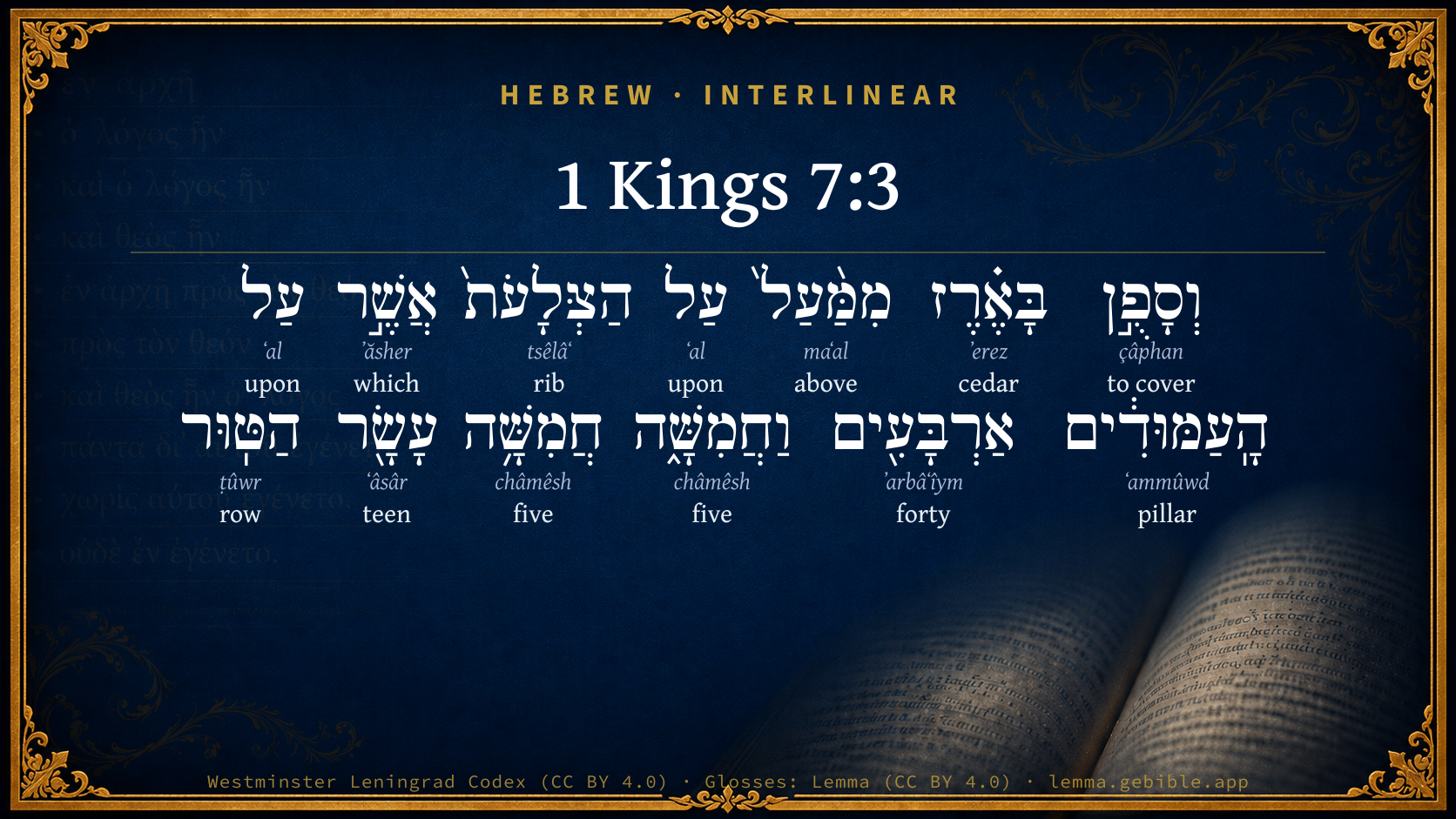
1 Kings 7:3

Hebrew (Westminster Leningrad Codex) 1 Kings 7:3 appears in the Hebrew Old Testament. The text above is from the Westminster Leningrad Codex. Each word links to its Strong’s number, a concise gloss, and parsing drawn from the Open Scriptures Hebrew Bible morphology. Click any word for its full Brown-Driver-Briggs (BDB) entry.
Download image
Cite this verse

1 Kings 7:3 (World English Bible). Public Domain. Lemma interlinear Bible study tool, https://lemma.gebible.app/v/1-kings/7/3.

Show BibTeX & RIS
BibTeX
RIS
English Translation
It was covered with cedar above over the forty-five beams, that were on the pillars; fifteen in a row.
World English Bible · Public Domain
Download a study sheet

One document with this verse’s original text, its word-by-word gloss line, the meaning frame, cross-references with their text, attributed commentary, and full source and license credits — printable, and it pastes into notes with its structure intact.

This verse Autodidact and up

Study sheet (.html) Plain text (.txt)

A passage Seminary Student

Up to 50 verses in one chapter. A passage sheet keeps up to 6 commentary sources and 12 cross-references per verse, in the order this page ranks them, and says so on the sheet whenever that leaves anything out. Ask for a single verse and you get the Autodidact verse sheet above.

Everything on this page stays free to read, with no account — the sheet is a download of what is already on screen, not access to it.

Want to remove ads? Support Godless Engineer
Compare translations 3

The same verse in 3 English versions, stacked beneath the original-language interlinear above. Click any original word for its lexicon entry.

Each is an independent rendering of the whole verse — the interlinear is not word-aligned to these translations.

Highlighted words mark where these versions differ — a whole-verse word diff, not a word-by-word alignment.

  • World English Bible Public Domain
    It was covered with cedar above over the forty-five beams, that were on the pillars; fifteen in a row.
  • King James Version Public Domain
    And it was covered with cedar above upon the beams, that lay on forty five pillars, fifteen in a row.
  • unfoldingWord Literal Text CC BY-SA 4.0
    And it was covered with cedar from above, upon the beams that were on 45 pillars, 15 the row.

unfoldingWord Literal Text — © unfoldingWord, licensed CC BY-SA 4.0. Word-aligned USFM3 via Door43 (git.door43.org/unfoldingWord/en_ult).

Versions to compare (up to 4)

3 of 4 selected

Show all 18 translations

Every available English version of this verse, each an independent rendering of the whole verse.

  • World English Bible Public Domain
    It was covered with cedar above over the forty-five beams, that were on the pillars; fifteen in a row.
  • Berean Standard Bible Public Domain
    The house was roofed with cedar above the beams that rested on the pillars—forty-five beams, fifteen per row.
  • Majority Standard Bible Public Domain
    The house was roofed with cedar above the beams that rested on the pillars—forty-five beams, fifteen per row.
  • King James Version Public Domain
    And it was covered with cedar above upon the beams, that lay on forty five pillars, fifteen in a row.
  • American Standard Version (1901) Public Domain
    And it was covered with cedar above over the forty and five beams, that were upon the pillars; fifteen in a row.
  • Revised Version (1885) Public Domain
    And it was covered with cedar above over the forty and five beams, that were upon the pillars; fifteen in a row.
  • Geneva Bible (1599) Public Domain
    And it was couered aboue with cedar vpon the beames, that lay on the fourtie and fiue pillars, fifteene in a rowe.
  • Douay-Rheims (1899) Public Domain
    And he covered the whole vault with boards of cedar, and it was held up with five and forty pillars. And one row had fifteen pillars,
  • Young's Literal Translation Public Domain
    and `it is' covered with cedar above, on the sides that `are' on the forty and five pillars, fifteen in the row.
  • Literal Standard Version CC BY-SA 4.0
    and [it is] covered with cedar above, on the sides that [are] on the forty-five pillars, fifteen in the row.
  • Unlocked Literal Bible CC BY-SA 4.0
    The house was roofed with cedar that rested on beams. Those beams were supported by pillars. There were forty-five beams, fifteen in a row.
  • unfoldingWord Literal Text CC BY-SA 4.0
    And it was covered with cedar from above, upon the beams that were on 45 pillars, 15 the row.
  • Darby Bible Public Domain
    and it was covered with cedar above upon the side-chambers, which were on forty-five pillars, fifteen in a row.
  • World Messianic Bible Public Domain
    It was covered with cedar above over the forty-five beams that were on the pillars, fifteen in a row.
  • Webster's Bible Public Domain
    And it was covered with cedar above upon the beams, that lay on forty-five pillars, fifteen in a row.
  • Free Bible Version CC BY-SA 4.0
    The cedar roof of the house was on top of the beams that rested on the pillars. There were forty-five beams, fifteen in each row.
  • Bible in Basic English Public Domain
    And it was covered with cedar over the forty-five supports which were on the pillars, fifteen in a line.
  • JPS Tanakh (1917) Public Domain
    And it was covered with cedar above upon the side-chambers, that lay on forty and five pillars, fifteen in a row.

Literal Standard Version (2020), Covenant Press — licensed CC BY-SA 4.0. Text via the HelloAO Bible API (eBible.org). Unlocked Literal Bible (unfoldingWord) — licensed CC BY-SA 4.0. Text via the HelloAO Bible API (eBible.org). unfoldingWord Literal Text — © unfoldingWord, licensed CC BY-SA 4.0. Word-aligned USFM3 via Door43 (git.door43.org/unfoldingWord/en_ult). Free Bible Version, Dr. Jonathan Gallagher — licensed CC BY-SA 4.0. Text via the HelloAO Bible API (eBible.org).

Word by word

More ways to search: Search by grammar → Find every occurrence → Compare this word →

Practice this passage: Drill this verse → Learn its vocabulary →

וְסָפֻ֣ן
çâphan
H5603
“and · covered”
Conjunction + Verb, Qal, Participle Passive, Masculine, Singular, Absolute
Part of Speech
Conjunction + Verb
Stem
Qal
Form
Participle Passive
Gender
Masculine
Number
Singular
State
Absolute
Full BDB Definition

Origin: a primitive root

TWOT: 1537

to cover, cover in, wainscotted, covered with boards or panelling - (Qal) - to cover in, panel - covered, panelled (participle)
  1. בָּאֶ֗רֶז ʼerez H730 “in/at the · cedar” Preposition, Determined + Noun, Common, Masculine, Singular, Absolute
  2. מִמַּ֨עַל֙ maʻal H4605 “from · above” Preposition + Adverb
  3. עַל ʻal H5921 “upon” Preposition
  4. הַצְּלָעֹת֙ tsêlâʻ H6763 “the · ribs” Particle, Definite Article + Noun, Common, Both, Plural, Absolute
  5. אֲשֶׁ֣ר ʼăsher H834 “which” Particle, Relative
  6. עַל ʻal H5921 “upon” Preposition
  7. הָֽעַמּוּדִ֔ים ʻammûwd H5982 “the · pillars” Particle, Definite Article + Noun, Common, Masculine, Plural, Absolute
  8. אַרְבָּעִ֖ים ʼarbâʻîym H705 “forty” Adjective, Cardinal number, Both, Plural, Absolute
  9. וַחֲמִשָּׁ֑ה châmêsh H2568 “and · five” Conjunction + Adjective, Cardinal number, Masculine, Singular, Absolute
  10. חֲמִשָּׁ֥ה châmêsh H2568 “five” Adjective, Cardinal number, Masculine, Singular, Absolute
  11. עָשָׂ֖ר ʻâsâr H6240 “teen” Adjective, Cardinal number, Masculine, Singular, Absolute
  12. הַטּֽוּר ṭûwr H2905 “the · row” Particle, Definite Article + Noun, Common, Masculine, Singular, Absolute

About this verse

These counts appear in no published source. They are computed here, from the morphology-tagged text and Lemma’s own curated glosses. What Lemma adds →

13
words
11
distinct lemmas
Historical
section

Notable vocabulary

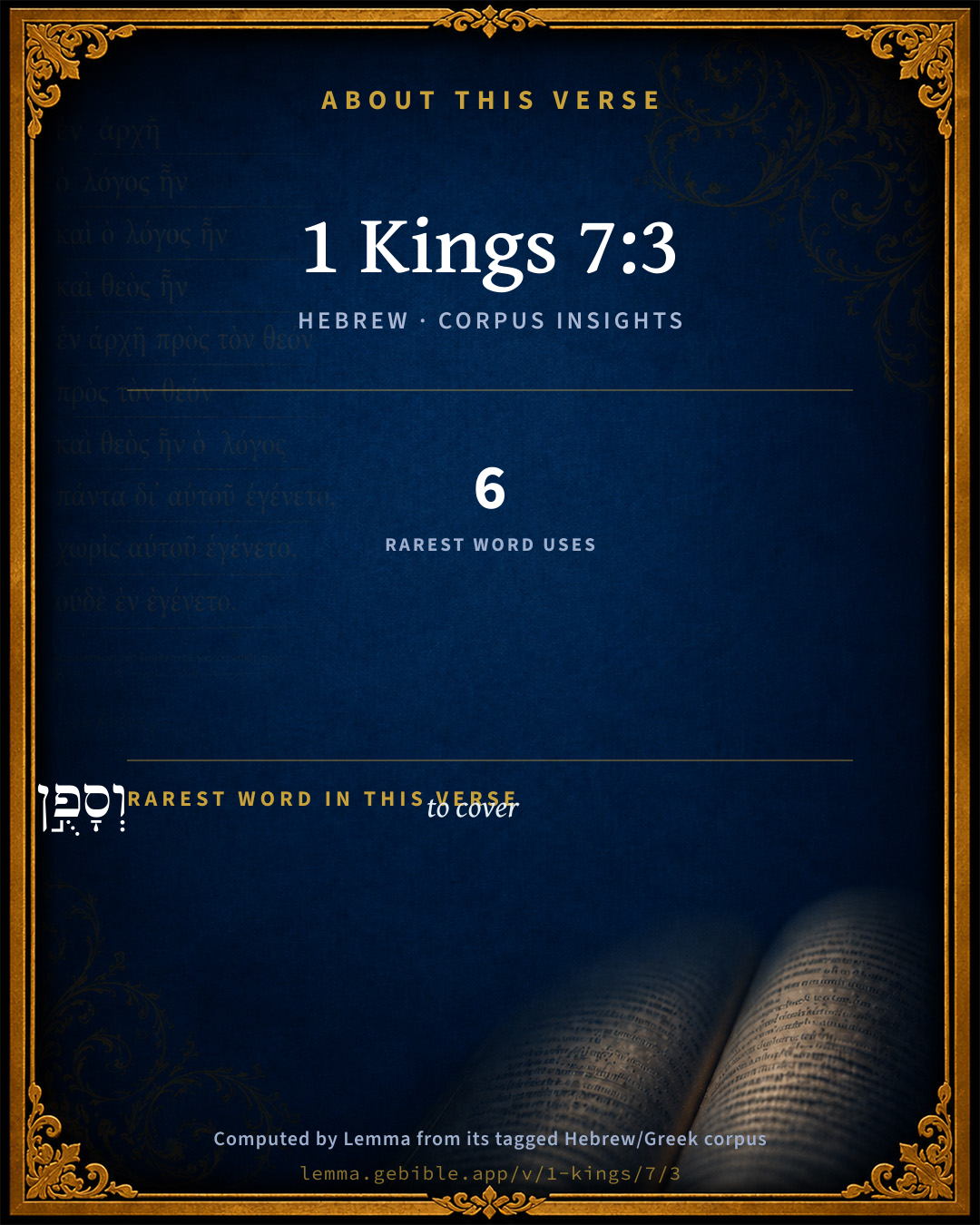
The rarest word here is וְסָפֻ֣ן to cover H5603 — appearing just 6 times in the whole Hebrew Bible.

Shared distinctive vocabulary

וְסָפֻ֣ן to cover H5603 occurs in 6 verses of the Hebrew Bible. Also found in:

Grammatical profile

  • 1 verb
  • 4 nouns
  • 4 adjectives
  • 2 prepositions
  • 1 adverb
  • 1 particle

Verb forms

  • וְסָפֻ֣ן Qal · Participle Passive

Repetition

Words recur within this verse — often emphatic in Hebrew:

  • עַל upon H5921 ×2
  • וַחֲמִשָּׁ֑ה five H2568 ×2

Cross-references

1

Topical passages linked to 1 Kings 7:3 in the Treasury of Scripture Knowledge — connected by theme and wording, ordered by reader-vote popularity; previews shown in the World English Bible.

  • 1 Kings 6:5 Against the wall of the house he built stories round about, against the walls of the house round about, both of the temple and of the oracle; and he made side-chambers round about.

Cross-references courtesy of OpenBible.info (CC BY 4.0).

Hebrew and Greek witnesses Masoretic Hebrew ↔ Greek Septuagint

The same verse in the two great witnesses to the Old Testament, shown verse-for-verse.

These are two independent witnesses, not word-aligned to each other, and the Septuagint is shown in lemma (dictionary) form.

Hebrew 1 Kings 7:3 Masoretic · Westminster Leningrad Codex

וְסָפֻ֣ן בָּאֶ֗רֶז מִמַּ֨עַל֙ עַל הַצְּלָעֹת֙ אֲשֶׁ֣ר עַל הָֽעַמּוּדִ֔ים אַרְבָּעִ֖ים וַחֲמִשָּׁ֑ה חֲמִשָּׁ֥ה עָשָׂ֖ר הַטּֽוּר

It was covered with cedar above over the forty-five beams, that were on the pillars; fifteen in a row.

World English Bible · Public Domain

Greek LXX 1 Kings 7:3 Septuagint · lemma form

καί χωνεύω ὁ δύο στῦλος ὁ αιλαμ ὁ οἶκος ὀκτωκαίδεκα πῆχυς ὕψος ὁ στῦλος καί περίμετρον τέσσαρες καί δέκα πῆχυς κύκλος αὐτός καί ὁ πάχος ὁ στῦλος τέσσαρες δάκτυλος ὁ κοίλωμα καί οὕτως ὁ στῦλος ὁ δεύτερος

No English rendering of this Greek verse — the small residue in the structurally divergent books.

On this verse, The Pulpit Commentary discusses the Septuagint’s reading. Read the note in Commentary ↓

Hebrew: Westminster Leningrad Codex (CC BY 4.0). Greek: Septuagint (public domain); English from a public-domain English Septuagint. How the Septuagint differs from the Hebrew →

Targum (Aramaic paraphrase)

1

The Targum is the ancient Jewish Aramaic paraphrase of the Hebrew Scriptures — an interpretive translation, not the Hebrew text itself. Onkelos (literal) and Pseudo-Jonathan (expansive) render the Torah, and Jonathan the Prophets. Coverage is partial: where no permissively-licensed English translation exists for a verse, only the Aramaic is shown. This is verse-level text, not a word-by-word alignment to the Hebrew.

  1. Targum Jonathan Prophets (Joshua–Malachi)
    וַחֲפָא נִסְרִין דְאַרְזָא מֵעִלַוֵי מְחִיצַיָא דְעַל עַמוּדַיָא אַרְבְּעִין וְחַמְשָׁא חֲמֵשׁ עַסְרִי סִדְרָא:

    (no public-domain English translation for this verse)

    Targum Jonathan — Aramaic: “Mikraot Gedolot” (public domain). English: “Sefaria Community Translation” (CC0 1.0 (public-domain dedication)); “London "Chaldee Paraphrase," 1871” (public domain). Text via Sefaria.

Commentary

Notes on 1 Kings 7:3 from classic Christian and Jewish commentators (each source and its license shown beneath its notes). The classic Christian expositions comment on the surrounding passage and are grouped to its opening verse, so a note may address several verses; the Jewish commentaries on the Tanakh (Rashi and others) are per-verse, so they appear only where the commentator wrote on this verse.

Lemma curates 59 commentaries, every one of them public domain or Creative Commons licensed, each selected and text-cleaned for this edition rather than reprinted as found. About our sources →

Trapp's Complete Commentary

John Trapp

1Ki 7:3 And [it was] covered with cedar above upon the beams, that [lay] on forty five pillars, fifteen [in] a row.

Ver. 3. Upon the beams.] Heb., Ribs: for beams are to a building what ribs are to a living creature. In Africa they make, if not beams, yet rafters for houses, of the whale’s ribs.

John Trapp, A Commentary or Exposition upon All the Books of the Old and New Testament (1647–1656) — public domain. Text from a community e-Sword module.

Joseph Benson's Commentary

1Ki 7:3-5. Fifteen in a row — So in this second story there were only three rows of pillars, which were sufficient for the ornament of the second and for the support of the third story; and we may conjecture from hence that there were threescore pillars below. Light was against light — One directly opposite to another, as is usual in well-contrived buildings. In three ranks — One exactly under another in three rows. All the doors, &c., were square with the windows — That is, the figures of the doors and windows were one and the same, namely, square. And light was against light, &c. — This is meant of the smaller windows or lights which were over the door, and which were also square.

Joseph Benson's Commentary on the Old and New Testaments (1811–1818) — public domain. Text from a community e-Sword module.

The Cambridge Bible for Schools and Colleges

gen. ed. J. J. S. Perowne

3. And it was covered with cedar above upon the beams] The word here rendered ‘beams’ is the same which has been rendered ‘side-chambers’ in 1Ki_6:5. In two descriptions which are so closely related as that chapter and this, it is difficult to suppose that the word has a different sense in the two places. And we have here an account of a series of side-chambers which ran all round the inside walls of this house of the forest of Lebanon, as the others did round the outside wall of the Temple. Taking the word as = ‘side-chambers,’ the text says that they were supported upon the pillars already mentioned in 1Ki_7:2, and then adds that these chambers were forty-five in number, fifteen in a row. This seems to mean that the whole three tiers of rooms numbered forty-five, each of the three stories being divided into fifteen chambers. If we suppose that the chambers were only on three sides like those surrounding the Temple, then six on each side and three at each end would exactly make up the number, and would suit with the dimensions of the house, which was twice as long as it was broad. The whole verse then may be translated ‘And it was covered with cedar above, over the forty and five side-chambers, which were upon the pillars, fifteen in a row.’

The Cambridge Bible for Schools and Colleges (gen. ed. J. J. S. Perowne; Cambridge University Press, 1878–1918) — public domain. Text from a community e-Sword module.

John Gill's Exposition

And it was covered with cedar above the beams, that lay on forty five pillars, fifteen in a row. On the second floor were three rows of pillars, fifteen in a row, which made forty five, that stood to east, north, and south; and upon these pillars beams, which were the floor of the third story, over which was a roof of cedar wood.

And it was covered with cedar above the beams, that lay on forty five pillars, fifteen in a row. On the second floor were three rows of pillars, fifteen in a row, which made forty five, that stood to east, north, and south; and upon these pillars beams, which were the floor of the third story, over which was a roof of cedar wood.

1 Kings 7:4

kg1 7:4

kg1 7:4

kg1 7:4And there were windows in three rows,.... Both in the second and third stories, east, north, and south, there being none in the west, where the porch stood:

and light was against light in three ranks; or the windows, through which light was let, answered to each other.

John Gill's Exposition of the Whole Bible (1746–1763) — public domain (CC PDM 1.0). Text via the HelloAO Bible API.

Matthew Poole's English Annotations

So in this second story were only three rows of pillars, which was sufficient for the ornament of the second, and for the support of the third story.

Matthew Poole's English Annotations on the Holy Bible (1683–1685) — public domain. Text from a community e-Sword/MySword module.

Whedon's Commentary on the Bible

Daniel D. Whedon

3. Upon the beams — Rather, Upon the chambers; for צלעת, here rendered beams, is the same word that is rendered chambers in 1Ki_6:5; 1Ki_6:8. The meaning here is, that he covered over or wainscotted with cedar the chambers, which in the stories above rested upon the four rows of pillars previously described. The whole verse should be translated thus: And above he covered over with cedar the side-chambers which were upon the pillars, forty-five, (in number,) fifteen in a row. That is, the chambers, not the pillars, were forty-five in number.

Fifteen in a row — That is, fifteen chambers on each story, running in a row around the sides. שׂור, a row, may be used of a layer of stones (1Ki_6:36) or a series of chambers, as here, as well as of a range of pillars. 1Ki_7:2. A single row or tier of these chambers is represented in the annexed cut, one chamber at the end being the place of the stairway.

Daniel D. Whedon (gen. ed.), Commentary on the Old and New Testaments (1874–1909) — public domain. Text from a community e-Sword module.

The Pulpit Commentary

And it was covered or roofed with cedar above cf. 6:9, 15 upon the beams twOlx lit., ribs, the word used in 1Ki_6:5 of the side chambers, and in 6:34 (in the masculine) of the leaves of the doors, that lay on forty-five pillars, fifteen in a row. Rawlinson, al. are much exercised to reconcile this statement with that of ver. 2, which speaks of four rows, But the explanation is very simple, viz., that the "forty-five, fifteen in a row" does not refer to the pillars but to the side chambers or compartments (A.V, "beams"). The description is so very loose and general that positive statements are out of place, but the meaning certainly appears to be this, that there was a roofing of cedar over the side chambers (which rested upon the pillars mentioned in ver. 2) forty-five in number, fifteen in a row. It is true the Masoretic punctuation is against this view. It is also clear that the LXX understood the numbers forty-five and fifteen to refer to the pillars, for they have essayed to cut the knot by reading three rows instead of "four rows," in ver. 2. Similarly the Arab. in ver. 3 reads sixty instead of forty-five; obviously another desperate attempt to solve the difficulty by a corruption of the text. But the solution suggested above is so simple and natural that we can hardly be wrong in adopting it. Bahr says positively that forty-five pillars could not have supported a structure 100 cubits by 50 cubits, "nor could the building have been named "forest of Lebanon" from forty-five scattered pillars." It would follow hence, that there were side chambers only on three sides of the building, as was the case in the temple. And if (as has been inferred from vers. 4, 5) a three-storied structure is here described; if, that is to say, the forty-five chambers were divided fifteen to a tier or story, it is highly probable that they would be distributed six to each long side and three to the rear (Bahr). This arrangement a court surrounded by a colonnade and galleries is still found in the East; as all travellers know. And in its favour it may be said that it is such as to have been suggested by the plan of the temple. The ground plan is the same, with this difference, that a courtyard occupies the place of the temple proper.

The Pulpit Commentary (1880–1919), ed. H.D.M. Spence-Jones & Joseph S. Exell — public domain. Text from a community e-Sword module.

John Wesley's Explanatory Notes

Fifteen - So in this second story were only three rows of pillars, which was sufficient for the ornament of the second and for the support of the third story.

John Wesley, Explanatory Notes Upon the Whole Bible (1754–1765) — public domain. Text via the GEBible commentary corpus.

unfoldingWord translationNotes

Door43 World Missions Community

General Information:

Some details are given about the structure of the Palace of the Forest of Lebanon.

The house was roofed with cedar that rested on beams

This can be stated in active form. AT: "The carpenters built a roof from cedar planks and attached them to beams" (See: Active or Passive)

beams

long pieces of strong wood usually used to support a roof

were made square

"had rectangular frames"

translationWords

column

unfoldingWord translationNotes — © Distant Shores Media and the Door43 World Missions Community, licensed CC BY-SA 4.0. Source: git.door43.org/Door43/en_tn.

Rashi

Rabbi Shlomo Yitzchaki (Rashi)

It was covered with cedar. A ceiling over it from above.

On top of the boards. The upper partitions which were on the cut [beams]. Four partitions, one next to the other along the width and extending along the length of the house. Each had openings and windows, because this was a summer home made for air. And on those partitions was the covering of the ceiling. The ceiling was [made] of forty-five boards, three rows of boards (for the three spaces) between the four rows of columns, fifteen boards to each row (i.e., fifteen of them were placed in each space). Their length was along the width of each row and their width was along the length of the house, one next to the other.

Rashi on the Tanakh — English translations: “The Judaica Press complete Tanach with Rashi, translated by A. J. Rosenberg” (CC BY 4.0); “Pentateuch with Rashi's commentary by M. Rosenbaum and A.M. Silbermann, 1929-1934” (public domain); “The Metsudah Tanach series, Lakewood, N.J” (CC BY 4.0); and “The Book of Joshua, Metsudah Publications, 1997” (CC BY 4.0). Text via Sefaria.

Lesson kit

Teaching starters — assembled from the data on this page, not authored interpretation. Every prompt links to the verse data it draws on. Edit before teaching.

1 Kings, in the Historical, opens this verse with 13 words (11 distinct Hebrew lemmas). Its most distinctive word is çâphan (“to cover”). A historical commentator’s framing appears above. Read the whole chapter for the surrounding context.

Discussion questions

  1. The word çâphan carries the sense “to cover.” How does it shape the verse?
  2. How does Deuteronomy 33:21, which shares the word «to cover», read alongside this verse?
  3. What does the repetition of “upon” (2× in this one verse) do in this verse?
  4. These translations render this verse differently; the difference is in the English rendering, not the original. What questions does that raise?
  5. «וְסָפֻ֣ן» is a Qal Participle Passive verb. How does that grammatical form shape the action described?
  6. Compare how Trapp's Complete Commentary and Joseph Benson's Commentary read this verse. Where do they agree or differ?

Things to notice

Reading settings

Reading text

Shown beneath each verse's original-language words.

Old Testament
Old Testament edition

Read the OT as the Masoretic Hebrew (MT) or the Greek Septuagint (LXX).

English shown for the Greek Septuagint (in the Hebrew ↔ Greek comparison).

Comparing translations? Open the Compare panel on any verse page to stack up to four side by side.