
Ezekiel 1:26

Hebrew (Westminster Leningrad Codex) Ezekiel 1:26 appears in the Hebrew Old Testament. The text above is from the Westminster Leningrad Codex. Each word links to its Strong’s number, a concise gloss, and parsing drawn from the Open Scriptures Hebrew Bible morphology. Click any word for its full Brown-Driver-Briggs (BDB) entry.
Download image
Cite this verse

Ezekiel 1:26 (World English Bible). Public Domain. Lemma interlinear Bible study tool, https://lemma.gebible.app/v/ezekiel/1/26.

Show BibTeX & RIS
BibTeX
RIS
English Translation
Above the expanse that was over their heads was the likeness of a throne, as the appearance of a sapphire stone; and on the likeness of the throne was a likeness as the appearance of a man on it above.
World English Bible · Public Domain
Download a study sheet

One document with this verse’s original text, its word-by-word gloss line, the meaning frame, cross-references with their text, attributed commentary, and full source and license credits — printable, and it pastes into notes with its structure intact.

This verse Autodidact and up

Study sheet (.html) Plain text (.txt)

A passage Seminary Student

Up to 50 verses in one chapter. A passage sheet keeps up to 6 commentary sources and 12 cross-references per verse, in the order this page ranks them, and says so on the sheet whenever that leaves anything out. Ask for a single verse and you get the Autodidact verse sheet above.

Everything on this page stays free to read, with no account — the sheet is a download of what is already on screen, not access to it.

Want to remove ads? Support Godless Engineer
Compare translations 3

The same verse in 3 English versions, stacked beneath the original-language interlinear above. Click any original word for its lexicon entry.

Each is an independent rendering of the whole verse — the interlinear is not word-aligned to these translations.

Highlighted words mark where these versions differ — a whole-verse word diff, not a word-by-word alignment.

  • World English Bible Public Domain
    Above the expanse that was over their heads was the likeness of a throne, as the appearance of a sapphire stone; and on the likeness of the throne was a likeness as the appearance of a man on it above.
  • King James Version Public Domain
    And above the firmament that was over their heads was the likeness of a throne, as the appearance of a sapphire stone: and upon the likeness of the throne was the likeness as the appearance of a man above upon it.
  • unfoldingWord Literal Text CC BY-SA 4.0
    Above the dome over their heads was the likeness of a throne that was like the appearance of a sapphire stone, and on the likeness of the throne was a likeness like the appearance of a man.

unfoldingWord Literal Text — © unfoldingWord, licensed CC BY-SA 4.0. Word-aligned USFM3 via Door43 (git.door43.org/unfoldingWord/en_ult).

Versions to compare (up to 4)

3 of 4 selected

Show all 18 translations

Every available English version of this verse, each an independent rendering of the whole verse.

  • World English Bible Public Domain
    Above the expanse that was over their heads was the likeness of a throne, as the appearance of a sapphire stone; and on the likeness of the throne was a likeness as the appearance of a man on it above.
  • Berean Standard Bible Public Domain
    Above the expanse over their heads was the likeness of a throne with the appearance of sapphire, and on the throne high above was a figure like that of a man.
  • Majority Standard Bible Public Domain
    Above the expanse over their heads was the likeness of a throne with the appearance of sapphire, and on the throne high above was a figure like that of a man.
  • King James Version Public Domain
    And above the firmament that was over their heads was the likeness of a throne, as the appearance of a sapphire stone: and upon the likeness of the throne was the likeness as the appearance of a man above upon it.
  • American Standard Version (1901) Public Domain
    And above the firmament that was over their heads was the likeness of a throne, as the appearance of a sapphire stone; and upon the likeness of the throne was a likeness as the appearance of a man upon it above.
  • Revised Version (1885) Public Domain
    And above the firmament that was over their heads was the likeness of a throne, as the appearance of a sapphire stone: and upon the likeness of the throne was a likeness as the appearance of a man upon it above.
  • Geneva Bible (1599) Public Domain
    And aboue the firmament that was ouer their heads, was the facion of a throne like vnto a saphir stone, and vpon the similitude of the throne was by appearance, as the similitude of a man aboue vpon it.
  • Douay-Rheims (1899) Public Domain
    And above the firmament that was over their heads, was the likeness of a throne, as the appearance of the sapphire stone, and upon the likeness of the throne, was a likeness as of the appearance of a man above upon it.
  • Young's Literal Translation Public Domain
    And above the expanse that `is' over their head, as an appearance of a sapphire stone, `is' the likeness of a throne, and on the likeness of the throne a likeness, as the appearance of man upon it from above.
  • Literal Standard Version CC BY-SA 4.0
    And above the expanse that [is] over their head, as an appearance of a sapphire stone, [is] the likeness of a throne, and on the likeness of the throne a likeness, as the appearance of man on it from above.
  • Unlocked Literal Bible CC BY-SA 4.0
    Above the dome over their heads was the likeness of a throne that was like the appearance of a sapphire stone, and on the likeness of the throne was a likeness like the appearance of a man.
  • unfoldingWord Literal Text CC BY-SA 4.0
    Above the dome over their heads was the likeness of a throne that was like the appearance of a sapphire stone, and on the likeness of the throne was a likeness like the appearance of a man.
  • Darby Bible Public Domain
    And above the expanse that was over their heads was the likeness of a throne, as the appearance of a sapphire stone; and upon the likeness of the throne was a likeness as the appearance of a man above upon it.
  • World Messianic Bible Public Domain
    Above the expanse that was over their heads was the likeness of a throne, as the appearance of a sapphire stone. On the likeness of the throne was a likeness as the appearance of a man on it above.
  • Webster's Bible Public Domain
    And above the firmament that was over their heads was the likeness of a throne, as the appearance of a sapphire stone: and upon the likeness of the throne was the likeness as the appearance of a man above upon it.
  • Free Bible Version CC BY-SA 4.0
    Above the expanse over their heads I saw what looked like a throne made of lapis lazuli. Sitting on the throne high above was a being who looked like a man.
  • Bible in Basic English Public Domain
    And on the top of the arch which was over their heads was the form of a king's seat, like a sapphire stone; and on the form of the seat was the form of a man seated on it on high.
  • JPS Tanakh (1917) Public Domain
    And above the firmament that was over their heads was the likeness of a throne, as the appearance of a sapphire stone; and upon the likeness of the throne was a likeness as the appearance of a man upon it above.

Literal Standard Version (2020), Covenant Press — licensed CC BY-SA 4.0. Text via the HelloAO Bible API (eBible.org). Unlocked Literal Bible (unfoldingWord) — licensed CC BY-SA 4.0. Text via the HelloAO Bible API (eBible.org). unfoldingWord Literal Text — © unfoldingWord, licensed CC BY-SA 4.0. Word-aligned USFM3 via Door43 (git.door43.org/unfoldingWord/en_ult). Free Bible Version, Dr. Jonathan Gallagher — licensed CC BY-SA 4.0. Text via the HelloAO Bible API (eBible.org).

Word by word

More ways to search: Search by grammar → Find every occurrence → Compare this word →

Practice this passage: Drill this verse → Learn its vocabulary →

סַפִּ֖יר
çappîyr
H5601
“sapphire”
Noun, Common, Masculine, Singular, Absolute
Part of Speech
Noun
Type
Common
Gender
Masculine
Number
Singular
State
Absolute
Full BDB Definition

Origin: from H5608

TWOT: 1535

sapphire, lapis lazuli
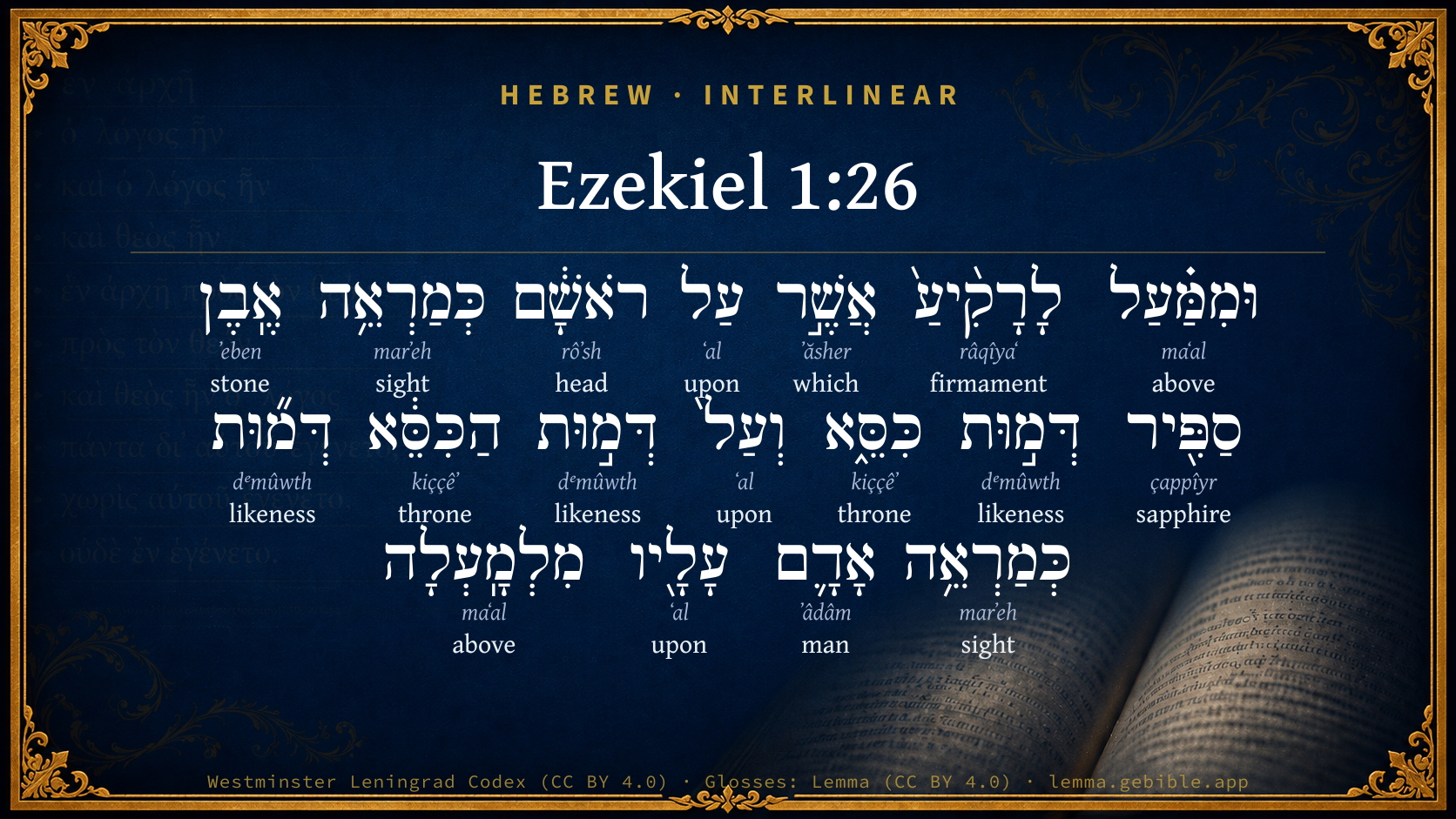
  1. וּמִמַּ֗עַל maʻal H4605 “and · from · above” Conjunction + Preposition + Adverb
  2. לָרָקִ֨יעַ֙ râqîyaʻ H7549 “to/for the · firmament” Preposition, Determined + Noun, Common, Masculine, Singular, Absolute
  3. אֲשֶׁ֣ר ʼăsher H834 “which” Particle, Relative
  4. עַל ʻal H5921 “upon” Preposition
  5. רֹאשָׁ֔ם rôʼsh H7218 “head · their” Noun, Common, Masculine, Singular, Construct + Suffix, Personal, 3rd Person, Masculine, Plural
  6. כְּמַרְאֵ֥ה marʼeh H4758 “like/as · sight of” Preposition + Noun, Common, Masculine, Singular, Construct
  7. אֶֽבֶן ʼeben H68 “stone of” Noun, Common, Feminine, Singular, Construct
  8. דְּמ֣וּת dᵉmûwth H1823 “likeness of” Noun, Common, Feminine, Singular, Construct
  9. כִּסֵּ֑א kiççêʼ H3678 “throne” Noun, Common, Masculine, Singular, Absolute
  10. וְעַל֙ ʻal H5921 “and · upon” Conjunction + Preposition
  11. דְּמ֣וּת dᵉmûwth H1823 “likeness of” Noun, Common, Feminine, Singular, Construct
  12. הַכִּסֵּ֔א kiççêʼ H3678 “the · throne” Particle, Definite Article + Noun, Common, Masculine, Singular, Absolute
  13. דְּמ֞וּת dᵉmûwth H1823 “likeness” Noun, Common, Feminine, Singular, Absolute
  14. כְּמַרְאֵ֥ה marʼeh H4758 “like/as · sight of” Preposition + Noun, Common, Masculine, Singular, Construct
  15. אָדָ֛ם ʼâdâm H120 “man” Noun, Common, Masculine, Singular, Absolute
  16. עָלָ֖יו ʻal H5921 “upon · him” Preposition + Suffix, Personal, 3rd Person, Masculine, Singular
  17. מִלְמָֽעְלָה maʻal H4605 “from · to/for · above · toward” Preposition + Preposition + Adverb + Suffix, Demonstrative

About this verse

These counts appear in no published source. They are computed here, from the morphology-tagged text and Lemma’s own curated glosses. What Lemma adds →

18
words
11
distinct lemmas
Prophets
section

Notable vocabulary

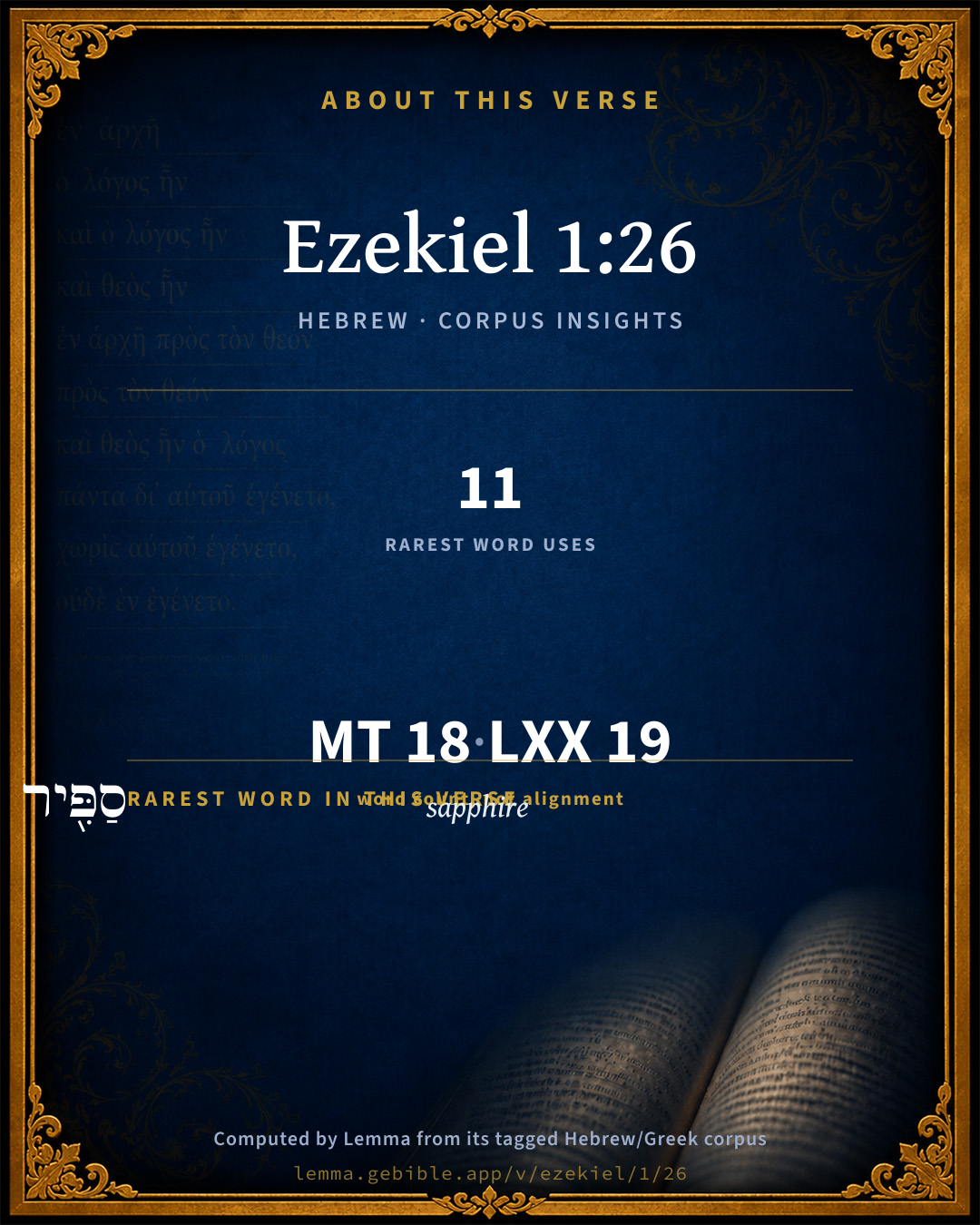
The rarest word here is סַפִּ֖יר sapphire H5601 — appearing just 11 times in the whole Hebrew Bible.

Shared distinctive vocabulary

סַפִּ֖יר sapphire H5601 occurs in 11 verses of the Hebrew Bible. Also found in:

Grammatical profile

  • 12 nouns
  • 3 prepositions
  • 2 adverbs
  • 1 particle

Repetition

Words recur within this verse — often emphatic in Hebrew:

  • עַל upon H5921 ×3
  • דְּמ֣וּת likeness H1823 ×3
  • וּמִמַּ֗עַל above H4605 ×2
  • כְּמַרְאֵ֥ה sight H4758 ×2
  • כִּסֵּ֑א throne H3678 ×2

Hebrew & Septuagint length

In English translation the verse runs 40 words from the Hebrew and 39 from the Septuagint (LXX English) — closely comparable.

A rough comparison of the two English renderings, which tokenize alike — not a word-level alignment.

Word counts can differ between the Hebrew and the Greek without any difference in meaning — e.g. the Hebrew direct-object marker אֵת has no separate Greek word, and Greek often adds the article ὁ.

In the original languages it is 18 Hebrew tokens and 19 Greek tokens — but the two are counted differently (Hebrew bundles its prefixes and suffixes into one token; the Greek is in lemma form), so that isn’t a like-for-like length.

Cross-references

28

Topical passages linked to Ezekiel 1:26 in the Treasury of Scripture Knowledge — connected by theme and wording, ordered by reader-vote popularity; previews shown in the World English Bible.

  • Ezekiel 10:1 Then I looked, and see, in the expanse that was over the head of the cherubim there appeared above them as it were a sapphire stone, as the appearance of the likeness of a throne.
  • Exodus 24:10 They saw the God of Israel. Under his feet was like a paved work of sapphire stone, like the skies for clearness.
  • Revelation 1:13 And among the lampstands was one like a son of man, clothed with a robe reaching down to his feet, and with a golden sash around his chest.
  • Ezekiel 1:22 Over the head of the living creature there was the likeness of an expanse, like the awesome crystal to look on, stretched forth over their heads above.
  • Daniel 10:18 Then there touched me again one like the appearance of a man, and he strengthened me.
  • Isaiah 6:1 In the year that king Uzziah died, I saw the Lord sitting on a throne, high and lifted up; and his train filled the temple.
  • Isaiah 9:6–7 For to us a child is born, to us a son is given; and the government shall be on his shoulder: and his name shall be called Wonderful, Counselor, Mighty God, Everlasting Father, Prince of Peace.
  • Isaiah 54:11 you afflicted, tossed with tempest, and not comforted, behold, I will set your stones in beautiful colors, and lay your foundations with sapphires.
  • Daniel 7:9–10 I saw until thrones were placed, and one who was ancient of days sat: his clothing was white as snow, and the hair of his head like pure wool; his throne was fiery flames, [and] the wheels of it burning fire.
  • Ephesians 1:21–22 far above all rule, and authority, and power, and dominion, and every name that is named, not only in this age, but also in that which is to come.
  • Philippians 2:9–10 Therefore God also highly exalted him, and gave to him the name which is above every name;
  • Hebrews 12:2 looking to Jesus, the author and perfecter of faith, who for the joy that was set before him endured the cross, despising shame, and has sat down at the right hand of the throne of God.
  • Revelation 4:2–3 Immediately I was in the Spirit. Behold, there was a throne set in heaven, and one sitting on the throne
  • Revelation 14:14 I looked, and behold, a white cloud; and on the cloud one sitting like a son of man, having on his head a golden crown, and in his hand a sharp sickle.
  • Revelation 20:11 I saw a great white throne, and him who sat on it, from whose face the earth and the heaven fled away. There was found no place for them.
  • Genesis 32:24–30 Jacob was left alone, and wrestled with a man there until the breaking of the day.
  • Psalms 45:6 Your throne, God, is forever and ever. A scepter of equity is the scepter of your kingdom.
  • Jeremiah 23:5–6 Behold, the days come, says Yahweh, that I will raise to David a righteous Branch, and he shall reign as king and deal wisely, and shall execute justice and righteousness in the land.
  • Zechariah 6:13 even he shall build the temple of Yahweh; and he shall bear the glory, and shall sit and rule on his throne; and he shall be a priest on his throne; and the counsel of peace shall be between them both.
  • Matthew 25:13 Watch therefore, for you don't know the day nor the hour in which the Son of Man is coming.
  • Matthew 28:18 Jesus came to them and spoke to them, saying, "All authority has been given to me in heaven and on earth.
  • Hebrews 1:8 but of the Son he says, "Your throne, O God, is forever and ever; The scepter of uprightness is the scepter of your Kingdom.
  • Hebrews 8:1 Now in the things which we are saying, the main point is this. We have such a high priest, who sat down on the right hand of the throne of the Majesty in the heavens,
  • 1 Peter 3:22 who is at the right hand of God, having gone into heaven, angels and authorities and powers being made subject to him.
  • Revelation 3:21 He who overcomes, I will give to him to sit down with me on my throne, as I also overcame, and sat down with my Father on his throne.
  • Revelation 5:13 I heard every created thing which is in heaven, on the earth, under the earth, on the sea, and everything in them, saying, "To him who sits on the throne, and to the Lamb be the blessing, the honor, the glory, and the dominion, forever and ever! Amen!"
  • Joshua 5:13–6:2 It happened, when Joshua was by Jericho, that he lifted up his eyes and looked, and, behold, there stood a man over against him with his sword drawn in his hand: and Joshua went to him, and said to him, Are you for us, or for our adversaries?
  • Daniel 7:14 There was given him dominion, and glory, and a kingdom, that all the peoples, nations, and languages should serve him: his dominion is an everlasting dominion, which shall not pass away, and his kingdom that which shall not be destroyed.

Cross-references courtesy of OpenBible.info (CC BY 4.0).

Hebrew and Greek witnesses Masoretic Hebrew ↔ Greek Septuagint

The same verse in the two great witnesses to the Old Testament, shown verse-for-verse.

These are two independent witnesses, not word-aligned to each other, and the Septuagint is shown in lemma (dictionary) form.

Hebrew Ezekiel 1:26 Masoretic · Westminster Leningrad Codex

וּמִמַּ֗עַל לָרָקִ֨יעַ֙ אֲשֶׁ֣ר עַל רֹאשָׁ֔ם כְּמַרְאֵ֥ה אֶֽבֶן סַפִּ֖יר דְּמ֣וּת כִּסֵּ֑א וְעַל֙ דְּמ֣וּת הַכִּסֵּ֔א דְּמ֞וּת כְּמַרְאֵ֥ה אָדָ֛ם עָלָ֖יו מִלְמָֽעְלָה

Above the expanse that was over their heads was the likeness of a throne, as the appearance of a sapphire stone; and on the likeness of the throne was a likeness as the appearance of a man on it above.

World English Bible · Public Domain

Greek LXX Ezekiel 1:26 Septuagint · lemma form

ὡς ὅρασις λίθος σάπφειρος ὁμοίωμα θρόνος ἐπί αὐτός καί ἐπί ὁ ὁμοίωμα ὁ θρόνος ὁμοίωμα ὡς εἶδος ἄνθρωπος ἄνωθεν

that was over their head, there was as the appearance of a sapphire stone, and the likeness of a throne upon it: and upon the likeness of the throne was the likeness as an appearance of a man above.

LXX2012 (modern English Septuagint) · Public Domain

On this verse, The Cambridge Bible for Schools and Colleges discusses the Septuagint’s reading. Read the note in Commentary ↓

Hebrew: Westminster Leningrad Codex (CC BY 4.0). Greek: Septuagint (public domain); English from LXX2012 (modern English Septuagint) (Public Domain). How the Septuagint differs from the Hebrew →

Targum (Aramaic paraphrase)

1

The Targum is the ancient Jewish Aramaic paraphrase of the Hebrew Scriptures — an interpretive translation, not the Hebrew text itself. Onkelos (literal) and Pseudo-Jonathan (expansive) render the Torah, and Jonathan the Prophets. Coverage is partial: where no permissively-licensed English translation exists for a verse, only the Aramaic is shown. This is verse-level text, not a word-by-word alignment to the Hebrew.

  1. Targum Jonathan Prophets (Joshua–Malachi)
    וּמֵעִלַוֵי רְקִיעָא דִי עַל רֵישֵׁיהוֹן כְּחַזוּ אֲבַן טָבָא דְמוּת כּוּרְסַיָא וְעַל דְמוּת כּוּרְסַיָא דְמוּת כְּחֵיזוּ אֱנָשָׁא עֲלוֹהִי מִלְעֶלָא:

    (no public-domain English translation for this verse)

    Targum Jonathan — Aramaic: “Mikraot Gedolot” (public domain). English: “Sefaria Community Translation” (CC0 1.0 (public-domain dedication)); “London "Chaldee Paraphrase," 1871” (public domain). Text via Sefaria.

Commentary

Notes on Ezekiel 1:26 from classic Christian and Jewish commentators (each source and its license shown beneath its notes). The classic Christian expositions comment on the surrounding passage and are grouped to its opening verse, so a note may address several verses; the Jewish commentaries on the Tanakh (Rashi and others) are per-verse, so they appear only where the commentator wrote on this verse.

Lemma curates 59 commentaries, every one of them public domain or Creative Commons licensed, each selected and text-cleaned for this edition rather than reprinted as found. About our sources →

Matthew Henry's Commentary

All the other parts of this vision were but a preface and introduction to this. God in them had made himself known as Lord of angels and supreme director of all the affairs of this lower world, whence it is easy to infer that whatever God by his prophets either promises or threatens to do he is able to effect it. Angels are his servants; men are his tools. But now that a divine revelation is to be given to a prophet, and by him to the church, we must look higher than the living creatures or the wheels, and must expect that from the eternal Word, of whom we have an account in these verses. Ezekiel, hearing a voice from the firmament, looked up, as John did, to see the voice that spoke with him, and he saw one like unto the Son of man, Rev 1:12, Rev 1:13. The second person sometimes tried the fashion of a man occasionally before he clothed himself with it for good and all; and the Spirit of prophecy is called the Spirit of Christ (Pe1 1:11) and the testimony of Jesus, Rev 19:10. 1. This glory of Christ that the prophet saw was above the firmament that was over the heads of the living creatures, Eze 1:26. Note, The heads of angels themselves are under the feet of the Lord Jesus; for the firmament that is over their heads is under his feet. Angels, principalities, and powers are made subject to him, Pe1 3:22. This dignity and dominion of the Redeemer before his incarnation magnify his condescension in his incarnation, when he was made a little lower than the angels, Heb 2:9. 2. The first thing he observed was a throne; for divine revelation comes backed and supported with a royal authority. We must have an eye of faith to God and Christ as upon a throne. The first thing that John discovered in his visions was a throne set in heaven (Rev 4:2), which commands reverence and subjection. It is a throne of glory, a throne of grace, a throne of triumph, a throne of government, a throne of judgment. The Lord has prepared his throne in the heavens, has prepared it for his Son, whom he has set King on his holy hill of Zion. 3. On the throne he saw the appearance of a man. This is good new to the children of men, that the throne above the firmament is filled with one that is not ashamed to appear, even there, in the likeness of man. Daniel, in vision, saw the kingdom and dominion given to one like the Son of man, who therefore has authority given him to execute judgment because he is the Son of man (Joh 5:27), so appearing in these visions. 4. He saw him as a prince and judge upon this throne. Though he appeared in fashion as a man, yet he appeared in more than human glory, Eze 1:27. (1.) Is God a shining light? So is he: when the prophet saw him he saw as the colour of amber, that is, a brightness round about; for God dwells in light, and covers himself with light as with a garment. How low did the Redeemer stoop for us when, to bring about our salvation, he suffered his glory to be eclipsed by the veil of his humanity! (2.) Is God a consuming fire? So is he: from his loins, both upward and downward, there was the appearance of fire. The fire above the loins was round about within the amber; it was inward and involved. That below the loins was more outward and open, and yet that also had brightness round about. Some make the former to signify Christ's divine nature, the glory and virtue of which are hidden within the colour of amber; it is what no man has seen nor can see. The latter they suppose to be his human nature, the glory of which there were those who saw; the glory as of the only begotten of the Father, full of grace and truth, Joh 1:14. He had rays coming out of his hand, and yet there was the hiding of his power, Hab 3:4. The fire in which the Son of man appeared here might be intended to signify the judgments that were ready to be executed upon Judah and Jerusalem, coming form that fiery indignation of the Almighty which devours the adversaries. Nothing is more dreadful to the most daring sinners than the wrath of him that sits upon the throne, and of the Lamb, Rev 6:16. The day is coming when the Lord Jesus shall be revealed in flaming fire, Th2 1:7, Th2 1:8. It concerns us therefore to kiss the Son lest he be angry. 5. The throne is surrounded with a rainbow, Eze 1:28. It is so in St. John's vision, Rev 4:3. The brightness about it was of divers colours, as the bow that is in the cloud in the day of rain, which, as it is a display of majesty, and looks very great, so it is a pledge of mercy, and looks very kind; for it is a confirmation of that gracious promise God has made that he will not drown the world again, and he has said, I will look upon the bow and remember the covenant, Gen 9:16. This intimates that he who sits upon the throne is the Mediator of the covenant, that his dominion is for our protection, not our destruction, that he interposes between us and the judgments our sins have deserved, and that all the promises of God are in him yea and amen. Now that the fire of God's wrath was breaking out against Jerusalem bounds should be set to it, and he would not make an utter destruction of it, for he would look upon the bow and remember the covenant, as he promised in such a case, Lev 26:42.

Lastly, We have the conclusion of this vision. Observe, 1. What notion the prophet himself had of it: This was the appearance of the likeness of the glory of the Lord. Here, as all along, he is careful to guard against all gross corporeal thoughts of God, which might derogate from the transcendent purity of his nature. he does not say, This was the Lord (for he is invisible), but, This was the glory of the Lord, in which he was pleased to manifest himself a glorious being; yet it is not the glory of the Lord, but the likeness of that glory, some faint resemblance of it; nor is it any adequate likeness of that glory, but only the appearance of that likeness, a shadow of it, and not the very image of the thing, Heb 10:1. 2. What impressions it made upon him: When I saw it, I fell upon my face. (1.) He was overpowered by it; the dazzling lustre of it conquered him and threw him upon his face; for who is able to stand before this holy Lord God? Or, rather, (2.) He prostrated himself in a humble sense of his own unworthiness of the honour now done him, and of the infinite distance which he now, more than ever, perceived to be between him and God; he fell upon his face in token of that holy awe and reverence of God with which his mind was possessed and filled. Note, The more God is pleased to make known of himself to us the more low we should be before him. He fell upon his face to adore the majesty of God, to implore his mercy and to deprecate the wrath he saw ready to break out against the children of his people. 3. What instructions he had from it. All he saw was only to prepare him for that which he was to hear; for faith comes by hearing. He therefore heard a voice of one that spoke; for we are taught by words, not merely by hieroglyphics. When he fell on his face, ready to received the word, then he heard the voice of one that spoke; for God delights to teach the humble.

Matthew Henry's Commentary on the Whole Bible (1708–1710) — public domain (CC PDM 1.0). Text via the HelloAO Bible API.

Trapp's Complete Commentary

John Trapp

Eze 1:26 And above the firmament that [was] over their heads [was] the likeness of a throne, as the appearance of a sapphire stone: and upon the likeness of the throne [was] the likeness as the appearance of a man above upon it.

Ver. 26. And above the firmament.] See on Eze 1:22.

Was the likeness of a throne.] Far beyond that of Solomon. {1Ki 10:18-19} That was of ivory, but this of sapphire; that had a rich canopy over it, but this the azured sky under it; {see Exo 24:10} all to set forth Christ’s kingly dignity and surpassing majesty.

And upon the likeness.] All was but likeness and appearance, because all was visional here.

As the appearance of a man.] This was the man Christ Jesus, and this is the last and best part of the vision - viz., Christ set by his Father in super celestial places, far above all principality and power, &c. {Eph 1:20-21} One of Augustine’s wishes was to have seen Christ on earth. Bede comes after, and wisheth rather to have seen Christ in his glory, and on his heavenly throne.

John Trapp, A Commentary or Exposition upon All the Books of the Old and New Testament (1647–1656) — public domain. Text from a community e-Sword module.

The Biblical Illustrator

Joseph S. Exell

Eze_1:26-28

As the appearance of a man.

Conceptions of God

Ezekiels conception of Jehovah appears in the visions of God which he describes (chaps. 1; 8; 10; 43.). These visions were all alike, and they reveal his general impression of that which Jehovah is: the fourfold nature of the cherubim, of their faces and wings and of the wheels, all forming a chariot moving in every direction alike, and with the velocity suggested by the wings and wheels, symbolises the omnipresence of Jehovah, while the eyes of which the whole are full are a token of His omniscience. The throne above the firmament on which He sat indicates that He is King in heaven, God over all, omnipotence. The Divine Being Himself appeared as of human form, while His nature was light, of such brightness that fire fitly represented Him only from the loins downwards; from the loins upwards the effulgence was something purer and more dazzling, and He was surrounded by a brightness like that of the rainbow in the day of ram. This glory, which contains Himself within it (Eze_10:4; Eze_01:18; Eze_43:5; Eze_34:6), is that which is manifested to men. (A. B. Davidson, D. D.)

Man a type of the supernatural

All the analogies of human thought are in themselves analogies of nature; and in proportion as they are built up or are perceived by mind in its higher attributes and work, they are part and parcel of natural truth. Man--he whom the Greeks call Anthropos, because, as it has been supposed, he is the only being whose look is upward--man is a part of nature, and no artificial definitions can separate him from it. And yet in another sense it is true that man is above nature--outside of it; and in this aspect he is the very type and image of the supernatural. (Duke of Argyll.)

As the appearance of the bow that is in the cloud in the day of rain.

The significance of the rainbow

Ezekiel was reminded that he had to present God before the people as clothed with fire--a symbol, probably, of His coming indignation on the last of Jerusalems inhabitants. But, not to disturb the righteous, or to give them the least idea for supposing that, in the final desolation of Jerusalem, Gods covenant should cease, the vision went on (verse 28) to reveal a rainbow overarching this fiery throne, the mild lustre of which outshone its blazing glare. Could anything be more gracious? From that time, both the prophet and His faithful people might well rest assured that they were safe. God would not, and could not, forsake them. The bow of the covenant was above them, far beyond the reach of those changing providences which were represented as going forward so rapidly and incessantly below them. And even thus, amidst the changes and troubles of this mortal life, the true Israel, the believers in Christ, are safe under Gods covenant mercy and grace. (J. H. Titcomb.)

The Biblical Illustrator, edited by Joseph S. Exell (c. 1880s–1900s) — public domain. Text from a community e-Sword module.

Joseph Benson's Commentary

Eze 1:26-27. Above the firmament was the likeness of a throne — Namely, the throne of God. God having given his prophet emblems of his attendants and ministers, while he was coming forth in the chariot of his power and justice, to execute judgment, and of the mysterious dispensations of his providence toward his church and the world, he now proceeds to discover to him some glimpses of his divine glory. The prophet does not say that he saw a real throne, but only the likeness of a throne, emblematical, doubtless, of God’s sovereign power and dominion over all creatures, whether in heaven or on earth. God is described in Scripture as dwelling in light, and clothing himself with it. So the throne of God is here described as made up of light resembling the colours and brightness of a sapphire-stone. And upon the likeness of the throne, as the appearance of a man — “When Moses and the elders saw the God of Israel, Exo 24:8, or the glory of God, as the Targum explains it, they saw no determinate figure, but an inconceivably resplendent brightness, that they might not think God could be represented by any image. But in this vision the form and shape of a man are directly represented to Ezekiel, as a prelude or figure of the incarnation.” This, indeed, was doubtless the ever- blessed and only-begotten Son of God, who was in due time to assume human nature, and in that nature to be the visible image and representative of his invisible Father, whom no man hath seen, or can see, 1Ti 6:16; Joh 1:18. He had appeared to Isaiah in glory, to constitute him a prophet, and he now appears to Ezekiel for the same purpose: see note on Isa 6:1, and compare Joh 12:37-41. He appears also as the Lawgiver and King of Israel, to vindicate his own honour, punish his rebellious subjects, and give warning by his prophet, ere he executed his just but severe indignation. And I saw as the colour of amber — See note on Eze 1:4. As the appearance of fire — Said to be a fire infolding itself, Eze 1:4. Round about within it — Namely, within the amber, to signify that Christ’s executing of judgment outwardly proceeded from his zeal for the glory of God and his indignation against sin. From the appearance of his loins even upward — Denoting, as some interpret it, his divine nature: and from the appearance of his loins even downward — Signifying his human nature. I saw, as it were, the appearance of fire — The general sense seems to be, that Christ, considered in his whole person, as God and man, is full of indignation against sin, and sinners continuing in sin, and is glorious in both his natures, and in all his proceedings: see 2Th 1:8. And it had brightness round about — Majesty, justice, and unstained holiness shine round about him. In this colour does Christ appear to the Jews; he that would have visited them, clothed with the garments of salvation, now put on the garments of vengeance, expressed by such metaphors.

Joseph Benson's Commentary on the Old and New Testaments (1811–1818) — public domain. Text from a community e-Sword module.

Tyndale Open Study Notes

Tyndale Open Resources

1:26-27 On the throne of God was a figure whose appearance resembled a man. Ezekiel’s ability to describe the scene was overwhelmed by the magnificence of the sight. This human form revealed the Lord’s overpoweringly radiant glory that had once filled the Tabernacle and the Temple as a visible manifestation of God’s presence (cp. Dan 7:9-10; Rev 1:12-17). While God’s awesome presence in human form comforts his faithful people, it signifies inevitable judgment for those who are disobeying him. This vision presages God’s coming to earth as a man in Jesus Christ.

Tyndale Open Study Notes — © Tyndale Open Resources, licensed CC BY-SA 4.0. Text via the HelloAO Bible API.

Jamieson, Fausset & Brown

Robert Jamieson, A. R. Fausset & David Brown

The Godhead appears in the likeness of enthroned humanity, as in Exo 24:10. Besides the "paved work of a sapphire stone, as it were the body of heaven in clearness," there, we have here the "throne," and God "as a man," with the "appearance of fire round about." This last was a prelude of the incarnation of Messiah, but in His character as Saviour and as Judge (Rev 19:11-16). The azure sapphire answers to the color of the sky. As others are called "sons of God," but He "the Son of God," so others are called "sons of man" (Eze 2:1, Eze 2:3), but He "the Son of man" (Mat 16:13), being the embodied representative of humanity and the whole human race; as, on the other hand, He is the representative of "the fulness of the Godhead" (Col 2:9). While the cherubim are movable, the throne above, and Jehovah who moves them, are firmly fixed. It is good news to man, that the throne above is filled by One who even there appears as "a man."

Jamieson, Fausset & Brown — Commentary Critical and Explanatory on the Whole Bible (1871) — public domain (CC PDM 1.0). Text via the HelloAO Bible API.

Adam Clarke's Commentary

Verse 26. A sapphire] The pure oriental sapphire, a large well cut specimen of which is now before me, is one of the most beautiful and resplendent blues that can be conceived. I have sometimes seen the heavens assume this illustrious hue. The human form above this canopy is supposed to represent Him who, in the fulness of time, was manifested in the flesh.

Adam Clarke's Commentary on the Bible (1810–1826) — public domain. Text from a community e-Sword/MySword module.

Ellicott's Commentary for English Readers

(26) As the appearance of a sapphire stone.—Comp. Exo_24:10, where the same description is applied to “the pavement under His feet” as here and in Eze_10:1 to his throne, in either case indicating the intense clearness of the heavenly blue. The constant repetition of the words “likeness” and “appearance” is very striking throughout this vision. They occur five times in this verse, and four times in each of the two following. The prophet thus labours to make it plain that what he saw was not the realities of existing things, but certain symbolic representations given for the purpose of producing their fitting impression upon the mind. It is especially important to remember this in connection with “the likeness as the appearance of a man” “upon the likeness of the throne.” It was not the Divine Being Himself whom Ezekiel saw, but certain appearances to impress upon him the character and attributes of Him whom “no man hath seen, nor can see.”

The appearance of a man—As in the case of the cherubim the form of a man, as the highest known in nature, was made the groundwork to which all their peculiarities were attached, so here, in rising to something still higher, the same basis must be retained in the impossibility of anything better; only that which is added is more vague, as being incapable of any definite description, Yet possibly there may be even her a hint at the great truth of the incarnation. (Comp. Dan_7:13; Rev_1:13.)

A Bible Commentary for English Readers, edited by Charles John Ellicott (1878–1897) — public domain. Text from a community e-Sword module.

The Cambridge Bible for Schools and Colleges

gen. ed. J. J. S. Perowne

26. The rendering of LXX. makes the sapphire stone different from the throne, the former being the ground on which the throne was placed. A special pavement, however, above the firmament, on which the throne was set is scarcely to be expected and is hardly the meaning of Exo_24:10. Comp. Eze_10:1.

26–28. The throne and glory of Him who sat on it

Above the firmament was the appearance of a throne, like a sapphire stone; and on the throne the appearance of one sitting, from his loins upwards like amber, and from his loins downwards like fire. And round about him was a glory like the rainbow in the day of rain.

The Cambridge Bible for Schools and Colleges (gen. ed. J. J. S. Perowne; Cambridge University Press, 1878–1918) — public domain. Text from a community e-Sword module.

John Gill's Exposition

And above the firmament that was over their heads,.... The heads of the living creatures:

was the likeness of a throne; a symbol of Christ's kingly power and authority, who is the person that sat upon it; as he is God, he is on the same throne with his Father; as Mediator, he is King of saints, and was so from eternity; he exercised his office before his incarnation; and as he was prophesied of as a King, he came as one, though little known, and his kingdom was not with observation; upon his ascension he was declared Lord and Christ; and will appear on a throne, when he shall come to judge the world, and particularly in the New Jerusalem church state: and this throne was

as the appearance of a sapphire stone; which is a stone very clear and transparent; very hard, solid, and durable; very precious and excellent; and of an azure sky colour; denoting the clear manifestation of Christ's righteous judgments, in the ministration of his kingly office; the duration of his government; the excellency of it; and its heavenly nature and original:

and upon the likeness of the throne was the likeness of the appearance of a man above upon it; this was no other than Christ; who, though he was not really man before his incarnation, yet often appeared in the form of a man; and, through his incarnation, he was found in fashion as a man; and was really man, though not a mere man; nor was the person here designed; for that was the appearance and likeness of the glory of the Lord, Eze 1:28; and this shows, that when Christ, as man, had done his work, he should sit down upon his throne above the firmament, being made higher than the heavens,

John Gill's Exposition of the Whole Bible (1746–1763) — public domain (CC PDM 1.0). Text via the HelloAO Bible API.

Albert Barnes' Notes on the Bible

Sapphire - Clear heavenly blue.

The appearance of a man - Deeply significant is the form of this manifestation. Here is no angel conveying God’s message to man, but the glory of the Lord Himself. We recognize in this vision the prophetic annunciation of the Holy Incarnation. We are told little of the extent to which the human form was made evident to the prophet. For the vision was rather to the mind than to the bodily eye, and even inspired language was inadequate to convey to the hearer the glory which eye hath not seen or ear heard, and which only by special revelation it hath entered into the heart of man to conceive.

Albert Barnes' Notes on the Bible (1834–1885) — public domain. Text from a community e-Sword/MySword module.

Haydock's Catholic Bible Commentary

Upon it. This might be omitted, as the Vulgate has only desuper, above. (Haydock) --- God was pleased to assume the shape of a man, seated on the throne.

George Leo Haydock (1774–1849), Haydock's Catholic Family Bible and Commentary, 1859 edition — public domain. Excludes Psalms (Douay-Rheims chapter numbering differs from Protestant) and Deuterocanonical books (Catholic canon only).

Matthew Poole's English Annotations

Above the firmament; the crystalline firmament which appeared in the vision, not the vast expanse or firmament in which are sun, moon, and stars.

That was over their heads; heads of the living creatures which moved the wheels, and stood by the chariot.

Was the likeness of a throne, as the appearance of a sapphire stone; in view appeared a sapphire stone, like or in likeness of a throne; so the Hebrew, though we transpose the words somewhat in our version: the sapphire speaks splendour and preciousness; the throne speaks the authority and power of him who sitteth thereon.

As the appearance of a man; Christ, God-man, who here appears as King and Judge to vindicate his own honour, to punish rebels, and to give warning by his prophet ere he execute his just but severe indignation.

Matthew Poole's English Annotations on the Holy Bible (1683–1685) — public domain. Text from a community e-Sword/MySword module.

Whedon's Commentary on the Bible

Daniel D. Whedon

26. The likeness of a throne — It should be again noticed how careful Ezekiel is not to say that this vision represented a literal reality. He only describes what he saw — “the likeness of four living creatures” which had “the likeness of a man” (Eze_1:5), and yet were “like the appearance of torches” (Eze_1:13), and lightning flashes (Eze_1:14); he saw four wheels, which “had one likeness “(Eze_1:16), and upon the heads of the living creatures “the likeness of a firmament” (Eze_1:22), and now he sees “the likeness of a throne,” and upon the likeness of the throne was the likeness as the appearance of a man above upon it, and “the likeness of the glory of the Lord” (Eze_1:28).

The likeness as the appearance of a man — That the human life should be seen to predominate and control all the varied life expressed by the living creatures, the highest ministers of Jehovah, does not seem too strange to believe and repeat; but here the amazement of the prophet passes all bounds, for he sees what looks to be a man on the throne of the unapproachable God! He dare not deny what he has seen, and yet he dare not affirm that he actually saw, even in a vision, a man on Jehovah’s throne.

So through the thunder comes a human voice,

Saying, “O heart I made, a heart beats here!

Face my hands fashioned, see it in myself!”

— Browning, Karshish.

What it meant, what it foreshadowed, Ezekiel never tried to tell, but his perplexity and wonder may be discovered in this strange sentence, “And upon the likeness of a throne was the likeness as the appearance of a man.” This is the most sublime prevision of the incarnation to be found in the holy oracles. Ezekiel, as truly as Isaiah, “saw his glory” though in a mirror, darkly (Joh_12:41; Col_1:15; Heb_1:3). Ezekiel did not know the real meaning of the man upon the throne, but in this vision the race was receiving its answer to its age-long cry.

‘Tis the weakness in strength that I cry

for, my flesh that I seek

In the Godhead! I seek and I find it.

— Browning, Saul.

Daniel D. Whedon (gen. ed.), Commentary on the Old and New Testaments (1874–1909) — public domain. Text from a community e-Sword module.

The Pulpit Commentary

The likeness of a throne. The greatest glory was kept to the last. High above the azure expanse was the likeness of a throne (we note the constant recurrence of the word "likeness," nine times in this one chapter, as indicating Ezekiel"s consciousness of the vision character of what he saw). The idea of the throne of the great King first appears in 1Ki_22:19, is frequent in the Psalms, (Psa_9:4, 7 11:4 45:6) notably in Isa_6:1. In the visions of St John (Rev_1:4, and passim) it is the dominant, central object throughout. As the appearance of a sapphire stone. The intense blue of the sapphire has made it in all ages the natural symbol of a heavenly purity. Ezekiel"s vision reproduces that of Exo_24:10. It appears among the gems of the high priest"s breastplate (Exo_28:18 Exo_39:11) and in the "foundations" of Rev_21:19. The description of the sapphire given by Pliny ("Hist. Nat.," 37:9), as "never transparent, and refulgent with spots of gold," suggests lapis lazuli. As used in the Old Testament, however, the word probably means the sapphire of modern jewellery (Braun, "De Vest. Sacerd.," p. 630, edit. 1680). A likeness as of the appearance of a man. The throne, the symbol of the sovereignty of God over the "living creatures" and the "wheels," over the forces and the laws which they represented, is not empty. There was "a likeness as of the appearance" (we note again the accumulation of words intended to guard against the thought that what was seen was more than an approximate symbolism) "of a man." In that likeness there was the witness that we can only think of God by reasoning upward from all that is highest in our conceptions of human greatness and goodness, and thinking of them as free from their present limitations. Man"s highest thought of God is that it is "a face like his face that receives him." He finds a humanity in the Godhead. It is noticeable that this preluding anticipation of the thought of the Incarnation, not recognized in the vision of Moses (Exo_24:10) or Isaiah, (Isa_6:1) appears prominently in the two prophets of the exile here and in the memorable Messianic vision of "One like unto the "a," Revised Version Son of man" in Dan_7:13. What might have been perilously anthropomorphic in the early stages of the growth of Israel, when men tended to identify the symbol with the thing symbolized, was now made subservient to the truth which underlies even anthropomorphic thought (Rev_1:13) Irenaeus ("Adv. Haer.," 4:20. 10), it may be noted, dwells on the fact that Ezekiel uses the words, visio similitudmis gloriae Domini," ne quis putaret forte eum in his proprie vidisse Deum.

Vers. 26-28. He who is upon the throne.

There is a natural tendency to clothe the spiritual in material form, and thus to bring the invisible and impalpable within the range and sphere of sense. It must not be supposed that, when the inspired writers, in this and similar passages, depict in imagery of material splendour the presence of the Almighty, they are misled by their own language, and forget that "God is a Spirit." Their aim is to represent, in such a way as shall impress the mind, the glorious attributes of the Eternal, to suggest the relations which he sustains to his creatures, and to inspire those emotions which are becoming to the subjects of Divine authority in approaching their rightful King. Thus understood, the language of this passage is fitted to help us to conceive aright of him whom no man hath seen.

I THE ELEVATION AND SUPERIORITY OF THE DIVINE BEING. The living creatures are depicted as above the earth, but below the heavens. Above the firmament that was over their heads, the prophet in his vision saw the dim form which shadowed forth the presence of the Eternal. Position, we know, is relative, and it would be absurd to take this representation as literal. Yet how instructive and inspiring is this picture! Ezekiel took the same view of the great Author of all being as was taken by Isaiah, who saw the Lord "high and lifted up." Raise our thoughts as we may, God is still immeasurably above us. When we speak of him as "the Most High," we are striving, in such language, to set forth his infinite superiority to ourselves and to all the works of his hands.

II THE AUTHORITY AND DOMINION OF THE DIVINE BEING. A throne speaks, not only of greatness, but of power and of right to rule. God is the King, to whose sway all creation is subject, and to whose moral authority all his creatures who are endowed with an intelligent and voluntary nature should delight to offer a glad obedience. His commands are the laws which we are bound to obey; his voice is for us the welcome voice of rightful authority. The religion of the Bible is a religion which enjoins and requires obedience and subjection. Christianity is the revelation of a kingdom which is righteousness, peace, and joy in the Holy Ghost.

III THE HUMANITY OF THE DIVINE BEING. Such language may at first hearing sound almost daring. And nothing would be further from the truth than to suggest that the Deity is subject to human frailties and infirmities, such as the heathen both savage and cultivated have been in the habit of attributing to their gods. But there is great significance in the language of Ezekiel, when he tells us that upon the throne of universal empire "there was the appearance of a man." We have thus brought before us the glorious truth that the human nature is akin to the Divine. We can reason to some extent from our own thoughts and feelings to those of the Infinite Spirit. The resemblance is of course partial, but it is real. And believers in the Incarnation cannot but recognize the justice and the preciousness of this representation of the prophet.

IV THE SPLENDOUR OF THE DIVINE BEING. Ezekiel uses all the resources of nature to invest his representation of the Eternal with unapproachable splendour. He failed, where all must fail, in the attempt to portray that which cannot be portrayed. His language, glowing as it is, gives but hints and suggestions of glory which surpasses human apprehension. Yet, as he speaks of sapphire and amber, of fire and brightness, we feel that his mind was impressed with the Divine glory, and that his description is fitted to awaken our profoundest and lowliest reverence and adoration.

V THE MERCY OF THE DIVINE BEING. No picture of the character and attributes of the Supreme would be complete which did not include mercy. Man stands pressingly in need of the Divine compassion. His weakness, his sin, his helplessness, are such, that Divine pity is his only hope. Now, the bow in the cloud is the emblem of mercy. The rain, the dense dark clouds, the floods upon the earth, represent affliction, chastisement, distress. But the sun of grace and kindness shines through the gloom; the rainbow spans the sky, and its beauty cheers the soul of the beholder, as with an assurance of compassion, as with a promise of relief. Mercy is the crowning attribute of the Supreme. God is our King and Judge; but he has not forgotten to be gracious; he is also our Father and our Saviour. T.

The Pulpit Commentary (1880–1919), ed. H.D.M. Spence-Jones & Joseph S. Exell — public domain. Text from a community e-Sword module.

John Wesley's Explanatory Notes

A man - Christ, God-man, who here appears as king and judge.

John Wesley, Explanatory Notes Upon the Whole Bible (1754–1765) — public domain. Text via the GEBible commentary corpus.

unfoldingWord translationNotes

Door43 World Missions Community

over their heads

"over the heads of the living creatures"

was the likeness of a throne

Here the abstract noun "likeness" means that what Ezekiel saw looked like a throne. The word can be translated with a verbal phrase. AT: "was something that looked like a throne" (See: Abstract Nouns)

sapphire

a very valuable stone that is clear blue and very shiny

on the likeness of the throne was

The abstract noun "likeness" can be translated with a verbal phrase. AT: "on what looked like a throne there was" (See: Abstract Nouns)

a likeness like the appearance of a man

The abstract nouns "likeness" and "appearance" can be translated with verbal phrases. If you need to tell who this is, you should probably identify him as Yahweh (Ezekiel 1:3). AT: "something that looked similar to what appeared to be a man" (See: Abstract Nouns)

translationWords

throne

unfoldingWord translationNotes — © Distant Shores Media and the Door43 World Missions Community, licensed CC BY-SA 4.0. Source: git.door43.org/Door43/en_tn.

Lesson kit

Teaching starters — assembled from the data on this page, not authored interpretation. Every prompt links to the verse data it draws on. Edit before teaching.

Ezekiel, in the Prophets, opens this verse with 18 words (11 distinct Hebrew lemmas). Its most distinctive word is çappîyr (“sapphire”). A historical commentator’s framing appears above. Read the whole chapter for the surrounding context.

Discussion questions

  1. How does “sapphire” (çappîyr) shape what this verse is saying?
  2. Exodus 24:10 shares the word «sapphire» with this verse. How do the two illuminate each other?
  3. “upon” occurs 3× in this one verse. What is the effect of the repetition?
  4. These translations render this verse differently. What is at stake in choosing one wording over another?
  5. Reading how Matthew Henry's Commentary and Trapp's Complete Commentary read this verse, where do the two commentators agree and where do they part?

Things to notice

Reading settings

Reading text

Shown beneath each verse's original-language words.

Old Testament
Old Testament edition

Read the OT as the Masoretic Hebrew (MT) or the Greek Septuagint (LXX).

English shown for the Greek Septuagint (in the Hebrew ↔ Greek comparison).

Comparing translations? Open the Compare panel on any verse page to stack up to four side by side.