
Haggai 2:18

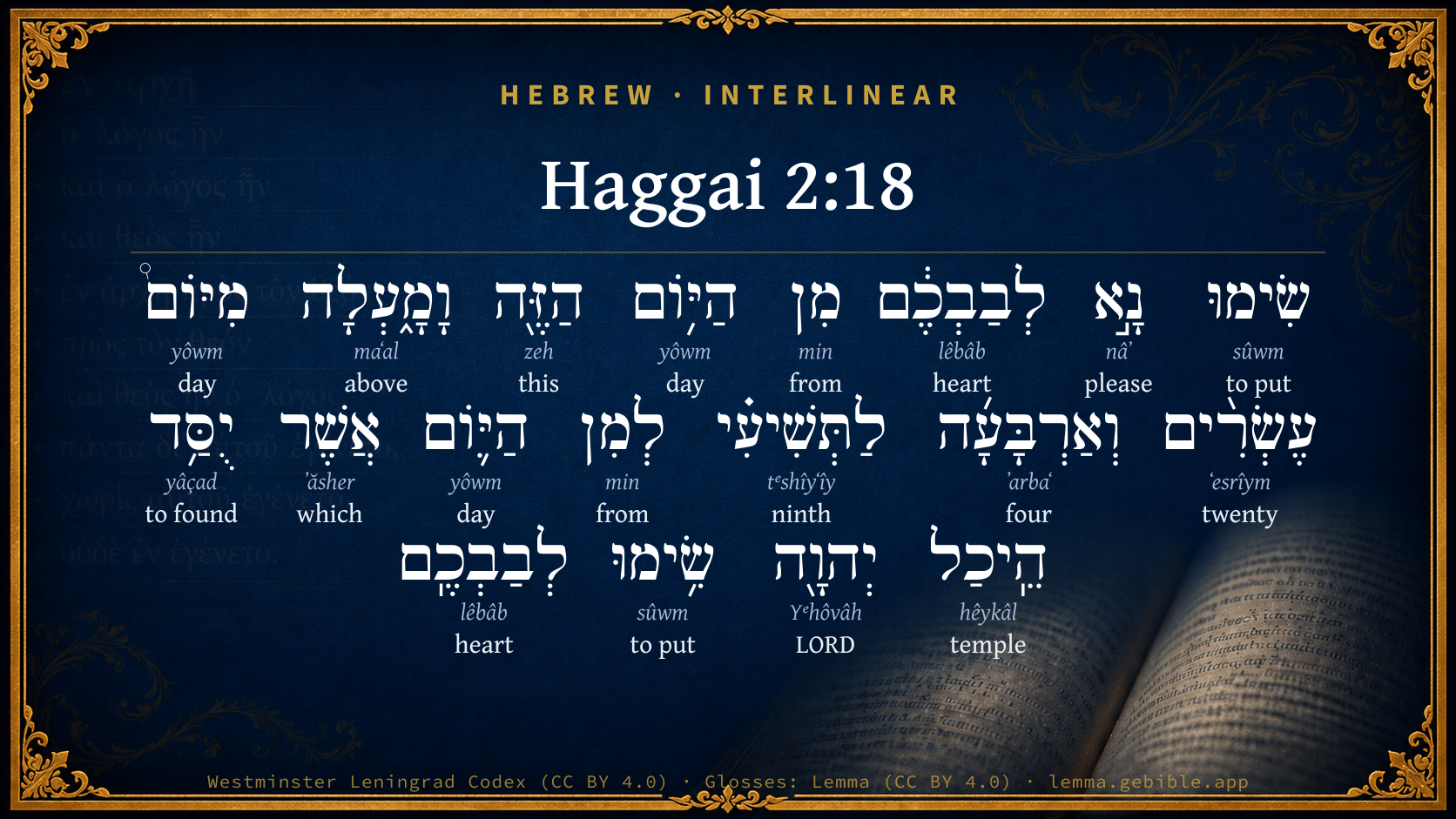
Hebrew (Westminster Leningrad Codex) Haggai 2:18 appears in the Hebrew Old Testament. The text above is from the Westminster Leningrad Codex. Each word links to its Strong’s number, a concise gloss, and parsing drawn from the Open Scriptures Hebrew Bible morphology. Click any word for its full Brown-Driver-Briggs (BDB) entry.
Download image
Cite this verse

Haggai 2:18 (World English Bible). Public Domain. Lemma interlinear Bible study tool, https://lemma.gebible.app/v/haggai/2/18.

Show BibTeX & RIS
BibTeX
RIS
English Translation
'Consider, please, from this day and backward, from the twenty-fourth day of the ninth month, since the day that the foundation of Yahweh's temple was laid, consider it.
World English Bible · Public Domain
Download a study sheet

One document with this verse’s original text, its word-by-word gloss line, the meaning frame, cross-references with their text, attributed commentary, and full source and license credits — printable, and it pastes into notes with its structure intact.

This verse Autodidact and up

Study sheet (.html) Plain text (.txt)

A passage Seminary Student

Up to 50 verses in one chapter. A passage sheet keeps up to 6 commentary sources and 12 cross-references per verse, in the order this page ranks them, and says so on the sheet whenever that leaves anything out. Ask for a single verse and you get the Autodidact verse sheet above.

Everything on this page stays free to read, with no account — the sheet is a download of what is already on screen, not access to it.

Want to remove ads? Support Godless Engineer
Compare translations 3

The same verse in 3 English versions, stacked beneath the original-language interlinear above. Click any original word for its lexicon entry.

Each is an independent rendering of the whole verse — the interlinear is not word-aligned to these translations.

Highlighted words mark where these versions differ — a whole-verse word diff, not a word-by-word alignment.

  • World English Bible Public Domain
    'Consider, please, from this day and backward, from the twenty-fourth day of the ninth month, since the day that the foundation of Yahweh's temple was laid, consider it.
  • King James Version Public Domain
    Consider now from this day and upward, from the four and twentieth day of the ninth month, even from the day that the foundation of the LORD's temple was laid, consider it.
  • unfoldingWord Literal Text CC BY-SA 4.0
    ‘Now set your hearts from before until this day, from the day that the temple of Yahweh was founded until this twenty-fourth day of the ninth. Set your hearts!

unfoldingWord Literal Text — © unfoldingWord, licensed CC BY-SA 4.0. Word-aligned USFM3 via Door43 (git.door43.org/unfoldingWord/en_ult).

Versions to compare (up to 4)

3 of 4 selected

Show all 18 translations

Every available English version of this verse, each an independent rendering of the whole verse.

  • World English Bible Public Domain
    'Consider, please, from this day and backward, from the twenty-fourth day of the ninth month, since the day that the foundation of Yahweh's temple was laid, consider it.
  • Berean Standard Bible Public Domain
    Consider carefully from this day forward—from the twenty-fourth day of the ninth month, the day the foundation of the LORD’s temple was laid—consider carefully:
  • Majority Standard Bible Public Domain
    Consider carefully from this day forward—from the twenty-fourth day of the ninth month, the day the foundation of the LORD’s temple was laid—consider carefully:
  • King James Version Public Domain
    Consider now from this day and upward, from the four and twentieth day of the ninth month, even from the day that the foundation of the LORD's temple was laid, consider it.
  • American Standard Version (1901) Public Domain
    Consider, I pray you, from this day and backward, from the four and twentieth day of the ninth `month', since the day that the foundation of Jehovah's temple was laid, consider it.
  • Revised Version (1885) Public Domain
    Consider, I pray you, from this day and upward, from the four and twentieth day of the ninth month, since the day that the foundation of the LORD’S temple was laid, consider it.
  • Geneva Bible (1599) Public Domain
    I smote you with blasting, and with mildewe, and with haile, in all the labours of your hands: yet you turned not to me, saith the Lord.
  • Douay-Rheims (1899) Public Domain
    I struck you with a blasting wind, and all the works of your hand with the mildew and with hail, yet there was none among you that returned to me, saith the Lord.
  • Young's Literal Translation Public Domain
    Set `it', I pray you, to your heart, from this day and onwards, from the twenty and fourth day of the ninth `month', even from the day that the temple of Jehovah hath been founded, set `it' to your heart.
  • Literal Standard Version CC BY-SA 4.0
    “Now set [it] to your heart, from this day and onward, from the twenty-fourth day of the ninth [month], even from the day that the temple of YHWH has been founded, set [it] to your heart.
  • Unlocked Literal Bible CC BY-SA 4.0
    Consider from this day forward, from the twenty-fourth day of the ninth month, from the day that the foundation of Yahweh's temple was laid. Consider it!
  • unfoldingWord Literal Text CC BY-SA 4.0
    ‘Now set your hearts from before until this day, from the day that the temple of Yahweh was founded until this twenty-fourth day of the ninth. Set your hearts!
  • Darby Bible Public Domain
    Consider, I pray you, from this day and onward, from the four and twentieth day of the ninth [month], from the day that the foundation of Jehovah's temple was laid, consider [it].
  • World Messianic Bible Public Domain
    ‘Consider, please, from this day and backward, from the twenty-fourth day of the ninth month, since the day that the foundation of the LORD’s temple was laid, consider it.
  • Webster's Bible Public Domain
    Consider now from this day, and upward, from the four and twentieth day of the ninth month, even from the day that the foundation of the LORD'S temple was laid, consider it.
  • Free Bible Version CC BY-SA 4.0
    Think about what you're doing from this day on, today the twenty-fourth day of the ninth month when a foundation was laid for the house of the Lord. Think about it:
  • Bible in Basic English Public Domain
    And now, give thought; looking on from this day, from the twenty-fourth day of the ninth month, from the time when the base of the Lord's house was put in its place, give thought to it.
  • JPS Tanakh (1917) Public Domain
    consider, I pray you, from this day and forward, from the four and twentieth day of the ninth month, even from the day that the foundation of the LORD'S temple was laid, consider it;

Literal Standard Version (2020), Covenant Press — licensed CC BY-SA 4.0. Text via the HelloAO Bible API (eBible.org). Unlocked Literal Bible (unfoldingWord) — licensed CC BY-SA 4.0. Text via the HelloAO Bible API (eBible.org). unfoldingWord Literal Text — © unfoldingWord, licensed CC BY-SA 4.0. Word-aligned USFM3 via Door43 (git.door43.org/unfoldingWord/en_ult). Free Bible Version, Dr. Jonathan Gallagher — licensed CC BY-SA 4.0. Text via the HelloAO Bible API (eBible.org).

Word by word

More ways to search: Search by grammar → Find every occurrence → Compare this word →

Practice this passage: Drill this verse → Learn its vocabulary →

לַתְּשִׁיעִ֗י
tᵉshîyʻîy
H8671
“to/for the · ninth”
Preposition, Determined + Adjective, Ordinal number, Masculine, Singular, Absolute
Part of Speech
Preposition + Adjective
Type
Ordinal number
Gender
Masculine
Number
Singular
State
Absolute
Full BDB Definition

Origin: ordinal from H8672

TWOT: 2551

ninth (as ordinal number)
  1. שִׂימוּ sûwm H7760 “put” Verb, Qal, Imperative, 2nd Person, Masculine, Plural
  2. נָ֣א nâʼ H4994 “please” Particle, Exhortation
  3. לְבַבְכֶ֔ם lêbâb H3824 “heart · your” Noun, Common, Masculine, Singular, Construct + Suffix, Personal, 2nd Person, Masculine, Plural
  4. מִן min H4480 “from” Preposition
  5. הַיּ֥וֹם yôwm H3117 “the · day” Particle, Definite Article + Noun, Common, Masculine, Singular, Absolute
  6. הַזֶּ֖ה zeh H2088 “the · this” Particle, Definite Article + Pronoun, Demonstrative, Masculine, Singular
  7. וָמָ֑עְלָה maʻal H4605 “and · above · toward” Conjunction + Adverb + Suffix, Demonstrative
  8. מִיּוֹם֩ yôwm H3117 “from · day of” Preposition + Noun, Common, Masculine, Singular, Construct
  9. עֶשְׂרִ֨ים ʻesrîym H6242 “twenty” Adjective, Cardinal number, Both, Plural, Absolute
  10. וְאַרְבָּעָ֜ה ʼarbaʻ H702 “and · four” Conjunction + Adjective, Cardinal number, Masculine, Singular, Absolute
  11. לְמִן min H4480 “to/for · from” Preposition + Preposition
  12. הַיּ֛וֹם yôwm H3117 “the · day” Particle, Definite Article + Noun, Common, Masculine, Singular, Absolute
  13. אֲשֶׁר ʼăsher H834 “which” Particle, Relative
  14. יֻסַּ֥ד yâçad H3245 “to found” Verb, Pual, Perfect, 3rd Person, Masculine, Singular
  15. הֵֽיכַל hêykâl H1964 “temple of” Noun, Common, Masculine, Singular, Construct
  16. יְהוָ֖ה Yᵉhôvâh H3068 “LORD” Noun, Proper
  17. שִׂ֥ימוּ sûwm H7760 “put” Verb, Qal, Imperative, 2nd Person, Masculine, Plural
  18. לְבַבְכֶֽם lêbâb H3824 “heart · your” Noun, Common, Masculine, Singular, Construct + Suffix, Personal, 2nd Person, Masculine, Plural

About this verse

These counts appear in no published source. They are computed here, from the morphology-tagged text and Lemma’s own curated glosses. What Lemma adds →

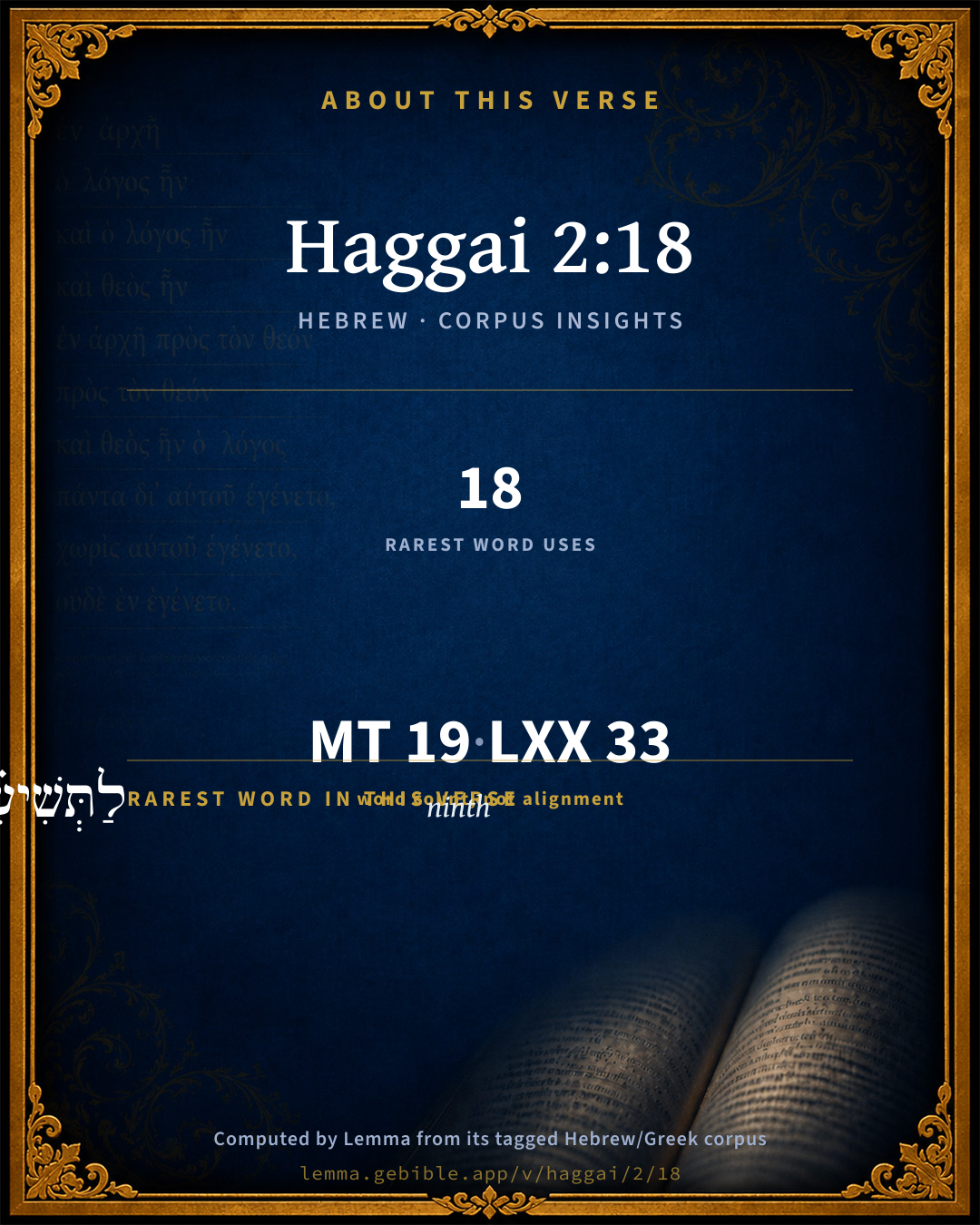
19
words
14
distinct lemmas
Prophets
section

Notable vocabulary

The rarest word here is לַתְּשִׁיעִ֗י ninth H8671 — appearing just 18 times in the whole Hebrew Bible.

Shared distinctive vocabulary

לַתְּשִׁיעִ֗י ninth H8671 occurs in 17 verses of the Hebrew Bible. Also found in:

Grammatical profile

  • 3 verbs
  • 7 nouns
  • 3 adjectives
  • 1 pronoun
  • 2 prepositions
  • 1 adverb
  • 2 particles

Verb forms

  • שִׂימוּ Qal · Imperative
  • יֻסַּ֥ד Pual · Perfect
  • שִׂ֥ימוּ Qal · Imperative

Repetition

Words recur within this verse — often emphatic in Hebrew:

  • הַיּ֥וֹם day H3117 ×3
  • שִׂימוּ to put H7760 ×2
  • לְבַבְכֶ֔ם heart H3824 ×2
  • מִן from H4480 ×2

Hebrew & Septuagint length

In English translation the verse runs 28 words from the Hebrew and 26 from the Septuagint (LXX English) — closely comparable.

A rough comparison of the two English renderings, which tokenize alike — not a word-level alignment.

Word counts can differ between the Hebrew and the Greek without any difference in meaning — e.g. the Hebrew direct-object marker אֵת has no separate Greek word, and Greek often adds the article ὁ.

In the original languages it is 19 Hebrew tokens and 33 Greek tokens — but the two are counted differently (Hebrew bundles its prefixes and suffixes into one token; the Greek is in lemma form), so that isn’t a like-for-like length.

Cross-references

8

Topical passages linked to Haggai 2:18 in the Treasury of Scripture Knowledge — connected by theme and wording, ordered by reader-vote popularity; previews shown in the World English Bible.

  • Zechariah 8:9 Thus says Yahweh of Hosts: "Let your hands be strong, you who hear in these days these words from the mouth of the prophets who were in the day that the foundation of the house of Yahweh of Hosts was laid, even the temple, that it might be built.
  • Ezra 5:1–2 Now the prophets, Haggai the prophet, and Zechariah the son of Iddo, prophesied to the Jews who were in Judah and Jerusalem; in the name of the God of Israel [prophesied they] to them.
  • Haggai 2:15 Now, please consider from this day and backward, before a stone was laid on a stone in the temple of Yahweh.
  • Zechariah 8:12 "For the seed of peace and the vine will yield its fruit, and the ground will give its increase, and the heavens will give their dew; and I will cause the remnant of this people to inherit all these things.
  • Deuteronomy 32:29 Oh that they were wise, that they understood this, That they would consider their latter end!
  • Haggai 1:14–15 Yahweh stirred up the spirit of Zerubbabel, the son of Shealtiel, governor of Judah, and the spirit of Joshua, the son of Jehozadak, the high priest, and the spirit of all the remnant of the people; and they came and worked on the house of Yahweh of Hosts, their God,
  • Haggai 2:10 In the twenty-fourth day of the ninth month, in the second year of Darius, the Word of Yahweh came by Haggai the prophet, saying,
  • Luke 15:17–20 But when he came to himself he said, 'How many hired servants of my father's have bread enough to spare, and I'm dying with hunger!

Cross-references courtesy of OpenBible.info (CC BY 4.0).

Hebrew and Greek witnesses Masoretic Hebrew ↔ Greek Septuagint

The same verse in the two great witnesses to the Old Testament, shown verse-for-verse.

These are two independent witnesses, not word-aligned to each other, and the Septuagint is shown in lemma (dictionary) form.

Hebrew Haggai 2:18 Masoretic · Westminster Leningrad Codex

שִׂימוּ נָ֣א לְבַבְכֶ֔ם מִן הַיּ֥וֹם הַזֶּ֖ה וָמָ֑עְלָה מִיּוֹם֩ עֶשְׂרִ֨ים וְאַרְבָּעָ֜ה לַתְּשִׁיעִ֗י לְמִן הַיּ֛וֹם אֲשֶׁר יֻסַּ֥ד הֵֽיכַל יְהוָ֖ה שִׂ֥ימוּ לְבַבְכֶֽם

'Consider, please, from this day and backward, from the twenty-fourth day of the ninth month, since the day that the foundation of Yahweh's temple was laid, consider it.

World English Bible · Public Domain

Greek LXX Haggai 2:18 Septuagint · lemma form

ὑποτάσσω δή ὁ καρδία σύ ἀπό ὁ ἡμέρα οὗτος καί ἐπέκεινα ἀπό ὁ τετράς καί εἰκάς ὁ ἔνατος μήν καί ἀπό ὁ ἡμέρα ὅς θεμελιόω ὁ ναός κύριος τίθημι ἐν ὁ καρδία σύ

I struck you with barrenness, and with blasting, and all the works of your hands with hail; yet you⌃ returned not to me, says the Lord.

LXX2012 (modern English Septuagint) · Public Domain

Hebrew: Westminster Leningrad Codex (CC BY 4.0). Greek: Septuagint (public domain); English from LXX2012 (modern English Septuagint) (Public Domain). How the Septuagint differs from the Hebrew →

Targum (Aramaic paraphrase)

1

The Targum is the ancient Jewish Aramaic paraphrase of the Hebrew Scriptures — an interpretive translation, not the Hebrew text itself. Onkelos (literal) and Pseudo-Jonathan (expansive) render the Torah, and Jonathan the Prophets. Coverage is partial: where no permissively-licensed English translation exists for a verse, only the Aramaic is shown. This is verse-level text, not a word-by-word alignment to the Hebrew.

  1. Targum Jonathan Prophets (Joshua–Malachi)
    שַׁווּ כְעַן לִבְּכוֹן מִן יוֹמָא הָדֵין וּלְעֵילָא מִיוֹם עַסְרִין וְאַרְבְּעָא לִתְשִׁיעָאָה לְמִן יוֹמָא דְיִשְׁרֵי לְאִשְׁתַּכְלָלָא הֵיכְלָא דַייָ שַׁווּ לִבְּכוֹן:

    (no public-domain English translation for this verse)

    Targum Jonathan — Aramaic: “Mikraot Gedolot” (public domain). English: “Sefaria Community Translation” (CC0 1.0 (public-domain dedication)); “London "Chaldee Paraphrase," 1871” (public domain). Text via Sefaria.

Commentary

Notes on Haggai 2:18 from classic Christian and Jewish commentators (each source and its license shown beneath its notes). The classic Christian expositions comment on the surrounding passage and are grouped to its opening verse, so a note may address several verses; the Jewish commentaries on the Tanakh (Rashi and others) are per-verse, so they appear only where the commentator wrote on this verse.

Lemma curates 59 commentaries, every one of them public domain or Creative Commons licensed, each selected and text-cleaned for this edition rather than reprinted as found. About our sources →

Trapp's Complete Commentary

John Trapp

Hag 2:18 Consider now from this day and upward, from the four and twentieth day of the ninth [month, even] from the day that the foundation of the LORD’S temple was laid, consider [it].

Ver. 18. Consider now from this day and upward] And see how punctually the time of benediction answereth to the time of your conversion; so that you no sooner begin to build, but I begin to bless. It is said of the men of Issachar, that they were in great account with David because they "had understanding of the times," 1Ch 12:32. It is certainly a point of spiritual prudence to consider the times, and to compare things past with present and future. Time is the wisest of all things, said Thales; the best counsellor, said Plutarch. Truth is the daughter of time, saith another philosopher. {See Trapp on "Hag 2:15"}

John Trapp, A Commentary or Exposition upon All the Books of the Old and New Testament (1647–1656) — public domain. Text from a community e-Sword module.

Joseph Benson's Commentary

Hag 2:18-19. Consider now, from this day and upward — That is, forward. In the 15th verse the prophet exhorted them to reflect upon the calamities they had suffered, from the time the rebuilding of the temple was intermitted. Now he bids them look forward, from the day the building was recommenced, (see Hag 1:15,) and they would find a visible change in their affairs for the better. Even from the day that the foundation was laid, &c. — The prophet expresses the carrying on of the building as if it were laying the foundation anew, because the work had been so long interrupted; (compare Zec 8:9;) but yet there is no doubt to be made that they built upon the same foundation which had been laid some years before, of which we have an account Ezr 3:8, and did not lay a new foundation. Is the seed yet in the barn — Is the harvest already laid up in the barn? or any fruits of the earth gathered in? No, certainly: for this is but the ninth month, (answering to our November,) when no judgment can be formed what will be the increase of the year following; yet, from this time, I promise you the blessing of a fruitful year, as an encouragement to you to carry on the building. Yea, as yet the vine and the fig-tree hath not brought forth — No sign yet appears what vintage you shall have, what store of wine, oil, figs, and pomegranates; yet by the word of God I tell you, you shall be blessed in them all, and have a large produce.

Joseph Benson's Commentary on the Old and New Testaments (1811–1818) — public domain. Text from a community e-Sword module.

Keil & Delitzsch

C. F. Keil & F. Delitzsch

After this appeal to lay to heart the past time during which the blessing had been withheld, Haggai called upon the people in Hag 2:18 and Hag 2:19 to fix their eyes upon the time which was commencing with that very day. Hag 2:18. "Direct your heart, then, from this day and onward, from the four and twentieth day of the ninth (month); namely, from the day when the foundation of the temple of Jehovah was laid, direct your heart. Hag 2:19. Is the seed still in the granary? and even to the vine, and pomegranate, and olive-tree, it has not borne: from this day forward will I bless." The twenty-fourth day of the ninth month was the day on which Haggai uttered this word of God (Hag 2:10). Hence ומעלה in Hag 2:18 is to be understood as denoting the direction towards the future (Itala, Vulg., and many comm.). This is evident partly from the fact, that only in that case can the repetition of שׂימוּ לבבכם in Hag 2:18 (end), and the careful announcement of the point of time (from the twenty-fourth day, etc.), be simply and naturally explained, and partly from the fact that min hayyōm hazzeh (from this day) is not explained here, as in Hag 2:15, by a clause pointing back to the past (like mitterem sūm in Hag 2:15), but simply by a precise notice of the day referred to, and that in the last clause of Hag 2:19 this day is clearly described as the commencement of a new era. For there can be no doubt whatever that in min hayyōm hazzeh in Hag 2:19 the terminus a quo mentioned in Hag 2:18 is resumed. But the time mentioned in Hag 2:18, "from the day that the foundation of the temple was laid," etc., and also the contents of the first two clauses of Hag 2:19, to the effect that there was no more seed in the granary, and that the vine, etc., had not borne, do not appear to harmonize with this. To remove the first of these difficulties, Ros., Maurer, Ewald, and others have taken למן־היּום אשׁר־יסּד as the terminus ad quem, and connected it with the foregoing terminus a quo: "observe the time," which reaches back from the present day, the twenty-fourth of the ninth month, to the day when the foundation of the temple was laid in the reign of Cyrus (Ezr 3:10). They have thus taken למן in the sense of ועד. But it is now generally admitted that this is at variance with the usage of the language; even Ewald and Gesenius acknowledge this (see Ew., Lehrbuch, 218, b, and Ges. Thes. p. 807). למן is never equivalent to עד or ועד, but invariably forms the antithesis to it (compare, for example, Jdg 19:30; Sa2 7:6, and Mic 7:12). Now, since lemin hayyōm cannot mean "to the time commencing with the laying of the foundation of the temple," but must mean "from the day when the foundation of the temple was laid," Hitzig and Koehler have taken למן היּום וגו as an explanatory apposition to מיּום עשׂרים וגו, and assume that through this apposition the twenty-fourth day of the ninth month, in the second year of Darius, is expressly designated as the day on which the foundation was laid for the temple of Jehovah. But this assumption is not only in direct contradiction to Ezr 3:10, where it is stated that the foundation of the temple was laid in the reign of Cyrus, in the second year after the return from Babylon, but also makes the prophet Haggai contradict himself in a manner which can only be poorly concealed by any quid pro quo at variance with the language, viz., (a) by identifying the words of Hag 2:15, "when stone was laid to stone at the temple of Jehovah," which, according to their simple meaning, express the carrying on or continuance of the building, with the laying of the foundation-stone, secondly (b), by understanding the statement, "they did work at the house of Jehovah on the twenty-fourth day of the sixth month" (Hag 1:14-15), not according to its natural meaning as relating to their building upon the foundation already laid, but as signifying the removal of the rubbish and the procuring of wood and stone, that is to say, as referring to the preparations for building; and lastly (c), by explaining אשׁר יסּד וגו in Hag 2:19 as signifying the laying of a fresh or second foundation. These assumptions are so forced, that if there were not a simpler and easier way of removing the difficulty raised, we would rather assume that there had been a corruption of the text.

But the thing is not so desperate as this. In the first place, we must pronounce the opinion that למן היּום וגו is an explanatory apposition to מיּום עשׂרים וגו an unfounded one. The position of the athnach in ומעלה furnishes no tenable proof of this. Nor can the assumption that lemin is synonymous with min be sustained. In support of the statement, "that lemin only differs from min in the greater emphasis with which it is spoken," Ewald (218, b), has merely adduced this passage, Hag 2:18, which is supposed to exhibit this with especial clearness, but in which, as we have just shown, such an assumption yields no appropriate meaning. למן followed by עד or ועד does indeed occur in several instances in such a connection, that it appears to be used instead of the simple min. But if we look more closely at the passages (e.g., Exo 11:7; Jdg 19:30; Sa2 7:6), the ל is never superfluous; and lemin is simply used in cases where the definition so introduced is not closely connected with what goes before, but is meant to be brought out as an independent assertion or additional definition, so that in all such cases the ל "has the peculiar force of a brief allusion to something not to be overlooked, a retrospective glance at the separate parts, or a rapid summary of the whole, like our 'with regard to,' 'as regards' (Lat. quoad);" and it only fails to correspond entirely to this, "from the fact that ל is only expressible in the softest manner, and indeed in our language can hardly be expressed in words at all, though it quite perceptibly yields this sense" (Ewald, 310). למקצת is also used in this sense in Dan 1:18 instead of מקצת (Hag 2:15), whilst in other cases (e.g., in למרחוק in Sa2 7:19) it indicates the direction to a place or towards an object (Ewald, 218, b).

(Note: Koehler's objection to this explanation of lemērâchōq, viz., that with the verb dibber, the object concerning which a person is spoken to, is never introduced with the preposition ל, is groundless. "With verbs of speaking ל yields the same double meaning as אל, according to the context," i.e., it can denote the person spoken to, and the person or thing to which the speaking refers, or about which a person is speaking (cf. Gen 21:7; Num 23:23; Isa 5:1; Mic 2:6; Jer 23:9; Psa 3:3; Psa 11:1; Psa 27:8; and Ewald, 217, c).)

In the verse before us, the ל before מן corresponds exactly to the German anlangend, betreffend, concerning, as to, sc. the time, from the day when the foundation of the temple was laid, and is used to give prominence to this assertion, and by the prominence given to it to preclude any close connection between the definition of the time so introduced and what goes before, and to point to the fact that the following definition contains a fresh subject of discourse. The expression שׂימוּ לבבכם, which closes the sentence commencing with למן היּום, and which would be somewhat tautological and superfluous, if the day of the laying of the foundation of the temple coincided with the twenty-fourth day of the ninth month, also points to this.

What space of time it is to which Haggai gives prominence in these words, as one which they are to lay to heart, is shown in Hag 2:19, "Is the seed still in the granary?" etc. That this question is not to be taken in the sense of a summons to proceed now with good heart to sow the summer crops, which were not sown till January, and therefore were still in the granary, as Hitzig supposes, has been pointed out by Koehler, who also correctly observes that the prophet first of all reminds his hearers of the mournful state of things in the past (not "in the present," as he says), that they may thoroughly appreciate the promise for the future. For even if the question to be answered with "no," viz., whether the corn is still in the granary, were to be referred to the present, what follows, viz., that the fruit-trees have not borne, would not suit this, since not having borne is a past thing, even if it merely related to the last year, although there is no ground for any such limitation of the words. And if in Hag 2:19 the prophet directs the attention of his hearers to the past, we must also understand the chronological datum immediately preceding as relating to the past as well, and must assume that the words from למן היּום in Hag 2:18 to לא נשׂא in Hag 2:19 contain a parenthetical thought; that is to say, we must assume that the prophet, in order to set clearly before their minds the difference between the past when the building of the temple was suspended, and the future commencing with that very day, before promising the blessing of God to be enjoyed in the future, directs another look at the past, and that from the time of the laying of the foundation of the temple in the reign of Cyrus to his own time, and reminds them once more of the want of blessing which they had experienced from that time forth even to the present time. Koehler's objection to this view cannot be sustained. He says, "The Jews are to observe the time from that day forward, namely, from the twenty-fourth day of the ninth month (backwards); the time from the laying of the foundation of the temple in the reign of Cyrus (forwards).... Such a mode of expression seems utterly out of place." But this only affects the erroneous assumption, that the definition "from the day of the laying of the foundation of the temple" is merely a more precise explanation of the previous definition, from the twenty-fourth day of the ninth month, and falls to the ground of itself as soon as these two definitions are separated, as the expression and the matter in hand require. The second objection - namely, that the day of the laying of the foundation of the temple in the reign of Cyrus does not suit as a terminus a quo for the commencement of the withdrawal of the divine favour, or for the infliction of a curse upon the people, inasmuch as the Jews were not punished because they laid the foundation for the house of Jehovah, but simply because they neglected the house of God, that is to say, because they desisted from the building they had already begun - is one that would have some force if an interval of at least one or more years had elapsed between the laying of the foundation of the temple and the suspension of the building. But if the work of building was interrupted immediately after the foundation had been laid, as is evident from Ezr 3:10, as compared with ch. 4, Haggai might with perfect propriety describe the whole time from the laying of the foundation of the temple in the reign of Cyrus to the twenty-fourth day of the ninth month of the second year of Darius as a time without blessing, without there being any necessity for him expressly to deduct the few weeks which elapsed between the laying of the foundation-stone and the suspension of the work of building, any more than the last three months, in which the work had been resumed again. The last three months could hardly be taken into account, because they fell for the most part in the period after the last harvest; so that if this had proved to be a bad one, the cause would be still in force. The prophet could therefore very properly inquire whether the seed was still in the granary, to which they would be obliged to answer No, because the miserable produce of the harvest was already either consumed for the supply of their daily wants, or used up for the sowing which was just ended. זרע, seed, is not what is sown, but what the sowing yields, the corn, as in Lev 27:30; Isa 23:3; Job 39:12. Megūrâh = mammegūrâh in Joe 1:17, a barn or granary, from gūr, ἀγείρεσθαι, congregari. The following words, ועד־הגּפן וגו, are really appended to the thought contained implicite in the first clause: the corn has not borne, and even to the vine, etc., it has borne nothing. נשׂא is indefinite: it has not borne = has borne nothing. It shall be different in future. From this day, i.e., from the twenty-fourth day of the ninth month, Jehovah will bless again, i.e., grant a blessing, namely, so that fruitful seasons will come again, and fields and fruit-trees bear once more. There is no necessity to supply a definite object to אברך.

Keil & Delitzsch — Biblical Commentary on the Old Testament (1861–1891) — public domain (CC PDM 1.0). Text via the HelloAO Bible API. (Old Testament only.)

Tyndale Open Study Notes

Tyndale Open Resources

2:18 Think about this eighteenth day of December, the day: Or On this eighteenth day of December, think about the day; literally Think about this day onward, this twenty-fourth day of the ninth month. Some believe that the phrase “this day” refers to the date of the initial clearing of rubble from the Temple site and the procuring of building materials (September 21, 520 BC; see 1:14-15).

Tyndale Open Study Notes — © Tyndale Open Resources, licensed CC BY-SA 4.0. Text via the HelloAO Bible API.

Jamieson, Fausset & Brown

Robert Jamieson, A. R. Fausset & David Brown

Resumed from Hag 2:15 after Hag 2:16-17, that the blessing in Hag 2:19 may stand in the more marked contrast with the curse in Hag 2:16-17. Affliction will harden the heart, if not referred to God as its author [MOORE].

even from the day that the foundation of . . . temple was laid--The first foundation beneath the earth had been long ago laid in the second year of Cyrus, 535 B.C. (Ezr 3:10-11); the foundation now laid was the secondary one, which, above the earth, was laid on the previous work [TIRINUS]. Or, translate, "From this day on which the temple is being begun," namely, on the foundations long ago laid [GROTIUS]. MAURER translates, "Consider . . . from the four and twentieth day . . . to (the time which has elapsed) from the day on which the foundation . . . was laid." The Hebrew supports English Version.

Jamieson, Fausset & Brown — Commentary Critical and Explanatory on the Whole Bible (1871) — public domain (CC PDM 1.0). Text via the HelloAO Bible API.

Adam Clarke's Commentary

Verse 18. Consider now from this day] I will now change my conduct towards you: from, this day that ye have begun heartily to rebuild my temple, and restore my worship, I will bless you. Whatever you sow, whatever you plant, shall be blessed; your land shall be fruitful, and ye shall have abundant crops of all sorts.

Adam Clarke's Commentary on the Bible (1810–1826) — public domain. Text from a community e-Sword/MySword module.

Ellicott's Commentary for English Readers

(18) Even from the day.—Better, even to the day. The rendering of the Authorised Version makes the passage quite unintelligible, for in no sense can the twenty-fourth day of the ninth month coincide with the day “that the foundation of the Lord’s Temple was laid.” The Temple had been founded fifteen years before, in the second month of the second year of Cyrus (Ezr_3:10). The work of building had been carried on intermittently till within two years of the present time. It had then been entirely suspended, and had only been actively taken in hand after Haggai’s address in the sixth month of this year. The force of the passage is sufficiently plain if we render as above. “In order to make the blessings to be announced in Hag_2:19 appear in strong contrast to the distress pictured in Hag_2:16-17, the prophet repeats the injunction of Hag_2:15, but with a larger range of retrospect. The whole period back to the time when the foundation of the Temple was laid in the reign of Cyrus was more or less one of distress on account of the unfaithfulness of the people; for between that time and the present all the efforts that had been made to complete the work were spasmodic and feeble” (McCurdy). The rendering “even to the day” is quite allowable, though the construction is certainly rare.

A Bible Commentary for English Readers, edited by Charles John Ellicott (1878–1897) — public domain. Text from a community e-Sword module.

The Cambridge Bible for Schools and Colleges

gen. ed. J. J. S. Perowne

18. from this day and upward] The Jews are again exhorted to fix their attention upon the period of time mentioned in ver. 15. It is first described as, from this day and upward, or backward. Then each limit of the period is more clearly defined. “This day” is “the four and twentieth day of the ninth month,” on which this prophecy was uttered, ver. 10. The “upward” or “backward” extends to the other limit from which the reckoning is to be made, viz. “the day that the foundation of the Lord’s temple was laid,” i.e. the day when the actual foundation was completed in the year after their return from Babylon. This is made clearer in R. V. by the substitution of, since the day, for even from the day. This period they are again called upon to “consider,” and to note well the dark cloud of adversity that brooded over it.

The Cambridge Bible for Schools and Colleges (gen. ed. J. J. S. Perowne; Cambridge University Press, 1878–1918) — public domain. Text from a community e-Sword module.

John Gill's Exposition

Is the seed yet in the barn?.... The seed for sowing the land, in order for the next harvest: this is by some answered in the affirmative, it was in the barn, it was not yet sown; this being the ninth month, the month Chisleu, which answers to part of our November; rather it should be in the negative, no, it was just sown; and therefore no conjecture could be made, whether it would be a good harvest, or not; yet the prophet, in the name of the Lord, promises them a good one so long before hand: for the month Chisleu, which was the ninth month, was the last for sowing, and even the first half of that; for so say (r) the Jews,

"half Tisri, all Marchesvan, and half Chisleu, is seed time;''

so that this being that month, seed time must have been just over; and the sense, is there any seed in the barn? no, it is sown; and so, is there any remaining in the granary for the support of families until the next harvest? they knew there were none, or very little: and yet the Lord promises to bless them, so that they should have enough:

yea, as yet the vine, and the fig tree, and the pomegranate, and the olive tree, hath not brought forth; their various fruits; this not being the time of their bearing fruit, for it was winter time; and it could not be said what they would bring forth in their season so long before hand; yet it is suggested by the prophet that they would be very fruitful; which were the principal fruit trees the land of Israel abounded with, Deu 8:8 and on which their comfortable subsistence depended. Kimchi observes, that it may be wondered at that the olive tree should be mentioned, because the time of its bearing fruit were the months of Marchesvan and Chisleu; but perhaps the time of its bearing fruit was delayed (as he says) because of the curse upon it:

from this day will I bless you; with plenty of all good things, in their fields and gardens, in their vineyards and olive yards; so that a difference between former and present times, and those to come, would easily be discerned, and the reasons of it.

(r) T. Bab. Bava Metzia, fol. 106. 2.

John Gill's Exposition of the Whole Bible (1746–1763) — public domain (CC PDM 1.0). Text via the HelloAO Bible API.

Albert Barnes' Notes on the Bible

From the day that the foundation of the Lord’s house - Zechariah, in a passage corresponding to this, uses the same words Zec 8:9, “the day that the foundation of the house of the Lord of hosts was laid, that the temple might be built,” not of the first foundation, but of the work as resumed in obedience to the words by “the mouth of the prophets,” Haggai and himself, which, Ezra also says, was Ezr 4:24; Ezr 5:1. “in the second year of Darius.” But that work was resumed, not now at the time of this prophecy, but three months before, on the 24th of the sixth month. Since then the word translated here, from, is in no case used of the present time, Haggai gives two dates, the resumption of the work, as marked in these words, and the, actual present. He would then say, that even in these last months, since they had begun the work, there were as yet no signs for the better. There was yet no “seed in the barn,” the harvest having been blighted and the fruit-trees stripped by the hail before the close of the sixth month, when they resumed the work. Yet though there were as yet no signs of change, no earnest that the promise should be fulfilled, God pledges His word, “from this day I will bless you.”

Thenceforth, from their obedience, God would give them those fruits of the earth, which in His Providence had been, during their negligence, withheld. “God,” said Paul and Barnabas, Act 14:17. “left not Himself without witness, in that He did good, and gave us rain from heaven and fruitful seasons, filling our hearts with food and gladness.”

All the Old and New Testament, the Law, the prophets and the Psalms, the Apostles and our Lord Himself, bear witness to the Providence of God who makes His natural laws serve to the moral discipline of His creature, man. The physical theory, which presupposes that God so fixed the laws of His creation, as to leave no room for Himself to vary them, would, if ever so true, only come to this, that Almighty God knowing absolutely (as He must know) the actions of His creatures (in what way soever this is reconcilable with our free-agency, of which we are conscious), framed the laws of His physical creation, so that plenty or famine, healthiness of our cattle or of the fruits of the earth or their sickness, should coincide with the good or evil conduct of man, with his prayers or his neglect of prayer. The reward or chastisement alike come to man, whether they be theresult of God’s will, acting apart from any system which He has created, or in it and through it.

It is alike His Providential agency, whether He have established any such system with all its minute variations, or whether these variations are the immediate result of His sovereign will. If He has instituted any physical system, so that the rain, hail, and its proportions, size, destructiveness, should come in a regulated irregularity, as fixed in all eternity as the revolutions of the heavenly bodies or the courses of the comets, then we come only to a more intricate perfection of His creation, that in all eternity He framed those laws in an exact conformity to the perfectly foreseen actions of men good and evil, and to their prayers also: that He, knowing certainly whether the creature, which He has framed to have its bliss in depending on Him, would or would not cry unto Him, framed those physical laws in conformity therewith; so that the supply of what is necessary for our wants or its withholding shall be in all time inworked into the system of our probation. Only, not to keep God out of His own world, we must remember that other truth, that, whether God act in any such system or no, He Heb 1:3. “upholdeth all things by the word of His power” by an everpresent working; so that it is He who at each moment doth what is done, doth and maintains in existence all which He has created in the exact order and variations of their being. Psa 148:8. “Fire and hail, snow and vapor, stormy wind fulfilling His word,” are as immediate results of His Divine Agency, in whatever way it pleaseth Him to act, and are the expression of His will.

Albert Barnes' Notes on the Bible (1834–1885) — public domain. Text from a community e-Sword/MySword module.

Matthew Poole's English Annotations

See Hag 2:15. Make you observation from the day when you began to build on the old foundation laid many years ago in the time of Cyrus.

Consider it; let that be the precise day from which you begin your reckoning. By this the prophet excites them to believe and wait, since he doth in the name of the Lord so expressly promise a blessing, and tells them when it shall begin to come unto them, and would have them observe how truly he speaks.

Matthew Poole's English Annotations on the Holy Bible (1683–1685) — public domain. Text from a community e-Sword/MySword module.

The Pulpit Commentary

Vers. 18, 19. 2. On their obedience the blessings of nature shall again be theirs.

Consider now from this day and upward (see note on ver. 15.) For "upward" Jerome has here in futurum, though he translated the same word supra in ver. 15. Such a rendering is allowable, and affords a good sense, the prophet directing the people"s attention to the happy prospect in the future announced in ver. 19. But it seems, best to keep to the same interpretation in two passages so closely allied. The prophet bids the people consider the period from the present, the four and twentieth day of the ninth month, when this prophecy was uttered (ver. 10), to the other limit explanatory of the term "upward" or "backward." Even from the day that the foundation, etc.; rather, since the day that, etc. This is obviously the same period as that named in ver. 15, after the foundation was completed, but before "stone was laid upon stone" of the superstructure. (comp. Zec_8:9)

The Pulpit Commentary (1880–1919), ed. H.D.M. Spence-Jones & Joseph S. Exell — public domain. Text from a community e-Sword module.

John Wesley's Explanatory Notes

From the day - When you began to build on the old foundation.

John Wesley, Explanatory Notes Upon the Whole Bible (1754–1765) — public domain. Text via the GEBible commentary corpus.

unfoldingWord translationNotes

Door43 World Missions Community

the twenty-fourth day of the ninth month

This is the ninth month of the Hebrew calendar. The twenty-fourth day is near the middle of December on Western calendars. See how you translated this in Haggai 2:10. (See: Hebrew Months and Ordinal Numbers)

the day that the foundation of Yahweh's temple was laid

This can be translated in active form. AT: "the day that you laid the foundation of Yahweh's temple" (See: Active or Passive)

Is there still seed in the storehouse?

Yahweh is preparing the people for the promise he is about to give them. This rhetorical question can be translated as a statement. AT: "You can see that there is no seed in the storehouse." (See: Rhetorical Question)

The vine, the fig tree, the pomegranate, and the olive tree

"Your grape vines, fig trees, pomegranate trees, and olive trees"

the pomegranate

This is a type of sweet fruit. You may need to make explicit that the tree is being spoken of. AT: "the pomegranate tree" (See: Assumed Knowledge and Implicit Information and Translate Unknowns)

translationWords

found

Yahweh

vine

olive

unfoldingWord translationNotes — © Distant Shores Media and the Door43 World Missions Community, licensed CC BY-SA 4.0. Source: git.door43.org/Door43/en_tn.

Rashi

Rabbi Shlomo Yitzchaki (Rashi)

that the Temple of the Lord was founded That now for the second time they began to add to the first foundation that they had built in the days of Cyrus.

Rashi on the Tanakh — English translations: “The Judaica Press complete Tanach with Rashi, translated by A. J. Rosenberg” (CC BY 4.0); “Pentateuch with Rashi's commentary by M. Rosenbaum and A.M. Silbermann, 1929-1934” (public domain); “The Metsudah Tanach series, Lakewood, N.J” (CC BY 4.0); and “The Book of Joshua, Metsudah Publications, 1997” (CC BY 4.0). Text via Sefaria.

Lesson kit

Teaching starters — assembled from the data on this page, not authored interpretation. Every prompt links to the verse data it draws on. Edit before teaching.

Haggai, in the Prophets, opens this verse with 19 words (14 distinct Hebrew lemmas). Its most distinctive word is tᵉshîyʻîy (“ninth”). A historical commentator’s framing appears above. Read the whole chapter for the surrounding context.

Discussion questions

  1. What does “ninth” (tᵉshîyʻîy) contribute to the verse as a whole?
  2. Leviticus 25:22 shares the word «ninth» with this verse. How do the two illuminate each other?
  3. “day” occurs 3× in this one verse. What is the effect of the repetition?
  4. These translations render this verse differently. What is at stake in choosing one wording over another?
  5. The verb «שִׂימוּ» is Qal Imperative. How does its form color the action?
  6. Reading how Trapp's Complete Commentary and Joseph Benson's Commentary read this verse, where do the two commentators agree and where do they part?

Things to notice

Reading settings

Reading text

Shown beneath each verse's original-language words.

Old Testament
Old Testament edition

Read the OT as the Masoretic Hebrew (MT) or the Greek Septuagint (LXX).

English shown for the Greek Septuagint (in the Hebrew ↔ Greek comparison).

Comparing translations? Open the Compare panel on any verse page to stack up to four side by side.