Job 3:4

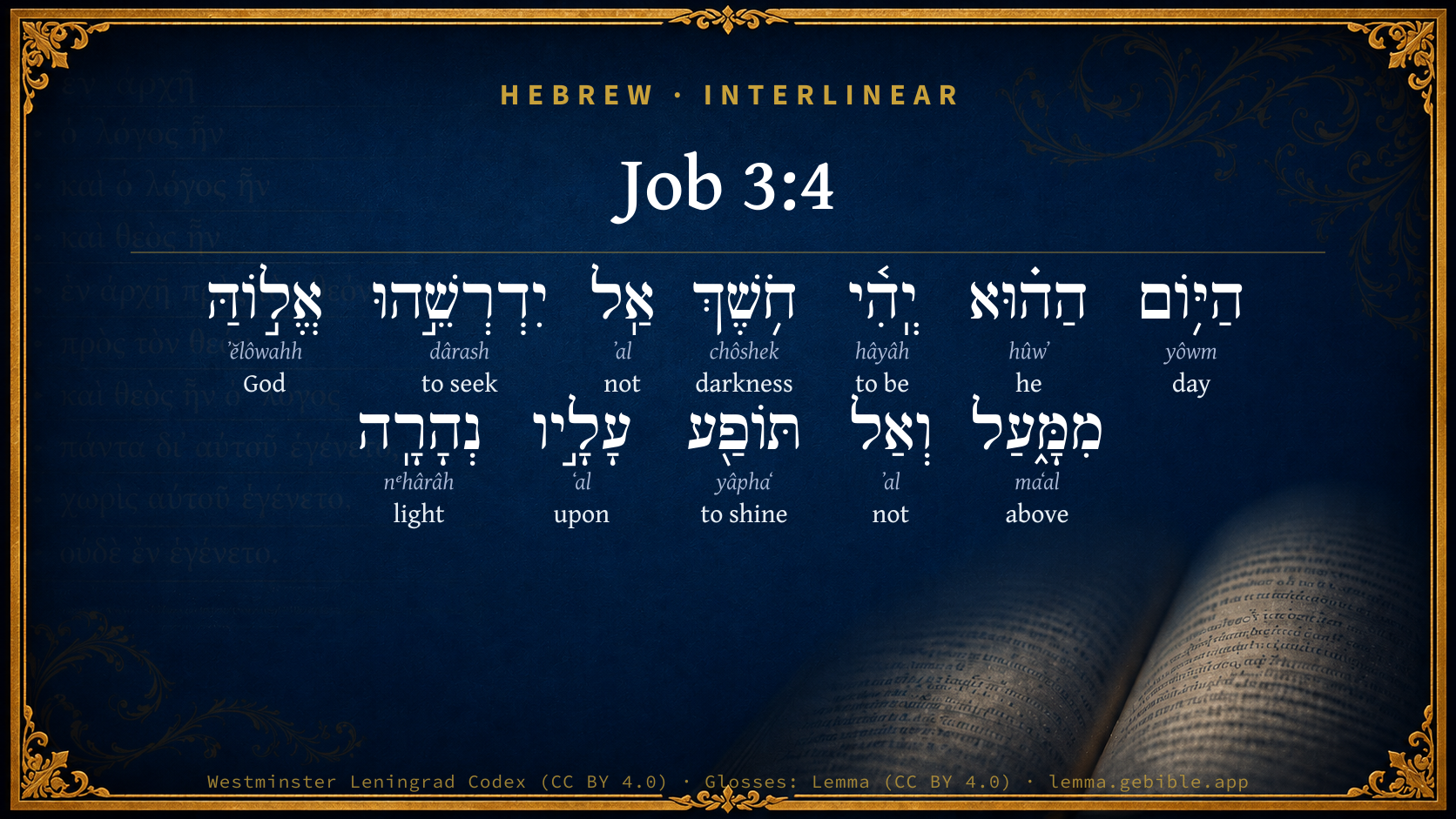
Hebrew (Westminster Leningrad Codex) Job 3:4 appears in the Hebrew Old Testament. The text above is from the Westminster Leningrad Codex. Each word links to its Strong’s number, a concise gloss, and parsing drawn from the Open Scriptures Hebrew Bible morphology. Click any word for its full Brown-Driver-Briggs (BDB) entry.
Download image
Cite this verse

Job 3:4 (World English Bible). Public Domain. Lemma interlinear Bible study tool, https://lemma.gebible.app/v/job/3/4.

Show BibTeX & RIS
BibTeX
RIS
English Translation
Let that day be darkness; Don't let God from above seek for it, Neither let the light shine on it.
World English Bible · Public Domain
Highlights
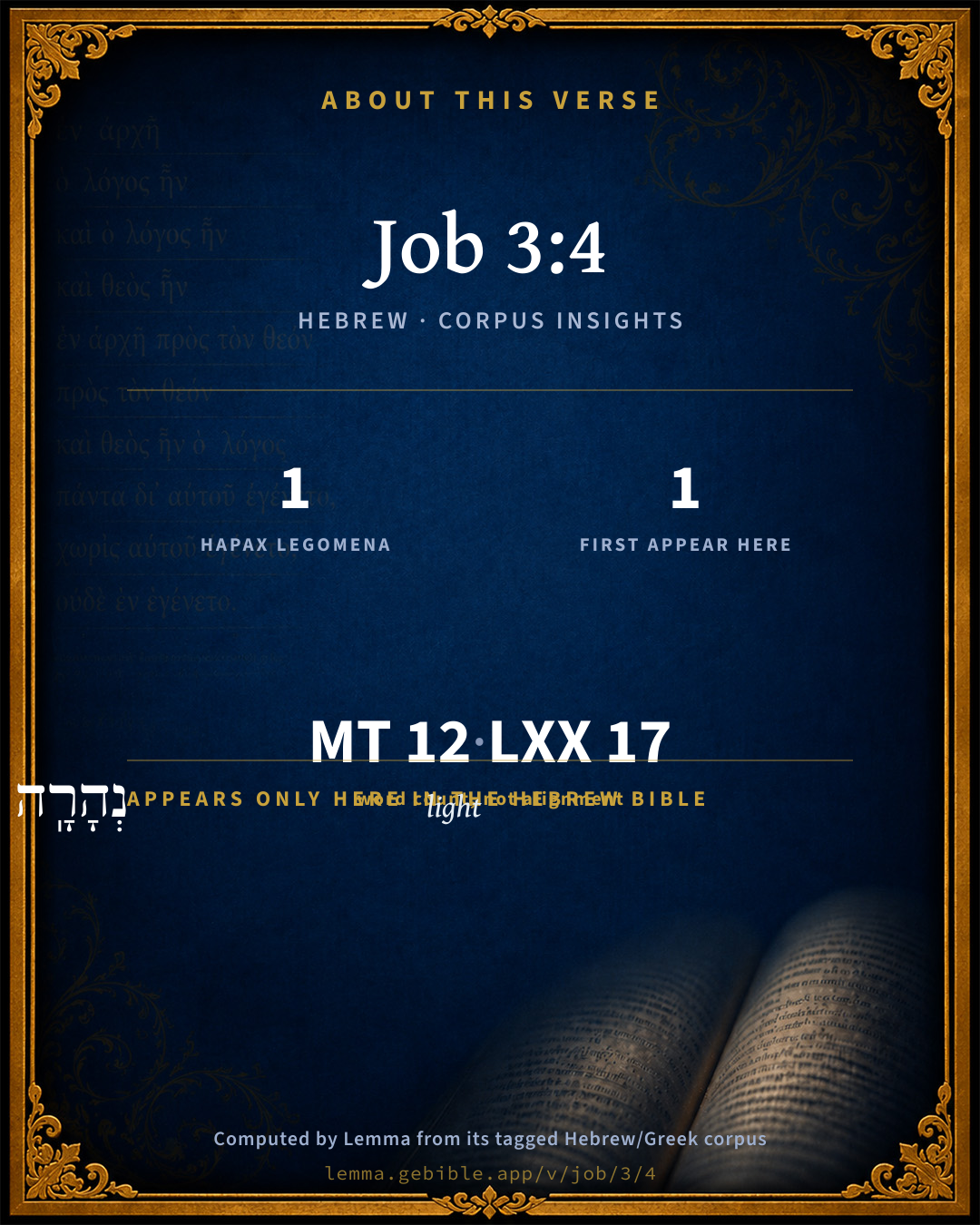
  • 1 hapax legomenon — only here in the Hebrew Bible
  • 1 first appearance in the Hebrew Bible
Full analysis ↓
Download a study sheet

One document with this verse’s original text, its word-by-word gloss line, the meaning frame, cross-references with their text, attributed commentary, and full source and license credits — printable, and it pastes into notes with its structure intact.

This verse Autodidact and up

Study sheet (.html) Plain text (.txt)

A passage Seminary Student

Up to 50 verses in one chapter. A passage sheet keeps up to 6 commentary sources and 12 cross-references per verse, in the order this page ranks them, and says so on the sheet whenever that leaves anything out. Ask for a single verse and you get the Autodidact verse sheet above.

Everything on this page stays free to read, with no account — the sheet is a download of what is already on screen, not access to it.

Want to remove ads? Support Godless Engineer
Compare translations 3

The same verse in 3 English versions, stacked beneath the original-language interlinear above. Click any original word for its lexicon entry.

Each is an independent rendering of the whole verse — the interlinear is not word-aligned to these translations.

Highlighted words mark where these versions differ — a whole-verse word diff, not a word-by-word alignment.

  • World English Bible Public Domain
    Let that day be darkness; Don't let God from above seek for it, Neither let the light shine on it.
  • King James Version Public Domain
    Let that day be darkness; let not God regard it from above, neither let the light shine upon it.
  • unfoldingWord Literal Text CC BY-SA 4.0
    That day—may it be dark! May God not seek it from above, and may light not shine upon it.

unfoldingWord Literal Text — © unfoldingWord, licensed CC BY-SA 4.0. Word-aligned USFM3 via Door43 (git.door43.org/unfoldingWord/en_ult).

Versions to compare (up to 4)

3 of 4 selected

Show all 18 translations

Every available English version of this verse, each an independent rendering of the whole verse.

  • World English Bible Public Domain
    Let that day be darkness; Don't let God from above seek for it, Neither let the light shine on it.
  • Berean Standard Bible Public Domain
    If only that day had turned to darkness! May God above disregard it; may no light shine upon it.
  • Majority Standard Bible Public Domain
    If only that day had turned to darkness! May God above disregard it; may no light shine upon it.
  • King James Version Public Domain
    Let that day be darkness; let not God regard it from above, neither let the light shine upon it.
  • American Standard Version (1901) Public Domain
    Let that day be darkness; Let not God from above seek for it, Neither let the light shine upon it.
  • Revised Version (1885) Public Domain
    Let that day be darkness; let not God regard it from above, neither let the light shine upon it.
  • Geneva Bible (1599) Public Domain
    Let that day bee darkenesse, let not God regarde it from aboue, neyther let the light shine vpon it,
  • Douay-Rheims (1899) Public Domain
    Let that day be turned into darkness, let not God regard it from above, and let not the light shine upon it.
  • Young's Literal Translation Public Domain
    That day -- let it be darkness, Let not God require it from above, Nor let light shine upon it.
  • Literal Standard Version CC BY-SA 4.0
    That day—let it be darkness, || Do not let God require it from above, || Nor let light shine on it.
  • Unlocked Literal Bible CC BY-SA 4.0
    May that day be dark; may not God from above call it to mind, neither may the sun shine on it.
  • unfoldingWord Literal Text CC BY-SA 4.0
    That day—may it be dark! May God not seek it from above, and may light not shine upon it.
  • Darby Bible Public Domain
    That day -- let it be darkness, let not +God care for it from above, neither let light shine upon it:
  • World Messianic Bible Public Domain
    Let that day be darkness. Don’t let God from above seek for it, neither let the light shine on it.
  • Webster's Bible Public Domain
    Let that day be darkness; let not God regard it from above, neither let the light shine upon it.
  • Free Bible Version CC BY-SA 4.0
    Turn that day to darkness. God above should not remember it. Don't let light shine on it.
  • Bible in Basic English Public Domain
    That day--let it be dark; let not God take note of it from on high, and let not the light be shining on it;
  • JPS Tanakh (1917) Public Domain
    Let that day be darkness; let not God inquire after it from above, neither let the light shine upon it.

Literal Standard Version (2020), Covenant Press — licensed CC BY-SA 4.0. Text via the HelloAO Bible API (eBible.org). Unlocked Literal Bible (unfoldingWord) — licensed CC BY-SA 4.0. Text via the HelloAO Bible API (eBible.org). unfoldingWord Literal Text — © unfoldingWord, licensed CC BY-SA 4.0. Word-aligned USFM3 via Door43 (git.door43.org/unfoldingWord/en_ult). Free Bible Version, Dr. Jonathan Gallagher — licensed CC BY-SA 4.0. Text via the HelloAO Bible API (eBible.org).

Word by word

More ways to search: Search by grammar → Find every occurrence → Compare this word →

Practice this passage: Drill this verse → Learn its vocabulary →

נְהָרָֽה
nᵉhârâh
H5105
“light”
Noun, Common, Feminine, Singular, Absolute
Part of Speech
Noun
Type
Common
Gender
Feminine
Number
Singular
State
Absolute
Full BDB Definition

Origin: from H5102 in its original sense

TWOT: 1316a

light, daylight
  1. הַיּ֥וֹם yôwm H3117 “the · day” Particle, Definite Article + Noun, Common, Masculine, Singular, Absolute
  2. הַה֗וּא hûwʼ H1931 “the · he” Particle, Definite Article + Pronoun, Personal, 3rd Person, Masculine, Singular
  3. יְֽהִ֫י hâyâh H1961 “to be” Verb, Qal, Jussive, 3rd Person, Masculine, Singular
  4. חֹ֥שֶׁךְ chôshek H2822 “darkness” Noun, Common, Masculine, Singular, Absolute
  5. אַֽל ʼal H408 “not” Particle, Negative
  6. יִדְרְשֵׁ֣הוּ dârash H1875 “to seek · him” Verb, Qal, Jussive, 3rd Person, Masculine, Singular + Suffix, Personal, 3rd Person, Masculine, Singular
  7. אֱל֣וֹהַּ ʼĕlôwahh H433 “God” Noun, Common, Masculine, Singular, Absolute
  8. מִמָּ֑עַל maʻal H4605 “from · above” Preposition + Adverb
  9. וְאַל ʼal H408 “and · not” Conjunction + Particle, Negative
  10. תּוֹפַ֖ע yâphaʻ H3313 “to shine” Verb, Hiphil, Jussive, 3rd Person, Feminine, Singular
  11. עָלָ֣יו ʻal H5921 “upon · him” Preposition + Suffix, Personal, 3rd Person, Masculine, Singular

About this verse

These counts appear in no published source. They are computed here, from the morphology-tagged text and Lemma’s own curated glosses. What Lemma adds →

12
words
11
distinct lemmas
Wisdom
section

Notable vocabulary

1 hapax legomenon — a word that appears only here in the entire Hebrew Bible:

  • נְהָרָֽה light H5105

First appearance in Scripture

This word makes its first canonical appearance in the Hebrew Bible here:

  • נְהָרָֽה light H5105

Shared distinctive vocabulary

תּוֹפַ֖ע to shine H3313 occurs in 8 verses of the Hebrew Bible. Also found in:

Grammatical profile

  • 3 verbs
  • 4 nouns
  • 1 pronoun
  • 1 preposition
  • 1 adverb
  • 2 particles

Verb forms

  • יְֽהִ֫י Qal · Jussive
  • יִדְרְשֵׁ֣הוּ Qal · Jussive
  • תּוֹפַ֖ע Hiphil · Jussive

Repetition

A word recurs within this verse — often emphatic in Hebrew:

  • אַֽל not H408 ×2

Hebrew & Septuagint length

In English translation the verse runs 20 words from the Hebrew and 20 from the Septuagint (LXX English) — the same length.

A rough comparison of the two English renderings, which tokenize alike — not a word-level alignment.

Word counts can differ between the Hebrew and the Greek without any difference in meaning — e.g. the Hebrew direct-object marker אֵת has no separate Greek word, and Greek often adds the article ὁ.

In the original languages it is 12 Hebrew tokens and 17 Greek tokens — but the two are counted differently (Hebrew bundles its prefixes and suffixes into one token; the Greek is in lemma form), so that isn’t a like-for-like length.

Cross-references

7

Topical passages linked to Job 3:4 in the Treasury of Scripture Knowledge — connected by theme and wording, ordered by reader-vote popularity; previews shown in the World English Bible.

  • Exodus 10:22–23 Moses stretched forth his hand toward the sky, and there was a thick darkness in all the land of Egypt three days.
  • Deuteronomy 11:12 a land which Yahweh your God cares for: the eyes of Yahweh your God are always on it, from the beginning of the year even to the end of the year.
  • Joel 2:2 A day of darkness and gloominess, A day of clouds and thick darkness. As the dawn spreading on the mountains, A great and strong people; There has never been the like, Neither will there be any more after them, Even to the years of many generations.
  • Amos 5:18 "Woe to you who desire the day of Yahweh! Why do you long for the day of Yahweh? It is darkness, And not light.
  • Matthew 27:45 Now from the sixth hour there was darkness over all the land until the ninth hour.
  • Acts 27:20 When neither sun nor stars shone on us for many days, and no small tempest pressed on us, all hope that we would be saved was now taken away.
  • Revelation 16:10 The fifth poured out his bowl on the throne of the beast, and his kingdom was darkened. They gnawed their tongues because of the pain,

Cross-references courtesy of OpenBible.info (CC BY 4.0).

Hebrew and Greek witnesses Masoretic Hebrew ↔ Greek Septuagint

The same verse in the two great witnesses to the Old Testament, shown verse-for-verse.

These are two independent witnesses, not word-aligned to each other, and the Septuagint is shown in lemma (dictionary) form.

Hebrew Job 3:4 Masoretic · Westminster Leningrad Codex

הַיּ֥וֹם הַה֗וּא יְֽהִ֫י חֹ֥שֶׁךְ אַֽל יִדְרְשֵׁ֣הוּ אֱל֣וֹהַּ מִמָּ֑עַל וְאַל תּוֹפַ֖ע עָלָ֣יו נְהָרָֽה

Let that day be darkness; Don't let God from above seek for it, Neither let the light shine on it.

World English Bible · Public Domain

Greek LXX Job 3:4 Septuagint · lemma form

ὁ ἡμέρα ἐκεῖνος εἰμί σκότος καί μή ἀναζητέω αὐτός ὁ κύριος ἄνωθεν μηδέ ἔρχομαι εἰς αὐτός φέγγος

Let that night be darkness, and let not the Lord regard it from above, neither let light come upon it.

LXX2012 (modern English Septuagint) · Public Domain

Hebrew: Westminster Leningrad Codex (CC BY 4.0). Greek: Septuagint (public domain); English from LXX2012 (modern English Septuagint) (Public Domain). How the Septuagint differs from the Hebrew →

Commentary

Notes on Job 3:4 from classic Christian and Jewish commentators (each source and its license shown beneath its notes). The classic Christian expositions comment on the surrounding passage and are grouped to its opening verse, so a note may address several verses; the Jewish commentaries on the Tanakh (Rashi and others) are per-verse, so they appear only where the commentator wrote on this verse.

Lemma curates 59 commentaries, every one of them public domain or Creative Commons licensed, each selected and text-cleaned for this edition rather than reprinted as found. About our sources →

Jamieson, Fausset & Brown

Robert Jamieson, A. R. Fausset & David Brown

let not God regard it--rather, more poetically, "seek it out." "Let not God stoop from His bright throne to raise it up from its dark hiding-place." The curse on the day in Job 3:3, is amplified in Job 3:4-5; that on the night, in Job 3:6-10.

Jamieson, Fausset & Brown — Commentary Critical and Explanatory on the Whole Bible (1871) — public domain (CC PDM 1.0). Text via the HelloAO Bible API.

Trapp's Complete Commentary

John Trapp

Job 3:4 Let that day be darkness; let not God regard it from above, neither let the light shine upon it.

Ver. 4. Let that day be darkness] Thick darkness, as that once was in Egypt, Exo 10:28. A day of trouble and distress, a day of darkness and gloominess, a day of clouds and thick darkness, Zep 1:15. Let it be a dreadful and a dismal day, let sorrow and sadness overshadow it, let mourning and tears overwhelm it; let it be as when the sun hideth his head in a mantle of black, and is eclipsed; at which time all creatures here below flag and hang the head. In the gloomiest day there is light enough to make it day, and distinguish it from night, though the sun shine not. But Job would have no light to appear on his birthday. Thus he throweth out words without wisdom, and as hinds by calving, so he by talking casteth out his sorrows, Job 39:3.

Let not God regard it] Or require it; let it pass as not worth looking after, let him not take care of it, or pour down any special blessing upon it, as he doth upon his people every day, but especially upon the Sabbath Day, God’s market day, called by the Jews desiderium dierum, the desire of days, and by the Primitive Christians Dies lucis, the day of light.

Neither let the light shine upon it] And what is the air without light, that first ornament of the visible world? so what are all creature comforts, unless God shine through them? What a woeful case is that poor soul in that walketh in darkness, and hath none of his light, Isa 50:10; how lamentably is such a one deserted, benighted! how doth he find himself in the very suburbs of hell itself, where the pain of loss is greater than the pain of sense, 2Th 1:9. And to note thus much, Job here, after he had said, Let that day be darkness, added as a greater evil, Let not the light shine upon it.

John Trapp, A Commentary or Exposition upon All the Books of the Old and New Testament (1647–1656) — public domain. Text from a community e-Sword module.

Albert Barnes' Notes on the Bible

Let that day be darkness - Let it not be day; or, O, that it had not been day, that the sun had not risen, and that it had been night.

Let not God regard it from above - The word rendered here “regard” דרשׁ dârash means properly to seek or inquire after, to ask for or demand. Dr. Good renders it here, “Let not God inclose it,” but this meaning is not found in the Hebrew. Noyes renders it literally, “Let not God seek it.” Herder, “Let not God inquire after it.” The sense may be, either that Job wished the day sunk beneath the horizon, or in the deep waters by which he conceived the earth to be surrounded, and prays that God would not seek it and bring it from its dark abode; or he desired that God would never inquire after it, that it might pass from his remembrance and be forgotten. What we value, we would wish God to remember and bless; what we dislike, we would wish him to forget. This seems to be the idea here. Job hated that day, and he wished all other beings to forget it. He wished it blotted out, so that even God would never inquire after it, but regard it as if it had never been.

Neither let the light shine upon it - Let it be utter darkness; let not a ray ever reveal it. It will be seen here that Job first curses “the day.” The amplification of the curse with which he commenced in the first part of Job 3:3, continues through Job 3:4-5; and then he returns to the “night,” which also (in the latter part of Job 3:3) he wished to be cursed. His desires in regard to that unhappy night, he expresses in Job 3:6-10.

Albert Barnes' Notes on the Bible (1834–1885) — public domain. Text from a community e-Sword/MySword module.

Joseph Benson's Commentary

Job 3:4. Let that day be darkness — I wish the sun had never risen on that day; or, which is the same thing, that it had never been: and whensoever that day returns, instead of the cheering and refreshing beams of light arising upon it, I wish it may be covered with gross, thick darkness, and rendered black, gloomy, and uncomfortable; let not God regard it from above — From heaven, by causing the light of heaven to visit it; or, let God make no more inquiry after it than if such a day had never been. Dr. Waterland renders it, Let not God take account of it.

Joseph Benson's Commentary on the Old and New Testaments (1811–1818) — public domain. Text from a community e-Sword module.

Geneva Bible (1599)

Geneva Bible translators

Let it be put out of the number of days, and let it not have the light of the Sun to separate it from the night.

Geneva Bible (1599) marginal notes — public domain. Text via Bolls.life.

Adam Clarke's Commentary

Verse 4. Let that day be darkness] The meaning is exactly the same with our expression, "Let it be blotted out of the calendar." However distinguished it may have been, as the birthday of a man once celebrated for his possessions, liberality, and piety, let it no longer be thus noted; as he who was thus celebrated is now the sport of adversity, the most impoverished, most afflicted, and most wretched of human beings.

Let not God regard it from above] אל ידרשהו al yidreshehu, "Let Him not require it" - let Him not consider it essential to the completion of the days of the year; and therefore he adds, neither let the light shine upon it. If it must be a part of duration, let it not be distinguished by the light of the sun.

Adam Clarke's Commentary on the Bible (1810–1826) — public domain. Text from a community e-Sword/MySword module.

Ellicott's Commentary for English Readers

(4) Regard.—Literally, require, ask for, and so manifest care about. (Comp. Deu_11:12.)

A Bible Commentary for English Readers, edited by Charles John Ellicott (1878–1897) — public domain. Text from a community e-Sword module.

The Cambridge Bible for Schools and Colleges

gen. ed. J. J. S. Perowne

4. regard it] lit. seek after it, or care for it. Let it perish from His mind that He cause no sun to rise upon it.

The Cambridge Bible for Schools and Colleges (gen. ed. J. J. S. Perowne; Cambridge University Press, 1878–1918) — public domain. Text from a community e-Sword module.

John Gill's Exposition

Let that day be darkness,.... Not only dark, but darkness itself, extremely dark; and which is to be understood not figuratively of the darkness of affliction and calamity; this Job would not wish for, either for himself, who had enough of that, or for others; but literally of gross natural darkness, that was horrible and dreadful, as some (x) render it: this was the reverse of what God said at the creation, "let there be light", Gen 1:3, and there was, and he called it day; but Job wishes his day might be darkness, as the night; either that it had been always dark, and never become day, or in its return be remarkably dark and gloomy:

let not God regard it, from above; that is, either God who is above, and on high, the High and Holy One, the Most High God, and who is higher than the highest, and so this is a descriptive character of him; or else this respects the place where he is, the highest heaven, where is his throne, and from whence he looks and takes notice of the sons of men, and of all things done below: and this wish must be understood consistent with his omniscience, who sees and knows all persons and things, even what are done in the dark, and in the darkest days; for the darkness and the light are alike to him; and as consistent with his providence, which is continually exercised about persons and things on earth without any intermission, even on every day in the year; and was it to cease one day, hour, or moment, all would be dissolved, and be thrown into the utmost confusion and disorder: but Job means the smiles of his providence, which he wishes might be restrained on this day; that he would not cause his sun in the heavens to shine out upon it, nor send down gentle and refreshing showers of rain on it; in which sense he is said to care for and regard the land of Canaan, Deu 11:11; where the same word is used as here; or the sense is, let it be so expunged from the days of the year, the when it is sought for, and if even it should be by God himself, let it not be found; or let him not "seek" (y) after it, to do any good upon it:

neither let the light shine upon it; the light of the sun, or the morning light, as the Targum, much less the light at noonday; even not the diurnal light, as Schmidt interprets it, in any part of the day: light is God's creature, and very delightful and desirable; the best things, and the most comfortable enjoyments, whether temporal, spiritual, or eternal, are expressed by it; and, on the other hand, a state of darkness is the most uncomfortable, and therefore the worst and most dismal things and states are signified by it.

(x) "horrens", Caligo, Schultens. (y) "ne requirat", Montanus, &c.

John Gill's Exposition of the Whole Bible (1746–1763) — public domain (CC PDM 1.0). Text via the HelloAO Bible API.

Matthew Poole's English Annotations

I wish the sun had never risen upon that day to make it day, or, which is all one, that it had never been; and whensoever that day returns, I wish it may be black, and gloomy, and uncomfortable, and therefore execrable and odious to all men.

From above, i.e. from heaven; either,

1. By causing the light of the sun which is in heaven to shine upon it. So it agrees both with the foregoing and following branches of this verse. Or,

2. By blessing and favouring it, or by giving his blessings to men upon it. Let it be esteemed by all an unlucky and comfortless day. Or, Let not God require it, i. e. bring it again in its course, as other days return. In this sense God is said to require that which is past, Ecc 3:15. Compare Job 3:3,6.

Matthew Poole's English Annotations on the Holy Bible (1683–1685) — public domain. Text from a community e-Sword/MySword module.

Whedon's Commentary on the Bible

Daniel D. Whedon

4. Let… regard it — Literally, not seek it out, דרשׁ. That is, not concern himself about it; “so that it may remain without light, on the supposition that each single day owes its light to an especial care of God.” — Dillmann.

Daniel D. Whedon (gen. ed.), Commentary on the Old and New Testaments (1874–1909) — public domain. Text from a community e-Sword module.

The Pulpit Commentary

Let that day be darkness; i.e. let a cloud rest upon it let it be regarded as a day of ill omen, "carbone notandus." Job recognizes that his wish, that the day should perish utterly, is vain, and limits himself now to the possible. Let not God regard it from above; i.e. let not God, from the heaven where he dwells, extend to it his protection and superintending care. Neither let the light shine upon it. Pleonastic, but having the sort of force which belongs to reiteration.

The Pulpit Commentary (1880–1919), ed. H.D.M. Spence-Jones & Joseph S. Exell — public domain. Text from a community e-Sword module.

John Wesley's Explanatory Notes

Darkness - I wish the sun had never risen upon that day, or, which is all one, that it had never been; and whensoever that day returns, I wish it may be black, and gloomy, and uncomfortable. Regard - From heaven, by causing the light of the sun which is in heaven to shine upon it.

John Wesley, Explanatory Notes Upon the Whole Bible (1754–1765) — public domain. Text via the GEBible commentary corpus.

unfoldingWord translationNotes

Door43 World Missions Community

General Information:

The expressions in these verses are all wishes that the day of Job's birth would no longer exist. This may imply that the day, although in the past, still existed somehow. The UDB translates them as expressions of sadness about what that day was like.

May that day be dark ... neither may the sun shine on it

These two clauses describe the darkness of the day of Job's birth, thus repeating Job's regret that he had been born. (See: Parallelism)

May that day be dark

This is a wish for that day to not exist any longer. AT: "may that day disappear" (See: Metaphor)

May darkness and the shadow of death claim it for their own

Here darkness and the shadow of death are spoken of as if they were people who could claim something as their own possession. The word "it" refers to the day of Job's birth. (See: Personification)

the shadow of death

Here a shadow represents death itself. AT: "death like a shadow" (See: Metaphor)

May a cloud live over it

Here a cloud is spoken of as if it were a person who could live over the day of Job's birth. AT: "May a cloud cover it so no one can see it" (See: Metaphor)

everything that makes the day black

This refers to things that block out the sun's light and create darkness. Here "black" represents darkness. (See: Metaphor)

terrify it

"terrify that day." The day is spoken of as if it were a person who could be terrified by the darkness. (See: Personification)

translationWords

darkness

shadow

unfoldingWord translationNotes — © Distant Shores Media and the Door43 World Missions Community, licensed CC BY-SA 4.0. Source: git.door43.org/Door43/en_tn.

Rashi

Rabbi Shlomo Yitzchaki (Rashi)

May that day be dark constantly; every year, when that day arrives.

let God not seek it from above for good.

and let no light shine upon it Heb. נהרה, light, like צהר, which is translated נהור.

Rashi on the Tanakh — English translations: “The Judaica Press complete Tanach with Rashi, translated by A. J. Rosenberg” (CC BY 4.0); “Pentateuch with Rashi's commentary by M. Rosenbaum and A.M. Silbermann, 1929-1934” (public domain); “The Metsudah Tanach series, Lakewood, N.J” (CC BY 4.0); and “The Book of Joshua, Metsudah Publications, 1997” (CC BY 4.0). Text via Sefaria.

Lesson kit

Teaching starters — assembled from the data on this page, not authored interpretation. Every prompt links to the verse data it draws on. Edit before teaching.

Job, in the Wisdom, opens this verse with 12 words (11 distinct Hebrew lemmas). Its most distinctive word is nᵉhârâh (“light”). A historical commentator’s framing appears above. Read the whole chapter for the surrounding context.

Discussion questions

  1. The word nᵉhârâh carries the sense “light.” How does it shape the verse?
  2. This verse holds 1 word here found nowhere else in the Hebrew Bible. What might the rare word draw attention to?
  3. The word “light” first appears here in Scripture. What is being introduced at this debut?
  4. Deuteronomy 33:2 shares the word «to shine» with this verse. How do the two illuminate each other?
  5. “not” occurs 2× in this one verse. What is the effect of the repetition?
  6. These translations render this verse differently. What is at stake in choosing one wording over another?
  7. The verb «יְֽהִ֫י» is Qal Jussive. How does its form color the action?
  8. Reading how Jamieson, Fausset & Brown and Trapp's Complete Commentary read this verse, where do the two commentators agree and where do they part?

Things to notice

  • 1 word in this verse appears nowhere else in the Hebrew Bible.
  • 1 word makes its first canonical appearance in Scripture here.
  • This verse counts 12 Hebrew ↔ 17 Greek words.
  • These translations choose different wording for 11 words in this verse.
  • “not” occurs 2× in this single verse.

Reading settings

Reading text

Shown beneath each verse's original-language words.

Old Testament
Old Testament edition

Read the OT as the Masoretic Hebrew (MT) or the Greek Septuagint (LXX).

English shown for the Greek Septuagint (in the Hebrew ↔ Greek comparison).

Comparing translations? Open the Compare panel on any verse page to stack up to four side by side.