
Isaiah 7:11

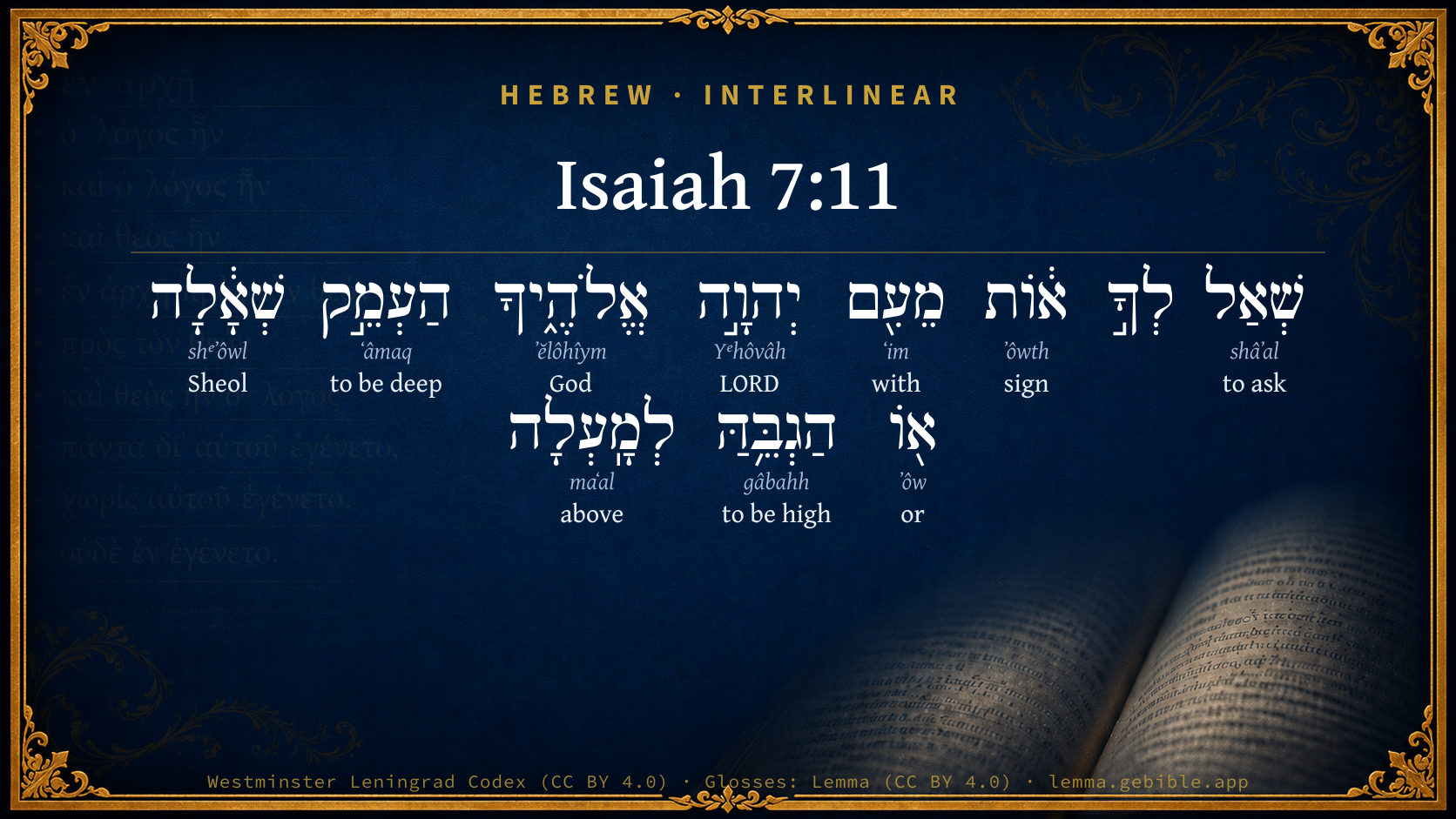
Hebrew (Westminster Leningrad Codex) Isaiah 7:11 appears in the Hebrew Old Testament. The text above is from the Westminster Leningrad Codex. Each word links to its Strong’s number, a concise gloss, and parsing drawn from the Open Scriptures Hebrew Bible morphology. Click any word for its full Brown-Driver-Briggs (BDB) entry.
Download image
Cite this verse

Isaiah 7:11 (World English Bible). Public Domain. Lemma interlinear Bible study tool, https://lemma.gebible.app/v/isaiah/7/11.

Show BibTeX & RIS
BibTeX
RIS
English Translation
"Ask a sign of Yahweh your God; ask it either in the depth, or in the height above."
World English Bible · Public Domain
Download a study sheet

One document with this verse’s original text, its word-by-word gloss line, the meaning frame, cross-references with their text, attributed commentary, and full source and license credits — printable, and it pastes into notes with its structure intact.

This verse Autodidact and up

Study sheet (.html) Plain text (.txt)

A passage Seminary Student

Up to 50 verses in one chapter. A passage sheet keeps up to 6 commentary sources and 12 cross-references per verse, in the order this page ranks them, and says so on the sheet whenever that leaves anything out. Ask for a single verse and you get the Autodidact verse sheet above.

Everything on this page stays free to read, with no account — the sheet is a download of what is already on screen, not access to it.

Want to remove ads? Support Godless Engineer
Compare translations 3

The same verse in 3 English versions, stacked beneath the original-language interlinear above. Click any original word for its lexicon entry.

Each is an independent rendering of the whole verse — the interlinear is not word-aligned to these translations.

Highlighted words mark where these versions differ — a whole-verse word diff, not a word-by-word alignment.

  • World English Bible Public Domain
    "Ask a sign of Yahweh your God; ask it either in the depth, or in the height above."
  • King James Version Public Domain
    Ask thee a sign of the LORD thy God; ask it either in the depth, or in the height above.
  • unfoldingWord Literal Text CC BY-SA 4.0
    “Ask a sign for yourself from Yahweh your God. Make deep Sheol or make high to above.”

unfoldingWord Literal Text — © unfoldingWord, licensed CC BY-SA 4.0. Word-aligned USFM3 via Door43 (git.door43.org/unfoldingWord/en_ult).

Versions to compare (up to 4)

3 of 4 selected

Show all 18 translations

Every available English version of this verse, each an independent rendering of the whole verse.

  • World English Bible Public Domain
    "Ask a sign of Yahweh your God; ask it either in the depth, or in the height above."
  • Berean Standard Bible Public Domain
    “Ask for a sign from the LORD your God, whether from the depths of Sheol or the heights of heaven.”
  • Majority Standard Bible Public Domain
    “Ask for a sign from the LORD your God, whether from the depths of Sheol or the heights of heaven.”
  • King James Version Public Domain
    Ask thee a sign of the LORD thy God; ask it either in the depth, or in the height above.
  • American Standard Version (1901) Public Domain
    Ask thee a sign of Jehovah thy God; ask it either in the depth, or in the height above.
  • Revised Version (1885) Public Domain
    Ask thee a sign of the LORD thy God; ask it either in the depth, or in the height above.
  • Geneva Bible (1599) Public Domain
    Aske a signe for thee of the Lord thy God: aske it, either in the depth beneath or in the height aboue.
  • Douay-Rheims (1899) Public Domain
    Ask thee a sign of the Lord thy God either unto the depth of hell, or unto the height above.
  • Young's Literal Translation Public Domain
    `Ask for thee a sign from Jehovah thy God, Make deep the request, or make `it' high upwards.'
  • Literal Standard Version CC BY-SA 4.0
    “Ask for a sign from your God YHWH, || Make the request deep, or make [it] high upwards.”
  • Unlocked Literal Bible CC BY-SA 4.0
    “Ask a sign of Yahweh your God; ask for it in the depths or in the height above.”
  • unfoldingWord Literal Text CC BY-SA 4.0
    “Ask a sign for yourself from Yahweh your God. Make deep Sheol or make high to above.”
  • Darby Bible Public Domain
    Ask for thee a sign from Jehovah thy God; ask for it in the deep, or in the height above.
  • World Messianic Bible Public Domain
    “Ask a sign of the LORD your God; ask it either in the depth, or in the height above.”
  • Webster's Bible Public Domain
    Ask thee a sign from the LORD thy God; ask it either in the depth, or in the hight above.
  • Free Bible Version CC BY-SA 4.0
    “Ask the Lord your God for a sign, whether as deep as where people are buried or as high as heaven.”
  • Bible in Basic English Public Domain
    Make a request to the Lord your God for a sign, a sign in the deep places of the underworld, or in the high heavens.
  • JPS Tanakh (1917) Public Domain
    'Ask thee a sign of the LORD thy God: ask it either in the depth, or in the height above.'

Literal Standard Version (2020), Covenant Press — licensed CC BY-SA 4.0. Text via the HelloAO Bible API (eBible.org). Unlocked Literal Bible (unfoldingWord) — licensed CC BY-SA 4.0. Text via the HelloAO Bible API (eBible.org). unfoldingWord Literal Text — © unfoldingWord, licensed CC BY-SA 4.0. Word-aligned USFM3 via Door43 (git.door43.org/unfoldingWord/en_ult). Free Bible Version, Dr. Jonathan Gallagher — licensed CC BY-SA 4.0. Text via the HelloAO Bible API (eBible.org).

Word by word

More ways to search: Search by grammar → Find every occurrence → Compare this word →

Practice this passage: Drill this verse → Learn its vocabulary →

About this verse

These counts appear in no published source. They are computed here, from the morphology-tagged text and Lemma’s own curated glosses. What Lemma adds →

11
words
10
distinct lemmas
Prophets
section

Notable vocabulary

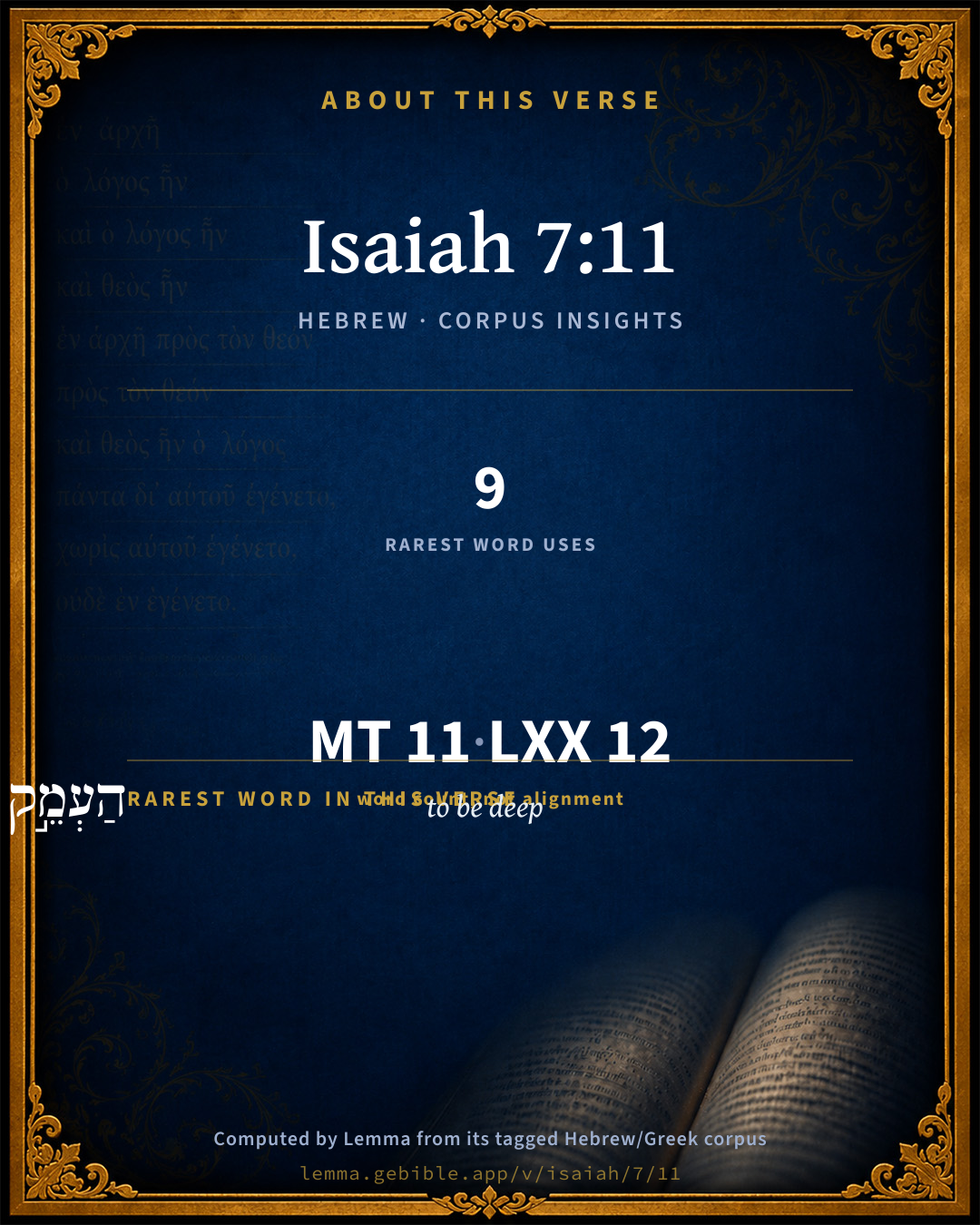
The rarest word here is הַעְמֵ֣ק to be deep H6009 — appearing just 9 times in the whole Hebrew Bible.

Shared distinctive vocabulary

הַעְמֵ֣ק to be deep H6009 occurs in 9 verses of the Hebrew Bible. Also found in:

Grammatical profile

  • 4 verbs
  • 3 nouns
  • 2 prepositions
  • 1 conjunction
  • 1 adverb

Verb forms

  • שְׁאַל Qal · Imperative
  • הַעְמֵ֣ק Hiphil · Infinitive Absolute
  • שְׁאָ֔לָה Qal · Infinitive Construct
  • הַגְבֵּ֥הַּ Hiphil · Infinitive Absolute

Hebrew & Septuagint length

In English translation the verse runs 18 words from the Hebrew and 17 from the Septuagint (LXX English) — closely comparable.

A rough comparison of the two English renderings, which tokenize alike — not a word-level alignment.

Word counts can differ between the Hebrew and the Greek without any difference in meaning — e.g. the Hebrew direct-object marker אֵת has no separate Greek word, and Greek often adds the article ὁ.

In the original languages it is 11 Hebrew tokens and 12 Greek tokens — but the two are counted differently (Hebrew bundles its prefixes and suffixes into one token; the Greek is in lemma form), so that isn’t a like-for-like length.

Cross-references

11

Topical passages linked to Isaiah 7:11 in the Treasury of Scripture Knowledge — connected by theme and wording, ordered by reader-vote popularity; previews shown in the World English Bible.

  • Isaiah 37:30 This shall be the sign to you: you shall eat this year that which grows of itself, and in the second year that which springs of the same; and in the third year sow you, and reap, and plant vineyards, and eat the fruit of it.
  • Isaiah 38:7–8 This shall be the sign to you from Yahweh, that Yahweh will do this thing that he has spoken:
  • 2 Kings 19:29 This shall be the sign to you: You shall eat this year that which grows of itself, and in the second year that which springs of the same; and in the third year sow you, and reap, and plant vineyards, and eat the fruit of it.
  • Judges 6:36–40 Gideon said to God, If you will save Israel by my hand, as you have spoken,
  • 2 Kings 20:8–11 Hezekiah said to Isaiah, What shall be the sign that Yahweh will heal me, and that I shall go up to the house of Yahweh the third day?
  • Isaiah 38:22 Hezekiah also had said, What is the sign that I shall go up to the house of Yahweh?
  • Jeremiah 19:10 Then shall you break the bottle in the sight of the men who go with you,
  • Matthew 12:38–40 Then certain of the scribes and Pharisees answered, "Teacher, we want to see a sign from you."
  • Jeremiah 19:1 Thus said Yahweh, Go, and buy a potter's earthen bottle, and [take] of the elders of the people, and of the elders of the priests;
  • Jeremiah 51:63–64 It shall be, when you have made an end of reading this book, that you shall bind a stone to it, and cast it into the midst of the Euphrates:
  • Matthew 16:1–4 The Pharisees and Sadducees came, and testing him, asked him to show them a sign from heaven.

Cross-references courtesy of OpenBible.info (CC BY 4.0).

Hebrew and Greek witnesses Masoretic Hebrew ↔ Greek Septuagint

The same verse in the two great witnesses to the Old Testament, shown verse-for-verse.

These are two independent witnesses, not word-aligned to each other, and the Septuagint is shown in lemma (dictionary) form.

Hebrew Isaiah 7:11 Masoretic · Westminster Leningrad Codex

שְׁאַל לְךָ֣ א֔וֹת מֵעִ֖ם יְהוָ֣ה אֱלֹהֶ֑יךָ הַעְמֵ֣ק שְׁאָ֔לָה א֖וֹ הַגְבֵּ֥הַּ לְמָֽעְלָה

"Ask a sign of Yahweh your God; ask it either in the depth, or in the height above."

World English Bible · Public Domain

Greek LXX Isaiah 7:11 Septuagint · lemma form

αἰτέω σεαυτοῦ σημεῖον παρά κύριος θεός σύ εἰς βάθος ἤ εἰς ὕψος

Ask for yourself a sign of the Lord your God, in the depth or in the height.

LXX2012 (modern English Septuagint) · Public Domain

Hebrew: Westminster Leningrad Codex (CC BY 4.0). Greek: Septuagint (public domain); English from LXX2012 (modern English Septuagint) (Public Domain). How the Septuagint differs from the Hebrew →

Targum (Aramaic paraphrase)

1

The Targum is the ancient Jewish Aramaic paraphrase of the Hebrew Scriptures — an interpretive translation, not the Hebrew text itself. Onkelos (literal) and Pseudo-Jonathan (expansive) render the Torah, and Jonathan the Prophets. Coverage is partial: where no permissively-licensed English translation exists for a verse, only the Aramaic is shown. This is verse-level text, not a word-by-word alignment to the Hebrew.

  1. Targum Jonathan Prophets (Joshua–Malachi)
    שְׁאַל לָךְ אָתָא מִן קֳדָם יְיָ אֱלָהָךְ שְׁאַל דִי יִתְעֲבֵיד לָךְ נֵס עַל אַרְעָא אוֹ תִתְחֲזֵי לָךְ אָת בִּשְׁמַיָא:

    Ask thee a sign from before the presence of the Lord, that a miracle may be done for thee upon the earth, or that a sign may be shewn thee in heaven.

    Targum Jonathan — Aramaic: “Mikraot Gedolot” (public domain). English: “Sefaria Community Translation” (CC0 1.0 (public-domain dedication)); “London "Chaldee Paraphrase," 1871” (public domain). Text via Sefaria.

Commentary

Notes on Isaiah 7:11 from classic Christian and Jewish commentators (each source and its license shown beneath its notes). The classic Christian expositions comment on the surrounding passage and are grouped to its opening verse, so a note may address several verses; the Jewish commentaries on the Tanakh (Rashi and others) are per-verse, so they appear only where the commentator wrote on this verse.

Lemma curates 59 commentaries, every one of them public domain or Creative Commons licensed, each selected and text-cleaned for this edition rather than reprinted as found. About our sources →

Trapp's Complete Commentary

John Trapp

Isa 7:11 Ask thee a sign of the LORD thy God; ask it either in the depth, or in the height above.

Ver. 11. Ask the sign of the Lord.] Not of any other God, to whom thou art addicted.

Thy God.] From whom thou hast deeply revolted; but of whom thou mightest upon thy return be graciously reaccepted.

Ask it either in the depth.] This was a fair offer to so foul a sinner; but all would not do - no, though he should have had a sight of heaven or of hell for a sign; and yet Bellarmine thinketh that one glimpse of hell were enough to work upon the most hard hearted sinner in the world, and to make him yield to anything.

John Trapp, A Commentary or Exposition upon All the Books of the Old and New Testament (1647–1656) — public domain. Text from a community e-Sword module.

The Biblical Illustrator

Joseph S. Exell

Isa_7:11

Ask thee a sign of the Lord thy God

Gods grace towards the wayward

Jehovah does not scorn to call Himself the God of this son of David who so hardens himself.

(F. Delitzsch, D. D.)

A critical moment

In this hour when Isaiah stands before Ahaz, the fate of the Jewish people is decided for more than two thousand years. (F. Delitzsch, D. D.)

The Biblical Illustrator, edited by Joseph S. Exell (c. 1880s–1900s) — public domain. Text from a community e-Sword module.

Tyndale Open Study Notes

Tyndale Open Resources

7:11 A sign of confirmation would be performed before Ahaz’s eyes as a token of God’s truthfulness. His son Hezekiah would also receive such a sign (see 37:30).

Tyndale Open Study Notes — © Tyndale Open Resources, licensed CC BY-SA 4.0. Text via the HelloAO Bible API.

Geneva Bible (1599)

Geneva Bible translators

For the confirmation of this thing that thine enemies shall be destroyed and thou preserved.

Geneva Bible (1599) marginal notes — public domain. Text via Bolls.life.

Jamieson, Fausset & Brown

Robert Jamieson, A. R. Fausset & David Brown

Ask thee--since thou dost not credit the prophet's words.

sign--a miraculous token to assure thee that God will fulfil His promise of saving Jerusalem (Isa 37:30; Isa 38:7-8). "Signs," facts then present or near at hand as pledges for the more distant future, are frequent in Isaiah.

ask . . . in . . . depth--literally, "Make deep . . . ask it," that is, Go to the depth of the earth or of Hades [Vulgate and LOWTH], or, Mount high for it (literally, "Make high"). So in Mat 16:1. Signs in heaven are contrasted with the signs on earth and below it (raising the dead) which Jesus Christ had wrought (compare Rom 10:6-7). He offers Ahaz the widest limits within which to make his choice.

Jamieson, Fausset & Brown — Commentary Critical and Explanatory on the Whole Bible (1871) — public domain (CC PDM 1.0). Text via the HelloAO Bible API.

Adam Clarke's Commentary

Verse 11. In the depth - "Go deep to the grave"] So Aquila, Symmachus, Theodotion, and the Vulgate.

Adam Clarke's Commentary on the Bible (1810–1826) — public domain. Text from a community e-Sword/MySword module.

The Cambridge Bible for Schools and Colleges

gen. ed. J. J. S. Perowne

11. Ask thee a sign] The “sign” (’ôth, móphçth, here the former), plays a very large part in O.T. religion and with considerable latitude of meaning. The most important cases are those in which a divine revelation is attested by some striking event within the range of immediate perception through the senses. Such a sign may be a supernatural occurrence conveying an irresistible persuasion of the divine agency (ch. Isa_38:7; Isa_38:22; Exo_7:8 ff.; Jdg_6:17; Jdg_6:36 ff.; 1Ki_13:1 ff.). But it may also be an ordinary event, which acquires significance through its having been foretold, or asked for (Gen_24:14; 1Sa_10:2 ff; 1Sa_14:10; Luk_2:12). Thus of two predicted events the nearer may be made a “sign” of the more remote (1Sa_2:34; Jer_44:29 f.). Or, in a still more general sense, the “sign” may be merely an incident of the fulfilled prediction, which carries the mind back to the time of the prophecy, when the sign was appointed (Exo_3:12; Isa_37:30). That for which a sign is here offered to Ahaz is the certainty of divine help, or (what is the same thing) the truth that God speaks to him through the prophet. Although Isaiah was undoubtedly prepared to give a miraculous sign (see next clause) it is not to be at once assumed that the sign actually given (Isa_7:14 ff.) must be of the same order.

ask it either in the depth … above] Lit.: going deep to Sheol or mounting high above (reading shì’ôlâh for shì’âlâh). It is thought by some that this translation could be obtained from the actual Hebrew vocalisation, but this is doubtful. It is at all events the one that would be most readily suggested by an unpointed text, and it is justified by the antithetic structure of the sentence. The whole realm of creation, from the heavens to the underworld, is as it were put at the disposal of Ahaz for the purpose of this sign. It has been said that Isaiah played a dangerous game in staking his reputation on so unbounded a choice. Undoubtedly he did, if he was not speaking under genuine divine inspiration.

The Cambridge Bible for Schools and Colleges (gen. ed. J. J. S. Perowne; Cambridge University Press, 1878–1918) — public domain. Text from a community e-Sword module.

John Gill's Exposition

Ask thee a sign of the Lord thy God,.... For though Ahaz was a wicked man, yet the Lord was his God, as he was the God of the people of Israel in general, as a nation; and knowing his unbelief and diffidence of his word unto him, offers to confirm it by a sign or miracle:

ask it either in the depth, or in the height above, in earth, or in heaven: so the Targum,

"ask that a miracle may be done for thee upon earth, or that a sign may be shown thee in heaven;''

either that the earth might gape and open its mouth, as in the days of Moses; or that the sun might stand still, as in the times of Joshua; or that a dead man might be raised out of the depth of the earth; or that there might be some strange appearances in the heavens.

John Gill's Exposition of the Whole Bible (1746–1763) — public domain (CC PDM 1.0). Text via the HelloAO Bible API.

Albert Barnes' Notes on the Bible

Ask thee - Ask for “thyself;” ask a sign that shall be convincing to “thyself,” since thou dost not fully credit the words of the prophet. It is evident that the words of the prophet had made no impression on the mind of Ahaz. God, therefore, proposes to him to ask any “proof or demonstration” which he might select; anything that would be an indication of divine power that should put what the prophet had said beyond doubt. Had Ahaz put confidence in God, he would have believed what the prophet said without miraculous proof. But he had no such confidence. ‘The prophet, therefore, proposes that he should ask any miraculous demonstration that what he said would come to pass. This proposition was made, probably, not so much from respect to Ahaz as to leave him without excuse, and in order that “the people” might have the assurance that the city and kingdom were safe.

A sign - A demonstration that shall confirm the promise now made, and that shall be an evidence that Jerusalem shall be safe. The word used here, and translated “sign” - ‘owt - אות 'ôth - means “a flag,” or “a standard,” Num 2:2; “a memorial or pledge” of a covenant, Gen 17:11; any “pledge, token, or proof” of a divine mission, Jdg 6:17; or a miracle performed in attestation of a divine promise or message. This is its sense here. That which Isaiah had spoken seemed highly improbable to Ahaz, and he asked him to seek a proof of it, if he doubted, by any prodigy or miracle. It was customary for miracles or prodigies to be exhibited on similar occasions; see Isa 38:7, where the shadow on the dial of this same Ahaz was carried backward ten degrees, in proof of what the prophet Isaiah had spoken; compare 1Sa 2:27-34; 1Ki 13:1-3; Exo 3:12; Jdg 6:36-40. That the word here refers to some event which could be brought about only by divine power, is evident from the whole connection. No mere natural occurrence could have satisfied Ahaz, or convey to the people a demonstration of the truth of what the prophet was saying. And if the prophet had been unable or unwilling to give a miraculous sign, where is the fitness of the answer of Ahaz? How could he be regarded as in any way tempting God by asking it, unless it was something which God only could do? And how could the prophet bring the charge Isa 7:13, that he had not merely offended men, but God also? It is clear, therefore, that Isaiah was conscious that he was invested by God with the power of working a miracle, and that he proposed to perform any miracle which Ahaz should suggest that would serve to remove his doubts, and lead him to put confidence in God.

Ask it either in the depth ... - He gave him his choice of a miracle - any sign or wonder in heaven, or on earth - above or below; a miracle in the sky, or from beneath the earth. Many of the versions understand the expression ‘the depth,’ as referring to “the grave,” or to the region of departed souls - “hades.” So the Vulgate, Aquila, Symmachus. The Chaldee reads it, ‘Seek that there may be a miracle to thee upon the earth, or a sign in the heavens.’ The literal meaning of the Hebrew is, ‘make low, ask for;’ that is, ask for a sign below; obtain, by asking for thyself; a miracle that shall take place below. It may refer to the earth, or to the region under the earth, since it stands in contrast with that which is above. If it refers to the region under the earth, it means that Isaiah would raise the dead to life if Ahaz desired it; if to the earth, that any wonder or miracle that should take place in the elements - as a tempest, or earthquake - should be performed.

The height above - The heaven, or the sky. So the Pharisees desired to see a sign from heaven, Mat 16:1.

Albert Barnes' Notes on the Bible (1834–1885) — public domain. Text from a community e-Sword/MySword module.

Haydock's Catholic Bible Commentary

Above. Require it to thunder, (1 Kings xii. 17.) or the earth to open, Numbers xvi. 28. (Calmet)

George Leo Haydock (1774–1849), Haydock's Catholic Family Bible and Commentary, 1859 edition — public domain. Excludes Psalms (Douay-Rheims chapter numbering differs from Protestant) and Deuterocanonical books (Catholic canon only).

Matthew Poole's English Annotations

Ask thee a sign of the Lord; I perceive thou dost not believe God’s word and message now delivered by me; yet God is so patient and merciful to thee, that he gives thee liberty to demand of him any signal or miraculous work, whereby thou mayst be assured of the truth and certainty of this promise.

Thy God; both by right of dominion, and by virtue’ of his gracious covenant made with all Israel, of whom thou art a member and king; and by thy own profession, for he still worshipped God together with his idols; and by the continuance of his care and kindness to thee and to thy people, notwithstanding all your wickedness; whereof this promise and offer is a clear demonstration.

Ask it either in the depth, or in the height above; demand some prodigy to be wrought, either in earth or in heaven, at thy pleasure.

Matthew Poole's English Annotations on the Holy Bible (1683–1685) — public domain. Text from a community e-Sword/MySword module.

Whedon's Commentary on the Bible

Daniel D. Whedon

11. Ask — The extraordinary option here offered to Ahaz indicates the nature of his scepticism. Any thing within the proper limits of a “sign” he may demand. And here a “sign” is nothing less than a miracle; an immediate supernatural performance, showing that divine power sustained the predictions uttered, and would sustain a firm faith in Jehovah against the most powerful nations.

Depth… height — In the sky above or on the earth, or even under the earth below. It is evidently a visible and immediate phenomenon that is offered.

Daniel D. Whedon (gen. ed.), Commentary on the Old and New Testaments (1874–1909) — public domain. Text from a community e-Sword module.

The Pulpit Commentary

Ask thee a sign. Asking for a sign is right or wrong, praiseworthy or blamable, according to the spirit in which the request is made. The Pharisees in our Lord"s time "asked for a sign," but would not have believed any the more had they received the sign for which they asked. Gideon asked for a sign to strengthen his faith, (Jud_1:6:37, 39) and received it, and in the strength of it went forth boldly against the Midianites. When God himself proposed to give a sign, and allowed his creature to choose what the sign should be, there could be no possible wrong-doing in a ready acceptance of the offer, which should have called forth gratitude and thanks. Ask it either in the depth, or in the height above; i.e. "Ask any sign thou wilt, either in hell or in heaven nothing shall be refused thee.

Vers. 11-14. Rightful and wrongful asking for signs.

To ask for a sign is sometimes spoken of in Scripture as indicative of want of faith, and therefore as an offence to God:

"An evil and adulterous generation seeketh after a sign", (Mat_12:39) "This is an evil generation; they seek a sign". (Luk_11:29) "Jesus sighed deeply in his spirit, and saith, Why doth this generation seek after a sign? Verily I say unto you, There shall no sign be given to this generation". (Mar_8:12) "The Jews require a sign, and the Greeks seek after wisdom". (1Co_1:22) On the other hand, it is sometimes spoken of without any dispraise, and seems to be viewed as natural, rightful, even as a sort of proof of faith. Ahaz, in the present passage, is bidden to "ask a sign, and is blamed for refusing to do so. His refusal wearies" God (ver. 13). The disciples ask our Lord, unrebuked," What shall be the sign of thy coming, and of the end of the world?". (Mat_24:3) Hezekiah asks Isaiah, "What shall be the sign that the Lord will heal me, and that I shall go up into the house of the Lord the third day?" (2Ki_20:8; comp. Isa_38:22). Can any tests belaid down whereby the right and the wrong may be distinguished in this matter? We think that some may.

I IT IS RIGHT TO ASK FOR A SIGN.

1. When a person comes forward and claims our obedience as a Divine teacher or leader. Moses anticipated that his countrymen in Egypt would refuse to listen to him if he presented himself to them without credentials, and was given at once the power of working certain miracles as signs that he was commissioned by God. (Exo_4:1-9) As soon as Jesus came forward to teach and to preach, he was asked, not unreasonably or improperly, What sign showest thou?", (Joh_2:18) and responded,without blaming those who asked him, by a reference to the greatest of his miracles, his resurrection. The apostles were authorized to work miracles as signs of their Divine mission.

2. When we have an invitation from God through his accredited messenger, as Ahaz had, to ask a sign.

3. When we feel that much depends on our decision in a practical matter e.g. the lives of others we may humbly ask, as Gideon did, (Jud 6:36-40) that God will, if he so please, give us some external indication, or else such strength of internal conviction as will assure us what his will is; only in such cases we must be careful to make our request conditional on its being acceptable to him, and we must be ready, if it be not granted, to act in the matter to the best of our ability on such light as is vouchsafed us.

II IT IS WRONG TO ASK FOR A SIGN.

1. In a captious spirit, with an intention to cavil at it, and (if possible) not accept it. This was the condition of mind of the Pharisees, who would not have believed even had Christ come down from the cross before their eyes, as they asked him to do. (Mat_27:42)

2. When we have already had abundant signs given us, and there is no reasonable ground for doubt or hesitation as to our duty. This was the case of those Jews who still "required a sign" (1Co_1:22) after the Resurrection and Ascension.

3. When we ask for it merely to gratify our curiosity, as Herod Antipas just before the Crucifixion. (Luk_23:8)

4. When we arbitrarily fix on our own sign, and determine to regard the result, whatever it be, as a sign from heaven. This is the case of those who choose to decide a practical matter by sortes Virgiliance, or sortes Biblicae, or any other appeal to chance. They are not entitled to ask God for signs of this kind, or to regard such signs as significant of his will. To trust to them is not faith, but superstition.

The Pulpit Commentary (1880–1919), ed. H.D.M. Spence-Jones & Joseph S. Exell — public domain. Text from a community e-Sword module.

J. A. Alexander on Isaiah

Joseph Addison Alexander

“Ask for thee (i.e., for thy own satisfaction) a sign from Jehovah thy God (literally from with Him, (i.e., from His presence and His power); ask deep or high above (make deep thy request or make it high),” (i.e., ask it either above or below). A sign is not necessarily a miracle, nor necessarily a prophecy, but a sensible pledge of the truth of something else, whether present, past, or future; sometimes consisting in a miracle (Exo 4:8; Jdg 6:37; Isa 38:7-8), but sometimes in a mere prediction (Exo 3:12; 1Sa 2:34; 2Ki 19:29) and sometimes only in a symbol, especially a symbolical name or action (Isa 8:18; Isa 20:3; Eze 4:3). The sign here offered is a proof of Isaiah’s divine legation, which Ahaz seemed to doubt. The offer is a general one, including all the kinds of signs which have been mentioned, though the only one which would have answered the purpose of accrediting the Prophet was a present miracle, as in the case of Moses (Exo 4:30). The phrase ‘thy God’ is emphatic and intended to remind Ahaz of his official relation to Jehovah, and as it were to afford him a last opportunity of profiting by the connection.

Joseph Addison Alexander, The Prophecies of Isaiah (1846–1847; New York: Scribner, 1870–1878) — public domain. Text from a community e-Sword module.

Rashi

Rabbi Shlomo Yitzchaki (Rashi)

Ask for yourself a sign for this thing, for I know that you do not believe the words of the Holy One, blessed be He.

ask it in the depths Heb. הַעֲמֵק שְׁאָלָה. Go down to the depths and ask. שְׁאָלָה is like, “שְׁמָעָה, hear, סְלָחָה, forgive” (Daniel 9:19). Ask for a sign in the depths of the abyss, to resurrect a dead person for you, or go up to the heights above to ask for a sign in the heavens.

Rashi on the Tanakh — English translations: “The Judaica Press complete Tanach with Rashi, translated by A. J. Rosenberg” (CC BY 4.0); “Pentateuch with Rashi's commentary by M. Rosenbaum and A.M. Silbermann, 1929-1934” (public domain); “The Metsudah Tanach series, Lakewood, N.J” (CC BY 4.0); and “The Book of Joshua, Metsudah Publications, 1997” (CC BY 4.0). Text via Sefaria.

Ibn Ezra

Rabbi Abraham ibn Ezra

העמק שאלה. Two consecutive imperatives without the conjunctive ו; comp. התאחדי הימיני Go thee one way, go on the right hand (Ez. 21:16). שְׁאָלָה Imperative, like שְׁמָעָה hear (Dan. 9:19). Ask, and touch the depth with the question, or ask on high above. Many take both העמק and הגבה as infinitives.

Ibn Ezra on the Tanakh — English translations: “Sefaria Community Translation” (CC0 1.0 (public-domain dedication)); “Yalkut, Sifsei Chachomim Chumash, Metsudah Publications, 2009” (CC BY 4.0); and “Commentary of Ibn Ezra on Isaiah - trans. by M. Friedlander, 1873” (public domain). Text via Sefaria.

Lesson kit

Teaching starters — assembled from the data on this page, not authored interpretation. Every prompt links to the verse data it draws on. Edit before teaching.

Isaiah, in the Prophets, opens this verse with 11 words (10 distinct Hebrew lemmas). Its most distinctive word is ʻâmaq (“to be deep”). A historical commentator’s framing appears above. Read the whole chapter for the surrounding context.

Discussion questions

  1. The word ʻâmaq carries the sense “to be deep.” How does it shape the verse?
  2. Psalms 92:5 shares the word «to be deep» with this verse. How do the two illuminate each other?
  3. These translations render this verse differently. What is at stake in choosing one wording over another?
  4. The verb «שְׁאַל» is Qal Imperative. How does its form color the action?
  5. Reading how Trapp's Complete Commentary and The Biblical Illustrator read this verse, where do the two commentators agree and where do they part?

Things to notice

Reading settings

Reading text

Shown beneath each verse's original-language words.

Old Testament
Old Testament edition

Read the OT as the Masoretic Hebrew (MT) or the Greek Septuagint (LXX).

English shown for the Greek Septuagint (in the Hebrew ↔ Greek comparison).

Comparing translations? Open the Compare panel on any verse page to stack up to four side by side.