1 Samuel 30:25

Hebrew (Westminster Leningrad Codex) 1 Samuel 30:25 appears in the Hebrew Old Testament. The text above is from the Westminster Leningrad Codex. Each word links to its Strong’s number, a concise gloss, and parsing drawn from the Open Scriptures Hebrew Bible morphology. Click any word for its full Brown-Driver-Briggs (BDB) entry.
Download image
Cite this verse

1 Samuel 30:25 (World English Bible). Public Domain. Lemma interlinear Bible study tool, https://lemma.gebible.app/v/1-samuel/30/25.

Show BibTeX & RIS
BibTeX
RIS
English Translation
It was so from that day forward, that he made it a statute and an ordinance for Israel to this day.
World English Bible · Public Domain
Download a study sheet

One document with this verse’s original text, its word-by-word gloss line, the meaning frame, cross-references with their text, attributed commentary, and full source and license credits — printable, and it pastes into notes with its structure intact.

This verse Autodidact and up

Study sheet (.html) Plain text (.txt)

A passage Seminary Student

Up to 50 verses in one chapter. A passage sheet keeps up to 6 commentary sources and 12 cross-references per verse, in the order this page ranks them, and says so on the sheet whenever that leaves anything out. Ask for a single verse and you get the Autodidact verse sheet above.

Everything on this page stays free to read, with no account — the sheet is a download of what is already on screen, not access to it.

Want to remove ads? Support Godless Engineer
Compare translations 3

The same verse in 3 English versions, stacked beneath the original-language interlinear above. Click any original word for its lexicon entry.

Each is an independent rendering of the whole verse — the interlinear is not word-aligned to these translations.

Highlighted words mark where these versions differ — a whole-verse word diff, not a word-by-word alignment.

  • World English Bible Public Domain
    It was so from that day forward, that he made it a statute and an ordinance for Israel to this day.
  • King James Version Public Domain
    And it was so from that day forward, that he made it a statute and an ordinance for Israel unto this day.
  • unfoldingWord Literal Text CC BY-SA 4.0
    And it happened, from that day and beyond, that he set it for a statute and for an ordinance for Israel to this day.

unfoldingWord Literal Text — © unfoldingWord, licensed CC BY-SA 4.0. Word-aligned USFM3 via Door43 (git.door43.org/unfoldingWord/en_ult).

Versions to compare (up to 4)

3 of 4 selected

Show all 18 translations

Every available English version of this verse, each an independent rendering of the whole verse.

  • World English Bible Public Domain
    It was so from that day forward, that he made it a statute and an ordinance for Israel to this day.
  • Berean Standard Bible Public Domain
    And so it has been from that day forward. David established this statute as an ordinance for Israel to this very day.
  • Majority Standard Bible Public Domain
    And so it has been from that day forward. David established this statute and ordinance for Israel to this very day.
  • King James Version Public Domain
    And it was so from that day forward, that he made it a statute and an ordinance for Israel unto this day.
  • American Standard Version (1901) Public Domain
    And it was so from that day forward, that he made it a statute and an ordinance for Israel unto this day.
  • Revised Version (1885) Public Domain
    And it was so from that day forward, that he made it a statute and an ordinance for Israel, unto this day.
  • Geneva Bible (1599) Public Domain
    So from that day forward hee made it a statute and a lawe in Israel, vntill this day.
  • Douay-Rheims (1899) Public Domain
    And this hath been done from that day forward, and since was made a statute, and an ordinance, and as a law in Israel.
  • Young's Literal Translation Public Domain
    And it cometh to pass from that day and forward, that he appointeth it for a statute and for an ordinance for Israel unto this day.
  • Literal Standard Version CC BY-SA 4.0
    And it comes to pass from that day and forward, that he appoints it for a statute and for an ordinance for Israel to this day.
  • Unlocked Literal Bible CC BY-SA 4.0
    It has been so from that day to this day, for David made it a statute and a decree for Israel.
  • unfoldingWord Literal Text CC BY-SA 4.0
    And it happened, from that day and beyond, that he set it for a statute and for an ordinance for Israel to this day.
  • Darby Bible Public Domain
    And it was [so] from that day forward; and he made it a statute and an ordinance for Israel to this day.
  • World Messianic Bible Public Domain
    It was so from that day forward that he made it a statute and an ordinance for Israel to this day.
  • Webster's Bible Public Domain
    And it was so from that day forward, that he made it a statute and an ordinance for Israel to this day.
  • Free Bible Version CC BY-SA 4.0
    David made this the rule and regulation for Israel from that day until now.
  • Bible in Basic English Public Domain
    And so he made it a rule and an order for Israel from that day till now.
  • JPS Tanakh (1917) Public Domain
    And it was so from that day forward, that he made it a statute and an ordinance for Israel unto this day.

Literal Standard Version (2020), Covenant Press — licensed CC BY-SA 4.0. Text via the HelloAO Bible API (eBible.org). Unlocked Literal Bible (unfoldingWord) — licensed CC BY-SA 4.0. Text via the HelloAO Bible API (eBible.org). unfoldingWord Literal Text — © unfoldingWord, licensed CC BY-SA 4.0. Word-aligned USFM3 via Door43 (git.door43.org/unfoldingWord/en_ult). Free Bible Version, Dr. Jonathan Gallagher — licensed CC BY-SA 4.0. Text via the HelloAO Bible API (eBible.org).

Word by word

More ways to search: Search by grammar → Find every occurrence → Compare this word →

Practice this passage: Drill this verse → Learn its vocabulary →

לְחֹ֤ק
chôq
H2706
“to/for · statute”
Preposition + Noun, Common, Masculine, Singular, Absolute
Part of Speech
Preposition + Noun
Type
Common
Gender
Masculine
Number
Singular
State
Absolute
Full BDB Definition

Origin: from H2710

TWOT: 728a

statute, ordinance, limit, something prescribed, due - prescribed task - prescribed portion - action prescribed (for oneself), resolve - prescribed due - prescribed limit, boundary - enactment, decree, ordinance - specific decree - law in general - enactments, statutes - conditions - enactments - decrees - civil enactments prescribed by God
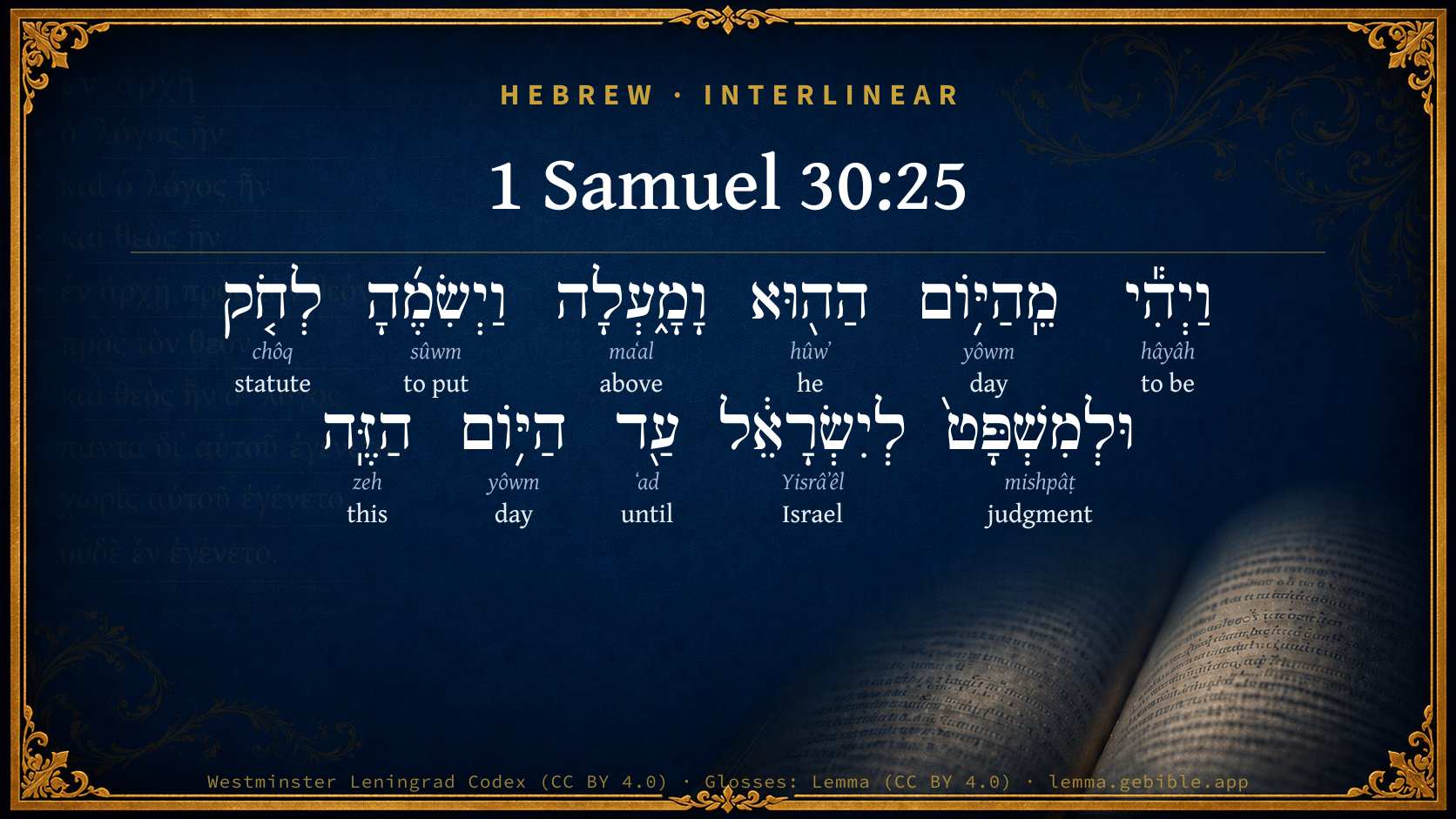
  1. וַיְהִ֕י hâyâh H1961 “and · to be” Conjunction + Verb, Qal, Sequential Imperfect, 3rd Person, Masculine, Singular
  2. מֵֽהַיּ֥וֹם yôwm H3117 “from · the · day” Preposition + Particle, Definite Article + Noun, Common, Masculine, Singular, Absolute
  3. הַה֖וּא hûwʼ H1931 “the · he” Particle, Definite Article + Pronoun, Personal, 3rd Person, Masculine, Singular
  4. וָמָ֑עְלָה maʻal H4605 “and · above · toward” Conjunction + Adverb + Suffix, Demonstrative
  5. וַיְשִׂמֶ֜הָ sûwm H7760 “and · to put · her” Conjunction + Verb, Qal, Sequential Imperfect, 3rd Person, Masculine, Singular + Suffix, Personal, 3rd Person, Feminine, Singular
  6. וּלְמִשְׁפָּט֙ mishpâṭ H4941 “and · to/for · judgment” Conjunction + Preposition + Noun, Common, Masculine, Singular, Absolute
  7. לְיִשְׂרָאֵ֔ל Yisrâʼêl H3478 “to/for · Israel” Preposition + Noun, Proper
  8. עַ֖ד ʻad H5704 “until” Preposition
  9. הַיּ֥וֹם yôwm H3117 “the · day” Particle, Definite Article + Noun, Common, Masculine, Singular, Absolute
  10. הַזֶּֽה zeh H2088 “the · this” Particle, Definite Article + Pronoun, Demonstrative, Masculine, Singular

About this verse

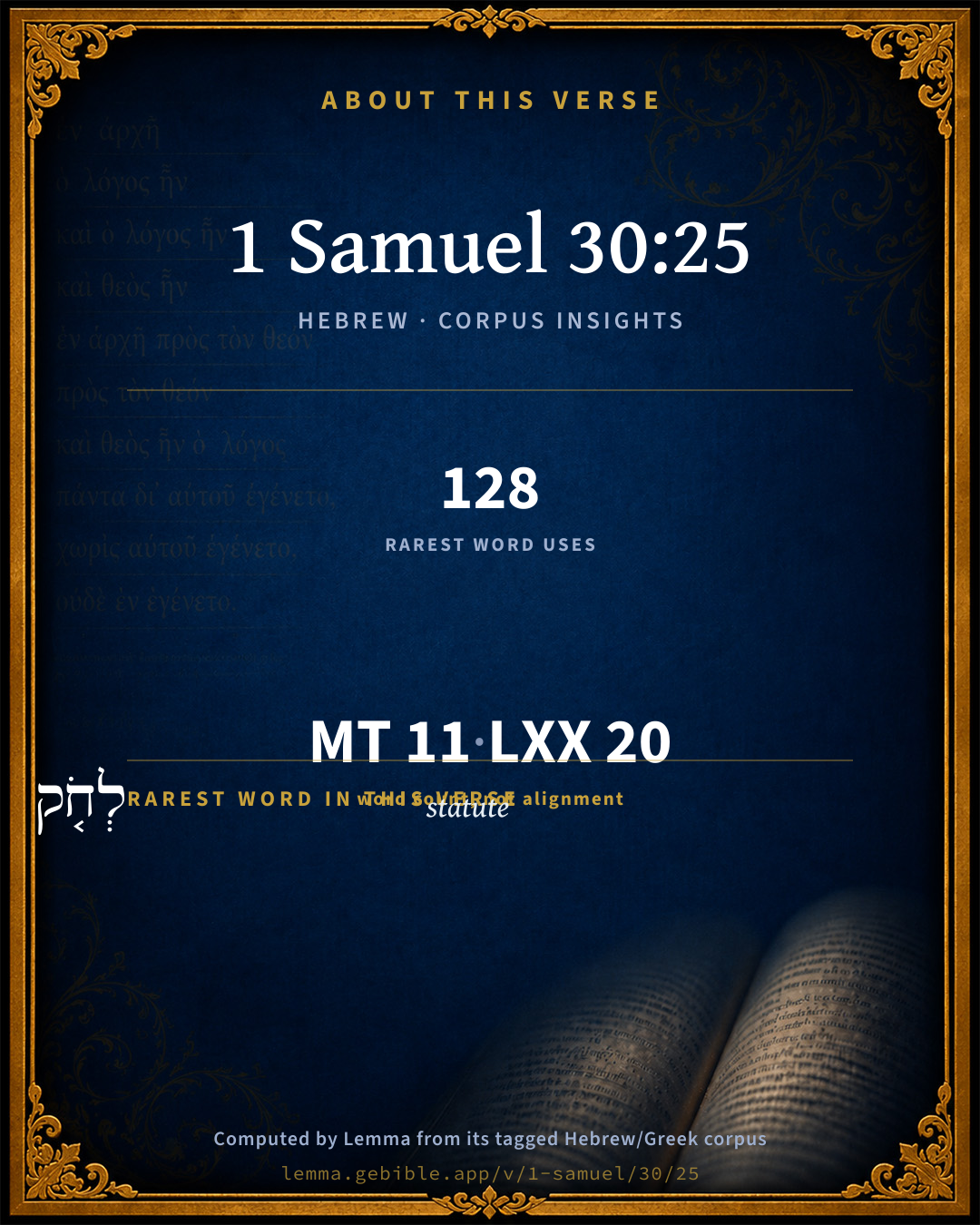
These counts appear in no published source. They are computed here, from the morphology-tagged text and Lemma’s own curated glosses. What Lemma adds →

11
words
10
distinct lemmas
Historical
section

Grammatical profile

  • 2 verbs
  • 5 nouns
  • 2 pronouns
  • 1 preposition
  • 1 adverb

Verb forms

  • וַיְהִ֕י Qal · Sequential Imperfect
  • וַיְשִׂמֶ֜הָ Qal · Sequential Imperfect

Repetition

A word recurs within this verse — often emphatic in Hebrew:

  • מֵֽהַיּ֥וֹם day H3117 ×2

Hebrew & Septuagint length

In English translation the verse runs 21 words from the Hebrew and 22 from the Septuagint (LXX English) — closely comparable.

A rough comparison of the two English renderings, which tokenize alike — not a word-level alignment.

Word counts can differ between the Hebrew and the Greek without any difference in meaning — e.g. the Hebrew direct-object marker אֵת has no separate Greek word, and Greek often adds the article ὁ.

In the original languages it is 11 Hebrew tokens and 20 Greek tokens — but the two are counted differently (Hebrew bundles its prefixes and suffixes into one token; the Greek is in lemma form), so that isn’t a like-for-like length.

Hebrew and Greek witnesses Masoretic Hebrew ↔ Greek Septuagint

The same verse in the two great witnesses to the Old Testament, shown verse-for-verse.

These are two independent witnesses, not word-aligned to each other, and the Septuagint is shown in lemma (dictionary) form.

Hebrew 1 Samuel 30:25 Masoretic · Westminster Leningrad Codex

וַיְהִ֕י מֵֽהַיּ֥וֹם הַה֖וּא וָמָ֑עְלָה וַיְשִׂמֶ֜הָ לְחֹ֤ק וּלְמִשְׁפָּט֙ לְיִשְׂרָאֵ֔ל עַ֖ד הַיּ֥וֹם הַזֶּֽה

It was so from that day forward, that he made it a statute and an ordinance for Israel to this day.

World English Bible · Public Domain

Greek LXX 1 Samuel 30:25 Septuagint · lemma form

καί γίγνομαι ἀπό ὁ ἡμέρα ἐκεῖνος καί ἐπάνω καί γίγνομαι εἰς πρόσταγμα καί εἰς δικαίωμα ὁ ἰσραήλ ἕως ὁ σήμερον

And it came to pass from that day forward, that it became an ordinance and a custom in Israel until this day.

LXX2012 (modern English Septuagint) · Public Domain

Hebrew: Westminster Leningrad Codex (CC BY 4.0). Greek: Septuagint (public domain); English from LXX2012 (modern English Septuagint) (Public Domain). How the Septuagint differs from the Hebrew →

Targum (Aramaic paraphrase)

1

The Targum is the ancient Jewish Aramaic paraphrase of the Hebrew Scriptures — an interpretive translation, not the Hebrew text itself. Onkelos (literal) and Pseudo-Jonathan (expansive) render the Torah, and Jonathan the Prophets. Coverage is partial: where no permissively-licensed English translation exists for a verse, only the Aramaic is shown. This is verse-level text, not a word-by-word alignment to the Hebrew.

  1. Targum Jonathan Prophets (Joshua–Malachi)
    וַהֲוָה מִיוֹמָא הַהוּא וּלְעֵלָא שַׁוְיָה לִגְזֵירַת דִין לְיִשְׂרָאֵל עַד יוֹמָא הָדֵין:

    (no public-domain English translation for this verse)

    Targum Jonathan — Aramaic: “Mikraot Gedolot” (public domain). English: “Sefaria Community Translation” (CC0 1.0 (public-domain dedication)); “London "Chaldee Paraphrase," 1871” (public domain). Text via Sefaria.

Commentary

Notes on 1 Samuel 30:25 from classic Christian and Jewish commentators (each source and its license shown beneath its notes). The classic Christian expositions comment on the surrounding passage and are grouped to its opening verse, so a note may address several verses; the Jewish commentaries on the Tanakh (Rashi and others) are per-verse, so they appear only where the commentator wrote on this verse.

Lemma curates 59 commentaries, every one of them public domain or Creative Commons licensed, each selected and text-cleaned for this edition rather than reprinted as found. About our sources →

Trapp's Complete Commentary

John Trapp

1Sa 30:25 And it was [so] from that day forward, that he made it a statute and an ordinance for Israel unto this day.

Ver. 25. That he made it a statute,] i.e., He revived and ratified it as most reasonable. The truth is, that all God’s laws are grounded upon so much good reason, that though he had never made them, yet it had been our wisest way to have lived according to them; since his will is not only recta but regula, the very rule of right.

John Trapp, A Commentary or Exposition upon All the Books of the Old and New Testament (1647–1656) — public domain. Text from a community e-Sword module.

Geneva Bible (1599)

Geneva Bible translators

Some refer these words to David, that he alleged an old custom and law, as if it were written, it is both now, and hath been ever.

Geneva Bible (1599) marginal notes — public domain. Text via Bolls.life.

Adam Clarke's Commentary

Verse 25. He made it a statute and an ordinance for Israel] Nothing could be more just and proper than this law: he who stays at home to defend house and property, has an equal right to the booty taken by those who go out to the war. There was a practice of this kind among the Israelites long before this time; see Nu 31:27; Jos 22:8; and the note on this latter verse. See Clarke on Jos 22:8.

Unto this day.] This is another indication that this book was composed long after the facts it commemorates. See the hypothesis in the preface.

Adam Clarke's Commentary on the Bible (1810–1826) — public domain. Text from a community e-Sword/MySword module.

Ellicott's Commentary for English Readers

(25) A statute and an ordinance for Israel.—The decree that they, who for good reasons tarry with the stuff, shall share alike with those who go down to the battle, which became a received ordinance in Israel, is not without its meaning. In the Heavenly Church of God

“ His state

Is kingly; thousands at his bidding speed,

And post o’er land and ocean without rest:

They also serve who only stand and wait.”

MILTON: Sonnet 19

Moses praying on the hill contributed to the victory over Amalek even more than Joshua fighting in the plain (Exo_17:11). “All Christians are not of equal strength, and some follow Christ to the conflict, others tarry with the stuff. Some fight the Lord’s battles in the din of active life; others, aged men and women, the Simeons and Annas of the Church . . . weak in body but strong in faith, fight with the peaceful arms of prayers and tears; Christ is omnipotent and merciful He rewards those who tarry in patience with the stuff, as well as those who go forth in the march to fight valiantly in the battle.”—Bishop Hall, in Wordsworth.

A Bible Commentary for English Readers, edited by Charles John Ellicott (1878–1897) — public domain. Text from a community e-Sword module.

John Gill's Exposition

And it was so from that day forward,.... Or "upwards" (x), of old, formerly; and so may refer either to what was done at the war with Midian, Num 31:27; or in the times of Abraham, Gen 14:23; and so Jarchi observes, it is not said, "henceforward", but "upwards", it being a statute and custom in the days of Abraham; the same he notes on Gen 14:24; where he, David, learnt this from thence; though Josephus (y) is express for it, that this law obtained from the time of David; and such was his authority, though as yet not king, but a wise and just commander:

that he made it a statute and an ordinance for Israel unto this day; it appeared so reasonable and equitable, that it was always regarded and attended to.

(x) "et supra", Pagninus, Montanus; "et jam olim", Tigurine version. (y) Antiqu. l. 6. c, 14. sect. 6.

John Gill's Exposition of the Whole Bible (1746–1763) — public domain (CC PDM 1.0). Text via the HelloAO Bible API.

Haydock's Catholic Bible Commentary

A law. Custom, (Calmet) and a particular injunction, had long before made way for it, Numbers xxxi. 27, (Haydock) and Josue xxii. 8. --- We might translate the Hebrew, "And this law had been observed in Israel from that day and before." David restored to its full vigour this ancient regulation. The Hebrews have no compound verbs, such as re-establish, re-build, &c., instead of which, they say, to establish, (Calmet) and build again. Thus, by the addition of adverbs, they can explain the same things. Protestants, "from that day forward he made it a statute," &c. (Haydock) --- It is not, therefore, unlawful to make new laws, provided they be conformable to those of God, Deuteronomy iv., and xii. (Worthington)

George Leo Haydock (1774–1849), Haydock's Catholic Family Bible and Commentary, 1859 edition — public domain. Excludes Psalms (Douay-Rheims chapter numbering differs from Protestant) and Deuterocanonical books (Catholic canon only).

Whedon's Commentary on the Bible

Daniel D. Whedon

25. He made it a statute — But it had been known in Israel before. See Num_31:27; Jos_22:8.

Daniel D. Whedon (gen. ed.), Commentary on the Old and New Testaments (1874–1909) — public domain. Text from a community e-Sword module.

The Pulpit Commentary

That he made it. Ie. David. Having been thus enacted by him and practised during his life, no king henceforward would venture to change it. In the war with the Midianites Moses had ordered that half the spoil should belong to the combatants and half to the congregation who remained in the comp. (Num_31:27) This enactment of David was in the same spirit.

The Pulpit Commentary (1880–1919), ed. H.D.M. Spence-Jones & Joseph S. Exell — public domain. Text from a community e-Sword module.

Rashi

Rabbi Shlomo Yitzchaki (Rashi)

From that day on. [Literally 'from that day and above']. It is not stated: "[from that day] on" but "[from that day] and above [=before]." Avrohom had already instituted this statute [when he said,] "Only what the lads have eaten," those are the ones who stayed with the equipment, "and the portion of the men" who went to war. In Breishis Raboh.

Rashi on the Tanakh — English translations: “The Judaica Press complete Tanach with Rashi, translated by A. J. Rosenberg” (CC BY 4.0); “Pentateuch with Rashi's commentary by M. Rosenbaum and A.M. Silbermann, 1929-1934” (public domain); “The Metsudah Tanach series, Lakewood, N.J” (CC BY 4.0); and “The Book of Joshua, Metsudah Publications, 1997” (CC BY 4.0). Text via Sefaria.

Lesson kit

Teaching starters — assembled from the data on this page, not authored interpretation. Every prompt links to the verse data it draws on. Edit before teaching.

1 Samuel, in the Historical, opens this verse with 11 words (10 distinct Hebrew lemmas). Its most distinctive word is chôq (“statute”). A historical commentator’s framing appears above. Read the whole chapter for the surrounding context.

Discussion questions

  1. What does “statute” (chôq) contribute to the verse as a whole?
  2. “day” occurs 2× in this one verse. What is the effect of the repetition?
  3. The translations on this page render this verse differently — a whole-verse word diff, not a word-by-word alignment. What might account for the different wordings?
  4. The verb «וַיְהִ֕י» is Qal Sequential Imperfect. How does its form color the action?
  5. Reading how Trapp's Complete Commentary and Geneva Bible (1599) read this verse, where do the two commentators agree and where do they part?

Things to notice

Reading settings

Reading text

Shown beneath each verse's original-language words.

Old Testament
Old Testament edition

Read the OT as the Masoretic Hebrew (MT) or the Greek Septuagint (LXX).

English shown for the Greek Septuagint (in the Hebrew ↔ Greek comparison).

Comparing translations? Open the Compare panel on any verse page to stack up to four side by side.