
1 Kings 7:31

Hebrew (Westminster Leningrad Codex) 1 Kings 7:31 appears in the Hebrew Old Testament. The text above is from the Westminster Leningrad Codex. Each word links to its Strong’s number, a concise gloss, and parsing drawn from the Open Scriptures Hebrew Bible morphology. Click any word for its full Brown-Driver-Briggs (BDB) entry.
Download image
Cite this verse

1 Kings 7:31 (World English Bible). Public Domain. Lemma interlinear Bible study tool, https://lemma.gebible.app/v/1-kings/7/31.

Show BibTeX & RIS
BibTeX
RIS
English Translation
The mouth of it within the capital and above was a cubit: and the mouth of it was round after the work of a pedestal, a cubit and a half; and also on the mouth of it were engravings, and their panels were foursquare, not round.
World English Bible · Public Domain
Download a study sheet

One document with this verse’s original text, its word-by-word gloss line, the meaning frame, cross-references with their text, attributed commentary, and full source and license credits — printable, and it pastes into notes with its structure intact.

This verse Autodidact and up

Study sheet (.html) Plain text (.txt)

A passage Seminary Student

Up to 50 verses in one chapter. A passage sheet keeps up to 6 commentary sources and 12 cross-references per verse, in the order this page ranks them, and says so on the sheet whenever that leaves anything out. Ask for a single verse and you get the Autodidact verse sheet above.

Everything on this page stays free to read, with no account — the sheet is a download of what is already on screen, not access to it.

Want to remove ads? Support Godless Engineer
Compare translations 3

The same verse in 3 English versions, stacked beneath the original-language interlinear above. Click any original word for its lexicon entry.

Each is an independent rendering of the whole verse — the interlinear is not word-aligned to these translations.

Highlighted words mark where these versions differ — a whole-verse word diff, not a word-by-word alignment.

  • World English Bible Public Domain
    The mouth of it within the capital and above was a cubit: and the mouth of it was round after the work of a pedestal, a cubit and a half; and also on the mouth of it were engravings, and their panels were foursquare, not round.
  • King James Version Public Domain
    And the mouth of it within the chapiter and above was a cubit: but the mouth thereof was round after the work of the base, a cubit and an half: and also upon the mouth of it were gravings with their borders, foursquare, not round.
  • unfoldingWord Literal Text CC BY-SA 4.0
    And its mouth from the inside of the capital and upward by a cubit. And its mouth circular, the work of a pedestal, a cubit and half of a cubit, and also on its mouth carvings. But their panels were square, not circular.

unfoldingWord Literal Text — © unfoldingWord, licensed CC BY-SA 4.0. Word-aligned USFM3 via Door43 (git.door43.org/unfoldingWord/en_ult).

Versions to compare (up to 4)

3 of 4 selected

Show all 18 translations

Every available English version of this verse, each an independent rendering of the whole verse.

  • World English Bible Public Domain
    The mouth of it within the capital and above was a cubit: and the mouth of it was round after the work of a pedestal, a cubit and a half; and also on the mouth of it were engravings, and their panels were foursquare, not round.
  • Berean Standard Bible Public Domain
    The opening to each stand inside the crown at the top was one cubit deep, with a round opening like the design of a pedestal, a cubit and a half wide. And around its opening were engravings, but the panels of the stands were square, not round.
  • Majority Standard Bible Public Domain
    The opening to each stand inside the crown at the top was one cubit deep, with a round opening like the design of a pedestal, a cubit and a half wide. And around its opening were engravings, but the panels of the stands were square, not round.
  • King James Version Public Domain
    And the mouth of it within the chapiter and above was a cubit: but the mouth thereof was round after the work of the base, a cubit and an half: and also upon the mouth of it were gravings with their borders, foursquare, not round.
  • American Standard Version (1901) Public Domain
    And the mouth of it within the capital and above was a cubit: and the mouth thereof was round after the work of a pedestal, a cubit and a half; and also upon the mouth of it were gravings, and their panels were foursquare, not round.
  • Revised Version (1885) Public Domain
    And the mouth of it within the chapiter and above was a cubit: and the mouth thereof was round after the work of a pedestal, a cubit and an half: and also upon the mouth of it were gravings, and their borders were foursquare, not round.
  • Geneva Bible (1599) Public Domain
    And the mouth of it was within the chapiter and aboue to measure by the cubite: for the mouth thereof was round made like a base, and it was a cubite and halfe a cubite: and also vpon the mouth thereof were grauen workes, whose borders were foure square, and not round.
  • Douay-Rheims (1899) Public Domain
    The mouth also of the laver within, was in the top of the chapiter: and that which appeared without, was of one cubit all round, and together it was one cubit and a half: and in the corners of the pillars were divers engravings: and the spaces between the pillars were square, not round.
  • Young's Literal Translation Public Domain
    And its mouth within the chapiter and above `is' by the cubit, and its mouth `is' round, the work of the base, a cubit and half a cubit; and also on its mouth `are' carvings and their borders, square, not round.
  • Literal Standard Version CC BY-SA 4.0
    And its mouth within the capital and above [is] by the cubit, and its mouth [is] round, the work of the base, a cubit and half a cubit; and also on its mouth [are] carvings and their borders, square, not round.
  • Unlocked Literal Bible CC BY-SA 4.0
    The opening was round like a pedestal, a cubit and a half wide, and was within a crown that rose up a cubit. On the opening were engravings, and their panels were square, not round.
  • unfoldingWord Literal Text CC BY-SA 4.0
    And its mouth from the inside of the capital and upward by a cubit. And its mouth circular, the work of a pedestal, a cubit and half of a cubit, and also on its mouth carvings. But their panels were square, not circular.
  • Darby Bible Public Domain
    And the mouth of it within the crown and above was a cubit; and its mouth was rounded, [as] the work of the base, a cubit and a half; and also upon its mouth was sculpture; but their panels were square, not round.
  • World Messianic Bible Public Domain
    Its opening within the capital and above was a cubit. Its opening was round like the work of a pedestal, a cubit and a half; and also on its opening were engravings, and their panels were square, not round.
  • Webster's Bible Public Domain
    And the mouth of it within the capital and above was a cubit: but the mouth of it was round after the work of the base, a cubit and a half: and also upon the mouth of it were gravings with their borders, foursquare, not round.
  • Free Bible Version CC BY-SA 4.0
    At the top of each cart was a round opening like a pedestal to hold the basin. The opening was one cubit deep, and one and a half cubits wide. The opening had carvings around it. The panels of the cart were square, not round.
  • Bible in Basic English Public Domain
    The mouth of it inside the angle-plate was one cubit across; it was round like a pillar, a cubit and a half across; it had designs cut on it; the sides were square, not round.
  • JPS Tanakh (1917) Public Domain
    And the mouth of it within the crown and above was a cubit high; and the mouth thereof was round after the work of a pedestal, a cubit and a half; and also upon the mouth of it were gravings; and their borders were foursquare, not round.

Literal Standard Version (2020), Covenant Press — licensed CC BY-SA 4.0. Text via the HelloAO Bible API (eBible.org). Unlocked Literal Bible (unfoldingWord) — licensed CC BY-SA 4.0. Text via the HelloAO Bible API (eBible.org). unfoldingWord Literal Text — © unfoldingWord, licensed CC BY-SA 4.0. Word-aligned USFM3 via Door43 (git.door43.org/unfoldingWord/en_ult). Free Bible Version, Dr. Jonathan Gallagher — licensed CC BY-SA 4.0. Text via the HelloAO Bible API (eBible.org).

Word by word

More ways to search: Search by grammar → Find every occurrence → Compare this word →

Practice this passage: Drill this verse → Learn its vocabulary →

מִקְלָע֔וֹת
miqlaʻath
H4734
“carvings”
Noun, Common, Feminine, Plural, Absolute
Part of Speech
Noun
Type
Common
Gender
Feminine
Number
Plural
State
Absolute
Full BDB Definition

Origin: from H7049

TWOT: 2031a

carving
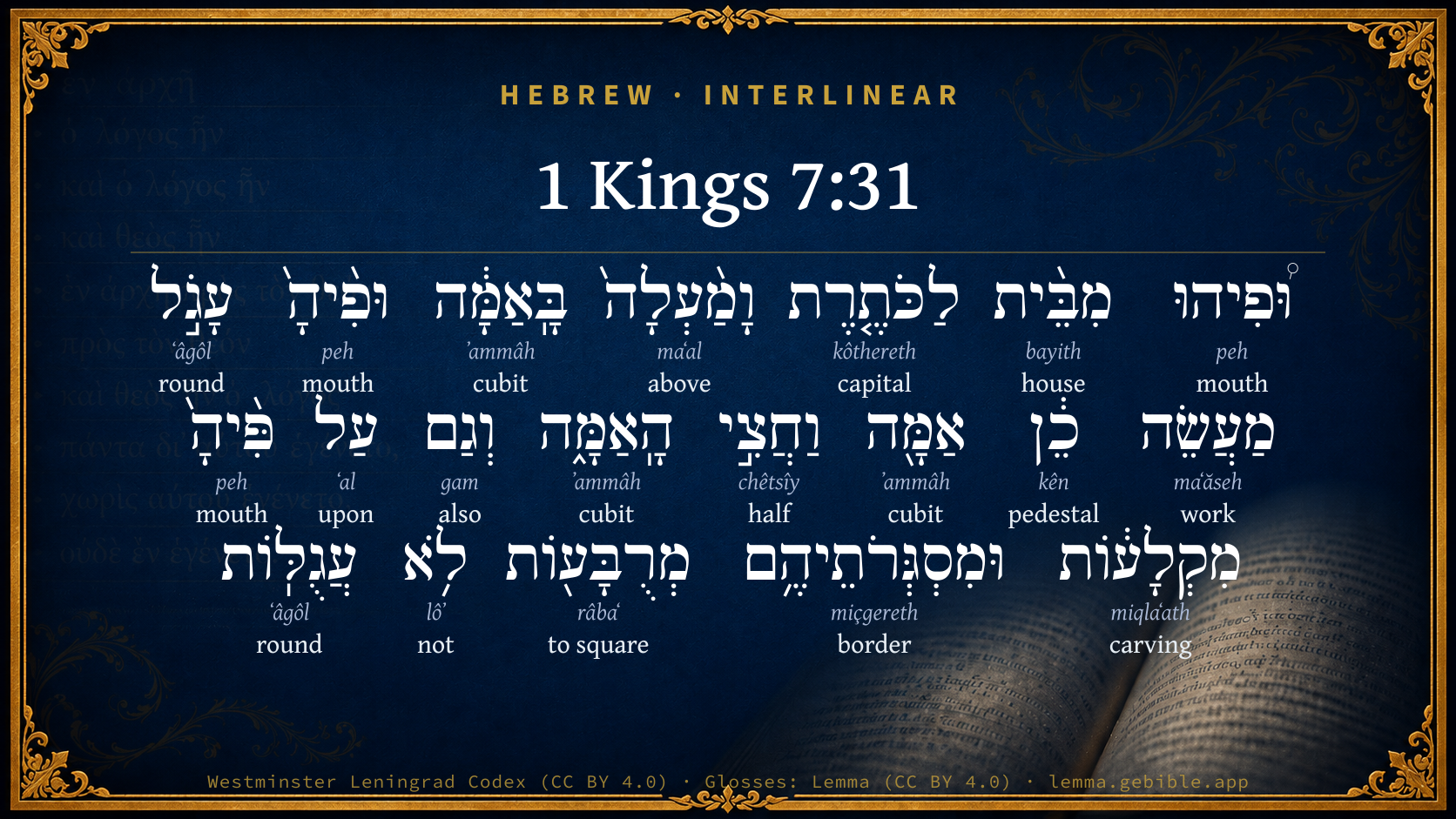
  1. וּ֠פִיהוּ peh H6310 “and · mouth · his” Conjunction + Noun, Common, Masculine, Singular, Construct + Suffix, Personal, 3rd Person, Masculine, Singular
  2. מִבֵּ֨ית bayith H1004 “from · house of” Preposition + Noun, Common, Masculine, Singular, Construct
  3. לַכֹּתֶ֤רֶת kôthereth H3805 “to/for the · capital” Preposition, Determined + Noun, Common, Feminine, Singular, Absolute
  4. וָמַ֨עְלָה֙ maʻal H4605 “and · above · toward” Conjunction + Adverb + Suffix, Demonstrative
  5. בָּֽאַמָּ֔ה ʼammâh H520 “in/at the · cubit” Preposition, Determined + Noun, Common, Feminine, Singular, Absolute
  6. וּפִ֨יהָ֙ peh H6310 “and · mouth · her” Conjunction + Noun, Common, Masculine, Singular, Construct + Suffix, Personal, 3rd Person, Feminine, Singular
  7. עָגֹ֣ל ʻâgôl H5696 “round” Adjective, Adjective, Masculine, Singular, Absolute
  8. מַעֲשֵׂה maʻăseh H4639 “work of” Noun, Common, Masculine, Singular, Construct
  9. כֵ֔ן kên H3653 “pedestal” Noun, Common, Masculine, Singular, Absolute
  10. אַמָּ֖ה ʼammâh H520 “cubit” Noun, Common, Feminine, Singular, Absolute
  11. וַחֲצִ֣י chêtsîy H2677 “and · half of” Conjunction + Noun, Common, Masculine, Singular, Construct
  12. הָֽאַמָּ֑ה ʼammâh H520 “the · cubit” Particle, Definite Article + Noun, Common, Feminine, Singular, Absolute
  13. וְגַם gam H1571 “and · also” Conjunction + Particle, Accusative
  14. עַל ʻal H5921 “upon” Preposition
  15. פִּ֨יהָ֙ peh H6310 “mouth · her” Noun, Common, Masculine, Singular, Construct + Suffix, Personal, 3rd Person, Feminine, Singular
  16. וּמִסְגְּרֹתֵיהֶ֥ם miçgereth H4526 “and · borders · their” Conjunction + Noun, Common, Feminine, Plural, Construct + Suffix, Personal, 3rd Person, Masculine, Plural
  17. מְרֻבָּע֖וֹת râbaʻ H7251 “squared” Verb, Pual, Participle Passive, Feminine, Plural, Absolute
  18. לֹ֥א lôʼ H3808 “not” Particle, Negative
  19. עֲגֻלּֽוֹת ʻâgôl H5696 “round” Adjective, Adjective, Feminine, Plural, Absolute

About this verse

These counts appear in no published source. They are computed here, from the morphology-tagged text and Lemma’s own curated glosses. What Lemma adds →

20
words
15
distinct lemmas
Historical
section

Notable vocabulary

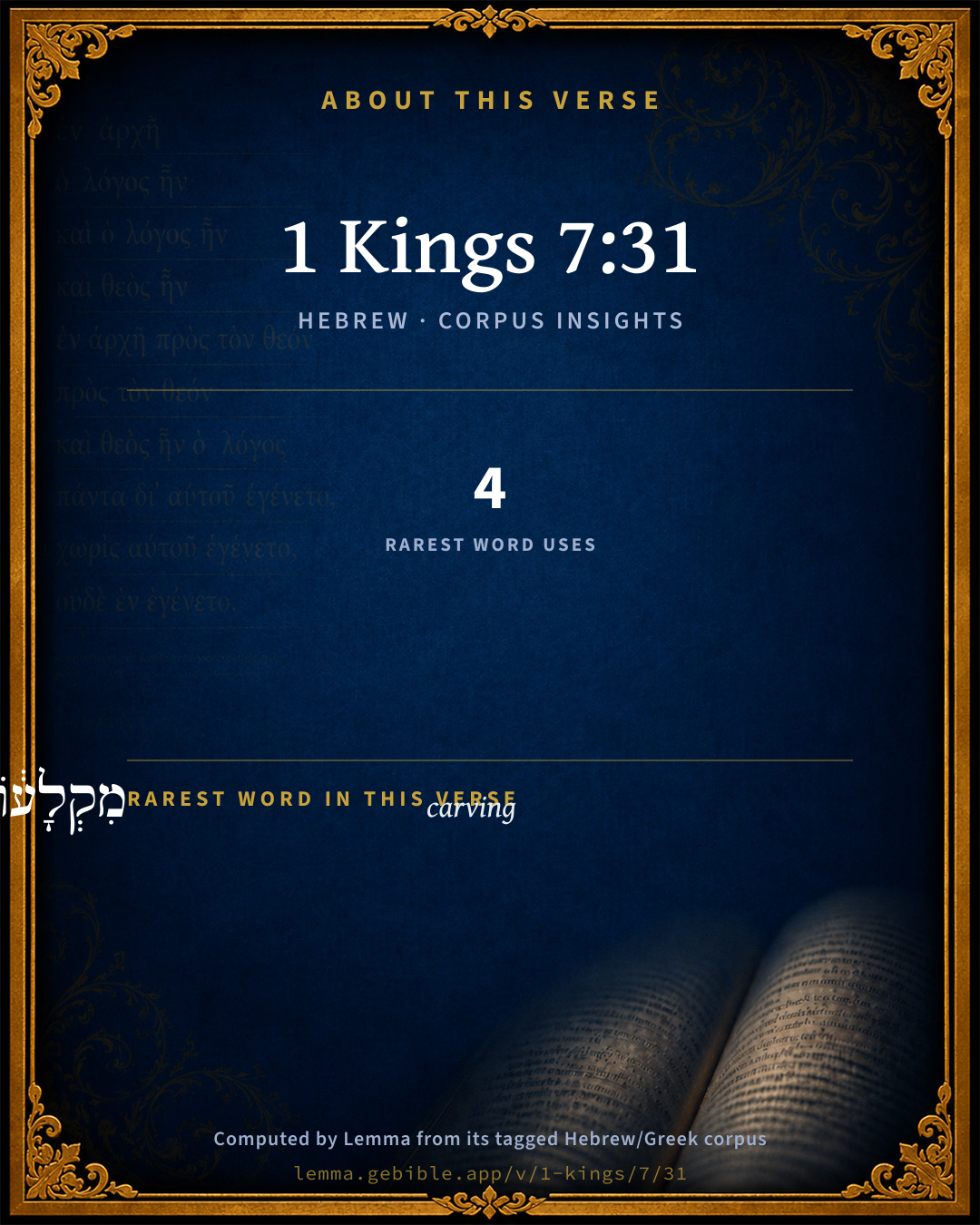
The rarest word here is מִקְלָע֔וֹת carving H4734 — appearing just 4 times in the whole Hebrew Bible.

Shared distinctive vocabulary

מִקְלָע֔וֹת carving H4734 occurs in 4 verses of the Hebrew Bible. Also found in:

Grammatical profile

  • 1 verb
  • 13 nouns
  • 2 adjectives
  • 1 preposition
  • 1 adverb
  • 2 particles

Verb forms

  • מְרֻבָּע֖וֹת Pual · Participle Passive

Repetition

Words recur within this verse — often emphatic in Hebrew:

  • וּ֠פִיהוּ mouth H6310 ×3
  • בָּֽאַמָּ֔ה cubit H520 ×3
  • עָגֹ֣ל round H5696 ×2

Hebrew & Septuagint length

In English translation the verse runs 46 words from the Hebrew and 10 from the Septuagint (LXX English) — the Septuagint runs noticeably shorter here. See the side-by-side →

A rough comparison of the two English renderings, which tokenize alike — not a word-level alignment.

Word counts can differ between the Hebrew and the Greek without any difference in meaning — e.g. the Hebrew direct-object marker אֵת has no separate Greek word, and Greek often adds the article ὁ.

Hebrew and Greek witnesses Masoretic Hebrew ↔ Greek Septuagint

The same verse in the two great witnesses to the Old Testament, shown verse-for-verse.

Here the Septuagint runs noticeably shorter than the Hebrew — LXX2012 (modern English Septuagint) 10 words vs World English Bible 46. A rough length comparison of the two English translations, not a word-level alignment — read both below.

These are two independent witnesses, not word-aligned to each other, and the Septuagint is shown in lemma (dictionary) form.

Hebrew 1 Kings 7:31 Masoretic · Westminster Leningrad Codex

וּ֠פִיהוּ מִבֵּ֨ית לַכֹּתֶ֤רֶת וָמַ֨עְלָה֙ בָּֽאַמָּ֔ה וּפִ֨יהָ֙ עָגֹ֣ל מַעֲשֵׂה כֵ֔ן אַמָּ֖ה וַחֲצִ֣י הָֽאַמָּ֑ה וְגַם עַל פִּ֨יהָ֙ מִקְלָע֔וֹת וּמִסְגְּרֹתֵיהֶ֥ם מְרֻבָּע֖וֹת לֹ֥א עֲגֻלּֽוֹת

The mouth of it within the capital and above was a cubit: and the mouth of it was round after the work of a pedestal, a cubit and a half; and also on the mouth of it were engravings, and their panels were foursquare, not round.

World English Bible · Public Domain

Greek LXX 1 Kings 7:31 Septuagint · lemma form

καί ὁ λέβης καί ὁ θερμαστρίς καί ὁ φιάλη καί πᾶς ὁ σκεῦος ὅς ποιέω χιραμ ὁ βασιλεύς σαλωμών ὁ οἶκος κύριος καί ὁ στῦλος τεσσαράκοντα καί ὀκτώ ὁ οἶκος ὁ βασιλεύς καί ὁ οἶκος κύριος πᾶς ὁ ἔργον ὁ βασιλεύς ὅς ποιέω χιραμ χαλκοῦς ἄρδην ὁ εἰμί εἰς ἡγέομαι ἐπί ὁ λαός ἐγώ ἰσραήλ

And there were axles in the wheels under the base.

LXX2012 (modern English Septuagint) · Public Domain

Hebrew: Westminster Leningrad Codex (CC BY 4.0). Greek: Septuagint (public domain); English from LXX2012 (modern English Septuagint) (Public Domain). How the Septuagint differs from the Hebrew →

Targum (Aramaic paraphrase)

1

The Targum is the ancient Jewish Aramaic paraphrase of the Hebrew Scriptures — an interpretive translation, not the Hebrew text itself. Onkelos (literal) and Pseudo-Jonathan (expansive) render the Torah, and Jonathan the Prophets. Coverage is partial: where no permissively-licensed English translation exists for a verse, only the Aramaic is shown. This is verse-level text, not a word-by-word alignment to the Hebrew.

  1. Targum Jonathan Prophets (Joshua–Malachi)
    וּפוּמֵיהּ מִגָיו לִקְרוֹנְתְּהוֹן וּלְעֵילָא בְּאַמְתָא וּפוּמֵיהּ סְגַלְגַל עוֹבַד כַּנְתָּא אַמְתָא וּפַלְגוּת אַמְתָא וְאַף עַל פּוּמָהּ קְלִיעִין וּגְדַנְפֵיהוֹן מְרַבְּעִין וְלָא סְגַלְגְלִין:

    (no public-domain English translation for this verse)

    Targum Jonathan — Aramaic: “Mikraot Gedolot” (public domain). English: “Sefaria Community Translation” (CC0 1.0 (public-domain dedication)); “London "Chaldee Paraphrase," 1871” (public domain). Text via Sefaria.

Commentary

Notes on 1 Kings 7:31 from classic Christian and Jewish commentators (each source and its license shown beneath its notes). The classic Christian expositions comment on the surrounding passage and are grouped to its opening verse, so a note may address several verses; the Jewish commentaries on the Tanakh (Rashi and others) are per-verse, so they appear only where the commentator wrote on this verse.

Lemma curates 59 commentaries, every one of them public domain or Creative Commons licensed, each selected and text-cleaned for this edition rather than reprinted as found. About our sources →

Trapp's Complete Commentary

John Trapp

1Ki 7:31 And the mouth of it within the chapiter and above [was] a cubit: but the mouth thereof [was] round [after] the work of the base, a cubit and an half: and also upon the mouth of it [were] gravings with their borders, foursquare, not round.

Ver. 31. And the mouth of it within the chapiter.] The round hollow place of the base, into which the lower part of the laver was put to the upper, was a cubit.

John Trapp, A Commentary or Exposition upon All the Books of the Old and New Testament (1647–1656) — public domain. Text from a community e-Sword module.

Joseph Benson's Commentary

1Ki 7:31. The mouth of it — So he calls that part in the top of the base which was left hollow, that the foot of the laver might be let into it. Within the chapiter — Within the little base, which he calls the chapiter, because it rose up from, and stood above the great base. And above — Above the chapiter; for the mouth went up and grew wider like a funnel. Was a cubit — In height, (1Ki 7:35,) whereof half a cubit was above the chapiter or little base, and the other half below it. A cubit and half — In compass. Four-square — So the innermost part, called the mouth, was round, but the outward part was square, as when a circle is made within a quadrangle.

Joseph Benson's Commentary on the Old and New Testaments (1811–1818) — public domain. Text from a community e-Sword module.

Geneva Bible (1599)

Geneva Bible translators

The mouth of the great base or frame entered into the chapiter, or pillar that bare up the cauldron.

Geneva Bible (1599) marginal notes — public domain. Text via Bolls.life.

Ellicott's Commentary for English Readers

(31) And the mouth.—This is most obscure, and in our version unintelligible. Keil renders it: “And the mouth of it (the laver) was within the chapiter, and in a cubit above it; and the mouth of it (the chapiter) was round, after the manner of pedestal, a cubit and a half; and upon the mouth was carved work, and the panels of it (the mouth) were square, not round.” But the rendering of the word “mouth,” now for the laver, now for the chapiter, is arbitrary, and the whole is still obscure. As the circular stand (or chapiter) was half a cubit deep, it looks as if the lower surface of the laver was a cubit above the “mouth.” If the laver were emptied by a cock near the bottom, this circular stand may have received the drippings. And as the top of this base would be square on plan, and the stand circular, there would be, of course, spaces left at each corner, which may possibly be the engraved “panels” referred to.

A Bible Commentary for English Readers, edited by Charles John Ellicott (1878–1897) — public domain. Text from a community e-Sword module.

The Cambridge Bible for Schools and Colleges

gen. ed. J. J. S. Perowne

31. And the mouth of it] Here the pronoun must, I think, be referred, as in ‘corners (feet) thereof’ of 1Ki_7:30, to the base. The bases appear to have had a circular orifice in the top, which is here called the mouth. This opening was, as it seems, surmounted and surrounded by a capital, which itself had an opening to receive the lowest part of the laver. The height of the capital above the level surface of the top of the base appears not to be specified unless the half cubit of 1Ki_7:35 be taken to refer to the capital. One cubit was the diameter of the orifice in the top of the base.

but the mouth thereof] Better, ‘And’ &c. The pronoun here by a difference of gender in the original is shewn to refer to a different noun. This can only be the ‘chapiter.’ That superstructure widened out towards the top, and the round opening in top of it, to receive the bottom of the laver, is what is meant by the second ‘mouth.’

after the work of the base] Better, as the word is the same which was so rendered in 1Ki_7:29, after the work of a pedestal. It was in this way that the chapiter served as a support to the laver. This chapiter had graved work all round about its upper edge, which may be fitly called ‘mouth’ as it was meant to receive the laver.

with their borders, foursquare, not round] Better, And their borders were foursquare, not round. It is better to render as literally as possible for it is very doubtful whether these words have reference at all to the chapiter. They seem to be a recurrence to the description of those borders (or panels) spoken of in 1Ki_7:28-29. In that case the pronoun ‘their’ in this clause would refer to the bases. This is the more probable because the ‘borders’ of the next verse are certainly those panels on the sides of the bases.

The Cambridge Bible for Schools and Colleges (gen. ed. J. J. S. Perowne; Cambridge University Press, 1878–1918) — public domain. Text from a community e-Sword module.

John Gill's Exposition

And under the borders were four wheels,.... Not under the borders last mentioned, but those in Kg1 7:29,

and the axle trees of the wheels were joined to the base; to the four sides of it:

and the height of a wheel was a cubit and half a cubit; that is, from the plate of brass on which it stood, to the axis or semicircle of it; so that the highest part of the ring being also a cubit and an half, reached to the top of the base, it being but three cubits high, Kg1 7:27.

John Gill's Exposition of the Whole Bible (1746–1763) — public domain (CC PDM 1.0). Text via the HelloAO Bible API.

Albert Barnes' Notes on the Bible

It seems impossible to determine what is meant by the “mouth” of the laver, or what by its “chapiter.”

Albert Barnes' Notes on the Bible (1834–1885) — public domain. Text from a community e-Sword/MySword module.

Matthew Poole's English Annotations

The mouth of it; so he calls that part in the top of the base which was left hollow, that the foot of the laver might be let into it, and fastened in it.

Within the chapiter, i.e. within the little base, which he calls the chapiter, because it rose up from and stood above the great base, as the head doth above the rest of the body.

And above; above the chapiter; for the mouth went up and grew wider, like a funnel.

Was a cubit; either in breadth; or rather in height, 1Ki 7:35; whereof half a cubit was above the chapiter or little base, as is said, 1Ki 7:35, and the other half is here implied to be within it, and below it.

A cubit and a half, to wit, in compass.

Four-square, not round; so the innermost part, called the mouth, was round, but the outward part was square, as when a circle is made within a quadrangle.

Matthew Poole's English Annotations on the Holy Bible (1683–1685) — public domain. Text from a community e-Sword/MySword module.

Whedon's Commentary on the Bible

Daniel D. Whedon

31. The mouth of it — The mouth of the laver; its opening at the top; involving in this case, also, the entire cavity or hollow of the laver.

Within the chapiter and above — An obscure and unintelligible expression, meaning, perhaps, the depth of the laver.

A cubit — Literally, in a cubit; perhaps an erroneous copying of כאמה, about a cubit. We take the meaning to be, that the depth of the laver was about one cubit.

The mouth thereof was round after the work of the base, a cubit and a half — This makes no sense at all, and if we follow the common punctuation, the passage is perfectly unintelligible. It is very likely that some words have here fallen out of the text. As it is, it seems best to punctuate and read as follows: And the mouth was round; the base-work was a cubit and a half; and also upon the mouth were engravings, and their panels were square, not rounded. On this rendering we make the following notes: Mouth… was round — That is, the opening was round at the top, like a bowl. Base-work was a cubit and a half — The base-work that connected immediately with the laver, and separated it a cubit and a half from the round compass (1Ki_7:35) of the base above. 1Ki_7:29. This base work probably consisted of a pedestal and open standards in the form of curved plates, as represented in the figure. (n n.) See on 1Ki_7:35. Upon the mouth were engravings — That is, upon the concave surface of the inside of the laver, and probably also on the outside. Their panels — The panels of the engravings. (P P in figure.) The lavers were so cast as to present the appearance of square panels set in the surface, and these panels were covered with sculptured work.

Daniel D. Whedon (gen. ed.), Commentary on the Old and New Testaments (1874–1909) — public domain. Text from a community e-Sword module.

The Pulpit Commentary

And the mouth of it Heb. his mouth. I incline, with Keil, to think the mouth of the laver just mentioned (ryOKi masc.) is referred to rather than the stand (Thenius), which would require a fern. suffix within the chapiter By this we are, perhaps, to understand a round ornament, resembling the capital of a pillar, which stood in the centre of the dome-shaped covering (see ver. 35) of the stand, and on which the laver rested (so Keil, Bahr). Rawlinson says, "No commentator has given a satisfactory explanation of this passage": and above Heb. upwards was a cubit i.e., the neck or foot of the laver measured uniformly one cubit, in width apparently: but the mouth Heb. and her mouth, fern. This last mentioned mouth is probably the mouth of the capital (fern.) The neck or mouth of the laver would appear to have been fitted into the mouth of the crown-shaped pedestal was round after the work of the base Heb. stand work, Ke here fixes the meaning of the word in ver. 29, i.e., it decides it to be the substantive (Keil, after Chald.), not the adverb (as Thenius, Bahr, al. ) a cubit and a half so that the first mouth would fit easily into the second, and also upon the mouth of it Heb. her mouth, that of the capital, which was external. The mouth of the laver was partially concealed were gravings Keil understands this of the carving of the stand already mentioned, ver. 29. But a mouth is mentioned, which the square stand lacked. Besides the word "also" points to additional carvings. I understand the chapiter which formed the mouth of the stand to be meant with Heb. and their borders, foursquare, not round. i.e. , the capital had panels like the stand, and the former, like those of the latter, were square.

The Pulpit Commentary (1880–1919), ed. H.D.M. Spence-Jones & Joseph S. Exell — public domain. Text from a community e-Sword module.

John Wesley's Explanatory Notes

The mouth - So he calls that part in the top of the base which was left hollow, that the foot of the laver might be let into it. The chapiter - Within the little base, which he calls the chapiter, because it rose up from, and stood above the great base. Above - Above the chapiter; for the mouth went up, and grew wider like a funnel. A cubit - In height, ver. 35, whereof half a cubit was above the chapiter or little base, and the other half below it. A cubit and half - In compass. Four square - So the innermost part, called the mouth, was round, but the outward part was square, as when a circle is made within a quadrangle.

John Wesley, Explanatory Notes Upon the Whole Bible (1754–1765) — public domain. Text via the GEBible commentary corpus.

Rashi

Rabbi Shlomo Yitzchaki (Rashi)

And the rim of the vessel was inside the crown and rose above it an amoh. The mouth of the base extends outward of the rim of the crown and goes upward an amoh high. The crown is the roof of the base, made like a hat, [i.e.,] sloping on all sides, and in the center a round hole was set, with a diameter that was one and one half amohs, and around that hole was the resemblance of an enclosure of a partition one half amoh high around. And below this is thus explained regarding this subject, as it is stated, “At the top of the base [was a frame] half an amoh high circular all around,” and that is called “פי הכותרות [=the rim of the crown].” And the base rests on that enclosure, and the bottom of the base is inserted into the rim of the enclosure, and it protrudes one amoh above it. This is what is stated here, “And the rim of the vessel was inside the crown and rose above it an amoh.”

The rim was round made like the base. And the rim of the crown was round, a replica of the base which was round.

One and a half amohs. Its width in diameter.

There were engravings on the rim as well. Designs of flowers.

Rashi on the Tanakh — English translations: “The Judaica Press complete Tanach with Rashi, translated by A. J. Rosenberg” (CC BY 4.0); “Pentateuch with Rashi's commentary by M. Rosenbaum and A.M. Silbermann, 1929-1934” (public domain); “The Metsudah Tanach series, Lakewood, N.J” (CC BY 4.0); and “The Book of Joshua, Metsudah Publications, 1997” (CC BY 4.0). Text via Sefaria.

Lesson kit

Teaching starters — assembled from the data on this page, not authored interpretation. Every prompt links to the verse data it draws on. Edit before teaching.

1 Kings, in the Historical, opens this verse with 20 words (15 distinct Hebrew lemmas). Its most distinctive word is miqlaʻath (“carving”). The Greek Septuagint runs shorter here. A historical commentator’s framing appears above. Read the whole chapter for the surrounding context.

Discussion questions

  1. How does “carving” (miqlaʻath) shape what this verse is saying?
  2. 1 Kings 6:18 shares the word «carving» with this verse. How do the two illuminate each other?
  3. “mouth” occurs 3× in this one verse. What is the effect of the repetition?
  4. Compared with the Hebrew, the Septuagint runs shorter here. What questions does that raise?
  5. These translations render this verse differently; the difference is in the English rendering, not the original. What questions does that raise?
  6. The verb «מְרֻבָּע֖וֹת» is Pual Participle Passive. How does its form color the action?
  7. Reading how Trapp's Complete Commentary and Joseph Benson's Commentary read this verse, where do the two commentators agree and where do they part?

Things to notice

Reading settings

Reading text

Shown beneath each verse's original-language words.

Old Testament
Old Testament edition

Read the OT as the Masoretic Hebrew (MT) or the Greek Septuagint (LXX).

English shown for the Greek Septuagint (in the Hebrew ↔ Greek comparison).

Comparing translations? Open the Compare panel on any verse page to stack up to four side by side.