Jeremiah 52:32

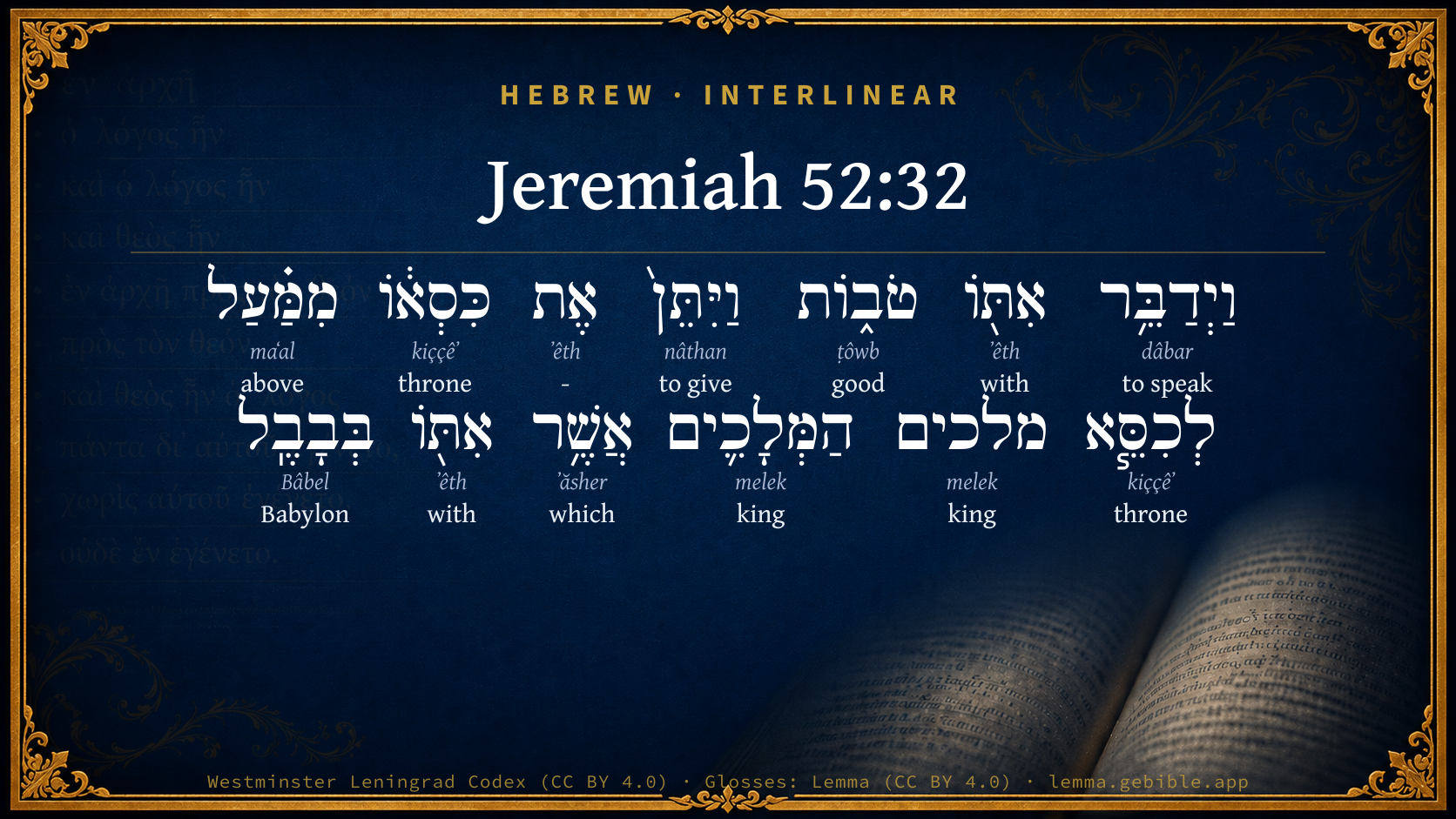
Hebrew (Westminster Leningrad Codex) Jeremiah 52:32 appears in the Hebrew Old Testament. The text above is from the Westminster Leningrad Codex. Each word links to its Strong’s number, a concise gloss, and parsing drawn from the Open Scriptures Hebrew Bible morphology. Click any word for its full Brown-Driver-Briggs (BDB) entry.
Download image
Cite this verse

Jeremiah 52:32 (World English Bible). Public Domain. Lemma interlinear Bible study tool, https://lemma.gebible.app/v/jeremiah/52/32.

Show BibTeX & RIS
BibTeX
RIS
English Translation
and he spoke kindly to him, and set his throne above the throne of the kings who were with him in Babylon,
World English Bible · Public Domain
Download a study sheet

One document with this verse’s original text, its word-by-word gloss line, the meaning frame, cross-references with their text, attributed commentary, and full source and license credits — printable, and it pastes into notes with its structure intact.

This verse Autodidact and up

Study sheet (.html) Plain text (.txt)

A passage Seminary Student

Up to 50 verses in one chapter. A passage sheet keeps up to 6 commentary sources and 12 cross-references per verse, in the order this page ranks them, and says so on the sheet whenever that leaves anything out. Ask for a single verse and you get the Autodidact verse sheet above.

Everything on this page stays free to read, with no account — the sheet is a download of what is already on screen, not access to it.

Want to remove ads? Support Godless Engineer
Compare translations 3

The same verse in 3 English versions, stacked beneath the original-language interlinear above. Click any original word for its lexicon entry.

Each is an independent rendering of the whole verse — the interlinear is not word-aligned to these translations.

Highlighted words mark where these versions differ — a whole-verse word diff, not a word-by-word alignment.

  • World English Bible Public Domain
    and he spoke kindly to him, and set his throne above the throne of the kings who were with him in Babylon,
  • King James Version Public Domain
    And spake kindly unto him, and set his throne above the throne of the kings that were with him in Babylon,
  • unfoldingWord Literal Text CC BY-SA 4.0
    He spoke kindly to him and gave him a seat more honorable than that of the other kings who were with him in Babylon.

unfoldingWord Literal Text — © unfoldingWord, licensed CC BY-SA 4.0. Word-aligned USFM3 via Door43 (git.door43.org/unfoldingWord/en_ult).

Versions to compare (up to 4)

3 of 4 selected

Show all 18 translations

Every available English version of this verse, each an independent rendering of the whole verse.

  • World English Bible Public Domain
    and he spoke kindly to him, and set his throne above the throne of the kings who were with him in Babylon,
  • Berean Standard Bible Public Domain
    And he spoke kindly to Jehoiachin and set his throne above the thrones of the other kings who were with him in Babylon.
  • Majority Standard Bible Public Domain
    And he spoke kindly to Jehoiachin and set his throne above the thrones of the other kings who were with him in Babylon.
  • King James Version Public Domain
    And spake kindly unto him, and set his throne above the throne of the kings that were with him in Babylon,
  • American Standard Version (1901) Public Domain
    and he spake kindly to him, and set his throne above the throne of the kings that were with him in Babylon,
  • Revised Version (1885) Public Domain
    and he spake kindly to him, and set his throne above the throne of the kings that were with him in Babylon.
  • Geneva Bible (1599) Public Domain
    And spake kindly vnto him, and set his throne aboue the throne of the Kings, that were with him in Babel,
  • Douay-Rheims (1899) Public Domain
    And he spoke kindly to him, and he set his throne above the thrones of the kings that were with him in Babylon.
  • Young's Literal Translation Public Domain
    and speaketh with him good things, and setteth his throne above the throne of the kings who `are' with him in Babylon,
  • Literal Standard Version CC BY-SA 4.0
    and speaks good things with him, and sets his throne above the throne of the kings who [are] with him in Babylon,
  • Unlocked Literal Bible CC BY-SA 4.0
    He spoke kindly to him and gave him a seat more honorable than that of the other kings who were with him in Babylon.
  • unfoldingWord Literal Text CC BY-SA 4.0
    He spoke kindly to him and gave him a seat more honorable than that of the other kings who were with him in Babylon.
  • Darby Bible Public Domain
    and he spoke kindly unto him, and set his seat above the seat of the kings that were with him in Babylon.
  • World Messianic Bible Public Domain
    He spoke kindly to him, and set his throne above the throne of the kings who were with him in Babylon,
  • Webster's Bible Public Domain
    And spoke kindly to him, and set his throne above the throne of the kings that were with him in Babylon,
  • Free Bible Version CC BY-SA 4.0
    The king of Babylon treated him well him and gave him a position of honor higher than the other kings there with him in Babylon.
  • Bible in Basic English Public Domain
    And he said kind words to him and put his seat higher than the seats of the other kings who were with him in Babylon.
  • JPS Tanakh (1917) Public Domain
    And he spoke kindly to him, and set his throne above the throne of the kings that were with him in Babylon.

Literal Standard Version (2020), Covenant Press — licensed CC BY-SA 4.0. Text via the HelloAO Bible API (eBible.org). Unlocked Literal Bible (unfoldingWord) — licensed CC BY-SA 4.0. Text via the HelloAO Bible API (eBible.org). unfoldingWord Literal Text — © unfoldingWord, licensed CC BY-SA 4.0. Word-aligned USFM3 via Door43 (git.door43.org/unfoldingWord/en_ult). Free Bible Version, Dr. Jonathan Gallagher — licensed CC BY-SA 4.0. Text via the HelloAO Bible API (eBible.org).

Word by word

More ways to search: Search by grammar → Find every occurrence → Compare this word →

Practice this passage: Drill this verse → Learn its vocabulary →

כִּסְא֔וֹ
kiççêʼ
H3678
“throne · his”
Noun, Common, Masculine, Singular, Construct + Suffix, Personal, 3rd Person, Masculine, Singular
Part of Speech
Noun
Type
Common
Gender
Masculine
Number
Singular
State
Construct
Full BDB Definition

Origin: from H3680

TWOT: 1007

seat (of honour), throne, seat, stool - seat (of honour), throne - royal dignity, authority, power (figuratively)
  1. וַיְדַבֵּ֥ר dâbar H1696 “and · to speak” Conjunction + Verb, Piel, Sequential Imperfect, 3rd Person, Masculine, Singular
  2. אִתּ֖וֹ ʼêth H854 “with · him” Preposition + Suffix, Personal, 3rd Person, Masculine, Singular
  3. טֹב֑וֹת ṭôwb H2896 “good” Adjective, Adjective, Feminine, Plural, Absolute
  4. וַיִּתֵּן֙ nâthan H5414 “and · to give” Conjunction + Verb, Qal, Sequential Imperfect, 3rd Person, Masculine, Singular
  5. אֶת ʼêth H853 “-” Particle, Direct Object
  6. מִמַּ֗עַל maʻal H4605 “from · above” Preposition + Adverb
  7. לְכִסֵּ֧א kiççêʼ H3678 “to/for · throne of” Preposition + Noun, Common, Masculine, Singular, Construct
  8. מלכים melek H4428 “kings” Noun, Common, Masculine, Plural, Absolute
  9. הַמְּלָכִ֛ים melek H4428 “the · kings” Particle, Definite Article + Noun, Common, Masculine, Plural, Absolute
  10. אֲשֶׁ֥ר ʼăsher H834 “which” Particle, Relative
  11. אִתּ֖וֹ ʼêth H854 “with · him” Preposition + Suffix, Personal, 3rd Person, Masculine, Singular
  12. בְּבָבֶֽל Bâbel H894 “in/at · Babylon” Preposition + Noun, Proper

About this verse

These counts appear in no published source. They are computed here, from the morphology-tagged text and Lemma’s own curated glosses. What Lemma adds →

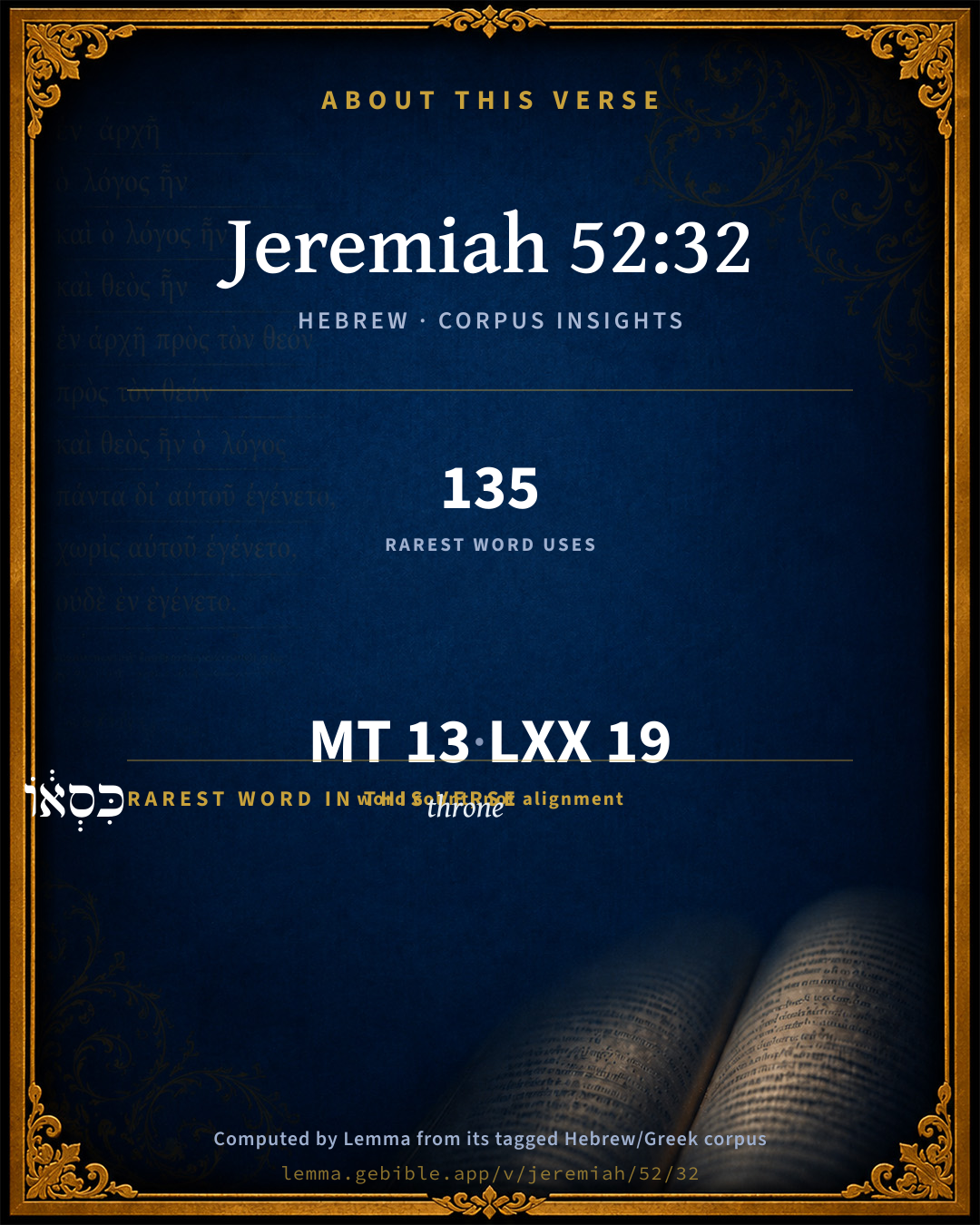
13
words
10
distinct lemmas
Prophets
section

Grammatical profile

  • 2 verbs
  • 5 nouns
  • 1 adjective
  • 2 prepositions
  • 1 adverb
  • 2 particles

Verb forms

  • וַיְדַבֵּ֥ר Piel · Sequential Imperfect
  • וַיִּתֵּן֙ Qal · Sequential Imperfect

Repetition

Words recur within this verse — often emphatic in Hebrew:

  • כִּסְא֔וֹ throne H3678 ×2
  • מלכים king H4428 ×2
  • אִתּ֖וֹ with H854 ×2

Hebrew & Septuagint length

In the original languages it is 13 Hebrew tokens and 19 Greek tokens — but the two are counted differently (Hebrew bundles its prefixes and suffixes into one token; the Greek is in lemma form), so that isn’t a like-for-like length.

Cross-references

4

Topical passages linked to Jeremiah 52:32 in the Treasury of Scripture Knowledge — connected by theme and wording, ordered by reader-vote popularity; previews shown in the World English Bible.

  • Proverbs 12:25 Anxiety in a man's heart weighs it down, But a kind word makes it glad.
  • Jeremiah 27:6–11 Now have I given all these lands into the hand of Nebuchadnezzar the king of Babylon, my servant; and the animals of the field also have I given him to serve him.
  • Daniel 2:37 You, O king, are king of kings, to whom the God of heaven has given the kingdom, the power, and the strength, and the glory;
  • Daniel 5:18–19 You king, the Most High God gave Nebuchadnezzar your father the kingdom, and greatness, and glory, and majesty:

Cross-references courtesy of OpenBible.info (CC BY 4.0).

Hebrew and Greek witnesses Masoretic Hebrew ↔ Greek Septuagint

The same verse in the two great witnesses to the Old Testament, shown verse-for-verse.

These are two independent witnesses, not word-aligned to each other, and the Septuagint is shown in lemma (dictionary) form.

Hebrew Jeremiah 52:32 Masoretic · Westminster Leningrad Codex

וַיְדַבֵּ֥ר אִתּ֖וֹ טֹב֑וֹת וַיִּתֵּן֙ אֶת כִּסְא֔וֹ מִמַּ֗עַל לְכִסֵּ֧א מלכים הַמְּלָכִ֛ים אֲשֶׁ֥ר אִתּ֖וֹ בְּבָבֶֽל

and he spoke kindly to him, and set his throne above the throne of the kings who were with him in Babylon,

World English Bible · Public Domain

Greek LXX Structure differs

In the Septuagint, Jeremiah is about an eighth shorter than the Hebrew and arranges its material differently — the Oracles Against the Nations (Hebrew chapters 46–51) appear in the middle of the Greek book, after 25:13. Because the chapter and verse boundaries do not line up, a verse-for-verse comparison with the Hebrew is not shown.

A verse-for-verse comparison isn’t shown here because the chapters and verses don’t line up. Switch to the LXX edition with the MT / LXX toggle above to read the Greek directly.

Hebrew: Westminster Leningrad Codex (CC BY 4.0). Greek: Septuagint (public domain); English from a public-domain English Septuagint. How the Septuagint differs from the Hebrew →

Targum (Aramaic paraphrase)

1

The Targum is the ancient Jewish Aramaic paraphrase of the Hebrew Scriptures — an interpretive translation, not the Hebrew text itself. Onkelos (literal) and Pseudo-Jonathan (expansive) render the Torah, and Jonathan the Prophets. Coverage is partial: where no permissively-licensed English translation exists for a verse, only the Aramaic is shown. This is verse-level text, not a word-by-word alignment to the Hebrew.

  1. Targum Jonathan Prophets (Joshua–Malachi)
    וּמַלֵיל עִמֵיהּ פִּתְגָמִין תַּקְנִין וִיהַב יַת כּוּרְסֵיהּ מֵעַיל לְכוּרְסֵי מַלְכַיָא דִי עִמֵיהּ בְּבָבֶל:

    (no public-domain English translation for this verse)

    Targum Jonathan — Aramaic: “Mikraot Gedolot” (public domain). English: “Sefaria Community Translation” (CC0 1.0 (public-domain dedication)); “London "Chaldee Paraphrase," 1871” (public domain). Text via Sefaria.

Commentary

Notes on Jeremiah 52:32 from classic Christian and Jewish commentators (each source and its license shown beneath its notes). The classic Christian expositions comment on the surrounding passage and are grouped to its opening verse, so a note may address several verses; the Jewish commentaries on the Tanakh (Rashi and others) are per-verse, so they appear only where the commentator wrote on this verse.

Lemma curates 59 commentaries, every one of them public domain or Creative Commons licensed, each selected and text-cleaned for this edition rather than reprinted as found. About our sources →

Jamieson, Fausset & Brown

Robert Jamieson, A. R. Fausset & David Brown

set his throne above--a mark of respect.

the kings--The Hebrew text reads (the other) kings." "The kings" is a Masoretic correction.

Jamieson, Fausset & Brown — Commentary Critical and Explanatory on the Whole Bible (1871) — public domain (CC PDM 1.0). Text via the HelloAO Bible API.

Adam Clarke's Commentary

Verse 32. Spake kindly] Conversed freely with him.

Set his throne] Gave him a more respectable seat than any of the captive princes, or better than even his own princes had, probably near his person.

Adam Clarke's Commentary on the Bible (1810–1826) — public domain. Text from a community e-Sword/MySword module.

The Cambridge Bible for Schools and Colleges

gen. ed. J. J. S. Perowne

32. set his throne above] in general, paid him more honour.

the kings] Captured kings were kept at the court of their conqueror to perpetuate the memory of his triumph as well as for security against rebellion. Cp. Jdg_1:7. So Croesus dwelt at the court of Cyrus.

The Cambridge Bible for Schools and Colleges (gen. ed. J. J. S. Perowne; Cambridge University Press, 1878–1918) — public domain. Text from a community e-Sword module.

John Gill's Exposition

And changed his prison garments,.... Which were filthy, and of an ill smell; and put on him raiment more comfortable, as well as more honourable, and suitable to his dignity, and more fit to appear in, in the presence of the king and his court:

and he did continually eat bread before him all the days of his life: either at the same table with the king; or at other near him, in his sight, in the same apartment; though the former seems more likely; and this he did as long as he lived; either Evilmerodach, or rather Jeconiah; though perhaps they both died much about the same time. All this was done about the year of the world 3444, and about five hundred sixty years before Christ, according to Bishop Usher (t) and Mr. Bedford (u); the authors of the Universal History (w) place it a year earlier.

(t) Annales Vet. Test. p. 138. (u) Scripture Chronology, p. 710. (w) Vol. 21. p. 64.

John Gill's Exposition of the Whole Bible (1746–1763) — public domain (CC PDM 1.0). Text via the HelloAO Bible API.

Haydock's Catholic Bible Commentary

Kings, who had been conquered, and kept at court for parade. (Calmet)

George Leo Haydock (1774–1849), Haydock's Catholic Family Bible and Commentary, 1859 edition — public domain. Excludes Psalms (Douay-Rheims chapter numbering differs from Protestant) and Deuterocanonical books (Catholic canon only).

Matthew Poole's English Annotations

The king of Babylon might have other kings his prisoners, his father having been so great a conqueror, or he might have other kings his subjects, that might reside at his court; and either out of a particular kindness he had to Jehoiachin, or in regard of the fame of David and Solomon, from whom Jehoiachin lineally descended, he might do him this honour.

Matthew Poole's English Annotations on the Holy Bible (1683–1685) — public domain. Text from a community e-Sword/MySword module.

unfoldingWord translationNotes

Door43 World Missions Community

He spoke kindly to him

"Awel-Marduk spoke kindly to Jehoiachin"

a seat more honorable

"a seat at the table that was closer to where Awel-Marduk sat"

removed Jehoiachin's prison clothes

The reader should understand that removing his prison clothes represents making him a free man. (See: Metonymy)

translationWords

honor

king

prison

life

unfoldingWord translationNotes — © Distant Shores Media and the Door43 World Missions Community, licensed CC BY-SA 4.0. Source: git.door43.org/Door43/en_tn.

Lesson kit

Teaching starters — assembled from the data on this page, not authored interpretation. Every prompt links to the verse data it draws on. Edit before teaching.

Jeremiah, in the Prophets, opens this verse with 13 words (10 distinct Hebrew lemmas). Its most distinctive word is kiççêʼ (“throne”). A historical commentator’s framing appears above. Read the whole chapter for the surrounding context.

Discussion questions

  1. How does “throne” (kiççêʼ) shape what this verse is saying?
  2. How does Proverbs 12:25, which shares this passage’s theme, read alongside this verse?
  3. What does the repetition of “throne” (2× in this one verse) do in this verse?
  4. These translations render this verse differently. What is at stake in choosing one wording over another?
  5. «וַיְדַבֵּ֥ר» is a Piel Sequential Imperfect verb. How does that grammatical form shape the action described?
  6. Compare how Jamieson, Fausset & Brown and Adam Clarke's Commentary read this verse. Where do they agree or differ?

Things to notice

Reading settings

Reading text

Shown beneath each verse's original-language words.

Old Testament
Old Testament edition

Read the OT as the Masoretic Hebrew (MT) or the Greek Septuagint (LXX).

English shown for the Greek Septuagint (in the Hebrew ↔ Greek comparison).

Comparing translations? Open the Compare panel on any verse page to stack up to four side by side.