
Genesis 7:20

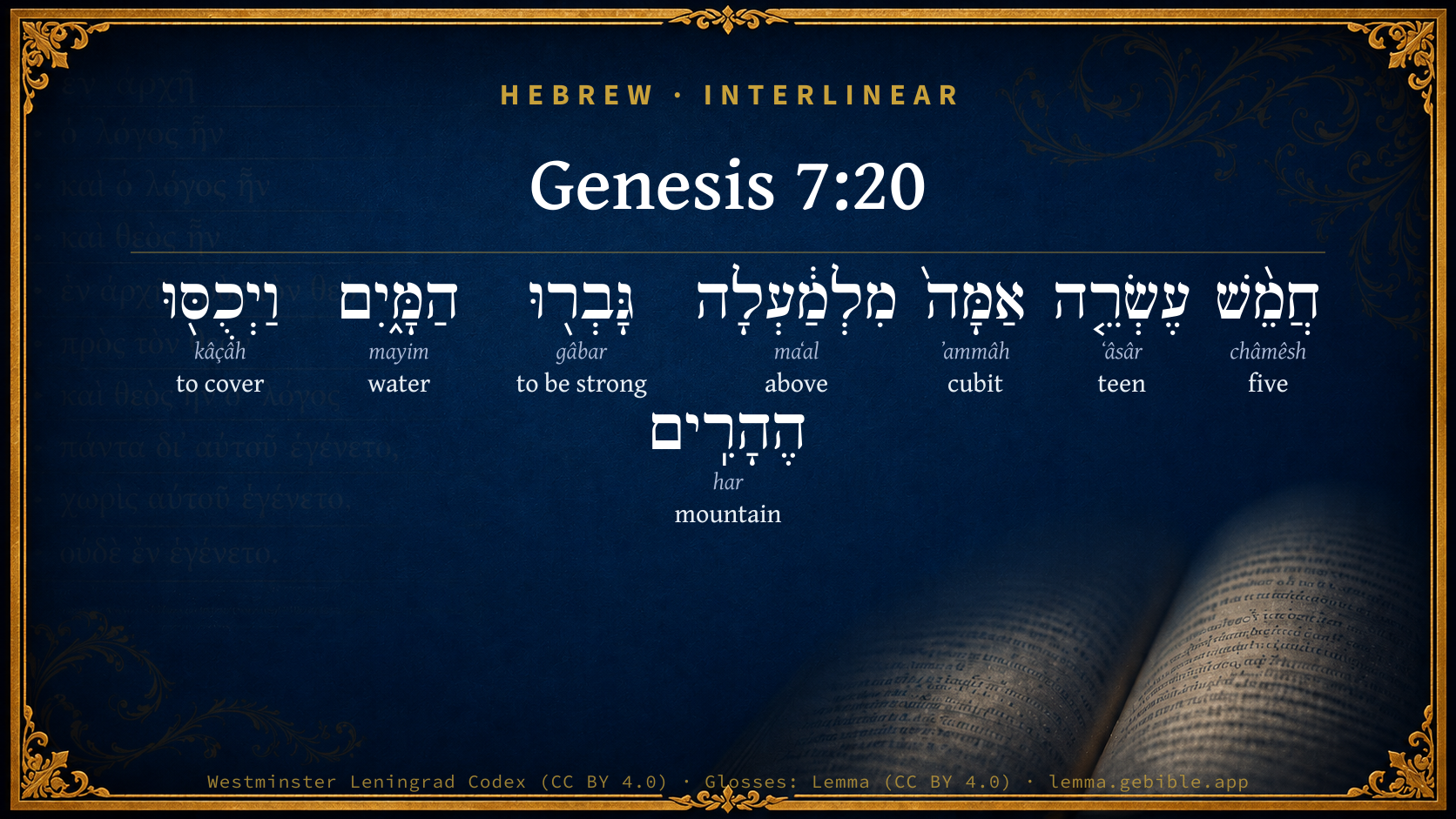
Hebrew (Westminster Leningrad Codex) Genesis 7:20 appears in the Hebrew Old Testament. The text above is from the Westminster Leningrad Codex. Each word links to its Strong’s number, a concise gloss, and parsing drawn from the Open Scriptures Hebrew Bible morphology. Click any word for its full Brown-Driver-Briggs (BDB) entry.
Download image
Cite this verse

Genesis 7:20 (World English Bible). Public Domain. Lemma interlinear Bible study tool, https://lemma.gebible.app/v/genesis/7/20.

Show BibTeX & RIS
BibTeX
RIS
English Translation
The waters prevailed fifteen cubits upward, and the mountains were covered.
World English Bible · Public Domain
Download a study sheet

One document with this verse’s original text, its word-by-word gloss line, the meaning frame, cross-references with their text, attributed commentary, and full source and license credits — printable, and it pastes into notes with its structure intact.

This verse Autodidact and up

Study sheet (.html) Plain text (.txt)

A passage Seminary Student

Up to 50 verses in one chapter. A passage sheet keeps up to 6 commentary sources and 12 cross-references per verse, in the order this page ranks them, and says so on the sheet whenever that leaves anything out. Ask for a single verse and you get the Autodidact verse sheet above.

Everything on this page stays free to read, with no account — the sheet is a download of what is already on screen, not access to it.

Want to remove ads? Support Godless Engineer
Compare translations 3

The same verse in 3 English versions, stacked beneath the original-language interlinear above. Click any original word for its lexicon entry.

Each is an independent rendering of the whole verse — the interlinear is not word-aligned to these translations.

Highlighted words mark where these versions differ — a whole-verse word diff, not a word-by-word alignment.

  • World English Bible Public Domain
    The waters prevailed fifteen cubits upward, and the mountains were covered.
  • King James Version Public Domain
    Fifteen cubits upward did the waters prevail; and the mountains were covered.
  • unfoldingWord Literal Text CC BY-SA 4.0
    The waters rose fifteen cubits above, so that the mountains were covered.

unfoldingWord Literal Text — © unfoldingWord, licensed CC BY-SA 4.0. Word-aligned USFM3 via Door43 (git.door43.org/unfoldingWord/en_ult).

Versions to compare (up to 4)

3 of 4 selected

Show all 18 translations

Every available English version of this verse, each an independent rendering of the whole verse.

  • World English Bible Public Domain
    The waters prevailed fifteen cubits upward, and the mountains were covered.
  • Berean Standard Bible Public Domain
    The waters rose and covered the mountaintops to a depth of fifteen cubits.
  • Majority Standard Bible Public Domain
    The waters rose and covered the mountaintops to a depth of fifteen cubits.
  • King James Version Public Domain
    Fifteen cubits upward did the waters prevail; and the mountains were covered.
  • American Standard Version (1901) Public Domain
    Fifteen cubits upward did the waters prevail; and the mountains were covered.
  • Revised Version (1885) Public Domain
    Fifteen cubits upward did the waters prevail; and the mountains were covered.
  • Geneva Bible (1599) Public Domain
    Fifteene cubites vpwarde did the waters preuaile, when the mountaines were couered.
  • Douay-Rheims (1899) Public Domain
    The water was fifteen cubits higher than the mountains which it covered.
  • Young's Literal Translation Public Domain
    fifteen cubits upwards have the waters become mighty, and the mountains are covered;
  • Literal Standard Version CC BY-SA 4.0
    the waters prevailed from above the mountains, and cover [them] fifteen cubits;
  • Unlocked Literal Bible CC BY-SA 4.0
    The waters rose fifteen cubits above the tops of the mountains.
  • unfoldingWord Literal Text CC BY-SA 4.0
    The waters rose fifteen cubits above, so that the mountains were covered.
  • Darby Bible Public Domain
    Fifteen cubits upward the waters prevailed; and the mountains were covered.
  • World Messianic Bible Public Domain
    The waters rose fifteen cubits higher, and the mountains were covered.
  • Webster's Bible Public Domain
    Fifteen cubits upward did the waters prevail: and the mountains were covered.
  • Free Bible Version CC BY-SA 4.0
    The water rose so much that it was higher than the mountains by fifteen cubits.
  • Bible in Basic English Public Domain
    The waters went fifteen cubits higher, till all the mountains were covered.
  • JPS Tanakh (1917) Public Domain
    Fifteen cubits upward did the waters prevail; and the mountains were covered.

Literal Standard Version (2020), Covenant Press — licensed CC BY-SA 4.0. Text via the HelloAO Bible API (eBible.org). Unlocked Literal Bible (unfoldingWord) — licensed CC BY-SA 4.0. Text via the HelloAO Bible API (eBible.org). unfoldingWord Literal Text — © unfoldingWord, licensed CC BY-SA 4.0. Word-aligned USFM3 via Door43 (git.door43.org/unfoldingWord/en_ult). Free Bible Version, Dr. Jonathan Gallagher — licensed CC BY-SA 4.0. Text via the HelloAO Bible API (eBible.org).

Word by word

More ways to search: Search by grammar → Find every occurrence → Compare this word →

Practice this passage: Drill this verse → Learn its vocabulary →

גָּבְר֖וּ
gâbar
H1396
“to be strong”
Verb, Qal, Perfect, 3rd Person, Common, Plural
Part of Speech
Verb
Stem
Qal
Form
Perfect
Person
3rd Person
Gender
Common
Number
Plural
Full BDB Definition

Origin: a primitive root

TWOT: 310

to prevail, have strength, be strong, be powerful, be mighty, be great - (Qal) - to be strong, mighty - to prevail - (Piel) to make strong, strengthen - (Hiphil) - to confirm, give strength - to confirm (a covenant) - (Hithpael) - to show oneself mighty - to act proudly (toward God)
  1. חֲמֵ֨שׁ châmêsh H2568 “five” Adjective, Cardinal number, Feminine, Singular, Absolute
  2. עֶשְׂרֵ֤ה ʻâsâr H6240 “teen” Adjective, Cardinal number, Feminine, Singular, Absolute
  3. אַמָּה֙ ʼammâh H520 “cubit” Noun, Common, Feminine, Singular, Absolute
  4. מִלְמַ֔עְלָה maʻal H4605 “from · to/for · above · toward” Preposition + Preposition + Adverb + Suffix, Demonstrative
  5. הַמָּ֑יִם mayim H4325 “the · water(s)” Particle, Definite Article + Noun, Common, Masculine, Plural, Absolute
  6. וַיְכֻסּ֖וּ kâçâh H3680 “and · to cover” Conjunction + Verb, Pual, Sequential Imperfect, 3rd Person, Masculine, Plural
  7. הֶהָרִֽים har H2022 “the · mountains” Particle, Definite Article + Noun, Common, Masculine, Plural, Absolute

About this verse

These counts appear in no published source. They are computed here, from the morphology-tagged text and Lemma’s own curated glosses. What Lemma adds →

8
words
8
distinct lemmas
Pentateuch
section

Notable vocabulary

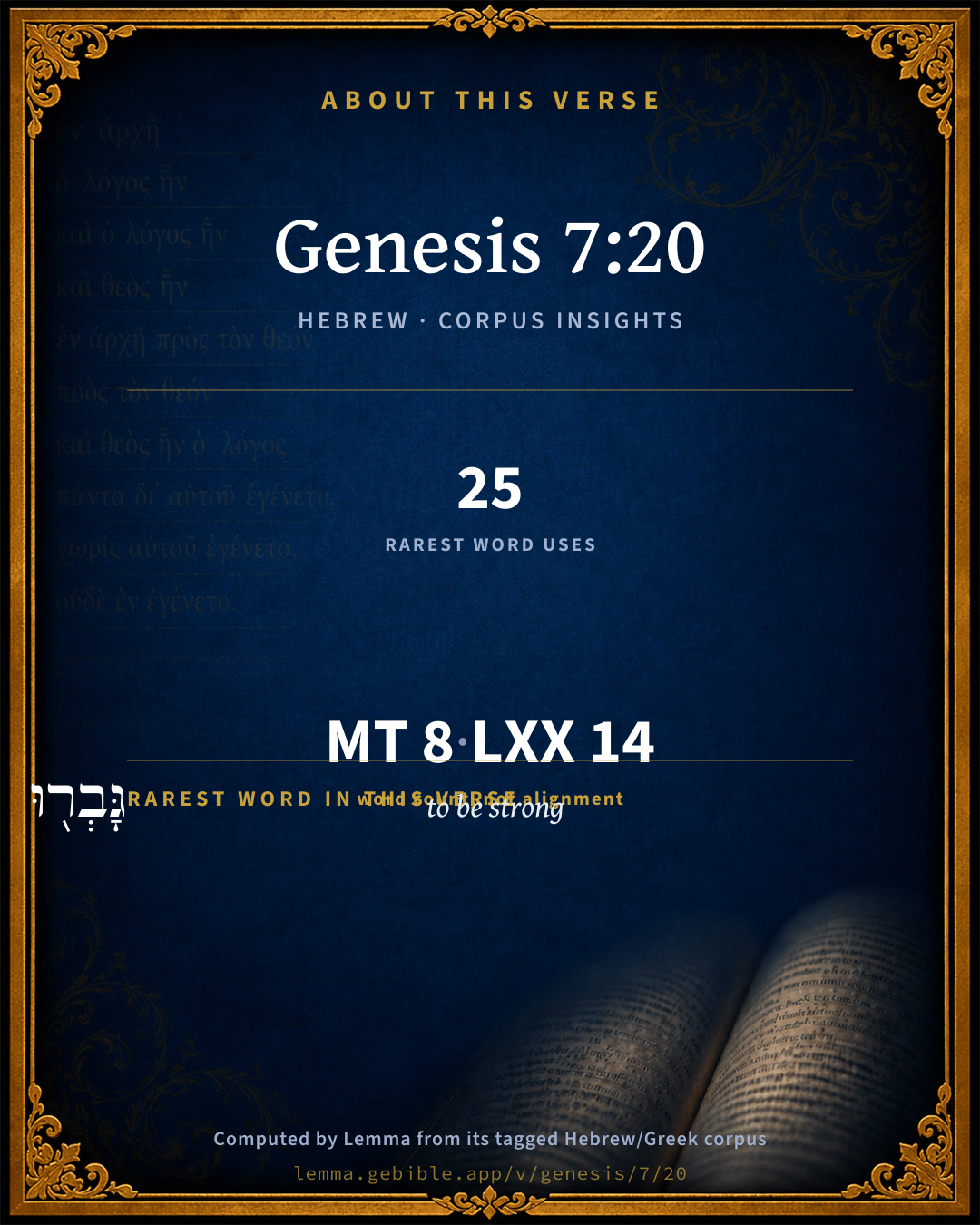
The rarest word here is גָּבְר֖וּ to be strong H1396 — appearing just 25 times in the whole Hebrew Bible.

Shared distinctive vocabulary

גָּבְר֖וּ to be strong H1396 occurs in 24 verses of the Hebrew Bible. Also found in:

Grammatical profile

  • 2 verbs
  • 3 nouns
  • 2 adjectives
  • 1 adverb

Verb forms

  • גָּבְר֖וּ Qal · Perfect
  • וַיְכֻסּ֖וּ Pual · Sequential Imperfect

Hebrew & Septuagint length

In English translation the verse runs 11 words from the Hebrew and 14 from the Septuagint (LXX English) — closely comparable.

A rough comparison of the two English renderings, which tokenize alike — not a word-level alignment.

Word counts can differ between the Hebrew and the Greek without any difference in meaning — e.g. the Hebrew direct-object marker אֵת has no separate Greek word, and Greek often adds the article ὁ.

In the original languages it is 8 Hebrew tokens and 14 Greek tokens — but the two are counted differently (Hebrew bundles its prefixes and suffixes into one token; the Greek is in lemma form), so that isn’t a like-for-like length.

Cross-references

2

Topical passages linked to Genesis 7:20 in the Treasury of Scripture Knowledge — connected by theme and wording, ordered by reader-vote popularity; previews shown in the World English Bible.

  • Jeremiah 3:23 Truly in vain is [the help that is looked for] from the hills, the tumult on the mountains: truly in Yahweh our God is the salvation of Israel.
  • Psalms 104:6 You covered it with the deep as with a cloak. The waters stood above the mountains.

Cross-references courtesy of OpenBible.info (CC BY 4.0).

Hebrew and Greek witnesses Masoretic Hebrew ↔ Greek Septuagint

The same verse in the two great witnesses to the Old Testament, shown verse-for-verse.

These are two independent witnesses, not word-aligned to each other, and the Septuagint is shown in lemma (dictionary) form.

Hebrew Genesis 7:20 Masoretic · Westminster Leningrad Codex

חֲמֵ֨שׁ עֶשְׂרֵ֤ה אַמָּה֙ מִלְמַ֔עְלָה גָּבְר֖וּ הַמָּ֑יִם וַיְכֻסּ֖וּ הֶהָרִֽים

The waters prevailed fifteen cubits upward, and the mountains were covered.

World English Bible · Public Domain

Greek LXX Genesis 7:20 Septuagint · lemma form

δέκα πέντε πῆχυς ἐπάνω ὑψόω ὁ ὕδωρ καί ἐπικαλύπτω πᾶς ὁ ὄρος ὁ ὑψηλός

Fifteen cubits upwards was the water raised, and it covered all the high mountains.

LXX2012 (modern English Septuagint) · Public Domain

Hebrew: Westminster Leningrad Codex (CC BY 4.0). Greek: Septuagint (public domain); English from LXX2012 (modern English Septuagint) (Public Domain). How the Septuagint differs from the Hebrew →

Targum (Aramaic paraphrase)

2

The Targum is the ancient Jewish Aramaic paraphrase of the Hebrew Scriptures — an interpretive translation, not the Hebrew text itself. Onkelos (literal) and Pseudo-Jonathan (expansive) render the Torah, and Jonathan the Prophets. Coverage is partial: where no permissively-licensed English translation exists for a verse, only the Aramaic is shown. This is verse-level text, not a word-by-word alignment to the Hebrew.

  1. Targum Onkelos Torah (Genesis–Deuteronomy)
    חֲמֵשׁ עַשְׂרֵי אַמִּין מִלְעֵלָּא תְּקִיפוּ מַיָּא וְאִתְחֲפִיאוּ טוּרַיָּא

    Fifteen cubits upward did the waters prevail, and the mountains were covered;

    Targum Onkelos — Aramaic: “Onkelos Genesis” (public domain); “Onkelos Exodus” (public domain); “Onkelos Leviticus” (public domain); “Onkelos Numbers” (public domain); “Onkelos Deuteronomy” (public domain). English: “Sefaria Community Translation” (CC0 1.0 (public-domain dedication)); “J.W. Etheridge. The Targums of Onkelos and Jonathan Ben Uzziel on the Pentateuch. London: Longmans, Green, 1862” (public domain). Text via Sefaria.

  2. Targum Pseudo-Jonathan Torah (Genesis–Deuteronomy)
    חֲמִיסְרֵי גַרְמִידִין מִלְעֵיל תָּקְפוּ מַיָא וְאִתְחַפִּיאוּ טוּרַיָא

    fifteen cubits higher did the waters prevail, and the mountains were covered.

    Targum Pseudo-Jonathan — Aramaic: “Targum Jonathan on Genesis” (public domain); “Targum Jonathan on Exodus” (public domain); “Targum Jonathan on Leviticus” (public domain); “Targum Jonathan on Numbers” (public domain); “Targum Jonathan on Deuteronomy” (public domain). English: “The Targum of Jonathan ben Uzziel, trans. J. W. Etheridge, London, 1862” (public domain). Text via Sefaria.

Commentary

Notes on Genesis 7:20 from classic Christian and Jewish commentators (each source and its license shown beneath its notes). The classic Christian expositions comment on the surrounding passage and are grouped to its opening verse, so a note may address several verses; the Jewish commentaries on the Tanakh (Rashi and others) are per-verse, so they appear only where the commentator wrote on this verse.

Lemma curates 59 commentaries, every one of them public domain or Creative Commons licensed, each selected and text-cleaned for this edition rather than reprinted as found. About our sources →

Trapp's Complete Commentary

John Trapp

Gen 7:20 Fifteen cubits upward did the waters prevail; and the mountains were covered.

Ver. 20. Fifteen cubits upward.] So, above any mountain. The Popish fable of Enoch, preserved alive in some high place of the earthly paradise, shall as soon be believed as the Jewish tale of Og (one of the old giants, say they), escaping death by riding astride upon the ark.

John Trapp, A Commentary or Exposition upon All the Books of the Old and New Testament (1647–1656) — public domain. Text from a community e-Sword module.

Jamieson, Fausset & Brown

Robert Jamieson, A. R. Fausset & David Brown

Fifteen cubits upward . . . and the mountains were covered--twenty-two and a half feet above the summits of the highest hills. The language is not consistent with the theory of a partial deluge.

Jamieson, Fausset & Brown — Commentary Critical and Explanatory on the Whole Bible (1871) — public domain (CC PDM 1.0). Text via the HelloAO Bible API.

Adam Clarke's Commentary

Verse 20. Fifteen cubits upward] Should any person object to the universality of the deluge because he may imagine there is not water sufficient to drown the whole globe in the manner here related, he may find a most satisfactory answer to all the objections he can raise on this ground in Mr. Ray's Physico-theological Discourses, 2d edit., 8vo., 1693.

Adam Clarke's Commentary on the Bible (1810–1826) — public domain. Text from a community e-Sword/MySword module.

Ellicott's Commentary for English Readers

(20) Fifteen cubits upward.—This apparently was the draught of the ark, computed after it had settled. in the region of Ararat. Fifteen cubits would be about twenty-two feet, and as the ark floated onward without interruption until it finally grounded, there must have been this depth of water even on the highest summit in its course. Continuous rains for forty days and nights would scarcely produce so vast a mass of water, unless we suppose that the adâmâh was some low-lying spot of ground whither the waters from many regions flowed together; but this is negatived by the ark having travelled into Armenia. In England the whole average mean rainfall in a year is not more than twenty-eight or thirty inches in depth. If we suppose this amount to have fallen in every twenty-four hours, the total quantity would be about 100 feet. Such a rain would denude the mountains of all soil, uproot all trees, sweep away all buildings, dig out new courses for the rivers, completely alter the whole surface of the ground, and cover the lower lands with débris. Wherever there was any obstacle in their way, the waters would deepen in volume, and quickly burst a passage through it. But as they would be seeking the lower grounds during the whole forty days, it is difficult to understand how they could cover any of the heights to the depth of twenty-two feet, unless there were some cosmic convulsion (see Note on Gen_7:11), by which the waters from the equator were carried towards the poles, and in this way there would be no difficulty in the ark being carried against the current of the Tigris and Euphrates up to the high lands of Armenia.

A Bible Commentary for English Readers, edited by Charles John Ellicott (1878–1897) — public domain. Text from a community e-Sword module.

The Cambridge Bible for Schools and Colleges

gen. ed. J. J. S. Perowne

20. Fifteen cubits] P describes a depth of water of 15 cubits (= 22 feet) above the mountains. Why should 15 cubits be mentioned? Very possibly, because the height of the ark was 30 cubits (Gen_6:15), and the ark was considered to be submerged for half its depth. It would thus just touch the top of “the mountains of Ararat” (Gen_8:4).

21 (P). And all flesh died] Cf. Gen_6:17. P here describes the death by drowning of all living creatures.

creeping thing] Literally, as marg., swarming thing that swarmeth. See note on Gen_1:20. The word used is characteristic of P.

22 (J). all] The account in this and the following verse gives J’s description of the destruction of all life. The repetition is obvious.

in whose nostrils, &c.] The expression is evidently based upon the words in Gen_2:7, “breathed into his nostrils the breath of life.” But “the breath of life” of that passage is combined here with “the spirit of life” which we find in Gen_6:17, Gen_7:15 (P). The one is a phrase characteristic of J, the other of P. The combination is not found elsewhere. Possibly the word “spirit” has been introduced by the compiler or by a copyist.

in the dry land] as if to emphasize the thought that the marine animals survived. The word in the Heb. rendered “the dry land” is different from that so rendered in Gen_1:9 (P).

23 (J). was destroyed … were destroyed] The better reading is that rendered in the R.V. marg., and he destroyed every living thing. For the word “destroyed,” Heb. blotted out, see Gen_6:7, Gen_7:4.

24 (P). an hundred and fifty days] The duration of the Flood, corresponding to the 40 days of J in Gen_7:12. According to P, the rising of the waters, described in Gen_7:18-20, continued or “prevailed” for 150 days, after which the waters began to fall: see Gen_8:3 b, 4a.

The Cambridge Bible for Schools and Colleges (gen. ed. J. J. S. Perowne; Cambridge University Press, 1878–1918) — public domain. Text from a community e-Sword module.

John Gill's Exposition

All in whose nostrils was the breath of life,.... Whether of fowls, beast, cattle, or creeping things:

of all that was in the dry land, died; by which description fishes were excepted, since they breathe not, having no lungs, and are not on the dry land, where they cannot live, but in the waters. Some pretend it to be the opinion of some Jewish writers, that the fishes did die, the waters being made hot, and scalded them; but this fable I have not met with.

John Gill's Exposition of the Whole Bible (1746–1763) — public domain (CC PDM 1.0). Text via the HelloAO Bible API.

Matthew Poole's English Annotations

Fifteen cubits were sufficient for the destruction of the highest men, or other creatures, though placed upon the highest mountains.

Matthew Poole's English Annotations on the Holy Bible (1683–1685) — public domain. Text from a community e-Sword/MySword module.

Whedon's Commentary on the Bible

Daniel D. Whedon

20. Fifteen cubits upward — The arithmetical exactness here is noteworthy. Here, as in the minute specifications of time, which are given as carefully as if they had been set down in a logbook, we have the language of one who was in the midst of the scene — a spectator who was profoundly impressed by the rushing floods, the rising and slowly moving ark, the sinking hills, the drowning men and beasts, yet was not confused or bewildered amid the awful scene. He notes and records the precise date of each critical event, and coolly fathoms the deluge itself. Probably the ark drew fifteen cubits of water, and as it did not ground upon the hills, the spectator saw that they were covered to this depth. Shut in with Jehovah, though in the unwieldy ark, floating he knew not whither, faith gave Noah a confidence more calm and grand than skill and science can ever give the navigator, though in a seaworthy ship traversing familiar waters.

Daniel D. Whedon (gen. ed.), Commentary on the Old and New Testaments (1874–1909) — public domain. Text from a community e-Sword module.

The Pulpit Commentary

Fifteen cubits upward half the height of the arkdid the waters prevail. Literally, become strong; above the highest mountains obviously, and not above the ground simply; as, on the latter alternative, it could scarcely have been added, and the mountains were covered.

The Pulpit Commentary (1880–1919), ed. H.D.M. Spence-Jones & Joseph S. Exell — public domain. Text from a community e-Sword module.

John Wesley's Explanatory Notes

The mountains were covered - Therefore there were mountains before the flood.

John Wesley, Explanatory Notes Upon the Whole Bible (1754–1765) — public domain. Text via the GEBible commentary corpus.

Rashi

Rabbi Shlomo Yitzchaki (Rashi)

חמש עשרה אמה מלמעלה FIFTEEN CUBITS ABOVE —above the summits of all the mountains when once the waters reached the level of the mountains (Yoma 76a).

Rashi on the Tanakh — English translations: “The Judaica Press complete Tanach with Rashi, translated by A. J. Rosenberg” (CC BY 4.0); “Pentateuch with Rashi's commentary by M. Rosenbaum and A.M. Silbermann, 1929-1934” (public domain); “The Metsudah Tanach series, Lakewood, N.J” (CC BY 4.0); and “The Book of Joshua, Metsudah Publications, 1997” (CC BY 4.0). Text via Sefaria.

Radak

Rabbi David Kimhi (Radak)

חמש עשרה, this number describes how much above the highest mount the keel of the ark had risen. ויכוסו ההרים, even the tallest of the mountains were covered by at least 15 cubits of water.

Radak on the Tanakh — English translations: “Sefaria Community Translation” (CC0 1.0 (public-domain dedication)); “Eliyahu Munk, HaChut Hameshulash” (CC BY 4.0); “Rabbi Mike Feuer, Jerusalem Anthology” (CC BY 4.0); and “R. David Kimhi on the first book of Psalms, Translated by R.G. Finch, London, 1919” (public domain). Text via Sefaria.

Lesson kit

Teaching starters — assembled from the data on this page, not authored interpretation. Every prompt links to the verse data it draws on. Edit before teaching.

Genesis, in the Pentateuch, opens this verse with 8 words (8 distinct Hebrew lemmas). Its most distinctive word is gâbar (“to be strong”). A historical commentator’s framing appears above. Read the whole chapter for the surrounding context.

Discussion questions

  1. The word gâbar carries the sense “to be strong.” How does it shape the verse?
  2. How does Genesis 7:18, which shares the word «to be strong», read alongside this verse?
  3. These translations render this verse differently. What is at stake in choosing one wording over another?
  4. «גָּבְר֖וּ» is a Qal Perfect verb. How does that grammatical form shape the action described?
  5. Compare how Trapp's Complete Commentary and Jamieson, Fausset & Brown read this verse. Where do they agree or differ?

Things to notice

Reading settings

Reading text

Shown beneath each verse's original-language words.

Old Testament
Old Testament edition

Read the OT as the Masoretic Hebrew (MT) or the Greek Septuagint (LXX).

English shown for the Greek Septuagint (in the Hebrew ↔ Greek comparison).

Comparing translations? Open the Compare panel on any verse page to stack up to four side by side.