
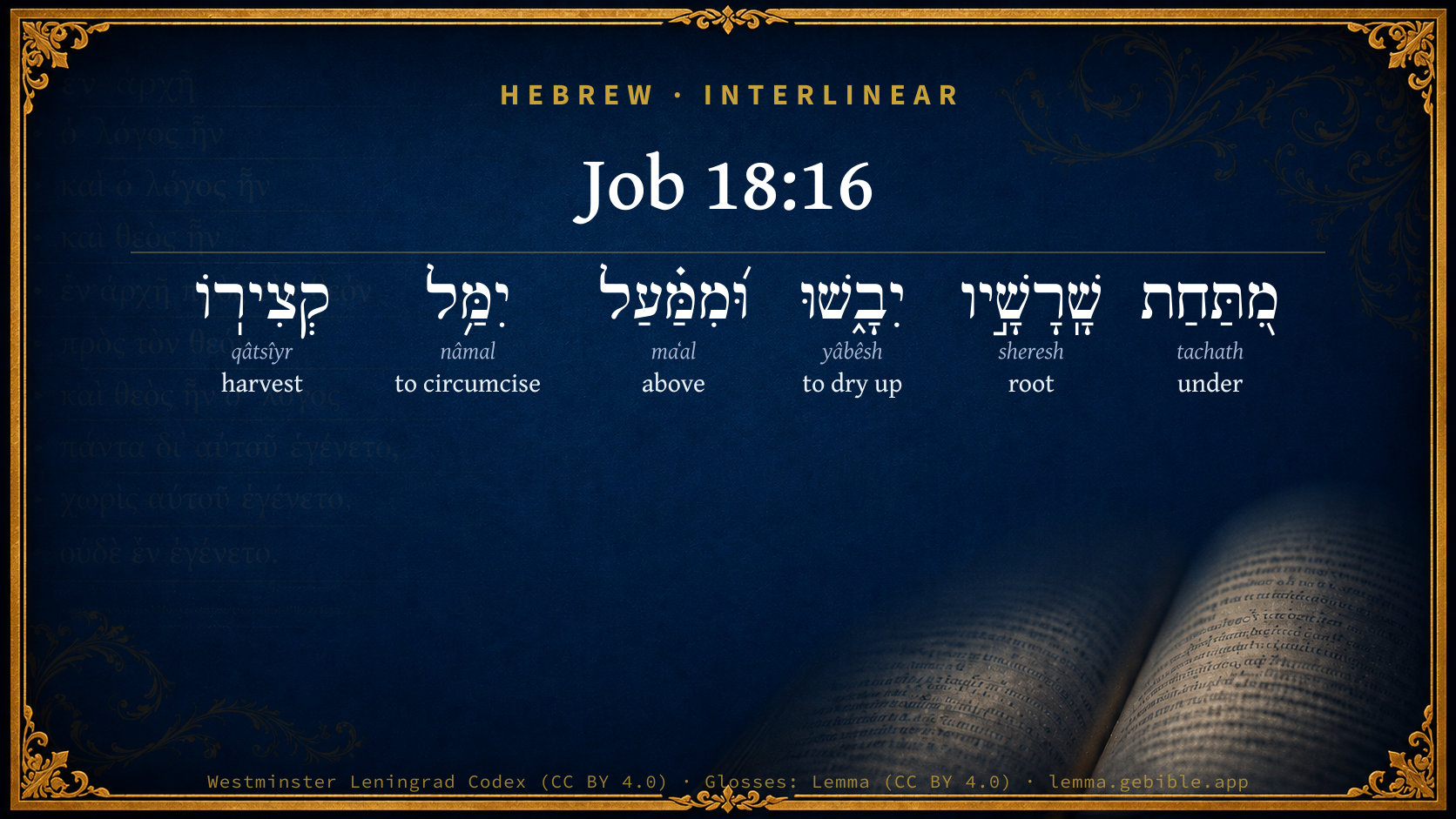
Job 18:16

Hebrew (Westminster Leningrad Codex) Job 18:16 appears in the Hebrew Old Testament. The text above is from the Westminster Leningrad Codex. Each word links to its Strong’s number, a concise gloss, and parsing drawn from the Open Scriptures Hebrew Bible morphology. Click any word for its full Brown-Driver-Briggs (BDB) entry.
Download image
Cite this verse

Job 18:16 (World English Bible). Public Domain. Lemma interlinear Bible study tool, https://lemma.gebible.app/v/job/18/16.

Show BibTeX & RIS
BibTeX
RIS
English Translation
His roots shall be dried up beneath, Above shall his branch be cut off.
World English Bible · Public Domain
Download a study sheet

One document with this verse’s original text, its word-by-word gloss line, the meaning frame, cross-references with their text, attributed commentary, and full source and license credits — printable, and it pastes into notes with its structure intact.

This verse Autodidact and up

Study sheet (.html) Plain text (.txt)

A passage Seminary Student

Up to 50 verses in one chapter. A passage sheet keeps up to 6 commentary sources and 12 cross-references per verse, in the order this page ranks them, and says so on the sheet whenever that leaves anything out. Ask for a single verse and you get the Autodidact verse sheet above.

Everything on this page stays free to read, with no account — the sheet is a download of what is already on screen, not access to it.

Want to remove ads? Support Godless Engineer
Compare translations 3

The same verse in 3 English versions, stacked beneath the original-language interlinear above. Click any original word for its lexicon entry.

Each is an independent rendering of the whole verse — the interlinear is not word-aligned to these translations.

Highlighted words mark where these versions differ — a whole-verse word diff, not a word-by-word alignment.

  • World English Bible Public Domain
    His roots shall be dried up beneath, Above shall his branch be cut off.
  • King James Version Public Domain
    His roots shall be dried up beneath, and above shall his branch be cut off.
  • unfoldingWord Literal Text CC BY-SA 4.0
    Below, his roots dry up, and above, his branch withers.

unfoldingWord Literal Text — © unfoldingWord, licensed CC BY-SA 4.0. Word-aligned USFM3 via Door43 (git.door43.org/unfoldingWord/en_ult).

Versions to compare (up to 4)

3 of 4 selected

Show all 18 translations

Every available English version of this verse, each an independent rendering of the whole verse.

  • World English Bible Public Domain
    His roots shall be dried up beneath, Above shall his branch be cut off.
  • Berean Standard Bible Public Domain
    The roots beneath him dry up, and the branches above him wither away.
  • Majority Standard Bible Public Domain
    The roots beneath him dry up, and the branches above him wither away.
  • King James Version Public Domain
    His roots shall be dried up beneath, and above shall his branch be cut off.
  • American Standard Version (1901) Public Domain
    His roots shall be dried up beneath, And above shall his branch be cut off.
  • Revised Version (1885) Public Domain
    His roots shall be dried up beneath, and above shall his branch be cut off.
  • Geneva Bible (1599) Public Domain
    His rootes shalbe dryed vp beneath, and aboue shall his branche be cut downe.
  • Douay-Rheims (1899) Public Domain
    Let his roots be dried up beneath, and his harvest destroyed above.
  • Young's Literal Translation Public Domain
    From beneath his roots are dried up, And from above cut off is his crop.
  • Literal Standard Version CC BY-SA 4.0
    From beneath his roots are dried up, || And from above his crop is cut off.
  • Unlocked Literal Bible CC BY-SA 4.0
    His roots will be dried up beneath; above will his branch be cut off.
  • unfoldingWord Literal Text CC BY-SA 4.0
    Below, his roots dry up, and above, his branch withers.
  • Darby Bible Public Domain
    His roots shall be dried up beneath, and above shall his branch be cut off;
  • World Messianic Bible Public Domain
    His roots will be dried up beneath. His branch will be cut off above.
  • Webster's Bible Public Domain
    His roots shall be dried up beneath, and above shall his branch be cut off.
  • Free Bible Version CC BY-SA 4.0
    They wither away, roots below and branches above;
  • Bible in Basic English Public Domain
    Under the earth his roots are dry, and over it his branch is cut off.
  • JPS Tanakh (1917) Public Domain
    His roots shall dry up beneath, and above shall his branch wither.

Literal Standard Version (2020), Covenant Press — licensed CC BY-SA 4.0. Text via the HelloAO Bible API (eBible.org). Unlocked Literal Bible (unfoldingWord) — licensed CC BY-SA 4.0. Text via the HelloAO Bible API (eBible.org). unfoldingWord Literal Text — © unfoldingWord, licensed CC BY-SA 4.0. Word-aligned USFM3 via Door43 (git.door43.org/unfoldingWord/en_ult). Free Bible Version, Dr. Jonathan Gallagher — licensed CC BY-SA 4.0. Text via the HelloAO Bible API (eBible.org).

Word by word

More ways to search: Search by grammar → Find every occurrence → Compare this word →

Practice this passage: Drill this verse → Learn its vocabulary →

About this verse

These counts appear in no published source. They are computed here, from the morphology-tagged text and Lemma’s own curated glosses. What Lemma adds →

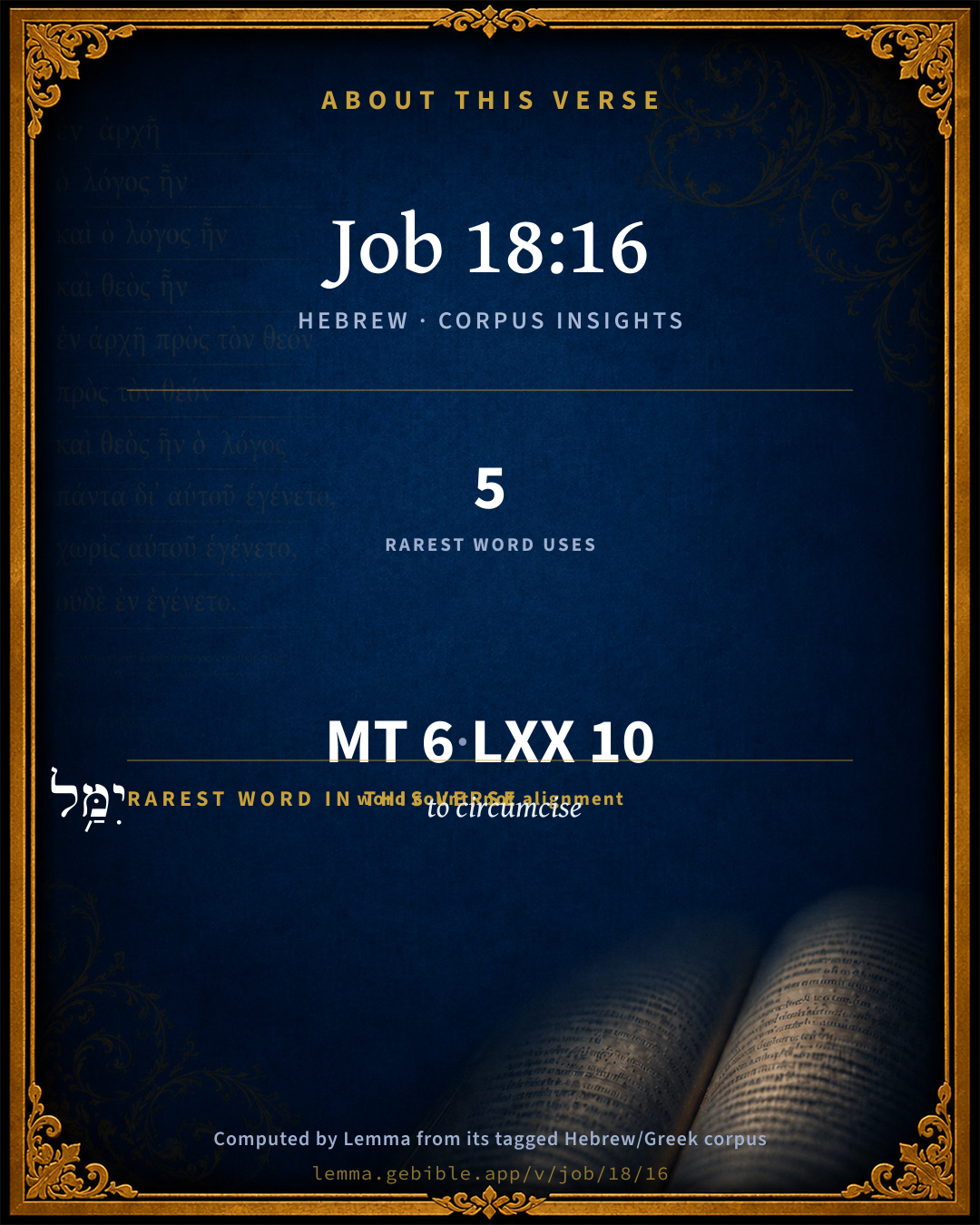
6
words
6
distinct lemmas
Wisdom
section

Notable vocabulary

The rarest word here is יִמַּ֥ל to circumcise H5243 — appearing just 5 times in the whole Hebrew Bible.

Shared distinctive vocabulary

יִמַּ֥ל to circumcise H5243 occurs in 5 verses of the Hebrew Bible. Also found in:

Grammatical profile

  • 2 verbs
  • 2 nouns
  • 1 preposition
  • 1 adverb

Verb forms

  • יִבָ֑שׁוּ Qal · Imperfect
  • יִמַּ֥ל Qal · Imperfect

Hebrew & Septuagint length

In English translation the verse runs 14 words from the Hebrew and 16 from the Septuagint (LXX English) — closely comparable.

A rough comparison of the two English renderings, which tokenize alike — not a word-level alignment.

Word counts can differ between the Hebrew and the Greek without any difference in meaning — e.g. the Hebrew direct-object marker אֵת has no separate Greek word, and Greek often adds the article ὁ.

In the original languages it is 6 Hebrew tokens and 10 Greek tokens — but the two are counted differently (Hebrew bundles its prefixes and suffixes into one token; the Greek is in lemma form), so that isn’t a like-for-like length.

Cross-references

7

Topical passages linked to Job 18:16 in the Treasury of Scripture Knowledge — connected by theme and wording, ordered by reader-vote popularity; previews shown in the World English Bible.

  • Hosea 9:16 Ephraim is struck. Their root has dried up. They will bear no fruit. Even though they bring forth, yet I will kill the beloved ones of their womb."
  • Isaiah 5:24 Therefore as the tongue of fire devours the stubble, And as the dry grass sinks down in the flame, So their root shall be as rottenness, And their blossom shall go up as dust; Because they have rejected the law of Yahweh of Hosts, And despised the word of the Holy One of Israel.
  • Job 15:30 He shall not depart out of darkness; The flame shall dry up his branches, By the breath of God's mouth shall he go away.
  • Amos 2:9 Yet I destroyed the Amorite before them, Whose height was like the height of the cedars, And he was strong as the oaks; Yet I destroyed his fruit from above, and his roots from beneath.
  • Malachi 4:1 "For, behold, the day comes, it burns as a furnace; and all the proud, and all who work wickedness, will be stubble; and the day that comes will burn them up," says Yahweh of Hosts, "that it shall leave them neither root nor branch.
  • Job 29:19 My root is spread out to the waters, The dew lies all night on my branch;
  • Job 5:3–4 I have seen the foolish taking root, But suddenly I cursed his habitation.

Cross-references courtesy of OpenBible.info (CC BY 4.0).

Hebrew and Greek witnesses Masoretic Hebrew ↔ Greek Septuagint

The same verse in the two great witnesses to the Old Testament, shown verse-for-verse.

These are two independent witnesses, not word-aligned to each other, and the Septuagint is shown in lemma (dictionary) form.

Hebrew Job 18:16 Masoretic · Westminster Leningrad Codex

מִ֭תַּחַת שָֽׁרָשָׁ֣יו יִבָ֑שׁוּ וּ֝מִמַּ֗עַל יִמַּ֥ל קְצִירֽוֹ

His roots shall be dried up beneath, Above shall his branch be cut off.

World English Bible · Public Domain

Greek LXX Job 18:16 Septuagint · lemma form

ὑποκάτωθεν ὁ ῥίζα αὐτός ξηραίνω καί ἐπάνωθεν ἐπιπίπτω θερισμός αὐτός

His roots shall be dried up from beneath, and his crop shall fall away from above.

LXX2012 (modern English Septuagint) · Public Domain

On this verse, Keil & Delitzsch discusses the Septuagint’s reading. Read the note in Commentary ↓

Hebrew: Westminster Leningrad Codex (CC BY 4.0). Greek: Septuagint (public domain); English from LXX2012 (modern English Septuagint) (Public Domain). How the Septuagint differs from the Hebrew →

Commentary

Notes on Job 18:16 from classic Christian and Jewish commentators (each source and its license shown beneath its notes). The classic Christian expositions comment on the surrounding passage and are grouped to its opening verse, so a note may address several verses; the Jewish commentaries on the Tanakh (Rashi and others) are per-verse, so they appear only where the commentator wrote on this verse.

Lemma curates 59 commentaries, every one of them public domain or Creative Commons licensed, each selected and text-cleaned for this edition rather than reprinted as found. About our sources →

Trapp's Complete Commentary

John Trapp

Job 18:16 His roots shall be dried up beneath, and above shall his branch be cut off.

Ver. 16. His roots shall be dried up beneath, &c.] The meaning is, saith Diodati, he shall be deprived of God’s grace, which is the root of all happiness, and of his blessing, which is the top of it.

John Trapp, A Commentary or Exposition upon All the Books of the Old and New Testament (1647–1656) — public domain. Text from a community e-Sword module.

Joseph Benson's Commentary

Job 18:16-19. His roots shall be dried up, &c. — That is, he shall be destroyed, both root and branch; both himself and his posterity. His remembrance shall perish — Instead of that honour and renown which he designed and expected to have, both while he lived, and after his death, he shall not be so much as remembered, unless it be with contempt and reproach. He shall be driven from light into darkness, &c. — From a prosperous state to disgrace and misery, and to the grave, the land of darkness. He shall neither have son nor nephew, &c. — But if any such survive, they shall be in the hands and power of strangers, or rather of their enemies, and not among his own people.

Joseph Benson's Commentary on the Old and New Testaments (1811–1818) — public domain. Text from a community e-Sword module.

Keil & Delitzsch

C. F. Keil & F. Delitzsch

16 His roots wither beneath,

And above his branch is lopped off.

17 His remembrance is vanished from the land,

And he hath no name far and wide on the plain;

18 They drive him from light into darkness,

And chase him out of the world.

19 He hath neither offspring nor descendant among his people,

Nor is there an escaped one in his dwellings.

The evil-doer is represented under the figure of a plant, Job 18:16, as we have had similar figures already, Job 8:16., Job 15:30, Job 15:32.;

(Note: To such biblical figures taken from plants, according to which root and branch are become familiar in the sense of ancestors and descendants (comp. Sir. 23:25, 40:15; Wisd. 4:3-5; Rom 11:16), the arbor consanguineitatis, which is not Roman, but is become common in the Christian refinement of the Roman right, may be traced back; the first trace of this is found in Isidorus Hispalensis (as also the Cabbalistic tree אילן, which represents the Sephir-genealogy, has its origin in Spain).)

his complete extirpation is like the dying off of the root and of the branch, as Amo 2:9; Isa 5:24, and "let him not have a root below and a branch above" in the inscription on the sarcophagus of Eschmunazar. Here we again meet with ימּל, the proper meaning of which is so disputed; it is translated by the Targ. (as by us) as Niph. יתמולל, but the meaning "to wither" is near at hand, which, as we said on Job 14:2, may be gained as well from the primary notion "to fall to pieces" (whence lxx ἐπιπεσεῖται), as from the primary notion "to parch, dry." אמל (whence אמלל, formed after the manner of the Arabic IX. form, usually of failing; vid., Caspari, 59) offers a third possible explanation; it signifies originally to be long and lax, to let anything hang down, and thence in Arab. (amala) to hope, i.e., to look out into the distance. Not the evil-doer's family alone is rooted out, but also his memory. With חוּץ, a very relative notion, both the street outside in front of the house (Job 31:32), and the pasture beyond the dwelling (Job 5:10), are described; here it is to be explained according to Pro 8:26 (ארץ וחוצות), where Hitz. remarks: "The lxx translates correctly ἀοικήτους. The districts beyond each persons' land, which also belong to no one else, the desert, whither one goes forth, is meant." So ארץ seems also here (comp. Job 30:8) to denote the land that is regularly inhabited - Job himself is a large proprietor within the range of a city (Job 29:7) - and חוץ the steppe traversed by the wandering tribes which lies out beyond. Thus also the Syr. version transl. 'al apai barito, over the plain of the desert, after which the Arabic version is el-barrı̂je (the synon. of bedw, bâdije, whence the name of the Beduin

(Note: The village with its meadow-land is el-beled wa 'l-berr. The arable land, in distinction from the steppe, is el-ardd el-âmira, and the steppe is el-berrı̂je. If both are intended, ardd can be used alone. Used specially, el-berrı̂je is the proper name for the great Syrian desert; hence the proverb: el-hhurrı̂je fi 'l-berrı̇je, there is freedom in the steppe (not in towns and villages). - Wetzst.)).

What is directly said in Job 18:17 is repeated figuratively in Job 18:18; as also what has been figuratively expressed in Job 18:16 is repeated in Job 18:19 without figure. The subj. of the verbs in Job 18:18 remains in the background, as Job 4:19; Psa 63:11; Luk 12:20 : they thrust him out of the light (of life, prosperity, and fame) into the darkness (of misfortune, death, and oblivion); so that the illustris becomes not merely ignobilis, but totally ignotus, and they hunt him forth (ינדּהוּ from the Hiph. הנד of the verb נדד, instead of which it might also be ינדהו from נדּה, they banish him) out of the habitable world (for this is the signification of תּבל, the earth as built upon and inhabited). There remains to him in his race neither sprout nor shoot; thus the rhyming alliteration נין and נכד (according to Luzzatto on Isa 14:22, used only of the descendants of persons in high rank, and certainly a nobler expression than our rhyming pairs: Germ. Stumpf und Stiel, Mann und Maus, Kind und Kegel). And there is no escaped one (as Deu 2:34 and freq., Arab. shârid, one fleeing; sharûd, a fugitive) in his abodes (מגוּר, as only besides Psa 55:16). Thus to die away without descendant and remembrance is still at the present day among the Arab races that profess Dı̂n Ibrâhı̂m (the religion of Abraham) the most unhappy thought, for the point of gravitation of continuance beyond the grave is transferred by them to the immortality of the righteous in the continuance of his posterity and works in this world (vid., supra, p. 386); and where else should it be at the time of Job, since no revelation had as yet drawn the curtain aside from the future world? Now follows the declamatory conclusion of the speech.

Keil & Delitzsch — Biblical Commentary on the Old Testament (1861–1891) — public domain (CC PDM 1.0). Text via the HelloAO Bible API. (Old Testament only.)

Jamieson, Fausset & Brown

Robert Jamieson, A. R. Fausset & David Brown

Roots--himself.

branch--his children (Job 8:12; Job 15:30; Mal 4:1).

Jamieson, Fausset & Brown — Commentary Critical and Explanatory on the Whole Bible (1871) — public domain (CC PDM 1.0). Text via the HelloAO Bible API.

Adam Clarke's Commentary

Verse 16. His roots shall be dried up - his branch be cut off.] He shall be as utterly destroyed, both in himself, his posterity, and his property, as a tree is whose branches are all lopped off, and whose every root is cut away.

Adam Clarke's Commentary on the Bible (1810–1826) — public domain. Text from a community e-Sword/MySword module.

Ellicott's Commentary for English Readers

(16) His roots shall be dried up.—With tacit allusion to what he had said in Job_8:12, and also to the destruction of Job’s own offspring, which had already been accomplished.

A Bible Commentary for English Readers, edited by Charles John Ellicott (1878–1897) — public domain. Text from a community e-Sword module.

The Cambridge Bible for Schools and Colleges

gen. ed. J. J. S. Perowne

16. shall his branch be cut off] Rather, his branches shall wither, see on ch. Job_14:2. The tree is not a figure for the sinner as a single person, but as the centre of a family, widely ramified and firmly established (his roots), and numerous (his branches). These all perish with him, cf. Bildad’s former plant-life lore, ch. Job_8:11 seq., 16 seq.

The Cambridge Bible for Schools and Colleges (gen. ed. J. J. S. Perowne; Cambridge University Press, 1878–1918) — public domain. Text from a community e-Sword module.

John Gill's Exposition

His remembrance shall perish from the earth,.... Not only are the wicked forgotten of God in heaven, and are as the slain he remembers no more, unless it be to pour out his wrath upon them, and punish them for their sins, for which great Babylon will come up in remembrance before him; but of men on earth, and in the very places where they were born, and lived all their days, Ecc 8:10; yea, those places, houses and palaces, towns and cities, which they have built to perpetuate their memory among men, perish and come to nought, and their memorial with them, Psa 9:5;

and he shall have no name in the street; much less in the house of God, still less in heaven, in the Lamb's book of life; so far from it, that he shall have none on earth, no good name among men; if ever his name is mentioned after his death, it is with some brand of infamy upon him; he is not spoken of in public, in a court of judicature, nor in any place of commerce and trade, nor in any concourse of people, or public assembly of any note, especially with any credit or commendation; such is the difference between a good man and a wicked man, see Pro 11:7.

John Gill's Exposition of the Whole Bible (1746–1763) — public domain (CC PDM 1.0). Text via the HelloAO Bible API.

Albert Barnes' Notes on the Bible

His roots shall be dried up - Another image of complete desolation - where he is compared to a tree that is dead - a figure whose meaning is obvious, and which often occurs; see Job 15:30, note; Job 8:12-13, notes.

Above his branch - Perhaps referring to his children or family. All shall be swept away - an allusion which Job could not well hesitate to apply to himself.

Albert Barnes' Notes on the Bible (1834–1885) — public domain. Text from a community e-Sword/MySword module.

Haydock's Catholic Bible Commentary

CHAPTER XVIII.

Harvest. Hebrew also, "branch;" (Calmet) his family, (Menochius) and all on which he trusted. (Calmet) --- All must be destroyed, root and branch.

George Leo Haydock (1774–1849), Haydock's Catholic Family Bible and Commentary, 1859 edition — public domain. Excludes Psalms (Douay-Rheims chapter numbering differs from Protestant) and Deuterocanonical books (Catholic canon only).

Matthew Poole's English Annotations

i.e. He shall be destroyed, both root and branch, i.e. both himself and his posterity. Compare Mal 4:1.

Matthew Poole's English Annotations on the Holy Bible (1683–1685) — public domain. Text from a community e-Sword/MySword module.

Whedon's Commentary on the Bible

Daniel D. Whedon

16. Be cut off — Wither. The sarcophagus of Ashmanasar, king of the Sidonians, discovered in recent times, has inscribed upon it a curse against those who should “disturb him upon his resting place;” — “let him not have a root below or a branch above.” In the East, man is often compared to a tree, his destruction to the cutting off of its branches. (See Roberts, in loc.)

Daniel D. Whedon (gen. ed.), Commentary on the Old and New Testaments (1874–1909) — public domain. Text from a community e-Sword module.

The Pulpit Commentary

His roots shall be dried up beneath. He shall be like a tree whose roots no moisture reaches, and which, therefore, withers and dries up. (comp. Job_14:8, 9 29:19) And above shall his branch be cut off; or, be withered. (comp. Job_14:2, where the same verb is used)

Vers. 16-21. The curse upon the family of the wicked.

The permanent continuance of the family was one of the most coveted blessings of Eastern nations. Very deeply was this embedded in the minds of the peoples. It was, therefore, a signal curse of God to cut off the remembrance of a family from the earth. With cruel error Bildad points to the cutting off of Job"s family at least, such is the presumption, otherwise his words are inappropriate here and he seems to charge upon Job the sin of which the punishment was to be found in the death of his children. That Bildad states a true principle of Divine retribution all agree; his error was in its application. The cutting off the family of the ungodly is

I A PRINCIPLE OF THE DIVINE JUDGMENT AGAINST EVILDOING. It is frequently announced in Holy Scripture. God, the jealous God, visits "the iniquity of the fathers upon the children unto the third and fourth generation." It is part of his holy and wise and just retribution. As he blesses the sons of the faithful for their fathers" sakes, so he visits upon the children the offences of their fathers. The evil-doer withers as a plant without water. "His roots shall be dried up beneath." Therefore his branches spread not; but they are "cut off." The remembrance of him perishes from the earth, and his name from the street (ver. 17). He dies away without descendant and without remembrance.

II This judgment is seen to be A NATIONAL CONSEQUENCE OF WRONG-DOING. For evil is visited in various ways by the avenging Nemesis that hovers over all life. Evil undermines the health; it tends to habits and pursuits which are destructive of the peace arid security and progress of home. It puts man in conflict with his neighbour, and so men drive the evil-doer "from light into darkness." He is "chased out of the world." Even should his posterity be perpetuated, it is lost to sight. It sinks down in the world till it sinks out of view.

III This judgment STANDS IN DIRECT CONTRAST TO THE LOT OF THE RIGHTEOUS the man who knoweth God. Over his house is the Divine protection. "When a man"s ways please the Lord, he maketh even his enemies to be at peace with him." The blessing of God rests upon the home and the doings of the righteous. Even though chastisement and calamity may fall upon him, they do not destroy him; rather, he, as a pruned tree, groweth the more and more fruitful God"s promise is unto the good, and unto their children after them. The family of the good man has the advantage Of a holy example. They are screened from a thousand perils, while innumerable blessings descend upon them in response to the prayer of faith. This will in the end be proved to be true of Job.

IV These judgments STAND AS A WARNING TO ALL PARENTS. They make the duty of parental piety more and more obvious. They illustrate the solemn responsibility of heads of houses, since their doings descend in their effects upon their children. They owe it to their offspring that they so live as rightly and beneficently to affect their lives. The blessing of God which rests upon the just, and the curse and condemnation of God upon the evil, are warnings to all. Upon those the eye of God rests, but upon these the curse of God. The abodes of wickedness, over which no blessing from on high hovers, are abodes of death and destruction. "Surely such are the dwellings of the wicked, and this is the place of him that knoweth not God. R.G.

Root and branch.

Bildad dwells upon his favourite topic of the withering doom of the wicked. It is complete root and branch are destroyed. A truth again, though inapplicable to Job.

I THE ROOTS DRIED UP. The roots stand for the sources of life and strength. Roots nourish the tree and hold it in its place. If they fail, all else must perish.

1. The roots are out of sight. The most important things are not the most prominent. The secret springs of toe soul are of vital interest. All that is visible to the eye may be untouched; yet if the hidden roots of our being fail we must be utterly undone.

2. The roots depend on nourishment. They are dried up for lack of moisture in the soil. There may be no defect in the roots; yet if the soil is drained dry they cannot perform their natural function of nourishing the soul. We are all dependent on what is outside us, in soul as well as in body. If the food of the soul is withdrawn, if the water of life no longer flows near to the roots of our spiritual being, no vigour of constitution, no inherent personal life, can survive.

3. The waters may fail. The course of the river may be deflected, or there may be a season of drought. We have nothing in ourselves or in the constitution of things to guarantee a continuance of supply in this case of our deepest wants. We have no right to that supply, no claim on the grace of God. The hand that gives may withhold. Therefore our continued prosperity depends absolutely on God"s continued favour. The insolent and rebellious independence that forfeits God"s grace withers the roots of the soul.

II THE BRANCH CUT OFF. The branch stands for the external growth. It is seen by all, snowed with blossoms and freshening with new green in the spring, or laden with luscious fruit in the autumn. When the root is dried up, leaves and fruit wither on the branch. But a more untimely fate may overtake it. It may be severed from the tree. Perhaps it is too stout and tough to be torn off in the gale, but it cannot resist the woodman"s axe.

1. The branch is cut off by an external calamity. This is what had happened to Job. His prosperity was suddenly wrenched away from him. The family into which his life had branched out was smitten; this branch was cut off from the parent stem. What we most love, rejoice in, and pride ourselves upon may be removed by the hand of death, or by some misfortune of life.

2. The cutting off of the branch may not be an unmitigated evil. It may be a pruning process. The tree may be running to wood rather than producing fruit. Mere growth of wealth and external prosperity may be taking the place of fruit-bearing in regard to the real good of life. Then it is to be observed that pruning a tree is not felling it. Though the branch is cut off, the trunk is left, and the life of the tree will yet be seen in a new and healthier growth. We must not despair at external disaster. If the life of God is in us, we shall survive it, and even triumph over it.

3. The most fatal condition is when the dying of the roots goes with the cutting off of the branch. If the internal resources are dried up when external calamity falls upon us, our condition is desperate. There is then nothing to fall back upon. External ruin only crowns and completes internal decay.

CONCLUSION. The gospel of Christ is as deep-searching and as far-reaching as the evil of in. It saves roots and branches, giving life to the soul, and also a Divine growth and prosperity. W.F.A.

The Pulpit Commentary (1880–1919), ed. H.D.M. Spence-Jones & Joseph S. Exell — public domain. Text from a community e-Sword module.

unfoldingWord translationNotes

Door43 World Missions Community

General Information:

Bildad continues to describe the wicked person.

His roots will be dried up ... branch be cut off

This speaks of the wicked man dying and having no descendants as if he were a tree whose roots dried up and branches withered, producing no fruit. AT: "He will die and leave no descendants, he will be like a tree whose roots have dried up and whose branches have all withered" (See: Metaphor)

will his branch be cut off

This can be stated in active form. AT: "his branches will wither" (See: Active or Passive)

His memory will perish from the earth; he will have no name in the street

These phrases have the same meaning and are used together to emphasize the fact that nobody will remember him after he dies. (See: Parallelism)

His memory will perish from the earth

This speaks of the "memory" of the wicked man as if it were a person who died. AT: "No one on the earth will remember him" (See: Metaphor)

he will have no name in the street

This is an idiom. AT: "no one walking along the street will even remember his name" (See: Idiom)

translationWords

perish

earth

name

unfoldingWord translationNotes — © Distant Shores Media and the Door43 World Missions Community, licensed CC BY-SA 4.0. Source: git.door43.org/Door43/en_tn.

Lesson kit

Teaching starters — assembled from the data on this page, not authored interpretation. Every prompt links to the verse data it draws on. Edit before teaching.

Job, in the Wisdom, opens this verse with 6 words (6 distinct Hebrew lemmas). Its most distinctive word is nâmal (“to circumcise”). A historical commentator’s framing appears above. Read the whole chapter for the surrounding context.

Discussion questions

  1. What does “to circumcise” (nâmal) contribute to the verse as a whole?
  2. How does Genesis 17:11, which shares the word «to circumcise», read alongside this verse?
  3. The translations on this page render this verse differently — a whole-verse word diff, not a word-by-word alignment. What might account for the different wordings?
  4. «יִבָ֑שׁוּ» is a Qal Imperfect verb. How does that grammatical form shape the action described?
  5. Compare how Trapp's Complete Commentary and Joseph Benson's Commentary read this verse. Where do they agree or differ?

Things to notice

Reading settings

Reading text

Shown beneath each verse's original-language words.

Old Testament
Old Testament edition

Read the OT as the Masoretic Hebrew (MT) or the Greek Septuagint (LXX).

English shown for the Greek Septuagint (in the Hebrew ↔ Greek comparison).

Comparing translations? Open the Compare panel on any verse page to stack up to four side by side.