
2 Chronicles 34:4

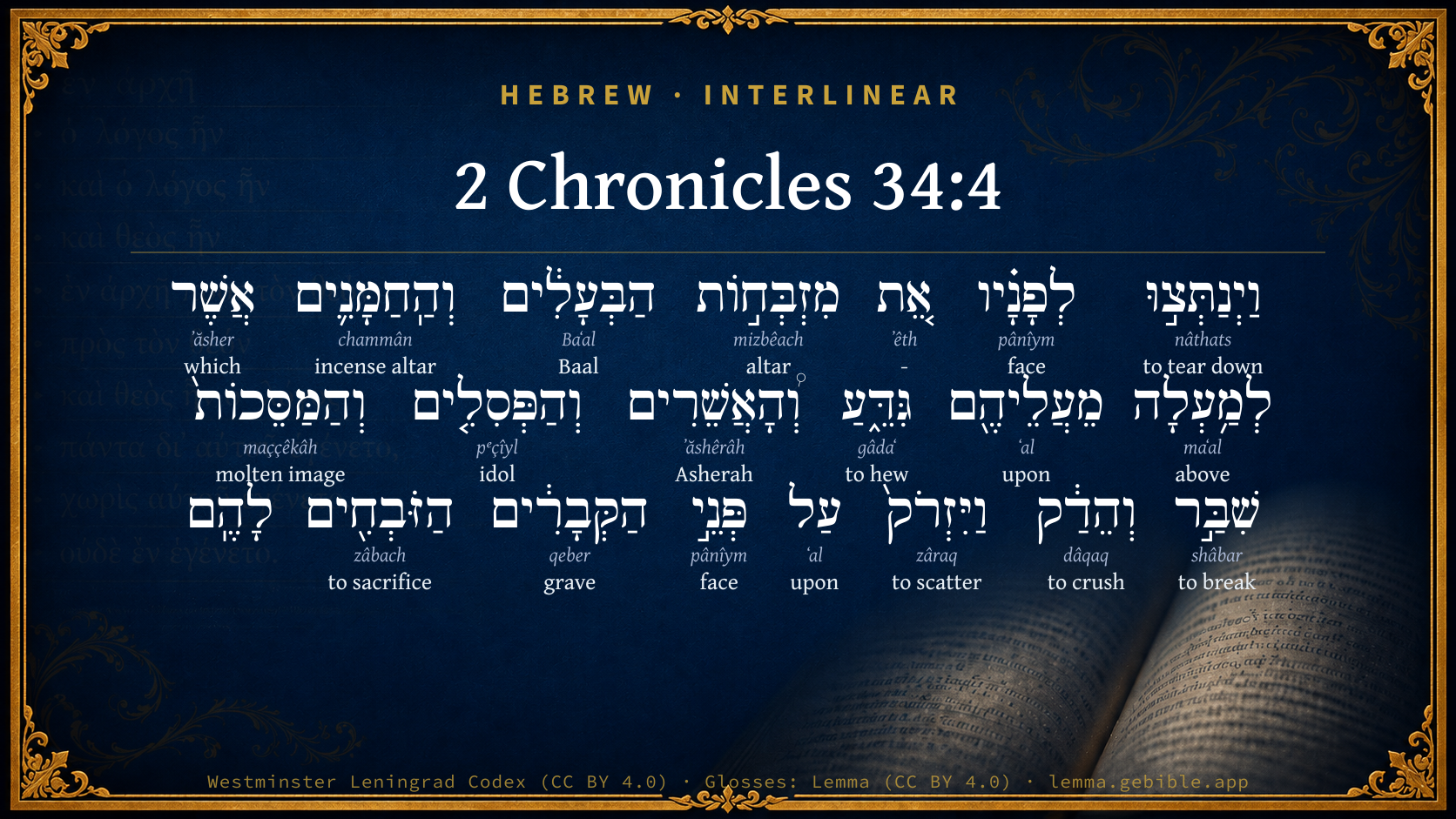
Hebrew (Westminster Leningrad Codex) 2 Chronicles 34:4 appears in the Hebrew Old Testament. The text above is from the Westminster Leningrad Codex. Each word links to its Strong’s number, a concise gloss, and parsing drawn from the Open Scriptures Hebrew Bible morphology. Click any word for its full Brown-Driver-Briggs (BDB) entry.
Download image
Cite this verse

2 Chronicles 34:4 (World English Bible). Public Domain. Lemma interlinear Bible study tool, https://lemma.gebible.app/v/2-chronicles/34/4.

Show BibTeX & RIS
BibTeX
RIS
English Translation
They broke down the altars of the Baals in his presence; and the sun-images that were on high above them he hewed down; and the Asherim, and the engraved images, and the molten images, he broke in pieces, and made dust of them, and strewed it on the graves [of those] who had sacrificed to them.
World English Bible · Public Domain
Download a study sheet

One document with this verse’s original text, its word-by-word gloss line, the meaning frame, cross-references with their text, attributed commentary, and full source and license credits — printable, and it pastes into notes with its structure intact.

This verse Autodidact and up

Study sheet (.html) Plain text (.txt)

A passage Seminary Student

Up to 50 verses in one chapter. A passage sheet keeps up to 6 commentary sources and 12 cross-references per verse, in the order this page ranks them, and says so on the sheet whenever that leaves anything out. Ask for a single verse and you get the Autodidact verse sheet above.

Everything on this page stays free to read, with no account — the sheet is a download of what is already on screen, not access to it.

Want to remove ads? Support Godless Engineer
Compare translations 3

The same verse in 3 English versions, stacked beneath the original-language interlinear above. Click any original word for its lexicon entry.

Each is an independent rendering of the whole verse — the interlinear is not word-aligned to these translations.

Highlighted words mark where these versions differ — a whole-verse word diff, not a word-by-word alignment.

  • World English Bible Public Domain
    They broke down the altars of the Baals in his presence; and the sun-images that were on high above them he hewed down; and the Asherim, and the engraved images, and the molten images, he broke in pieces, and made dust of them, and strewed it on the graves [of those] who had sacrificed to them.
  • King James Version Public Domain
    And they brake down the altars of Baalim in his presence; and the images, that were on high above them, he cut down; and the groves, and the carved images, and the molten images, he brake in pieces, and made dust of them, and strewed it upon the graves of them that had sacrificed unto them.
  • unfoldingWord Literal Text CC BY-SA 4.0
    And they tore down before him the altars of the Baals, and the incense altars which were above them he cut to pieces. And the Asherim and the idols and the metal images he shattered, and he crushed, and he scattered over the faces of the graves of those who sacrificed to them.

unfoldingWord Literal Text — © unfoldingWord, licensed CC BY-SA 4.0. Word-aligned USFM3 via Door43 (git.door43.org/unfoldingWord/en_ult).

Versions to compare (up to 4)

3 of 4 selected

Show all 18 translations

Every available English version of this verse, each an independent rendering of the whole verse.

  • World English Bible Public Domain
    They broke down the altars of the Baals in his presence; and the sun-images that were on high above them he hewed down; and the Asherim, and the engraved images, and the molten images, he broke in pieces, and made dust of them, and strewed it on the graves [of those] who had sacrificed to them.
  • Berean Standard Bible Public Domain
    Then in his presence the altars of the Baals were torn down, and he cut to pieces the incense altars that were above them. He shattered the Asherah poles, the carved idols, and the cast images, crushed them to dust, and scattered them over the graves of those who had sacrificed to them.
  • Majority Standard Bible Public Domain
    Then in his presence the altars of the Baals were torn down, and he cut to pieces the incense altars that were above them. He shattered the Asherah poles, the carved idols, and the cast images, crushed them to dust, and scattered them over the graves of those who had sacrificed to them.
  • King James Version Public Domain
    And they brake down the altars of Baalim in his presence; and the images, that were on high above them, he cut down; and the groves, and the carved images, and the molten images, he brake in pieces, and made dust of them, and strewed it upon the graves of them that had sacrificed unto them.
  • American Standard Version (1901) Public Domain
    And they brake down the altars of the Baalim in his presence; and the sun-images that were on high above them he hewed down; and the Asherim, and the graven images, and the molten images, he brake in pieces, and made dust of them, and strewed it upon the graves `of them' that had sacrificed unto them.
  • Revised Version (1885) Public Domain
    And they brake down the altars of the Baalim in his presence; and the sun-images, that were on high above them, he hewed down; and the Asherim, and the graven images, and the molten images, he brake in pieces, and made dust of them, and strowed it upon the graves of them that had sacrificed unto them.
  • Geneva Bible (1599) Public Domain
    And they brake downe in his sight the altars of Baalim, and hee caused to cut downe the images that were on hie vpon them: he brake also the groues, and the carued images, and the molten images, and stampt them to pouder, and strowed it vpon the graues of them that had sacrificed vnto them.
  • Douay-Rheims (1899) Public Domain
    And they broke down before him the altars of Baalim, and demolished the idols that had been set upon them: and be cut down the groves and the graven things, and broke them in pieces: and strewed the fragments upon the graves of them that had sacrificed to them.
  • Young's Literal Translation Public Domain
    And they break down before him the altars of the Baalim, and the images that `are' on high above them he hath cut down, and the shrines, and the graven images, and the molten images, he hath broken and beaten small, and streweth on the surface of the graves of those sacrificing to them,
  • Literal Standard Version CC BY-SA 4.0
    And they break down the altars of the Ba‘alim before him, and he has cut down the images that [are] on high above them, and the Asherim, and the carved images, and the molten images, he has broken and beaten small, and strews [them] on the surface of the graves of those sacrificing to them,
  • Unlocked Literal Bible CC BY-SA 4.0
    The people broke down the altars of the Baals in his presence; he cut apart the incense altars that were above them. He broke the Asherah poles and the carved figures, and the cast metal figures in pieces until they were dust. He scattered the dust on the graves of those who had sacrificed to them.
  • unfoldingWord Literal Text CC BY-SA 4.0
    And they tore down before him the altars of the Baals, and the incense altars which were above them he cut to pieces. And the Asherim and the idols and the metal images he shattered, and he crushed, and he scattered over the faces of the graves of those who sacrificed to them.
  • Darby Bible Public Domain
    And they broke down the altars of the Baals in his presence; and the sun-pillars that were on high above them he cut down; and the Asherahs and the graven images and the molten images he broke in pieces, and made dust [of them] and strewed it upon the graves of those that had sacrificed to them;
  • World Messianic Bible Public Domain
    They broke down the altars of the Baals in his presence; and he cut down the incense altars that were on high above them. He broke the Asherah poles, the engraved images, and the molten images in pieces, made dust of them, and scattered it on the graves of those who had sacrificed to them.
  • Webster's Bible Public Domain
    And they broke down the altars of Baalim in his presence; and the images, that were on high above them, he cut down; and the groves, and the carved images, and the molten images, he broke in pieces, and made dust of them and strewed it upon the graves of them that had sacrificed to them.
  • Free Bible Version CC BY-SA 4.0
    He had the altars of Baal torn down in front of him, and the incense altars above them cut down. In addition, the Asherah poles, the carved idols, and the metal images were smashed to pieces and scattered over the graves of those who had been sacrificing to them.
  • Bible in Basic English Public Domain
    He had the altars of the Baals broken down, while he himself was present; and the sun-images which were placed on high over them he had cut down; and the pillars of wood and the metal images he had broken up and crushed to dust, dropping the dust over the resting-places of the dead who had made offerings to them.
  • JPS Tanakh (1917) Public Domain
    And they broke down the altars of the Baalim in his presence; and the sun-images, that were on high above them, he hewed down; and the Asherim, and the graven images, and the molten images, he broke in pieces, and made dust of them, and strewed it upon the graves of them that had sacrificed unto them.

Literal Standard Version (2020), Covenant Press — licensed CC BY-SA 4.0. Text via the HelloAO Bible API (eBible.org). Unlocked Literal Bible (unfoldingWord) — licensed CC BY-SA 4.0. Text via the HelloAO Bible API (eBible.org). unfoldingWord Literal Text — © unfoldingWord, licensed CC BY-SA 4.0. Word-aligned USFM3 via Door43 (git.door43.org/unfoldingWord/en_ult). Free Bible Version, Dr. Jonathan Gallagher — licensed CC BY-SA 4.0. Text via the HelloAO Bible API (eBible.org).

Word by word

More ways to search: Search by grammar → Find every occurrence → Compare this word →

Practice this passage: Drill this verse → Learn its vocabulary →

וְהַֽחַמָּנִ֛ים
chammân
H2553
“and · the · incense altars”
Conjunction + Particle, Definite Article + Noun, Common, Masculine, Plural, Absolute
Part of Speech
Conjunction + Particle + Noun
Type
Common
Gender
Masculine
Number
Plural
State
Absolute
Full BDB Definition

Origin: from H2535

TWOT: TWOT- 677d

incense altar, sun-pillar, idol, image - used in idolatrous worship
  1. וַיְנַתְּצ֣וּ nâthats H5422 “and · to tear down” Conjunction + Verb, Piel, Sequential Imperfect, 3rd Person, Masculine, Plural
  2. לְפָנָ֗יו pânîym H6440 “to/for · face(s) · his” Preposition + Noun, Common, Both, Plural, Construct + Suffix, Personal, 3rd Person, Masculine, Singular
  3. אֵ֚ת ʼêth H853 “-” Particle, Direct Object
  4. מִזְבְּח֣וֹת mizbêach H4196 “altars of” Noun, Common, Masculine, Plural, Construct
  5. הַבְּעָלִ֔ים Baʻal H1168 “the · Baal” Particle, Definite Article + Noun, Proper
  6. אֲשֶׁר ʼăsher H834 “which” Particle, Relative
  7. לְמַ֥עְלָה maʻal H4605 “to/for · above · toward” Preposition + Adverb + Suffix, Demonstrative
  8. מֵעֲלֵיהֶ֖ם ʻal H5921 “from · upon · them” Preposition + Preposition + Suffix, Personal, 3rd Person, Masculine, Plural
  9. גִּדֵּ֑עַ gâdaʻ H1438 “to hew” Verb, Piel, Perfect, 3rd Person, Masculine, Singular
  10. וְ֠הָאֲשֵׁרִים ʼăshêrâh H842 “and · the · Asherah” Conjunction + Particle, Definite Article + Noun, Proper
  11. וְהַפְּסִלִ֤ים pᵉçîyl H6456 “and · the · idols” Conjunction + Particle, Definite Article + Noun, Common, Masculine, Plural, Absolute
  12. וְהַמַּסֵּכוֹת֙ maççêkâh H4541 “and · the · molten images” Conjunction + Particle, Definite Article + Noun, Common, Feminine, Plural, Absolute
  13. שִׁבַּ֣ר shâbar H7665 “to break” Verb, Piel, Perfect, 3rd Person, Masculine, Singular
  14. וְהֵדַ֔ק dâqaq H1854 “and · to crush” Conjunction + Verb, Hiphil, Perfect, 3rd Person, Masculine, Singular
  15. וַיִּזְרֹק֙ zâraq H2236 “and · to scatter” Conjunction + Verb, Qal, Sequential Imperfect, 3rd Person, Masculine, Singular
  16. עַל ʻal H5921 “upon” Preposition
  17. פְּנֵ֣י pânîym H6440 “face(s) of” Noun, Common, Both, Plural, Construct
  18. הַקְּבָרִ֔ים qeber H6913 “the · graves” Particle, Definite Article + Noun, Common, Masculine, Plural, Absolute
  19. הַזֹּבְחִ֖ים zâbach H2076 “the · sacrificing” Particle, Definite Article + Verb, Qal, Participle Active, Masculine, Plural, Absolute

About this verse

These counts appear in no published source. They are computed here, from the morphology-tagged text and Lemma’s own curated glosses. What Lemma adds →

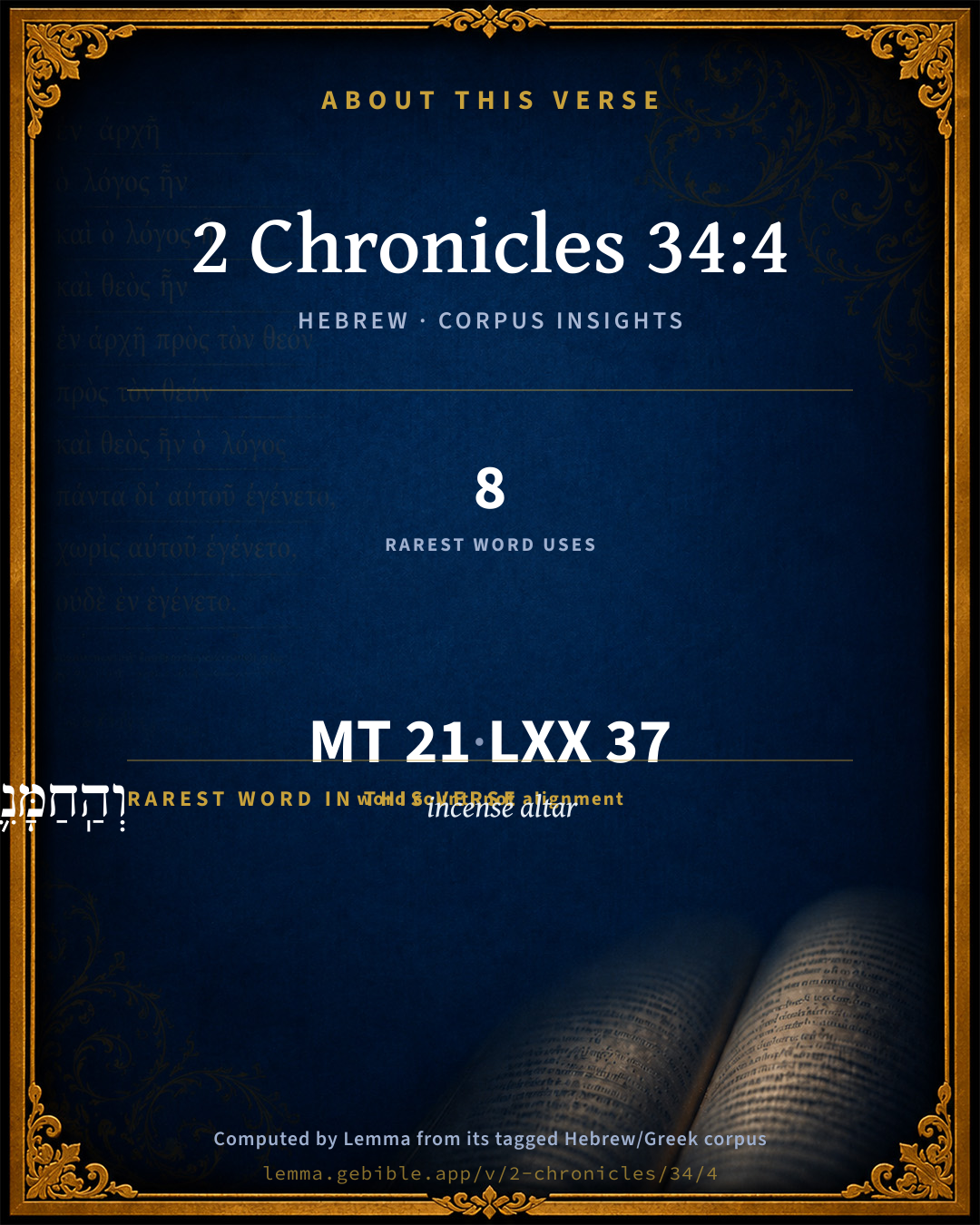
21
words
18
distinct lemmas
Historical
section

Notable vocabulary

The rarest word here is וְהַֽחַמָּנִ֛ים incense altar H2553 — appearing just 8 times in the whole Hebrew Bible.

Shared distinctive vocabulary

וְהַֽחַמָּנִ֛ים incense altar H2553 occurs in 8 verses of the Hebrew Bible. Also found in:

Grammatical profile

  • 6 verbs
  • 9 nouns
  • 3 prepositions
  • 1 adverb
  • 2 particles

Verb forms

  • וַיְנַתְּצ֣וּ Piel · Sequential Imperfect
  • גִּדֵּ֑עַ Piel · Perfect
  • שִׁבַּ֣ר Piel · Perfect
  • וְהֵדַ֔ק Hiphil · Perfect
  • וַיִּזְרֹק֙ Qal · Sequential Imperfect
  • הַזֹּבְחִ֖ים Qal · Participle Active

Repetition

Words recur within this verse — often emphatic in Hebrew:

  • לְפָנָ֗יו face H6440 ×2
  • מֵעֲלֵיהֶ֖ם upon H5921 ×2

Hebrew & Septuagint length

In English translation the verse runs 56 words from the Hebrew and 59 from the Septuagint (LXX English) — closely comparable.

A rough comparison of the two English renderings, which tokenize alike — not a word-level alignment.

Word counts can differ between the Hebrew and the Greek without any difference in meaning — e.g. the Hebrew direct-object marker אֵת has no separate Greek word, and Greek often adds the article ὁ.

In the original languages it is 21 Hebrew tokens and 37 Greek tokens — but the two are counted differently (Hebrew bundles its prefixes and suffixes into one token; the Greek is in lemma form), so that isn’t a like-for-like length.

Cross-references

14

Topical passages linked to 2 Chronicles 34:4 in the Treasury of Scripture Knowledge — connected by theme and wording, ordered by reader-vote popularity; previews shown in the World English Bible.

  • Exodus 32:20 He took the calf which they had made, and burnt it with fire, ground it to powder, and scattered it on the water, and made the children of Israel drink of it.
  • Leviticus 26:30 I will destroy your high places, and cut down your incense altars, and cast your dead bodies upon the bodies of your idols; and my soul will abhor you.
  • 2 Kings 23:4–6 The king commanded Hilkiah the high priest, and the priests of the second order, and the keepers of the threshold, to bring forth out of the temple of Yahweh all the vessels that were made for Baal, and for the Asherah, and for all the host of the sky, and he burned them outside of Jerusalem in the fields of the Kidron, and carried the ashes of them to Bethel.
  • Exodus 23:24 You shall not bow down to their gods, nor serve them, nor follow their practices, but you shall utterly overthrow them and demolish their pillars.
  • Deuteronomy 7:5 But thus shall you deal with them: you shall break down their altars, and dash in pieces their pillars, and hew down their Asherim, and burn their engraved images with fire.
  • Deuteronomy 7:25 The engraved images of their gods shall you burn with fire: you shall not covet the silver or the gold that is on them, nor take it to you, lest you be snared therein; for it is an abomination to Yahweh your God.
  • Deuteronomy 9:21 I took your sin, the calf which you had made, and burnt it with fire, and stamped it, grinding it very small, until it was as fine as dust: and I cast the dust of it into the brook that descended out of the mountain.
  • 2 Kings 10:26–27 They brought forth the pillars that were in the house of Baal, and burned them.
  • 2 Kings 23:11–12 He took away the horses that the kings of Judah had given to the sun, at the entrance of the house of Yahweh, by the chamber of Nathan-melech the chamberlain, which was in the precincts; and he burned the chariots of the sun with fire.
  • 2 Chronicles 14:5 Also he took away out of all the cities of Judah the high places and the sun-images: and the kingdom was quiet before him.
  • 2 Chronicles 33:3 For he built again the high places which Hezekiah his father had broken down; and he reared up altars for the Baals, and made Asheroth, and worshiped all the host of the sky, and served them.
  • 2 Chronicles 34:7 He broke down the altars, and beat the Asherim and the engraved images into powder, and hewed down all the sun-images throughout all the land of Israel, and returned to Jerusalem.
  • Psalms 18:42 Then I beat them small as the dust before the wind. I cast them out as the mire of the streets.
  • Isaiah 27:9 Therefore by this shall the iniquity of Jacob be forgiven, and this is all the fruit of taking away his sin: that he makes all the stones of the altar as chalk stones that are beaten in sunder, [so that] the Asherim and the sun-images shall rise no more.

Cross-references courtesy of OpenBible.info (CC BY 4.0).

Hebrew and Greek witnesses Masoretic Hebrew ↔ Greek Septuagint

The same verse in the two great witnesses to the Old Testament, shown verse-for-verse.

These are two independent witnesses, not word-aligned to each other, and the Septuagint is shown in lemma (dictionary) form.

Hebrew 2 Chronicles 34:4 Masoretic · Westminster Leningrad Codex

וַיְנַתְּצ֣וּ לְפָנָ֗יו אֵ֚ת מִזְבְּח֣וֹת הַבְּעָלִ֔ים וְהַֽחַמָּנִ֛ים אֲשֶׁר לְמַ֥עְלָה מֵעֲלֵיהֶ֖ם גִּדֵּ֑עַ וְ֠הָאֲשֵׁרִים וְהַפְּסִלִ֤ים וְהַמַּסֵּכוֹת֙ שִׁבַּ֣ר וְהֵדַ֔ק וַיִּזְרֹק֙ עַל פְּנֵ֣י הַקְּבָרִ֔ים הַזֹּבְחִ֖ים לָהֶֽם

They broke down the altars of the Baals in his presence; and the sun-images that were on high above them he hewed down; and the Asherim, and the engraved images, and the molten images, he broke in pieces, and made dust of them, and strewed it on the graves [of those] who had sacrificed to them.

World English Bible · Public Domain

Greek LXX 2 Chronicles 34:4 Septuagint · lemma form

καί κατασπάω κατά πρόσωπον αὐτός ὁ θυσιαστήριον ὁ βααλιμ καί ὁ ὑψηλός ὁ ἐπί αὐτός καί κόπτω ὁ ἄλσος καί ὁ γλυπτός καί ὁ χωνευτός συντρίβω καί λεπτύνω καί ῥίπτω ἐπί πρόσωπον ὁ μνῆμα ὁ θυσιάζω αὐτός

And he pulled down the altars of Baalim that were before his face, and the high places that were above them; and he cut down the groves, and the graven images, and broke in pieces the molten images, and reduced them to powder, and cast it upon the surface of the tombs of those who had sacrificed to them.

LXX2012 (modern English Septuagint) · Public Domain

Hebrew: Westminster Leningrad Codex (CC BY 4.0). Greek: Septuagint (public domain); English from LXX2012 (modern English Septuagint) (Public Domain). How the Septuagint differs from the Hebrew →

Commentary

Notes on 2 Chronicles 34:4 from classic Christian and Jewish commentators (each source and its license shown beneath its notes). The classic Christian expositions comment on the surrounding passage and are grouped to its opening verse, so a note may address several verses; the Jewish commentaries on the Tanakh (Rashi and others) are per-verse, so they appear only where the commentator wrote on this verse.

Lemma curates 59 commentaries, every one of them public domain or Creative Commons licensed, each selected and text-cleaned for this edition rather than reprinted as found. About our sources →

Trapp's Complete Commentary

John Trapp

2Ch 34:4 And they brake down the altars of Baalim in his presence; and the images, that [were] on high above them, he cut down; and the groves, and the carved images, and the molten images, he brake in pieces, and made dust [of them], and strowed [it] upon the graves of them that had sacrificed unto them.

Ver. 4. In his presence.] He would see it done; that so it might be thoroughly done.

He cut down … he brake in pieces, &c.] Notanda est congeries verborum, saith Lavater. Five or six several words are here used, to show how he mauled them, and made mortar of them, as we say; such was his holy indignation, zeal, and revenge.

John Trapp, A Commentary or Exposition upon All the Books of the Old and New Testament (1647–1656) — public domain. Text from a community e-Sword module.

Geneva Bible (1599)

Geneva Bible translators

Which showeth that he would see the reformation with his own eyes.

Geneva Bible (1599) marginal notes — public domain. Text via Bolls.life.

Jamieson, Fausset & Brown

Robert Jamieson, A. R. Fausset & David Brown

the graves of them that had sacrificed unto them--He treated the graves themselves as guilty of the crimes of those who were lying in them [BERTHEAU].

Jamieson, Fausset & Brown — Commentary Critical and Explanatory on the Whole Bible (1871) — public domain (CC PDM 1.0). Text via the HelloAO Bible API.

Adam Clarke's Commentary

Verse 4. The altars of Baalim] How often have these been broken down, and how soon set up again! We see that the religion of a land is as the religion of its king. If the king were idolatrous, up went the altars, on them were placed the statues, and the smoke of incense ascended in ceaseless clouds to the honour of that which is vanity, and nothing to the world; on the other hand, when the king was truly religious, down went the idolatrous altars, broken in pieces were the images, and the sacrificial smoke ascended only to the true God: in all these cases the people were as one man with the king.

Adam Clarke's Commentary on the Bible (1810–1826) — public domain. Text from a community e-Sword/MySword module.

Ellicott's Commentary for English Readers

(4) Of Baalim.—Of the Baals. 2Ki_23:4-5, “the Baal.”

In his presence.—Comp. 2Ki_23:16, from which it appears that Josiah personally superintended the work of demolition.

The images.—Sun statues (2Ch_14:4).

That were on high above them, he cut down.—Or, that were above, from off them he hewed.

The molten images.—Rather, the maççebuth, or sacred pillars. (See 2Ki_23:14.)

Made dust of them.—2Ki_23:6 (of an Asherah).

And showed . . . unto them.—Literally, and sprinkled upon the face of the graves that used to sacrifice unto them, as if the graves were guilty. 2Ki_23:6 relates this of the temple Asherah only.

A Bible Commentary for English Readers, edited by Charles John Ellicott (1878–1897) — public domain. Text from a community e-Sword module.

The Cambridge Bible for Schools and Colleges

gen. ed. J. J. S. Perowne

4. Baalim] R.V. the Baalim; cp. 2Ch_33:3 (note).

the images] R.V. the sun-images (so 2Ch_34:7 for “the idols”). See 2Ki_23:11.

he cut down; and the groves, and the carved images] R.V. he hewed down; and the Asherim, and the graven images.

The Cambridge Bible for Schools and Colleges (gen. ed. J. J. S. Perowne; Cambridge University Press, 1878–1918) — public domain. Text from a community e-Sword module.

John Gill's Exposition

And he burnt the bones of the priests upon their altars,.... On which they sacrificed, in detestation of their idolatry, and to deter from it; and this he did according to the prophecy of him, above three hundred and fifty years before:

and cleansed Judah and Jerusalem; from idolatry, and all the monuments of it.

John Gill's Exposition of the Whole Bible (1746–1763) — public domain (CC PDM 1.0). Text via the HelloAO Bible API.

Albert Barnes' Notes on the Bible

The images - Margin, sun-images. See Lev 26:30 note.

Albert Barnes' Notes on the Bible (1834–1885) — public domain. Text from a community e-Sword/MySword module.

Haydock's Catholic Bible Commentary

Idols. Heb. chammanim, (H.) "statues of the sun." The term often denotes those open enclosures, where sacred fire was kept in honour of the sun. C. --- Sept. "the heights above them." Syriac, "he destroyed the altars, idols, tigers, and temples, (5) the bracelets, little bells, and all the trees which had been consecrated to idols." Arabic, "the altars, idols, and leopards."

George Leo Haydock (1774–1849), Haydock's Catholic Family Bible and Commentary, 1859 edition — public domain. Excludes Psalms (Douay-Rheims chapter numbering differs from Protestant) and Deuterocanonical books (Catholic canon only).

The Pulpit Commentary

Note references in Lev_26:1, Lev_26:30. The images, that were on high above them; i.e., as Revised Version, the sun-images ( The word and name occur only eight times in Leviticus as just quoted; in our Second Book of Chronicles three times; in Isaiah twice; and in Ezekiel twice. The groves; i.e. the Asherim; again as last verse. The carved images; Revised Version, graven images; Hebrew, This word is found twenty-two times, occurring in Deuteronomy, Judges, Kings, Chronicles, Psalms, Isaiah, Jeremiah, Hosea, and Micah. The molten images; Hebrew, twOkSeMh. This word also occurs just twenty-two times, from Exodus downwards. Made dust of them and strewed it. (so Exo_32:20 2Ki_23:6)

The Pulpit Commentary (1880–1919), ed. H.D.M. Spence-Jones & Joseph S. Exell — public domain. Text from a community e-Sword module.

unfoldingWord translationNotes

Door43 World Missions Community

in his presence

"in Josiah's presence"

he cut apart ... He broke ... He scattered ... He burned

Josiah would have commanded his workers to do these things. AT: "he had them cut apart ... He commanded them to break ... He had them scatter ... He commanded them to burn" (See: Metonymy)

dust

very small pieces that could be carried away by the wind

He burned the bones of their priests on their altars

This means that the bones of the priests who offered sacrifices on the altars to the false gods were burned on the altars that the priests had previously made sacrifices on.

he cleansed Judah and Jerusalem

This speaks of Josiah causing Judah and Jerusalem to be acceptable to Yahweh as if he made them physically clean. AT: "he caused Judah and Jerusalem to be acceptable again to Yahweh" (See: Metaphor)

translationWords

altar

Baal

incense

grave

sacrifice

priest

unfoldingWord translationNotes — © Distant Shores Media and the Door43 World Missions Community, licensed CC BY-SA 4.0. Source: git.door43.org/Door43/en_tn.

Rashi

Rabbi Shlomo Yitzchaki (Rashi)

and the sun images images of the sun.

that were above That they had placed above them, on high, opposite the sun, and they would prostrate themselves to it. Manasseh had done all this, as it is written above (33:3): “and he prostrated himself to the entire host of the heaven, and he worshipped them.”

and he cast them upon the graves Here was fulfilled what he said to Jeroboam, (I Kings 13:2): “so said the Lord, ‘Behold a son will be born to the house of David, Josiah will be his name, and upon you will he sacrifice, etc., and human bones, etc.’”

Rashi on the Tanakh — English translations: “The Judaica Press complete Tanach with Rashi, translated by A. J. Rosenberg” (CC BY 4.0); “Pentateuch with Rashi's commentary by M. Rosenbaum and A.M. Silbermann, 1929-1934” (public domain); “The Metsudah Tanach series, Lakewood, N.J” (CC BY 4.0); and “The Book of Joshua, Metsudah Publications, 1997” (CC BY 4.0). Text via Sefaria.

Lesson kit

Teaching starters — assembled from the data on this page, not authored interpretation. Every prompt links to the verse data it draws on. Edit before teaching.

2 Chronicles, in the Historical, opens this verse with 21 words (18 distinct Hebrew lemmas). Its most distinctive word is chammân (“incense altar”). A historical commentator’s framing appears above. Read the whole chapter for the surrounding context.

Discussion questions

  1. What does “incense altar” (chammân) contribute to the verse as a whole?
  2. How does Leviticus 26:30, which shares the word «incense altar», read alongside this verse?
  3. What does the repetition of “face” (2× in this one verse) do in this verse?
  4. The translations on this page render this verse differently — a whole-verse word diff, not a word-by-word alignment. What might account for the different wordings?
  5. «וַיְנַתְּצ֣וּ» is a Piel Sequential Imperfect verb. How does that grammatical form shape the action described?
  6. Compare how Trapp's Complete Commentary and Geneva Bible (1599) read this verse. Where do they agree or differ?

Things to notice

Reading settings

Reading text

Shown beneath each verse's original-language words.

Old Testament
Old Testament edition

Read the OT as the Masoretic Hebrew (MT) or the Greek Septuagint (LXX).

English shown for the Greek Septuagint (in the Hebrew ↔ Greek comparison).

Comparing translations? Open the Compare panel on any verse page to stack up to four side by side.