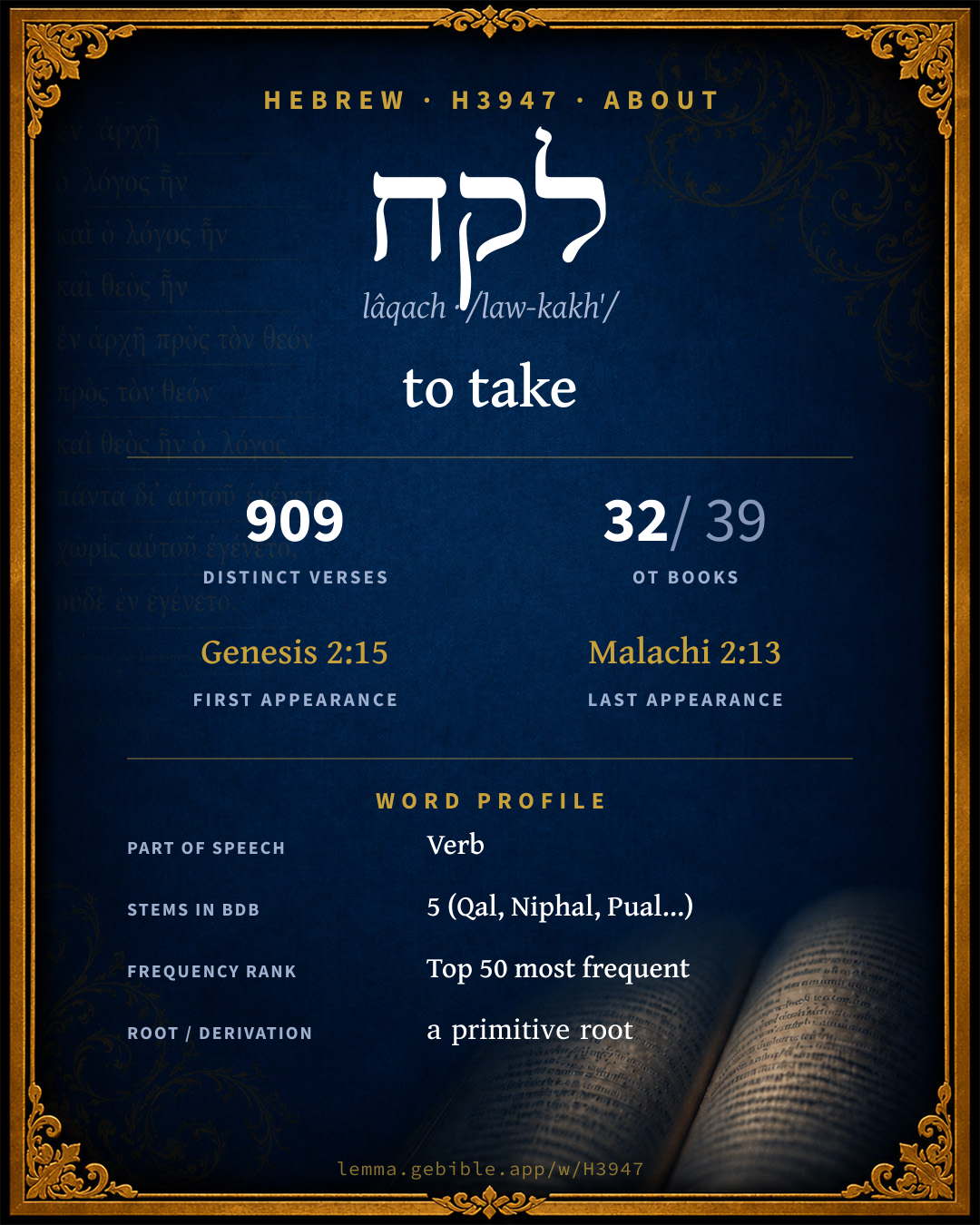
לָקַח
to take
also: get, fetch, lay hold of, seize fuller range ↓
Full lexicon entry — Brown-Driver-Briggs (BDB)
From Brown-Driver-Briggs (BDB)
Where this word appears
Grammar key — what these labels mean
Part of speech
- Verb
- An action or state-of-being word.
- Noun
- A naming word — a person, place, thing, or idea.
Noun type
- Common
- A common noun — a general class of person, place, or thing (“king,” “city,” “water”), not a specific name.
Stem
- Qal
- The basic, simple active stem — the plain form of the verb (“he wrote”). Here: ‘take’
- Pual
- The passive counterpart of the Piel. Here: ‘be taken from’
- Niphal
- Usually the simple passive or reflexive of the Qal (“he was written”). Here: ‘be captured’
- Hithpael
- The reflexive or reciprocal stem (the subject acts on itself).
- Qal Passive
- An archaic passive of the Qal, preserved in a few forms.
Form
- Sequential Imperfect
- An imperfect with prefixed waw — the standard past-narrative form (waw-consecutive imperfect).
- Imperative
- A direct command (“write!”).
- Perfect
- A completed action or state — Hebrew marks aspect (completeness) more than strict tense (“he wrote”).
- Imperfect
- An incomplete, ongoing, or future action (“he will / would write”).
- Sequential Perfect
- A perfect with prefixed waw continuing a preceding imperfect or command (waw-consecutive perfect).
- Infinitive Construct
- A bound verbal noun, frequently with prepositions (“to write / in writing”).
- Participle Active
- A verbal adjective expressing ongoing or characteristic action (“writing / one who writes”).
- Cohortative
- A first-person volitional form expressing wish or resolve (“let me / let us write”).
- Infinitive Absolute
- An unbound verbal noun, often intensifying or standing in for a finite verb.
- Jussive
- A third- or second-person volitional form expressing wish or command (“let him write”).
- Participle Passive
- A verbal adjective expressing action received (“written”).
State
- Absolute
- The independent form of a noun, not bound to a following word.
- Construct
- A noun bound to a following noun in a possessive / “of” relationship (the construct chain).
Person
- 3rd Person
- The one spoken about (“he / she / it / they”).
- 2nd Person
- The one addressed (“you”).
- 1st Person
- The speaker (“I / we”).
Gender
- Masculine
- Grammatically masculine.
- Feminine
- Grammatically feminine.
- Common
- Either gender — not distinguished for this form.
Number
- Singular
- One.
- Plural
- More than one (in Hebrew, generally three or more).
Every verse where H3947 appears in the Book of Deuteronomy — 43 distinct verses. Click any verse to open its interlinear word-by-word view. Verse text shown in the World English Bible for context — . Each verse’s Hebrew form is shown with its reference; the English is not keyword-highlighted, since the data carries no word-level English alignment. Use “Compare translations” on any verse to read it across multiple English versions. This concordance covers the Hebrew Bible; Septuagint (Greek Old Testament) occurrences are not indexed here.
Deuteronomy
- Deuteronomy 1:15 וָ/אֶקַּ֞ח conj + Qal wimpf 1cs So I took the heads of your tribes, wise men, and known, and made them heads over you, captains of thousands, and captains of hundreds, and captains of fifties, and captains of tens, and officers, according to your tribes.
- Deuteronomy 1:23 וָ/אֶקַּ֤ח conj + Qal wimpf 1cs The thing pleased me well; and I took twelve men of you, one man for every tribe:
- Deuteronomy 1:25 וַ/יִּקְח֤וּ conj + Qal wimpf 3mp They took of the fruit of the land in their hands, and brought it down to us, and brought us word again, and said, It is a good land which Yahweh our God gives to us.
- Deuteronomy 3:4 לָקַ֖חְנוּ Qal pf 1cp We took all his cities at that time; there was not a city which we didn't take from them; sixty cities, all the region of Argob, the kingdom of Og in Bashan.
- Deuteronomy 3:8 וַ/נִּקַּ֞ח conj + Qal wimpf 1cp We took the land at that time out of the hand of the two kings of the Amorites who were beyond the Jordan, from the valley of the Arnon to Mount Hermon;
- Deuteronomy 3:14 לָקַח֙ Qal pf 3ms Jair the son of Manasseh took all the region of Argob, to the border of the Geshurites and the Maacathites, and called them, even Bashan, after his own name, Havvoth Jair, to this day.)
- Deuteronomy 4:20 לָקַ֣ח Qal pf 3ms But Yahweh has taken you, and brought you forth out of the iron furnace, out of Egypt, to be to him a people of inheritance, as at this day.
- Deuteronomy 4:34 לָ/קַ֨חַת prep + Qal inf.cs Or has God tried to go and take him a nation from the midst of [another] nation, by trials, by signs, and by wonders, and by war, and by a mighty hand, and by an outstretched arm, and by great terrors, according to all that Yahweh your God did for you in Egypt before your eyes?
- Deuteronomy 7:3 תִקַּ֥ח Qal impf 2ms neither shall you make marriages with them; your daughter you shall not give to his son, nor his daughter shall you take to your son.
- Deuteronomy 7:25 וְ/לָקַחְתָּ֣ conj + Qal wpf 2ms The engraved images of their gods shall you burn with fire: you shall not covet the silver or the gold that is on them, nor take it to you, lest you be snared therein; for it is an abomination to Yahweh your God.
- Deuteronomy 9:9 לָ/קַ֜חַת prep + Qal inf.cs When I was gone up onto the mountain to receive the tables of stone, even the tables of the covenant which Yahweh made with you, then I stayed on the mountain forty days and forty nights; I did neither eat bread nor drink water.
- Deuteronomy 9:21 לָקַחְתִּי֮ Qal pf 1cs I took your sin, the calf which you had made, and burnt it with fire, and stamped it, grinding it very small, until it was as fine as dust: and I cast the dust of it into the brook that descended out of the mountain.
- Deuteronomy 10:17 יִקַּ֖ח Qal impf 3ms For Yahweh your God, he is God of gods, and Lord of lords, the great God, the mighty, and the awesome, who doesn't regard persons, nor takes reward.
- Deuteronomy 15:17 וְ/לָקַחְתָּ֣ conj + Qal wpf 2ms then you shall take an awl, and thrust it through his ear to the door, and he shall be your servant forever. Also to your maid-servant you shall do likewise.
- Deuteronomy 16:19 תִקַּ֣ח Qal impf 2ms You shall not wrest justice: you shall not respect persons; neither shall you take a bribe; for a bribe does blind the eyes of the wise, and pervert the words of the righteous.
- Deuteronomy 19:12 וְ/לָקְח֥וּ conj + Qal wpf 3cp then the elders of his city shall send and bring him there, and deliver him into the hand of the avenger of blood, that he may die.
- Deuteronomy 20:7 לְקָחָ֔/הּ יִקָּחֶֽ/נָּה Qal pf 3ms + sfx pers 3fs Qal impf 3ms + sfx pers 3fs What man is there who has pledged to be married a wife, and has not taken her? let him go and return to his house, lest he die in the battle, and another man take her.
- Deuteronomy 21:3 וְ/לָֽקְח֡וּ conj + Qal wpf 3cp and it shall be, that the city which is nearest to the slain man, even the elders of that city shall take a heifer of the herd, which hasn't been worked with, and which has not drawn in the yoke;
- Deuteronomy 21:11 וְ/לָקַחְתָּ֥ conj + Qal wpf 2ms and see among the captives a beautiful woman, and you have a desire to her, and would take her to you as wife;
- Deuteronomy 22:6 תִקַּ֥ח Qal impf 2ms If a bird's nest chance to be before you in the way, in any tree or on the ground, with young ones or eggs, and the hen sitting on the young, or on the eggs, you shall not take the hen with the young:
- Deuteronomy 22:7 תִּֽקַּֽח Qal impf 2ms you shall surely let the hen go, but the young you may take to yourself; that it may be well with you, and that you may prolong your days.
- Deuteronomy 22:13 יִקַּ֥ח Qal impf 3ms If any man take a wife, and go in to her, and hate her,
- Deuteronomy 22:14 לָקַ֔חְתִּי Qal pf 1cs and lay shameful things to her charge, and bring up an evil name on her, and say, I took this woman, and when I came near to her, I didn't find in her the tokens of virginity;
- Deuteronomy 22:15 וְ/לָקַ֛ח conj + Qal wpf 3ms then shall the father of the young lady, and her mother, take and bring forth the tokens of the young lady's virginity to the elders of the city in the gate;
- Deuteronomy 22:18 וְ/לָֽקְח֛וּ conj + Qal wpf 3cp The elders of that city shall take the man and chastise him;
- Deuteronomy 22:30 יִקַּ֥ח Qal impf 3ms A man shall not take his father's wife, and shall not uncover his father's skirt.
- Deuteronomy 24:1 יִקַּ֥ח Qal impf 3ms When a man takes a wife, and marries her, then it shall be, if she find no favor in his eyes, because he has found some unseemly thing in her, that he shall write her a bill of divorce, and give it in her hand, and send her out of his house.
- Deuteronomy 24:3 לְקָחָ֥/הּ Qal pf 3ms + sfx pers 3fs If the latter husband hate her, and write her a bill of divorce, and give it in her hand, and send her out of his house; or if the latter husband die, who took her to be his wife;
- Deuteronomy 24:4 לְ/קַחְתָּ֜/הּ prep + Qal inf.cs + sfx pers 3fs her former husband, who sent her away, may not take her again to be his wife, after that she is defiled; for that is abomination before Yahweh: and you shall not cause the land to sin, which Yahweh your God gives you for an inheritance.
- Deuteronomy 24:5 יִקַּ֥ח לָקָֽח Qal impf 3ms Qal pf 3ms When a man takes a new wife, he shall not go out in the host, neither shall he be charged with any business: he shall be free at home one year, and shall cheer his wife whom he has taken.
- Deuteronomy 24:19 לְ/קַחְתּ֔/וֹ prep + Qal inf.cs + sfx pers 3ms When you reap your harvest in your field, and have forgot a sheaf in the field, you shall not go again to get it: it shall be for the foreigner, for the fatherless, and for the widow; that Yahweh your God may bless you in all the work of your hands.
- Deuteronomy 25:5 וּ/לְקָחָ֥/הּ conj + Qal wpf 3ms + sfx pers 3fs If brothers dwell together, and one of them die, and have no son, the wife of the dead shall not be married outside to a stranger: her husband's brother shall go in to her, and take her to him as wife, and perform the duty of a husband's brother to her.
- Deuteronomy 25:7 לָ/קַ֖חַת prep + Qal inf.cs If the man doesn't want to take his brother's wife, then his brother's wife shall go up to the gate to the elders, and say, My husband's brother refuses to raise up to his brother a name in Israel; he will not perform the duty of a husband's brother to me.
- Deuteronomy 25:8 לְ/קַחְתָּֽ/הּ prep + Qal inf.cs + sfx pers 3fs Then the elders of his city shall call him, and speak to him: and if he stand, and say, I don't want to take her;
- Deuteronomy 26:2 וְ/לָקַחְתָּ֞ conj + Qal wpf 2ms that you shall take of the first of all the fruit of the ground, which you shall bring in from your land that Yahweh your God gives you; and you shall put it in a basket, and shall go to the place which Yahweh your God shall choose, to cause his name to dwell there.
- Deuteronomy 26:4 וְ/לָקַ֧ח conj + Qal wpf 3ms The priest shall take the basket out of your hand, and set it down before the altar of Yahweh your God.
- Deuteronomy 27:25 לֹקֵ֣חַ Qal ptcp.act ms Cursed be he who takes a bribe to kill an innocent person. All the people shall say, Amen.
- Deuteronomy 29:8 וַ/נִּקַּח֙ conj + Qal wimpf 1cp and we took their land, and gave it for an inheritance to the Reubenites, and to the Gadites, and to the half-tribe of the Manassites.
- Deuteronomy 30:4 יִקָּחֶֽ/ךָ Qal impf 3ms + sfx pers 2ms If [any of] your outcasts are in the uttermost parts of the heavens, from there will Yahweh your God gather you, and from there will he bring you back:
- Deuteronomy 30:12 וְ/יִקָּחֶ֣/הָ conj + Qal impf 3ms + sfx pers 3fs It is not in heaven, that you should say, Who shall go up for us to heaven, and bring it to us, and make us to hear it, that we may do it?
- Deuteronomy 30:13 וְ/יִקָּחֶ֣/הָ conj + Qal impf 3ms + sfx pers 3fs Neither is it beyond the sea, that you should say, Who shall go over the sea for us, and bring it to us, and make us to hear it, that we may do it?
- Deuteronomy 31:26 לָקֹ֗חַ Qal inf.abs Take this book of the law, and put it by the side of the ark of the covenant of Yahweh your God, that it may be there for a witness against you.
- Deuteronomy 32:11 יִקָּחֵ֔/הוּ Qal impf 3ms + sfx pers 3ms As an eagle that stirs up her nest, That flutters over her young, He spread abroad his wings, he took them, He bore them on his feathers.
About this entry
At a glance — auto-summarized from this page’s data, not written by a person. Every figure links to its source below. This summary describes the numbers; it doesn’t interpret them.
לקח (lâqach) is a Hebrew verb most often rendered “to take.” Different stems carry different senses — BDB groups them under 5 stems, among them Qal and Niphal. Spanning 909 verses in 32 books, it ranks among the most common words of the Hebrew Bible. Scripture first uses it in Genesis 2:15. Sharing its root, it stands alongside לקח, מלקוח and מלקח. For the data behind this summary, explore the sense tree and the renderings breakdown below.
Gloss history
Strong's 1890 vs modern scholarship

About this word
Strong's H3947 catalogs a Hebrew word from the Hebrew Old Testament.
These counts are not copied from any lexicon or concordance. They are computed here, from the morphology-tagged Hebrew Old Testament. What Lemma adds →
- 909
- distinct verses
- The word appears in 909 distinct verses.
- 32 / 39
- OT books
- The word appears in 32 of 39 Old Testament books.
- #44
- by frequency
- Top 50 most frequent Hebrew words (rank 44 of 8,640 Hebrew words by occurrence).
View all 909 occurrences in the concordance →
By section of the Old Testament
By traditional corpus
Conventional, traditional groupings — biblical authorship is debated, so this is a traditional corpus grouping, not an authorship claim. Each share is this word’s portion of its verses in that division of the Hebrew canon. Each figure is a share of the word’s 909 distinct verses.
- Prophets (Nevi'im) 443 verses · 49%
- Torah (Pentateuch) 371 verses · 41%
- Writings (Ketuvim) 95 verses · 10%
How translations render this word
Counts come from each version’s own published word-to-Strong’s tagging or interlinear alignment — an approximate guide to how each version renders this word, not a word-level alignment the data otherwise carries. Because each total is that version’s own tagged count, the per-version totals vary from one another and need not match the appearance or distinct-verse counts above. These counts may also differ from a printed concordance because Lemma counts each distinctly tagged rendering and does not collapse phrase taggings into a single head-word total. This is a fixed set of word-tagged versions (KJV, ASV, BSB, ULT) and does not change with the reading translation you choose elsewhere. Each version’s license is shown beside its name below (and on Sources).
BDB lists this Strong’s number as 2 distinct words (homographs). Each count above pools all of them and is not split by sense — see the Senses section below. A low-frequency rendering may belong to a different one of those words, not the primary meaning.
- King James Version†: Took 222×, Take 163×, He took 53×
- American Standard Version†: Took 202×, Take 130×, He took 53×
- Berean Standard Bible†: Take 150×, Took 147×, He took 36×
- unfoldingWord Literal Text†: Take 191×, Took 176×, And 111×
King James Version Public Domain
Renders H3947 across 968† tagged occurrences — most commonly:
Plus other, less common renderings. Plus 173 renderings that appear only once — usually multi-word phrases or single function words the recovered tagging swept in, not distinct renderings. Not rendered by a distinct English word in 1 further occurrence.
American Standard Version Public Domain
Renders H3947 across 967† tagged occurrences — most commonly:
Plus other, less common renderings. Plus 193 renderings that appear only once — usually multi-word phrases or single function words the recovered tagging swept in, not distinct renderings.
Berean Standard Bible Public Domain
Renders H3947 across 937† tagged occurrences — most commonly:
Plus other, less common renderings. Plus 245 renderings that appear only once — usually multi-word phrases or single function words the recovered tagging swept in, not distinct renderings. Not rendered by a distinct English word in 27 further occurrences.
unfoldingWord Literal Text CC BY-SA 4.0
Renders H3947 across 1,162† tagged occurrences — most commonly:
Plus other, less common renderings. Plus 123 renderings that appear only once — usually multi-word phrases or single function words the recovered tagging swept in, not distinct renderings.
37 senses and sub-senses in the full BDB
Hebrew verbs can shift meaning by stem (binyan): Qal is the basic action, Niphal is often passive or reflexive, Piel often intensifies or makes it factitive, and Hiphil is typically causative. The senses below are grouped under the stem BDB assigns to each. This entry also uses Pual (the passive of Piel), Hophal (the passive of Hiphil), and Hithpael (reflexive or reciprocal).
What do BDB’s symbols mean?
BDB uses these scholarly abbreviations:
| Symbol | Meaning |
|---|---|
| 𝔊 | the Septuagint (the ancient Greek translation, LXX) |
| 𝔙 | the Vulgate (the Latin translation) |
| 𝔖 | the Syriac version (the Peshitta) |
| 𝔗 | the Targum (the Aramaic translation) |
| ψ | the Psalms |
| √ | root (the underlying root or stem) |
| ‖ | parallel passage (a synonymous or contrasted parallel) |
| † | the dagger: every passage where the word occurs is cited |
The 37 senses and sub-senses the full Brown-Driver-Briggs lexicon distinguishes for this word, in lexicon order (not ranked by frequency), with BDB’s own verbatim wording and sub-sense lettering. Shown in Hebrew script with BDB’s own scholarly abbreviations. The condensed entry is in the Lexicon Entry tab. See also the Forms in the corpus table below.
Qal
- Pf. ל׳ Gn 2:22 +, לָקָ֑ח 27:36 + (קָח Ez 17:5 is textual error; om. 𝔊 𝔖 Co, cf. Ges§ 19, 3.a); sf. לְקָחַנִי Gn 24:7, לְקָחָם Je 27:20 (for קָחָם Ho 11:3 read prob. אֶקָּחֵם 𝔊 𝔗 Ew St Sta§ 384, 4 Now Che Or We); 2 ms. לָקַחְתָּ Gn 20:3 +, etc.; Impf. יִקַּח Ex 21:10 +, וַיִּקַּח Gn 2:15 + (Nu 16:1 read וַיָּקָם Bö We Di Dr 2 S 18:18; 1 S 30:20 read וַיִּקְחוּ We Dr Kit Bu); sf. יִקָּחֵנִי 2 S 22:17 +; יִקָּחֲךָ Jb 15:12; 3 fs. תִּקַּח Gn 38:23 +; 1 s. אֶקַּח 14:23 +, וָאֶקְחָה Zc 11:13; 1 pl. נִקַּח Gn 34:6 +, נִקְחָה 1 S 4:3 +; וַנִּקַּח Dt 3:8; 29:7; Imv. לְקַח Ex 29:1 Pr 20:16 + Ez 37:16 (Co וְלָקַחְתָּ֫, after 𝔊); fs. לִקְחִי 1 K 17:11; usually קַח Gn 6:21 +, קְחָה 15:9, sf. 3 ms. קָחֶנּוּ 1 S 16:11 + 2 times; sf. 3 fs. קָחֶנָּה Je 36:14; sf. 3 mpl. קָחֶם־נָא Gn 48:9 (cf. Köi. 330 Ges§ 61, 2); fs. קְחִי Is 23:16 + 3 times; mpl. קְחוּ Gn 42:33 +, sf. 3 ms. קָחֻהוּ 1 K 20:33; Inf. abs. לָקוֹחַ Je 32:14 + 2 times, לָקֹחַ Dt 31:26; cstr. קַחַת Je 5:3 +; קְחַת־ 2 K 12:9 (Köi. 318); usually c. prep. לָקַ֫חַת Gn 4:11 +, מִקַּ֫חַת 1 K 22:3 +, etc.; sf. קַחְתִּי Ez 24:25, קַחְתֵּךְ Gn 30:15 +, etc.; Pt. act. לֹקֵחַ 27:46 +, etc.; pass. pl. לְקֻחִים Pr 24:11;— e.g. Genesis 2:22
- 1. take, take in the hand, sq. acc. rei, Ex 7:15 (J), 17:5 (E), Nu 25:7 (P), 2 K 4:29 (all c. בְּיַד) 2 S 18:14 (c. בְּכַף), cf. Gn 8:9 (J), Ex 4:17; 12:22 (JE), Dt 15:17 + often; Gn 40:11 (E; of plucking grapes. 2 S 4:6 read סֹקְלָה for לֹקְחֵי v. חִטָּה, p. 334 supra, and סקל). This easily passes into e.g. Exodus 7:15
- 2. take and carry along with oneself, כֶּסֶף קְחוּ בְיֶדְכֶם Gn 43:12 (J), Jos 9:11 (JE), 1 K 14:3; 2 K 5:5; 8:8, 9; 9:1 Pr 7:20 (all c. בְּיַד); cf. Gn 43:15 Jos 9:4 (both JE), +. e.g. Genesis 43:12
- 3.
- a. take from, or out of, sq. acc. rei vel pers., + מִן loc.: Gn 2:22 (rib from man), 3:22 (man from ground; both J); Dt 19:12; 1 S 17:49; 1 K 17:19 +; וַיִּקַּה אֶת־הַחֶרֶב מֵעַל יֶרֶךְ יְמִינוֹ Ju 3:21 (i.e. drew it); c. ב instr. בְּמֶלְקָחַיִם ל׳ מֵעַל הַמִּזְבֵּחַ Is 6:6; sq. מִן partit. 2 S 12:4. e.g. Genesis 2:22
- b. take, carry away: Ez 3:14 spirit lifted me up and carried me away; fig. of passion carrying one away Jb 15:12. e.g. Ezekiel 3:14
- c. take away from, so as to deprive of, sq. acc. Gn 42:36 (E); sq. acc. + מִן, Gn 44:29 (מֵעִם; J), 1 K 11:34 ψ 51:13; י׳ לֹקֵחַ אֶת־אֲדֹנֶיךָ מֵעַל רֹאשֶׁ֑ךָ 2 K 2:3 י׳ is about to take away thy lord from over thy head, so v 5; cf. abs. אֵינֶנּוּ כִּי־ל׳ אֹתוֹ אלהים Gn 5:24 (P); more often without מִן, Gn 27:36(×2); 30:15(×2); 31:1 (all J), Ju 11:13, 15; 15:6; 18:24 1 S 12:3(×2) 2 S 12:4; 1 K 11:34 Jb 12:20; abs. Jb 1:21; אֶתֶּן־לְךָ מֶלֶךְ בְּאַפִּי וְאֶקַּח בְּעֶבְרָתִי Ho 13:11; of the sword, taking away its victims Ez 33:4, 6; fig. of taking away understanding Ho 4:11. e.g. Genesis 42:36
- d. especially take away life 1 K 19:10, 14 ψ 31:14; Pr 1:19 Jon 4:3. e.g. 1 Kings 19:10
- 4. take to or for a person:
- a. for oneself, sq. acc. + לְ, = appropriate to oneself Dt 7:25 Nu 8:16 (P), Dt 22:7; 2 K 12:6; c. לְ as dat. comm., Zc 11:7; ל׳ אֶת־שְׁנֵי יְלָדַי לוֹ לַעֲבָדִים 2 K 4:1 to take my two sons for himself for slaves; so (without לְ reflex.), תִּקָּחֶנּוּ לְעֶבֶד עוֹלָם Jb 40:28 wilt thou take him as slave for ever? e.g. Deuteronomy 7:25
- b. = procure, get, sq. acc. + לְ, קְחוּ לָכֶם תֶּבֶן Ex 5:11 (J) get you straw; לֹקֵחַ לוֹ קָלוֹן Pr 9:7 getteth to himself shame; so often, especially קַח לְךָ, etc., Gn 6:21; 12:19; 16:21; 45:19 +; without לְ, Ne 5:2 let us procure corn, and eat and live; of acquiring a field Pr 31:16. e.g. Exodus 5:11
- c. take possession of, sq. acc., of land Dt 29:7 Jos 11:16, 23 (all D), 2 Ch 16:5; cf. פְּקֻדָּתוֹ יִקַּח אַחֵר ψ 109:8 his office let another take; fig. הַלַּיְלָה הַהוּא יִקָּחֵהוּ אֹפֶל Jb 3:6 that night—let darkness take possession of it! e.g. Deuteronomy 29:7
- d. = select, choose, וְאֶתְכֶם ל׳ י׳ Dt 4:20, cf. v 34 (+ לוֹ), 1 K 11:37; of men Dt 1:15 Jos 3:12 (JE; + לָכֶם); + מִן Dt 1:23 Jos 4:2 (JE). e.g. Deuteronomy 4:20
- e. especially take in marriage: (1) for another, especially a son, c. לְ, וְלָקַחְתָּ֫ אִשָּׁה לִבְנִי Gn 24:4 and thou shalt take a wife for my son, so v 7, 38, 40, 48 (all J), 21:21 (E), Je 29:6b; (2) more often for oneself, usually c. לְ reflex. (sometimes + לְאִשָּׁה), Gn 4:19; 6:2; 11:29; 12:19 (all J), + often; without לְ Gn 20:2, 3 (E), etc. e.g. Genesis 24:4
- f. = receive, accept, especially a bribe, gift, ransom, etc., 1 S 8:3; 12:3c, 4 (both sq. מִן), Am 5:12; 2 K 5:15, 16, 20, 23, 26(×2) ψ 15:5; interest-money Ez 18:13, 17; 22:12; inheritance Jos 13:8; 18:7 (both D), Nu 34:14(×2), 15 (P); of earth, receiving Abel’s blood Gn 4:11 (J); chastisement Is 40:2; of perceiving a sound, Jb 4:11 mine ear received a whisper of it; receive mentally: וְלָקַח בְּעָלָיו Ex 22:10 (E) i.e. shall accept the oath as satisfactory; בָּרֵךְ לָקַחְתִּי Nu 23:20 (JE), i.e. I have received (commandment by revelation) to bless; receive instruction Pr 24:32 Je 2:30 +; entanglements of temptation Pr 22:25. e.g. 1 Samuel 8:3
- g. take, as preliminary to further action: Gn 31:34 (E), she took them and put them; Ju 3:25 take key and open; Jos 2:4 she took the two men and hid them; 1 K 18:4 Obadiah took 100 prophets and hid them; 19:21 Elisha took the yoke of oxen and slew them, cf. 2 S 17:19; 18:18; sometimes wholly redundant, קְחוּ וַעֲשׂוּ עֲגָלָה חֲדָשָׁה 1 S 6:7 take and prepare a new cart, etc.; sq. ל pers. Je 40:2; differently הַלֹּקְחִים לְשׁוֹנָם וַיִּנְאֲמוּ נְאֻם Je 23:31, they take (= use) their own tongues, and talk oracles. e.g. Genesis 31:34
- 5. take up, upon = put upon, sq. עַל: וַתִּקַּח תָּמָר אֵפֶר עַל־רֹאשָׁהּ 2 S 13:19 and Tamar put ashes upon her head; וַיִּקָּחֶהָ עַל־הַחֲמוֹר Ju 19:28 cf. יִפְרשֹׁ כְּנָפָיו יִקָּחֵהוּ Dt 32:11 he spreadeth his wings, he taketh him up. e.g. 2 Samuel 13:19
- 6. = fetch: קְחִי־נָא לִי מְעַט־מַיִם 1 K 17:10 fetch me, pray, a little water, cf. v 11(×2), 2 K 2:20; 4:41; וְקַח־לִי מִשָּׁם שְׁנֵי גְּדָיֵי עִזִּים Gn 27:9 and fetch me thence two kids, cf. v 13 (J); + בְּיָדִי 1 S 21:9; an offering Lv 12:8 (P; ‖ הֵבִיא v 6); c. human obj. often nearly = summon, לָקֹב אֹיְבַי לְקַחְתִּיךָ Nu 33:11 (JE) to curse mine enemies did I summon thee, Ju 11:5; 1 S 16:11; שְׁלַח וְקַח אֹתוֹ אֵלַי 1 S 20:31 send and bring him unto me; 2 K 3:15; 6:13 +; of י׳, summoning his people from exile, מִשָּׁם יְקָּהֶ֑ךָ Dt 30:4. e.g. 1 Kings 17:10
- 7. take = lead, conduct (with or without contact): וַיִּקַּח אֶת־שְׁנֵי בָנָיו עִמּוֹ Gn 48:1; גַּם בְּקַרְכֶם קְחוּ Ex 12:32 (both E); וְאֶת־עַמּוֹ לָקַח עִמּוֹ Ex 14:6 (J) and his people he took with him; cf. v 7 (J), Jos 8:1 (JE), Ju 4:6; אֶקָּֽחֲךָ אֶל־מָקוֹם אַחֵר Nu 23:27 I will take the unto another place, cf. v 14, 28 (all JE); י׳ subj., וָאֶקַּח אֶת־אֲבִיכֶם Jos 24:3 (E) and I took your father Abraham from beyond the river; הַצֵּל לְקֻחִים לַמָּוֶת Pr 24:11 rescue those led to death. e.g. Genesis 48:1
- 8. take = capture, seize: לָקַחְתִּי בְחָזְקָה 1 S 2:16 I will take by force, sc. flesh; of spoils, בֶּצַע כֶּסֶף לֹא ל׳ Ju 5:19 gain of silver they took not; of capture of ark 1 S 5:1; bronze 2 S 8:8, etc.; territory Gn 48:22 (E), Dt 3:14; cities Nu 21:25 (JE), Dt 3:14 Jos 11:19 (D), 1 S 7:14 2 S 8:1; of capture of hippopotamus Jb 40:24; of seductions of woman, וְאַל־תִּקָּֽחֲךָ בְּעַפְעַפֶּיהָ Pr 6:25 and let her not capture thee with her eyelids. e.g. 1 Samuel 2:16
- 9. take = carry off:
- a. as booty Gn 14:11; 1 S 27:9; 30:16, 18, 19, 20; 1 K 14:26(×2). e.g. Genesis 14:11
- b. as prisoners Gn 14:12; 2 K 18:32 = Is 36:17, 2 K 23:34 = 2 Ch 36:4. e.g. Genesis 14:12
- 10. in phr. take vengeance: וְנִקְחָה נִקְמָתֵנוּ מִמֶּנּוּ Je 20:10 and we will take our vengeance upon him; abs. נָקָם אֶקַּה Is 47:3 vengeance will I take. e.g. Jeremiah 20:10
Niphal
- Pf. נִלְקַח 1 S 4:22; נִלֳקָ֑ח 4:11 Ez 33:6; 3 fs. נִלֳק֑חָה 1 S 4:17; Impf. 3 fs. וַתִּלָּקַח Est 2:8, 16; 1 s. אֶלָּקַח 2 K 2:9; Inf. cstr. הִלָּקַח 1 S 4:19, 21, sf. הִלָּֽקְחוֹ 1 S 21:7;— e.g. 1 Samuel 4:22
- 1. be captured, of ark 1 S 4:11, 17, 19, 21, 22. e.g. 1 Samuel 4:11
- 2. be taken away, removed, of shewbread 1 S 21:7; of removal by death Ez 33:6; of translation of Elijah 2 K 2:9 (c. מֵעִם pers.) e.g. 1 Samuel 21:7
- 3. be taken, brought unto (אֶל־), only Est 2:8, 16. e.g. Esther 2:8
Pual
- Pf. לֻקַּח Gn 3:23 +, 3 fs. לֻקָֿחָה־ 2:23, 2 ms. לֻקָּ֑חְתָּ 3:19 (Ges§ 53 e, s);— e.g. Genesis 3:23
- 1. be taken from, out of (מִן of source) Gn 2:23; 3:19, 23 (all J); cf. וְלֻקַּח מֵהֶם קְלָלָה Je 29:22 and there shall be taken from them (derived from their case) a curse-formula. e.g. Genesis 2:23
- 2. = be stolen from, Ju 17:2 (ל pers.) e.g. Judges 17:2
- 3. be taken captive, Je 48:46, cf. Is 52:5. e.g. Jeremiah 48:46
- 4. be taken away, removed (= Niph. 2), of Elijah’s translation 2 K 2:10 (c. מֵאֵת pers.), of death Is 53:8 (c. מִן, prob. instr.) e.g. 2 Kings 2:10
Hophal
- Impf. יֻקַּח Gn 18:4 + (Ges§ 53 u);— e.g. Genesis 18:4
- 1. be taken, brought unto Gn 12:15 (J; sq. בֵּית to the house of), 18:4 (abs.). e.g. Genesis 12:15
- 2. be taken out of Jb 28:2 (מִן of source), from, of Ez 15:3 (מִן partit.) e.g. Job 28:2
- 3. be taken away from Is 49:24 (מִן pers.); abs. v 25. e.g. Isaiah 49:24
Hithpael
- Pt. fs. אֵשׁ מִתְלַקַּ֫חַת lit. fire taking hold of itself, of lightning Ex 9:24 (JE), Ez 1:4, exact signif. dub.; in close succession, incessant Di Sm, infolding itself, i.e. a mass of fire, Thes RobGes AV VB SS, > of quivering flashes Buhl, of forked or zigzag lightning Da. e.g. Exodus 9:24
Senses from the full Brown-Driver-Briggs lexicon (Brown, Driver, Briggs; Oxford 1906 — public domain), digitized via Sefaria, supplemented by the OpenScriptures HebrewLexicon (CC BY 4.0). Full attribution on Sources.
Word origin
לָקַח965 vb. take (NH id., especially buy, and (Niph.) be taken in marriage; MI17, 20 Impf. ואקח; Ph. לקח; Assyrian liḳû, laḳû DlHWB 384; Arabic لَقِحَ conceive (of female), iv. impregnate; Ethiopic ለቅሐ receive; Zinj. לקח DHMSendsch. 59; Aramaic also Inscr. of Carpentr.3 (Imv. קחי); cf. CookGloss. Aramaic Inscr.);—
— Brown-Driver-Briggs (Oxford 1906, public domain), digitized via Sefaria, supplemented by the OpenScriptures HebrewLexicon (CC BY 4.0). See Sources.
Origin: a primitive root
Jastrow Dictionary
A second Hebrew/Aramaic lexicon for comparison, covering Aramaic and post-biblical (Talmudic, Targumic, Midrashic) usage that the biblical-Hebrew BDB does not. Matched by lemma rather than by Strong’s number, so a lemma may carry more than one Jastrow headword (shown separately below), and the entries cover usage well beyond the Bible.
לָקַח
- (b. h.)
- 1. to take, receive. B. Kam. 119ᵃ גבאי צדקה לוֹקְחִין וכ׳ collectors of charity may receive from them small contributions. Ex. R. s. 3 ל׳ את שלו he received his due (punishment). Tanḥ. Korah 3 ל׳ טליתו he took up his cloak; a. fr.
- 2. to carry away; to persuade. Ib. 1 (ref. to Num. XVI, 1) אין ויקח אלא משיכת וכ׳ vayikkaḥ means attraction by soft words; ib. 2 אין ויקח אלא לשון פליגה שלבו לְקָחוֹ vayikkaḥ has the meaning of separation, for his heart (pride) carried him away; Num. R. s. 18. e.g. Numbers 16:1
- 3. to buy, acquire. Dem. IV, 5 קַח לי וכ׳ buy (provision) for me of one who is reliable &c. Ib. הלך לִיקַּח … ולָקַחְתִּי לך וכ׳ if he went to buy of him (of the designated person), and … not finding him I bought of &c. Ib. V, 1 הלוֹקֵחַ מן וכ׳ he who buys of a baker. B. Mets. 16ᵇ לכשאֶקָּחֶנָּה when I shall have bought it; a. v. fr.—לוֹקֵחַ buyer. Ib. 15ᵇ bot. דמית ל׳ when the buyer is dead. Ber. 5ᵃ ול׳ שמח and the purchaser is glad; a. v. fr.—Part. pass. לָקוּחַ, f. לְקוּחָה; pl. לְקוּחִים, לְקוּחִון; לְקוּחוֹת. Y. Pes. II, 29ᵇ הל׳ בכסף מעשר that which has been bought with tithe-money. B. Mets. 110ᵃ ל׳ היא בידי I have it as a purchased property. Y. Snh. IX, beg. 26ᵈ [read:] עד שתהא הראשונה ל׳ לו until the first wife has been legally acquired (betrothed) by him; (Y. Yeb. XI, 11ᵈ top זקוקה), v. לְקִיחָה; a. fr.—V. לְקוּחוֹת.
- , נִקַּח to be taken, bought, acquired. Maas. Sh. I, 3 אינו נל׳ בכסף מעשר must not be bought with tithe-money; Ḥull. I, 7 אינו ניקח. Men. 42ᵇ נִקְּחֵית; נִקְּחִין; a. fr.—Kidd. 2ᵇ (ref. to Deut. XXII, 13) it is not written כי תִלָּקֵחַ אשה לאיש if a woman is married (marries herself) to a man (Var. תִקַּח). e.g. Deuteronomy 22:13
- to be enclosed, squeezed in. Num. R. s. 12; Cant. R. to III, 11; Pesik. Vayhi, p. 4ᵃ (expl. מִתְלַקַּחַת, Ex. IX, 24), v. עֲשָׁשִׁיתָא. e.g. Exodus 9:24
*לְקַח
- Ithpe. אִלְּקַח to be taken, married. Keth. IV, 11 (52ᵇ) עד דתִלַּקְחוּן לגוברין Bab. ed. (Mish. a. Y. ed. דתינסבן) until they shall be married; ib. 53ᵇ דתִילַּקְחָן.
לֶקַח
- preced.) purchase; (acceptable) gift; lesson. Taan. 7a (ref. to לקחי, Deut. XXXII, 2) אין ל׳ אלא תורה lekaḥ means the Law (with ref. to Prov. IV, 2); Tanḥ. Haăz. 3; a. fr.—אבן הל׳ auction-stone. Yalk. Lev. 667, v. מֶקַח. e.g. Deuteronomy 32:2
A Dictionary of the Targumim, the Talmud Babli and Yerushalmi, and the Midrashic Literature (Marcus Jastrow; London, Luzac, 1903) — Public Domain. Digitized via Sefaria. Digitized via Sefaria. Full attribution on Sources.
Forms in the corpus
The 415 distinct written forms H3947 takes in the Hebrew Bible, most frequent first — each parse links to that stem’s occurrences in the concordance. Hebrew forms include their vowel points and cantillation, so a single lemma takes many written forms.
The 60 most common forms are shown; 355 rarer forms follow in the full concordance.
Same root — word family
Other BDB entries built from the same root as H3947, grouped by Strong’s listed origin. These share a root / origin per the lexicon — not necessarily a shared meaning. Each links to that word’s own entry.
Derived from this word
- לקח leqach H3948 instruction
- מלקוח malqôwach H4455 prey
- מלקח melqâch H4457 snuffers
- מקח miqqâch H4727 receiving
- מקחה maqqâchâh H4728 ware
Proper names from this root
People and places named from this root — a name, not an additional meaning of the word.
Compare all same-root words → Showing 4 of 7 — not the complete family. 1 of the same-root words is a proper name (a person or place). They share a root, not necessarily a meaning.
Septuagint verse parallels
This word appears in 873 verses that also exist in the Greek Old Testament (Septuagint), out of the 909 Hebrew verses it occurs in. You can read those verses in Greek by switching the Old Testament edition to the Septuagint.
Read these verses in the Septuagint
- Genesis 2:15
- Exodus 2:1
- Leviticus 4:5
- Numbers 1:17
- Deuteronomy 1:15
- Joshua 2:4
- Judges 3:6
- Ruth 4:2
- 1 Samuel 2:14
- 2 Samuel 1:10
- 1 Kings 1:33
- 2 Kings 2:3
This is a verse-level parallel only — the same verses exist in both the Hebrew and Greek Old Testaments. No word-level Hebrew↔Greek correspondence is claimed: the data carries no such alignment, so no Greek word is shown as this Hebrew word’s translation. Coverage is not total — the Septuagint omits the deuterocanon and renumbers the Psalms, so some Hebrew verses have no direct Greek parallel.