Deuteronomy 7:3

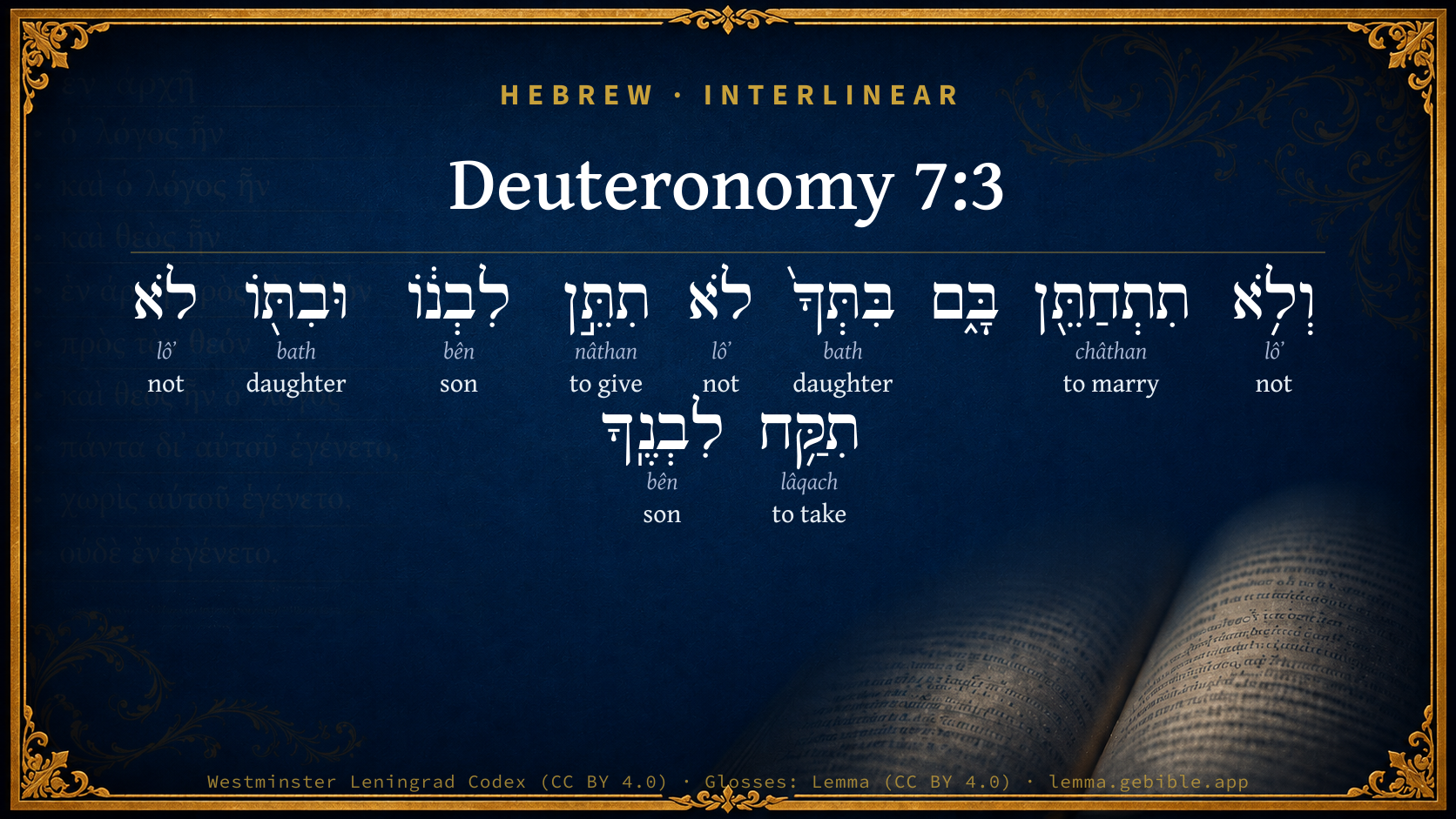
Hebrew (Westminster Leningrad Codex) Deuteronomy 7:3 appears in the Hebrew Old Testament. The text above is from the Westminster Leningrad Codex. Each word links to its Strong’s number, a concise gloss, and parsing drawn from the Open Scriptures Hebrew Bible morphology. Click any word for its full Brown-Driver-Briggs (BDB) entry.
Download image
Cite this verse

Deuteronomy 7:3 (World English Bible). Public Domain. Lemma interlinear Bible study tool, https://lemma.gebible.app/v/deuteronomy/7/3.

Show BibTeX & RIS
BibTeX
RIS
English Translation
neither shall you make marriages with them; your daughter you shall not give to his son, nor his daughter shall you take to your son.
World English Bible · Public Domain
Download a study sheet

One document with this verse’s original text, its word-by-word gloss line, the meaning frame, cross-references with their text, attributed commentary, and full source and license credits — printable, and it pastes into notes with its structure intact.

This verse Autodidact and up

Study sheet (.html) Plain text (.txt)

A passage Seminary Student

Up to 50 verses in one chapter. A passage sheet keeps up to 6 commentary sources and 12 cross-references per verse, in the order this page ranks them, and says so on the sheet whenever that leaves anything out. Ask for a single verse and you get the Autodidact verse sheet above.

Everything on this page stays free to read, with no account — the sheet is a download of what is already on screen, not access to it.

Want to remove ads? Support Godless Engineer
Compare translations 3

The same verse in 3 English versions, stacked beneath the original-language interlinear above. Click any original word for its lexicon entry.

Each is an independent rendering of the whole verse — the interlinear is not word-aligned to these translations.

Highlighted words mark where these versions differ — a whole-verse word diff, not a word-by-word alignment.

  • World English Bible Public Domain
    neither shall you make marriages with them; your daughter you shall not give to his son, nor his daughter shall you take to your son.
  • King James Version Public Domain
    Neither shalt thou make marriages with them; thy daughter thou shalt not give unto his son, nor his daughter shalt thou take unto thy son.
  • unfoldingWord Literal Text CC BY-SA 4.0
    And do not arrange marriages with them. Do not give your daughter to his son, and you shall not take his daughter for your son.

unfoldingWord Literal Text — © unfoldingWord, licensed CC BY-SA 4.0. Word-aligned USFM3 via Door43 (git.door43.org/unfoldingWord/en_ult).

Versions to compare (up to 4)

3 of 4 selected

Show all 18 translations

Every available English version of this verse, each an independent rendering of the whole verse.

  • World English Bible Public Domain
    neither shall you make marriages with them; your daughter you shall not give to his son, nor his daughter shall you take to your son.
  • Berean Standard Bible Public Domain
    Do not intermarry with them. Do not give your daughters to their sons or take their daughters for your sons,
  • Majority Standard Bible Public Domain
    Do not intermarry with them. Do not give your daughters to their sons or take their daughters for your sons,
  • King James Version Public Domain
    Neither shalt thou make marriages with them; thy daughter thou shalt not give unto his son, nor his daughter shalt thou take unto thy son.
  • American Standard Version (1901) Public Domain
    neither shalt thou make marriages with them; thy daughter thou shalt not give unto his son, nor his daughter shalt thou take unto thy son.
  • Revised Version (1885) Public Domain
    neither shalt thou make marriages with them; thy daughter thou shalt not give unto his son, nor his daughter shalt thou take unto thy son.
  • Geneva Bible (1599) Public Domain
    Neither shalt thou make marriages with them, neither giue thy daughter vnto his sonne, nor take his daughter vnto thy sonne.
  • Douay-Rheims (1899) Public Domain
    Neither shalt thou make marriages with them. Thou shalt not give thy daughter to his son, nor take his daughter for thy son:
  • Young's Literal Translation Public Domain
    `And thou dost not join in marriage with them; thy daughter thou dost not give to his son, and his daughter thou dost not take to thy son,
  • Literal Standard Version CC BY-SA 4.0
    And you do not join in marriage with them; you do not give your daughter to his son, and you do not take his daughter to your son,
  • Unlocked Literal Bible CC BY-SA 4.0
    Neither will you arrange any marriages with them. You will not give your daughters to their sons, and you will not take their daughters for your sons.
  • unfoldingWord Literal Text CC BY-SA 4.0
    And do not arrange marriages with them. Do not give your daughter to his son, and you shall not take his daughter for your son.
  • Darby Bible Public Domain
    And thou shalt make no marriages with them: thy daughter thou shalt not give unto his son, nor take his daughter for thy son;
  • World Messianic Bible Public Domain
    You shall not make marriages with them. You shall not give your daughter to his son, nor shall you take his daughter for your son.
  • Webster's Bible Public Domain
    Neither shalt thou make marriages with them; thy daughter thou shalt not give to his son, nor his daughter shalt thou take to thy son.
  • Free Bible Version CC BY-SA 4.0
    Don't intermarry with them. Don't let your daughters marry their sons or have their daughters marry your sons,
  • Bible in Basic English Public Domain
    Do not take wives or husbands from among them; do not give your daughters to their sons, or take their daughters for your sons.
  • JPS Tanakh (1917) Public Domain
    neither shalt thou make marriages with them: thy daughter thou shalt not give unto his son, nor his daughter shalt thou take unto thy son.

Literal Standard Version (2020), Covenant Press — licensed CC BY-SA 4.0. Text via the HelloAO Bible API (eBible.org). Unlocked Literal Bible (unfoldingWord) — licensed CC BY-SA 4.0. Text via the HelloAO Bible API (eBible.org). unfoldingWord Literal Text — © unfoldingWord, licensed CC BY-SA 4.0. Word-aligned USFM3 via Door43 (git.door43.org/unfoldingWord/en_ult). Free Bible Version, Dr. Jonathan Gallagher — licensed CC BY-SA 4.0. Text via the HelloAO Bible API (eBible.org).

Word by word

More ways to search: Search by grammar → Find every occurrence → Compare this word →

Practice this passage: Drill this verse → Learn its vocabulary →

תִתְחַתֵּ֖ן
châthan
H2859
“to marry”
Verb, Hithpael, Imperfect, 2nd Person, Masculine, Singular
Part of Speech
Verb
Stem
Hithpael
Form
Imperfect
Person
2nd Person
Gender
Masculine
Number
Singular
Full BDB Definition

Origin: a primitive root

TWOT: 781b

to become a son-in-law, make oneself a daughter's husband - (Qal) wife's father, wife's mother, father-in-law, mother-in-law (participle) - (Hithpael) to make oneself a daughter's husband
  1. וְלֹ֥א lôʼ H3808 “and · not” Conjunction + Particle, Negative
  2. בִּתְּךָ֙ bath H1323 “daughter · your” Noun, Common, Feminine, Singular, Construct + Suffix, Personal, 2nd Person, Masculine, Singular
  3. לֹא lôʼ H3808 “not” Particle, Negative
  4. תִתֵּ֣ן nâthan H5414 “to give” Verb, Qal, Imperfect, 2nd Person, Masculine, Singular
  5. לִבְנ֔וֹ bên H1121 “to/for · son · his” Preposition + Noun, Common, Masculine, Singular, Construct + Suffix, Personal, 3rd Person, Masculine, Singular
  6. וּבִתּ֖וֹ bath H1323 “and · daughter · his” Conjunction + Noun, Common, Feminine, Singular, Construct + Suffix, Personal, 3rd Person, Masculine, Singular
  7. לֹא lôʼ H3808 “not” Particle, Negative
  8. תִקַּ֥ח lâqach H3947 “to take” Verb, Qal, Imperfect, 2nd Person, Masculine, Singular
  9. לִבְנֶֽךָ bên H1121 “to/for · son · your” Preposition + Noun, Common, Masculine, Singular, Construct + Suffix, Personal, 2nd Person, Masculine, Singular

About this verse

These counts appear in no published source. They are computed here, from the morphology-tagged text and Lemma’s own curated glosses. What Lemma adds →

11
words
6
distinct lemmas
Pentateuch
section

Shared distinctive vocabulary

תִתְחַתֵּ֖ן to marry H2859 occurs in 32 verses of the Hebrew Bible. Also found in:

Grammatical profile

  • 3 verbs
  • 4 nouns
  • 1 preposition
  • 3 particles

Verb forms

  • תִתְחַתֵּ֖ן Hithpael · Imperfect
  • תִתֵּ֣ן Qal · Imperfect
  • תִקַּ֥ח Qal · Imperfect

Repetition

Words recur within this verse — often emphatic in Hebrew:

  • בִּתְּךָ֙ daughter H1323 ×2
  • לִבְנ֔וֹ son H1121 ×2
  • וְלֹ֥א not H3808 ×3

Hebrew & Septuagint length

In English translation the verse runs 25 words from the Hebrew and 26 from the Septuagint (LXX English) — closely comparable.

A rough comparison of the two English renderings, which tokenize alike — not a word-level alignment.

Word counts can differ between the Hebrew and the Greek without any difference in meaning — e.g. the Hebrew direct-object marker אֵת has no separate Greek word, and Greek often adds the article ὁ.

Cross-references

8

Topical passages linked to Deuteronomy 7:3 in the Treasury of Scripture Knowledge — connected by theme and wording, ordered by reader-vote popularity; previews shown in the World English Bible.

  • 1 Kings 11:2 of the nations concerning which Yahweh said to the children of Israel, You shall not go among them, neither shall they come among you; for surely they will turn away your heart after their gods: Solomon joined to these in love.
  • Joshua 23:12–13 Else if you do at all go back, and cleave to the remnant of these nations, even these who remain among you, and make marriages with them, and go in to them, and they to you;
  • Exodus 34:15–16 Don't make a covenant with the inhabitants of the land, lest they play the prostitute after their gods, and sacrifice to their gods, and one call you and you eat of his sacrifice;
  • 2 Corinthians 6:14–17 Don't be unequally yoked with unbelievers, for what fellowship have righteousness and iniquity? Or what communion has light with darkness?
  • Judges 3:6–7 and they took their daughters to be their wives, and gave their own daughters to their sons and served their gods.
  • Nehemiah 13:23–27 In those days also saw I the Jews who had married women of Ashdod, of Ammon, [and] of Moab:
  • Genesis 6:2–3 that God's sons saw that men's daughters were beautiful, and they took for themselves wives of all that they chose.
  • Ezra 9:1–2 Now when these things were done, the princes drew near to me, saying, The people of Israel, and the priests and the Levites, have not separated themselves from the peoples of the lands, [doing] according to their abominations, even of the Canaanites, the Hittites, the Perizzites, the Jebusites, the Ammonites, the Moabites, the Egyptians, and the Amorites.

Cross-references courtesy of OpenBible.info (CC BY 4.0).

Hebrew and Greek witnesses Masoretic Hebrew ↔ Greek Septuagint

The same verse in the two great witnesses to the Old Testament, shown verse-for-verse.

These are two independent witnesses, not word-aligned to each other, and the Septuagint is shown in lemma (dictionary) form.

Hebrew Deuteronomy 7:3 Masoretic · Westminster Leningrad Codex

וְלֹ֥א תִתְחַתֵּ֖ן בָּ֑ם בִּתְּךָ֙ לֹא תִתֵּ֣ן לִבְנ֔וֹ וּבִתּ֖וֹ לֹא תִקַּ֥ח לִבְנֶֽךָ

neither shall you make marriages with them; your daughter you shall not give to his son, nor his daughter shall you take to your son.

World English Bible · Public Domain

Greek LXX Deuteronomy 7:3 Septuagint · lemma form

οὐδέ μή γαμβρεύω πρός αὐτός ὁ θυγάτηρ σύ οὐ δίδωμι ὁ υἱός αὐτός καί ὁ θυγάτηρ αὐτός οὐ λαμβάνω ὁ υἱός σύ

neither shall you⌃ contract marriages with them: you shall not give your daughter to his son, and you shall not take his daughter to your son.

LXX2012 (modern English Septuagint) · Public Domain

Hebrew: Westminster Leningrad Codex (CC BY 4.0). Greek: Septuagint (public domain); English from LXX2012 (modern English Septuagint) (Public Domain). How the Septuagint differs from the Hebrew →

Targum (Aramaic paraphrase)

2

The Targum is the ancient Jewish Aramaic paraphrase of the Hebrew Scriptures — an interpretive translation, not the Hebrew text itself. Onkelos (literal) and Pseudo-Jonathan (expansive) render the Torah, and Jonathan the Prophets. Coverage is partial: where no permissively-licensed English translation exists for a verse, only the Aramaic is shown. This is verse-level text, not a word-by-word alignment to the Hebrew.

  1. Targum Onkelos Torah (Genesis–Deuteronomy)
    וְלָא תִתְחַתַּן בְּהוֹן בְּרַתָּךְ לָא תִתֵּן לִבְרֵהּ וּבְרַתֵּהּ לָא תִסַב לִבְרָךְ

    (no public-domain English translation for this verse)

    Targum Onkelos — Aramaic: “Onkelos Genesis” (public domain); “Onkelos Exodus” (public domain); “Onkelos Leviticus” (public domain); “Onkelos Numbers” (public domain); “Onkelos Deuteronomy” (public domain). English: “Sefaria Community Translation” (CC0 1.0 (public-domain dedication)); “J.W. Etheridge. The Targums of Onkelos and Jonathan Ben Uzziel on the Pentateuch. London: Longmans, Green, 1862” (public domain). Text via Sefaria.

  2. Targum Pseudo-Jonathan Torah (Genesis–Deuteronomy)
    לָא תִתְחַתְּנוּן בְּהוֹן בְּנָתֵיכוֹן לָא תִתְּנוּן לִבְנֵיהוֹן וּבְנָתֵיהוֹן לָא תִסְבוּן לִבְנֵיכוֹן דְּכָל מַאן דְּמִתְחַתֵּן בְּהוֹן כְּמִתְחַתֵּן בְּטַעֲוַותְהוֹן

    You shall not intermarry with them; your daughters you shall not give to their sons, nor take their daughters for your sons; for whosoever marrieth with them is as if he made marriage with their idols.

    Targum Pseudo-Jonathan — Aramaic: “Targum Jonathan on Genesis” (public domain); “Targum Jonathan on Exodus” (public domain); “Targum Jonathan on Leviticus” (public domain); “Targum Jonathan on Numbers” (public domain); “Targum Jonathan on Deuteronomy” (public domain). English: “The Targum of Jonathan ben Uzziel, trans. J. W. Etheridge, London, 1862” (public domain). Text via Sefaria.

Commentary

Notes on Deuteronomy 7:3 from classic Christian and Jewish commentators (each source and its license shown beneath its notes). The classic Christian expositions comment on the surrounding passage and are grouped to its opening verse, so a note may address several verses; the Jewish commentaries on the Tanakh (Rashi and others) are per-verse, so they appear only where the commentator wrote on this verse.

Lemma curates 59 commentaries, every one of them public domain or Creative Commons licensed, each selected and text-cleaned for this edition rather than reprinted as found. About our sources →

Trapp's Complete Commentary

John Trapp

Deu 7:3 Neither shalt thou make marriages with them; thy daughter thou shalt not give unto his son, nor his daughter shalt thou take unto thy son.

Ver. 3. Neither shalt thou make marriages with them.] As neither with any other that were idolatots. {Ezr 9:1-2}

John Trapp, A Commentary or Exposition upon All the Books of the Old and New Testament (1647–1656) — public domain. Text from a community e-Sword module.

Joseph Benson's Commentary

Deu 7:3. Neither shalt thou make marriages with them — From this prohibition it has been justly inferred that the Canaanites, as individuals, might be spared upon their repentance and reformation from idolatry. For on the supposition that nothing that breathed was to be saved alive, but that all were to be utterly destroyed, there could be no occasion for this injunction. What end could it answer to forbid all intermarriages with a people supposed not to exist?

Joseph Benson's Commentary on the Old and New Testaments (1811–1818) — public domain. Text from a community e-Sword module.

Adam Clarke's Commentary

Verse 3. Neither shalt thou make marriages, &c.] The heart being naturally inclined to evil, there is more likelihood that the idolatrous wife should draw aside the believing husband, than that the believing husband should be able to bring over his idolatrous wife to the true faith.

Adam Clarke's Commentary on the Bible (1810–1826) — public domain. Text from a community e-Sword/MySword module.

The Cambridge Bible for Schools and Colleges

gen. ed. J. J. S. Perowne

3. neither … make marriages with them] In the narratives in Genesis and Judges marriages are regarded as best when between members of the same family or tribe (Gen_28:2; Gen_28:8 f.) and as unfortunate when the wives are foreign (Gen_26:34 f., Gen_27:46; Jdg_14:3). But no law against marriage with foreigners is either assumed or implied. On the contrary, Moses (Exo_2:21), David (2Sa_3:3), Solomon (1Ki_11:1), Ahab (1Ki_16:31), all marry foreigners, and there are other instances (Bath-sheba and Uriah, etc.). The deuteronomic veto, therefore, may be assumed to be the earliest law against such marriages (Exo_34:16 is editorial) and to have become necessary by the experience of their evil consequences, conducive to idolatry (Jdg_3:5 f., deuteronomic). At the same time D allows marriage with a foreign woman taken in war (Deu_21:10). That the law was not kept is seen from the Book of Ezra.

The Cambridge Bible for Schools and Colleges (gen. ed. J. J. S. Perowne; Cambridge University Press, 1878–1918) — public domain. Text from a community e-Sword module.

John Gill's Exposition

Neither shalt thou make marriages with them,.... Unless they became proselytes, as Rahab, who was married by Salmon, and so those of other nations, as Ruth the Moabitess, and so any captive taken in war; otherwise it was not lawful, bad consequences have followed upon it, which it is the design of this law to prevent; that is, being snared and drawn aside into idolatry, which was the case of Solomon:

thy daughter thou shalt not give unto his son, nor his daughter shalt thou take unto thy son; for, according to the Targum of Jonathan, whosoever marries with them, it is as if he married with their idols: and this law, according to the Jewish writers (c), is binding with respect to other nations besides the seven; and whosoever marries any Heathen, of whatsoever nation, is to be beaten.

(c) Maimon. Hilchot lssure Biah, c. 12. sect. 1.

John Gill's Exposition of the Whole Bible (1746–1763) — public domain (CC PDM 1.0). Text via the HelloAO Bible API.

Haydock's Catholic Bible Commentary

Marriages. Some believe that it was unlawful to marry the people of Chanaan, if they were even converted, and also those of other nations, as we find that Esdras (1 Esdras x. 2, 12,) ordered such strange wives to be sent away. But the context shews, as well as the practice of most pious Hebrews, that it was only forbidden to marry with those who adhered to their idolatry, ver. 4. Salmon took to wife Rahab, of Jericho; Mahalon and Booz successively married Ruth, the Moabitess, and Moses himself allows the Hebrews to espouse their captives, and to preserve the lives of women and children, chap. xx. 14., and xxi. 11. (Calmet) See Exodus xxxiv. 15. --- Hence all the Chanaanites were not necessarily to be slain. The few exceptions did not hinder the rule from being general. See ver. 16., and Numbers xiv. 23.

George Leo Haydock (1774–1849), Haydock's Catholic Family Bible and Commentary, 1859 edition — public domain. Excludes Psalms (Douay-Rheims chapter numbering differs from Protestant) and Deuterocanonical books (Catholic canon only).

Whedon's Commentary on the Bible

Daniel D. Whedon

3. Neither shalt thou make marriages with them — There was always peril to the Israelites in their having close relations with the heathen nations. Their history thus far since they left Egypt has shown how prone they were to idolatry.

Daniel D. Whedon (gen. ed.), Commentary on the Old and New Testaments (1874–1909) — public domain. Text from a community e-Sword module.

The Pulpit Commentary

Neither shalt thou make marriages with them. Brought into intimate relations with idolaters, they might be seduced into idolatry; and where marriage was contracted with an idolater, the children might be brought up in idolatry. Such unions were forbidden.

Vers. 3, 4. Marriage in the Lord.

This law, forbidding marriages with the ungodly, is one for all time. The apostle revives it in 1Co_7:39. That marriage should be only in the Lord is evident

I FROM THE TRUE IDEA OF MARRIAGE. Two individuals unite their lives, and enter into a fellowship the most intimate possible to what end? Surely that their natures may be raised to greater perfection, and that they may be better enabled to attain the ends of their existence. This implies a certain harmony of disposition, an essential accordance in the views taken of life and its duties. It is a union, as One has said, not merely between two creatures, but also between two spirits. But what communion, it may be asked, can exist in spiritual respects between two persons severed from each other in the deepest principles of their lives?

II FROM A REGARD TO THE DIVINE BLESSING. Where one partner is irreligious, the blessing cannot rest upon the home in the same degree as where both are "heirs together of the grace of life". (1Pe_3:7) Believers are to "agree" as touching what things they shall ask. (Mat_18:19) Variances even in godly households result in prayers being "hindered". (1Pe_3:7) How much sadder the case of a home, so-called, where husband and wife stand so far apart that they cannot unite in prayer at all! And who that values God"s blessing would willingly enter into a relation which inevitably stints and limits it?

III FROM THE DANGER ACCRUING TO SPIRITUAL LIFE. The danger is not imaginary. (1Ki_11:3) Where spiritual life is not destroyed, as we may hope that often it is not, yet nothing but harm can come from an association in every respect adverse to it. How intolerable to a spiritual mind to endure "the blight of all sympathy, to be dragged down to earth, and forced to become frivolous and commonplace; to lose all zest and earnestness in life; to have heart and life degraded by mean and perpetually recurring sources of disagreement" (F. W. Robertson)! This is the species of living death to which unequal yoking not infrequently leads. The effects on offspring are also to be considered. Yet such marriages are rushed into, and, in the prevalent anxiety to make marriage the stepping-stone to wealth and social position, seem likely to become increasingly numerous. Would that men were wise, that they understood these things. J.O.

The Pulpit Commentary (1880–1919), ed. H.D.M. Spence-Jones & Joseph S. Exell — public domain. Text from a community e-Sword module.

Lesson kit

Teaching starters — assembled from the data on this page, not authored interpretation. Every prompt links to the verse data it draws on. Edit before teaching.

Deuteronomy, in the Pentateuch, opens this verse with 11 words (6 distinct Hebrew lemmas). Its most distinctive word is châthan (“to marry”). A historical commentator’s framing appears above. Read the whole chapter for the surrounding context.

Discussion questions

  1. The word châthan carries the sense “to marry.” How does it shape the verse?
  2. How does Genesis 34:9, which shares the word «to marry», read alongside this verse?
  3. What does the repetition of “daughter” (2× in this one verse) do in this verse?
  4. These translations render this verse differently. What is at stake in choosing one wording over another?
  5. «תִתְחַתֵּ֖ן» is a Hithpael Imperfect verb. How does that grammatical form shape the action described?
  6. Compare how Trapp's Complete Commentary and Joseph Benson's Commentary read this verse. Where do they agree or differ?

Things to notice

  • These translations choose different wording for 6 words in this verse.
  • “daughter” occurs 2× in this single verse.
  • 6 distinct Hebrew lemmas span 11 words in this verse.

Reading settings

Reading text

Shown beneath each verse's original-language words.

Old Testament
Old Testament edition

Read the OT as the Masoretic Hebrew (MT) or the Greek Septuagint (LXX).

English shown for the Greek Septuagint (in the Hebrew ↔ Greek comparison).

Comparing translations? Open the Compare panel on any verse page to stack up to four side by side.