
Ezekiel 18:13

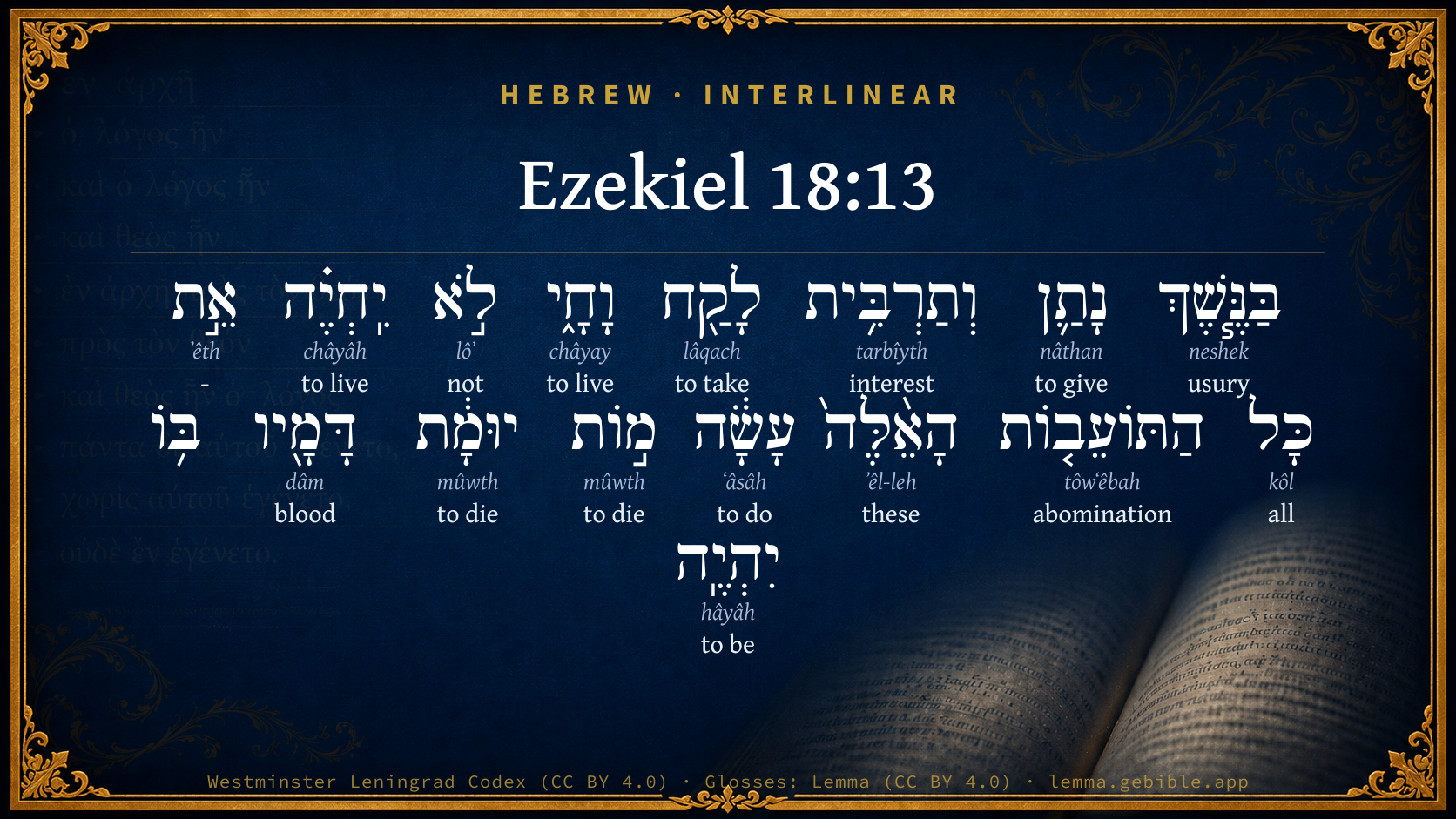
Hebrew (Westminster Leningrad Codex) Ezekiel 18:13 appears in the Hebrew Old Testament. The text above is from the Westminster Leningrad Codex. Each word links to its Strong’s number, a concise gloss, and parsing drawn from the Open Scriptures Hebrew Bible morphology. Click any word for its full Brown-Driver-Briggs (BDB) entry.
Download image
Cite this verse

Ezekiel 18:13 (World English Bible). Public Domain. Lemma interlinear Bible study tool, https://lemma.gebible.app/v/ezekiel/18/13.

Show BibTeX & RIS
BibTeX
RIS
English Translation
has given forth on interest, and has taken increase; shall he then live? he shall not live: he has done all these abominations; he shall surely die; his blood shall be on him.
World English Bible · Public Domain
Download a study sheet

One document with this verse’s original text, its word-by-word gloss line, the meaning frame, cross-references with their text, attributed commentary, and full source and license credits — printable, and it pastes into notes with its structure intact.

This verse Autodidact and up

Study sheet (.html) Plain text (.txt)

A passage Seminary Student

Up to 50 verses in one chapter. A passage sheet keeps up to 6 commentary sources and 12 cross-references per verse, in the order this page ranks them, and says so on the sheet whenever that leaves anything out. Ask for a single verse and you get the Autodidact verse sheet above.

Everything on this page stays free to read, with no account — the sheet is a download of what is already on screen, not access to it.

Want to remove ads? Support Godless Engineer
Compare translations 3

The same verse in 3 English versions, stacked beneath the original-language interlinear above. Click any original word for its lexicon entry.

Each is an independent rendering of the whole verse — the interlinear is not word-aligned to these translations.

Highlighted words mark where these versions differ — a whole-verse word diff, not a word-by-word alignment.

  • World English Bible Public Domain
    has given forth on interest, and has taken increase; shall he then live? he shall not live: he has done all these abominations; he shall surely die; his blood shall be on him.
  • King James Version Public Domain
    Hath given forth upon usury, and hath taken increase: shall he then live? he shall not live: he hath done all these abominations; he shall surely die; his blood shall be upon him.
  • unfoldingWord Literal Text CC BY-SA 4.0
    and he lends out money at too high interest and he makes too much profit on what he sells, should that man live? Surely he will not! He will certainly die and his blood will be on him because he has done all these detestable things.

unfoldingWord Literal Text — © unfoldingWord, licensed CC BY-SA 4.0. Word-aligned USFM3 via Door43 (git.door43.org/unfoldingWord/en_ult).

Versions to compare (up to 4)

3 of 4 selected

Show all 18 translations

Every available English version of this verse, each an independent rendering of the whole verse.

  • World English Bible Public Domain
    has given forth on interest, and has taken increase; shall he then live? he shall not live: he has done all these abominations; he shall surely die; his blood shall be on him.
  • Berean Standard Bible Public Domain
    He engages in usury and takes excess interest. Will this son live? He will not! Since he has committed all these abominations, he will surely die; his blood will be on his own head.
  • Majority Standard Bible Public Domain
    He engages in usury and takes excess interest. Will this son live? He will not! Since he has committed all these abominations, he will surely die; his blood will be on his own head.
  • King James Version Public Domain
    Hath given forth upon usury, and hath taken increase: shall he then live? he shall not live: he hath done all these abominations; he shall surely die; his blood shall be upon him.
  • American Standard Version (1901) Public Domain
    hath given forth upon interest, and hath taken increase; shall he then live? he shall not live: he hath done all these abominations; he shall surely die; his blood shall be upon him.
  • Revised Version (1885) Public Domain
    hath given forth upon usury, and hath taken increase: shall he then live? he shall not live: he hath done all these abominations: he shall surely die; his blood shall be upon him.
  • Geneva Bible (1599) Public Domain
    Or hath giuen forth vpon vsurie, or hath taken increase, shall he liue? he shall not liue: seeing he hath done all these abominations, he shall die the death, and his blood shall be vpon him.
  • Douay-Rheims (1899) Public Domain
    That giveth upon usury, and that taketh an increase: shall such a one live? he shall not live. Seeing he hath done all these detestable things, he shall surely die, his blood shall be upon him.
  • Young's Literal Translation Public Domain
    In usury he hath given, and increase taken, And he liveth: he doth not live, All these abominations he hath done, He doth surely die, his blood is on him.
  • Literal Standard Version CC BY-SA 4.0
    He has given in usury, and taken increase, || And he lives? He does not live, || He has done all these abominations, || He surely dies, his blood is on him.
  • Unlocked Literal Bible CC BY-SA 4.0
    and he lends out money at too high interest and he makes too much profit on what he sells, should that man live? Surely he will not! He will certainly die and his blood will be on him because he has done all these detestable things.
  • unfoldingWord Literal Text CC BY-SA 4.0
    and he lends out money at too high interest and he makes too much profit on what he sells, should that man live? Surely he will not! He will certainly die and his blood will be on him because he has done all these detestable things.
  • Darby Bible Public Domain
    given forth upon usury, and taken increase; shall he then live? He shall not live: he hath done all these abominations; he shall certainly die; his blood shall be upon him.
  • World Messianic Bible Public Domain
    has lent with interest, and has taken increase from the poor, shall he then live? He shall not live. He has done all these abominations. He shall surely die. His blood will be on him.
  • Webster's Bible Public Domain
    Hath given forth upon interest, and hath taken increase: shall he then live? he shall not live: he hath done all these abominations; he shall surely die; his blood shall be upon him.
  • Free Bible Version CC BY-SA 4.0
    He lends with interest and makes a profit from loans. Is someone like this going to live? No, he won't! Because he has done all these offensive things, he will die for certain, and he will be responsible for his own death.
  • Bible in Basic English Public Domain
    And has given out his money at interest and taken great profits: he will certainly not go on living: he has done all these disgusting things: death will certainly be his fate; his blood will be on him.
  • JPS Tanakh (1917) Public Domain
    hath given forth upon interest, and hath taken increase; shall he then live? he shall not live — he hath done all these abominations; he shall surely be put to death, his blood shall be upon him.

Literal Standard Version (2020), Covenant Press — licensed CC BY-SA 4.0. Text via the HelloAO Bible API (eBible.org). Unlocked Literal Bible (unfoldingWord) — licensed CC BY-SA 4.0. Text via the HelloAO Bible API (eBible.org). unfoldingWord Literal Text — © unfoldingWord, licensed CC BY-SA 4.0. Word-aligned USFM3 via Door43 (git.door43.org/unfoldingWord/en_ult). Free Bible Version, Dr. Jonathan Gallagher — licensed CC BY-SA 4.0. Text via the HelloAO Bible API (eBible.org).

Word by word

More ways to search: Search by grammar → Find every occurrence → Compare this word →

Practice this passage: Drill this verse → Learn its vocabulary →

וְתַרְבִּ֥ית
tarbîyth
H8636
“and · interest”
Conjunction + Noun, Common, Feminine, Singular, Absolute
Part of Speech
Conjunction + Noun
Type
Common
Gender
Feminine
Number
Singular
State
Absolute
Full BDB Definition

Origin: from H7235

TWOT: 2103f

increment, usury, interest, bonus
  1. בַּנֶּ֧שֶׁךְ neshek H5392 “in/at the · usury” Preposition, Determined + Noun, Common, Masculine, Singular, Absolute
  2. נָתַ֛ן nâthan H5414 “to give” Verb, Qal, Perfect, 3rd Person, Masculine, Singular
  3. לָקַ֖ח lâqach H3947 “to take” Verb, Qal, Perfect, 3rd Person, Masculine, Singular
  4. וָחָ֑י châyay H2425 “and · to live” Conjunction + Verb, Qal, Sequential Perfect, 3rd Person, Masculine, Singular
  5. לֹ֣א lôʼ H3808 “not” Particle, Negative
  6. יִֽחְיֶ֗ה châyâh H2421 “to live” Verb, Qal, Imperfect, 3rd Person, Masculine, Singular
  7. אֵ֣ת ʼêth H853 “-” Particle, Direct Object
  8. כָּל kôl H3605 “all of” Noun, Common, Masculine, Singular, Construct
  9. הַתּוֹעֵב֤וֹת tôwʻêbah H8441 “the · abominations” Particle, Definite Article + Noun, Common, Feminine, Plural, Absolute
  10. הָאֵ֨לֶּה֙ ʼêl-leh H428 “the · these” Particle, Definite Article + Pronoun, Demonstrative, Common, Plural
  11. עָשָׂ֔ה ʻâsâh H6213 “to do” Verb, Qal, Perfect, 3rd Person, Masculine, Singular
  12. מ֣וֹת mûwth H4191 “to die” Verb, Qal, Infinitive Absolute
  13. יוּמָ֔ת mûwth H4191 “to die” Verb, Hophal, Imperfect, 3rd Person, Masculine, Singular
  14. דָּמָ֖יו dâm H1818 “blood · his” Noun, Common, Masculine, Plural, Construct + Suffix, Personal, 3rd Person, Masculine, Singular
  15. יִהְיֶֽה hâyâh H1961 “to be” Verb, Qal, Imperfect, 3rd Person, Masculine, Singular

About this verse

These counts appear in no published source. They are computed here, from the morphology-tagged text and Lemma’s own curated glosses. What Lemma adds →

17
words
15
distinct lemmas
Prophets
section

Notable vocabulary

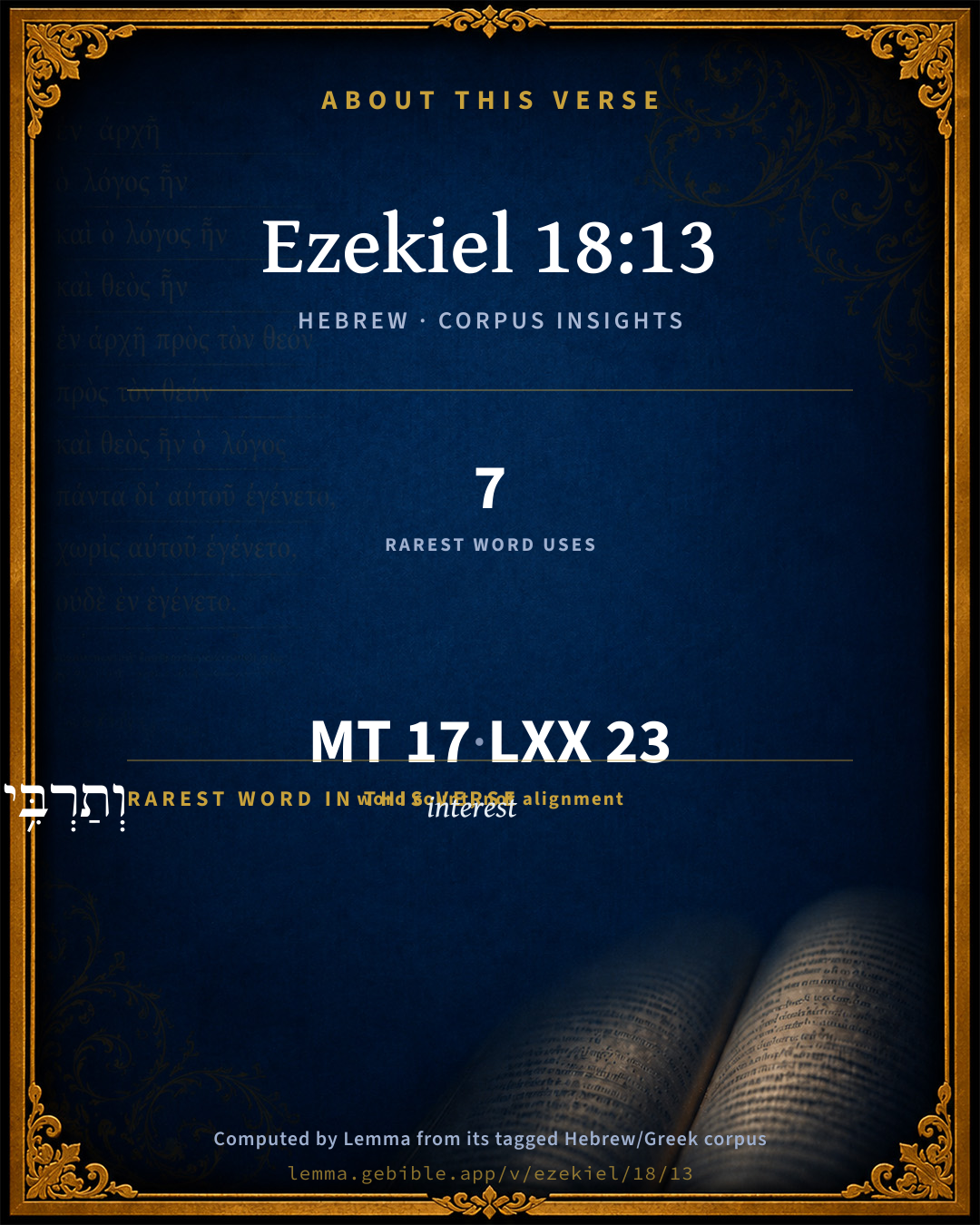
The rarest word here is וְתַרְבִּ֥ית interest H8636 — appearing just 7 times in the whole Hebrew Bible.

Shared distinctive vocabulary

וְתַרְבִּ֥ית interest H8636 occurs in 6 verses of the Hebrew Bible. Also found in:

Grammatical profile

  • 8 verbs
  • 5 nouns
  • 1 pronoun
  • 1 preposition
  • 2 particles

Verb forms

  • נָתַ֛ן Qal · Perfect
  • לָקַ֖ח Qal · Perfect
  • וָחָ֑י Qal · Sequential Perfect
  • יִֽחְיֶ֗ה Qal · Imperfect
  • עָשָׂ֔ה Qal · Perfect
  • מ֣וֹת Qal · Infinitive Absolute
  • יוּמָ֔ת Hophal · Imperfect
  • יִהְיֶֽה Qal · Imperfect

Repetition

A word recurs within this verse — often emphatic in Hebrew:

  • מ֣וֹת to die H4191 ×2

Hebrew & Septuagint length

In English translation the verse runs 33 words from the Hebrew and 30 from the Septuagint (LXX English) — closely comparable.

A rough comparison of the two English renderings, which tokenize alike — not a word-level alignment.

Word counts can differ between the Hebrew and the Greek without any difference in meaning — e.g. the Hebrew direct-object marker אֵת has no separate Greek word, and Greek often adds the article ὁ.

In the original languages it is 17 Hebrew tokens and 23 Greek tokens — but the two are counted differently (Hebrew bundles its prefixes and suffixes into one token; the Greek is in lemma form), so that isn’t a like-for-like length.

Cross-references

12

Topical passages linked to Ezekiel 18:13 in the Treasury of Scripture Knowledge — connected by theme and wording, ordered by reader-vote popularity; previews shown in the World English Bible.

  • Exodus 22:25 "If you lend money to any of my people with you who is poor, you shall not be to him as a creditor; neither shall you charge him interest.
  • Leviticus 20:9 "'For everyone who curses his father or his mother shall surely be put to death: he has cursed his father or his mother; his blood shall be upon him.
  • Ezekiel 18:8 he who has not given forth on interest, neither has taken any increase, who has withdrawn his hand from iniquity, has executed true justice between man and man,
  • Leviticus 20:11–13 The man who lies with his father's wife has uncovered his father's nakedness: both of them shall surely be put to death; their blood shall be upon them.
  • Leviticus 20:27 "'A man or a woman that is a medium, or is a wizard, shall surely be put to death: they shall stone them with stones; their blood shall be upon them.'"
  • Ezekiel 3:18 When I tell the wicked, You shall surely die; and you give him no warning, nor speak to warn the wicked from his wicked way, to save his life; the same wicked man shall die in his iniquity; but his blood will I require at your hand.
  • Ezekiel 18:17 who has withdrawn his hand from the poor, who has not received interest nor increase, has executed my ordinances, has walked in my statutes; he shall not die for the iniquity of his father, he shall surely live.
  • Ezekiel 18:24 But when the righteous turns away from his righteousness, and commits iniquity, and does according to all the abominations that the wicked man does, shall he live? None of his righteous deeds that he has done shall be remembered: in his trespass that he has trespassed, and in his sin that he has sinned, in them shall he die.
  • Ezekiel 18:28 Because he considers, and turns away from all his transgressions that he has committed, he shall surely live, he shall not die.
  • Ezekiel 18:32 For I have no pleasure in the death of him who dies, says the Lord Yahweh: therefore turn yourselves, and live.
  • Ezekiel 33:4–5 then whoever hears the sound of the trumpet, and doesn't take warning, if the sword come, and take him away, his blood shall be on his own head.
  • Acts 18:6 When they opposed him and blasphemed, he shook out his clothing and said to them, "Your blood be on your own heads! I am clean. From now on, I will go to the Gentiles!"

Cross-references courtesy of OpenBible.info (CC BY 4.0).

Hebrew and Greek witnesses Masoretic Hebrew ↔ Greek Septuagint

The same verse in the two great witnesses to the Old Testament, shown verse-for-verse.

These are two independent witnesses, not word-aligned to each other, and the Septuagint is shown in lemma (dictionary) form.

Hebrew Ezekiel 18:13 Masoretic · Westminster Leningrad Codex

בַּנֶּ֧שֶׁךְ נָתַ֛ן וְתַרְבִּ֥ית לָקַ֖ח וָחָ֑י לֹ֣א יִֽחְיֶ֗ה אֵ֣ת כָּל הַתּוֹעֵב֤וֹת הָאֵ֨לֶּה֙ עָשָׂ֔ה מ֣וֹת יוּמָ֔ת דָּמָ֖יו בּ֥וֹ יִהְיֶֽה

has given forth on interest, and has taken increase; shall he then live? he shall not live: he has done all these abominations; he shall surely die; his blood shall be on him.

World English Bible · Public Domain

Greek LXX Ezekiel 18:13 Septuagint · lemma form

μετά τόκος δίδωμι καί πλεονασμός λαμβάνω οὗτος ζωή οὐ ζάω πᾶς ὁ ἀνομία οὗτος ποιέω θάνατος θανατόω ὁ αἷμα αὐτός ἐπί αὐτός εἰμί

has lent upon usury, and taken usurious increase; he shall by no means live: he has wrought all these iniquities; he shall surely die; his blood shall be upon him.

LXX2012 (modern English Septuagint) · Public Domain

Hebrew: Westminster Leningrad Codex (CC BY 4.0). Greek: Septuagint (public domain); English from LXX2012 (modern English Septuagint) (Public Domain). How the Septuagint differs from the Hebrew →

Targum (Aramaic paraphrase)

1

The Targum is the ancient Jewish Aramaic paraphrase of the Hebrew Scriptures — an interpretive translation, not the Hebrew text itself. Onkelos (literal) and Pseudo-Jonathan (expansive) render the Torah, and Jonathan the Prophets. Coverage is partial: where no permissively-licensed English translation exists for a verse, only the Aramaic is shown. This is verse-level text, not a word-by-word alignment to the Hebrew.

  1. Targum Jonathan Prophets (Joshua–Malachi)
    בְּחִבּוּלְיָא יְהַב וְרִבִּיתָא נְסִיב הֲאִתְקַיֵם לָא יִתְקַיֵם יַת כָּל תּוֹעֲבָתָּא הָאִלֵין עֲבַד מֵימַת יְמוּת חוֹבַת קְטוֹלֵהּ בֵּיהּ תְּהֵי:

    (no public-domain English translation for this verse)

    Targum Jonathan — Aramaic: “Mikraot Gedolot” (public domain). English: “Sefaria Community Translation” (CC0 1.0 (public-domain dedication)); “London "Chaldee Paraphrase," 1871” (public domain). Text via Sefaria.

Commentary

Notes on Ezekiel 18:13 from classic Christian and Jewish commentators (each source and its license shown beneath its notes). The classic Christian expositions comment on the surrounding passage and are grouped to its opening verse, so a note may address several verses; the Jewish commentaries on the Tanakh (Rashi and others) are per-verse, so they appear only where the commentator wrote on this verse.

Lemma curates 59 commentaries, every one of them public domain or Creative Commons licensed, each selected and text-cleaned for this edition rather than reprinted as found. About our sources →

Trapp's Complete Commentary

John Trapp

Eze 18:13 Hath given forth upon usury, and hath taken increase: shall he then live? he shall not live: he hath done all these abominations; he shall surely die; his blood shall be upon him.

Ver. 13. He hath done all these abominations.] Or, If he have done but one of them, and undo it not again by true repentance.

He shall surely die.] Neither shall his father’s righteousness privilege him, or prevail at all for him.

His blood shall be upon him.] He is felo de se, his own death’s man, and his mends he hath in his own hands, as they say.

John Trapp, A Commentary or Exposition upon All the Books of the Old and New Testament (1647–1656) — public domain. Text from a community e-Sword module.

Geneva Bible (1599)

Geneva Bible translators

He showeth how the son is punished for his father’s fault: that is, if he be wicked as his father was, and doth not repent, he shall be punished as his father was, or else not.

Geneva Bible (1599) marginal notes — public domain. Text via Bolls.life.

Jamieson, Fausset & Brown

Robert Jamieson, A. R. Fausset & David Brown

shall he . . . live?--because of the merits of his father; answering, by contrast, to "die for the iniquity of his father" (Eze 18:17).

his blood shall be upon him--The cause of his bloody death shall rest with himself; God is not to blame, but is vindicated as just in punishing him.

Jamieson, Fausset & Brown — Commentary Critical and Explanatory on the Whole Bible (1871) — public domain (CC PDM 1.0). Text via the HelloAO Bible API.

Adam Clarke's Commentary

Verse 13. Shall he then live?] Because his father was a righteous man, shall the father's holiness be imputed to him? No!

He shall surely die; his blood shall be upon him.] He shall suffer for his own crimes.

Adam Clarke's Commentary on the Bible (1810–1826) — public domain. Text from a community e-Sword/MySword module.

Ellicott's Commentary for English Readers

(13) Hath done all these abominations.—This expression is collective, while that in Eze_18:10 is partitive. This is not because he who commits one sin is considered as having committed all, but because he who willingly commits any sin thereby puts himself into the class of sinners, of those who do not wish or intend to abide by the Divine will, but choose rather to do their own. Such a man places himself among the enemies of God. (Comp. Jas_2:10.)

A Bible Commentary for English Readers, edited by Charles John Ellicott (1878–1897) — public domain. Text from a community e-Sword module.

The Cambridge Bible for Schools and Colleges

gen. ed. J. J. S. Perowne

13. shall surely die] The formula common in the law, “shall surely be put to death,” Lev_20:11; Exo_21:15; Exo_22:18.

his blood … upon him] He shall suffer the death due to his own deeds, ch. Eze_33:4; Lev_20:9; 2Sa_1:16.

Eze_18:14-20. Third link in the chain of illustration: this unrighteous man on the other hand begets a son who, seeing his father’s iniquities, is deterred by them and lives righteously. This son shall not die for the sins of his father, but live because of his own righteousness.

The Cambridge Bible for Schools and Colleges (gen. ed. J. J. S. Perowne; Cambridge University Press, 1878–1918) — public domain. Text from a community e-Sword module.

Haydock's Catholic Bible Commentary

Him. He alone is answerable, and shall suffer.

George Leo Haydock (1774–1849), Haydock's Catholic Family Bible and Commentary, 1859 edition — public domain. Excludes Psalms (Douay-Rheims chapter numbering differs from Protestant) and Deuterocanonical books (Catholic canon only).

Matthew Poole's English Annotations

See Eze 18:8.

Shall he then live? Do you think his father’s righteousness shall preserve him from the punishment his own unrighteousness deserveth, my law threateneth, and my justice inflicteth? Shall he not with other sinners be spoiled, besieged, die by the sword or famine, or languish in a long captivity, and there die?

He shall not live; a decisive answer to the former question; such a one shall not prosper, nor long escape the strokes of my justice; and the answer is parallel with that Eze 17:10.

He hath done all these abominations; is personally involved in the sins which are worthy of death, and which are so expressly threatened by law and prophets.

Done; not only winked at, or not hindered, but hath been a forward, voluntary, active doer of them.

All these that are here, and elsewhere in this prophet, and in others, charged on the Jews as the cause of their calamities at this day.

Abominations; great enormities, sins to be abominated and hated, not practised and justified by shameless sinners.

He shall surely die; most certainly die; or if you suppose such a one finally impenitent, he shall surely die under temporal judgments, and so by the first death fall under the second death also: dying he shall die; a Hebrew phrase, and very full.

His blood shall be upon him; Heb. it is plural, bloods: both the blood of the innocent which he murdered, and his own blood, which thereby he forfeited, the blood of his own soul and life, that is, the whole blame of his misery in time and eternity, shall lie upon himself, who brought all those sorrows on himself by his own wickednesses.

Matthew Poole's English Annotations on the Holy Bible (1683–1685) — public domain. Text from a community e-Sword/MySword module.

Whedon's Commentary on the Bible

Daniel D. Whedon

13. He shall surely die, etc. — The legal sentence (Exo_21:15; Exo_22:18; Lev_20:11).

His blood shall be upon him — He is responsible for his own death (Eze_33:4; Lev_20:9; 2Sa_1:16; Mat_27:24-25).

Daniel D. Whedon (gen. ed.), Commentary on the Old and New Testaments (1874–1909) — public domain. Text from a community e-Sword module.

The Pulpit Commentary

One holes the special emphasis, first of the question, and then of the direct negative, as though that, in the judgment alike of God and man, was the only answer that could be given to it in the very words of the. (Lev_20:9, Lev_20:11, Lev_20:13)

The Pulpit Commentary (1880–1919), ed. H.D.M. Spence-Jones & Joseph S. Exell — public domain. Text from a community e-Sword module.

John Wesley's Explanatory Notes

His blood - Hebrew. 'Tis plural, bloods; both the blood of the innocent which he murdered, and his own blood which thereby he forfeited; the blood of his own soul and life: that is the whole blame of his misery in time and eternity, shall lie upon himself.

John Wesley, Explanatory Notes Upon the Whole Bible (1754–1765) — public domain. Text via the GEBible commentary corpus.

Lesson kit

Teaching starters — assembled from the data on this page, not authored interpretation. Every prompt links to the verse data it draws on. Edit before teaching.

Ezekiel, in the Prophets, opens this verse with 17 words (15 distinct Hebrew lemmas). Its most distinctive word is tarbîyth (“interest”). A historical commentator’s framing appears above. Read the whole chapter for the surrounding context.

Discussion questions

  1. How does “interest” (tarbîyth) shape what this verse is saying?
  2. Leviticus 25:36 shares the word «interest» with this verse. How do the two illuminate each other?
  3. “to die” occurs 2× in this one verse. What is the effect of the repetition?
  4. These translations render this verse differently; the difference is in the English rendering, not the original. What questions does that raise?
  5. The verb «נָתַ֛ן» is Qal Perfect. How does its form color the action?
  6. Reading how Trapp's Complete Commentary and Geneva Bible (1599) read this verse, where do the two commentators agree and where do they part?

Things to notice

Reading settings

Reading text

Shown beneath each verse's original-language words.

Old Testament
Old Testament edition

Read the OT as the Masoretic Hebrew (MT) or the Greek Septuagint (LXX).

English shown for the Greek Septuagint (in the Hebrew ↔ Greek comparison).

Comparing translations? Open the Compare panel on any verse page to stack up to four side by side.