Deuteronomy 29:7

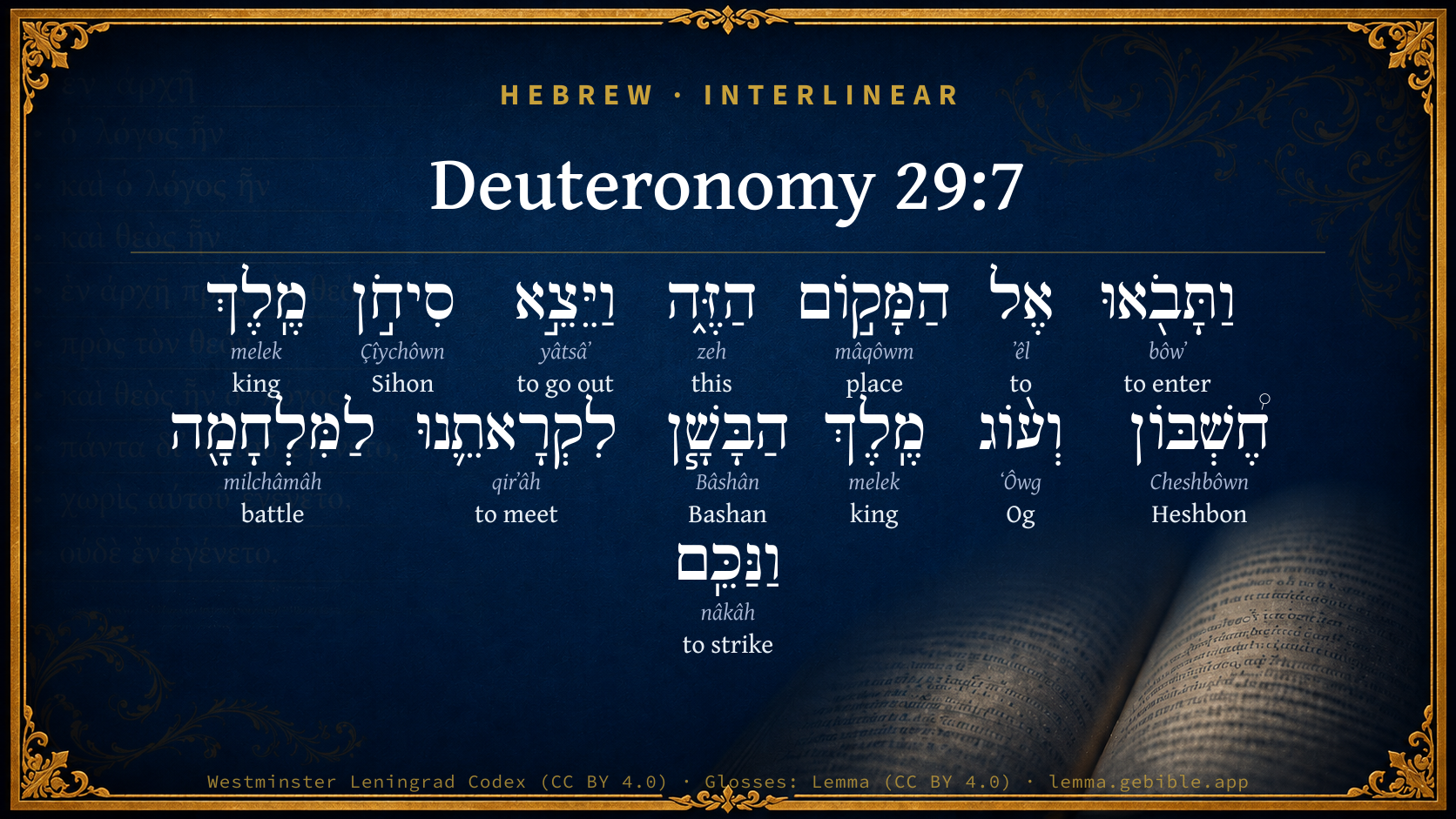
Hebrew (Westminster Leningrad Codex) Deuteronomy 29:7 appears in the Hebrew Old Testament. The text above is from the Westminster Leningrad Codex. Each word links to its Strong’s number, a concise gloss, and parsing drawn from the Open Scriptures Hebrew Bible morphology. Click any word for its full Brown-Driver-Briggs (BDB) entry.
Download image
Cite this verse

Deuteronomy 29:7 (World English Bible). Public Domain. Lemma interlinear Bible study tool, https://lemma.gebible.app/v/deuteronomy/29/7.

Show BibTeX & RIS
BibTeX
RIS
English Translation
When you came to this place, Sihon the king of Heshbon, and Og the king of Bashan, came out against us to battle, and we struck them:
World English Bible · Public Domain
Download a study sheet

One document with this verse’s original text, its word-by-word gloss line, the meaning frame, cross-references with their text, attributed commentary, and full source and license credits — printable, and it pastes into notes with its structure intact.

This verse Autodidact and up

Study sheet (.html) Plain text (.txt)

A passage Seminary Student

Up to 50 verses in one chapter. A passage sheet keeps up to 6 commentary sources and 12 cross-references per verse, in the order this page ranks them, and says so on the sheet whenever that leaves anything out. Ask for a single verse and you get the Autodidact verse sheet above.

Everything on this page stays free to read, with no account — the sheet is a download of what is already on screen, not access to it.

Want to remove ads? Support Godless Engineer
Compare translations 3

The same verse in 3 English versions, stacked beneath the original-language interlinear above. Click any original word for its lexicon entry.

Each is an independent rendering of the whole verse — the interlinear is not word-aligned to these translations.

Highlighted words mark where these versions differ — a whole-verse word diff, not a word-by-word alignment.

  • World English Bible Public Domain
    When you came to this place, Sihon the king of Heshbon, and Og the king of Bashan, came out against us to battle, and we struck them:
  • King James Version Public Domain
    And when ye came unto this place, Sihon the king of Heshbon, and Og the king of Bashan, came out against us unto battle, and we smote them:
  • unfoldingWord Literal Text CC BY-SA 4.0
    And you came to this place, and Sihon the king of Heshbon and Og the king of Bashan came out against us for the battle, and we struck them down.

unfoldingWord Literal Text — © unfoldingWord, licensed CC BY-SA 4.0. Word-aligned USFM3 via Door43 (git.door43.org/unfoldingWord/en_ult).

Versions to compare (up to 4)

3 of 4 selected

Show all 18 translations

Every available English version of this verse, each an independent rendering of the whole verse.

  • World English Bible Public Domain
    When you came to this place, Sihon the king of Heshbon, and Og the king of Bashan, came out against us to battle, and we struck them:
  • Berean Standard Bible Public Domain
    When you reached this place, Sihon king of Heshbon and Og king of Bashan came out against us in battle, but we defeated them.
  • Majority Standard Bible Public Domain
    When you reached this place, Sihon king of Heshbon and Og king of Bashan came out against us in battle, but we defeated them.
  • King James Version Public Domain
    And when ye came unto this place, Sihon the king of Heshbon, and Og the king of Bashan, came out against us unto battle, and we smote them:
  • American Standard Version (1901) Public Domain
    And when ye came unto this place, Sihon the king of Heshbon, and Og the king of Bashan, came out against us unto battle, and we smote them:
  • Revised Version (1885) Public Domain
    And when ye came unto this place, Sihon the king of Heshbon, and Og the king of Bashan, came out against us unto battle, and we smote them:
  • Geneva Bible (1599) Public Domain
    After, ye came vnto this place, and Sihon King of Heshbon, and Og King of Bashan came out against vs vnto battell, and we slewe them,
  • Douay-Rheims (1899) Public Domain
    And you came to this place: sand Sehon king of Hesebon, and Og king of Basan, came out against us to fight. And we slew them.
  • Young's Literal Translation Public Domain
    `And ye come in unto this place, and Sihon king of Heshbon -- also Og king of Bashan -- doth come out to meet us, to battle, and we smite them,
  • Literal Standard Version CC BY-SA 4.0
    And you come to this place, and Sihon king of Heshbon—also Og king of Bashan—comes out to meet us to battle, and we strike them,
  • Unlocked Literal Bible CC BY-SA 4.0
    When you came to this place, Sihon, the king of Heshbon, and Og, the king of Bashan, came out against us to fight, and we struck them down.
  • unfoldingWord Literal Text CC BY-SA 4.0
    And you came to this place, and Sihon the king of Heshbon and Og the king of Bashan came out against us for the battle, and we struck them down.
  • Darby Bible Public Domain
    And ye came to this place; and Sihon the king of Heshbon and Og the king of Bashan came out against us for battle, and we smote them.
  • World Messianic Bible Public Domain
    When you came to this place, Sihon the king of Heshbon and Og the king of Bashan came out against us to battle, and we struck them.
  • Webster's Bible Public Domain
    And when ye came to this place, Sihon the king of Heshbon, and Og the king of Bashan, came out against us to battle, and we smote them:
  • Free Bible Version CC BY-SA 4.0
    When we arrived here, Sihon king of Heshbon and Og king of Bashan marched out to fight us in battle, but we defeated them.
  • Bible in Basic English Public Domain
    When you came to this place, Sihon, king of Heshbon, and Og, king of Bashan, came out to make war against us and we overcame them:
  • JPS Tanakh (1917) Public Domain
    (29-6) And when ye came unto this place, Sihon the king of Heshbon, and Og the king of Bashan, came out against us unto battle, and we smote them.

Literal Standard Version (2020), Covenant Press — licensed CC BY-SA 4.0. Text via the HelloAO Bible API (eBible.org). Unlocked Literal Bible (unfoldingWord) — licensed CC BY-SA 4.0. Text via the HelloAO Bible API (eBible.org). unfoldingWord Literal Text — © unfoldingWord, licensed CC BY-SA 4.0. Word-aligned USFM3 via Door43 (git.door43.org/unfoldingWord/en_ult). Free Bible Version, Dr. Jonathan Gallagher — licensed CC BY-SA 4.0. Text via the HelloAO Bible API (eBible.org).

Word by word

More ways to search: Search by grammar → Find every occurrence → Compare this word →

Practice this passage: Drill this verse → Learn its vocabulary →

וְע֨וֹג
ʻÔwg
H5747
“and · Og”
Conjunction + Noun, Proper
Part of Speech
Conjunction + Noun
Type
Proper
Full BDB Definition

Origin: probably from H5746

TWOT: None

Og = "long-necked" - the Amorite king of Bashan and one of the last representatives of the giants of Rephaim
  1. וַתָּבֹ֖אוּ bôwʼ H935 “and · to enter” Conjunction + Verb, Qal, Sequential Imperfect, 2nd Person, Masculine, Plural
  2. אֶל ʼêl H413 “to” Preposition
  3. הַמָּק֣וֹם mâqôwm H4725 “the · place” Particle, Definite Article + Noun, Common, Masculine, Singular, Absolute
  4. הַזֶּ֑ה zeh H2088 “the · this” Particle, Definite Article + Pronoun, Demonstrative, Masculine, Singular
  5. וַיֵּצֵ֣א yâtsâʼ H3318 “and · to go out” Conjunction + Verb, Qal, Sequential Imperfect, 3rd Person, Masculine, Singular
  6. סִיחֹ֣ן Çîychôwn H5511 “Sihon” Noun, Proper
  7. מֶֽלֶךְ melek H4428 “king of” Noun, Common, Masculine, Singular, Construct
  8. חֶ֠שְׁבּוֹן Cheshbôwn H2809 “Heshbon” Noun, Proper
  9. מֶֽלֶךְ melek H4428 “king of” Noun, Common, Masculine, Singular, Construct
  10. הַבָּשָׁ֧ן Bâshân H1316 “the · Bashan” Particle, Definite Article + Noun, Proper
  11. לִקְרָאתֵ֛נוּ qirʼâh H7125 “to meet · us” Preposition + Verb, Qal, Infinitive Construct + Suffix, Personal, 1st Person, Common, Plural
  12. לַמִּלְחָמָ֖ה milchâmâh H4421 “to/for the · battle” Preposition, Determined + Noun, Common, Feminine, Singular, Absolute
  13. וַנַּכֵּֽם nâkâh H5221 “and · to strike · them” Conjunction + Verb, Hiphil, Sequential Imperfect, 1st Person, Common, Plural + Suffix, Personal, 3rd Person, Masculine, Plural

About this verse

These counts appear in no published source. They are computed here, from the morphology-tagged text and Lemma’s own curated glosses. What Lemma adds →

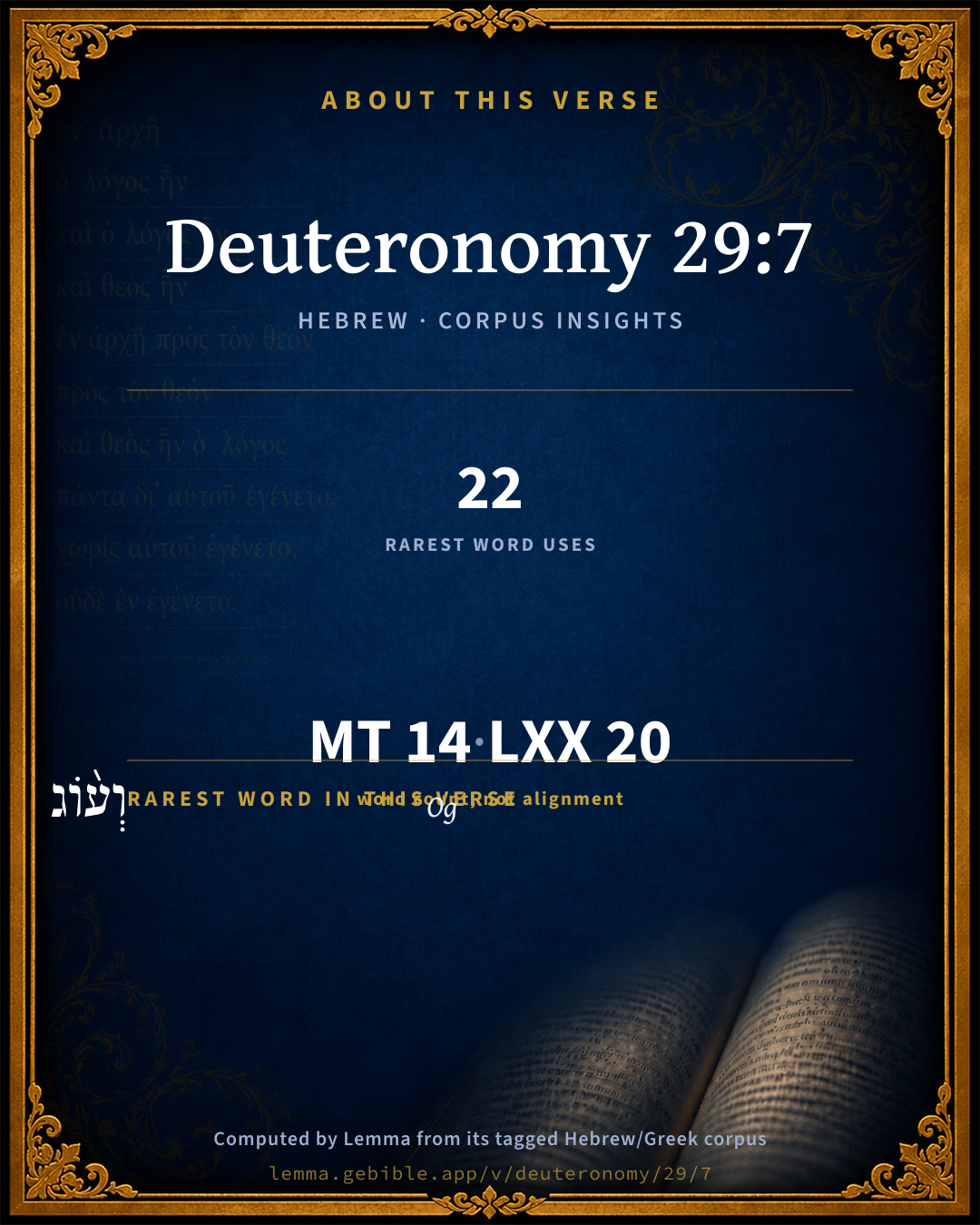
14
words
13
distinct lemmas
Pentateuch
section

Notable vocabulary

The rarest word here is וְע֨וֹג Og H5747 — appearing just 22 times in the whole Hebrew Bible.

Shared distinctive vocabulary

וְע֨וֹג Og H5747 occurs in 22 verses of the Hebrew Bible. Also found in:

Grammatical profile

  • 4 verbs
  • 8 nouns
  • 1 pronoun
  • 1 preposition

Verb forms

  • וַתָּבֹ֖אוּ Qal · Sequential Imperfect
  • וַיֵּצֵ֣א Qal · Sequential Imperfect
  • לִקְרָאתֵ֛נוּ Qal · Infinitive Construct
  • וַנַּכֵּֽם Hiphil · Sequential Imperfect

Repetition

A word recurs within this verse — often emphatic in Hebrew:

  • מֶֽלֶךְ king H4428 ×2

Hebrew & Septuagint length

In English translation the verse runs 27 words from the Hebrew and 26 from the Septuagint (LXX English) — closely comparable.

A rough comparison of the two English renderings, which tokenize alike — not a word-level alignment.

Word counts can differ between the Hebrew and the Greek without any difference in meaning — e.g. the Hebrew direct-object marker אֵת has no separate Greek word, and Greek often adds the article ὁ.

In the original languages it is 14 Hebrew tokens and 20 Greek tokens — but the two are counted differently (Hebrew bundles its prefixes and suffixes into one token; the Greek is in lemma form), so that isn’t a like-for-like length.

Cross-references

5

Topical passages linked to Deuteronomy 29:7 in the Treasury of Scripture Knowledge — connected by theme and wording, ordered by reader-vote popularity; previews shown in the World English Bible.

  • Numbers 21:21–35 Israel sent messengers to Sihon king of the Amorites, saying,
  • Numbers 32:33–42 Moses gave to them, even to the children of Gad, and to the children of Reuben, and to the half-tribe of Manasseh the son of Joseph, the kingdom of Sihon king of the Amorites, and the kingdom of Og king of Bashan, the land, according to the cities of it with [their] borders, even the cities of the land round about.
  • Deuteronomy 2:24–3:17 Rise up, take your journey, and pass over the valley of the Arnon: behold, I have given into your hand Sihon the Amorite, king of Heshbon, and his land; begin to possess it, and contend with him in battle.
  • Psalms 135:10–12 Who struck many nations, And killed mighty kings,
  • Psalms 136:17–22 To him who struck great kings; For his loving kindness endures forever;

Cross-references courtesy of OpenBible.info (CC BY 4.0).

Hebrew and Greek witnesses Masoretic Hebrew ↔ Greek Septuagint

The same verse in the two great witnesses to the Old Testament, shown verse-for-verse.

These are two independent witnesses, not word-aligned to each other, and the Septuagint is shown in lemma (dictionary) form.

Hebrew Deuteronomy 29:7 Masoretic · Westminster Leningrad Codex

וַתָּבֹ֖אוּ אֶל הַמָּק֣וֹם הַזֶּ֑ה וַיֵּצֵ֣א סִיחֹ֣ן מֶֽלֶךְ חֶ֠שְׁבּוֹן וְע֨וֹג מֶֽלֶךְ הַבָּשָׁ֧ן לִקְרָאתֵ֛נוּ לַמִּלְחָמָ֖ה וַנַּכֵּֽם

When you came to this place, Sihon the king of Heshbon, and Og the king of Bashan, came out against us to battle, and we struck them:

World English Bible · Public Domain

Greek LXX Deuteronomy 29:7 Septuagint · lemma form

καί λαμβάνω ὁ γῆ αὐτός καί δίδωμι αὐτός ἐν κλῆρος ὁ ρουβην καί ὁ γαδ καί ὁ ἥμισυς φυλή μανασσή

And you⌃ came as far as this place; and there came forth Seon king of Esebon, and Og king of Basan, to meet us in war.

LXX2012 (modern English Septuagint) · Public Domain

Hebrew: Westminster Leningrad Codex (CC BY 4.0). Greek: Septuagint (public domain); English from LXX2012 (modern English Septuagint) (Public Domain). How the Septuagint differs from the Hebrew →

Targum (Aramaic paraphrase)

2

The Targum is the ancient Jewish Aramaic paraphrase of the Hebrew Scriptures — an interpretive translation, not the Hebrew text itself. Onkelos (literal) and Pseudo-Jonathan (expansive) render the Torah, and Jonathan the Prophets. Coverage is partial: where no permissively-licensed English translation exists for a verse, only the Aramaic is shown. This is verse-level text, not a word-by-word alignment to the Hebrew.

  1. Targum Onkelos Torah (Genesis–Deuteronomy)
    וּנְסִבְנָא יָת אַרְעֲהוֹן וִיהָבִנַהּ לְאַחֲסָנָא לְשִׁבְטָּא דִרְאוּבֵן וּלְשִׁבְטָא דְגָד וּלְפַלְגוּת שִׁבְטָא דִמְנַשֶׁה

    (no public-domain English translation for this verse)

    Targum Onkelos — Aramaic: “Onkelos Genesis” (public domain); “Onkelos Exodus” (public domain); “Onkelos Leviticus” (public domain); “Onkelos Numbers” (public domain); “Onkelos Deuteronomy” (public domain). English: “Sefaria Community Translation” (CC0 1.0 (public-domain dedication)); “J.W. Etheridge. The Targums of Onkelos and Jonathan Ben Uzziel on the Pentateuch. London: Longmans, Green, 1862” (public domain). Text via Sefaria.

  2. Targum Pseudo-Jonathan Torah (Genesis–Deuteronomy)
    וּכְבַשְׁנָן יַת אַרְעֲהוֹן וִיהָבָנָא אַחֲסָנָא לְשֵׁיבַט רְאוּבֵן וּלְשֵׁיבַט גָד וּלְפַלְגוּת שֵׁיבַט מְנַשֶׁה

    and subdued their land, and gave it for an inheritance to the tribe of Reuben, Gad, and the half tribe of Menasheh.

    Targum Pseudo-Jonathan — Aramaic: “Targum Jonathan on Genesis” (public domain); “Targum Jonathan on Exodus” (public domain); “Targum Jonathan on Leviticus” (public domain); “Targum Jonathan on Numbers” (public domain); “Targum Jonathan on Deuteronomy” (public domain). English: “The Targum of Jonathan ben Uzziel, trans. J. W. Etheridge, London, 1862” (public domain). Text via Sefaria.

Commentary

Notes on Deuteronomy 29:7 from classic Christian and Jewish commentators (each source and its license shown beneath its notes). The classic Christian expositions comment on the surrounding passage and are grouped to its opening verse, so a note may address several verses; the Jewish commentaries on the Tanakh (Rashi and others) are per-verse, so they appear only where the commentator wrote on this verse.

Lemma curates 59 commentaries, every one of them public domain or Creative Commons licensed, each selected and text-cleaned for this edition rather than reprinted as found. About our sources →

Tyndale Open Study Notes

Tyndale Open Resources

29:7 King Sihon of Heshbon, ruler of the Amorites, had controlled an area from the Arnon River to the Ammonite border. See Num 21:31-35. • Heshbon: See Deut 1:4; 2:24. • King Og of Bashan had ruled an Amorite kingdom east of the Sea of Galilee (see 3:1).

Tyndale Open Study Notes — © Tyndale Open Resources, licensed CC BY-SA 4.0. Text via the HelloAO Bible API.

The Cambridge Bible for Schools and Colleges

gen. ed. J. J. S. Perowne

7. came unto this place] Deu_1:31, Deu_9:7.

Sihon … and Og …] Deu_2:32 ff., Deu_3:1 ff.

The Cambridge Bible for Schools and Colleges (gen. ed. J. J. S. Perowne; Cambridge University Press, 1878–1918) — public domain. Text from a community e-Sword module.

John Gill's Exposition

And when ye came unto this place,.... The borders of Moab, the wilderness before it, to which joined the plains they were now in; see Num 21:13,

Sihon king of Heshbon, and Og king of Bashan, came out against us unto battle; not together, but one after the other, and that very quickly; as soon almost as they had fought with the one, and conquered him, the other came out against them:

and we smote them; killed them and their armies, and the inhabitants of their countries; the history of which see in Num 21:23.

John Gill's Exposition of the Whole Bible (1746–1763) — public domain (CC PDM 1.0). Text via the HelloAO Bible API.

Whedon's Commentary on the Bible

Daniel D. Whedon

7. Sihon… and Og — Comp. Deu_2:30; Deu_3:2.

Daniel D. Whedon (gen. ed.), Commentary on the Old and New Testaments (1874–1909) — public domain. Text from a community e-Sword module.

unfoldingWord translationNotes

Door43 World Missions Community

Sihon, the king of Heshbon, and Og, the king of Bashan

See how you translated these names in Deuteronomy 1:4.

came out against us

Here "us" refers to Moses and the people of Israel. (See: Inclusive "We")

keep the words of this covenant and do them

These two phrases mean the same thing and emphasize that the people were to obey Yahweh's commands. AT: "obey all the words of this covenant" (See: Parallelism)

translationWords

king

Bashan

inherit

Reuben

Gad

tribe

Manasseh

covenant

prosper

unfoldingWord translationNotes — © Distant Shores Media and the Door43 World Missions Community, licensed CC BY-SA 4.0. Source: git.door43.org/Door43/en_tn.

Lesson kit

Teaching starters — assembled from the data on this page, not authored interpretation. Every prompt links to the verse data it draws on. Edit before teaching.

Deuteronomy, in the Pentateuch, opens this verse with 14 words (13 distinct Hebrew lemmas). Its most distinctive word is ʻÔwg (“Og”). A historical commentator’s framing appears above. Read the whole chapter for the surrounding context.

Discussion questions

  1. What does “Og” (ʻÔwg) contribute to the verse as a whole?
  2. How does Numbers 21:33, which shares the word «Og», read alongside this verse?
  3. What does the repetition of “king” (2× in this one verse) do in this verse?
  4. The translations on this page render this verse differently — a whole-verse word diff, not a word-by-word alignment. What might account for the different wordings?
  5. «וַתָּבֹ֖אוּ» is a Qal Sequential Imperfect verb. How does that grammatical form shape the action described?
  6. Compare how Tyndale Open Study Notes and The Cambridge Bible for Schools and Colleges read this verse. Where do they agree or differ?

Things to notice

Reading settings

Reading text

Shown beneath each verse's original-language words.

Old Testament
Old Testament edition

Read the OT as the Masoretic Hebrew (MT) or the Greek Septuagint (LXX).

English shown for the Greek Septuagint (in the Hebrew ↔ Greek comparison).

Comparing translations? Open the Compare panel on any verse page to stack up to four side by side.