
Exodus 30:23

Hebrew (Westminster Leningrad Codex) Exodus 30:23 appears in the Hebrew Old Testament. The text above is from the Westminster Leningrad Codex. Each word links to its Strong’s number, a concise gloss, and parsing drawn from the Open Scriptures Hebrew Bible morphology. Click any word for its full Brown-Driver-Briggs (BDB) entry.
Download image
Cite this verse

Exodus 30:23 (World English Bible). Public Domain. Lemma interlinear Bible study tool, https://lemma.gebible.app/v/exodus/30/23.

Show BibTeX & RIS
BibTeX
RIS
English Translation
"Also take fine spices: of liquid myrrh, five hundred shekels; and of fragrant cinnamon half as much, even two hundred and fifty; and of fragrant cane, two hundred and fifty;
World English Bible · Public Domain
Highlights
  • 3 first appearances in the Hebrew Bible
Full analysis ↓
Download a study sheet

One document with this verse’s original text, its word-by-word gloss line, the meaning frame, cross-references with their text, attributed commentary, and full source and license credits — printable, and it pastes into notes with its structure intact.

This verse Autodidact and up

Study sheet (.html) Plain text (.txt)

A passage Seminary Student

Up to 50 verses in one chapter. A passage sheet keeps up to 6 commentary sources and 12 cross-references per verse, in the order this page ranks them, and says so on the sheet whenever that leaves anything out. Ask for a single verse and you get the Autodidact verse sheet above.

Everything on this page stays free to read, with no account — the sheet is a download of what is already on screen, not access to it.

Want to remove ads? Support Godless Engineer
Compare translations 3

The same verse in 3 English versions, stacked beneath the original-language interlinear above. Click any original word for its lexicon entry.

Each is an independent rendering of the whole verse — the interlinear is not word-aligned to these translations.

Highlighted words mark where these versions differ — a whole-verse word diff, not a word-by-word alignment.

  • World English Bible Public Domain
    "Also take fine spices: of liquid myrrh, five hundred shekels; and of fragrant cinnamon half as much, even two hundred and fifty; and of fragrant cane, two hundred and fifty;
  • King James Version Public Domain
    Take thou also unto thee principal spices, of pure myrrh five hundred shekels, and of sweet cinnamon half so much, even two hundred and fifty shekels, and of sweet calamus two hundred and fifty shekels,
  • unfoldingWord Literal Text CC BY-SA 4.0
    “As for you, take the best spices: myrrh of flowing, 500, and cinnamon of fragrance, its half, 250, and cane of fragrance, 250,

unfoldingWord Literal Text — © unfoldingWord, licensed CC BY-SA 4.0. Word-aligned USFM3 via Door43 (git.door43.org/unfoldingWord/en_ult).

Versions to compare (up to 4)

3 of 4 selected

Show all 18 translations

Every available English version of this verse, each an independent rendering of the whole verse.

  • World English Bible Public Domain
    "Also take fine spices: of liquid myrrh, five hundred shekels; and of fragrant cinnamon half as much, even two hundred and fifty; and of fragrant cane, two hundred and fifty;
  • Berean Standard Bible Public Domain
    “Take the finest spices: 500 shekels of liquid myrrh, half that amount (250 shekels) of fragrant cinnamon, 250 shekels of fragrant cane,
  • Majority Standard Bible Public Domain
    “Take the finest spices: 500 shekels of liquid myrrh, half that amount (250 shekels) of fragrant cinnamon, 250 shekels of fragrant cane,
  • King James Version Public Domain
    Take thou also unto thee principal spices, of pure myrrh five hundred shekels, and of sweet cinnamon half so much, even two hundred and fifty shekels, and of sweet calamus two hundred and fifty shekels,
  • American Standard Version (1901) Public Domain
    Take thou also unto thee the chief spices: of flowing myrrh five hundred `shekels', and of sweet cinnamon half so much, even two hundred and fifty, and of sweet calamus two hundred and fifty,
  • Revised Version (1885) Public Domain
    Take thou also unto thee the chief spices, of flowing myrrh five hundred shekels, and of sweet cinnamon half so much, even two hundred and fifty, and of sweet calamus two hundred and fifty,
  • Geneva Bible (1599) Public Domain
    Take thou also vnto thee, principall spices of the most pure myrrhe fiue hundreth shekels, of sweete cinamon halfe so much, that is, two hundreth and fiftie, and of sweete calamus, two hundreth, and fiftie:
  • Douay-Rheims (1899) Public Domain
    Saying: Take spices, of principal and chosen myrrh five hundred sicles, and of cinnamon half so much, that is, two hundred and fifty sicles, of calamus in like manner two hundred and fifty.
  • Young's Literal Translation Public Domain
    `And thou, take to thyself principal spices, wild honey five hundred `shekels'; and spice-cinnamon, the half of that, two hundred and fifty; and spice-cane two hundred and fifty;
  • Literal Standard Version CC BY-SA 4.0
    “And you, take [these] principal spices for yourself: five hundred [shekels] of liquid myrrh, and the half of that—two hundred and fifty [shekels]—of spice-cinnamon, and two hundred and fifty [shekels] of spice-cane,
  • Unlocked Literal Bible CC BY-SA 4.0
    “Take these fine spices: five hundred shekels of flowing myrrh, 250 shekels of sweet-smelling cinnamon, 250 shekels of sweet-smelling cane,
  • unfoldingWord Literal Text CC BY-SA 4.0
    “As for you, take the best spices: myrrh of flowing, 500, and cinnamon of fragrance, its half, 250, and cane of fragrance, 250,
  • Darby Bible Public Domain
    And thou, take best spices -- of liquid myrrh five hundred [shekels], and of sweet cinnamon the half -- two hundred and fifty, and of sweet myrtle two hundred and fifty,
  • World Messianic Bible Public Domain
    “Also take fine spices: of liquid myrrh, five hundred shekels; and of fragrant cinnamon half as much, even two hundred and fifty; and of fragrant cane, two hundred and fifty;
  • Webster's Bible Public Domain
    Take thou also to thee principal spices, of pure myrrh five hundred shekels, and of sweet cinnamon half as much, even two hundred and fifty shekels, and of sweet calamus two hundred and fifty shekels,
  • Free Bible Version CC BY-SA 4.0
    “Take the best quality spices: 500 shekels of liquid myrrh, 250 shekels of sweet-smelling cinnamon, 250 shekels of aromatic reed,
  • Bible in Basic English Public Domain
    Take the best spices, five hundred shekels' weight of liquid myrrh, and of sweet cinnamon half as much, that is, two hundred and fifty shekels, and two hundred and fifty shekels of sweet calamus,
  • JPS Tanakh (1917) Public Domain
    'Take thou also unto thee the chief spices, of flowing myrrh five hundred shekels, and of sweet cinnamon half so much, even two hundred and fifty, and of sweet calamus two hundred and fifty,

Literal Standard Version (2020), Covenant Press — licensed CC BY-SA 4.0. Text via the HelloAO Bible API (eBible.org). Unlocked Literal Bible (unfoldingWord) — licensed CC BY-SA 4.0. Text via the HelloAO Bible API (eBible.org). unfoldingWord Literal Text — © unfoldingWord, licensed CC BY-SA 4.0. Word-aligned USFM3 via Door43 (git.door43.org/unfoldingWord/en_ult). Free Bible Version, Dr. Jonathan Gallagher — licensed CC BY-SA 4.0. Text via the HelloAO Bible API (eBible.org).

Word by word

More ways to search: Search by grammar → Find every occurrence → Compare this word →

Practice this passage: Drill this verse → Learn its vocabulary →

וְקִנְּמָן
qinnâmôwn
H7076
“and · cinnamon of”
Conjunction + Noun, Common, Masculine, Singular, Construct
Part of Speech
Conjunction + Noun
Type
Common
Gender
Masculine
Number
Singular
State
Construct
Full BDB Definition

Origin: from an unused root (meaning to erect)

TWOT: 2041

cinnamon - fragrant bark used as spice
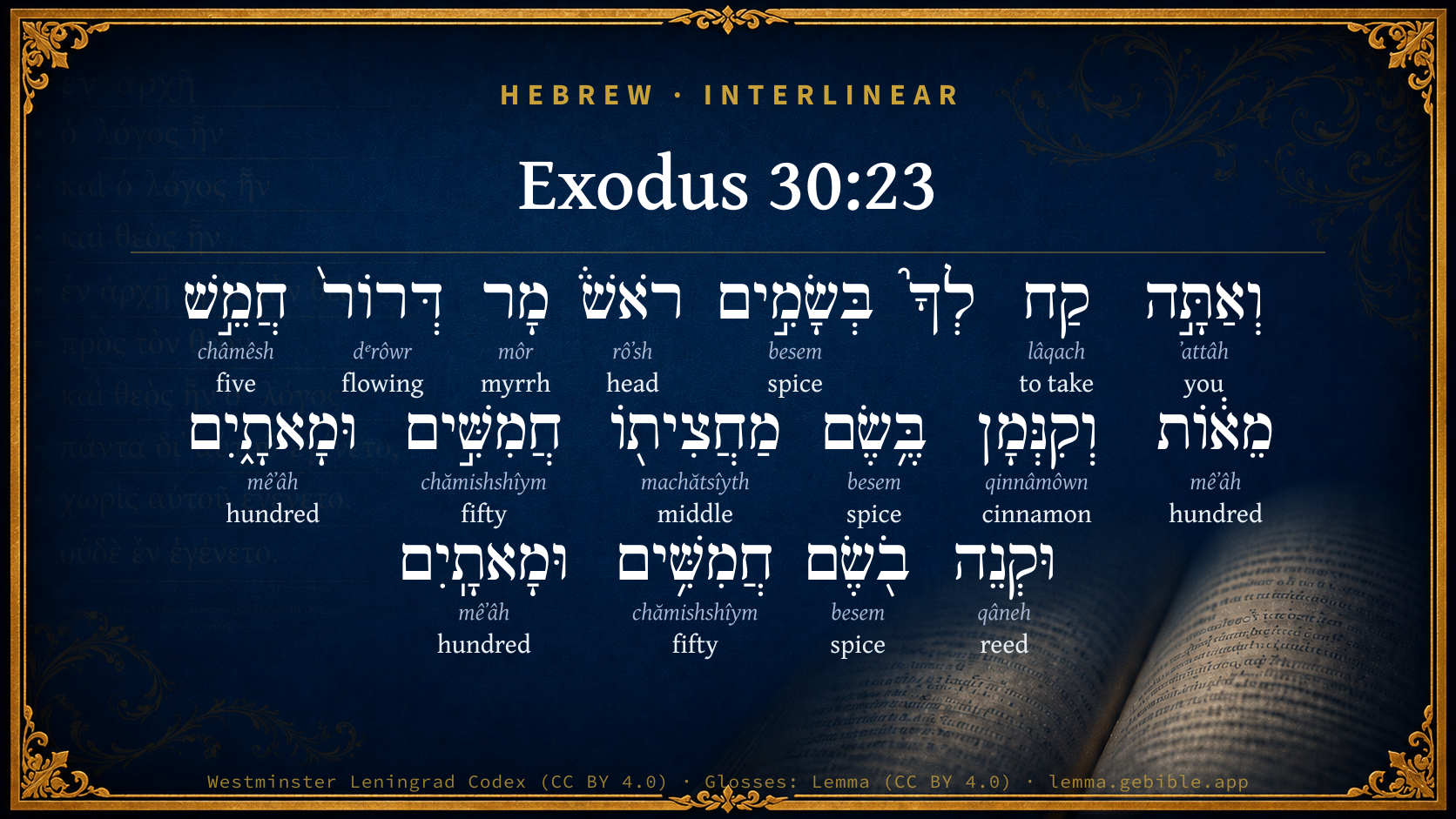
  1. וְאַתָּ֣ה ʼattâh H859 “and · you” Conjunction + Pronoun, Personal, 2nd Person, Masculine, Singular
  2. קַח lâqach H3947 “take” Verb, Qal, Imperative, 2nd Person, Masculine, Singular
  3. בְּשָׂמִ֣ים besem H1314 “spices” Noun, Common, Masculine, Plural, Absolute
  4. רֹאשׁ֒ rôʼsh H7218 “head of” Noun, Common, Masculine, Singular, Construct
  5. מָר môr H4753 “myrrh of” Noun, Common, Masculine, Singular, Construct
  6. דְּרוֹר֙ dᵉrôwr H1865 “flowing” Noun, Common, Masculine, Singular, Absolute
  7. חֲמֵ֣שׁ châmêsh H2568 “five” Adjective, Cardinal number, Feminine, Singular, Absolute
  8. מֵא֔וֹת mêʼâh H3967 “hundred” Adjective, Cardinal number, Both, Plural, Absolute
  9. בֶּ֥שֶׂם besem H1314 “spice” Noun, Common, Masculine, Singular, Absolute
  10. מַחֲצִית֖וֹ machătsîyth H4276 “middle · his” Noun, Common, Feminine, Singular, Construct + Suffix, Personal, 3rd Person, Masculine, Singular
  11. חֲמִשִּׁ֣ים chămishshîym H2572 “fifty” Adjective, Cardinal number, Both, Plural, Absolute
  12. וּמָאתָ֑יִם mêʼâh H3967 “and · hundred” Conjunction + Adjective, Cardinal number, Both, Dual, Absolute
  13. וּקְנֵה qâneh H7070 “and · reed of” Conjunction + Noun, Common, Masculine, Singular, Construct
  14. בֹ֖שֶׂם besem H1314 “spice” Noun, Common, Masculine, Singular, Absolute
  15. חֲמִשִּׁ֥ים chămishshîym H2572 “fifty” Adjective, Cardinal number, Both, Plural, Absolute
  16. וּמָאתָֽיִם mêʼâh H3967 “and · hundred” Conjunction + Adjective, Cardinal number, Both, Dual, Absolute

About this verse

These counts appear in no published source. They are computed here, from the morphology-tagged text and Lemma’s own curated glosses. What Lemma adds →

18
words
12
distinct lemmas
Pentateuch
section

Notable vocabulary

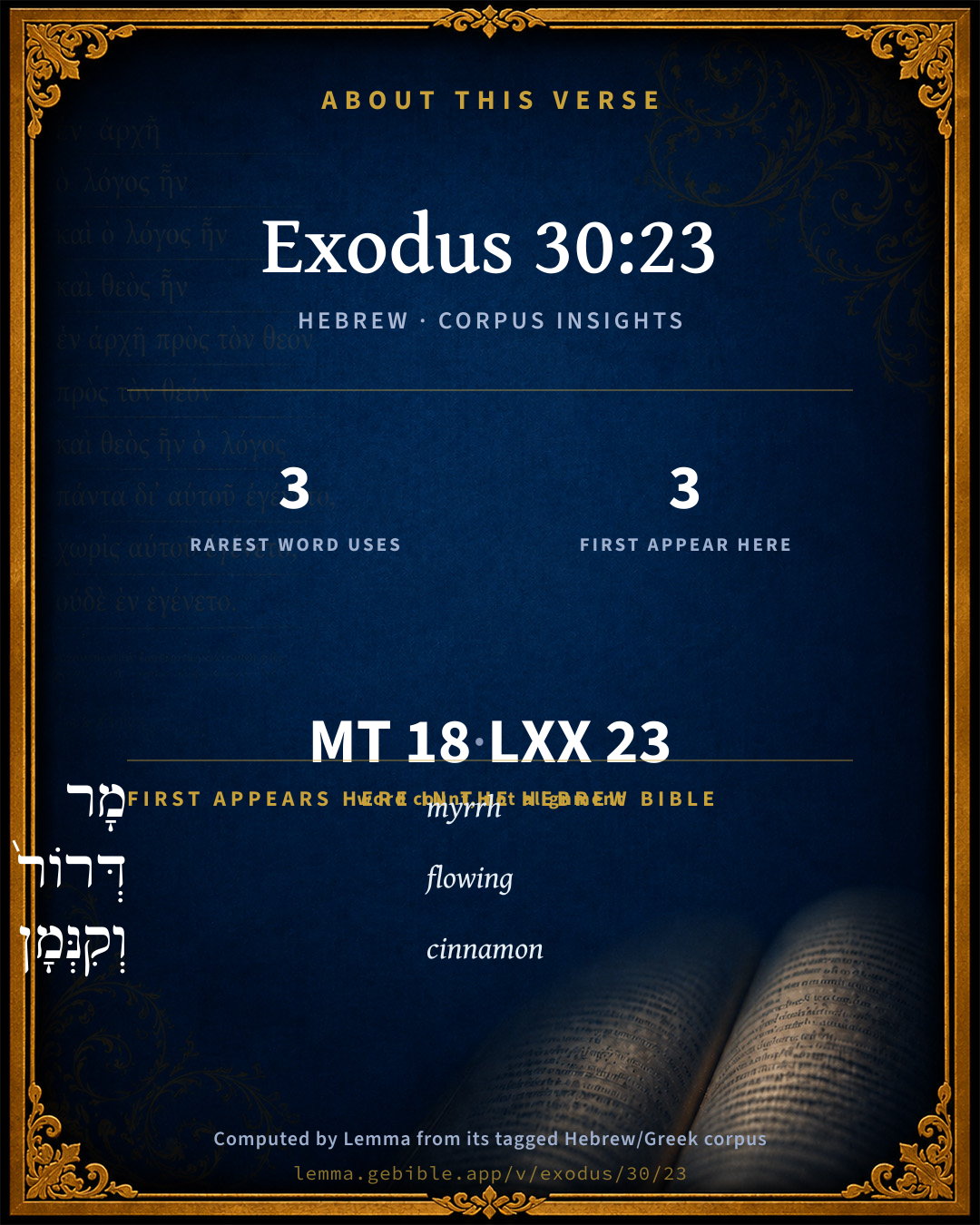
The rarest word here is וְקִנְּמָן cinnamon H7076 — appearing just 3 times in the whole Hebrew Bible.

First appearance in Scripture

These words make their first canonical appearance in the Hebrew Bible here:

  • מָר myrrh H4753
  • דְּרוֹר֙ flowing H1865
  • וְקִנְּמָן cinnamon H7076

Shared distinctive vocabulary

וְקִנְּמָן cinnamon H7076 occurs in 3 verses of the Hebrew Bible. Also found in:

Grammatical profile

  • 1 verb
  • 9 nouns
  • 6 adjectives
  • 1 pronoun
  • 1 preposition

Verb forms

  • קַח Qal · Imperative

Repetition

Words recur within this verse — often emphatic in Hebrew:

  • בְּשָׂמִ֣ים spice H1314 ×3
  • מֵא֔וֹת hundred H3967 ×3
  • חֲמִשִּׁ֣ים fifty H2572 ×2

Hebrew & Septuagint length

In English translation the verse runs 30 words from the Hebrew and 38 from the Septuagint (LXX English) — closely comparable.

A rough comparison of the two English renderings, which tokenize alike — not a word-level alignment.

Word counts can differ between the Hebrew and the Greek without any difference in meaning — e.g. the Hebrew direct-object marker אֵת has no separate Greek word, and Greek often adds the article ὁ.

In the original languages it is 18 Hebrew tokens and 23 Greek tokens — but the two are counted differently (Hebrew bundles its prefixes and suffixes into one token; the Greek is in lemma form), so that isn’t a like-for-like length.

Cross-references

9

Topical passages linked to Exodus 30:23 in the Treasury of Scripture Knowledge — connected by theme and wording, ordered by reader-vote popularity; previews shown in the World English Bible.

  • Song of Solomon 4:14 Spikenard and saffron, Calamus and cinnamon, with every kind of incense tree; Myrrh and aloes, with all the best spices,
  • Ezekiel 27:19 Vedan and Javan traded with yarn for your wares: bright iron, cassia, and calamus, were among your merchandise.
  • Ezekiel 27:22 The traffickers of Sheba and Raamah, they were your traffickers; they traded for your wares with the chief of all spices, and with all precious stones, and gold.
  • Jeremiah 6:20 To what purpose comes there to me frankincense from Sheba, and the sweet cane from a far country? your burnt offerings are not acceptable, nor your sacrifices pleasing to me.
  • Exodus 37:29 He made the holy anointing oil and the pure incense of sweet spices, after the art of the perfumer.
  • Psalms 45:8 All your garments smell like myrrh, aloes, and cassia. Out of ivory palaces stringed instruments have made you glad.
  • Proverbs 7:17 I have perfumed my bed with myrrh, aloes, and cinnamon.
  • Song of Solomon 1:3 Your oils have a pleasing fragrance. Your name is oil poured forth, Therefore the virgins love you.

Cross-references courtesy of OpenBible.info (CC BY 4.0).

Hebrew and Greek witnesses Masoretic Hebrew ↔ Greek Septuagint

The same verse in the two great witnesses to the Old Testament, shown verse-for-verse.

These are two independent witnesses, not word-aligned to each other, and the Septuagint is shown in lemma (dictionary) form.

Hebrew Exodus 30:23 Masoretic · Westminster Leningrad Codex

וְאַתָּ֣ה קַח לְךָ֮ בְּשָׂמִ֣ים רֹאשׁ֒ מָר דְּרוֹר֙ חֲמֵ֣שׁ מֵא֔וֹת וְקִנְּמָן בֶּ֥שֶׂם מַחֲצִית֖וֹ חֲמִשִּׁ֣ים וּמָאתָ֑יִם וּקְנֵה בֹ֖שֶׂם חֲמִשִּׁ֥ים וּמָאתָֽיִם

"Also take fine spices: of liquid myrrh, five hundred shekels; and of fragrant cinnamon half as much, even two hundred and fifty; and of fragrant cane, two hundred and fifty;

World English Bible · Public Domain

Greek LXX Exodus 30:23 Septuagint · lemma form

καί σύ λαμβάνω ἥδυσμα ὁ ἄνθος σμύρνα ἐκλεκτός πεντακόσιοι σίκλος καί κιννάμωμον εὐώδης ὁ ἥμισυς οὗτος διακόσιοι πεντήκοντα καί κάλαμος εὐώδης διακόσιοι πεντήκοντα

Do you also take sweet herbs, the flower of choice myrrh five hundred shekels, and the half of this two hundred and fifty shekels of sweet smelling cinnamon, and two hundred and fifty shekels of sweet smelling calamus,

LXX2012 (modern English Septuagint) · Public Domain

Hebrew: Westminster Leningrad Codex (CC BY 4.0). Greek: Septuagint (public domain); English from LXX2012 (modern English Septuagint) (Public Domain). How the Septuagint differs from the Hebrew →

Targum (Aramaic paraphrase)

2

The Targum is the ancient Jewish Aramaic paraphrase of the Hebrew Scriptures — an interpretive translation, not the Hebrew text itself. Onkelos (literal) and Pseudo-Jonathan (expansive) render the Torah, and Jonathan the Prophets. Coverage is partial: where no permissively-licensed English translation exists for a verse, only the Aramaic is shown. This is verse-level text, not a word-by-word alignment to the Hebrew.

  1. Targum Onkelos Torah (Genesis–Deuteronomy)
    וְאַתְּ סַב לָךְ בּוּסְמִין רֵישָׁא מֵירָא דַכְיָא מַתְקַל חֲמֵשׁ מְאָה וְקִנְמָן בֶּשֶׂם פַּלְגוּתֵהּ מַתְקַל מָאתָן וְחַמְשִׁין וּקְנֵה בוּסְמָא מַתְקַל מָאתָן וְחַמְשִׁין:

    (no public-domain English translation for this verse)

    Targum Onkelos — Aramaic: “Onkelos Genesis” (public domain); “Onkelos Exodus” (public domain); “Onkelos Leviticus” (public domain); “Onkelos Numbers” (public domain); “Onkelos Deuteronomy” (public domain). English: “Sefaria Community Translation” (CC0 1.0 (public-domain dedication)); “J.W. Etheridge. The Targums of Onkelos and Jonathan Ben Uzziel on the Pentateuch. London: Longmans, Green, 1862” (public domain). Text via Sefaria.

  2. Targum Pseudo-Jonathan Torah (Genesis–Deuteronomy)
    וְאַנְתְּ סַב לָךְ בּוּסְמִין בִּשְׁרוּיָיא מוֹר בְּחִיר מַתְקַל חֲמֵשׁ מְאָה מָנִין וְקִינְמוֹן בּוֹשֶם פַּלְגוּתֵיהּ מַתְקַל מָאתָן וְחַמְשִׁין מָנִין וּקְנֵהּ בּוּשְמָא מַתְקַל מָאתָן וְחַמְשִׁין מָנִין

    And thou also take to thee the first aromatics, choice myrrh, in weight five hundred minas, and sweet cinnamon of half the weight, two hundred and fifty minas,

    Targum Pseudo-Jonathan — Aramaic: “Targum Jonathan on Genesis” (public domain); “Targum Jonathan on Exodus” (public domain); “Targum Jonathan on Leviticus” (public domain); “Targum Jonathan on Numbers” (public domain); “Targum Jonathan on Deuteronomy” (public domain). English: “The Targum of Jonathan ben Uzziel, trans. J. W. Etheridge, London, 1862” (public domain). Text via Sefaria.

Commentary

Notes on Exodus 30:23 from classic Christian and Jewish commentators (each source and its license shown beneath its notes). The classic Christian expositions comment on the surrounding passage and are grouped to its opening verse, so a note may address several verses; the Jewish commentaries on the Tanakh (Rashi and others) are per-verse, so they appear only where the commentator wrote on this verse.

Lemma curates 59 commentaries, every one of them public domain or Creative Commons licensed, each selected and text-cleaned for this edition rather than reprinted as found. About our sources →

Joseph Benson's Commentary

Exo 30:23. Interpreters are not agreed concerning these ingredients: the spices, which were in all near half a hundred weight, were to be infused in the oil, which was to be about five or six quarts, and then strained out, leaving an admirable smell in the oil. With this oil God’s tent and all the furniture of it were to be anointed; it was to be used also in the consecration of the priests. It was to be continued throughout their generations, Exo 30:31. Solomon was anointed with it, 1Ki 1:39, and some other of the kings, and all the high-priests, with such a quantity of it, as that it ran down to the skirts of the garments; and we read of the making it up, 1Ch 9:30. Yet all agree, that in the second temple there was none of this holy oil, which was probably owing to a notion they had, that it was not lawful to make it up; Providence overruling that want as a presage of the better unction of the Holy Ghost in gospel times, the variety of whose gifts are typified by these sweet ingredients.

Joseph Benson's Commentary on the Old and New Testaments (1811–1818) — public domain. Text from a community e-Sword module.

Geneva Bible (1599)

Geneva Bible translators

Weighing so much.

It is a kind of reed of a very sweet savor within, and it is used in powders and odors.

Geneva Bible (1599) marginal notes — public domain. Text via Bolls.life.

Jamieson, Fausset & Brown

Robert Jamieson, A. R. Fausset & David Brown

Take thou also . . . principal spices, &c.--Oil is frequently mentioned in Scripture as an emblem of sanctification, and anointing with it a means of designating objects as well as persons to the service of God. Here it is prescribed by divine authority, and the various ingredients in their several proportions described which were to compose the oil used in consecrating the furniture of the tabernacle.

myrrh--a fragrant and medicinal gum from a little known tree in Arabia.

sweet cinnamon--produced from a species of laurel or sweet bay, found chiefly in Ceylon, growing to a height of twenty feet: this spice is extracted from the inner bark, but it is not certain whether that mentioned by Moses is the same as that with which we are familiar.

sweet calamus--or sweet cane, a product of Arabia and India, of a tawny color in appearance; it is like the common cane and strongly odoriferous.

Jamieson, Fausset & Brown — Commentary Critical and Explanatory on the Whole Bible (1871) — public domain (CC PDM 1.0). Text via the HelloAO Bible API.

Adam Clarke's Commentary

Verse 23. Take - unto thee principal spices] From this and the following verse we learn that the holy anointing oil was compounded of the following ingredients: -

Pure myrrh, מר דרור mar deror

500 shekels - Myrrh is the produce of an oriental tree not well known, and is collected by making an incision in the tree. What is now called by this name is precisely the same with that of the ancients.

Sweet cinnamon, קנמן בשם kinnemon besem, (probably from Arabia)

250 shekels.

Sweet calamus, קנה בשם keneh bosem, or sweet cane, Jer 6:20. - Calamus aromaticus.

250 shekels.

Cassia, קדה kildah, (cassia lignea,) brought also from Arabia.

500 shekels.

Olive oil, שמן זית shemen sayith, one hin, about...

5 quarts.

lbs.

oz.

dwts.

grs.

lbs. oz. dwts. grs. 500 shekels of the first and last, make

48

4

12

21 21/31

250 of the cinnamon and calamus

24

2

6

10 26/31

Olive oil is supposed to be the best preservative of odours. As the gifts and graces of the Holy Spirit are termed the anointing of the Holy Ghost, therefore this holy ointment appears to have been designed as emblematical of those gifts and graces. See Ac 1:5; Ac 10:38; 2Co 1:21; 1Jo 2:20, 1Jo 2:27.

Adam Clarke's Commentary on the Bible (1810–1826) — public domain. Text from a community e-Sword/MySword module.

Ellicott's Commentary for English Readers

(23) Principal spices.—The East is productive of a great variety of spices; but of these some few have always been regarded with especial favour. Herodotus (iii. 107-112) mentions five “principal spices” as furnished by Arabia to other countries, whereof two at least appear to be identical with those here spoken of.

Pure myrrh.—Heb., myrrh of freedom. The shrub which produces myrrh is the balsamodendron myrrha. The spice is obtained from it in two ways. That which is purest and best exudes from it naturally (Theophrast. De Odoribus, § 29; Plin., H. N., xii. 35), and is here called “myrrh of freedom,” or “freely flowing myrrh.” The other and inferior form is obtained from incisions made in the bark. Myrrh was very largely used in ancient times. The Egyptians employed it as a main element in their best method of embalming (Herod. ii. 86), and also burnt it in some of their sacrifices (ib. 40). In Persia it was highly esteemed as an odour (Athen., Deipn. 12, p. 514A); the Greeks used it in unguents. And as incense; Roman courtesans scented their hair with it (Hor. Od., iii. 14, 1. 22); the later Jews applied it as an antiseptic to corpses (Joh_19:39). This is the first mention of myrrh (Heb., môr) in the Bible, the word translated “myrrh” in Gen_37:25; Gen_43:11 being lôt, which is properly, not myrrh, but ladanum.

Sweet cinnamon.—While myrrh was one of the commonest of spices in the ancient world, cinnamon was one of the rarest. It is the produce of the laurus cinnamomum, or cinnamomum zeylanicum, a tree allied to the laurel, which now grows only in Ceylon, Borneo, Sumatra, China, Cochin China, and in India on the coast of Malabar. According to Herodotus (iii. 111) and Strabo (16, p. 535), it grew anciently in Arabia; but this is doubted, and the Arabians are believed to have imported it from India or Ceylon, and passed it on to the Phœnicians, who conveyed it to Egypt and Greece. The present passage of Scripture is the first in which it is mentioned, and in the rest of the Old Testament it obtains notice only twice (Pro_7:16; Son_4:14). The word used, which is kinnĕmôn, makes it tolerably certain that the true cinnamon is meant.

Sweet calamus.—There are several distinct kinds of aromatic reed in the East. One sort, according to Pliny (H. N., xii. 22), grew in Syria, near Mount Lebanon; others were found in India and Arabia. It is quite uncertain what particular species is intended, either here or in the other passages of Scripture where “sweet cane” is spoken of. (See Son_4:14; Isa_43:24; Jer_6:20; Eze_27:17.)

A Bible Commentary for English Readers, edited by Charles John Ellicott (1878–1897) — public domain. Text from a community e-Sword module.

The Cambridge Bible for Schools and Colleges

gen. ed. J. J. S. Perowne

23. Take thou also] And thou (emph.), take: cf. on Exo_27:20.

spices] such as were brought to Solomon by the Queen of Sheba, and others (1Ki_10:2; 1Ki_10:10; 1Ki_10:15), and prized by the Hebrews (Son_4:10; Son_4:14; Son_4:16; Son_5:13; Isa_39:2). For chief (i.e. finest, best), cf. Son_4:14, Eze_27:22; and for the Heb. idiom here, G.-K. § 131d.

flowing myrrh] cf. Son_5:5; Son_5:13, which likewise imply a liquid. Modern ‘myrrh’ (the produce of Balsamodendron Myrrha, indigenous in Yemen and E. Africa) is, however, a solid, and also devoid, or nearly so, of aroma: the liquid môr of the Hebrews appears to have been what is now called the ‘Balsam of Mecca,’ a ‘greenish turbid fluid of syrupy consistence, having a very grateful odour, something like oil of rosemary,’ the product of Balsamodendron opobalsamum, a tree which grows abundantly on the coast territory of Arabia, and for which in ancient times Jericho was especially celebrated (see Sir W. Thiselton-Dyer’s art. Balsam in EB.: the art. Myrrh is briefer).

five hundred shekels] probably about 16 lbs. av. (DB. iv. 906a).

sweet-smelling cinnamon] Cinnamon is mentioned also in Pro_7:17, Son_4:14, Rev_18:13†. Modern cinnamon is the fragrant inner bark of Cinnamomum zeylanicum, a plant of the laurel family, and is obtained from Ceylon. The cinnamon of the ancients, however, came from S. China (the Indians, Persians, and Arabians called it Chinese wood), and was probably the Cinnamomum cassia (see EB. s.v.). ‘The Greeks and Romans used cinnamon as an unguent: the cinnama rara was highly prized by them (Theophr. plant. ix. 7; Diosc. i. 13; Martial iv. 13. 3); and the unguentum cinnamomimum was very costly (Plin. xiii. 2; Athen. p. 439, 690)’ (Kn.). ‘Sweet-smelling’ cinnamon would be cinnamon of the best kind: there were other kinds which yielded an inferior fragrance (Diosc. l.c., Theophr. ix. 5, cited by Kn.).

sweet calamus] better, sweet-smelling cane (the word is the ordinary Heb. one for ‘cane’ or ‘reed’), elsewhere called ‘the goodly cane from a far country’ (Jer_6:20), or cane alone, Isa_43:14, Eze_27:19, Son_4:14 : the κάλαμος ἀρωματικός, calamus odoratus of the classical writers, which ‘came from India (cf. the ‘far country’ of Jer.), and was used both as incense and medicinally (Diosc. i. 17), and also as an ingredient in unguents (Theophr. ix. 7, Plin. xiii.2, xii. 48)’ (Kn.). It may have been what is now known in India as the Lemon grass (cf. NHB. 439; DB. iv. 213a). Cf. in Ass. ritual, EB. iv. 4123.

The Cambridge Bible for Schools and Colleges (gen. ed. J. J. S. Perowne; Cambridge University Press, 1878–1918) — public domain. Text from a community e-Sword module.

John Gill's Exposition

Take thou also unto thee principal spices,.... To make the anointing oil with, and are as follow:

of pure myrrh five hundred shekels; it is strange that Saadiah, and so Maimonides (f), should take this for musk, which comes from a beast, and is confuted by Aben Ezra from Sol 5:1 from whence it plainly appears to be what comes from a tree; and the word "mor", here used, gives the tree the name of myrrh almost in all languages. And it is justly mentioned first among the chief of spices; since, as Pliny (g) says, none is preferred unto the stacte or liquor that flows from it, that which is pure myrrh, unmixed, unadulterated; or "myrrh of freedom" (h), which flows freely, either of itself, or, when cut, which is the best; and this was fitly used as a principal ingredient in the anointing oil, since oil was made out of it itself, called oil of myrrh, Est 2:12 and as a shekel is generally supposed to weigh half an ounce, the quantity of this to be taken was two hundred and fifty ounces:

and of sweet cinnamon half so much, even two hundred and fifty shekels; or one hundred twenty five ounces: it is here called sweet cinnamon, to distinguish it from that which was not sweet; so Jarchi observes,"there is one sort that has a good smell and taste, another that has not, but is as wood (common wood), therefore it was necessary to say sweet cinnamon.''So Pliny (i) speaks of two sorts of it, one whiter, and another blacker; sometimes the white is preferred, and sometimes the black is commended. The cinnamon tree grows in great plenty in the island of Zeilon in India (Ceylon or called Srilanka today, Editor), as Vartomanus (k) relates, who says it is not much unlike a bay tree, especially the leaves; it beareth berries as does the bay tree, but less and white; it is doubtless no other than the bark of a tree, and gathered in this manner; every third year they cut the branches of the tree--when it is first gathered it is not yet so sweet, but a month after, when it waxeth dry; and with this Pliny (l) agrees, who says it is not odorous while it is green. Pancirollus (m) reckons cinnamon among the things that are lost; and says, that we have no knowledge of the true cinnamon; and reports from Galen, that in his time it was so scarce, that it was rarely found but in the cabinets of emperors. Pliny (n) makes mention of it, as used in ointments:

and of sweet calamus two hundred and fifty shekels; or one hundred and twenty five ounces; and this is called sweet, because there is a calamus that is not sweet, as Jarchi; this is the same with the sweet cane from a far country, Jer 6:20 from India, as is generally thought; but rather perhaps from Sheba, or some part of Arabia; it must be nearer at hand than India, from whence the Israelites had these spices; and Moses is bid to take them, as if they were near indeed; and Pliny speaks of myrrh, and of sweet calamus, as growing in many places of Arabia, and of cinnamon in Syria (o); and Dionysius Periegetes (p) mentions calamus along with frankincense, myrrh, and cassia, and calls it sweet smelling calamus; and so Strabo (q) speaks of cassia and cinnamon as in Arabia Felix; and Diodorus Siculus (r) makes mention of all these in Arabia, and of cassia that follows.

(f) Cele Hamikdash, c. 1. sect. 3. (g) Nat. Hist. l. 12, 15. (h) "myrrhae libertatis", Montanus, Vatablus; "myrrhae sponte fluentis", Tigurine version. (i) Ibid. c. 19. (k) Navigat. l. 6. c. 4. (l) Ut supra. (Nat. Hist. l. 12, 15.) (m) Rer. Memorab. sive Deperd. par. 1. tit. 9. p. 28. (n) Ib. l. 15. c. 7. (o) Nat. Hist. l. 12. c. 15, 22, 28. (p) Orb. Descript. l. 937. (q) Geograph. l. 16. p. 538. (r) Bibliothec. l. 2. p. 132.

John Gill's Exposition of the Whole Bible (1746–1763) — public domain (CC PDM 1.0). Text via the HelloAO Bible API.

Haydock's Catholic Bible Commentary

Spices. Perfumes were probably first invented in Arabia and Egypt. Ovid makes Bacchus the author of bloody sacrifices, and of incense offered to Jupiter. (Fast. 3.) --- Myrrh. Hebrew, "the head of the myrrh of liberty," or such as flowed freely and was most excellent, free from any mixture. Sudant sponte....stacten dictam. (Pliny, [Natural History?] xii. 15. (Calmet) --- Stacte takes its name from distilling. (Menochius) --- Sicles; this is not expressed in the Hebrew, as this measure is commonly meant. --- Cinnamon, a plant extremely rare. Matthcole assures us, that it is not now to be found in Arabia, no more than balm in Judea. --- Calamus. Hebrew adds the epithet sweet-smelling both to cinnamon and calamus, or cane, the latter of which grows in the Indies. (Dioscor. i. 17.) That which druggists sell, under this name, is not a proper ingredient for ointments.

George Leo Haydock (1774–1849), Haydock's Catholic Family Bible and Commentary, 1859 edition — public domain. Excludes Psalms (Douay-Rheims chapter numbering differs from Protestant) and Deuterocanonical books (Catholic canon only).

Matthew Poole's English Annotations

Take thou also unto thee: the words are very emphatical, and the Jews from hence do rightly infer, that this ointment was but once made, and that by Moses’s own hands. Spices: see Son 4:14; Eze 27:22; and compare Psa 45:8; Amo 6:6.

Pure myrrh, Heb. myrrh of liberty; either,

1. Free from adulteration or mixture; or rather,

2. Freely dropping from the tree, which is esteemed better than that which is forced out of it.

Calamus; a sweet reed, of which see Isa 43:24; Jer 6:20.

Matthew Poole's English Annotations on the Holy Bible (1683–1685) — public domain. Text from a community e-Sword/MySword module.

The Pulpit Commentary

Principal spices. The ancients recognised a vast variety of spices. Pliny notices an ointment which was composed of twenty-six ingredients, chiefly spices (H.N. 13:2, Herodotus mentions five "principal spices" as furnished by Arabia (3:107), of which four seem to be identical with those employed in the holy oil. Pure myrrh. Literally, "myrrh of freedom," or "freely flowing myrrh." The shrub which yields myrrh (Balsamodendron myrrha) produces two kinds one, which exudes spontaneously, and is regarded as the best (Plin. II 4:12:35; Theophrast. De Odoribus, and another, of inferior quality, which flows from incisions made in the bark. It is the former kind which is here intended. Myrrh was among the ancients in high request as a spice. It was used by the Egyptians for embalming (Heb 2:86), in Persia as an odour (Athen. Deipn, 12. p. 514, A); by the Greeks for incense (Soph. Fr. 340) and in unguents (Aristoph Eq 1. 1332); by the later Jews in funerals; (Joh_19:39) and was largely exported from Arabia and Ethiopia into various parts of Asia and Europe. Sweet cinnamon. Cinnamon was a far rarer spice than myrrh. It is only mentioned three times in the Old Testament. (cf. Pro_7:16; Son_4:14) I am not aware of any trace of it in Egypt; but Herodotus says that it was obtained by the Greeks from Arabia in his day (3:111). It is the inner bark or rind of a tree allied to the laurel, and called by some Laurus cinnamomum, by others Cinnamomum zeylanicum. The tree now grows only in India on the Malabar coast, in Ceylon, Borneo, Sumatra, Cochin China, and China. If its habitat has not suffered contraction, we must regard the mention of it here as indicative of a very early commerce of a very extensive character. Sweet calamus. Aromatic reeds, probably of several distinct kind, seem to have been the produce anciently of Palestine, Arabia, Mesopotamia, and India. It is impossible to say what exactly was the species here intended. Calamus is mentioned as a spice in Isa_43:24; Jer_6:20; Eze_27:17; and Son_4:14; but the term used (kaneh, "cane") is vague; and it is not at all clear that one species only is alluded to.

HOMILETICS.

Vers. 23-25. The sweetness of the Holy anointing Oil.

The holy oil had infused into it the essence of four "principal spices myrrh, that scents the garments of the great king; (Psa_45:8; Son_3:6) cinnamon, the choicest of the spices of distant and; sweet calamus, that exhales its best fragrance when bruised; cassia, which, together with sweet calamus, formed one of the glories of the market of Tyro. (Eze_27:19) How passing sweet must have been the odour of these blended perfumes each delicious alone all enhanced by the combination, which had taxed the best skill of the "apothecary" (ver. 25)! But the sweetness of our anointing oil is greater. "We have an unction from the Holy One." Our "anointing oil" is the Blessed Spirit of God.. What is there in all the experiences of this world so sweet to the weary soul as he? How sweet and dear is he

I Is THE SOFT GENTLENESS OF HIS DESCENT UPON US. Silently, unperceivedly, without sight, or sound, or stir, the gentle influence comes steals into the heart only by degrees makes its presence known to us.A crisis a manifest change of fire," or the rush of a "mighty wind" would cause the weak believer to tremble with fear, and perhaps draw back to his undoing. Our "anointing oil" descends upon us soft as "the dew of Hermon, which fell upon the hill of Sion.

He comes, sweet influence to impart, A gracious willing guest, While he can find one humble heart Wherein to rest.

II IN THE METHOD OF HIS ORDINARY WORKING. Not by rude shocks, or sudden terrible alarms; but by the mild coercion of little checks and scarcely-felt restraints by whispers softly breathed into the ear of the soul by the suggestion of good thoughts by the presentation of holy memories does he effect his ends. Wise as any serpent, harmless as his own emblem, the dove, he feeds us as we are able to receive of him. He has "milk" for such as stand in need of milk. He has "strong meat" for such as can bear it. Manifold and diverse are his gifts, but given to every man "to profit withal". (1Co_12:7)

His is that gentle voice we hear, Soft as the breath of even, That checks each fault, that calms each fear. And speaks of Heaven.

And every virtue we possess, And every conquest won, And every thought of holiness, Are his alone.

III IN HIS PATIENCE WITH US WHEN WE ABE WAYWARD. God once declared, "My spirit shall not always strive with man"; (Gen_6:3) and Scripture warns us that the Holy Ghost may be "resisted" (Act_7:51) and even "quenched". (1Th_5:19) But how wonderful is his patience and forbearance towards those who thwart and oppose him! How unwilling is he to give them up! How loth to quit their souls, and leave them to their own guidance! Assuredly he is "provoked every day" by each one of us. But he is not even angry he simply "grieves" (Eph_4:30) is "vexed" (Isa_63:10) made sorrowful. No sooner do we show any signs of relenting than he forgives encourages us, cheers, comforts, consoles. "There is a friend thatsticketh closer than a brother." Such a friend to man is "the Comforter.

IV IN HIS KINDNESS TOWARDS US WHEN WE TURN TO HIM. It is the Christian"s privilege to speak with God "as a man to his friend". (Exo_33:11) With the in-dwelling Spirit we may ever have this "mystic sweet communion." Would we speak to him at any moment, his ear is attent to hear. Unworthy as we are, unclean as we are, rebellious as we are, and self-willed, and self-seeking, he will commune with us, if we will commune with him he will tell us of the things of heaven, "guide us into all truth", (Joh_16:13) "receive of Christ"s and show it unto us" (ib, 14). The sweetness of such commune is inexpressible it may well "ravish our heart" (Son_4:9) and make us "sick of love". (Son_5:8)

The Pulpit Commentary (1880–1919), ed. H.D.M. Spence-Jones & Joseph S. Exell — public domain. Text from a community e-Sword module.

John Wesley's Explanatory Notes

Interpreters are not agreed concerning these ingredients: the spices, which were in all near half a hundred weight, were to be infused in the oil, which was to be about five or six quarts, and then strained out, leaving an admirable smell in the oil. With this oil God's tent and all the furniture of it were to be anointed; it was to be used also in the consecration of the priests. It was to be continued throughout their generations, ver. 31. Solomon was anointed with it, 1 Kings i, 39, and some other of the kings, and all the high priests, with such a quantity of it, as that it ran down to the skirts of the garments; and we read of the making it up, 1 Chron. ix, 30. Yet all agree that in the second temple there was none of this holy oil, which was probably owing to a notion they had, that it was not lawful to make it up; Providence over-ruling that want as a presage of the better unction of the Holy Ghost in gospel-times, the variety of whose gifts was typified by these sweet ingredients.

John Wesley, Explanatory Notes Upon the Whole Bible (1754–1765) — public domain. Text via the GEBible commentary corpus.

Rashi

Rabbi Shlomo Yitzchaki (Rashi)

בשמים ראש PRINCIPAL SPICES — i. e. excellent ones.

וקנמן בשם AND OF CINNAMON SPICE — Because cinnamon is the bark of a tree there is some of good quality, having fragrance and a pleasant taste and there is some which is merely like wood; Scripture therefore felt itself compelled to state, “Cinnamon בשם — with sweet scent”: of the good species.

מחציתו חמשים ומאתים [AND OF CINNAMON SPICE] HALF SO MUCH, EVEN TWO HUNDRED AND FIFTY [SHEKELS] — The half of what is to be brought shall be 250 shekels; consequently the whole weight of this species was 500 shekels exactly the same as that of the myrrh. But if this be so, why is it (the quantity to be brought) expressed in halves? It is the ordinance of Scripture that it should be brought in halves only, so that the quantity may be increased by two overweights, for there was no exact balancing of the scales in weighing the spices, but a little was always added. Thus it is stated in Keritot 5a.

וקנה בשם AND CALAMUS SPICE — i. e. cane of sweet spices. Because there are canes which do not bear sweet spices Scripture had to state (add the word) בֹשֶׂם‎

חמשים ומאתים TWO HUNDRED AND FIFTY was the amount of its entire weight (not of the half of it as in the case of the preceding ingredient).

Rashi on the Tanakh — English translations: “The Judaica Press complete Tanach with Rashi, translated by A. J. Rosenberg” (CC BY 4.0); “Pentateuch with Rashi's commentary by M. Rosenbaum and A.M. Silbermann, 1929-1934” (public domain); “The Metsudah Tanach series, Lakewood, N.J” (CC BY 4.0); and “The Book of Joshua, Metsudah Publications, 1997” (CC BY 4.0). Text via Sefaria.

Ramban (Nachmanides)

Rabbi Moshe ben Nachman (Ramban / Nachmanides)

MOR DROR’ (FLOWING MYRRH) FIVE HUNDRED SHEKELS. The commentators — including Harav Rabbi Moshe [ben Maimon], 1:3: “Mor is the blood gathered up [in the abdomen] of a certain animal in the land of India known to all, which is used in perfumery.” — have agreed that mor is that perfume which is called musk [an animal perfume]. and mor. But Rabbi Abraham ibn Ezra objected to this interpretation, since [musk] is not a spice [as are the sweet cinnamon and the sweet calamus mentioned here in the same verse], even though it has a pleasing odor. Perhaps this is why Scripture separated it from the spices.” And then [Ibn Ezra] asked: “But is it not written, I have gathered ‘mori’ (my myrrh), which shows that mor is something gathered [like spices], while those who bring musk say that it is a substance gathered in a glandular sac under the skin of the neck of the deer? is not musk as Saadia Gaon said, for the verse speaks of mor being gathered while musk is not “gathered.” Moreover, the verse states, and my hands dropped with myrrh, [and musk does not drop]. But perhaps it does do so, due to its moistness.” [Thus far are Ibn Ezra’s words].It is possible that we say that Scripture states I have gathered ‘mori’ because mor is the blood gathered up in the abdomen of an animal of the hind species known in the land of India; when it walks between the shrubs on very hot days it scratches against the sac and the blood comes out in thickened mass, which is then gathered from the reed-grass. It states and my hands dropped ‘mor,’ because Scripture imagines its odor to be such that one’s hands drop globules of water because of it.Others have argued: how could there be included in the incense (myrrh, cassia, spikenard etc.) (Kerithoth 6 a). and the sacred oil the blood of an unclean animal? This too is no question, for that moisture gathered up in the animal because of its abundant blood, which drops from [the animal] whilst still alive, is not susceptible to uncleanness, nor is it repulsive.The word dror they. have explained to be of the expression, and ye shall proclaim ‘dror’ (liberty), here meaning that it should be free from any imitation or adulteration. Perhaps we might say that Scripture requires it to be gathered when free, meaning that it should be taken from that deer whilst it is free, wandering between the beds of spices and enjoying itself at will, because once it is captured and held in the possession of man, it produces but little mor (musk) and it does not have such a pleasant odor. This is clear.Yet despite all this [that we have written to justify the opinion of Rabbeinu Saadia Gaon and Rabbi Moshe ben Maimon, that mor mentioned here is musk], it appears to me from the words of our Rabbis that mor is not musk, for they have said in Midrash Chazita: “Mor means inmirinon” [an unguent scented with Arabian myrtle], while musk is so called even in the language of the Sages, just as it is said in Tractate Berachoth: [“Over all spices put on coals one recites the Benediction: ‘Blessed… Who createst diverse kinds of spices’], except over musk, because it is derived from an animal.” In the Yerushalmi there they likewise say, [with respect to this Benediction]: “excepting muskin,” and the author of the Aruch. wrote that it is also so called in Greek. In Midrash Chazita it furthermore says: “My beloved is unto me a bag of ‘hamor’ — this refers to Abraham. Just as the mor is the chief of all kinds of spices, so was Abraham the chief of all righteous people. Just as this mor exudes only through the fire, so Abraham’s deeds were not known until he was thrown in the fiery furnace. And just as with this mor [we see that] whoever gathers it with his hands develops bad sores, so did Abraham cause himself to be distressed and afflicted with suffering” [for the sake of his love of G-d.] Now the musk exudes its odor [spontaneously], without being put upon the flame! Moreover, we have been taught [in a Mishnah]: “These interpose in vessels: pitch and mor etc. on a packsaddle. Rabban (Prince) of the Sanhedrin. Shimon ben Gamaliel says: [They interpose only] if they are as big as an Italian issar [a Roman coin].” And it further teaches there: “This is the general principle: Anything about which a person is particular, interposes [and invalidates the immersion]; anything about which he is not particular that does not interpose.” Now musk is not something which sticks [to a vessel or to a garment] so that it should interpose [and invalidate the immersion, and so, if mor is musk, why does the Mishnah state that it does interpose]! And even if perhaps they fix it in such a way that it does attach to vessels, a person is not particular about it, so that it should interpose even on a packsaddle! Moreover, the verse ‘mor va’aholoth k’tzioth’ are all thy garments [Yonathan ben Uziel] translated: ‘mura,’ aloe-wood and cassia. [Thus it is clear that mor is not musk, for mura is myrrh.]It is likely that mor is so called in Arabic as there are diverse kinds of it — mur achmar ve’abitz. It is used for incense, and when burned produces a sweet odor. Thus all languages — Hebrew, Aramaic, and also Arabic — are alike in the usage of this term. And in the language of the Agadah [quoted above] — be it Persian or Greek is explained as a word of Greek origin. — it is a similar expression: inmirinon. In Latin as well it is called myrrha. The consensus of the languages on this term would thus indicate that [the mor of the Torah] is indeed that substance [called myrrh or its equivalent in the above-mentioned languages — and not the musk mentioned by Saadia Gaon], and it is counted among the spices.And as to that which the Rabbis said above, that “the mor is the chief of all kinds of spices,” they mean that [in the verse before us where the spices are listed] the Torah mentioned it first, or it may mean that for aromatic purposes it is the best of all spices. Possibly amongst its diverse kinds there may be a still more aromatic one, and that is called dror, and the one who gathers it [as the Midrash quoted above said], develops bad sores on his hands, because it is bitter as wormwood. And the Rabbis have taught in the Sifra: 22:7. “Things which cannot be recognized, such as a mixture of water into wine, or of gum in myrrh,” for this is how they falsify the myrrh, by putting into it a certain gum which resembles it, called tzemeg in Arabic. This is why He said mor dror, meaning that it be clear of any of these usual adulterations. It is possible that the term dror always indicates “clean” (or “pure”). Similarly, and ye shall proclaim ‘dror’ throughout the land unto all the inhabitants thereof, means that all people of the land be “clean” from servitude, and from all subjection attaching to their persons or lands, similar to the expression, and the owner of the ox shall be quit. And as to that which Scripture says, And my hands dropped with ‘mor’, and my fingers with flowing ‘mor,’ it is possible that the meaning is as follows: “and my hands dropped with oil of myrrh,” for it is customary to apply it also to the hands in order to make them gentle and soft, as it is written, six months with oil of myrrh, which our Rabbis have explained to be: “the oil of olives that have not reached a third of their growth, because that makes the hair fall out and improves the complexion.” And the purport thereof is that that oil was prepared with myrrh and therefore it was so called [“oil of myrrh”]. This then is the meaning of ‘natphu’ (dropped with) ‘mor’, [the dropping being not from the myrrh but from the oil put in it]. I hold this to be the inmirinon mentioned in the Midrash [quoted above, namely that it is identical with the oil of myrrh mentioned in the Scroll of Esther], for similarly the Rabbis in the Yerushalmi call “oil of v’rad” (roses): vardinun [and in the same way they called “the oil of mor” — inmirinon]. Such is the customary usage for names of oils in the various languages of the nations. [Finally,] it is also possible that they extract oil from the myrrh, as is done with gum mastic and other kinds of gums. Thus it is correct to call it “myrrh,” and “oil of myrrh.”

V’KINMON BESEM’ (AND OF CINNAMON SPICE) HALF SO MUCH. “Since cinnamon is the bark of a tree [and it is of two kinds], one which has a good taste and fragrance, whilst the other is just like [any other] wood, therefore Scripture had to say: kinmon besem — of the good kind.” This is Rashi’s language. And Harav Rabbi Moshe [ben Maimon] said, is in our texts of Rambam’s commentary found on a different name altogether. The term mentioned here is in Arabic since Rambam wrote his commentary to the Mishnah in Arabic. See also following note. that it is “kesher salichah.” Other scholars hold that it is that precious tree called itib. But none of these interpretations is correct, for the Rabbis have said in Bereshith Rabbah and in Midrash Chazita: “‘kinmon’ grew in the Land of Israel, and goat and deer ate of it.” Thus it is like the grass of the field from which the sheep pasture. In my opinion kinmon besem is the aromatic grass called in Arabic adbar, and in Latin ascinant, which is an important spice, called in the vernacular, saika domika, and where it grows it is used as fodder for camels. Our Rabbi [Yitzchak Alfasi] wrote in [his Halachoth on Tractate] Pesachim,. [in connection with the spices put into charoseth in memory of the straw from which the Israelites in Egypt made the bricks]: “such as kinmon and sanbal, which are similar to straw.”Kidah is known from the Aramaic language, [as Onkelos rendered it] k’tziah (cassia). It is also so in Arabic.

Ramban (Nachmanides) on the Tanakh — English translation: “Commentary on the Torah by Ramban (Nachmanides). Translated and annotated by Charles B. Chavel. New York, Shilo Pub. House, 1971-1976” (CC BY 4.0). Text via Sefaria.

Lesson kit

Teaching starters — assembled from the data on this page, not authored interpretation. Every prompt links to the verse data it draws on. Edit before teaching.

Exodus, in the Pentateuch, opens this verse with 18 words (12 distinct Hebrew lemmas). Its most distinctive word is qinnâmôwn (“cinnamon”). A historical commentator’s framing appears above. Read the whole chapter for the surrounding context.

Discussion questions

  1. What does “cinnamon” (qinnâmôwn) contribute to the verse as a whole?
  2. 3 words here appear for the first time in Scripture. What is being introduced at this debut?
  3. Proverbs 7:17 shares the word «cinnamon» with this verse. How do the two illuminate each other?
  4. “spice” occurs 3× in this one verse. What is the effect of the repetition?
  5. These translations render this verse differently; the difference is in the English rendering, not the original. What questions does that raise?
  6. The verb «קַח» is Qal Imperative. How does its form color the action?
  7. Reading how Joseph Benson's Commentary and Geneva Bible (1599) read this verse, where do the two commentators agree and where do they part?

Things to notice

Reading settings

Reading text

Shown beneath each verse's original-language words.

Old Testament
Old Testament edition

Read the OT as the Masoretic Hebrew (MT) or the Greek Septuagint (LXX).

English shown for the Greek Septuagint (in the Hebrew ↔ Greek comparison).

Comparing translations? Open the Compare panel on any verse page to stack up to four side by side.