Deuteronomy 21:11

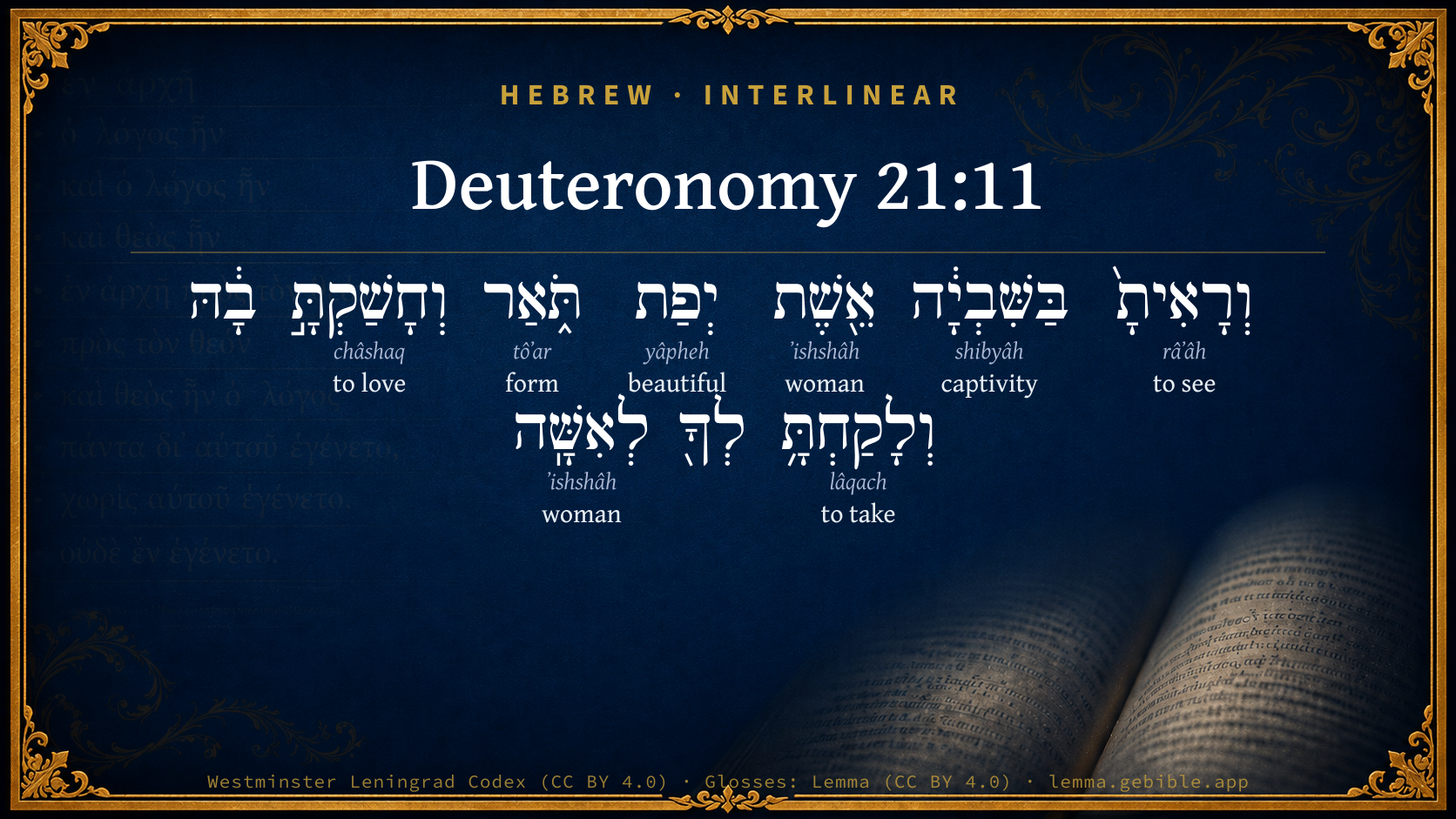
Hebrew (Westminster Leningrad Codex) Deuteronomy 21:11 appears in the Hebrew Old Testament. The text above is from the Westminster Leningrad Codex. Each word links to its Strong’s number, a concise gloss, and parsing drawn from the Open Scriptures Hebrew Bible morphology. Click any word for its full Brown-Driver-Briggs (BDB) entry.
Download image
Cite this verse

Deuteronomy 21:11 (World English Bible). Public Domain. Lemma interlinear Bible study tool, https://lemma.gebible.app/v/deuteronomy/21/11.

Show BibTeX & RIS
BibTeX
RIS
English Translation
and see among the captives a beautiful woman, and you have a desire to her, and would take her to you as wife;
World English Bible · Public Domain
Highlights
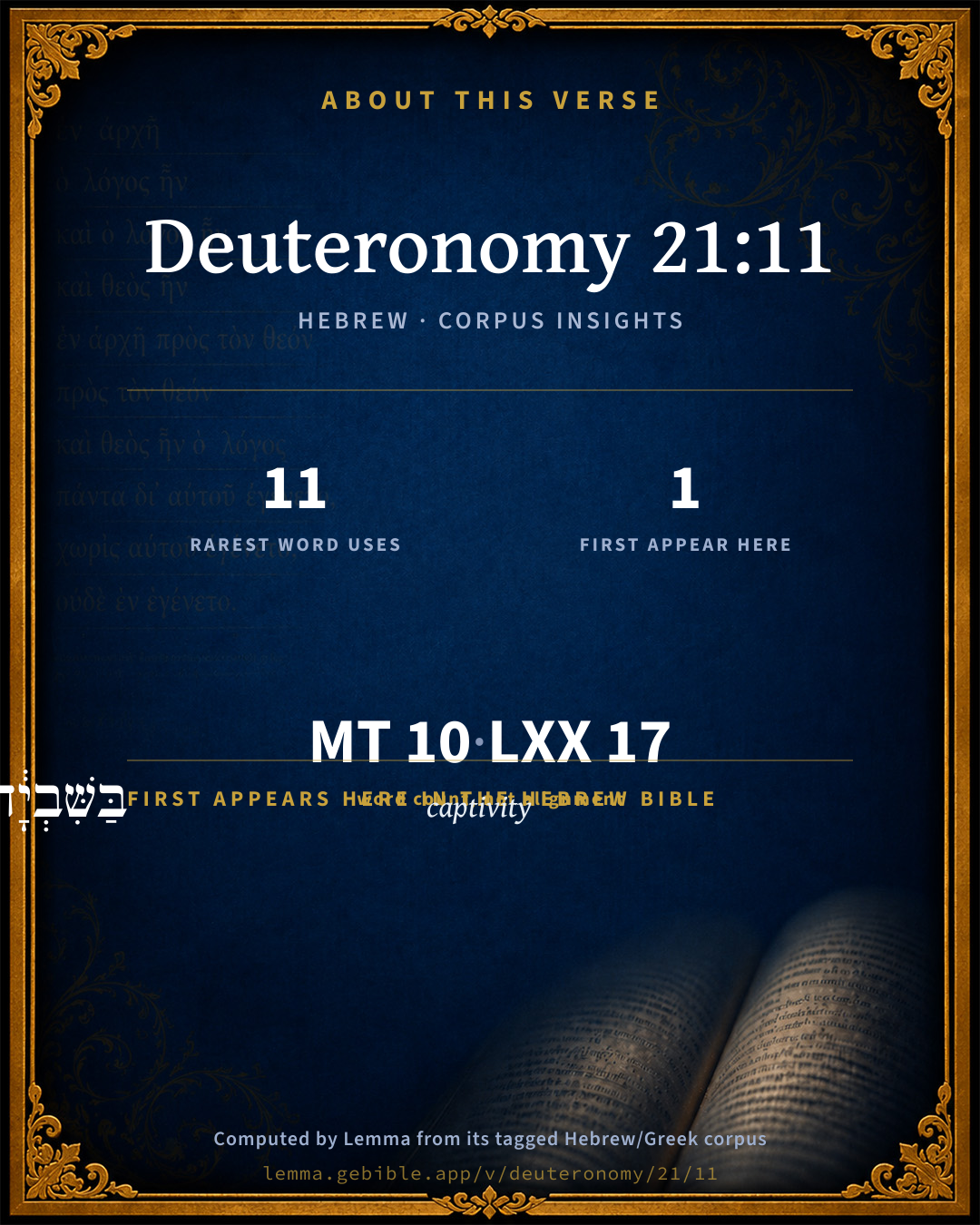
  • 1 first appearance in the Hebrew Bible
Full analysis ↓
Download a study sheet

One document with this verse’s original text, its word-by-word gloss line, the meaning frame, cross-references with their text, attributed commentary, and full source and license credits — printable, and it pastes into notes with its structure intact.

This verse Autodidact and up

Study sheet (.html) Plain text (.txt)

A passage Seminary Student

Up to 50 verses in one chapter. A passage sheet keeps up to 6 commentary sources and 12 cross-references per verse, in the order this page ranks them, and says so on the sheet whenever that leaves anything out. Ask for a single verse and you get the Autodidact verse sheet above.

Everything on this page stays free to read, with no account — the sheet is a download of what is already on screen, not access to it.

Want to remove ads? Support Godless Engineer
Compare translations 3

The same verse in 3 English versions, stacked beneath the original-language interlinear above. Click any original word for its lexicon entry.

Each is an independent rendering of the whole verse — the interlinear is not word-aligned to these translations.

Highlighted words mark where these versions differ — a whole-verse word diff, not a word-by-word alignment.

  • World English Bible Public Domain
    and see among the captives a beautiful woman, and you have a desire to her, and would take her to you as wife;
  • King James Version Public Domain
    And seest among the captives a beautiful woman, and hast a desire unto her, that thou wouldest have her to thy wife;
  • unfoldingWord Literal Text CC BY-SA 4.0
    and you see among the captives a woman of beautiful form, and you desire her and take for yourself as a wife,

unfoldingWord Literal Text — © unfoldingWord, licensed CC BY-SA 4.0. Word-aligned USFM3 via Door43 (git.door43.org/unfoldingWord/en_ult).

Versions to compare (up to 4)

3 of 4 selected

Show all 18 translations

Every available English version of this verse, each an independent rendering of the whole verse.

  • World English Bible Public Domain
    and see among the captives a beautiful woman, and you have a desire to her, and would take her to you as wife;
  • Berean Standard Bible Public Domain
    if you see a beautiful woman among them, and you desire her and want to take her as your wife,
  • Majority Standard Bible Public Domain
    if you see a beautiful woman among them, and you desire her and want to take her as your wife,
  • King James Version Public Domain
    And seest among the captives a beautiful woman, and hast a desire unto her, that thou wouldest have her to thy wife;
  • American Standard Version (1901) Public Domain
    and seest among the captives a beautiful woman, and thou hast a desire unto her, and wouldest take her to thee to wife;
  • Revised Version (1885) Public Domain
    and seest among the captives a beautiful woman, and thou hast a desire unto her, and wouldest take her to thee to wife;
  • Geneva Bible (1599) Public Domain
    And shalt see among the captiues a beautifull woman, and hast a desire vnto her, and wouldest take her to thy wife,
  • Douay-Rheims (1899) Public Domain
    And seest in the number of the captives a beautiful woman, and lovest her, and wilt have her to wife,
  • Young's Literal Translation Public Domain
    and hast seen in the captivity a woman of fair form, and hast delighted in her, and hast taken to thee for a wife,
  • Literal Standard Version CC BY-SA 4.0
    and have seen a woman of beautiful form in the captivity, and have delighted in her, and have taken [her] to yourself for a wife,
  • Unlocked Literal Bible CC BY-SA 4.0
    if you see among the captives a beautiful woman, and you have a desire for her and wish to take her for yourself as a wife,
  • unfoldingWord Literal Text CC BY-SA 4.0
    and you see among the captives a woman of beautiful form, and you desire her and take for yourself as a wife,
  • Darby Bible Public Domain
    and thou seest among the captives a woman of beautiful form, and hast a desire unto her, and takest her as thy wife;
  • World Messianic Bible Public Domain
    and see among the captives a beautiful woman, and you are attracted to her, and desire to take her as your wife,
  • Webster's Bible Public Domain
    And thou seest among the captives a beautiful woman, and hast a desire to her, that thou wouldest have her for thy wife:
  • Free Bible Version CC BY-SA 4.0
    you may see that one of them is a beautiful woman who you like and want to marry.
  • Bible in Basic English Public Domain
    If among the prisoners you see a beautiful woman and it is your desire to make her your wife;
  • JPS Tanakh (1917) Public Domain
    and seest among the captives a woman of goodly form, and thou hast a desire unto her, and wouldest take her to thee to wife;

Literal Standard Version (2020), Covenant Press — licensed CC BY-SA 4.0. Text via the HelloAO Bible API (eBible.org). Unlocked Literal Bible (unfoldingWord) — licensed CC BY-SA 4.0. Text via the HelloAO Bible API (eBible.org). unfoldingWord Literal Text — © unfoldingWord, licensed CC BY-SA 4.0. Word-aligned USFM3 via Door43 (git.door43.org/unfoldingWord/en_ult). Free Bible Version, Dr. Jonathan Gallagher — licensed CC BY-SA 4.0. Text via the HelloAO Bible API (eBible.org).

Word by word

More ways to search: Search by grammar → Find every occurrence → Compare this word →

Practice this passage: Drill this verse → Learn its vocabulary →

וְחָשַׁקְתָּ֣
châshaq
H2836
“and · to love”
Conjunction + Verb, Qal, Sequential Perfect, 2nd Person, Masculine, Singular
Part of Speech
Conjunction + Verb
Stem
Qal
Form
Sequential Perfect
Person
2nd Person
Gender
Masculine
Number
Singular
Full BDB Definition

Origin: a primitive root

TWOT: 773

(Qal) to love, be attached to, long for - (Piel) fillet - (Pual) fillet
  1. וְרָאִיתָ֙ râʼâh H7200 “and · to see” Conjunction + Verb, Qal, Sequential Perfect, 2nd Person, Masculine, Singular
  2. בַּשִּׁבְיָ֔ה shibyâh H7633 “in/at the · captivity” Preposition, Determined + Noun, Common, Both, Singular, Absolute
  3. אֵ֖שֶׁת ʼishshâh H802 “woman of” Noun, Common, Feminine, Singular, Construct
  4. יְפַת yâpheh H3303 “beautiful of” Adjective, Adjective, Feminine, Singular, Construct
  5. תֹּ֑אַר tôʼar H8389 “form” Noun, Common, Masculine, Singular, Absolute
  6. וְלָקַחְתָּ֥ lâqach H3947 “and · to take” Conjunction + Verb, Qal, Sequential Perfect, 2nd Person, Masculine, Singular
  7. לְאִשָּֽׁה ʼishshâh H802 “to/for · woman” Preposition + Noun, Common, Feminine, Singular, Absolute

About this verse

These counts appear in no published source. They are computed here, from the morphology-tagged text and Lemma’s own curated glosses. What Lemma adds →

10
words
7
distinct lemmas
Pentateuch
section

Notable vocabulary

The rarest word here is וְחָשַׁקְתָּ֣ to love H2836 — appearing just 11 times in the whole Hebrew Bible.

First appearance in Scripture

This word makes its first canonical appearance in the Hebrew Bible here:

  • בַּשִּׁבְיָ֔ה captivity H7633

Shared distinctive vocabulary

וְחָשַׁקְתָּ֣ to love H2836 occurs in 11 verses of the Hebrew Bible. Also found in:

Grammatical profile

  • 3 verbs
  • 4 nouns
  • 1 adjective
  • 2 prepositions

Verb forms

  • וְרָאִיתָ֙ Qal · Sequential Perfect
  • וְחָשַׁקְתָּ֣ Qal · Sequential Perfect
  • וְלָקַחְתָּ֥ Qal · Sequential Perfect

Repetition

A word recurs within this verse — often emphatic in Hebrew:

  • אֵ֖שֶׁת woman H802 ×2

Hebrew & Septuagint length

In English translation the verse runs 23 words from the Hebrew and 23 from the Septuagint (LXX English) — the same length.

A rough comparison of the two English renderings, which tokenize alike — not a word-level alignment.

Word counts can differ between the Hebrew and the Greek without any difference in meaning — e.g. the Hebrew direct-object marker אֵת has no separate Greek word, and Greek often adds the article ὁ.

In the original languages it is 10 Hebrew tokens and 17 Greek tokens — but the two are counted differently (Hebrew bundles its prefixes and suffixes into one token; the Greek is in lemma form), so that isn’t a like-for-like length.

Cross-references

10

Topical passages linked to Deuteronomy 21:11 in the Treasury of Scripture Knowledge — connected by theme and wording, ordered by reader-vote popularity; previews shown in the World English Bible.

  • Genesis 6:2 that God's sons saw that men's daughters were beautiful, and they took for themselves wives of all that they chose.
  • Genesis 12:14–15 It happened that when Abram had come into Egypt, the Egyptians saw that the woman was very beautiful.
  • Genesis 29:18–20 Jacob loved Rachel. He said, "I will serve you seven years for Rachel, your younger daughter."
  • Genesis 34:3 His soul joined to Dinah, the daughter of Jacob, and he loved the young lady, and spoke kindly to the young lady.
  • Genesis 34:8 Hamor talked with them, saying, "The soul of my son, Shechem, longs for your daughter. Please give her to him as a wife.
  • Numbers 31:18 But all the girls, who have not known man by lying with him, keep alive for yourselves.
  • Judges 14:2–3 He came up, and told his father and his mother, and said, I have seen a woman in Timnah of the daughters of the Philistines: now therefore get her for me as wife.
  • Proverbs 6:25 Don't lust after her beauty in your heart, Neither let her captivate you with her eyelids.
  • Proverbs 31:10 Who can find a worthy woman? For her price is far above rubies.
  • Proverbs 31:30 Charm is deceitful, and beauty is vain; But a woman who fears Yahweh, she shall be praised.

Cross-references courtesy of OpenBible.info (CC BY 4.0).

Hebrew and Greek witnesses Masoretic Hebrew ↔ Greek Septuagint

The same verse in the two great witnesses to the Old Testament, shown verse-for-verse.

These are two independent witnesses, not word-aligned to each other, and the Septuagint is shown in lemma (dictionary) form.

Hebrew Deuteronomy 21:11 Masoretic · Westminster Leningrad Codex

וְרָאִיתָ֙ בַּשִּׁבְיָ֔ה אֵ֖שֶׁת יְפַת תֹּ֑אַר וְחָשַׁקְתָּ֣ בָ֔הּ וְלָקַחְתָּ֥ לְךָ֖ לְאִשָּֽׁה

and see among the captives a beautiful woman, and you have a desire to her, and would take her to you as wife;

World English Bible · Public Domain

Greek LXX Deuteronomy 21:11 Septuagint · lemma form

καί ὁράω ἐν ὁ προνομή γυνή καλός ὁ εἶδος καί ἐνθυμέομαι αὐτός καί λαμβάνω αὐτός σεαυτοῦ γυνή

and should see among the spoil a woman beautiful in countenance, and should desire her, and take her to yourself for a wife,

LXX2012 (modern English Septuagint) · Public Domain

On this verse, The Cambridge Bible for Schools and Colleges discusses the Septuagint’s reading. Read the note in Commentary ↓

Hebrew: Westminster Leningrad Codex (CC BY 4.0). Greek: Septuagint (public domain); English from LXX2012 (modern English Septuagint) (Public Domain). How the Septuagint differs from the Hebrew →

Targum (Aramaic paraphrase)

2

The Targum is the ancient Jewish Aramaic paraphrase of the Hebrew Scriptures — an interpretive translation, not the Hebrew text itself. Onkelos (literal) and Pseudo-Jonathan (expansive) render the Torah, and Jonathan the Prophets. Coverage is partial: where no permissively-licensed English translation exists for a verse, only the Aramaic is shown. This is verse-level text, not a word-by-word alignment to the Hebrew.

  1. Targum Onkelos Torah (Genesis–Deuteronomy)
    וְתֶחֱזֵי בְּשִׁבְיָה אִתְּתָא שַׁפִּירַת חֵזוּ וְתִתִּרְעֵי בַהּ וְתִסְבַהּ לָךְ לְאִנְתּוּ

    (no public-domain English translation for this verse)

    Targum Onkelos — Aramaic: “Onkelos Genesis” (public domain); “Onkelos Exodus” (public domain); “Onkelos Leviticus” (public domain); “Onkelos Numbers” (public domain); “Onkelos Deuteronomy” (public domain). English: “Sefaria Community Translation” (CC0 1.0 (public-domain dedication)); “J.W. Etheridge. The Targums of Onkelos and Jonathan Ben Uzziel on the Pentateuch. London: Longmans, Green, 1862” (public domain). Text via Sefaria.

  2. Targum Pseudo-Jonathan Torah (Genesis–Deuteronomy)
    וְתֵיחֲמוּן בִּשְׁבִיתָא אִתָּא שַׁפִּירַת רֵיוֵוי וְתִתְיַדְעוּן בָּהּ וְתִסְבוּנָהּ לְכוֹן לְאִינְתּוּ

    if you see in the captivity a woman of fair countenance, and you approve of her, and would take her to you to wife;

    Targum Pseudo-Jonathan — Aramaic: “Targum Jonathan on Genesis” (public domain); “Targum Jonathan on Exodus” (public domain); “Targum Jonathan on Leviticus” (public domain); “Targum Jonathan on Numbers” (public domain); “Targum Jonathan on Deuteronomy” (public domain). English: “The Targum of Jonathan ben Uzziel, trans. J. W. Etheridge, London, 1862” (public domain). Text via Sefaria.

Commentary

Notes on Deuteronomy 21:11 from classic Christian and Jewish commentators (each source and its license shown beneath its notes). The classic Christian expositions comment on the surrounding passage and are grouped to its opening verse, so a note may address several verses; the Jewish commentaries on the Tanakh (Rashi and others) are per-verse, so they appear only where the commentator wrote on this verse.

Lemma curates 59 commentaries, every one of them public domain or Creative Commons licensed, each selected and text-cleaned for this edition rather than reprinted as found. About our sources →

Trapp's Complete Commentary

John Trapp

Deu 21:11 And seest among the captives a beautiful woman, and hast a desire unto her, that thou wouldest have her to thy wife;

Ver. 11. And hast a desire unto her.] This was permitted them, as divorce was, ob duricordium. But that is a base passage in the Turk’s Koran, that God did not give men such appetites to have them frustrate, but enjoyed, as made for the gust of man, not for his torment, wherein his Creator delights not; and therefore they hold it lawful for a man to marry as many wives as he is able to maintain.

John Trapp, A Commentary or Exposition upon All the Books of the Old and New Testament (1647–1656) — public domain. Text from a community e-Sword module.

Matthew Poole's English Annotations

Hast a desire unto her; or, hast cleaved to her, to wit, in love; or, hast taken delight in her; which may be a modest expression for lying with her, and seems probable, because it is said, Deu 21:14, that he had humbled her, to wit, by military insolence, when he took her captive, not after he had married her, for then he would have expressed it thus, because thou hast married her, which had been more emphatical than to say, because thou hast humbled her. And here seem to be two cases supposed, and direction given what to do in both of them:

1. That he did desire to marry her, of which he speaks Deu 21:11-13.

2. That he did not desire this, or not delight in her, of which he speaks Deu 21:14.

Matthew Poole's English Annotations on the Holy Bible (1683–1685) — public domain. Text from a community e-Sword/MySword module.

Joseph Benson's Commentary

Deu 21:11. And hast a desire unto her — Moses here returning to the case of war with the neighbouring nations, directs that, if a Hebrew soldier conceived a peculiar regard for a captive woman, and desired to marry her, he must not do it immediately after she became his prisoner, it being of dangerous consequence for the Israelites to marry Gentile wives. He was first to keep the woman in his house for a month, at least, where she was to live in the retirement and habit of a mourner, for the loss of her parents and her country; as also to give her time to be instructed in the knowledge of the true God and his will, and renounce her idolatrous worship, and to allow him sufficient space to try whether his affection for her was calm and steady, or might cool and wear off. If this interval caused no abatement of his love, but, upon her turning proselyte, he still desired to make her his wife, he might then lawfully do it.

Joseph Benson's Commentary on the Old and New Testaments (1811–1818) — public domain. Text from a community e-Sword module.

Adam Clarke's Commentary

Verse 11. And seest - a beautiful woman] No forcible possession was allowed even in this case, when the woman was taken in war, and was, by the general consent of ancient nations, adjudged as a part of the spoils. The person to whose lot or share such a woman as is here described fell, might, if he chose, have her for a wife on certain conditions; but he was not permitted to use her under any inferior character.

Adam Clarke's Commentary on the Bible (1810–1826) — public domain. Text from a community e-Sword/MySword module.

The Cambridge Bible for Schools and Colleges

gen. ed. J. J. S. Perowne

11. the captives] Sam. his.

hast a desire unto her] Heb. ḥashaḳ, see on Deu_7:7.

and wouldest take her] So Sam. LXX. Heb. omits her.

The Cambridge Bible for Schools and Colleges (gen. ed. J. J. S. Perowne; Cambridge University Press, 1878–1918) — public domain. Text from a community e-Sword module.

John Gill's Exposition

And seest among the captives a beautiful woman,.... Whether a virgin, wife, or widow, according to the Jewish writers, even though another man's wife; so Jarchi (c), and Maimonides (d); the marriages of Gentiles being reckoned by the Jews no marriages:

and hast a desire unto her; being captivated with her beauty; some understand this of the strength and rage of lust, but it rather signifies a passionate desire of enjoying her in a lawful way, as follows:

that thou wouldest have her to thy wife; to be married to her in a legal manner; for though it was not allowed the Israelites to marry any of the seven nations of Canaan, nor indeed with any of other nations continuing in their idolatry; yet they might marry such as became their captives and servants, and were wholly in their own power; and especially if proselytes to their religion, and which this fair captive was to become before marriage, as is by some gathered from the following things to be done by her; though after all, this was only a permission, because of the hardness of their hearts, as is said of divorce; and that such marriages were not very grateful to God appears, as some have observed, from the ceremonies used before marriage, to render her contemptible; and the easy dismission of her afterwards, according to the sense of some interpreters.

(c) Vid. T. Bab. Kiddushin, fol. 21. 2. (d) Hilchot Melachim, c. 8. sect. 3.

John Gill's Exposition of the Whole Bible (1746–1763) — public domain (CC PDM 1.0). Text via the HelloAO Bible API.

Haydock's Catholic Bible Commentary

Lovest her. The Jewish doctors explain this of an action, which modesty disallows, and which they tolerate nevertheless in the first transports of victory; (Selden, Jur. v. 13,) though the pagans condemned it as unjust and contrary to reason. (Grotius, Jur. iii. 4.) --- All know with what reserve Alexander treated women; and the Romans banished one Torquatus, for having violated a prisoner of war. (Plut.) --- Yet the Jews blush not to assert, that such liberties might be taken even with married women, as their former marriage with a pagan was by some deemed null, and by others thought to be dissolved. (Josephus iv. 8.) (Calmet) --- The law, however, seems only to allow the marrying of those who had no husbands before, as the women are only said to mourn for father and mother, v. 13. (Haydock) --- On these occasions the Chinese, and probably the Egyptians also, and the Roman matrons, formerly clothed themselves in white, while almost all other nations assumed black. (Tirinus)

George Leo Haydock (1774–1849), Haydock's Catholic Family Bible and Commentary, 1859 edition — public domain. Excludes Psalms (Douay-Rheims chapter numbering differs from Protestant) and Deuterocanonical books (Catholic canon only).

John Wesley's Explanatory Notes

Hast a desire unto her - Or, hast taken delight in her: which may be a modest expression for lying with her, and seems probable, because it is said, ver. 14, that he had humbled her. And here seem to be two cases supposed, and direction given what to do in both of them,

1. that he did desire to marry her, of which he speaks, ver. 11-13.

2. that he did not desire this, of which he speaks, ver. 14.

John Wesley, Explanatory Notes Upon the Whole Bible (1754–1765) — public domain. Text via the GEBible commentary corpus.

Rashi

Rabbi Shlomo Yitzchaki (Rashi)

אשת [AND THOU SEEST AMONG THE CAPTIVES] A WOMAN — even if she be a married woman (Sifrei Devarim 211:7; Kiddushin 21b).

ולקחת לך לאשה [AND THOU DELIGHTEST IN HER,] THAT THOU WOULDEST TAKE HER FOR THY WIFE) — Scripture is speaking (makes this concession) only in view of man’s evil inclination (his carnal desires) (Kiddushin 21b). For if the Holy One, blessed be He, would not permit her to him as a wife, he would nevertheless marry her although she would then be forbidden to him. However, if he does marry her, in the end he will hate her, for Scripture writes immediately afterwards, (v. 15) “If a man have two wives, one beloved, and another hated, etc.” and ultimately he will beget a refractory and rebellious son by her (v. 18). It is for this reason that these sections are put in juxtaposition (Midrash Tanchuma, Ki Teitzei 1).

Rashi on the Tanakh — English translations: “The Judaica Press complete Tanach with Rashi, translated by A. J. Rosenberg” (CC BY 4.0); “Pentateuch with Rashi's commentary by M. Rosenbaum and A.M. Silbermann, 1929-1934” (public domain); “The Metsudah Tanach series, Lakewood, N.J” (CC BY 4.0); and “The Book of Joshua, Metsudah Publications, 1997” (CC BY 4.0). Text via Sefaria.

Ramban (Nachmanides)

Rabbi Moshe ben Nachman (Ramban / Nachmanides)

A BEAUTIFUL WOMAN. Scripture speaks of the common case. And in the Sifre it is stated: 211. “Whence do we know that [the same law applies] even if she be ugly? From what Scripture states, and thou desirest her — even though she is not beautiful.” And Rabbi Abraham ibn Ezra commented: “A beautiful woman — in his eyes.” Thus the expression [a beautiful woman] is connected with [the first word in the verse] ‘v’ra’itha’ (and thou seest).. Ramban thus points out that, according to Ibn Ezra’s interpretation, the verse means to say: “and thou seest a beautiful woman among the captives,” for the beauty is in the eyes of the beholder. She may actually be ugly. Scripture mentions and thou desirest her, denoting that he is not to permit her to himself except because of lust — when his impulse overpowers him. However, if he discovers within himself that he has no lust for cohabitation with her, but he wants just to take a wife, he should not marry her. Thus the Rabbis have said in the Sifre: 212. “And thou wouldest take her to thee to wife. You are not to say, ‘This one is for [my] father, that one for my brother.’” And in the Gemara we find that he is not to take two women — one for his son and one for himself, or one for his father and one for himself. Now the prohibition against taking one for his son [or for his father] applies even to her alone [i.e., if he has not taken one for himself].

Ramban (Nachmanides) on the Tanakh — English translation: “Commentary on the Torah by Ramban (Nachmanides). Translated and annotated by Charles B. Chavel. New York, Shilo Pub. House, 1971-1976” (CC BY 4.0). Text via Sefaria.

Lesson kit

Teaching starters — assembled from the data on this page, not authored interpretation. Every prompt links to the verse data it draws on. Edit before teaching.

Deuteronomy, in the Pentateuch, opens this verse with 10 words (7 distinct Hebrew lemmas). Its most distinctive word is châshaq (“to love”). A historical commentator’s framing appears above. Read the whole chapter for the surrounding context.

Discussion questions

  1. How does “to love” (châshaq) shape what this verse is saying?
  2. The word “captivity” first appears here in Scripture. What is being introduced at this debut?
  3. Genesis 34:8 shares the word «to love» with this verse. How do the two illuminate each other?
  4. “woman” occurs 2× in this one verse. What is the effect of the repetition?
  5. These translations render this verse differently; the difference is in the English rendering, not the original. What questions does that raise?
  6. The verb «וְרָאִיתָ֙» is Qal Sequential Perfect. How does its form color the action?
  7. Reading how Trapp's Complete Commentary and Matthew Poole's English Annotations read this verse, where do the two commentators agree and where do they part?

Things to notice

Reading settings

Reading text

Shown beneath each verse's original-language words.

Old Testament
Old Testament edition

Read the OT as the Masoretic Hebrew (MT) or the Greek Septuagint (LXX).

English shown for the Greek Septuagint (in the Hebrew ↔ Greek comparison).

Comparing translations? Open the Compare panel on any verse page to stack up to four side by side.