
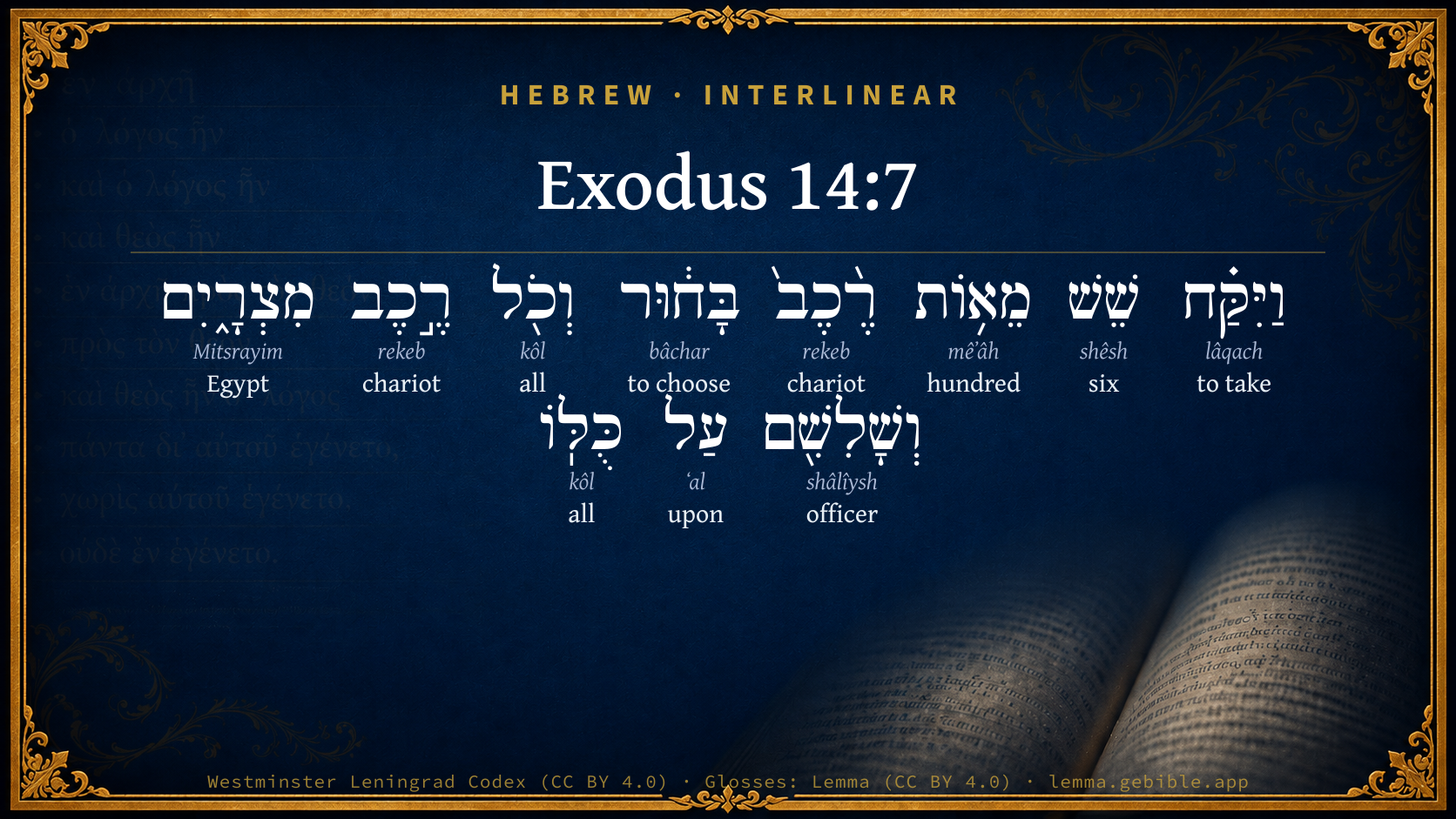
Exodus 14:7

Hebrew (Westminster Leningrad Codex) Exodus 14:7 appears in the Hebrew Old Testament. The text above is from the Westminster Leningrad Codex. Each word links to its Strong’s number, a concise gloss, and parsing drawn from the Open Scriptures Hebrew Bible morphology. Click any word for its full Brown-Driver-Briggs (BDB) entry.
Download image
Cite this verse

Exodus 14:7 (World English Bible). Public Domain. Lemma interlinear Bible study tool, https://lemma.gebible.app/v/exodus/14/7.

Show BibTeX & RIS
BibTeX
RIS
English Translation
and he took six hundred chosen chariots, and all the chariots of Egypt, and captains over all of them.
World English Bible · Public Domain
Highlights
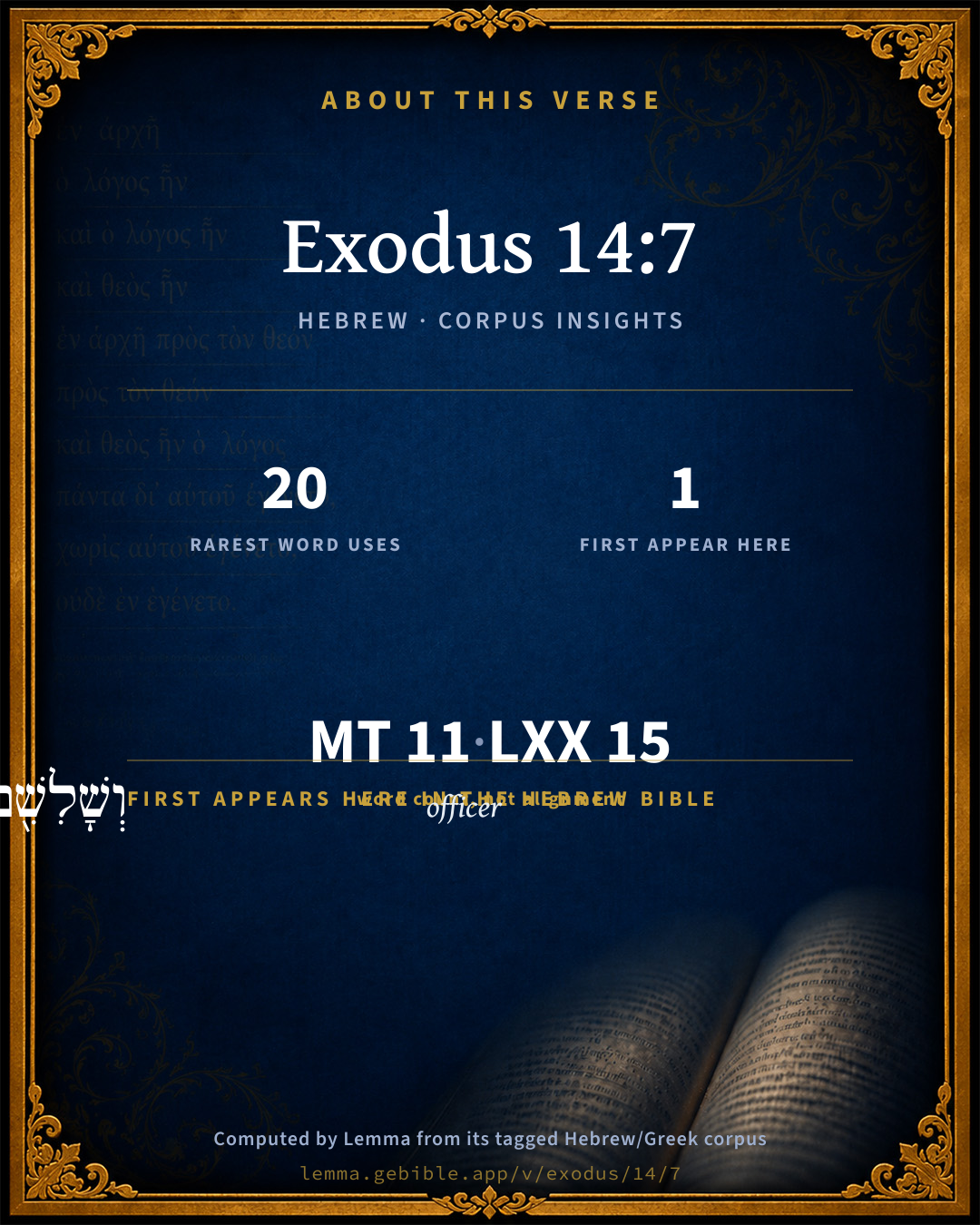
  • 1 first appearance in the Hebrew Bible
Full analysis ↓
Download a study sheet

One document with this verse’s original text, its word-by-word gloss line, the meaning frame, cross-references with their text, attributed commentary, and full source and license credits — printable, and it pastes into notes with its structure intact.

This verse Autodidact and up

Study sheet (.html) Plain text (.txt)

A passage Seminary Student

Up to 50 verses in one chapter. A passage sheet keeps up to 6 commentary sources and 12 cross-references per verse, in the order this page ranks them, and says so on the sheet whenever that leaves anything out. Ask for a single verse and you get the Autodidact verse sheet above.

Everything on this page stays free to read, with no account — the sheet is a download of what is already on screen, not access to it.

Want to remove ads? Support Godless Engineer
Compare translations 3

The same verse in 3 English versions, stacked beneath the original-language interlinear above. Click any original word for its lexicon entry.

Each is an independent rendering of the whole verse — the interlinear is not word-aligned to these translations.

Highlighted words mark where these versions differ — a whole-verse word diff, not a word-by-word alignment.

  • World English Bible Public Domain
    and he took six hundred chosen chariots, and all the chariots of Egypt, and captains over all of them.
  • King James Version Public Domain
    And he took six hundred chosen chariots, and all the chariots of Egypt, and captains over every one of them.
  • unfoldingWord Literal Text CC BY-SA 4.0
    And he took 600 chosen chariots, and all of the chariots of Egypt, and third men were on all of them.

unfoldingWord Literal Text — © unfoldingWord, licensed CC BY-SA 4.0. Word-aligned USFM3 via Door43 (git.door43.org/unfoldingWord/en_ult).

Versions to compare (up to 4)

3 of 4 selected

Show all 18 translations

Every available English version of this verse, each an independent rendering of the whole verse.

  • World English Bible Public Domain
    and he took six hundred chosen chariots, and all the chariots of Egypt, and captains over all of them.
  • Berean Standard Bible Public Domain
    He took 600 of the best chariots, and all the other chariots of Egypt, with officers over all of them.
  • Majority Standard Bible Public Domain
    He took 600 of the best chariots, and all the other chariots of Egypt, with officers over all of them.
  • King James Version Public Domain
    And he took six hundred chosen chariots, and all the chariots of Egypt, and captains over every one of them.
  • American Standard Version (1901) Public Domain
    and he took six hundred chosen chariots, and all the chariots of Egypt, and captains over all of them.
  • Revised Version (1885) Public Domain
    and he took six hundred chosen chariots, and all the chariots of Egypt, and captains over all of them.
  • Geneva Bible (1599) Public Domain
    And tooke sixe hundreth chosen charets, and all the charets of Egypt, and captaines ouer euery one of them.
  • Douay-Rheims (1899) Public Domain
    And he took six hundred chosen chariots, and all the chariots that were in Egypt: and the captains of the whole army.
  • Young's Literal Translation Public Domain
    and he taketh six hundred chosen chariots, even all the chariots of Egypt, and captains over them all;
  • Literal Standard Version CC BY-SA 4.0
    and he takes six hundred chosen chariots, even all the chariots of Egypt, and captains over them all;
  • Unlocked Literal Bible CC BY-SA 4.0
    He took six hundred chosen chariots and all the other chariots of Egypt, with officers on all of them.
  • unfoldingWord Literal Text CC BY-SA 4.0
    And he took 600 chosen chariots, and all of the chariots of Egypt, and third men were on all of them.
  • Darby Bible Public Domain
    And he took six hundred chosen chariots, and all the chariots of Egypt, and captains over every one of them.
  • World Messianic Bible Public Domain
    and he took six hundred chosen chariots, and all the chariots of Egypt, with captains over all of them.
  • Webster's Bible Public Domain
    And he took six hundred chosen chariots, and all the chariots of Egypt, and captains over every one of them.
  • Free Bible Version CC BY-SA 4.0
    He took 600 of his best chariots along with all the other chariots of Egypt, each with their officer-in-charge.
  • Bible in Basic English Public Domain
    And he took six hundred carriages, all the carriages of Egypt, and captains over all of them.
  • JPS Tanakh (1917) Public Domain
    And he took six hundred chosen chariots, and all the chariots of Egypt, and captains over all of them.

Literal Standard Version (2020), Covenant Press — licensed CC BY-SA 4.0. Text via the HelloAO Bible API (eBible.org). Unlocked Literal Bible (unfoldingWord) — licensed CC BY-SA 4.0. Text via the HelloAO Bible API (eBible.org). unfoldingWord Literal Text — © unfoldingWord, licensed CC BY-SA 4.0. Word-aligned USFM3 via Door43 (git.door43.org/unfoldingWord/en_ult). Free Bible Version, Dr. Jonathan Gallagher — licensed CC BY-SA 4.0. Text via the HelloAO Bible API (eBible.org).

Word by word

More ways to search: Search by grammar → Find every occurrence → Compare this word →

Practice this passage: Drill this verse → Learn its vocabulary →

וְשָׁלִשִׁ֖ם
shâlîysh
H7991
“and · officers”
Conjunction + Noun, Common, Masculine, Plural, Absolute
Part of Speech
Conjunction + Noun
Type
Common
Gender
Masculine
Number
Plural
State
Absolute
Full BDB Definition

Origin: from H7969

TWOT: 2403e , 2403f , 2403g

third part - name of a measure - a musical instrument - maybe three-stringed, triangular shape, or three-barred - perhaps a sistrum or triangle - shield carrier, adjutant, officer, captain
  1. וַיִּקַּ֗ח lâqach H3947 “and · to take” Conjunction + Verb, Qal, Sequential Imperfect, 3rd Person, Masculine, Singular
  2. שֵׁשׁ shêsh H8337 “six” Adjective, Cardinal number, Feminine, Singular, Absolute
  3. מֵא֥וֹת mêʼâh H3967 “hundred” Adjective, Cardinal number, Both, Plural, Absolute
  4. רֶ֨כֶב֙ rekeb H7393 “chariot” Noun, Common, Masculine, Singular, Absolute
  5. בָּח֔וּר bâchar H977 “chosen” Verb, Qal, Participle Passive, Masculine, Singular, Absolute
  6. וְכֹ֖ל kôl H3605 “and · all of” Conjunction + Noun, Common, Masculine, Singular, Construct
  7. רֶ֣כֶב rekeb H7393 “chariot of” Noun, Common, Masculine, Singular, Construct
  8. מִצְרָ֑יִם Mitsrayim H4714 “Egypt” Noun, Proper
  9. עַל ʻal H5921 “upon” Preposition
  10. כֻּלּֽוֹ kôl H3605 “all · his” Noun, Common, Masculine, Singular, Construct + Suffix, Personal, 3rd Person, Masculine, Singular

About this verse

These counts appear in no published source. They are computed here, from the morphology-tagged text and Lemma’s own curated glosses. What Lemma adds →

11
words
9
distinct lemmas
Pentateuch
section

Notable vocabulary

The rarest word here is וְשָׁלִשִׁ֖ם officer H7991 — appearing just 20 times in the whole Hebrew Bible.

First appearance in Scripture

This word makes its first canonical appearance in the Hebrew Bible here:

  • וְשָׁלִשִׁ֖ם officer H7991

Shared distinctive vocabulary

וְשָׁלִשִׁ֖ם officer H7991 occurs in 18 verses of the Hebrew Bible. Also found in:

Grammatical profile

  • 2 verbs
  • 6 nouns
  • 2 adjectives
  • 1 preposition

Verb forms

  • וַיִּקַּ֗ח Qal · Sequential Imperfect
  • בָּח֔וּר Qal · Participle Passive

Repetition

Words recur within this verse — often emphatic in Hebrew:

  • רֶ֨כֶב֙ chariot H7393 ×2
  • וְכֹ֖ל all H3605 ×2

Hebrew & Septuagint length

In English translation the verse runs 19 words from the Hebrew and 18 from the Septuagint (LXX English) — closely comparable.

A rough comparison of the two English renderings, which tokenize alike — not a word-level alignment.

Word counts can differ between the Hebrew and the Greek without any difference in meaning — e.g. the Hebrew direct-object marker אֵת has no separate Greek word, and Greek often adds the article ὁ.

In the original languages it is 11 Hebrew tokens and 15 Greek tokens — but the two are counted differently (Hebrew bundles its prefixes and suffixes into one token; the Greek is in lemma form), so that isn’t a like-for-like length.

Cross-references

8

Topical passages linked to Exodus 14:7 in the Treasury of Scripture Knowledge — connected by theme and wording, ordered by reader-vote popularity; previews shown in the World English Bible.

  • Exodus 15:4 Pharaoh's chariots and his host has he cast into the sea; His chosen captains are sunk in the Red Sea.
  • Exodus 14:23 The Egyptians pursued, and went in after them into the midst of the sea: all of Pharaoh's horses, his chariots, and his horsemen.
  • Judges 4:3 The children of Israel cried to Yahweh: for he had nine hundred chariots of iron; and twenty years he mightily oppressed the children of Israel.
  • Judges 4:15 Yahweh confused Sisera, and all his chariots, and all his host, with the edge of the sword before Barak; and Sisera alighted from his chariot, and fled away on his feet.
  • Psalms 20:7 Some trust in chariots, and some in horses, But we trust the name of Yahweh our God.
  • Psalms 68:17 The chariots of God are tens of thousands and thousands of thousands. The Lord is among them, from Sinai, into the sanctuary.
  • Isaiah 37:24 By your servants have you defied the Lord, and have said, With the multitude of my chariots am I come up to the height of the mountains, to the innermost parts of Lebanon; and I will cut down the tall cedars of it, and the choice fir trees of it; and I will enter into its farthest height, the forest of its fruitful field;
  • Joshua 17:16–18 The children of Joseph said, The hill-country is not enough for us: and all the Canaanites who dwell in the land of the valley have chariots of iron, both they who are in Beth-shean and its towns, and they who are in the valley of Jezreel.

Cross-references courtesy of OpenBible.info (CC BY 4.0).

Hebrew and Greek witnesses Masoretic Hebrew ↔ Greek Septuagint

The same verse in the two great witnesses to the Old Testament, shown verse-for-verse.

These are two independent witnesses, not word-aligned to each other, and the Septuagint is shown in lemma (dictionary) form.

Hebrew Exodus 14:7 Masoretic · Westminster Leningrad Codex

וַיִּקַּ֗ח שֵׁשׁ מֵא֥וֹת רֶ֨כֶב֙ בָּח֔וּר וְכֹ֖ל רֶ֣כֶב מִצְרָ֑יִם וְשָׁלִשִׁ֖ם עַל כֻּלּֽוֹ

and he took six hundred chosen chariots, and all the chariots of Egypt, and captains over all of them.

World English Bible · Public Domain

Greek LXX Exodus 14:7 Septuagint · lemma form

καί λαμβάνω ἑξακόσιοι ἅρμα ἐκλεκτός καί πᾶς ὁ ἵππος ὁ αἰγύπτιος καί τριστάτης ἐπί πᾶς

having also taken six hundred chosen chariots, and all the cavalry of the Egyptians, and rulers over all.

LXX2012 (modern English Septuagint) · Public Domain

On this verse, The Cambridge Bible for Schools and Colleges discusses the Septuagint’s reading. Read the note in Commentary ↓

Hebrew: Westminster Leningrad Codex (CC BY 4.0). Greek: Septuagint (public domain); English from LXX2012 (modern English Septuagint) (Public Domain). How the Septuagint differs from the Hebrew →

Targum (Aramaic paraphrase)

2

The Targum is the ancient Jewish Aramaic paraphrase of the Hebrew Scriptures — an interpretive translation, not the Hebrew text itself. Onkelos (literal) and Pseudo-Jonathan (expansive) render the Torah, and Jonathan the Prophets. Coverage is partial: where no permissively-licensed English translation exists for a verse, only the Aramaic is shown. This is verse-level text, not a word-by-word alignment to the Hebrew.

  1. Targum Onkelos Torah (Genesis–Deuteronomy)
    וּדְבַר שִׁתְּ מְאָה רְתִכִּין בְּחִירָן וְכֹל רְתִכֵּי מִצְרָאֵי וְגִבָּרִין מְמַנָן עַל כֻּלְהוֹן:

    (no public-domain English translation for this verse)

    Targum Onkelos — Aramaic: “Onkelos Genesis” (public domain); “Onkelos Exodus” (public domain); “Onkelos Leviticus” (public domain); “Onkelos Numbers” (public domain); “Onkelos Deuteronomy” (public domain). English: “Sefaria Community Translation” (CC0 1.0 (public-domain dedication)); “J.W. Etheridge. The Targums of Onkelos and Jonathan Ben Uzziel on the Pentateuch. London: Longmans, Green, 1862” (public domain). Text via Sefaria.

  2. Targum Pseudo-Jonathan Torah (Genesis–Deuteronomy)
    וּדְבַר שִׁית מְאָה רְתִיכִין בְּחִירִין וְכָל רְתִיכֵי מִצְרָאֵי עַבְדוֹי דִדְחִילוּ מִפִּתְגָמָא דַיְיָ דְלָא מִיתוּ בְּמוֹתָנָא וְלָא בְּבַרְדָא וּמוֹלִיתָא תְּלִיתָתָא לְמִנְגַד וּלְמִרְדוֹף בִּבְהִילוּ אוֹסִיף עַל כָּל רְתִיכָא וּרְתִיכָא

    And he took six hundred choice chariots, and all the chariots of the Mizraee his servants, who were afraid of the Word of the Lord, lest they should be killed with pestilence, if not with hail: and a third mule, for drawing and following swiftly, he added to each chariot.

    Targum Pseudo-Jonathan — Aramaic: “Targum Jonathan on Genesis” (public domain); “Targum Jonathan on Exodus” (public domain); “Targum Jonathan on Leviticus” (public domain); “Targum Jonathan on Numbers” (public domain); “Targum Jonathan on Deuteronomy” (public domain). English: “The Targum of Jonathan ben Uzziel, trans. J. W. Etheridge, London, 1862” (public domain). Text via Sefaria.

Commentary

Notes on Exodus 14:7 from classic Christian and Jewish commentators (each source and its license shown beneath its notes). The classic Christian expositions comment on the surrounding passage and are grouped to its opening verse, so a note may address several verses; the Jewish commentaries on the Tanakh (Rashi and others) are per-verse, so they appear only where the commentator wrote on this verse.

Lemma curates 59 commentaries, every one of them public domain or Creative Commons licensed, each selected and text-cleaned for this edition rather than reprinted as found. About our sources →

Trapp's Complete Commentary

John Trapp

Exo 14:7 And he took six hundred chosen chariots, and all the chariots of Egypt, and captains over every one of them.

Ver. 7. Six hundred chosen chariots.] They fought of old out of chariots armed with scythes and hooks; which at first were a terror, and after a scorn. {a}

{a} Veget., lib. i. cap. 24.

John Trapp, A Commentary or Exposition upon All the Books of the Old and New Testament (1647–1656) — public domain. Text from a community e-Sword module.

Joseph Benson's Commentary

Exo 14:7. Six hundred chosen chariots — The strength of ancient Egypt, which is a plain country, consisted in cavalry and military chariots. Indeed, it appears from sundry passages of Scripture, that the eastern nations in general, in the early ages of the world, made great use of armed chariots in war. Captains over every one of them — Or rather over all of them, distributing the command of them to his several captains.

Joseph Benson's Commentary on the Old and New Testaments (1811–1818) — public domain. Text from a community e-Sword module.

Geneva Bible (1599)

Geneva Bible translators

Josephus writeth, that besides those chariots there were 50,000 horsemen, and 80,000 footmen.

Geneva Bible (1599) marginal notes — public domain. Text via Bolls.life.

Adam Clarke's Commentary

Verse 7. Six hundred chosen chariots, c.] According to the most authentic accounts we have of war-chariots, they were frequently drawn by two or by four horses, and carried three persons: one was charioteer, whose business it was to guide the horses, but he seldom fought the second chiefly defended the charioteer; and the third alone was properly the combatant. It appears that in this case Pharaoh had collected all the cavalry of Egypt; (see Ex 14:17); and though these might not have been very numerous, yet, humanly speaking, they might easily overcome the unarmed and encumbered Israelites, who could not be supposed to be able to make any resistance against cavalry and war-chariots.

Adam Clarke's Commentary on the Bible (1810–1826) — public domain. Text from a community e-Sword/MySword module.

Ellicott's Commentary for English Readers

(7) Six hundred chosen chariots.—The chariot force was that on which the Egyptians chiefly relied for victory from the beginning of the eighteenth

dynasty. Diodorus Siculus assigns to his Sesostris (probably Rameses II.) a force of 27,000 chariots; but this is, no doubt, an exaggeration. The largest number of chariots brought together on any one occasion that is sufficiently attested, is believed by the present writer to be 3,940, which were collected by various confederates against an Assyrian king (Ancient Monarchies, vol. ii, p. 103, Note). In 1Sa_13:5, 30,000 chariots are mentioned, no doubt by some numerical error. A force of 2,500 is said by Rameses II. to have been brought against him in his great Hittite campaign (Records of the Past, vol. ii., pp. 69, 71). Sheshonk I. (Shishak) invaded Judaea with 1,200 (2Ch_12:3). The “six hundred chosen chariots” of the present passage are thus quite within the limits of probability. Most likely they constituted a division of the royal guard, and were thus always at the king’s disposal.

And all the chariots of Egypt.—The word “all” must not be pressed. The writer means “all that were available—that could be readily summoned.” These could only be the chariots of Lower Egypt—those stationed at Memphis, Heliopolis, Bubastis, Pithom, Sebennytus perhaps, and Pelusium. They would probably amount to several hundreds.

Captains over every one of them.—Rather, over the whole of them. These “captains” are again mentioned in Exo_15:4. The word in the original—a derivative from the numeral three—is supposed to have meant, primarily, “persons occupying the third rank below the king.”

A Bible Commentary for English Readers, edited by Charles John Ellicott (1878–1897) — public domain. Text from a community e-Sword module.

The Cambridge Bible for Schools and Colleges

gen. ed. J. J. S. Perowne

7. all the chariots] i.e. all the other chariots.

and knights upon (not ‘over’) all of them] The Heb. shâlîsh is not the word usually rendered ‘captain’; but denotes apparently some superior kind of military officer: in 2Ki_7:2; 2Ki_7:17; 2Ki_9:25; 2Ki_10:25; 2Ki_15:25 it is used of a military attendant of the king,—or, in the plural, of a body of such attendants,—such as we might, for distinction, call a knight: the same rend. would suit also Exo_15:4, Eze_23:15; Eze_23:23, 2Ch_8:9 (in 2Sa_23:8 = 1Ch_11:11 RVm. ‘three’ [שלשה] should probably be read for ‘captains’ [שלשם]). From the resemblance of the word to the Heb. for ‘three’ it has often been supposed to denote the third man in a chariot (cf. LXX. in Ex. and Kings, τριστάτης), i.e. the shield-bearer (by the side of the driver and the bowman). But (1) as appears from pictorial representations (see ill. in Wilk.-B. i. 223 f.), the Egyptian war-chariot was manned, except in triumphal processions (Wilk.-B. l.c.; EB. i. 726), by only two occupants, the driver and the bowman (EB. l.c.; Erman, p. 547); the chariots of the Hittites had three occupants (see ill. in EB. i. 729, or Erman, l.c.), but this, at the battle of Kadesh on the Orontes, under Rameses II, surprised the Egyptians (Erman, l.c.); the Assyrian chariots also carried only two occupants. (2) The shâlïshim, are not in any of the other passages where they are mentioned specially associated with chariots,—even in 2Ki_9:25, Bidkar is not necessarily Jehu’s chariot-attendant; and in Exo_15:4 the expression, ‘the choice of his shâlîshim,’ would seem to suggest some more select and distinguished body than those who took only the third place in the chariots. We cannot be sure of the precise sense which was felt to attach to the word; but knight seems to suit all the passages in which it occurs. It may mean properly (Di.) ‘a man of the third rank.’

8–9 (P). The sequel to v. 4.

The Cambridge Bible for Schools and Colleges (gen. ed. J. J. S. Perowne; Cambridge University Press, 1878–1918) — public domain. Text from a community e-Sword module.

John Gill's Exposition

And he took six hundred chosen chariots,.... The chief and best he had, war chariots, chariots of iron; perhaps such as had iron scythes to them, to cut down men as they drove along; these were taken partly for quickness of dispatch, that they might be able the sooner to overtake the Israelites, who had got several days' marches before them; and partly for their strength and the annoyance of their enemies with them:

and all the chariots of Egypt: as many as could in so short a time be got together: for the words are not to be taken in the utmost latitude, but to signify a great number, and all that could be conveniently come at: the Greek version is, "all the horse", the cavalry, which better distinguishes them from the former:

and captains over everyone of them: over everyone of the chariots, so that they must each of them have many in them, to have captains over them: and perhaps the infantry, or foot soldiers, for, quickness of expedition, were put into them; for, besides these, there were horsemen: Josephus (p) makes the whole number of his army to be 50,000 horse, and 200,000 foot, and the same number is given by a Jewish chronologer (q): but Patricides, an Arabic writer, says (r) it consisted of 600,000, and Ezekiel (s), the tragic poet, has made it amount to a million of horse and foot: should it be asked where horses could be had to draw the chariots, and horses for the horsemen after mentioned, when all were destroyed by the hail, Exo 9:25 it may be replied, that only those in the field were killed, not such as were in stables, where chariot horses and horses for war may be supposed to be: besides, as the Targum of Jonathan intimates, these might belong to these servants of Pharaoh who feared the word of the Lord, and took their cattle home, Exo 9:20.

(p) Antiqu. l. 2. c. 15. sect. 3. (q) Shalshalet Hakabala, fol. 77. 4. (r) Apud Hottinger. Smegma, p. 464. (s) Apud Euseb. ut supra. (Praepar. Evangel. c. 27. p. 436.)

John Gill's Exposition of the Whole Bible (1746–1763) — public domain (CC PDM 1.0). Text via the HelloAO Bible API.

Albert Barnes' Notes on the Bible

Six hundred chosen chariots - The Egyptian army comprised large numbers of chariots, each drawn by two horses, with two men, one bearing the shield and driving, the other fully armed. The horses were thoroughbred, renowned for strength and spirit. Chariots are first represented on the monuments of the 18th dynasty. By “all the chariots of Egypt” we are to understand all that were stationed in Lower Egypt, most of them probably at Rameses and other frontier garrisons near the headquarters of Pharaoh.

Captains - The word שׁלישׁ shâlı̂ysh, literally “third or thirtieth,” may represent an Egyptian title. The king had about him a council of thirty, each of whom bore a title, Mapu, a “thirty man.” The word occurs frequently in the Books of Kings. David seems to have organized the Shalishim as a distinct corps (see 2Sa 23:8 Hebrew), retaining the old name, and adopting the Egyptian system.

Albert Barnes' Notes on the Bible (1834–1885) — public domain. Text from a community e-Sword/MySword module.

Haydock's Catholic Bible Commentary

Captains. Septuagint, "Tristatas." Three men rode on every chariot, which was armed with scythes, to cut down all that came within contact, the chief warrior, with his armour bearer and charioteer. (St. Gregory of Nyssa) (Haydock) --- Or these three captains may very probably be the three chief officers of state, (Calmet) or the generals of cavalry, and of infantry, and the chief treasurer, or receiver of taxes, principes equitum peditumque erant, & tributorum. (St. Jerome)

George Leo Haydock (1774–1849), Haydock's Catholic Family Bible and Commentary, 1859 edition — public domain. Excludes Psalms (Douay-Rheims chapter numbering differs from Protestant) and Deuterocanonical books (Catholic canon only).

Matthew Poole's English Annotations

Quest. How. could he use or carry his chariots, when all his horses were killed by that plague? Exo 9:6.

Answ. That plague slew only the horses which were in the field, Exo 9:3, not those kept in houses, as the chariot-horses generally were, and now are.

All the chariots, i.e. a great number; all that could be got together in haste, which the present service required.

Over every one of them; over the men that fought out of every chariot. Or, over all of them; the command of all these chariots being distributed to several captains or commanders.

Matthew Poole's English Annotations on the Holy Bible (1683–1685) — public domain. Text from a community e-Sword/MySword module.

Whedon's Commentary on the Bible

Daniel D. Whedon

7. Six hundred — This was a picked chariot force, and Josephus adds, from traditional sources, that there were fifty thousand horsemen and two hundred thousand footmen. The word “all” is not to be taken absolutely, as if every chariot in Egypt was in the pursuit. See note on Exo_9:6.

Captains — Literally, third men, one of three, because the chariot was sometimes manned by three.

Daniel D. Whedon (gen. ed.), Commentary on the Old and New Testaments (1874–1909) — public domain. Text from a community e-Sword module.

The Pulpit Commentary

Six hundred chosen chariots. Diodorus Siculus assigns to one Egyptian king a force of 27, 000 chariots (1. 54, which however is probably beyond the truth. But the 1200 assigned to Shishak (2Ch_12:3) may well be regarded as historical; and the great kings of the nineteenth dynasty would possess at least an equal number. The six hundred chosen chariots" set in motion on this occasion probably constituted a division of the royal body-guard (Heb 2:168). The remaining force would be collected from the neighbouring cities of Northern Egypt, as Memphis, Heliopolis, Bubastis, Pithom, and Pelusium. Captains over every one of them. Rather, Captains over the whole of them. " So the LXX the Vulgate and Syriac version. Some, however, understand warriors in each of them" (Gesenius, Bodiger, Kalisch).

The Pulpit Commentary (1880–1919), ed. H.D.M. Spence-Jones & Joseph S. Exell — public domain. Text from a community e-Sword module.

John Wesley's Explanatory Notes

Captains over every one of them - Or rather over all of them; distributing the command of them to his several Captains.

John Wesley, Explanatory Notes Upon the Whole Bible (1754–1765) — public domain. Text via the GEBible commentary corpus.

Rashi

Rabbi Shlomo Yitzchaki (Rashi)

בחור means CHOSEN. The word בחור is singular number — the idea is: each and every chariot in that number was a selected one.

וכל רכב מצרים signifies AND with these were ALL THE other CHARIOTS OF EGYPT. And whence came all these animals required for the chariots? If you say that they were from the cattle of the Egyptians — but you know it is stated, (Exodus 9:6) “And all the cattle of the Egyptians died”. And if you say that they were from the Israelites’ cattle — but is it not stated, (Exodus 10:26) “Our cattle, also, shall go with us”! Then whose were they? They were of those “who feared the word of the Lord” and saved their cattle by bringing them into their stables (Exodus 9:20). Deriving it from here (on account of this fact) R. Simeon said: The best amongst the Egyptians — kill him (otherwise he will afterwards devise evil against you); the best amongst the serpents — crush its brains (Mekhilta).

ושלשים על כלו means army-captains, as the Targum has it.

Rashi on the Tanakh — English translations: “The Judaica Press complete Tanach with Rashi, translated by A. J. Rosenberg” (CC BY 4.0); “Pentateuch with Rashi's commentary by M. Rosenbaum and A.M. Silbermann, 1929-1934” (public domain); “The Metsudah Tanach series, Lakewood, N.J” (CC BY 4.0); and “The Book of Joshua, Metsudah Publications, 1997” (CC BY 4.0). Text via Sefaria.

Lesson kit

Teaching starters — assembled from the data on this page, not authored interpretation. Every prompt links to the verse data it draws on. Edit before teaching.

Exodus, in the Pentateuch, opens this verse with 11 words (9 distinct Hebrew lemmas). Its most distinctive word is shâlîysh (“officer”). A historical commentator’s framing appears above. Read the whole chapter for the surrounding context.

Discussion questions

  1. How does “officer” (shâlîysh) shape what this verse is saying?
  2. The word “officer” first appears here in Scripture. What is being introduced at this debut?
  3. Exodus 15:4 shares the word «officer» with this verse. How do the two illuminate each other?
  4. “chariot” occurs 2× in this one verse. What is the effect of the repetition?
  5. These translations render this verse differently. What is at stake in choosing one wording over another?
  6. The verb «וַיִּקַּ֗ח» is Qal Sequential Imperfect. How does its form color the action?
  7. Reading how Trapp's Complete Commentary and Joseph Benson's Commentary read this verse, where do the two commentators agree and where do they part?

Things to notice

Reading settings

Reading text

Shown beneath each verse's original-language words.

Old Testament
Old Testament edition

Read the OT as the Masoretic Hebrew (MT) or the Greek Septuagint (LXX).

English shown for the Greek Septuagint (in the Hebrew ↔ Greek comparison).

Comparing translations? Open the Compare panel on any verse page to stack up to four side by side.