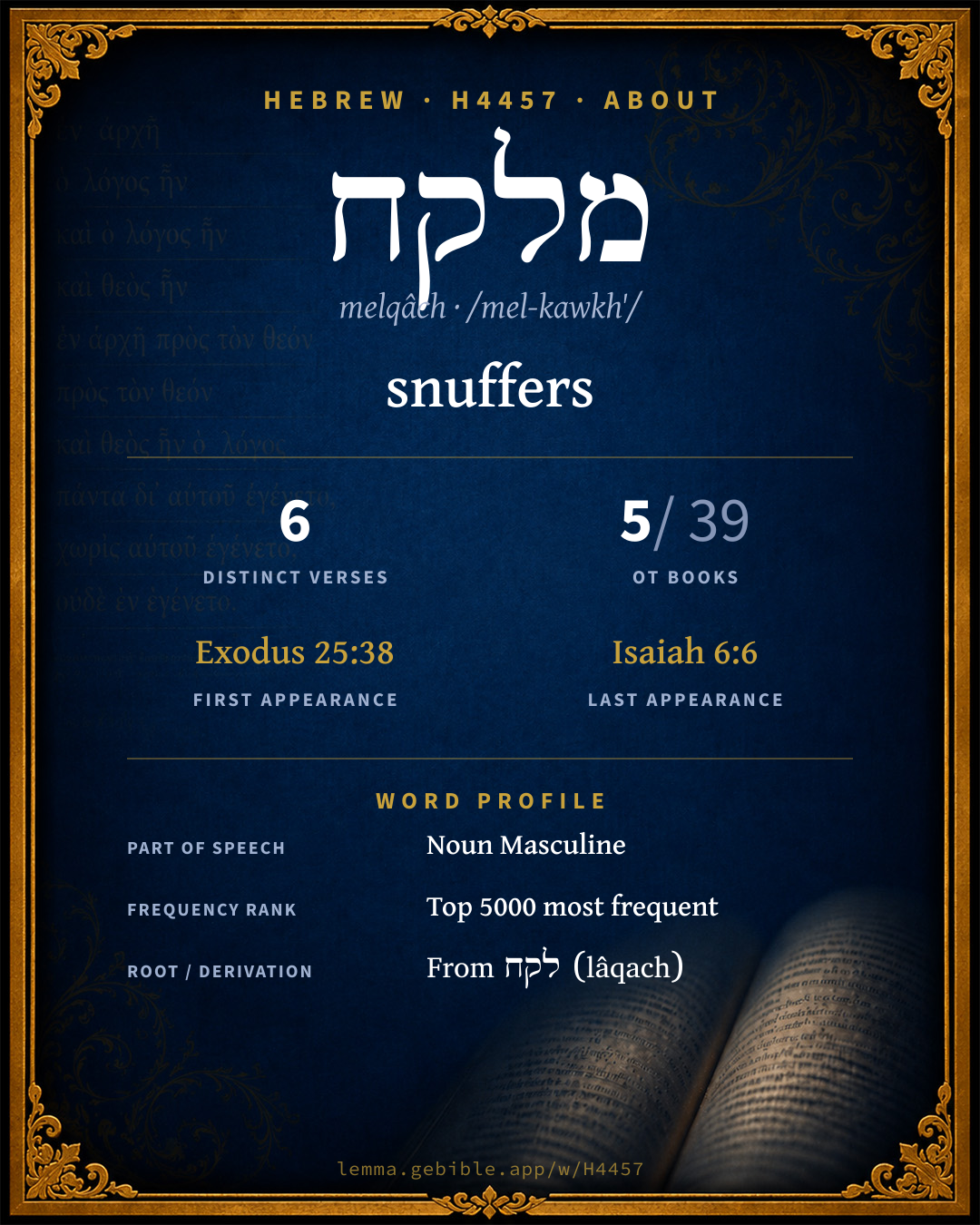
מֶלְקָחַ֫יִם
snuffers
‘snuffers’ is one of 3 main senses fuller range ↓
Full lexicon entry — Brown-Driver-Briggs (BDB)
From Brown-Driver-Briggs (BDB)
Where this word appears
See every Absolute-state word in the Hebrew Bible →
Grammar key — what these labels mean
Part of speech
- Noun
- A naming word — a person, place, thing, or idea.
Noun type
- Common
- A common noun — a general class of person, place, or thing (“king,” “city,” “water”), not a specific name.
State
- Construct
- A noun bound to a following noun in a possessive / “of” relationship (the construct chain).
- Absolute
- The independent form of a noun, not bound to a following word.
Gender
- Masculine
- Grammatically masculine.
Number
- Dual
- Exactly two — for natural pairs and some measures of time.
Grammatical forms
- Noun, Common, Masculine, Dual, Construct 3 times (50%)
- Noun, Common, Masculine, Dual, Absolute 3 times (50%)
Parsed forms decoded from the imported morphology (morphhb / Westminster Leningrad Codex — WLC text public domain, morphhb tagging CC BY 4.0), counted across 6 parsed occurrences — not distinct verses.
Every verse where H4457 appears — 6 distinct verses across 5 books. Click any verse to open its interlinear word-by-word view. Verse text shown in the World English Bible for context — . Each verse’s Hebrew form is shown with its reference; the English is not keyword-highlighted, since the data carries no word-level English alignment. Use “Compare translations” on any verse to read it across multiple English versions. This concordance covers the Hebrew Bible; Septuagint (Greek Old Testament) occurrences are not indexed here.
Exodus 2 verses
Numbers 1 verse
1 Kings 1 verse
2 Chronicles 1 verse
Isaiah 1 verse
About this entry
At a glance — auto-summarized from this page’s data, not written by a person. Every figure links to its source below. This summary describes the numbers; it doesn’t interpret them.
The Hebrew noun מלקח centers on the idea of “snuffers.” Its earliest occurrence is Exodus 25:38. The Hebrew Bible uses it across 6 verses — uncommon. Exodus dominates its distribution — 2 of 6 verses. The lexicon spreads it across several senses; see its full sense range. Dig into 6-verse concordance and the renderings breakdown below.
Gloss history
Strong's 1890 vs modern scholarship
About this word
Strong's H4457 catalogs a Hebrew word from the Hebrew Old Testament.
These counts are not copied from any lexicon or concordance. They are computed here, from the morphology-tagged Hebrew Old Testament. What Lemma adds →
- 6
- distinct verses
- The word appears in 6 distinct verses.
- 5 / 39
- OT books
- The word appears in 5 of 39 Old Testament books.
- #3,040
- by frequency
- Top 5000 most frequent Hebrew words (rank 3,040 of 8,640 Hebrew words by occurrence).
View all 6 occurrences in the concordance →
By section of the Old Testament
By traditional corpus
Conventional, traditional groupings — biblical authorship is debated, so this is a traditional corpus grouping, not an authorship claim. Each share is this word’s portion of its verses in that division of the Hebrew canon. Each figure is a share of the word’s 6 distinct verses.
- Torah (Pentateuch) 3 verses · 50%
- Prophets (Nevi'im) 2 verses · 33%
- Writings (Ketuvim) 1 verse · 17%
How translations render this word
Counts come from each version’s own published word-to-Strong’s tagging or interlinear alignment — an approximate guide to how each version renders this word, not a word-level alignment the data otherwise carries. Because each total is that version’s own tagged count, the per-version totals vary from one another and need not match the appearance or distinct-verse counts above. These counts may also differ from a printed concordance because Lemma counts each distinctly tagged rendering and does not collapse phrase taggings into a single head-word total. This is a fixed set of word-tagged versions (KJV, ASV, BSB, ULT) and does not change with the reading translation you choose elsewhere. Each version’s license is shown beside its name below (and on Sources).
- King James Version: Tongs 5×
- American Standard Version: Tongs 3×, Snuffers 2×
- Berean Standard Bible: Tongs 3×, Wick trimmers 3×
- unfoldingWord Literal Text: Tongs 4×
King James Version Public Domain
Renders H4457 across 6 tagged occurrences — most commonly:
Plus 1 rendering that appears only once — usually multi-word phrases or single function words the recovered tagging swept in, not distinct renderings.
American Standard Version Public Domain
Renders H4457 across 6 tagged occurrences — most commonly:
Plus 1 rendering that appears only once — usually multi-word phrases or single function words the recovered tagging swept in, not distinct renderings.
Berean Standard Bible Public Domain
Renders H4457 across 6 tagged occurrences — most commonly:
unfoldingWord Literal Text CC BY-SA 4.0
Renders H4457 across 7 tagged occurrences — most commonly:
Plus 3 renderings that appear only once — usually multi-word phrases or single function words the recovered tagging swept in, not distinct renderings.
Senses in the full BDB
What do BDB’s symbols mean?
BDB uses these scholarly abbreviations:
| Symbol | Meaning |
|---|---|
| 𝔊 | the Septuagint (the ancient Greek translation, LXX) |
| 𝔙 | the Vulgate (the Latin translation) |
| 𝔖 | the Syriac version (the Peshitta) |
| 𝔗 | the Targum (the Aramaic translation) |
| ψ | the Psalms |
| √ | root (the underlying root or stem) |
| ‖ | parallel passage (a synonymous or contrasted parallel) |
| † | the dagger: every passage where the word occurs is cited |
The 2 senses and sub-senses the full Brown-Driver-Briggs lexicon distinguishes for this word, in lexicon order (not ranked by frequency), with BDB’s own verbatim wording and sub-sense lettering. Shown in Hebrew script with BDB’s own scholarly abbreviations. The condensed entry is in the Lexicon Entry tab. See also the Forms in the corpus table below.
- 1. tongs used at altar of temple, for lifting coal, in Is.’s vision, Is 6:6. e.g. Isaiah 6:6
- 2. lamp-snuffers, in temple 1 K 7:49 = 2 Ch 4:21; in tabern. sf. (ref. to lamp-stand, מְנוֹרָה) מַלְקָחֶיהָ Ex 25:38; 37:23 Nu 4:9 (all P). e.g. 1 Kings 7:49
Senses from the full Brown-Driver-Briggs lexicon (Brown, Driver, Briggs; Oxford 1906 — public domain), digitized via Sefaria, supplemented by the OpenScriptures HebrewLexicon (CC BY 4.0). Full attribution on Sources.
Word origin
[מַלְקָחַיִם] n.[m.]du. tongs, snuffers;—
— Brown-Driver-Briggs (Oxford 1906, public domain), digitized via Sefaria, supplemented by the OpenScriptures HebrewLexicon (CC BY 4.0). See Sources.
Derived from לקח (lâqach) (H3947) — to take.
Jastrow Dictionary
A second Hebrew/Aramaic lexicon for comparison, covering Aramaic and post-biblical (Talmudic, Targumic, Midrashic) usage that the biblical-Hebrew BDB does not. Matched by lemma rather than by Strong’s number, so a lemma may carry more than one Jastrow headword (shown separately below), and the entries cover usage well beyond the Bible.
לָקַח
- (b. h.)
- 1. to take, receive. B. Kam. 119ᵃ גבאי צדקה לוֹקְחִין וכ׳ collectors of charity may receive from them small contributions. Ex. R. s. 3 ל׳ את שלו he received his due (punishment). Tanḥ. Korah 3 ל׳ טליתו he took up his cloak; a. fr.
- 2. to carry away; to persuade. Ib. 1 (ref. to Num. XVI, 1) אין ויקח אלא משיכת וכ׳ vayikkaḥ means attraction by soft words; ib. 2 אין ויקח אלא לשון פליגה שלבו לְקָחוֹ vayikkaḥ has the meaning of separation, for his heart (pride) carried him away; Num. R. s. 18. e.g. Numbers 16:1
- 3. to buy, acquire. Dem. IV, 5 קַח לי וכ׳ buy (provision) for me of one who is reliable &c. Ib. הלך לִיקַּח … ולָקַחְתִּי לך וכ׳ if he went to buy of him (of the designated person), and … not finding him I bought of &c. Ib. V, 1 הלוֹקֵחַ מן וכ׳ he who buys of a baker. B. Mets. 16ᵇ לכשאֶקָּחֶנָּה when I shall have bought it; a. v. fr.—לוֹקֵחַ buyer. Ib. 15ᵇ bot. דמית ל׳ when the buyer is dead. Ber. 5ᵃ ול׳ שמח and the purchaser is glad; a. v. fr.—Part. pass. לָקוּחַ, f. לְקוּחָה; pl. לְקוּחִים, לְקוּחִון; לְקוּחוֹת. Y. Pes. II, 29ᵇ הל׳ בכסף מעשר that which has been bought with tithe-money. B. Mets. 110ᵃ ל׳ היא בידי I have it as a purchased property. Y. Snh. IX, beg. 26ᵈ [read:] עד שתהא הראשונה ל׳ לו until the first wife has been legally acquired (betrothed) by him; (Y. Yeb. XI, 11ᵈ top זקוקה), v. לְקִיחָה; a. fr.—V. לְקוּחוֹת.
- , נִקַּח to be taken, bought, acquired. Maas. Sh. I, 3 אינו נל׳ בכסף מעשר must not be bought with tithe-money; Ḥull. I, 7 אינו ניקח. Men. 42ᵇ נִקְּחֵית; נִקְּחִין; a. fr.—Kidd. 2ᵇ (ref. to Deut. XXII, 13) it is not written כי תִלָּקֵחַ אשה לאיש if a woman is married (marries herself) to a man (Var. תִקַּח). e.g. Deuteronomy 22:13
- to be enclosed, squeezed in. Num. R. s. 12; Cant. R. to III, 11; Pesik. Vayhi, p. 4ᵃ (expl. מִתְלַקַּחַת, Ex. IX, 24), v. עֲשָׁשִׁיתָא. e.g. Exodus 9:24
*לְקַח
- Ithpe. אִלְּקַח to be taken, married. Keth. IV, 11 (52ᵇ) עד דתִלַּקְחוּן לגוברין Bab. ed. (Mish. a. Y. ed. דתינסבן) until they shall be married; ib. 53ᵇ דתִילַּקְחָן.
לֶקַח
- preced.) purchase; (acceptable) gift; lesson. Taan. 7a (ref. to לקחי, Deut. XXXII, 2) אין ל׳ אלא תורה lekaḥ means the Law (with ref. to Prov. IV, 2); Tanḥ. Haăz. 3; a. fr.—אבן הל׳ auction-stone. Yalk. Lev. 667, v. מֶקַח. e.g. Deuteronomy 32:2
A Dictionary of the Targumim, the Talmud Babli and Yerushalmi, and the Midrashic Literature (Marcus Jastrow; London, Luzac, 1903) — Public Domain. Digitized via Sefaria. Digitized via Sefaria. Full attribution on Sources.
Forms in the corpus
The 4 distinct written forms H4457 takes in the Hebrew Bible, most frequent first — each parse links to that state’s occurrences in the concordance. Hebrew forms include their vowel points and cantillation, so a single lemma takes many written forms.
| Form | Parsing | Example | Uses |
|---|---|---|---|
| וְ/הַ/מֶּלְקַחַ֖יִם | Noun, Common, Masculine, Dual, Absolute | 1 Kings 7:49 | 2 |
| וּ/מַלְקָחֶ֥י/הָ | Noun, Common, Masculine, Dual, Construct | Exodus 25:38 | 2 |
| בְּ/מֶ֨לְקַחַ֔יִם | Noun, Common, Masculine, Dual, Absolute | Isaiah 6:6 | 1 |
| מַלְקָחֶ֖י/הָ | Noun, Common, Masculine, Dual, Construct | Numbers 4:9 | 1 |
Same root — word family
Other BDB entries built from the same root as H4457, grouped by Strong’s listed origin. These share a root / origin per the lexicon — not necessarily a shared meaning. Each links to that word’s own entry.
Derives from
Shares the same root
- לקח leqach H3948 instruction
- מלקוח malqôwach H4455 prey
- מקח miqqâch H4727 receiving
- מקחה maqqâchâh H4728 ware
Proper names from this root
People and places named from this root — a name, not an additional meaning of the word.
Compare all same-root words → Showing 4 of 8 — not the complete family. 2 of the same-root words are proper names (people or places). They share a root, not necessarily a meaning.
Septuagint verse parallels
This word appears in 5 verses that also exist in the Greek Old Testament (Septuagint), out of the 6 Hebrew verses it occurs in. You can read those verses in Greek by switching the Old Testament edition to the Septuagint.
Read these verses in the Septuagint
This is a verse-level parallel only — the same verses exist in both the Hebrew and Greek Old Testaments. No word-level Hebrew↔Greek correspondence is claimed: the data carries no such alignment, so no Greek word is shown as this Hebrew word’s translation. Coverage is not total — the Septuagint omits the deuterocanon and renumbers the Psalms, so some Hebrew verses have no direct Greek parallel.