Deuteronomy 22:7

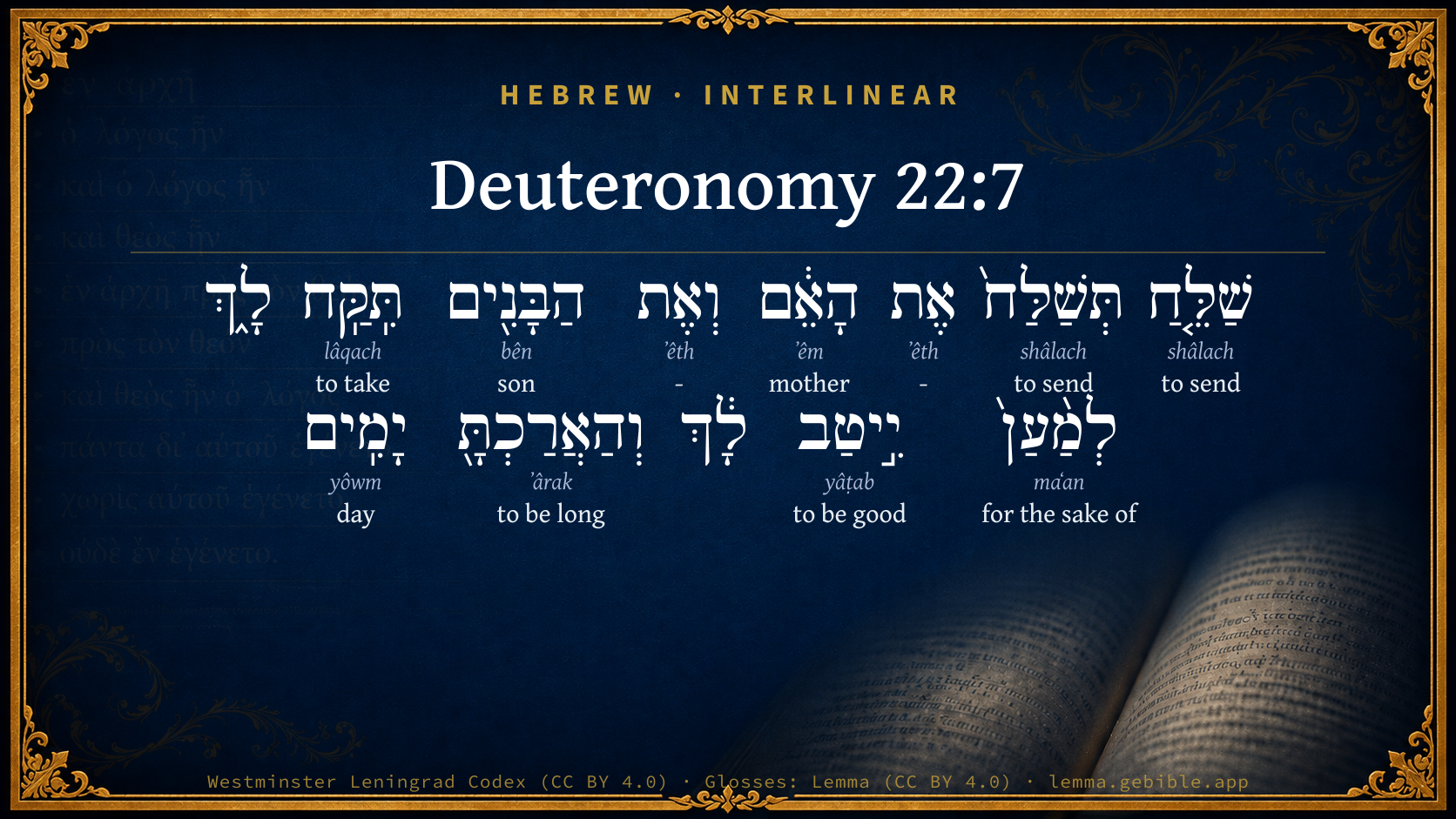
Hebrew (Westminster Leningrad Codex) Deuteronomy 22:7 appears in the Hebrew Old Testament. The text above is from the Westminster Leningrad Codex. Each word links to its Strong’s number, a concise gloss, and parsing drawn from the Open Scriptures Hebrew Bible morphology. Click any word for its full Brown-Driver-Briggs (BDB) entry.
Download image
Cite this verse

Deuteronomy 22:7 (World English Bible). Public Domain. Lemma interlinear Bible study tool, https://lemma.gebible.app/v/deuteronomy/22/7.

Show BibTeX & RIS
BibTeX
RIS
English Translation
you shall surely let the hen go, but the young you may take to yourself; that it may be well with you, and that you may prolong your days.
World English Bible · Public Domain
Download a study sheet

One document with this verse’s original text, its word-by-word gloss line, the meaning frame, cross-references with their text, attributed commentary, and full source and license credits — printable, and it pastes into notes with its structure intact.

This verse Autodidact and up

Study sheet (.html) Plain text (.txt)

A passage Seminary Student

Up to 50 verses in one chapter. A passage sheet keeps up to 6 commentary sources and 12 cross-references per verse, in the order this page ranks them, and says so on the sheet whenever that leaves anything out. Ask for a single verse and you get the Autodidact verse sheet above.

Everything on this page stays free to read, with no account — the sheet is a download of what is already on screen, not access to it.

Want to remove ads? Support Godless Engineer
Compare translations 3

The same verse in 3 English versions, stacked beneath the original-language interlinear above. Click any original word for its lexicon entry.

Each is an independent rendering of the whole verse — the interlinear is not word-aligned to these translations.

Highlighted words mark where these versions differ — a whole-verse word diff, not a word-by-word alignment.

  • World English Bible Public Domain
    you shall surely let the hen go, but the young you may take to yourself; that it may be well with you, and that you may prolong your days.
  • King James Version Public Domain
    But thou shalt in any wise let the dam go, and take the young to thee; that it may be well with thee, and that thou mayest prolong thy days.
  • unfoldingWord Literal Text CC BY-SA 4.0
    Sending, you shall send the mother, but the children you may take for yourself, so that it may go well with you, and you may prolong days.

unfoldingWord Literal Text — © unfoldingWord, licensed CC BY-SA 4.0. Word-aligned USFM3 via Door43 (git.door43.org/unfoldingWord/en_ult).

Versions to compare (up to 4)

3 of 4 selected

Show all 18 translations

Every available English version of this verse, each an independent rendering of the whole verse.

  • World English Bible Public Domain
    you shall surely let the hen go, but the young you may take to yourself; that it may be well with you, and that you may prolong your days.
  • Berean Standard Bible Public Domain
    You may take the young, but be sure to let the mother go, so that it may be well with you and that you may prolong your days.
  • Majority Standard Bible Public Domain
    You may take the young, but be sure to let the mother go, so that it may be well with you and that you may prolong your days.
  • King James Version Public Domain
    But thou shalt in any wise let the dam go, and take the young to thee; that it may be well with thee, and that thou mayest prolong thy days.
  • American Standard Version (1901) Public Domain
    thou shalt surely let the dam go, but the young thou mayest take unto thyself; that it may be well with thee, and that thou mayest prolong thy days.
  • Revised Version (1885) Public Domain
    thou shalt in any wise let the dam go, but the young thou mayest take unto thyself; that it may be well with thee, and that thou mayest prolong thy days.
  • Geneva Bible (1599) Public Domain
    But shalt in any wise let the damme go, and take the yong to thee, that thou mayest prosper and prolong thy dayes.
  • Douay-Rheims (1899) Public Domain
    But shalt let her go, keeping the young which thou hast caught: that it may be well with thee, and thou mayst live a long time.
  • Young's Literal Translation Public Domain
    thou dost certainly send away the mother, and the young ones dost take to thyself, so that it is well with thee, and thou hast prolonged days.
  • Literal Standard Version CC BY-SA 4.0
    you certainly send the mother away, and take the young ones for yourself, so that it is well with you and you have prolonged days.
  • Unlocked Literal Bible CC BY-SA 4.0
    You must surely let the mother go, but the young you may take for yourself. Obey this command so that it may go well with you, and that you may prolong your days.
  • unfoldingWord Literal Text CC BY-SA 4.0
    Sending, you shall send the mother, but the children you may take for yourself, so that it may go well with you, and you may prolong days.
  • Darby Bible Public Domain
    thou shalt in any case let the dam go, and thou mayest take the young to thee, that it may be well with thee, and that thou mayest prolong thy days.
  • World Messianic Bible Public Domain
    You shall surely let the hen go, but the young you may take for yourself, that it may be well with you, and that you may prolong your days.
  • Webster's Bible Public Domain
    But thou shalt in any wise let the dam go, and take the young to thee; that it may be well with thee, and that thou mayest prolong thy days.
  • Free Bible Version CC BY-SA 4.0
    You may take the young, but make sure you let the mother go, so that you will do well and have a good long life.
  • Bible in Basic English Public Domain
    See that you let the mother bird go, but the young ones you may take; so it will be well for you and your life will be long.
  • JPS Tanakh (1917) Public Domain
    thou shalt in any wise let the dam go, but the young thou mayest take unto thyself; that it may be well with thee, and that thou mayest prolong thy days.

Literal Standard Version (2020), Covenant Press — licensed CC BY-SA 4.0. Text via the HelloAO Bible API (eBible.org). Unlocked Literal Bible (unfoldingWord) — licensed CC BY-SA 4.0. Text via the HelloAO Bible API (eBible.org). unfoldingWord Literal Text — © unfoldingWord, licensed CC BY-SA 4.0. Word-aligned USFM3 via Door43 (git.door43.org/unfoldingWord/en_ult). Free Bible Version, Dr. Jonathan Gallagher — licensed CC BY-SA 4.0. Text via the HelloAO Bible API (eBible.org).

Word by word

More ways to search: Search by grammar → Find every occurrence → Compare this word →

Practice this passage: Drill this verse → Learn its vocabulary →

וְהַאֲרַכְתָּ֖
ʼârak
H748
“and · to be long”
Conjunction + Verb, Hiphil, Sequential Perfect, 2nd Person, Masculine, Singular
Part of Speech
Conjunction + Verb
Stem
Hiphil
Form
Sequential Perfect
Person
2nd Person
Gender
Masculine
Number
Singular
Full BDB Definition

Origin: a primitive root

TWOT: 162

to be long, prolong - (Qal) to be long - (Hiphil) - to prolong (days) - to make long (tent cords) - to grow long, continue long
  1. שַׁלֵּ֤חַ shâlach H7971 “to send” Verb, Piel, Infinitive Absolute
  2. תְּשַׁלַּח֙ shâlach H7971 “to send” Verb, Piel, Imperfect, 2nd Person, Masculine, Singular
  3. אֶת ʼêth H853 “-” Particle, Direct Object
  4. הָאֵ֔ם ʼêm H517 “the · mother” Particle, Definite Article + Noun, Common, Feminine, Singular, Absolute
  5. וְאֶת ʼêth H853 “and · -” Conjunction + Particle, Direct Object
  6. הַבָּנִ֖ים bên H1121 “the · sons” Particle, Definite Article + Noun, Common, Masculine, Plural, Absolute
  7. תִּֽקַּֽח lâqach H3947 “to take” Verb, Qal, Imperfect, 2nd Person, Masculine, Singular
  8. לְמַ֨עַן֙ maʻan H4616 “for the sake of” Preposition
  9. יִ֣יטַב yâṭab H3190 “to be good” Verb, Qal, Imperfect, 3rd Person, Masculine, Singular
  10. יָמִֽים yôwm H3117 “days” Noun, Common, Masculine, Plural, Absolute

About this verse

These counts appear in no published source. They are computed here, from the morphology-tagged text and Lemma’s own curated glosses. What Lemma adds →

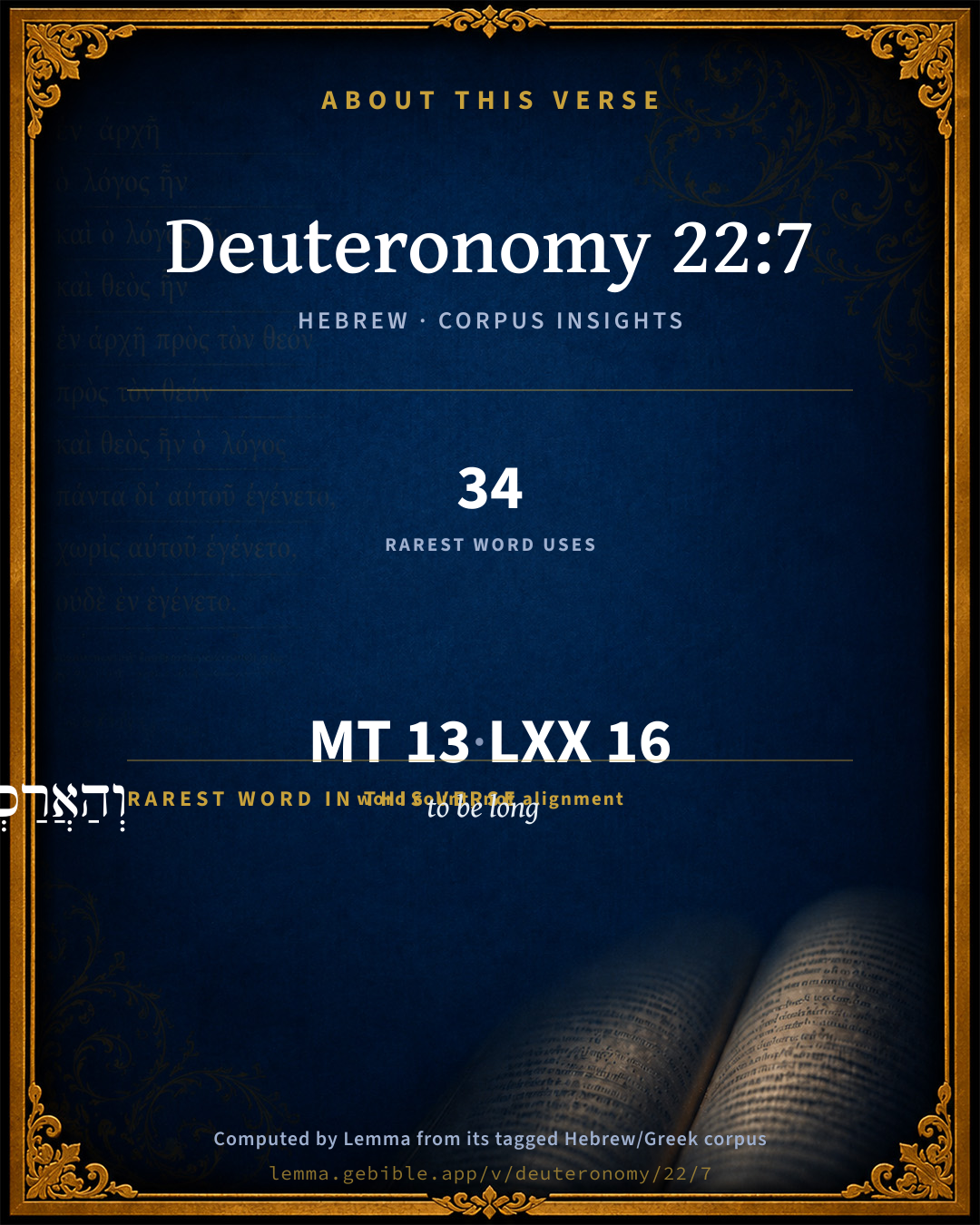
13
words
9
distinct lemmas
Pentateuch
section

Shared distinctive vocabulary

וְהַאֲרַכְתָּ֖ to be long H748 occurs in 34 verses of the Hebrew Bible. Also found in:

Grammatical profile

  • 5 verbs
  • 3 nouns
  • 3 prepositions
  • 2 particles

Verb forms

  • שַׁלֵּ֤חַ Piel · Infinitive Absolute
  • תְּשַׁלַּח֙ Piel · Imperfect
  • תִּֽקַּֽח Qal · Imperfect
  • יִ֣יטַב Qal · Imperfect
  • וְהַאֲרַכְתָּ֖ Hiphil · Sequential Perfect

Repetition

A word recurs within this verse — often emphatic in Hebrew:

  • שַׁלֵּ֤חַ to send H7971 ×2

Hebrew & Septuagint length

In English translation the verse runs 29 words from the Hebrew and 30 from the Septuagint (LXX English) — closely comparable.

A rough comparison of the two English renderings, which tokenize alike — not a word-level alignment.

Word counts can differ between the Hebrew and the Greek without any difference in meaning — e.g. the Hebrew direct-object marker אֵת has no separate Greek word, and Greek often adds the article ὁ.

In the original languages it is 13 Hebrew tokens and 16 Greek tokens — but the two are counted differently (Hebrew bundles its prefixes and suffixes into one token; the Greek is in lemma form), so that isn’t a like-for-like length.

Cross-references

2

Topical passages linked to Deuteronomy 22:7 in the Treasury of Scripture Knowledge — connected by theme and wording, ordered by reader-vote popularity; previews shown in the World English Bible.

  • Deuteronomy 4:40 You shall keep his statutes, and his commandments, which I command you this day, that it may go well with you, and with your children after you, and that you may prolong your days in the land, which Yahweh your God gives you, forever.
  • Proverbs 22:4 The result of humility and the fear of Yahweh Is wealth, honor, and life.

Cross-references courtesy of OpenBible.info (CC BY 4.0).

Hebrew and Greek witnesses Masoretic Hebrew ↔ Greek Septuagint

The same verse in the two great witnesses to the Old Testament, shown verse-for-verse.

These are two independent witnesses, not word-aligned to each other, and the Septuagint is shown in lemma (dictionary) form.

Hebrew Deuteronomy 22:7 Masoretic · Westminster Leningrad Codex

שַׁלֵּ֤חַ תְּשַׁלַּח֙ אֶת הָאֵ֔ם וְאֶת הַבָּנִ֖ים תִּֽקַּֽח לָ֑ךְ לְמַ֨עַן֙ יִ֣יטַב לָ֔ךְ וְהַאֲרַכְתָּ֖ יָמִֽים

you shall surely let the hen go, but the young you may take to yourself; that it may be well with you, and that you may prolong your days.

World English Bible · Public Domain

Greek LXX Deuteronomy 22:7 Septuagint · lemma form

ἀποστολή ἀποστέλλω ὁ μήτηρ ὁ δέ παιδεία λαμβάνω σεαυτοῦ ἵνα εὖ σύ γίγνομαι καί πολυήμερος εἰμί

You shall by all means let the mother go, but you shall take the young to yourself; that it may be well with you, and that you may live long.

LXX2012 (modern English Septuagint) · Public Domain

Hebrew: Westminster Leningrad Codex (CC BY 4.0). Greek: Septuagint (public domain); English from LXX2012 (modern English Septuagint) (Public Domain). How the Septuagint differs from the Hebrew →

Targum (Aramaic paraphrase)

2

The Targum is the ancient Jewish Aramaic paraphrase of the Hebrew Scriptures — an interpretive translation, not the Hebrew text itself. Onkelos (literal) and Pseudo-Jonathan (expansive) render the Torah, and Jonathan the Prophets. Coverage is partial: where no permissively-licensed English translation exists for a verse, only the Aramaic is shown. This is verse-level text, not a word-by-word alignment to the Hebrew.

  1. Targum Onkelos Torah (Genesis–Deuteronomy)
    שַׁלָחָא תְשַׁלַח יָת אִמָא וְיָת בְּנַיָא תִּסַב לָךְ בְּדִיל דְיֵיטַב לָךְ וְתוֹרִיךְ יוֹמִין

    (no public-domain English translation for this verse)

    Targum Onkelos — Aramaic: “Onkelos Genesis” (public domain); “Onkelos Exodus” (public domain); “Onkelos Leviticus” (public domain); “Onkelos Numbers” (public domain); “Onkelos Deuteronomy” (public domain). English: “Sefaria Community Translation” (CC0 1.0 (public-domain dedication)); “J.W. Etheridge. The Targums of Onkelos and Jonathan Ben Uzziel on the Pentateuch. London: Longmans, Green, 1862” (public domain). Text via Sefaria.

  2. Targum Pseudo-Jonathan Torah (Genesis–Deuteronomy)
    מִפְטַר תִּפְטוֹר יַת אִמָּא וְיַת בְּנַיָא תִסַּב לָךְ מִן בִּגְלַל דְּיוֹטַב לָךְ בְּעַלְמָא הָדֵין וְתוֹרִיךְ יוֹמִין בְּעַלְמָא דְאָתֵי

    thou shalt be sure to send the mother away, but thou mayest take the young for thyself that it may be well with thee in this world, and that thou mayest prolong tby days in the world to come.

    Targum Pseudo-Jonathan — Aramaic: “Targum Jonathan on Genesis” (public domain); “Targum Jonathan on Exodus” (public domain); “Targum Jonathan on Leviticus” (public domain); “Targum Jonathan on Numbers” (public domain); “Targum Jonathan on Deuteronomy” (public domain). English: “The Targum of Jonathan ben Uzziel, trans. J. W. Etheridge, London, 1862” (public domain). Text via Sefaria.

Commentary

Notes on Deuteronomy 22:7 from classic Christian and Jewish commentators (each source and its license shown beneath its notes). The classic Christian expositions comment on the surrounding passage and are grouped to its opening verse, so a note may address several verses; the Jewish commentaries on the Tanakh (Rashi and others) are per-verse, so they appear only where the commentator wrote on this verse.

Lemma curates 59 commentaries, every one of them public domain or Creative Commons licensed, each selected and text-cleaned for this edition rather than reprinted as found. About our sources →

Trapp's Complete Commentary

John Trapp

Deu 22:7 [But] thou shalt in any wise let the dam go, and take the young to thee; that it may be well with thee, and [that] thou mayest prolong [thy] days.

Ver. 7. And that thou mayest prolong, &c.] They were commanded to spare the dam, because she represented the parents in bringing up of her young ones; and if their days should be for that prolonged, much more for this. The Hebrews reckon this commandment for the least of all in Moses’s law; and yet such a promise is annexed thereunto.

John Trapp, A Commentary or Exposition upon All the Books of the Old and New Testament (1647–1656) — public domain. Text from a community e-Sword module.

Adam Clarke's Commentary

Verse 7. Thou shalt - let the dam go, and take the young to thee; that it may be well with thee] This passage may be understood literally. If they destroyed both young and old, must not the breed soon fail, and would it not in the end be ill with them; and by thus cutting off the means of their continual support, must not their days be shortened on the land? But we may look for a humane precept in this law. The young never knew the sweets of liberty; the dam did: they might be taken and used for any lawful purpose, but the dam must not be brought into a state of captivity. They who can act otherwise must be either very inconsiderate or devoid of feeling; and such persons can never be objects of God's peculiar care and attention, and therefore need not expect that it shall be well with them, or that they shall prolong their days on the earth. Every thing contrary to the spirit of mercy and kindness the ever blessed God has in utter abhorrence. And we should remember a fact, that he who can exercise cruelty towards a sparrow or a wren, will, when circumstances are favourable, be cruel to his fellow creatures. The poet Phocylides has a maxim in his admonitory poem very similar to that in the sacred text: -

Μηδε τις ορυιθας καλιης ἁμα παντας ἑλεσθω·

Μητερα δ' εκπρολιπῃς, ἱν' εχῃς παλι τησδε νεοττους.

PHOCYL. Ποιημα Νουθετ., ver. 80.

"Nor from a nest take all the birds away;

The mother spare, she'll breed a future day."

Adam Clarke's Commentary on the Bible (1810–1826) — public domain. Text from a community e-Sword/MySword module.

John Gill's Exposition

But thou shall in any wise let the dam go, and take the young to thee,.... Or "in letting go, let go", or "in sending, send away" (a); that is, willingly, certainly, entirely, frequently, always; so the Jewish canons (b),"if anyone lets her go, and she returns, even four or five times, he is obliged to let her go, as it is said, "in letting go, let go";''nay, Maimonides says (c), even a thousand times; the canon proceeds,"if anyone says, lo, I take the dam and let go the young, he is obliged to let her go; if he takes the young, and returns them again to the nest, and after that returns the dam to them, he is free from letting her go;"

that it may be well with thee, and that thou mayest prolong thy days; the Targum of Jonathan is,"that it may be well with thee in this world, and thou mayest prolong thy days in the world to come:''the same blessing that is promised to observers of the fifth command, which is one of the weightier matters of the law, is made to this; which the Jews say (d) is but as the value of a farthing, or of little account in comparison of others; wherefore, as Fagius rightly observes (e), God, in bestowing such rewards, has regard not to the works of men, but to his own grace and kindness; for what merit can there be in letting go or preserving the life of a little bird?

(a) "dimittendo dimittes", Pagninus, Montanus, Vatablus; so Ainsworth. (b) Misn. Cholin, c. 12. sect. 3. (c) In Misn. ib. (d) Misn. ib. sect. 5. (e) In loc.

John Gill's Exposition of the Whole Bible (1746–1763) — public domain (CC PDM 1.0). Text via the HelloAO Bible API.

Haydock's Catholic Bible Commentary

Time. Those who refrain from cruelty, even towards beasts, will be induced more easily to shew mercy to their fellow creatures, (Tertullian, contra Marc. ii.) and will draw down the blessings of God upon themselves. (Menochius)

George Leo Haydock (1774–1849), Haydock's Catholic Family Bible and Commentary, 1859 edition — public domain. Excludes Psalms (Douay-Rheims chapter numbering differs from Protestant) and Deuterocanonical books (Catholic canon only).

Matthew Poole's English Annotations

Let the dam go; partly for the bird’s sake, which suffered enough by the loss of its young; for God would not have cruelty exercised towards the brute creatures; and partly for men’s sake, to restrain their greediness and covetousness, that they should not monopolize all to themselves, but might leave the hopes of a future seed for others.

Matthew Poole's English Annotations on the Holy Bible (1683–1685) — public domain. Text from a community e-Sword/MySword module.

John Wesley's Explanatory Notes

Let the dam go - Partly for the bird's sake, which suffered enough by the loss of its young; for God would not have cruelty exercised towards the brute creatures: and partly for mens sake, to refrain their greediness, that, they should not monopolize all to themselves, but leave the hopes of a future seed for others.

John Wesley, Explanatory Notes Upon the Whole Bible (1754–1765) — public domain. Text via the GEBible commentary corpus.

Rashi

Rabbi Shlomo Yitzchaki (Rashi)

למען ייטב לך וגו׳ THAT IT MAY BE WELL WITH THEE etc. — If in the case of an easy command which involves no monetary loss, Scripture states “Do this in order that it may be well with thee and thou mayest prolong thy days”, it follows à fortiori that this at least will be the grant of the reward for the fulfilment of commands which are more difficult to observe (Chullin 142a).

Rashi on the Tanakh — English translations: “The Judaica Press complete Tanach with Rashi, translated by A. J. Rosenberg” (CC BY 4.0); “Pentateuch with Rashi's commentary by M. Rosenbaum and A.M. Silbermann, 1929-1934” (public domain); “The Metsudah Tanach series, Lakewood, N.J” (CC BY 4.0); and “The Book of Joshua, Metsudah Publications, 1997” (CC BY 4.0). Text via Sefaria.

Ibn Ezra

Rabbi Abraham ibn Ezra

So that you will benefit. So that Hashem will have mercy on you and do good for you.

And you will live long. When you do not destroy the nest, but leave it intact.

Ibn Ezra on the Tanakh — English translations: “Sefaria Community Translation” (CC0 1.0 (public-domain dedication)); “Yalkut, Sifsei Chachomim Chumash, Metsudah Publications, 2009” (CC BY 4.0); and “Commentary of Ibn Ezra on Isaiah - trans. by M. Friedlander, 1873” (public domain). Text via Sefaria.

Lesson kit

Teaching starters — assembled from the data on this page, not authored interpretation. Every prompt links to the verse data it draws on. Edit before teaching.

Deuteronomy, in the Pentateuch, opens this verse with 13 words (9 distinct Hebrew lemmas). Its most distinctive word is ʼârak (“to be long”). A historical commentator’s framing appears above. Read the whole chapter for the surrounding context.

Discussion questions

  1. How does “to be long” (ʼârak) shape what this verse is saying?
  2. Genesis 26:8 shares the word «to be long» with this verse. How do the two illuminate each other?
  3. “to send” occurs 2× in this one verse. What is the effect of the repetition?
  4. The translations on this page render this verse differently — a whole-verse word diff, not a word-by-word alignment. What might account for the different wordings?
  5. The verb «שַׁלֵּ֤חַ» is Piel Infinitive Absolute. How does its form color the action?
  6. Reading how Trapp's Complete Commentary and Adam Clarke's Commentary read this verse, where do the two commentators agree and where do they part?

Things to notice

Reading settings

Reading text

Shown beneath each verse's original-language words.

Old Testament
Old Testament edition

Read the OT as the Masoretic Hebrew (MT) or the Greek Septuagint (LXX).

English shown for the Greek Septuagint (in the Hebrew ↔ Greek comparison).

Comparing translations? Open the Compare panel on any verse page to stack up to four side by side.