
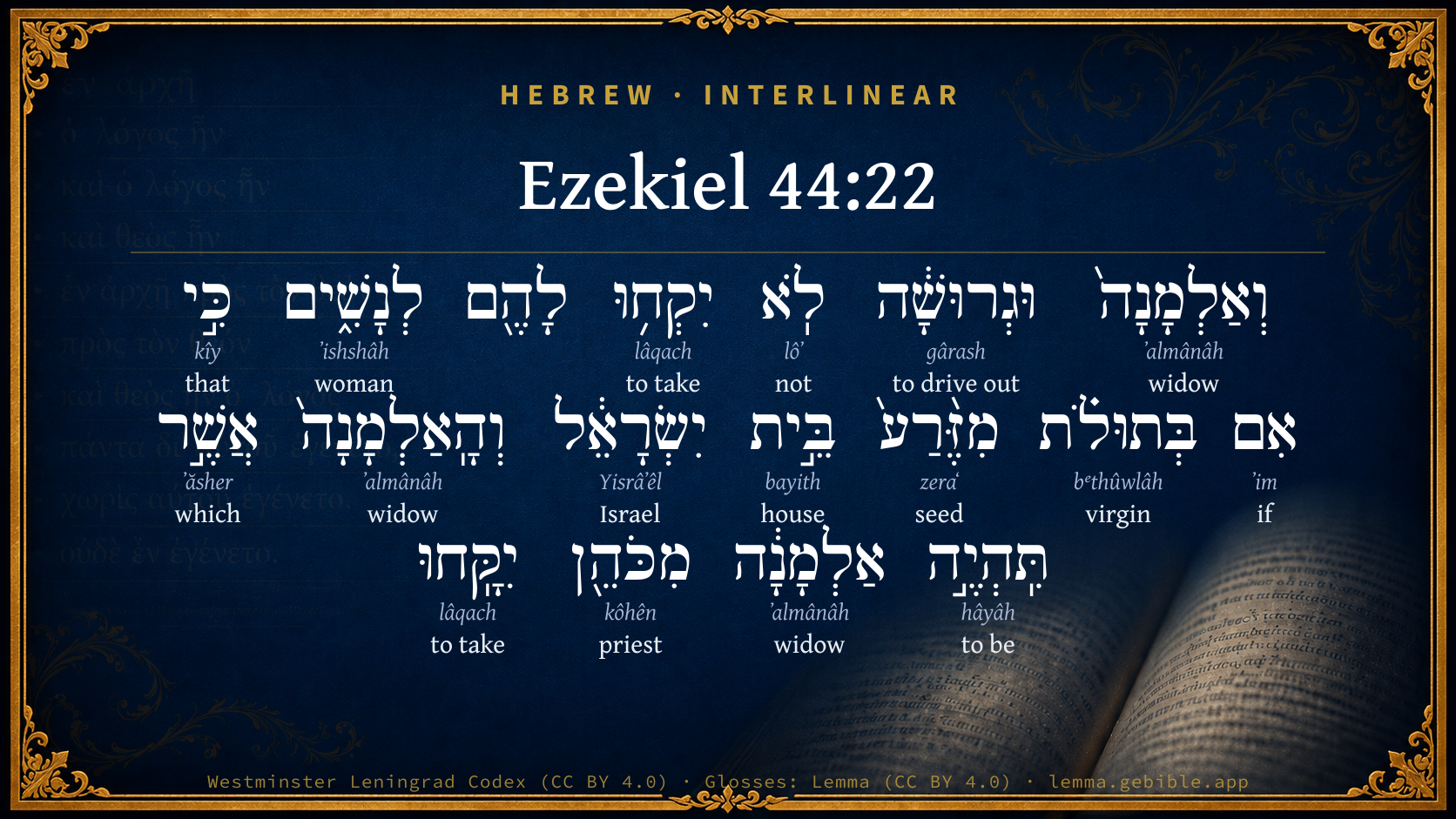
Ezekiel 44:22

Hebrew (Westminster Leningrad Codex) Ezekiel 44:22 appears in the Hebrew Old Testament. The text above is from the Westminster Leningrad Codex. Each word links to its Strong’s number, a concise gloss, and parsing drawn from the Open Scriptures Hebrew Bible morphology. Click any word for its full Brown-Driver-Briggs (BDB) entry.
Download image
Cite this verse

Ezekiel 44:22 (World English Bible). Public Domain. Lemma interlinear Bible study tool, https://lemma.gebible.app/v/ezekiel/44/22.

Show BibTeX & RIS
BibTeX
RIS
English Translation
Neither shall they take for their wives a widow, nor her who is put away; but they shall take virgins of the seed of the house of Israel, or a widow who is the widow of a priest.
World English Bible · Public Domain
Download a study sheet

One document with this verse’s original text, its word-by-word gloss line, the meaning frame, cross-references with their text, attributed commentary, and full source and license credits — printable, and it pastes into notes with its structure intact.

This verse Autodidact and up

Study sheet (.html) Plain text (.txt)

A passage Seminary Student

Up to 50 verses in one chapter. A passage sheet keeps up to 6 commentary sources and 12 cross-references per verse, in the order this page ranks them, and says so on the sheet whenever that leaves anything out. Ask for a single verse and you get the Autodidact verse sheet above.

Everything on this page stays free to read, with no account — the sheet is a download of what is already on screen, not access to it.

Want to remove ads? Support Godless Engineer
Compare translations 3

The same verse in 3 English versions, stacked beneath the original-language interlinear above. Click any original word for its lexicon entry.

Each is an independent rendering of the whole verse — the interlinear is not word-aligned to these translations.

Highlighted words mark where these versions differ — a whole-verse word diff, not a word-by-word alignment.

  • World English Bible Public Domain
    Neither shall they take for their wives a widow, nor her who is put away; but they shall take virgins of the seed of the house of Israel, or a widow who is the widow of a priest.
  • King James Version Public Domain
    Neither shall they take for their wives a widow, nor her that is put away: but they shall take maidens of the seed of the house of Israel, or a widow that had a priest before.
  • unfoldingWord Literal Text CC BY-SA 4.0
    nor take a widow or a divorced woman as a wife for himself, but only a virgin from the line of the house of Israel or a widow who was previously married to a priest.

unfoldingWord Literal Text — © unfoldingWord, licensed CC BY-SA 4.0. Word-aligned USFM3 via Door43 (git.door43.org/unfoldingWord/en_ult).

Versions to compare (up to 4)

3 of 4 selected

Show all 18 translations

Every available English version of this verse, each an independent rendering of the whole verse.

  • World English Bible Public Domain
    Neither shall they take for their wives a widow, nor her who is put away; but they shall take virgins of the seed of the house of Israel, or a widow who is the widow of a priest.
  • Berean Standard Bible Public Domain
    And they shall not marry a widow or a divorced woman, but must marry a virgin of the descendants of the house of Israel, or a widow of a priest.
  • Majority Standard Bible Public Domain
    And they shall not marry a widow or a divorced woman, but must marry a virgin of the descendants of the house of Israel, or a widow of a priest.
  • King James Version Public Domain
    Neither shall they take for their wives a widow, nor her that is put away: but they shall take maidens of the seed of the house of Israel, or a widow that had a priest before.
  • American Standard Version (1901) Public Domain
    Neither shall they take for their wives a widow, nor her that is put away; but they shall take virgins of the seed of the house of Israel, or a widow that is the widow of a priest.
  • Revised Version (1885) Public Domain
    Neither shall they take for their wives a widow, nor her that is put away: but they shall take virgins of the seed of the house of Israel, or a widow that is the widow of a priest.
  • Geneva Bible (1599) Public Domain
    Neither shall they take for their wiues a widowe, or her that is diuorced: but they shall take maidens of the seede of the house of Israel, or a widow that hath bene the widow of a Priest.
  • Douay-Rheims (1899) Public Domain
    Neither shall they take to wife a widow, nor one that is divorced, but they shall take virgins of the seed of the house of Israel: but they may take a widow also, that is, the widow of a priest.
  • Young's Literal Translation Public Domain
    And a widow and divorced woman they do not take to them for wives: but -- virgins of the seed of the house of Israel, and the widow who is widow of a priest, do they take.
  • Literal Standard Version CC BY-SA 4.0
    And they do not take a widow or divorced woman to themselves for wives, but they take virgins of the seed of the house of Israel, and the widow who is widow of a priest.
  • Unlocked Literal Bible CC BY-SA 4.0
    nor take a widow or a divorced woman as a wife for himself, but only a virgin from the line of the house of Israel or a widow who was previously married to a priest.
  • unfoldingWord Literal Text CC BY-SA 4.0
    nor take a widow or a divorced woman as a wife for himself, but only a virgin from the line of the house of Israel or a widow who was previously married to a priest.
  • Darby Bible Public Domain
    And they shall not take for their wives a widow, nor her that is put away; but they shall take maidens of the seed of the house of Israel, or a widow that is the widow of a priest.
  • World Messianic Bible Public Domain
    They shall not take for their wives a widow, or her who is put away; but they shall take virgins of the offspring of the house of Israel, or a widow who is the widow of a priest.
  • Webster's Bible Public Domain
    Neither shall they take for their wives a widow, nor her that is put away: but they shall take maidens of the seed of the house of Israel, or a widow that had a priest before.
  • Free Bible Version CC BY-SA 4.0
    They are not to marry a woman who is a widow or divorced; they can only marry a virgin of Israelite descent, or a widow of a priest.
  • Bible in Basic English Public Domain
    And they are not to take as wives any widow or woman whose husband has put her away: but they may take virgins of the seed of Israel, or a widow who is the widow of a priest.
  • JPS Tanakh (1917) Public Domain
    Neither shall they take for their wives a widow, nor her that is put away; but they shall take virgins of the seed of the house of Israel, or a widow that is the widow of a priest.

Literal Standard Version (2020), Covenant Press — licensed CC BY-SA 4.0. Text via the HelloAO Bible API (eBible.org). Unlocked Literal Bible (unfoldingWord) — licensed CC BY-SA 4.0. Text via the HelloAO Bible API (eBible.org). unfoldingWord Literal Text — © unfoldingWord, licensed CC BY-SA 4.0. Word-aligned USFM3 via Door43 (git.door43.org/unfoldingWord/en_ult). Free Bible Version, Dr. Jonathan Gallagher — licensed CC BY-SA 4.0. Text via the HelloAO Bible API (eBible.org).

Word by word

More ways to search: Search by grammar → Find every occurrence → Compare this word →

Practice this passage: Drill this verse → Learn its vocabulary →

וּגְרוּשָׁ֔ה
gârash
H1644
“and · driven out”
Conjunction + Verb, Qal, Participle Passive, Feminine, Singular, Absolute
Part of Speech
Conjunction + Verb
Stem
Qal
Form
Participle Passive
Gender
Feminine
Number
Singular
State
Absolute
Full BDB Definition

Origin: a primitive root

TWOT: 388

to drive out, expel, cast out, drive away, divorce, put away, thrust away, trouble, cast up - (Qal) to thrust out, cast out - (Niphal) to be driven away, be tossed - (Piel) to drive out, drive away - (Pual) to be thrust out
  1. וְאַלְמָנָה֙ ʼalmânâh H490 “and · widow” Conjunction + Noun, Common, Feminine, Singular, Absolute
  2. לֹֽא lôʼ H3808 “not” Particle, Negative
  3. יִקְח֥וּ lâqach H3947 “to take” Verb, Qal, Imperfect, 3rd Person, Masculine, Plural
  4. לְנָשִׁ֑ים ʼishshâh H802 “to/for · women” Preposition + Noun, Common, Feminine, Plural, Absolute
  5. כִּ֣י kîy H3588 “that” Conjunction
  6. אִם ʼim H518 “if” Conjunction
  7. בְּתוּלֹ֗ת bᵉthûwlâh H1330 “virgins” Noun, Common, Feminine, Plural, Absolute
  8. מִזֶּ֨רַע֙ zeraʻ H2233 “from · seed of” Preposition + Noun, Common, Masculine, Singular, Construct
  9. בֵּ֣ית bayith H1004 “house of” Noun, Common, Masculine, Singular, Construct
  10. יִשְׂרָאֵ֔ל Yisrâʼêl H3478 “Israel” Noun, Proper
  11. וְהָֽאַלְמָנָה֙ ʼalmânâh H490 “and · the · widow” Conjunction + Particle, Definite Article + Noun, Common, Feminine, Singular, Absolute
  12. אֲשֶׁ֣ר ʼăsher H834 “which” Particle, Relative
  13. תִּֽהְיֶ֣ה hâyâh H1961 “to be” Verb, Qal, Imperfect, 3rd Person, Feminine, Singular
  14. אַלְמָנָ֔ה ʼalmânâh H490 “widow” Noun, Common, Feminine, Singular, Absolute
  15. מִכֹּהֵ֖ן kôhên H3548 “from · priest” Preposition + Noun, Common, Masculine, Singular, Absolute
  16. יִקָּֽחוּ lâqach H3947 “to take” Verb, Qal, Imperfect, 3rd Person, Masculine, Plural

About this verse

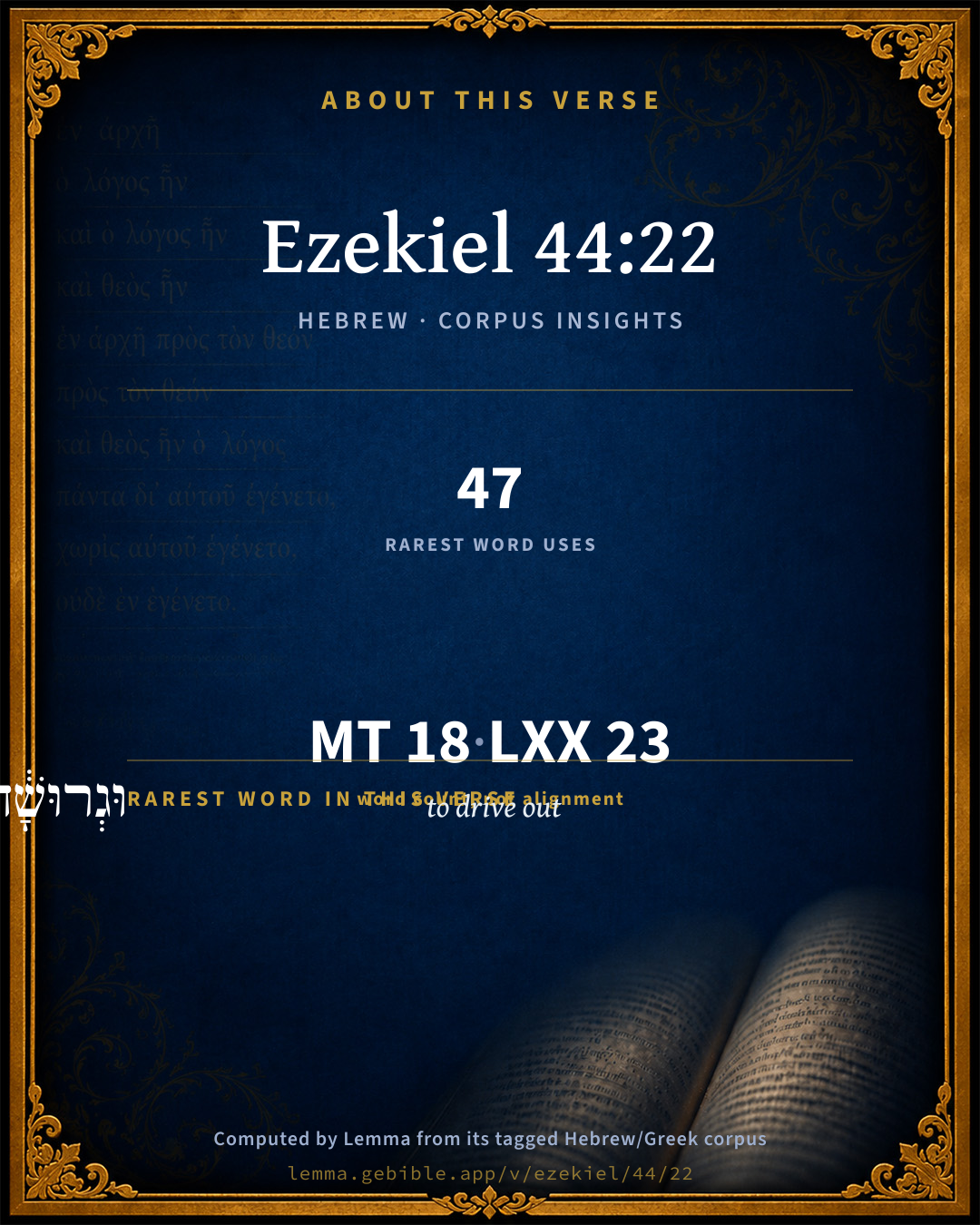
These counts appear in no published source. They are computed here, from the morphology-tagged text and Lemma’s own curated glosses. What Lemma adds →

18
words
14
distinct lemmas
Prophets
section

Shared distinctive vocabulary

וּגְרוּשָׁ֔ה to drive out H1644 occurs in 45 verses of the Hebrew Bible. Also found in:

Grammatical profile

  • 4 verbs
  • 9 nouns
  • 1 preposition
  • 2 conjunctions
  • 2 particles

Verb forms

  • וּגְרוּשָׁ֔ה Qal · Participle Passive
  • יִקְח֥וּ Qal · Imperfect
  • תִּֽהְיֶ֣ה Qal · Imperfect
  • יִקָּֽחוּ Qal · Imperfect

Repetition

Words recur within this verse — often emphatic in Hebrew:

  • וְאַלְמָנָה֙ widow H490 ×3
  • יִקְח֥וּ to take H3947 ×2

Hebrew & Septuagint length

In English translation the verse runs 38 words from the Hebrew and 38 from the Septuagint (LXX English) — the same length.

A rough comparison of the two English renderings, which tokenize alike — not a word-level alignment.

Word counts can differ between the Hebrew and the Greek without any difference in meaning — e.g. the Hebrew direct-object marker אֵת has no separate Greek word, and Greek often adds the article ὁ.

In the original languages it is 18 Hebrew tokens and 23 Greek tokens — but the two are counted differently (Hebrew bundles its prefixes and suffixes into one token; the Greek is in lemma form), so that isn’t a like-for-like length.

Cross-references

7

Topical passages linked to Ezekiel 44:22 in the Treasury of Scripture Knowledge — connected by theme and wording, ordered by reader-vote popularity; previews shown in the World English Bible.

  • Leviticus 21:7 "'They shall not marry a woman who is a prostitute, or profane; neither shall they marry a woman divorced from her husband: for he is holy to his God.
  • Leviticus 21:13–14 "'He shall take a wife in her virginity.
  • Deuteronomy 24:1–4 When a man takes a wife, and marries her, then it shall be, if she find no favor in his eyes, because he has found some unseemly thing in her, that he shall write her a bill of divorce, and give it in her hand, and send her out of his house.
  • 1 Timothy 3:2 The overseer therefore must be without reproach, the husband of one wife, temperate, sensible, modest, hospitable, good at teaching;
  • 1 Timothy 3:4–5 one who rules his own house well, having children in subjection with all reverence;
  • 1 Timothy 3:11–12 Their wives in the same way must be reverent, not slanderers, temperate, faithful in all things.
  • Titus 1:6 if anyone is blameless, the husband of one wife, having children who believe, who are not accused of loose or unruly behavior.

Cross-references courtesy of OpenBible.info (CC BY 4.0).

Hebrew and Greek witnesses Masoretic Hebrew ↔ Greek Septuagint

The same verse in the two great witnesses to the Old Testament, shown verse-for-verse.

These are two independent witnesses, not word-aligned to each other, and the Septuagint is shown in lemma (dictionary) form.

Hebrew Ezekiel 44:22 Masoretic · Westminster Leningrad Codex

וְאַלְמָנָה֙ וּגְרוּשָׁ֔ה לֹֽא יִקְח֥וּ לָהֶ֖ם לְנָשִׁ֑ים כִּ֣י אִם בְּתוּלֹ֗ת מִזֶּ֨רַע֙ בֵּ֣ית יִשְׂרָאֵ֔ל וְהָֽאַלְמָנָה֙ אֲשֶׁ֣ר תִּֽהְיֶ֣ה אַלְמָנָ֔ה מִכֹּהֵ֖ן יִקָּֽחוּ

Neither shall they take for their wives a widow, nor her who is put away; but they shall take virgins of the seed of the house of Israel, or a widow who is the widow of a priest.

World English Bible · Public Domain

Greek LXX Ezekiel 44:22 Septuagint · lemma form

καί χήρα καί ἐκβεβηλόω οὐ λαμβάνω ἑαυτοῦ εἰς γυνή ἀλλά ἤ παρθένος ἐκ ὁ σπέρμα ἰσραήλ καί χήρα ἐάν γίγνομαι ἐκ ἱερεύς λαμβάνω

Neither shall they take to themselves to wife a widow, or one that is put away, but a virgin of the seed of Israel: but if there should happen to be a priest's widow, they shall take her.

LXX2012 (modern English Septuagint) · Public Domain

Hebrew: Westminster Leningrad Codex (CC BY 4.0). Greek: Septuagint (public domain); English from LXX2012 (modern English Septuagint) (Public Domain). How the Septuagint differs from the Hebrew →

Targum (Aramaic paraphrase)

1

The Targum is the ancient Jewish Aramaic paraphrase of the Hebrew Scriptures — an interpretive translation, not the Hebrew text itself. Onkelos (literal) and Pseudo-Jonathan (expansive) render the Torah, and Jonathan the Prophets. Coverage is partial: where no permissively-licensed English translation exists for a verse, only the Aramaic is shown. This is verse-level text, not a word-by-word alignment to the Hebrew.

  1. Targum Jonathan Prophets (Joshua–Malachi)
    וְאַרְמִלָא וּמְתָרְכָא לָא יִסְבוּן לְהוֹן לִנְשִׁין אֱלָהֵין בְּתוּלְתָּא מִזַרְעָא דְבֵית יִשְׂרָאֵל וְאַרְמַלְתָּא דִי תְהֵי אַרְמַלְתָּא שְׁאַר כַּהֲנַיָא יִסְבוּן:

    (no public-domain English translation for this verse)

    Targum Jonathan — Aramaic: “Mikraot Gedolot” (public domain). English: “Sefaria Community Translation” (CC0 1.0 (public-domain dedication)); “London "Chaldee Paraphrase," 1871” (public domain). Text via Sefaria.

Commentary

Notes on Ezekiel 44:22 from classic Christian and Jewish commentators (each source and its license shown beneath its notes). The classic Christian expositions comment on the surrounding passage and are grouped to its opening verse, so a note may address several verses; the Jewish commentaries on the Tanakh (Rashi and others) are per-verse, so they appear only where the commentator wrote on this verse.

Lemma curates 59 commentaries, every one of them public domain or Creative Commons licensed, each selected and text-cleaned for this edition rather than reprinted as found. About our sources →

Trapp's Complete Commentary

John Trapp

Eze 44:22 Neither shall they take for their wives a widow, nor her that is put away: but they shall take maidens of the seed of the house of Israel, or a widow that had a priest before.

Ver. 22. Neither shall they take for their wives.] Ministers, of all men, should be careful whom they wed, for many reasons. Hear what good counsel one minister {a} of mine acquaintance gave another:

“ Quaere tibi uxorem quae sit Pia, Pulchra, Pudica,

Provida, verborum Parca, et Parere parata. ”

“Seek for yourself a wife who is pius, beautiful, chaste,

has forsight, of few words, and prepared to have children.”

{a} Mr Thomas Dugard.

John Trapp, A Commentary or Exposition upon All the Books of the Old and New Testament (1647–1656) — public domain. Text from a community e-Sword module.

Adam Clarke's Commentary

Verse 22. Neither shall they take for their wives a widow] This was prohibited to the high priest only, by Moses, Le 21:13-14.

Adam Clarke's Commentary on the Bible (1810–1826) — public domain. Text from a community e-Sword/MySword module.

Ellicott's Commentary for English Readers

(22) A widow that had a priest before.—In regard both to marriage and to mourning (Eze_44:25-27) the Levitical law made a broad distinction between the ordinary priest and the high priest. The former was only forbidden to marry a divorced woman (Lev_21:7), but was allowed to marry a widow; the latter could marry only a virgin of Israel (ib. 14). So also in the law of mourning; the high priest might not be “defiled” nor make any sign of mourning even for his nearest of kin (Lev_21:11-14). Ezekiel does not recognise this distinction, and in fact nowhere mentions the high priest at all; but, instead, gives a general law for all priests, somewhat between the two.

A Bible Commentary for English Readers, edited by Charles John Ellicott (1878–1897) — public domain. Text from a community e-Sword module.

The Cambridge Bible for Schools and Colleges

gen. ed. J. J. S. Perowne

22. The marriage of the priests. They shall marry only virgins, or the widows of former priests. In Lev_21:14 marrying a widow of any kind is forbidden to the high-priest, but no restriction is imposed on the priests (Eze_44:7). Ezek. makes no allusion anywhere to a high-priest.

The Cambridge Bible for Schools and Colleges (gen. ed. J. J. S. Perowne; Cambridge University Press, 1878–1918) — public domain. Text from a community e-Sword module.

John Gill's Exposition

Neither shall they take for their wives a widow,.... Who has been not only another man's, but at her own will, and done her own pleasure, and been her own mistress, and so not easily brought into subjection, and to behave as becoming her station:

or her that is put away; or, "thrust forth" (q); out of doors; whose husband has given her a bill of divorce; since she may be suspected of having done some ill thing:

but they shall take maidens of the seed of the house of Israel; virgins, and not of the families of unconverted persons, who have been brought up in an irreligious way, but of godly families, and who have had a religious education:

or a widow that had a priest before: and so used to religious exercises, and to the manner of living of such persons. All good men should be careful whom they marry, and especially ministers of the Gospel; who are here supposed and allowed to marry, contrary to the church of Rome, which forbids her priests to marry. It is observed by some, and with great propriety, that in the latter days antichristian churches will be disowned; and that godly faithful ministers will become pastors, and take the care of such churches, who are like a chaste virgin espoused to Christ, and such who have had faithful pastors over them before. This seems to refer to the law concerning the marriage of the high priest, Lev 21:13, and what is there enjoined him is here enjoined all the priests of the Lord; and therefore, as Kimchi rightly observes, this is a new rule respecting future times.

(q) "expulsam", Montanus, Heb; "ejectam", Piscator.

John Gill's Exposition of the Whole Bible (1746–1763) — public domain (CC PDM 1.0). Text via the HelloAO Bible API.

Haydock's Catholic Bible Commentary

Widow. Moses laid this restraint upon the high priest, Leviticus xxi. 13. (Calmet)

George Leo Haydock (1774–1849), Haydock's Catholic Family Bible and Commentary, 1859 edition — public domain. Excludes Psalms (Douay-Rheims chapter numbering differs from Protestant) and Deuterocanonical books (Catholic canon only).

Matthew Poole's English Annotations

God allowed them to marry, only directs that it be not to one of ill fame or divorced, Lev 21:13,14, nor the widow of any deceased common person; yet a priest might realty a priest’s widow, but a virgin is rather commended to their choice; and whether widow or virgin, it must not be as Moses married a daughter of a strange people, or as they did in Babylon, Ezr 10:18, &c.; and possibly this of Ezekiel was designed as a rule to direct Ezra in reforming this disorder when they came from Babylon. Nor were they at liberty to marry any of any tribe, but it must be one of their own tribe too.

Matthew Poole's English Annotations on the Holy Bible (1683–1685) — public domain. Text from a community e-Sword/MySword module.

Whedon's Commentary on the Bible

Daniel D. Whedon

22. The restriction is now placed upon all priests which was formerly laid only upon the high priest (Lev_21:7-14). This shows once more the supreme holiness of the new temple.

Daniel D. Whedon (gen. ed.), Commentary on the Old and New Testaments (1874–1909) — public domain. Text from a community e-Sword module.

The Pulpit Commentary

As to marriage (since the priests in Ezekiel"s "house" were no more expected to be celibates than were those employed about Moses" tabernacle or Solomon"s temple), they were forbidden to marry widows (which the Levitical priests were not, though the high priest was) or divorced women, and allowed to wed only virgins of the house of Israel, or (the sole exception) widows of such as had been priests (compare with the priest-code. (Lev_21:7, Lev_21:13, Lev_21:14) Ezekiel"s enactment discovers two variations first, that it does not formally forbid to the priests marriage with a harlot; and, second, that it sanctions marriage with a priest"s widow. But the first was implied in the prohibition of marriage with an adulteress, and the second was a sign of the higher sanctity of the priesthood belonging to Ezekiel"s temple. Hence, so far from indicating the priority of Ezekiel, it rather points to the priority of Leviticus.

The Pulpit Commentary (1880–1919), ed. H.D.M. Spence-Jones & Joseph S. Exell — public domain. Text from a community e-Sword module.

Rashi

Rabbi Shlomo Yitzchaki (Rashi)

but...virgins may the High Priests take. But there are some priests who may take a widow, namely, the ordinary ones, and this is the meaning of “some of the priests may marry”; there are some priests who are permitted to marry a widow.

who is only a widow A real [widow], excluding a divorcee and a woman upon whom the rite of chalitzah was performed; although she is unmarried, she is forbidden even for an ordinary [priest].

Rashi on the Tanakh — English translations: “The Judaica Press complete Tanach with Rashi, translated by A. J. Rosenberg” (CC BY 4.0); “Pentateuch with Rashi's commentary by M. Rosenbaum and A.M. Silbermann, 1929-1934” (public domain); “The Metsudah Tanach series, Lakewood, N.J” (CC BY 4.0); and “The Book of Joshua, Metsudah Publications, 1997” (CC BY 4.0). Text via Sefaria.

Lesson kit

Teaching starters — assembled from the data on this page, not authored interpretation. Every prompt links to the verse data it draws on. Edit before teaching.

Ezekiel, in the Prophets, opens this verse with 18 words (14 distinct Hebrew lemmas). Its most distinctive word is gârash (“to drive out”). A historical commentator’s framing appears above. Read the whole chapter for the surrounding context.

Discussion questions

  1. What does “to drive out” (gârash) contribute to the verse as a whole?
  2. How does Genesis 3:24, which shares the word «to drive out», read alongside this verse?
  3. What does the repetition of “widow” (3× in this one verse) do in this verse?
  4. These translations render this verse differently. What is at stake in choosing one wording over another?
  5. «וּגְרוּשָׁ֔ה» is a Qal Participle Passive verb. How does that grammatical form shape the action described?
  6. Compare how Trapp's Complete Commentary and Adam Clarke's Commentary read this verse. Where do they agree or differ?

Things to notice

Reading settings

Reading text

Shown beneath each verse's original-language words.

Old Testament
Old Testament edition

Read the OT as the Masoretic Hebrew (MT) or the Greek Septuagint (LXX).

English shown for the Greek Septuagint (in the Hebrew ↔ Greek comparison).

Comparing translations? Open the Compare panel on any verse page to stack up to four side by side.