Deuteronomy 30:4

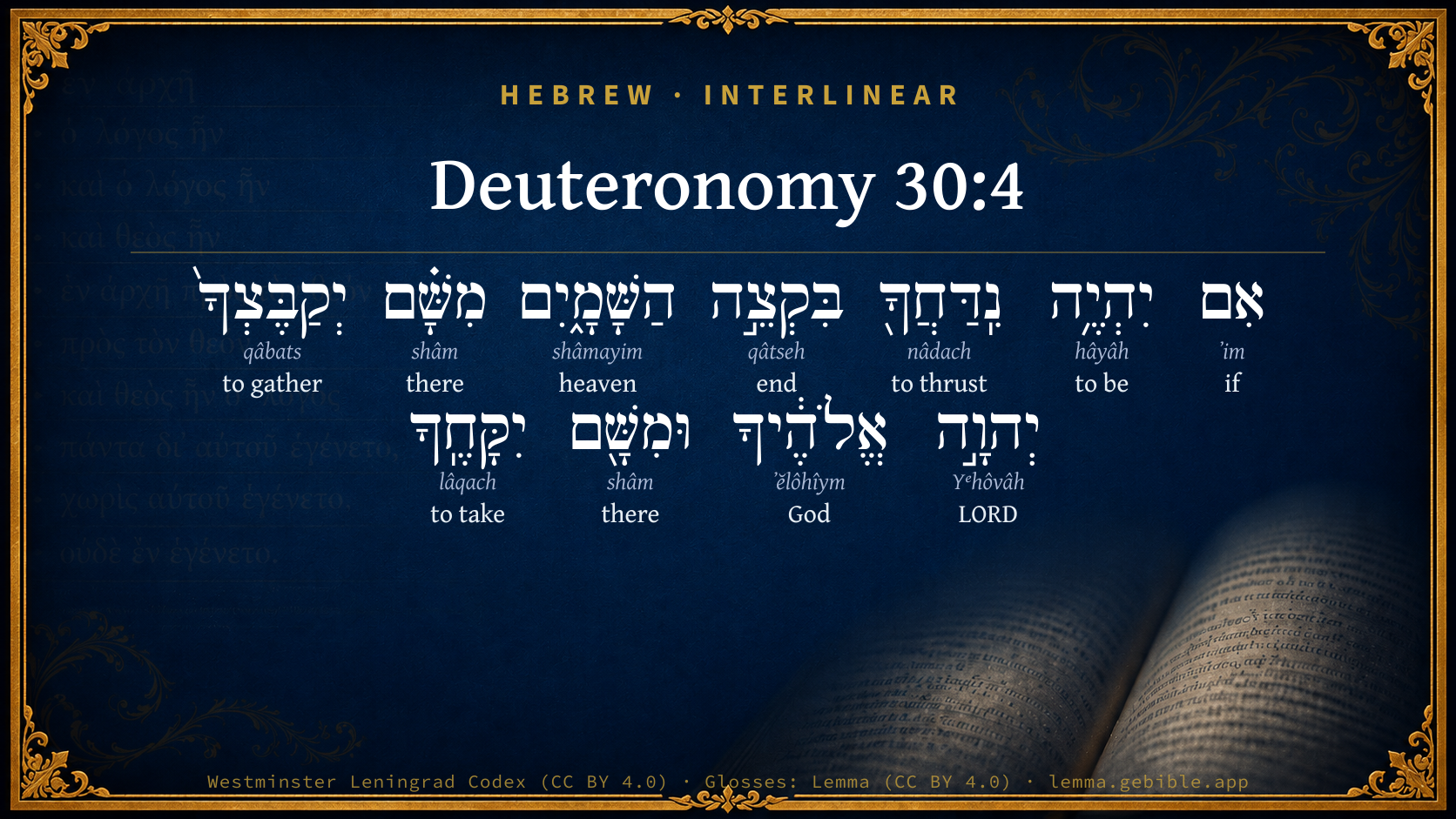
Hebrew (Westminster Leningrad Codex) Deuteronomy 30:4 appears in the Hebrew Old Testament. The text above is from the Westminster Leningrad Codex. Each word links to its Strong’s number, a concise gloss, and parsing drawn from the Open Scriptures Hebrew Bible morphology. Click any word for its full Brown-Driver-Briggs (BDB) entry.
Download image
Cite this verse

Deuteronomy 30:4 (World English Bible). Public Domain. Lemma interlinear Bible study tool, https://lemma.gebible.app/v/deuteronomy/30/4.

Show BibTeX & RIS
BibTeX
RIS
English Translation
If [any of] your outcasts are in the uttermost parts of the heavens, from there will Yahweh your God gather you, and from there will he bring you back:
World English Bible · Public Domain
Download a study sheet

One document with this verse’s original text, its word-by-word gloss line, the meaning frame, cross-references with their text, attributed commentary, and full source and license credits — printable, and it pastes into notes with its structure intact.

This verse Autodidact and up

Study sheet (.html) Plain text (.txt)

A passage Seminary Student

Up to 50 verses in one chapter. A passage sheet keeps up to 6 commentary sources and 12 cross-references per verse, in the order this page ranks them, and says so on the sheet whenever that leaves anything out. Ask for a single verse and you get the Autodidact verse sheet above.

Everything on this page stays free to read, with no account — the sheet is a download of what is already on screen, not access to it.

Want to remove ads? Support Godless Engineer
Compare translations 3

The same verse in 3 English versions, stacked beneath the original-language interlinear above. Click any original word for its lexicon entry.

Each is an independent rendering of the whole verse — the interlinear is not word-aligned to these translations.

Highlighted words mark where these versions differ — a whole-verse word diff, not a word-by-word alignment.

  • World English Bible Public Domain
    If [any of] your outcasts are in the uttermost parts of the heavens, from there will Yahweh your God gather you, and from there will he bring you back:
  • King James Version Public Domain
    If any of thine be driven out unto the outmost parts of heaven, from thence will the LORD thy God gather thee, and from thence will he fetch thee:
  • unfoldingWord Literal Text CC BY-SA 4.0
    If your scattered people are in the end of the heavens, from there Yahweh your God will gather you, and from there he will take you.

unfoldingWord Literal Text — © unfoldingWord, licensed CC BY-SA 4.0. Word-aligned USFM3 via Door43 (git.door43.org/unfoldingWord/en_ult).

Versions to compare (up to 4)

3 of 4 selected

Show all 18 translations

Every available English version of this verse, each an independent rendering of the whole verse.

  • World English Bible Public Domain
    If [any of] your outcasts are in the uttermost parts of the heavens, from there will Yahweh your God gather you, and from there will he bring you back:
  • Berean Standard Bible Public Domain
    Even if you have been banished to the farthest horizon, He will gather you and return you from there.
  • Majority Standard Bible Public Domain
    Even if you have been banished to the farthest horizon, He will gather you and return you from there.
  • King James Version Public Domain
    If any of thine be driven out unto the outmost parts of heaven, from thence will the LORD thy God gather thee, and from thence will he fetch thee:
  • American Standard Version (1901) Public Domain
    If `any of' thine outcasts be in the uttermost parts of heaven, from thence will Jehovah thy God gather thee, and from thence will he fetch thee:
  • Revised Version (1885) Public Domain
    If any of thine outcasts be in the uttermost parts of heaven, from thence will the LORD thy God gather thee, and from thence will he fetch thee:
  • Geneva Bible (1599) Public Domain
    Though thou werest cast vnto the vtmost part of heauen, from thence will the Lord thy God gather thee, and from thence wil he take thee,
  • Douay-Rheims (1899) Public Domain
    If thou be driven as far as the poles of heaven, the Lord thy God will fetch thee back from thence,
  • Young's Literal Translation Public Domain
    `If thine outcast is in the extremity of the heavens, thence doth Jehovah thy God gather thee, and thence He doth take thee;
  • Literal Standard Version CC BY-SA 4.0
    If your outcast is in the extremity of the heavens, your God YHWH gathers you from there and He takes you from there;
  • Unlocked Literal Bible CC BY-SA 4.0
    If any of your exiled people are in the farthest places under the heavens, from there Yahweh your God will gather you, and from there he will bring you.
  • unfoldingWord Literal Text CC BY-SA 4.0
    If your scattered people are in the end of the heavens, from there Yahweh your God will gather you, and from there he will take you.
  • Darby Bible Public Domain
    Though there were of you driven out unto the end of the heavens, from thence will Jehovah thy God gather thee, and from thence will he fetch thee;
  • World Messianic Bible Public Domain
    If your outcasts are in the uttermost parts of the heavens, from there the LORD your God will gather you, and from there he will bring you back.
  • Webster's Bible Public Domain
    If any of thine shall be driven out to the outmost parts of heaven, from thence will the LORD thy God gather thee, and from thence will he bring thee:
  • Free Bible Version CC BY-SA 4.0
    Even if you're exiled to the ends of the earth, I will gather you from there and bring you back.
  • Bible in Basic English Public Domain
    Even if those who have been forced out are living in the farthest part of heaven, the Lord your God will go in search of you, and take you back;
  • JPS Tanakh (1917) Public Domain
    If any of thine that are dispersed be in the uttermost parts of heaven, from thence will the LORD thy God gather thee, and from thence will He fetch thee.

Literal Standard Version (2020), Covenant Press — licensed CC BY-SA 4.0. Text via the HelloAO Bible API (eBible.org). Unlocked Literal Bible (unfoldingWord) — licensed CC BY-SA 4.0. Text via the HelloAO Bible API (eBible.org). unfoldingWord Literal Text — © unfoldingWord, licensed CC BY-SA 4.0. Word-aligned USFM3 via Door43 (git.door43.org/unfoldingWord/en_ult). Free Bible Version, Dr. Jonathan Gallagher — licensed CC BY-SA 4.0. Text via the HelloAO Bible API (eBible.org).

Word by word

More ways to search: Search by grammar → Find every occurrence → Compare this word →

Practice this passage: Drill this verse → Learn its vocabulary →

נִֽדַּחֲךָ֖
nâdach
H5080
“thrust · you”
Verb, Niphal, Participle Passive, Masculine, Singular, Construct + Suffix, Personal, 2nd Person, Masculine, Singular
Part of Speech
Verb
Stem
Niphal
Form
Participle Passive
Gender
Masculine
Number
Singular
State
Construct
Full BDB Definition

Origin: a primitive root

TWOT: 1304

to impel, thrust, drive away, banish - (Qal) - to impel - to thrust away, banish - (Niphal) - to be impelled - to be thrust out, be banished - banished, outcast (participle) - to be driven away - to be thrust away, thrust aside - (Pual) to be thrust into - thrust (participle) - (Hiphil) - to thrust, move, impel - to thrust out, banish - to thrust away, thrust aside - (Hophal) to be chased, be hunted - chased, hunted (participle)
  1. אִם ʼim H518 “if” Conjunction
  2. יִהְיֶ֥ה hâyâh H1961 “to be” Verb, Qal, Imperfect, 3rd Person, Masculine, Singular
  3. בִּקְצֵ֣ה qâtseh H7097 “in/at · end of” Preposition + Noun, Common, Both, Singular, Construct
  4. הַשָּׁמָ֑יִם shâmayim H8064 “the · heaven(s)” Particle, Definite Article + Noun, Common, Masculine, Plural, Absolute
  5. מִשָּׁ֗ם shâm H8033 “from · there” Preposition + Adverb
  6. יְקַבֶּצְךָ֙ qâbats H6908 “to gather · you” Verb, Piel, Imperfect, 3rd Person, Masculine, Singular + Suffix, Personal, 2nd Person, Masculine, Singular
  7. יְהוָ֣ה Yᵉhôvâh H3068 “LORD” Noun, Proper
  8. אֱלֹהֶ֔יךָ ʼĕlôhîym H430 “God(s) · your” Noun, Common, Masculine, Plural, Construct + Suffix, Personal, 2nd Person, Masculine, Singular
  9. וּמִשָּׁ֖ם shâm H8033 “and · from · there” Conjunction + Preposition + Adverb
  10. יִקָּחֶֽךָ lâqach H3947 “to take · you” Verb, Qal, Imperfect, 3rd Person, Masculine, Singular + Suffix, Personal, 2nd Person, Masculine, Singular

About this verse

These counts appear in no published source. They are computed here, from the morphology-tagged text and Lemma’s own curated glosses. What Lemma adds →

11
words
10
distinct lemmas
Pentateuch
section

Shared distinctive vocabulary

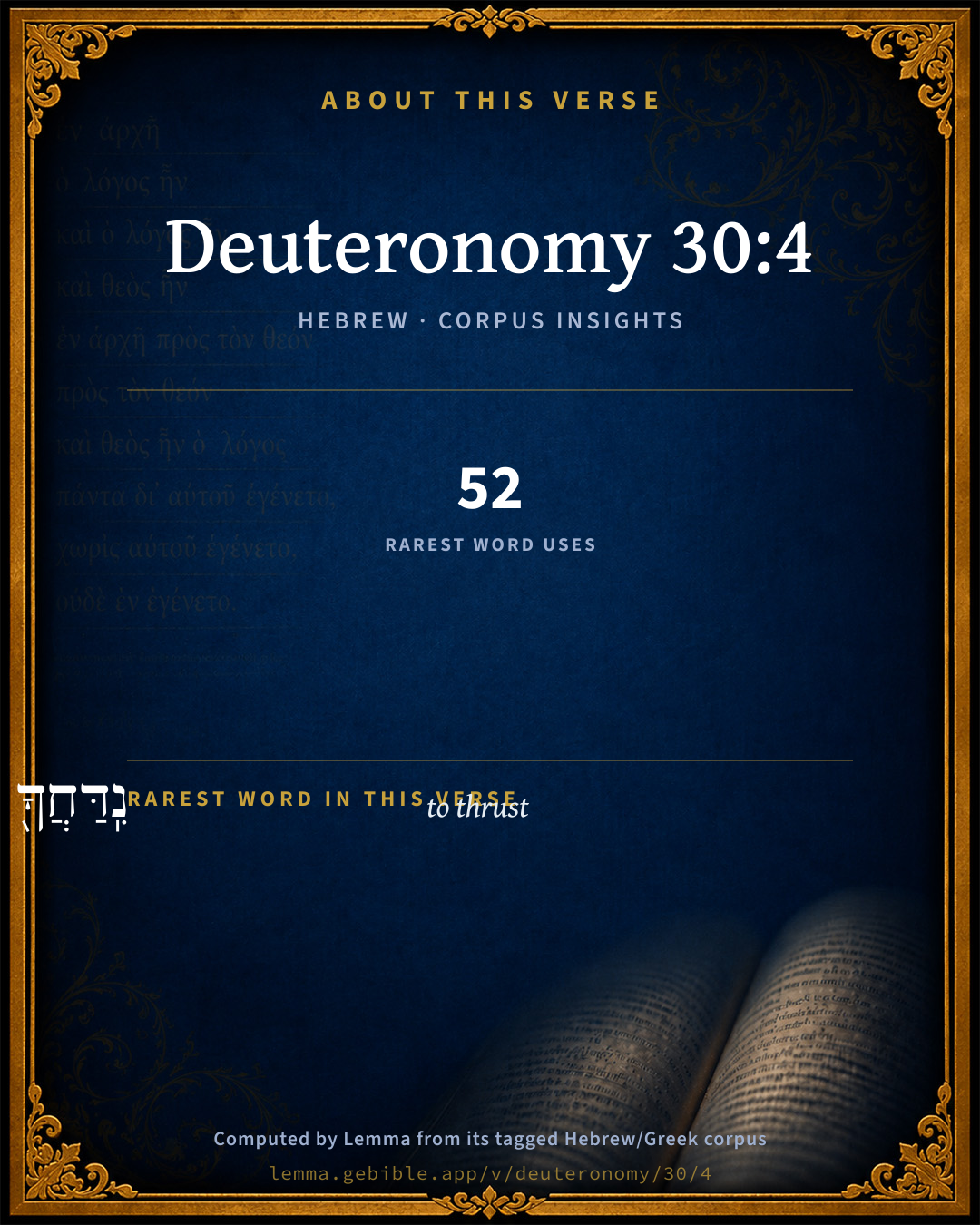
נִֽדַּחֲךָ֖ to thrust H5080 occurs in 51 verses of the Hebrew Bible. Also found in:

Grammatical profile

  • 4 verbs
  • 4 nouns
  • 1 conjunction
  • 2 adverbs

Verb forms

  • יִהְיֶ֥ה Qal · Imperfect
  • נִֽדַּחֲךָ֖ Niphal · Participle Passive
  • יְקַבֶּצְךָ֙ Piel · Imperfect
  • יִקָּחֶֽךָ Qal · Imperfect

Repetition

A word recurs within this verse — often emphatic in Hebrew:

  • מִשָּׁ֗ם there H8033 ×2

Hebrew & Septuagint length

In English translation the verse runs 29 words from the Hebrew and 29 from the Septuagint (LXX English) — the same length.

A rough comparison of the two English renderings, which tokenize alike — not a word-level alignment.

Word counts can differ between the Hebrew and the Greek without any difference in meaning — e.g. the Hebrew direct-object marker אֵת has no separate Greek word, and Greek often adds the article ὁ.

Cross-references

6

Topical passages linked to Deuteronomy 30:4 in the Treasury of Scripture Knowledge — connected by theme and wording, ordered by reader-vote popularity; previews shown in the World English Bible.

  • Nehemiah 1:9 but if you return to me, and keep my commandments and do them, though your outcasts were in the uttermost part of the heavens, yet will I gather them from there, and will bring them to the place that I have chosen, to cause my name to dwell there.
  • Ezekiel 39:25–29 Therefore thus says the Lord Yahweh: Now will I bring back the captivity of Jacob, and have mercy on the whole house of Israel; and I will be jealous for my holy name.
  • Deuteronomy 28:64 Yahweh will scatter you among all peoples, from the one end of the earth even to the other end of the earth; and there you shall serve other gods, which you have not known, you nor your fathers, even wood and stone.
  • Isaiah 11:11–16 It shall happen in that day, that the Lord will set his hand again the second time to recover the remnant of his people, who shall remain, from Assyria, and from Egypt, and from Pathros, and from Cush, and from Elam, and from Shinar, and from Hamath, and from the islands of the sea.
  • Isaiah 43:6 I will tell the north, Give up; and to the south, Don't keep back; bring my sons from far, and my daughters from the end of the earth;
  • Zephaniah 3:19–20 Behold, at that time I will deal with all those who afflict you, and I will save those who are lame, and gather those who were driven away. I will give them praise and honor, whose shame has been in all the earth.

Cross-references courtesy of OpenBible.info (CC BY 4.0).

Hebrew and Greek witnesses Masoretic Hebrew ↔ Greek Septuagint

The same verse in the two great witnesses to the Old Testament, shown verse-for-verse.

These are two independent witnesses, not word-aligned to each other, and the Septuagint is shown in lemma (dictionary) form.

Hebrew Deuteronomy 30:4 Masoretic · Westminster Leningrad Codex

אִם יִהְיֶ֥ה נִֽדַּחֲךָ֖ בִּקְצֵ֣ה הַשָּׁמָ֑יִם מִשָּׁ֗ם יְקַבֶּצְךָ֙ יְהוָ֣ה אֱלֹהֶ֔יךָ וּמִשָּׁ֖ם יִקָּחֶֽךָ

If [any of] your outcasts are in the uttermost parts of the heavens, from there will Yahweh your God gather you, and from there will he bring you back:

World English Bible · Public Domain

Greek LXX Deuteronomy 30:4 Septuagint · lemma form

ἐάν εἰμί ὁ διασπορά σύ ἀπό ἄκρος ὁ οὐρανός ἕως ἄκρος ὁ οὐρανός ἐκεῖθεν συνἄγω σύ κύριος ὁ θεός σύ καί ἐκεῖθεν λαμβάνω σύ κύριος ὁ θεός σύ

If your dispersion be from one end of heaven to the other, thence will the Lord your God gather you, and thence will the Lord your God take you.

LXX2012 (modern English Septuagint) · Public Domain

On this verse, Ellicott's Commentary for English Readers discusses the Septuagint’s reading. Read the note in Commentary ↓

Hebrew: Westminster Leningrad Codex (CC BY 4.0). Greek: Septuagint (public domain); English from LXX2012 (modern English Septuagint) (Public Domain). How the Septuagint differs from the Hebrew →

Targum (Aramaic paraphrase)

2

The Targum is the ancient Jewish Aramaic paraphrase of the Hebrew Scriptures — an interpretive translation, not the Hebrew text itself. Onkelos (literal) and Pseudo-Jonathan (expansive) render the Torah, and Jonathan the Prophets. Coverage is partial: where no permissively-licensed English translation exists for a verse, only the Aramaic is shown. This is verse-level text, not a word-by-word alignment to the Hebrew.

  1. Targum Onkelos Torah (Genesis–Deuteronomy)
    אִם יְהֵי גַלְוָתָךְ בִּסְיָפֵי שְׁמַיָא מִתַּמָן יִכְנְשִׁנָךְ יְיָ אֱלָהָךְ וּמִתַּמָן יְקָרְבִנָךְ

    (no public-domain English translation for this verse)

    Targum Onkelos — Aramaic: “Onkelos Genesis” (public domain); “Onkelos Exodus” (public domain); “Onkelos Leviticus” (public domain); “Onkelos Numbers” (public domain); “Onkelos Deuteronomy” (public domain). English: “Sefaria Community Translation” (CC0 1.0 (public-domain dedication)); “J.W. Etheridge. The Targums of Onkelos and Jonathan Ben Uzziel on the Pentateuch. London: Longmans, Green, 1862” (public domain). Text via Sefaria.

  2. Targum Pseudo-Jonathan Torah (Genesis–Deuteronomy)
    אִין יְהוֹן מְבַדְרֵיכוֹן בִּסְיָפֵי שְׁמַיָא מִתַּמָן יִכְנוֹשׁ יַתְכוֹן מֵימְרָא דַיְיָ אֱלָהָכוֹן עַל יְדוֹי דְאֵלִיָהוּ כַּהֲנָא רַבָּא וּמִתַּמָן יְקָרֵב יַתְכוֹן עַל יְדוֹי דְמַלְכָּא מְשִׁיחָא

    Though you may be dispersed unto the ends of the heavens, from thence will the Word of the Lord gather you together by the hand of Elijah the great priest, and from thence will He bring you by the hand of the King Meshiha.

    Targum Pseudo-Jonathan — Aramaic: “Targum Jonathan on Genesis” (public domain); “Targum Jonathan on Exodus” (public domain); “Targum Jonathan on Leviticus” (public domain); “Targum Jonathan on Numbers” (public domain); “Targum Jonathan on Deuteronomy” (public domain). English: “The Targum of Jonathan ben Uzziel, trans. J. W. Etheridge, London, 1862” (public domain). Text via Sefaria.

Commentary

Notes on Deuteronomy 30:4 from classic Christian and Jewish commentators (each source and its license shown beneath its notes). The classic Christian expositions comment on the surrounding passage and are grouped to its opening verse, so a note may address several verses; the Jewish commentaries on the Tanakh (Rashi and others) are per-verse, so they appear only where the commentator wrote on this verse.

Lemma curates 59 commentaries, every one of them public domain or Creative Commons licensed, each selected and text-cleaned for this edition rather than reprinted as found. About our sources →

Trapp's Complete Commentary

John Trapp

Deu 30:4 If [any] of thine be driven out unto the outmost [parts] of heaven, from thence will the LORD thy God gather thee, and from thence will he fetch thee:

Ver. 4. If any of thine be driven.] The Jews have been, for this sixteen hundred years and upwards, a dejected and despised people, hated and cast out by a common consent of all nations, for their unexpiable guilt in murdering the Messiah, which they now begin to be somewhat sensible of, and will be so more and more. {See Trapp on "Deu 28:28"}

John Trapp, A Commentary or Exposition upon All the Books of the Old and New Testament (1647–1656) — public domain. Text from a community e-Sword module.

Joseph Benson's Commentary

Deu 30:4. If any of thine be driven out unto the out-most parts of heaven — This part of the prophecy has been fulfilled; they have been thus driven away. From thence will the Lord gather thee — Not the widest and most distant dispersion of any of thy tribes shall cause them to be finally lost.

But God, upon the before-mentioned condition, will so order it that you shall in the most material instances recover your ancient state. Nehemiah pleads this promise in his prayer for the restoration of Jerusalem, Neh 1:8-9. And it was in part fulfilled when Cyrus issued a proclamation throughout all his kingdom, that all the Jews might return, if they pleased, into their own land, Ezr 1:1-5. But the promise is generally considered as having a further view; and as respecting their restoration to their own country in the latter days, after this their long and last dispersion. The Jews themselves apply it to their present condition, being of opinion that God hath appointed a time for their deliverance, and that if they repent he will shorten the days of their banishment. But, as we have just observed, they must also believe in Jesus of Nazareth, as the true Messiah, before they be restored.

Joseph Benson's Commentary on the Old and New Testaments (1811–1818) — public domain. Text from a community e-Sword module.

Geneva Bible (1599)

Geneva Bible translators

And bring thee into thy country.

Even to the world’s end.

Geneva Bible (1599) marginal notes — public domain. Text via Bolls.life.

Ellicott's Commentary for English Readers

(4) If any of thine be driven out.—In the LXX., “If thy dispersion be.”

Unto the outmost parts of heaven.—The LXX. version of these words is traceable in Mat_24:31, “From the one end of heaven to the other.”

A Bible Commentary for English Readers, edited by Charles John Ellicott (1878–1897) — public domain. Text from a community e-Sword module.

The Cambridge Bible for Schools and Colleges

gen. ed. J. J. S. Perowne

4. If any of thine outcasts] quoted in Neh_1:9; cp. above Deu_30:1 (driven), Deu_28:64, and in another sense Deu_22:1.

The Cambridge Bible for Schools and Colleges (gen. ed. J. J. S. Perowne; Cambridge University Press, 1878–1918) — public domain. Text from a community e-Sword module.

John Gill's Exposition

If any of thine be driven out unto the outmost parts of heaven,.... As many of them are in this remote island of ours, Great Britain, reckoned formerly the uttermost part of the earth, as Thule, supposed to be Schetland, an isle belonging to Scotland, is said to be (m); See Gill on Deu 28:49; and as some of them are thought to be in America, which Manasseh Ben Israel (n) had a firm belief of:

from thence will the Lord thy God gather thee, and from thence will he fetch thee; whose eye is omniscient, and reaches every part of the world; and whose arm is omnipotent, and none can stay it, or turn it back. The Targum of Jonathan is,"from thence will he bring you near by the hands of the King Messiah.''

(m) "Ultima Thule", Virgil. Georgic. l. 1. v. 30. Seneca Medea, Act 2. in fine. (n) Spes Israelis, sect. 38.

John Gill's Exposition of the Whole Bible (1746–1763) — public domain (CC PDM 1.0). Text via the HelloAO Bible API.

Haydock's Catholic Bible Commentary

Poles. The arctic and antarctic, the northern and southern poles; that is, into the most distant regions. (Menochius) --- Hebrew, "the end of heaven," where it seems to rest upon the earth. (Calmet)

George Leo Haydock (1774–1849), Haydock's Catholic Family Bible and Commentary, 1859 edition — public domain. Excludes Psalms (Douay-Rheims chapter numbering differs from Protestant) and Deuterocanonical books (Catholic canon only).

The Pulpit Commentary

Vers. 4, 5. Consequent on this deliverance would be the gathering of Israel from all the places of the dispersion and their return to possess the land which their fathers possessed, in greater numbers than their fathers were. This last statement suggests doubt as to the literal interpretation of this prediction, for, as Keil remarks, "If there is to be an increase in the num-bet of the Jews when gathered out of their dispersion into all the world, above the number of their fathers, and therefore above the number of the Israelites in the time of Solomon and the first monarchs of the two kingdoms, Palestine will never furnish room enough for a nation multiplied like this." The reference in the following verse to a spiritual renewal suggests the inquiry whether the reference here is not to such a gathering and restoration of Israel as that which St. Paul describes in Romans 11., when the branches that had been broken from the olive tree shall be again grafted into it, and all Israel shall be saved after the fullness of the Gentiles shall be, brought in. To Moses, and indeed to all the Old Testament prophets and saints, the Israel of God presented itself as a nation dwelling in a land given to it by God; but as the national Israel was the type of the spiritual Israel, and as Canaan was the type of the spiritual kingdom of God, the full import of what is said concerning the former is only to be perceived when it is viewed as realized in the latter. Certain it is that it was on this principle that the apostles interpreted the fulfillment of the Old Testament declarations concerning Israel, of which the explanation given by St. James of Amo_9:11, 12 may be noted as an instructive example. (Act_15:15-17) If the rebuilding of the ruined tabernacle of David is to be effected by "the residue of men" being brought to "seek after the Lord, and all the Gentiles upon whom his Name is called," we need not shrink from interpreting this prophecy of Moses as referring to the restoration of Israel by the bringing in of Jew and Gentile into the one fold under the one Shepherd, the Shepherd of Israel. (Joh_9:16)

The Pulpit Commentary (1880–1919), ed. H.D.M. Spence-Jones & Joseph S. Exell — public domain. Text from a community e-Sword module.

unfoldingWord translationNotes

Door43 World Missions Community

General Information:

Moses speaks to the Israelites as if they were one man, so the words "you" and "your" here are singular. (See: Forms of You)

If any of your exiled people are in the farthest places

"Even those of your exiled people who are in the farthest places"

under the heavens

"under the sky" or "on the earth"

translationWords

exile

people of God

heaven

Promised Land

ancestor

possess

unfoldingWord translationNotes — © Distant Shores Media and the Door43 World Missions Community, licensed CC BY-SA 4.0. Source: git.door43.org/Door43/en_tn.

Lesson kit

Teaching starters — assembled from the data on this page, not authored interpretation. Every prompt links to the verse data it draws on. Edit before teaching.

Deuteronomy, in the Pentateuch, opens this verse with 11 words (10 distinct Hebrew lemmas). Its most distinctive word is nâdach (“to thrust”). A historical commentator’s framing appears above. Read the whole chapter for the surrounding context.

Discussion questions

  1. The word nâdach carries the sense “to thrust.” How does it shape the verse?
  2. Deuteronomy 4:19 shares the word «to thrust» with this verse. How do the two illuminate each other?
  3. “there” occurs 2× in this one verse. What is the effect of the repetition?
  4. The translations on this page render this verse differently — a whole-verse word diff, not a word-by-word alignment. What might account for the different wordings?
  5. The verb «יִהְיֶ֥ה» is Qal Imperfect. How does its form color the action?
  6. Reading how Trapp's Complete Commentary and Joseph Benson's Commentary read this verse, where do the two commentators agree and where do they part?

Things to notice

Reading settings

Reading text

Shown beneath each verse's original-language words.

Old Testament
Old Testament edition

Read the OT as the Masoretic Hebrew (MT) or the Greek Septuagint (LXX).

English shown for the Greek Septuagint (in the Hebrew ↔ Greek comparison).

Comparing translations? Open the Compare panel on any verse page to stack up to four side by side.