Ezekiel 3:14

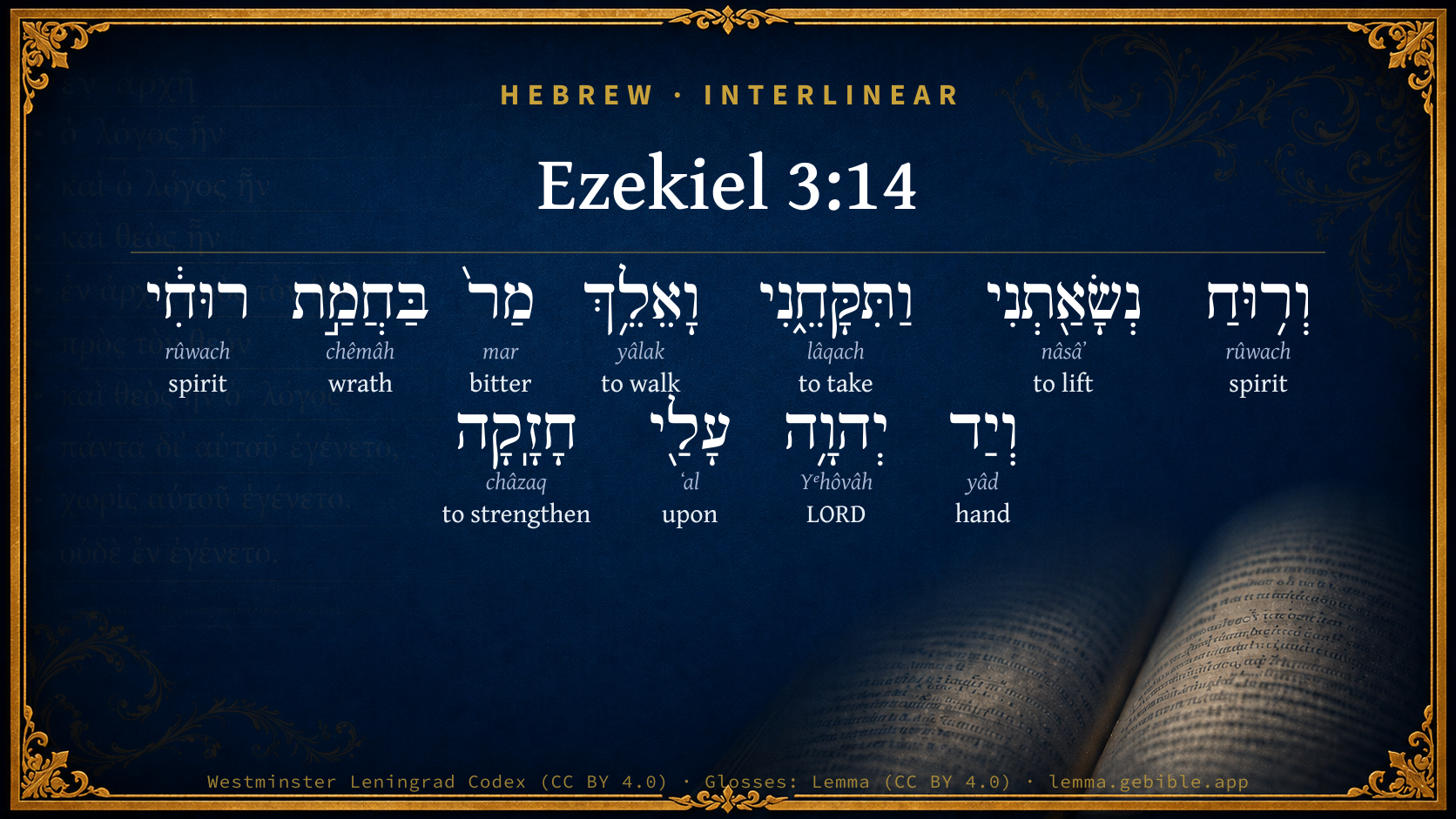
Hebrew (Westminster Leningrad Codex) Ezekiel 3:14 appears in the Hebrew Old Testament. The text above is from the Westminster Leningrad Codex. Each word links to its Strong’s number, a concise gloss, and parsing drawn from the Open Scriptures Hebrew Bible morphology. Click any word for its full Brown-Driver-Briggs (BDB) entry.
Download image
Cite this verse

Ezekiel 3:14 (World English Bible). Public Domain. Lemma interlinear Bible study tool, https://lemma.gebible.app/v/ezekiel/3/14.

Show BibTeX & RIS
BibTeX
RIS
English Translation
So the Spirit lifted me up, and took me away; and I went in bitterness, in the heat of my spirit; and the hand of Yahweh was strong on me.
World English Bible · Public Domain
Download a study sheet

One document with this verse’s original text, its word-by-word gloss line, the meaning frame, cross-references with their text, attributed commentary, and full source and license credits — printable, and it pastes into notes with its structure intact.

This verse Autodidact and up

Study sheet (.html) Plain text (.txt)

A passage Seminary Student

Up to 50 verses in one chapter. A passage sheet keeps up to 6 commentary sources and 12 cross-references per verse, in the order this page ranks them, and says so on the sheet whenever that leaves anything out. Ask for a single verse and you get the Autodidact verse sheet above.

Everything on this page stays free to read, with no account — the sheet is a download of what is already on screen, not access to it.

Want to remove ads? Support Godless Engineer
Compare translations 3

The same verse in 3 English versions, stacked beneath the original-language interlinear above. Click any original word for its lexicon entry.

Each is an independent rendering of the whole verse — the interlinear is not word-aligned to these translations.

Highlighted words mark where these versions differ — a whole-verse word diff, not a word-by-word alignment.

  • World English Bible Public Domain
    So the Spirit lifted me up, and took me away; and I went in bitterness, in the heat of my spirit; and the hand of Yahweh was strong on me.
  • King James Version Public Domain
    So the spirit lifted me up, and took me away, and I went in bitterness, in the heat of my spirit; but the hand of the LORD was strong upon me.
  • unfoldingWord Literal Text CC BY-SA 4.0
    The Spirit lifted me up and took me away, and I went with bitterness in my spirit’s rage, for the hand of Yahweh was powerfully pressing on me!

unfoldingWord Literal Text — © unfoldingWord, licensed CC BY-SA 4.0. Word-aligned USFM3 via Door43 (git.door43.org/unfoldingWord/en_ult).

Versions to compare (up to 4)

3 of 4 selected

Show all 18 translations

Every available English version of this verse, each an independent rendering of the whole verse.

  • World English Bible Public Domain
    So the Spirit lifted me up, and took me away; and I went in bitterness, in the heat of my spirit; and the hand of Yahweh was strong on me.
  • Berean Standard Bible Public Domain
    So the Spirit lifted me up and took me away, and I went in bitterness and in the anger of my spirit, with the strong hand of the LORD upon me.
  • Majority Standard Bible Public Domain
    So the Spirit lifted me up and took me away, and I went in bitterness and in the anger of my spirit, with the strong hand of the LORD upon me.
  • King James Version Public Domain
    So the spirit lifted me up, and took me away, and I went in bitterness, in the heat of my spirit; but the hand of the LORD was strong upon me.
  • American Standard Version (1901) Public Domain
    So the Spirit lifted me up, and took me away; and I went in bitterness, in the heat of my spirit; and the hand of Jehovah was strong upon me.
  • Revised Version (1885) Public Domain
    So the spirit lifted me up, and took me away: and I went in bitterness, in the heat of my spirit, and the hand of the LORD was strong upon me.
  • Geneva Bible (1599) Public Domain
    So the spirit lift me vp, and tooke me away and I went in bitternesse, and indignation of my spirite, but the hand of the Lord was strong vpon me.
  • Douay-Rheims (1899) Public Domain
    The spirit also lifted me, and took me up: and I went away in bitterness in the indignation of my spirit: for the hand of the Lord was with me, strengthening me.
  • Young's Literal Translation Public Domain
    And a spirit hath lifted me up, and doth take me away, and I go bitterly, in the heat of my spirit, and the hand of Jehovah on me `is' strong.
  • Literal Standard Version CC BY-SA 4.0
    And [the] Spirit has lifted me up, and takes me away, and I go bitterly, in the heat of my spirit, and the hand of YHWH [is] strong on me.
  • Unlocked Literal Bible CC BY-SA 4.0
    The Spirit lifted me up and took me away, and I went with bitterness in my spirit's rage, for the hand of Yahweh was powerfully pressing on me!
  • unfoldingWord Literal Text CC BY-SA 4.0
    The Spirit lifted me up and took me away, and I went with bitterness in my spirit’s rage, for the hand of Yahweh was powerfully pressing on me!
  • Darby Bible Public Domain
    And the Spirit lifted me up, and took me away; and I went in bitterness, in the heat of my spirit, and the hand of Jehovah was strong upon me.
  • World Messianic Bible Public Domain
    So the Spirit lifted me up, and took me away; and I went in bitterness, in the heat of my spirit; and the LORD’s hand was strong on me.
  • Webster's Bible Public Domain
    So the spirit lifted me up, and took me away, and I went in bitterness, in the heat of my spirit; but the hand of the LORD was strong upon me.
  • Free Bible Version CC BY-SA 4.0
    As I said, the Spirit lifted me up and carried me away. As I went I was feeling upset and angry; however the Lord's power had taken full control of me.
  • Bible in Basic English Public Domain
    And the wind, lifting me up, took me away: and I went in the heat of my spirit, and the hand of the Lord was strong on me.
  • JPS Tanakh (1917) Public Domain
    So a spirit lifted me up, and took me away; and I went in bitterness, in the heat of my spirit, and the hand of the LORD was strong upon me.

Literal Standard Version (2020), Covenant Press — licensed CC BY-SA 4.0. Text via the HelloAO Bible API (eBible.org). Unlocked Literal Bible (unfoldingWord) — licensed CC BY-SA 4.0. Text via the HelloAO Bible API (eBible.org). unfoldingWord Literal Text — © unfoldingWord, licensed CC BY-SA 4.0. Word-aligned USFM3 via Door43 (git.door43.org/unfoldingWord/en_ult). Free Bible Version, Dr. Jonathan Gallagher — licensed CC BY-SA 4.0. Text via the HelloAO Bible API (eBible.org).

Word by word

More ways to search: Search by grammar → Find every occurrence → Compare this word →

Practice this passage: Drill this verse → Learn its vocabulary →

מַר֙
mar
H4751
“bitter”
Adjective, Adjective, Masculine, Singular, Absolute
Part of Speech
Adjective
Type
Adjective
Gender
Masculine
Number
Singular
State
Absolute
Full BDB Definition

Origin: from H4843

TWOT: 1248a , 1248c

bitter, bitterness (adjective) - of water or food - of harlot's end, end of wickedness, cry (figuratively) - of pain (substantive) - bitterly (adverb)
  1. וְר֥וּחַ rûwach H7307 “and · spirit” Conjunction + Noun, Common, Both, Singular, Absolute
  2. נְשָׂאַ֖תְנִי nâsâʼ H5375 “to lift · me” Verb, Qal, Perfect, 3rd Person, Feminine, Singular + Suffix, Personal, 1st Person, Common, Singular
  3. וַתִּקָּחֵ֑נִי lâqach H3947 “and · to take · me” Conjunction + Verb, Qal, Sequential Imperfect, 3rd Person, Feminine, Singular + Suffix, Personal, 1st Person, Common, Singular
  4. וָאֵלֵ֥ךְ yâlak H3212 “and · to walk” Conjunction + Verb, Qal, Sequential Imperfect, 1st Person, Common, Singular
  5. בַּחֲמַ֣ת chêmâh H2534 “in/at · wrath of” Preposition + Noun, Common, Feminine, Singular, Construct
  6. רוּחִ֔י rûwach H7307 “spirit · my” Noun, Common, Both, Singular, Construct + Suffix, Personal, 1st Person, Common, Singular
  7. וְיַד yâd H3027 “and · hand of” Conjunction + Noun, Common, Both, Singular, Construct
  8. יְהוָ֥ה Yᵉhôvâh H3068 “LORD” Noun, Proper
  9. עָלַ֖י ʻal H5921 “upon · me” Preposition + Suffix, Personal, 1st Person, Common, Singular
  10. חָזָֽקָה châzaq H2388 “to strengthen” Verb, Qal, Perfect, 3rd Person, Feminine, Singular

About this verse

These counts appear in no published source. They are computed here, from the morphology-tagged text and Lemma’s own curated glosses. What Lemma adds →

11
words
10
distinct lemmas
Prophets
section

Shared distinctive vocabulary

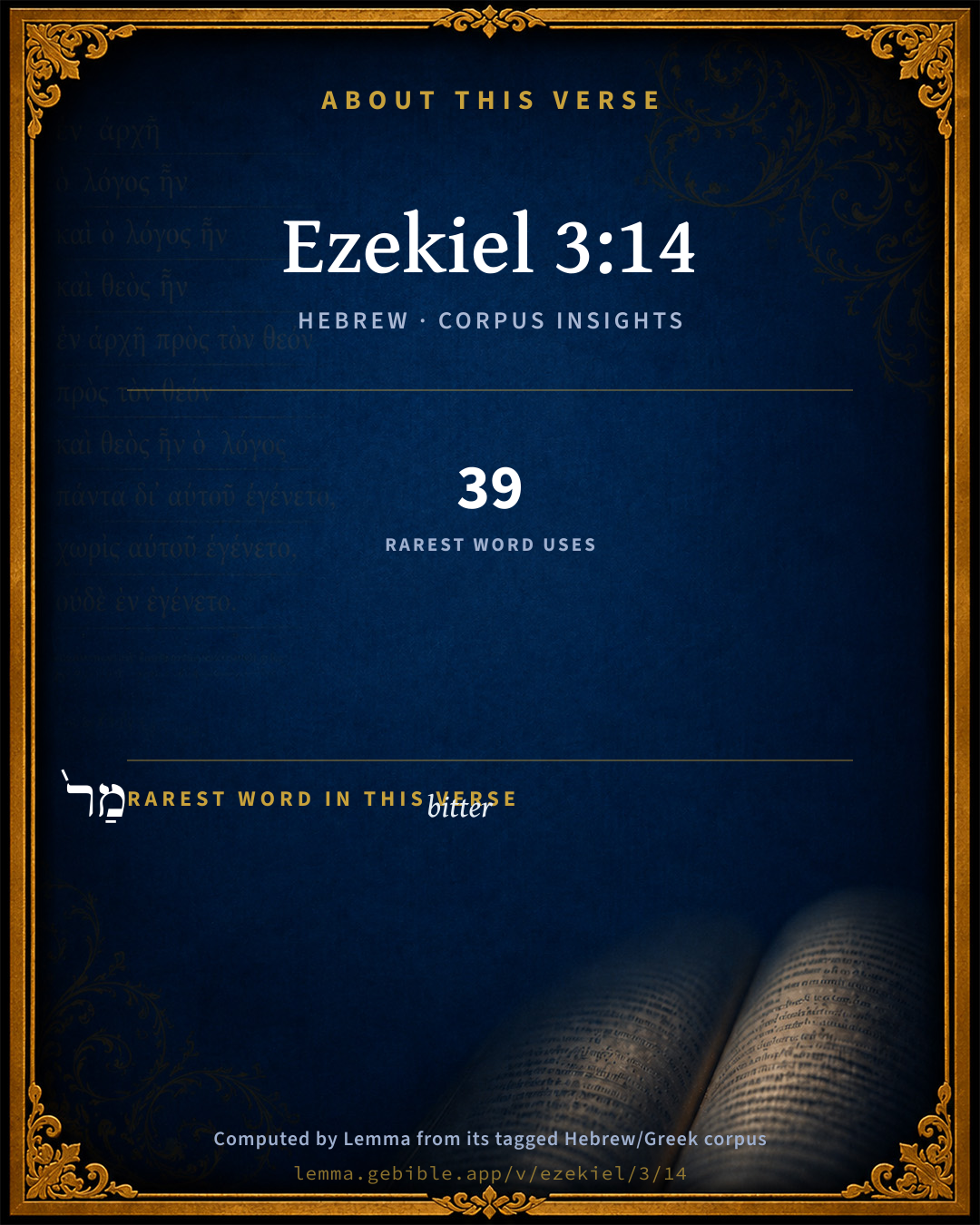
מַר֙ bitter H4751 occurs in 36 verses of the Hebrew Bible. Also found in:

Grammatical profile

  • 4 verbs
  • 5 nouns
  • 1 adjective
  • 1 preposition

Verb forms

  • נְשָׂאַ֖תְנִי Qal · Perfect
  • וַתִּקָּחֵ֑נִי Qal · Sequential Imperfect
  • וָאֵלֵ֥ךְ Qal · Sequential Imperfect
  • חָזָֽקָה Qal · Perfect

Repetition

A word recurs within this verse — often emphatic in Hebrew:

  • וְר֥וּחַ spirit H7307 ×2

Hebrew & Septuagint length

In English translation the verse runs 30 words from the Hebrew and 28 from the Septuagint (LXX English) — closely comparable.

A rough comparison of the two English renderings, which tokenize alike — not a word-level alignment.

Word counts can differ between the Hebrew and the Greek without any difference in meaning — e.g. the Hebrew direct-object marker אֵת has no separate Greek word, and Greek often adds the article ὁ.

Cross-references

15

Topical passages linked to Ezekiel 3:14 in the Treasury of Scripture Knowledge — connected by theme and wording, ordered by reader-vote popularity; previews shown in the World English Bible.

  • 2 Kings 3:15 But now bring me a minstrel. It happened, when the minstrel played, that the hand of Yahweh came on him.
  • Jeremiah 20:7–9 Yahweh, you have persuaded me, and I was persuaded; you are stronger than I, and have prevailed: I am become a laughing-stock all the day, every one mocks me.
  • Ezekiel 37:1 The hand of Yahweh was on me, and he brought me out in the Spirit of Yahweh, and set me down in the midst of the valley; and it was full of bones.
  • Ezekiel 8:3 He put forth the form of a hand, and took me by a lock of my head; and the Spirit lifted me up between earth and the sky, and brought me in the visions of God to Jerusalem, to the door of the gate of the inner [court] that looks toward the north; where was the seat of the image of jealousy, which provokes to jealousy.
  • 2 Kings 2:16 They said to him, See now, there are with your servants fifty strong men; let them go, we pray you, and seek your master, lest the Spirit of Yahweh has taken him up, and cast him on some mountain, or into some valley. He said, You shall not send.
  • Ezekiel 1:3 the word of Yahweh came expressly to Ezekiel the priest, the son of Buzi, in the land of the Chaldeans by the river Chebar; and the hand of Yahweh was there on him.
  • Ezekiel 3:12 Then the Spirit lifted me up, and I heard behind me the voice of a great rushing, [saying], Blessed be the glory of Yahweh from his place.
  • Numbers 11:11–19 Moses said to Yahweh, Why have you dealt ill with your servant? and why haven't I found favor in your sight, that you lay the burden of all this people on me?
  • 1 Kings 18:46 and the hand of Yahweh was on Elijah; and he girded up his loins, and ran before Ahab to the entrance of Jezreel.
  • Jeremiah 6:11 Therefore I am full of the wrath of Yahweh; I am weary with holding in: pour it out on the children in the street, and on the assembly of young men together; for even the husband with the wife shall be taken, the aged with him who is full of days.
  • Jeremiah 20:14–18 Cursed be the day in which I was born: don't let the day in which my mother bore me be blessed.
  • Ezekiel 8:1 It happened in the sixth year, in the sixth [month], in the fifth [day] of the month, as I sat in my house, and the elders of Judah sat before me, that the hand of the Lord Yahweh fell there on me.
  • John 4:1 Therefore when the Lord knew that the Pharisees had heard that Jesus was making and baptizing more disciples than John
  • John 4:3 he left Judea, and departed into Galilee.
  • John 4:9 The Samaritan woman therefore said to him, "How is it that you, being a Jew, ask for a drink from me, a Samaritan woman?" (For Jews have no dealings with Samaritans.)

Cross-references courtesy of OpenBible.info (CC BY 4.0).

Hebrew and Greek witnesses Masoretic Hebrew ↔ Greek Septuagint

The same verse in the two great witnesses to the Old Testament, shown verse-for-verse.

These are two independent witnesses, not word-aligned to each other, and the Septuagint is shown in lemma (dictionary) form.

Hebrew Ezekiel 3:14 Masoretic · Westminster Leningrad Codex

וְר֥וּחַ נְשָׂאַ֖תְנִי וַתִּקָּחֵ֑נִי וָאֵלֵ֥ךְ מַר֙ בַּחֲמַ֣ת רוּחִ֔י וְיַד יְהוָ֥ה עָלַ֖י חָזָֽקָה

So the Spirit lifted me up, and took me away; and I went in bitterness, in the heat of my spirit; and the hand of Yahweh was strong on me.

World English Bible · Public Domain

Greek LXX Ezekiel 3:14 Septuagint · lemma form

καί ὁ πνεῦμα ἐκαἴρω ἐγώ καί ἀναλαμβάνω ἐγώ καί πορεύομαι ἐν ὁρμή ὁ πνεῦμα ἐγώ καί χείρ κύριος γίγνομαι ἐπί ἐγώ κραταιός

And the Spirit lifted me, and took me up, and I went in the impulse of my spirit; and the hand of the Lord was mighty upon me.

LXX2012 (modern English Septuagint) · Public Domain

On this verse, The Cambridge Bible for Schools and Colleges discusses the Septuagint’s reading. Read the note in Commentary ↓

Hebrew: Westminster Leningrad Codex (CC BY 4.0). Greek: Septuagint (public domain); English from LXX2012 (modern English Septuagint) (Public Domain). How the Septuagint differs from the Hebrew →

Targum (Aramaic paraphrase)

1

The Targum is the ancient Jewish Aramaic paraphrase of the Hebrew Scriptures — an interpretive translation, not the Hebrew text itself. Onkelos (literal) and Pseudo-Jonathan (expansive) render the Torah, and Jonathan the Prophets. Coverage is partial: where no permissively-licensed English translation exists for a verse, only the Aramaic is shown. This is verse-level text, not a word-by-word alignment to the Hebrew.

  1. Targum Jonathan Prophets (Joshua–Malachi)
    וְרוּחָא נְטָלַתְנִי וּנְסֵיבְתַּנִי וַאֲזֵלֵית בִּמְרִיר בִּתְקוֹף רוּחִי וּנְבוּאָה מִן קֳדָם יְיָ עֲלַי תַּקִיפַת:

    (no public-domain English translation for this verse)

    Targum Jonathan — Aramaic: “Mikraot Gedolot” (public domain). English: “Sefaria Community Translation” (CC0 1.0 (public-domain dedication)); “London "Chaldee Paraphrase," 1871” (public domain). Text via Sefaria.

Commentary

Notes on Ezekiel 3:14 from classic Christian and Jewish commentators (each source and its license shown beneath its notes). The classic Christian expositions comment on the surrounding passage and are grouped to its opening verse, so a note may address several verses; the Jewish commentaries on the Tanakh (Rashi and others) are per-verse, so they appear only where the commentator wrote on this verse.

Lemma curates 59 commentaries, every one of them public domain or Creative Commons licensed, each selected and text-cleaned for this edition rather than reprinted as found. About our sources →

Trapp's Complete Commentary

John Trapp

Eze 3:14 So the spirit lifted me up, and took me away, and I went in bitterness, in the heat of my spirit; but the hand of the LORD was strong upon me.

Ver. 14. So the spirit lifted me up.] As it did afterwards also Philip, {Act 8:39-40} not visionally, but really.

And took me away.] To Telabib.

And I went in bitterness, in the heat of my spirit.] {a} Heb., I went bitter in the hot anger of my spirit, q.d., I was in a great pet, as considering that God’s truths must be spoken, however they are taken: and full ill they would be taken from me by mine untoward countrymen. This made me, for the time, much out of temper; but I soon denied myself, and got the better of mine unruly passions. For,

The hand of the Lord was strong upon me.] I was overpowered by the Spirit of God, who soon brought those high thoughts of mine into captivity and conformity to Christ. {2Co 10:5}

{a} Hic ecce pillula voluminis in ore dulcis, in ventre dissoluta, ventrem torquet et lancinat. - A Lapide.

John Trapp, A Commentary or Exposition upon All the Books of the Old and New Testament (1647–1656) — public domain. Text from a community e-Sword module.

The Biblical Illustrator

Joseph S. Exell

Eze_3:14-15

So the Spirit lifted me up.

In the uplifted life we are fitted to do the Lords work

Ezekiel was now strengthened to do a very difficult work. He was to go and speak to a people who had no sympathy with him,--who would not listen to him, as the old classic prophetess Cassandra was doomed forever to speak the truth and never to be believed. If he had been commissioned to break up new ground amongst people whose language he did not understand, he would have deserved some pity. But the actual case was worse than such a hypothetical one. Jeremiah had preached in Jerusalem for thirty-five years without success, and now Ezekiel was assured that his own prophesying in Babylon would fail of its immediate purpose. To expect defeat is one of the surest ways of incurring it. On the contrary, to have an unswerving confidence in the prosperous issue of any cause is most likely to ensure it. To have, as the only visible result of your efforts, your words flung back in your face, like shot rebounding from the adamant, must result in depressing your energies and paralysing your power. Ezekiel is now called to this terrible kind of service; and if he is not to falter and slacken in the strenuousness of his effort, he must have special preparation for it. The Spirit lifts him up, and then the hand of the Lord is strong upon him; and thus his natural weakness and timidity are reinforced. A Mr. Davis has written of the beneficial effects of high altitudes in certain kinds of diseases, more particularly in pulmonary troubles, and has summarised those advantages as, dryness of air and comparative freedom from microorganisms and atmospheric dust; profusion of sunlight; lowness of temperature, the heat of the sun being easily borne, while the violet rays of the spectrum act chemically on the blood, increasing the haemoglobin; diminished barometric pressure, facilitating chemical action in the blood and tissues, and favouring vaporisation of moist secretions in the lungs, while it aids pulmonary circulation and expansion; and the general stimulus of high levels, producing exhilaration and an increase of nutrition. Who would wish to live on low levels after reading that! Those who live in any low-lying places, such as the poor Swiss of the Valals, are languid and enfeebled. They can never be robust while they breathe the damp air, the miasma, the foggy, misty atmosphere. There are correspondences in the spiritual sphere to these literal facts. When Christians dwell in the marshy, malarial lowlands of doubt and unbelief, selfishness and worldliness, they are unequal to holy enterprise. To serve the Lord requires strength and vigour, and these qualities they lack. We can also see that by means of this lifting up Ezekiel was brought into sympathy with men. Then I came to them of the captivity at Tel-abib, that dwelt by the river of Chebar, and I sat where they sat, and remained there astonished among them seven days. Many have complained of such a method of expressing interest, and ridiculed it as strange friendship. But the action is full of true, deep sympathy. Job sat down among the ashes, a loathsome sufferer. Yet his friends sat with him, sharing in silence his sorrow and humiliation. Similarly Ezekiel does not appear to have spoken. Silence is often golden. Words would sometimes only bewilder or irritate or wound. It is in the uplifted life that we learn how to come near to people in their misery and degradation,--how to join ourselves in the truest sympathy with the masses in their sad weariness, their pain-stricken anxiety, their tempted, struggling, sinning condition. Observe that by being lifted up Ezekiel was brought into sympathy with God. So the Spirit lifted me up, and took me away, and I went in bitterness, in the heat of my spirit. As you read these words you at first think they denote the very reverse of an advance towards the mind of God. What can bitterness of spirit signify? what but a spirit of rebellion against the will of God? But that is not the meaning. The prophet was now brought into deeper sympathy with the Divine will. He was, like Jeremiah, filled with the indignation of the Lord. In Bible parlance, the Lord was angry with the people, and so now was he. The roll which was spread before him was written with lamentations and mourning and woe. He was bidden to eat it. Surely a very bitter portion for him! But he says, It was in my mouth as honey for sweetness (chap. 3, verse 3). Why did the bitter become sweet? Because he was already in perfect accord with the will of God. The will of God should, we know, be the law of a Christians life. Henry Martyn remarked just before he reached Madras, I am going upon a work exactly according to the mind of Christ. At the height of 200 feet above the earth, to the listener on tower or crag, the varying sounds from below, harmonies and discords alike, are blent into one musical note--F natural--pure, sweet, distinct. So when we are lifted up to the Mount of the Lord the dissonant, discordant, jarring notes of our self-will are brought into unison with the will of God; our imperfect, inharmonious natures are reduced into full and complete accord with the Divine purpose. (A. W. Welch.)

The Biblical Illustrator, edited by Joseph S. Exell (c. 1880s–1900s) — public domain. Text from a community e-Sword module.

Joseph Benson's Commentary

Eze 3:14. So the spirit lifted me up and took me away — Caught me up into the air, and carried me, (as Philip was carried away from the eunuch,) and brought me to the place where I was to deliver my message, the place where the captive Jews were settled in great numbers: compare 1Ki 18:12; 2Ki 2:16; Act 8:39. I went in bitterness, &c. — I went in grief and anguish of mind, on account of the grievous things I was to declare to them, and the offence I foresaw I should give, and the opposition and ill treatment I should meet with. But the hand of the Lord was strong upon me — Urging and impelling, as well as empowering me to execute my commission.

Joseph Benson's Commentary on the Old and New Testaments (1811–1818) — public domain. Text from a community e-Sword module.

Tyndale Open Study Notes

Tyndale Open Resources

3:14-15 The Spirit lifted me up: Ezekiel was brought back from his visionary experience to the ordinary world of the exiles. Ezekiel regularly experienced the powerful impact of the Spirit’s transporting him to another location (see also 8:3; 11:1, 24; 40:1-3; 43:5). • After the Spirit departed from him, Ezekiel experienced the conflicting emotions associated with his commission. As a prophet who spoke for God, he began to feel the bitterness and turmoil of God’s anger against the sins of his people.

Tyndale Open Study Notes — © Tyndale Open Resources, licensed CC BY-SA 4.0. Text via the HelloAO Bible API.

Geneva Bible (1599)

Geneva Bible translators

This showeth that there is ever an infirmity of the flesh which can never be ready to render full obedience to God, and also God’s grace who ever assisteth his, and overcometh their rebellious affections.

Geneva Bible (1599) marginal notes — public domain. Text via Bolls.life.

Jamieson, Fausset & Brown

Robert Jamieson, A. R. Fausset & David Brown

bitterness--sadness on account of the impending calamities of which I was required to be the unwelcome messenger. But the "hand," or powerful impulse of Jehovah, urged me forward.

Jamieson, Fausset & Brown — Commentary Critical and Explanatory on the Whole Bible (1871) — public domain (CC PDM 1.0). Text via the HelloAO Bible API.

Adam Clarke's Commentary

Verse 14. I went in bitterness] Being filled with indignation at the wickedness and obstinacy of my people, I went, determining to speak the word of God without disguise, and to reprove them sharply for their rebellion; and yet I was greatly distressed because of the heavy message which I was commanded to deliver.

Adam Clarke's Commentary on the Bible (1810–1826) — public domain. Text from a community e-Sword/MySword module.

John Calvin's Commentaries

He confirms what we have formerly seen, namely, that he was acted upon by the Spirit of God, so that it was in some way without himself, and not as profane men have invented, enthusiastically: for their Prophets were deprived of self-control, and the devil so dealt with them, that they were not of sound mind. Hence the Prophet does not understand that he was deprived of self-control, because God’s Prophets were of a sedate and composed mind; but he understands that he was so governed by the Spirit of God, that he was unlike himself, and did not breathe a terrestrial air; lastly, he understands that visible marks were graven upon him, which obtained for his doctrine authority with all the people. And it was the more necessary that the Prophet should be adorned with his own proofs, on account of the dullness of the people, and also because his message was distasteful to them, and he had not previously discharged the duty of a teacher. It was needful, therefore, that he should be so renewed that the people should acknowledge him as inspired. He had lived familiarly among his friends, and was sufficiently known both by appearance and character. Meanwhile God, as I have said, separated him from common life, that he should represent something celestial; and the object of this was, as we have shown, to conciliate confidence and reverence towards his teaching. He felt indeed the agitation of the Spirit, and it is scarcely to be doubted that the people also knew it, otherwise they would scarcely have had confidence in him when speaking of himself.

The object of this remarkable government of the Spirit was, that the Israelites, if only awake and attentive to the miracle, might know the Prophet to be in some manner renovated. But what follows seems opposed to the former sentence; for he says (Ezekiel 3:3) the volume was sweet as honey, but now that he departed in the bitterness of his spirit;. but as I briefly explained yesterday, this is easily reconciled; for the Prophet was not deprived of all sensation. Although he was entirely consecrated to God, and in no degree remitted his diligence and alacrity, yet he retained some human feelings: hence the spirit of bitterness of which he speaks, which he calls his own spirit Whence we perceive an implied contrast between that motion by which he was caught up and that feeling, which, although not sinful, was in some way different from the grace of the Spirit, because the Prophet so burnt with zeal that he performed the commands of God almost in forgetfulness of self: yet, at the same time, he felt within him something human, since the power of the Spirit had not extinguished all sorrow. We hold, therefore, that the Prophet was in some degree inspired by the Spirit, and yet that his own spirit was bitter He adds, and the hand of Jehovah was strong upon me By “hand,” some understand prophecy, but in my opinion ignorantly: I do not doubt that its meaning is power or authority. He says, the hand of God was strong, because he ought to obey God, although the bitterness of which he spoke should draw him in a contrary direction. As Paul says, (2 Corinthians 5:14, and Philippians 1:23,) that he was constrained by a zeal of God, so also the Prophet signifies that he was constrained by the secret instinct of the Spirit, so that he did not act from human motives, nor yet obey the wishes of his own mind, nor follow his own individual will, but was only intent on rendering obedience to God. In this sense, then, he says, that the hand of God was strong upon him Otherwise it might be objected — why did he not fall away when he was so oppressed with grief, and anxiety so overwhelmed his spirit? he replies, the hand of God was strong and prevailed, since otherwise he would have failed a hundred times, had he not been supported by the power of God. And thus we see that there was some repugnance in the Prophet, since as man he was affected with sorrow, but the power of the Holy Spirit ruled over him, so that he denied himself and all his human affections.

John Calvin's Commentaries (1540-1563) — public domain. Text from the Calvin Translation Society English edition (1840s-50s) via the Christian Classics Ethereal Library (ccel.org). Calvin's coverage is partial (roughly two-thirds of the Bible); uncommented books and verses are honest gaps, never fabricated. The 19th-century editor's footnotes and remarks are omitted so the notes are faithfully Calvin's own voice.

Ellicott's Commentary for English Readers

(14) I went in bitterness, in the heat of my prophet now begins to realise the sorrow and the trial of the task laid upon him. The command of the Lord was sweet (Eze_3:3), its performance is bitter. “But the hand of the Lord was strong” upon him, and he could not forbear. Compare the similar experience of Jeremiah (Jer_20:8-9; see also Amo_3:8), when in his discouragement he had almost resolved to refuse to declare God s message, but the word of the Lord was as a burning fire within, and he could not refrain—an experience which every faithful teacher in God’s name is obliged, more or less fully, to pass through.

A Bible Commentary for English Readers, edited by Charles John Ellicott (1878–1897) — public domain. Text from a community e-Sword module.

The Cambridge Bible for Schools and Colleges

gen. ed. J. J. S. Perowne

14. in bitterness] i. e. indignation, or anger, Jdg_18:25 (angry fellows), 2Sa_17:8. Similarly “heat of spirit” is fury or wrath. The prophet was lifted up into sympathy with God and shared his righteous indignation against Israel. Again Jeremiah is his model: “Therefore I am full of the fury of the Lord; I am weary with holding in: Pour it out upon the children in the street and upon the assembly of young men together,” Jer_6:11. LXX. omits “bitterness.”

but the hand] Rather: and (or, for) the hand. See on ch. Eze_1:3. Cf. Jer_15:17, “I sat not in the assembly of them that make merry, nor rejoiced; I sat alone because of thy hand; for thou hast filled me with indignation.”

The Cambridge Bible for Schools and Colleges (gen. ed. J. J. S. Perowne; Cambridge University Press, 1878–1918) — public domain. Text from a community e-Sword module.

John Gill's Exposition

So the spirit lifted me up, and took me away,.... Lifted him up from the earth, and carried him through the air:

and I went in bitterness; full of trouble and sorrow, that the Lord was departing from the temple; that his people had been guilty, of such crimes they had, and were such an impudent, and hardhearted people they were; and that such judgments were coming upon them he had seers written in the roll, full of lamentations, mourning, and woe:

in the heat of my spirit; the Targum and Vulgate Latin render it, "in the indignation of my spirit"; his spirit was hot and angry, he was froward and unwilling to go on the errand, to prophesy sad and dismal things to his people:

but the hand of the Lord was strong upon me; the Spirit of the Lord powerfully wrought upon him, and obliged him to go; and the hand of the Lord strengthened him, and removed his frowardness and perverseness of spirit. The Targum is,

"and prophecy from before the Lord was strong upon me;''

so Kimchi interprets it of the hand of prophecy; the Spirit of the Lord, as a spirit of prophecy, came upon him, with great impulse upon his spirit, and he could not refuse going to his people, to declare it to them.

John Gill's Exposition of the Whole Bible (1746–1763) — public domain (CC PDM 1.0). Text via the HelloAO Bible API.

Albert Barnes' Notes on the Bible

Lifted me up - We are not to suppose that the prophet was miraculously transported from one place to another in the land of his captivity. Compare Mat 4:1; Act 8:39. He had been in an ecstatic vision Eze 1:1, and now guided by the Spirit he goes forth among his countrymen.

The heat of my spirit - Full of the righteous indignation, which God inspired, against the sin which he was to denounce.

But the hand - and “the hand.” The Lord strengthened him for his mission.

Albert Barnes' Notes on the Bible (1834–1885) — public domain. Text from a community e-Sword/MySword module.

Haydock's Catholic Bible Commentary

Spirit, resolved to rebuke (Calmet) sinners. Septuagint, "the spirit of the Lord also lifted me....and I went aloft (like a meteor; Greek: meteoros) by the impulse of my spirit; for the hand of the Lord upon me was strong; and I went loft, to the captivity, and passed through them....conversing in the midst of them." (Haydock)

George Leo Haydock (1774–1849), Haydock's Catholic Family Bible and Commentary, 1859 edition — public domain. Excludes Psalms (Douay-Rheims chapter numbering differs from Protestant) and Deuterocanonical books (Catholic canon only).

Matthew Poole's English Annotations

So, Heb. And, or then, at that very time.

The spirit, the Spirit of God, as Eze 3:12, which see.

Lifted me up, either from that prostration which the terrible vision had caused when he fell to the ground; or rather, caught him, who before was on his legs and well come to himself, up into the air.

Took me away; carried me, (as was Philip when carried away from the eunuch,) and brought me to the place where I was to deliver my message, the place where the captive Jews were crowded together.

I went: hitherto nothing appears of the prophet’s concurrence, but the verse seems to speak constraint and force, but now you have his voluntary concurrence with the motion of the Spirit. He went when so moved and assisted.

In bitterness, in the heat of my spirit; Heb. bitter in the heat of my spirit; grieved, sad, and my spirit within me was as all in a heat of anger: either,

1. Enkindled within by the sympathy he had with his countrymen in their sufferings and calamities; or,

2. Because of those wickednesses he saw and reproved in them; or,

3. Because he must be the unwelcome messenger of such unwelcome news; or,

4. Because of the danger he was exposed to among enraged desperadoes: which way soever you explain it, Ezekiel’s weakness and distempered humour will appear in it; Jonas-like, he will be angry. But; for, as some others; and, as the Hebrew. The hand of the Lord was strong upon me; either in general the power of God, which cannot be resisted; or the Spirit of prophecy, which, as a fire shut up, will break forth, as in Jer 20:7-9; indeed both concur.

Matthew Poole's English Annotations on the Holy Bible (1683–1685) — public domain. Text from a community e-Sword/MySword module.

Whedon's Commentary on the Bible

Daniel D. Whedon

14. I went in bitterness, in the heat of my spirit — The taste that was at first sweet (Eze_3:3) is now bitter. (Compare Rev_10:9-10; Mat_26:41.) The bitterness is an angry bitterness (Jdg_18:25; 2Sa_17:8), and the heat of spirit is the hotness of wrath. (See notes Eze_2:8; Eze_3:10-11.) Almost all expositors believe this to have been fury against the sins which he was about to condemn (compare Jer_6:11); but his spirit toward his countrymen in other passages, taken in connection with all the circumstances of his call and his refusal to speak until again and again God had appeared to him and warned him not to rebel, declaring that if he did not warn the people their blood would be upon his own head (Eze_3:20), added to the repeated statement that he only succeeded finally in doing as he was commanded because the hand of the Lord was heavy upon him, leads us to the conclusion that this bitterness and heat of spirit was caused by the prophet’s unwillingness to enter upon the work to which God called him. (Compare Jon_1:3; Jon_4:1.) The utter inadequacy of the usual explanation is illustrated in the Expositor’s Bible, where this “bitterness” and “heat” is declared to be due to the “mental prostration” produced by the vision, or, as Bertholet more bluntly puts it, “it was a psychological reaction from his cataleptic state.”(!) Rather see our notes Eze_2:8; Eze_3:10-11; Eze_3:15-21; Eze_16:44.

Daniel D. Whedon (gen. ed.), Commentary on the Old and New Testaments (1874–1909) — public domain. Text from a community e-Sword module.

The Pulpit Commentary

The Spirit lifted me up (see note on ver. 12). Here the LXX has the more definite phrase, "the Spirit of the Lord. For bitterness. (see note on Eze_2:3) The heat of my spirit. The first noun is here translated literally. Elsewhere it is rendered as "wrath" (Job_21:20; Pro_15:11, et al. ) "fury". (Jer_4:4) Here probably it points to the conflict of emotions indignation against the sins of his people, the dread of failure, the consciousness of unfitness. The hand of the Lord, etc. The word for "strong" is the same as that which enters into Ezekiel"s name. Taking this and ver. 9 into account, there seems sufficient reason for translating as the Vulgate does, confortans (so Luther, "held me firm"), at least for thinking of that meaning as implied. (Ezr_7:9 Ezr_8:18; Neh_2:8; Dan_10:18) There was a sustaining power in spite of the "bitterness" and the "heat." In a more general sense, as in Eze_1:3, it is used as implying a special intensity of prophetic inspiration, as in the case of Elisha; (2Ki_3:15) but this is the only case in which it occurs with the adjective "strong.

The start in life.

Ezekiel here describes the commencement of his active ministry. Hitherto he has been under preparation, receiving communications from heaven in vision and word. Now the time has come for him to start on his errand and begin his work among the captives of Babylon.

I THE PROPHET IS CARRIED AWAY BY THE SPIRIT OF GOD. Although we need not suppose that Ezekiel was carried up bodily into the clouds, blown over the fields, and dropped down in the midst of a crowd of his countrymen, we are not to suppose that his visit to them was any the less one of Divine impulses. Like Philip the evangelist, when he was taken from the Ethiopian convert and sent to Azotus, (Act_8:39, Act_8:40) Ezekiel felt a mighty power of God driving him to his work. Inspiration does not only illumine; it impels. The Spirit of God drove Christ into the wilderness. (Mar_1:12) Such an action does not involve forcible constraint against the will. God only works on men in this way through their wills. The will of the man is so completely subservient to the will of God that it no longer acts separately; it voluntarily obeys as though it were but a Divine instrument. The highest work for God is always done in this way. Without the mighty spiritual impulse such tasks as God sets his servants could never be accomplished; but with it the hardest service ends in success.

II THE PROPHET GOES IN GRIEF AND ANGER.

1. In grief. The prophet is in bitterness. The cause of his sorrow is that he is to speak of bad subjects, and to face unwilling hearers. Nothing can be more painful to a sympathetic soul. If a preacher could delight in denunciation and take a pleasure in describing the horrors of future punishment, he would be little better than a demon at heart. A true preacher of repentance must be a voice of sorrow. Moreover, it must be painful to a sensitive man to find himself compelled to create unpopularity for himself by fidelity to his message. His face may be as adamant; but his heart will bleed.

2. In anger. Ezekiel went "in heat." There is a righteous wrath. Christ could be "moved with indignation" against cruelty and hypocrisy. The man who is incapable of this anger lacks power of conscience. Love must lie at the heart of the servant of God, but anger at sin and at the wrong of it to God and man may show itself in his voice and manner.

III THE PROPHET FEELS THE MIGHTY HAND OF GOD UPON HIM. God does not only send his servant; he accompanies him. The Spirit carried Ezekiel forth; the hand of God was strong upon him all the way. This hand of God is felt in various ways.

1. In pushing forward. God thus keeps his servants to the front. While he is with them he will allow of no cowardice or indolence.

2. In support. This hand of God is a helping hand, a holding hand, a supporting hand. God sustains those whom he sends.

3. In restraint. While pushing his servants on in the right way, God is ready to hold them back from peril, error, and ruin.

4. In uplifting. The servants of God may slip and even fall. Then they are not deserted. The same strong hand which sent them forth lifts them up and sets them on their Jest again. Thus the mighty ever-present God stands by to help his feeblest servants and lead them on to victory.

Human bitterness and Divine strength.

The Prophet Ezekiel would have been more or less than human had he not felt poignantly the painful commission with which he was entrusted. He was a patriot as well as a prophet; and his distress and trouble arose not merely from the discouragement natural to his position and service, but from his sympathy with his fellow countrymen, his censure of their sin, his sorrow for their fate. Yet it was not the will of God that his grief should interfere with the efficiency of his ministry. And the Lord who called him to his special work chose the occasion of the prophet"s depression as the occasion of his intervention upon his behalf and for his strengthening. It was when Ezekiel was in bitterness and the heat of his spirit that the hand of the Lord was strong upon him. Nor was this experience peculiar to this prophet; many have, in God"s service, known Ezekiel"s bitterness, and have, in the time of their bitterness, felt God"s hand upon them, a hand of encouragement, of guidance, and of blessing.

I THE NATURAL DEPRESSION OF THE DISAPPOINTED WORKER FOR GOD. The circumstances described in the context are abundantly sufficient to account for the bitterness and heat of the prophet"s spirit. Every faithful servant and minister of God can enter, more or less completely, into his feelings. The conditions of labour are often discouraging and distressing.

II THERE IS DANGER LEST THE EFFECT OF MENTAL BITTERNESS SHOULD BE THE CRIPPLING OF THE HANDS FOR EFFICIENT LABOUR. A cheerful mind contributes to efficient toil. Even if the task be difficult and painful, it will not be well performed if bitterness and heat of spirit prevail. "The joy of the Lord is your strength.

III DIVINE INTERPOSITION CAN IMPART STRENGTH, CAN ALLAY VEXATION, CAN FIT FOR SPIRITUAL MINISTRY. "The hand of the Lord," says the prophet, "was strong upon me." This metaphorical expression is full of significance.

1. Strong to uphold, as a father"s hand sustains his child in a difficult and dangerous road.

2. Strong to defend, as the hand of an escort may ward off from his charge the attack of a foe.

3. Strong to direct, as the hand of the helmsman may steer the ship upon her course.

4. Strong to cheer and encourage, as the hand of the husband may grasp that of the wife, to comfort and to animate with courage, in times of common difficulty, sorrow, and distress.

5. Strong to save, as the hand of a deliverer may rescue a drowning form from raging waterhoods. T.

The Pulpit Commentary (1880–1919), ed. H.D.M. Spence-Jones & Joseph S. Exell — public domain. Text from a community e-Sword module.

John Wesley's Explanatory Notes

Spirit - Caught him up into the air. Took - Carried me to the place where the captive Jews were crowded together. Bitterness - Not at all pleased with my work. He went in the heat of his spirit; because of the discouragements he foresaw he should meet with. But the hand of the Lord was strong upon him, not only to compel him to the work, but to fit him for it.

John Wesley, Explanatory Notes Upon the Whole Bible (1754–1765) — public domain. Text via the GEBible commentary corpus.

unfoldingWord translationNotes

Door43 World Missions Community

General Information:

Ezekiel seems to have been angry because Yahweh had sent him to speak to the Israelite exiles, thus rebelling against Yahweh himself. Though he was supposed to speak to them, he sat in silence for seven days, even though he could feel the anger of Yahweh "powerfully pressing on" him.

away, and I went with bitterness in my spirit's rage

The words "bitterness" and "rage" are types of anger. This can be stated as a separate sentence. AT: "away. I was bitter and my spirit was full of anger" or "away. I was very bitter and angry"

bitterness

Ezekiel speaks of his anger at Yahweh as if there were a bad taste in his mouth because Yahweh had forced him to eat something that tasted bad. (See: Metaphor)

for the hand of Yahweh was powerfully pressing on me

Ezekiel speaks of being sad and tired because Yahweh had commanded him to do things he did not want to do as if Yahweh were pushing him down into the ground. (See: Metaphor)

the hand of Yahweh

Possible meanings are 1) the word "hand" is often used to refer to someone's power or action. AT: "the power of Yahweh" or 2) Ezekiel knew that Yahweh was angry with him because he was not obeying Yahweh by speaking to the Israelite exiles. (See: Metonymy)

Tel Aviv

A town in Babylon, about 80 kilometers southeast of the main city, which was also called Babylon. (See: How to Translate Names)

the Kebar Canal

This is a river that people in Chaldea had dug to give water to their gardens. See how you translated this in Ezekiel 1:1.

overwhelmed in amazement

"unable to do anything because I was so amazed"

translationWords

Holy Spirit

hand

Yahweh

captive

amazed

unfoldingWord translationNotes — © Distant Shores Media and the Door43 World Missions Community, licensed CC BY-SA 4.0. Source: git.door43.org/Door43/en_tn.

Rashi

Rabbi Shlomo Yitzchaki (Rashi)

and I went, embittered because it was distasteful to me to chide the children of my people.

and the hand of the Lord became strong upon me His coercion and His strength to lead me against my will.

Rashi on the Tanakh — English translations: “The Judaica Press complete Tanach with Rashi, translated by A. J. Rosenberg” (CC BY 4.0); “Pentateuch with Rashi's commentary by M. Rosenbaum and A.M. Silbermann, 1929-1934” (public domain); “The Metsudah Tanach series, Lakewood, N.J” (CC BY 4.0); and “The Book of Joshua, Metsudah Publications, 1997” (CC BY 4.0). Text via Sefaria.

Lesson kit

Teaching starters — assembled from the data on this page, not authored interpretation. Every prompt links to the verse data it draws on. Edit before teaching.

Ezekiel, in the Prophets, opens this verse with 11 words (10 distinct Hebrew lemmas). Its most distinctive word is mar (“bitter”). A historical commentator’s framing appears above. Read the whole chapter for the surrounding context.

Discussion questions

  1. What does “bitter” (mar) contribute to the verse as a whole?
  2. How does Genesis 27:34, which shares the word «bitter», read alongside this verse?
  3. What does the repetition of “spirit” (2× in this one verse) do in this verse?
  4. These translations render this verse differently; the difference is in the English rendering, not the original. What questions does that raise?
  5. «נְשָׂאַ֖תְנִי» is a Qal Perfect verb. How does that grammatical form shape the action described?
  6. Compare how Trapp's Complete Commentary and The Biblical Illustrator read this verse. Where do they agree or differ?

Things to notice

Reading settings

Reading text

Shown beneath each verse's original-language words.

Old Testament
Old Testament edition

Read the OT as the Masoretic Hebrew (MT) or the Greek Septuagint (LXX).

English shown for the Greek Septuagint (in the Hebrew ↔ Greek comparison).

Comparing translations? Open the Compare panel on any verse page to stack up to four side by side.