
1 Kings 14:26

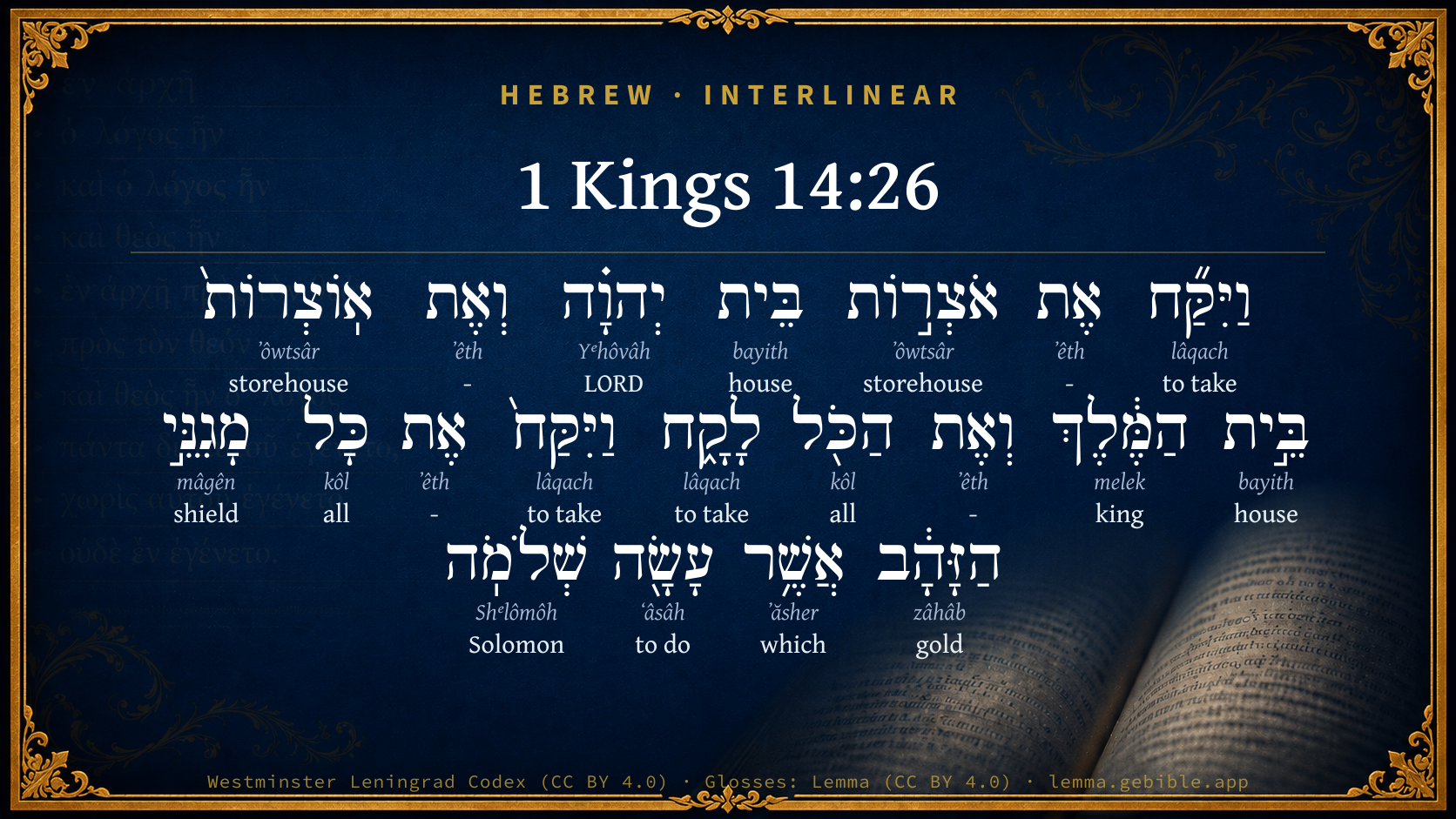
Hebrew (Westminster Leningrad Codex) 1 Kings 14:26 appears in the Hebrew Old Testament. The text above is from the Westminster Leningrad Codex. Each word links to its Strong’s number, a concise gloss, and parsing drawn from the Open Scriptures Hebrew Bible morphology. Click any word for its full Brown-Driver-Briggs (BDB) entry.
Download image
Cite this verse

1 Kings 14:26 (World English Bible). Public Domain. Lemma interlinear Bible study tool, https://lemma.gebible.app/v/1-kings/14/26.

Show BibTeX & RIS
BibTeX
RIS
English Translation
and he took away the treasures of the house of Yahweh, and the treasures of the king's house; he even took away all: and he took away all the shields of gold which Solomon had made.
World English Bible · Public Domain
Download a study sheet

One document with this verse’s original text, its word-by-word gloss line, the meaning frame, cross-references with their text, attributed commentary, and full source and license credits — printable, and it pastes into notes with its structure intact.

This verse Autodidact and up

Study sheet (.html) Plain text (.txt)

A passage Seminary Student

Up to 50 verses in one chapter. A passage sheet keeps up to 6 commentary sources and 12 cross-references per verse, in the order this page ranks them, and says so on the sheet whenever that leaves anything out. Ask for a single verse and you get the Autodidact verse sheet above.

Everything on this page stays free to read, with no account — the sheet is a download of what is already on screen, not access to it.

Want to remove ads? Support Godless Engineer
Compare translations 3

The same verse in 3 English versions, stacked beneath the original-language interlinear above. Click any original word for its lexicon entry.

Each is an independent rendering of the whole verse — the interlinear is not word-aligned to these translations.

Highlighted words mark where these versions differ — a whole-verse word diff, not a word-by-word alignment.

  • World English Bible Public Domain
    and he took away the treasures of the house of Yahweh, and the treasures of the king's house; he even took away all: and he took away all the shields of gold which Solomon had made.
  • King James Version Public Domain
    And he took away the treasures of the house of the LORD, and the treasures of the king's house; he even took away all: and he took away all the shields of gold which Solomon had made.
  • unfoldingWord Literal Text CC BY-SA 4.0
    And he took the treasures of the house of Yahweh and the treasures of the house of the king. And he took everything. And he took all of the shields of gold that Solomon had made.

unfoldingWord Literal Text — © unfoldingWord, licensed CC BY-SA 4.0. Word-aligned USFM3 via Door43 (git.door43.org/unfoldingWord/en_ult).

Versions to compare (up to 4)

3 of 4 selected

Show all 18 translations

Every available English version of this verse, each an independent rendering of the whole verse.

  • World English Bible Public Domain
    and he took away the treasures of the house of Yahweh, and the treasures of the king's house; he even took away all: and he took away all the shields of gold which Solomon had made.
  • Berean Standard Bible Public Domain
    He seized the treasures of the house of the LORD and of the royal palace. He took everything, including all the gold shields that Solomon had made.
  • Majority Standard Bible Public Domain
    He seized the treasures of the house of the LORD and of the royal palace. He took everything, including all the gold shields that Solomon had made.
  • King James Version Public Domain
    And he took away the treasures of the house of the LORD, and the treasures of the king's house; he even took away all: and he took away all the shields of gold which Solomon had made.
  • American Standard Version (1901) Public Domain
    and he took away the treasures of the house of Jehovah, and the treasures of the king's house; he even took away all: and he took away all the shields of gold which Solomon had made.
  • Revised Version (1885) Public Domain
    and he took away the treasures of the house of the LORD, and the treasures of the king’s house; he even took away all: and he took away all the shields of gold which Solomon had made.
  • Geneva Bible (1599) Public Domain
    And tooke the treasures of the house of the Lord, and the treasures of the Kings house, and tooke away all: also he caried away all the shields of golde which Salomon had made.
  • Douay-Rheims (1899) Public Domain
    And he took away the treasures of the house of the Lord, and the king's treasures, and carried all off: as also the shields of gold which Solomon had made.
  • Young's Literal Translation Public Domain
    and he taketh the treasures of the house of Jehovah, and the treasures of the house of the king, yea, the whole he hath taken; and he taketh all the shields of gold that Solomon made.
  • Literal Standard Version CC BY-SA 4.0
    and he takes the treasures of the house of YHWH, and the treasures of the house of the king, indeed, he has taken the whole; and he takes all the shields of gold that Solomon made.
  • Unlocked Literal Bible CC BY-SA 4.0
    He took away the treasures in the house of Yahweh, and the treasures in the king's house. He took everything away; he also took all the shields of gold that Solomon had made.
  • unfoldingWord Literal Text CC BY-SA 4.0
    And he took the treasures of the house of Yahweh and the treasures of the house of the king. And he took everything. And he took all of the shields of gold that Solomon had made.
  • Darby Bible Public Domain
    And he took away the treasures of the house of Jehovah, and the treasures of the king's house; he even took away all; and he took away all the shields of gold that Solomon had made.
  • World Messianic Bible Public Domain
    and he took away the treasures of the LORD’s house and the treasures of the king’s house. He even took away all of it, including all the gold shields which Solomon had made.
  • Webster's Bible Public Domain
    And he took away the treasures of the house of the LORD, and the treasures of the king's house; he even took away all; and he took away all the shields of gold which Solomon had made.
  • Free Bible Version CC BY-SA 4.0
    He took the treasures of the Lord's Temple and the royal palace. He took everything, including all the gold shields Solomon had made.
  • Bible in Basic English Public Domain
    And took away all the stored wealth from the house of the Lord, and from the king's house, and all the gold body-covers which Solomon had made.
  • JPS Tanakh (1917) Public Domain
    and he took away the treasures of the house of the LORD, and the treasures of the king's house; he even took away all; and he took away all the shields of gold which Solomon had made.

Literal Standard Version (2020), Covenant Press — licensed CC BY-SA 4.0. Text via the HelloAO Bible API (eBible.org). Unlocked Literal Bible (unfoldingWord) — licensed CC BY-SA 4.0. Text via the HelloAO Bible API (eBible.org). unfoldingWord Literal Text — © unfoldingWord, licensed CC BY-SA 4.0. Word-aligned USFM3 via Door43 (git.door43.org/unfoldingWord/en_ult). Free Bible Version, Dr. Jonathan Gallagher — licensed CC BY-SA 4.0. Text via the HelloAO Bible API (eBible.org).

Word by word

More ways to search: Search by grammar → Find every occurrence → Compare this word →

Practice this passage: Drill this verse → Learn its vocabulary →

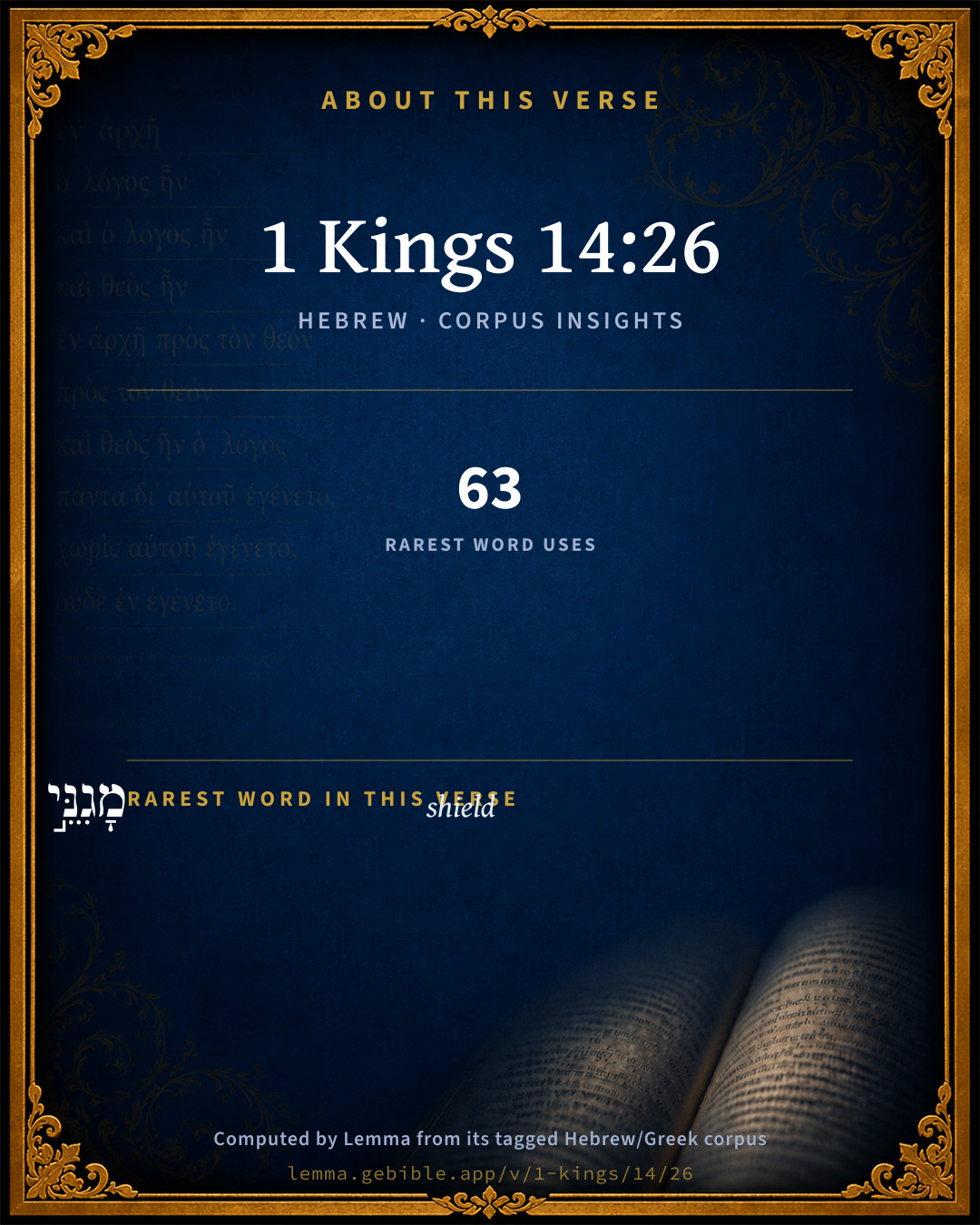
מָגִנֵּ֣י
mâgên
H4043
“shields of”
Noun, Common, Both, Plural, Construct
Part of Speech
Noun
Type
Common
Gender
Both
Number
Plural
State
Construct
Full BDB Definition

Origin: from H1598

TWOT: 367c

shield, buckler
  1. וַיִּקַּ֞ח lâqach H3947 “and · to take” Conjunction + Verb, Qal, Sequential Imperfect, 3rd Person, Masculine, Singular
  2. אֶת ʼêth H853 “-” Particle, Direct Object
  3. אֹצְר֣וֹת ʼôwtsâr H214 “storehouses of” Noun, Common, Masculine, Plural, Construct
  4. בֵּית bayith H1004 “house of” Noun, Common, Masculine, Singular, Construct
  5. יְהוָ֗ה Yᵉhôvâh H3068 “LORD” Noun, Proper
  6. וְאֶת ʼêth H853 “and · -” Conjunction + Particle, Direct Object
  7. אֽוֹצְרוֹת֙ ʼôwtsâr H214 “storehouses of” Noun, Common, Masculine, Plural, Construct
  8. בֵּ֣ית bayith H1004 “house of” Noun, Common, Masculine, Singular, Construct
  9. הַמֶּ֔לֶךְ melek H4428 “the · king” Particle, Definite Article + Noun, Common, Masculine, Singular, Absolute
  10. וְאֶת ʼêth H853 “and · -” Conjunction + Particle, Direct Object
  11. הַכֹּ֖ל kôl H3605 “the · all” Particle, Definite Article + Noun, Common, Masculine, Singular, Absolute
  12. לָקָ֑ח lâqach H3947 “to take” Verb, Qal, Perfect, 3rd Person, Masculine, Singular
  13. וַיִּקַּח֙ lâqach H3947 “and · to take” Conjunction + Verb, Qal, Sequential Imperfect, 3rd Person, Masculine, Singular
  14. אֶת ʼêth H853 “-” Particle, Direct Object
  15. כָּל kôl H3605 “all of” Noun, Common, Masculine, Singular, Construct
  16. הַזָּהָ֔ב zâhâb H2091 “the · gold” Particle, Definite Article + Noun, Common, Masculine, Singular, Absolute
  17. אֲשֶׁ֥ר ʼăsher H834 “which” Particle, Relative
  18. עָשָׂ֖ה ʻâsâh H6213 “to do” Verb, Qal, Perfect, 3rd Person, Masculine, Singular
  19. שְׁלֹמֹֽה Shᵉlômôh H8010 “Solomon” Noun, Proper

About this verse

These counts appear in no published source. They are computed here, from the morphology-tagged text and Lemma’s own curated glosses. What Lemma adds →

20
words
12
distinct lemmas
Historical
section

Grammatical profile

  • 4 verbs
  • 11 nouns
  • 5 particles

Verb forms

  • וַיִּקַּ֞ח Qal · Sequential Imperfect
  • לָקָ֑ח Qal · Perfect
  • וַיִּקַּח֙ Qal · Sequential Imperfect
  • עָשָׂ֖ה Qal · Perfect

Repetition

Words recur within this verse — often emphatic in Hebrew:

  • וַיִּקַּ֞ח to take H3947 ×3
  • אֹצְר֣וֹת storehouse H214 ×2
  • בֵּית house H1004 ×2
  • הַכֹּ֖ל all H3605 ×2

Hebrew & Septuagint length

In English translation the verse runs 36 words from the Hebrew and 61 from the Septuagint (LXX English) — the Septuagint runs noticeably longer here. See the side-by-side →

A rough comparison of the two English renderings, which tokenize alike — not a word-level alignment.

Word counts can differ between the Hebrew and the Greek without any difference in meaning — e.g. the Hebrew direct-object marker אֵת has no separate Greek word, and Greek often adds the article ὁ.

Cross-references

10

Topical passages linked to 1 Kings 14:26 in the Treasury of Scripture Knowledge — connected by theme and wording, ordered by reader-vote popularity; previews shown in the World English Bible.

  • 1 Kings 15:18 Then Asa took all the silver and the gold that were left in the treasures of the house of Yahweh, and the treasures of the king's house, and delivered them into the hand of his servants; and king Asa sent them to Ben Hadad, the son of Tabrimmon, the son of Hezion, king of Syria, who lived at Damascus, saying,
  • 2 Chronicles 9:15–16 King Solomon made two hundred bucklers of beaten gold; six hundred [shekels] of beaten gold went to one buckler.
  • 1 Kings 7:51 Thus all the work that king Solomon worked in the house of Yahweh was finished. Solomon brought in the things which David his father had dedicated, [even] the silver, and the gold, and the vessels, and put them in the treasuries of the house of Yahweh.
  • 1 Kings 10:16–17 King Solomon made two hundred bucklers of beaten gold; six hundred [shekels] of gold went to one buckler.
  • 2 Kings 24:13 He carried out there all the treasures of the house of Yahweh, and the treasures of the king's house, and cut in pieces all the vessels of gold, which Solomon king of Israel had made in the temple of Yahweh, as Yahweh had said.
  • 2 Chronicles 12:9–11 So Shishak king of Egypt came up against Jerusalem, and took away the treasures of the house of Yahweh, and the treasures of the king's house: he took all away: he took away also the shields of gold which Solomon had made.
  • Psalms 39:6 "Surely every man walks like a shadow. Surely they busy themselves in vain. He heaps up, and doesn't know who shall gather.
  • Psalms 89:35–45 Once have I sworn by my holiness, I will not lie to David.
  • Proverbs 23:5 Why do you set your eyes on that which is not? For it certainly sprouts wings like an eagle and flies in the sky.
  • Ecclesiastes 2:18–19 I hated all my labor in which I labored under the sun, seeing that I must leave it to the man who comes after me.

Cross-references courtesy of OpenBible.info (CC BY 4.0).

Hebrew and Greek witnesses Masoretic Hebrew ↔ Greek Septuagint

The same verse in the two great witnesses to the Old Testament, shown verse-for-verse.

Here the Septuagint runs noticeably longer than the Hebrew — LXX2012 (modern English Septuagint) 61 words vs World English Bible 36. A rough length comparison of the two English translations, not a word-level alignment — read both below.

These are two independent witnesses, not word-aligned to each other, and the Septuagint is shown in lemma (dictionary) form.

Hebrew 1 Kings 14:26 Masoretic · Westminster Leningrad Codex

וַיִּקַּ֞ח אֶת אֹצְר֣וֹת בֵּית יְהוָ֗ה וְאֶת אֽוֹצְרוֹת֙ בֵּ֣ית הַמֶּ֔לֶךְ וְאֶת הַכֹּ֖ל לָקָ֑ח וַיִּקַּח֙ אֶת כָּל מָגִנֵּ֣י הַזָּהָ֔ב אֲשֶׁ֥ר עָשָׂ֖ה שְׁלֹמֹֽה

and he took away the treasures of the house of Yahweh, and the treasures of the king's house; he even took away all: and he took away all the shields of gold which Solomon had made.

World English Bible · Public Domain

Greek LXX 1 Kings 14:26 Septuagint · lemma form
and took all the treasures of the house of the Lord, and the treasures of the king's house, and the golden spears which David took out of the hand of the sons of Adrazaar king of Suba, and brought them into Jerusalem, even all that he took, and the golden shields which Solomon had made, and carried them away into Egypt.

LXX2012 (modern English Septuagint) · Public Domain

On this verse, The Cambridge Bible for Schools and Colleges discusses the Septuagint’s reading. Read the note in Commentary ↓

Hebrew: Westminster Leningrad Codex (CC BY 4.0). Greek: Septuagint (public domain); English from LXX2012 (modern English Septuagint) (Public Domain). How the Septuagint differs from the Hebrew →

Targum (Aramaic paraphrase)

1

The Targum is the ancient Jewish Aramaic paraphrase of the Hebrew Scriptures — an interpretive translation, not the Hebrew text itself. Onkelos (literal) and Pseudo-Jonathan (expansive) render the Torah, and Jonathan the Prophets. Coverage is partial: where no permissively-licensed English translation exists for a verse, only the Aramaic is shown. This is verse-level text, not a word-by-word alignment to the Hebrew.

  1. Targum Jonathan Prophets (Joshua–Malachi)
    וּנְסִיב יַת אוֹצָרֵי בֵּית מַקְדְשָׁא דַייָ וְיַת אוֹצָרֵי בֵּית מַלְכָּא וְיַת כּוֹלָא נְסִיב וּנְסִיב יַת כָּל מְגִנֵי דַהֲבָא דַעֲבַד שְׁלֹמֹה:

    (no public-domain English translation for this verse)

    Targum Jonathan — Aramaic: “Mikraot Gedolot” (public domain). English: “Sefaria Community Translation” (CC0 1.0 (public-domain dedication)); “London "Chaldee Paraphrase," 1871” (public domain). Text via Sefaria.

Commentary

Notes on 1 Kings 14:26 from classic Christian and Jewish commentators (each source and its license shown beneath its notes). The classic Christian expositions comment on the surrounding passage and are grouped to its opening verse, so a note may address several verses; the Jewish commentaries on the Tanakh (Rashi and others) are per-verse, so they appear only where the commentator wrote on this verse.

Lemma curates 59 commentaries, every one of them public domain or Creative Commons licensed, each selected and text-cleaned for this edition rather than reprinted as found. About our sources →

Trapp's Complete Commentary

John Trapp

1Ki 14:26 And he took away the treasures of the house of the LORD, and the treasures of the king’s house; he even took away all: and he took away all the shields of gold which Solomon had made.

Ver. 26. And he took away.] Without any great resistance; such was the pusillanimity and effeminacy of Rehoboam; which was also laid in his dish by Shishak setting up pillars and ugly pictures thereon, to the shame of the Jewish nation, as Diodorus {a} showeth.

{a} Lib. i.

John Trapp, A Commentary or Exposition upon All the Books of the Old and New Testament (1647–1656) — public domain. Text from a community e-Sword module.

Joseph Benson's Commentary

1Ki 14:26. And he took, &c. — Rehoboam, according to Josephus, delivered up the city to him without striking a stroke; which may seem strange, considering the great strength of it, and how much time it took Nebuchadnezzar and Titus to become masters of it. But it is probable that David and Solomon, in their building and altering the city, had more respect to state and magnificence than to its defence, as having no great cause to fear the invasion of any enemies: and it is certain that after the division between Judah and Israel, the kings of Judah added very much to the fortifications of it. Add to this, that this Shishak had a vast army, as we read 2Ch 12:2, and so powerful, that as Herodotus, who calls him Sesostris, tells us, with it he conquered Asia. He took away the treasures of the Lord’s house — Within twenty-five years after it was finished, he plundered it, as also the king’s house, of all the wealth which they contained, and which had been amassed by David and Solomon. This, it is probable, had tempted Shishak to make this descent, and this Rehoboam lamely resigned to him, to prevent still worse consequences. Who that had seen the glory, the riches, the magnificence, the power of Solomon, would not have concluded, as the queen of Sheba seems to have done, that a long and lasting state of security and happiness was entailed on this people? But the Holy Scriptures inform us, that at the very time when every one was admiring and extolling Solomon’s glory and happiness, it was denounced unto him by the Lord himself, that if either he or his children should turn aside from following the Lord, and go after other gods, they should certainly and soon fall from their glory, and be a proverb and by-word among all people, 1Ki 11:6, &c.; and that even that house, which was viewed by all the nations around as a prodigy of magnificence and strength, should be so reduced and brought to desolation, that every one that passed by should be astonished and hiss at it. Human foresight, doubtless, then perceived no likelihood of any such change taking place; but the event soon showed that its security and continuance depended on something more than human means.

Joseph Benson's Commentary on the Old and New Testaments (1811–1818) — public domain. Text from a community e-Sword module.

Tyndale Open Study Notes

Tyndale Open Resources

14:26-28 When Rehoboam replaced Solomon’s gold shields with bronze shields, it reflected the declining spiritual value of Rehoboam’s kingdom. The complete destruction of Judah and Jerusalem was avoided only when Rehoboam repented in response to the Lord’s word through the prophet Shemaiah (2 Chr 12:5-6, 12).

Tyndale Open Study Notes — © Tyndale Open Resources, licensed CC BY-SA 4.0. Text via the HelloAO Bible API.

Adam Clarke's Commentary

Verse 26. He took away the treasures] All the treasures which Solomon had amassed, both in the temple and in his own houses; a booty the most immense ever acquired in one place.

All the shields of gold which Solomon had made.] These were three hundred in number, and were all made of beaten gold. See a computation of their value in Clarke's note on "1Ki 10:17".

Adam Clarke's Commentary on the Bible (1810–1826) — public domain. Text from a community e-Sword/MySword module.

Ellicott's Commentary for English Readers

(26) He even took away all.—There is a touch of pathos in the description of the utter spoil of the treasures in which Solomon and Israel had gloried, and which now served only to buy off the victorious Egyptians. There is no notice of any sack of Jerusalem, nor, as in later cases, of any desecration of the Temple, or even of the plunder of its decorations. The record seems to imply surrender of the city and its treasures. The idea sometimes advanced, that, like the capture of Rome by the Gauls, the invasion of Shishak destroyed all ancient monuments and archives, has therefore no historical support from this passage; and with it many conclusions derived from it as to the dates of our Scriptural records must pass away.

A Bible Commentary for English Readers, edited by Charles John Ellicott (1878–1897) — public domain. Text from a community e-Sword module.

The Cambridge Bible for Schools and Colleges

gen. ed. J. J. S. Perowne

26. he even took away all] Instead of these words the LXX. gives: ‘and the golden shields which David took from the hands of the servants of Hadadezer king of Zobah and brought them to Jerusalem.’ On these captures of David see 2Sa_8:7.

On the shields of gold made by Solomon cf. 1Ki_10:17. At the close of the verse the LXX. adds that Shishak ‘brought’ his booty ‘into Egypt.’

The Cambridge Bible for Schools and Colleges (gen. ed. J. J. S. Perowne; Cambridge University Press, 1878–1918) — public domain. Text from a community e-Sword module.

John Gill's Exposition

And King Rehoboam made in their stead brazen shields,.... For the king of Egypt had so stripped him of his gold, that he was not able to replace golden ones:

and committed them into the hands of the chief of the guard; or "runners" (p), that went before the king, or attended him as his bodyguard when he went abroad:

which kept the door of the king's house; which kept guard night and day in their turns.

(p) "cursorum", Pagninus, Montanus, &c.

John Gill's Exposition of the Whole Bible (1746–1763) — public domain (CC PDM 1.0). Text via the HelloAO Bible API.

Albert Barnes' Notes on the Bible

The circumstances of Shishak’s invasion, related here with extreme brevity, are given with some fulness by the author of Chronicles (marginal reference). It is still a question whether the submission of the Jewish king is or is not expressly recorded in the Karnak inscription. Midway in the list of cities and tribes occurs the entry “YUDeH-MALK” which it has been proposed to translate “Judah, king.” Others regard it as the name of a Palestinian town not otherwise known to us.

Albert Barnes' Notes on the Bible (1834–1885) — public domain. Text from a community e-Sword/MySword module.

Matthew Poole's English Annotations

He took away the treasures; it is implied, that first he took the city; which may seem strange considering the great strength of that city, and how much time it took Nebuchadnezzar and Titus to take it. But, first, It might cost Shishak also some time and a long siege ere he took it, though that be not here related. Secondly, It is probable that David and Solomon, in their building and altering of this city, had more respect to state and magnificence than to its defence, as having no great cause to fear the invasion of any enemies, and being too secure in reference to their posterity, because of God’s promise of the kingdom to be continued to them and to their seed for ever. And it is probable and certain, that after the division between Judah and Israel, the kings of Judah did add very much to the fortifications of this city.

Matthew Poole's English Annotations on the Holy Bible (1683–1685) — public domain. Text from a community e-Sword/MySword module.

Whedon's Commentary on the Bible

Daniel D. Whedon

26. He took away the treasures — The splendour of Solomon’s buildings, and the immense treasures which he had amassed, were doubtless spoken of far and wide, and to obtain these treasures was probably the main object of Shishak’s expedition. He may have been prompted by Jeroboam to this action, for Jeroboam had dwelt at his court, (1Ki_11:40,) and was on friendly terms with him, and would gladly see him afflict the kingdom of Judah.

Daniel D. Whedon (gen. ed.), Commentary on the Old and New Testaments (1874–1909) — public domain. Text from a community e-Sword module.

The Pulpit Commentary

And he took away the treasures of the house of the Lord The historian omits to mention the interposition of Shemaiah. (2Ch_12:5-8) The account of the Chronicles is altogether much fuller, and the treasures of the king"s house; he even took away all rather, and everything (sc. that he could lay his hands on) he took away." The spoil must have been enormous: and he took away all the shields of gold (cf. 1Ki_10:17) which Solomon had made.

The Pulpit Commentary (1880–1919), ed. H.D.M. Spence-Jones & Joseph S. Exell — public domain. Text from a community e-Sword module.

John Wesley's Explanatory Notes

He took - First the city: which may seem strange, considering the great strength of it, and how much time it took Nebuchadnezzar and Titus to take it. But, first, it might cost Shishak also a long siege though that be not here related. Secondly, it is probable David and Solomon in their building and altering the city, had more respect to state and magnificence than to its defense, as having no great cause to fear the invasion of any enemies. And it is certain, that after the division between Judah and Israel, the kings of Judah added very much to the fortifications of it.

John Wesley, Explanatory Notes Upon the Whole Bible (1754–1765) — public domain. Text via the GEBible commentary corpus.

Rashi

Rabbi Shlomo Yitzchaki (Rashi)

He took everything. The throne, that was dearer to him than everything.

Rashi on the Tanakh — English translations: “The Judaica Press complete Tanach with Rashi, translated by A. J. Rosenberg” (CC BY 4.0); “Pentateuch with Rashi's commentary by M. Rosenbaum and A.M. Silbermann, 1929-1934” (public domain); “The Metsudah Tanach series, Lakewood, N.J” (CC BY 4.0); and “The Book of Joshua, Metsudah Publications, 1997” (CC BY 4.0). Text via Sefaria.

Lesson kit

Teaching starters — assembled from the data on this page, not authored interpretation. Every prompt links to the verse data it draws on. Edit before teaching.

1 Kings, in the Historical, opens this verse with 20 words (12 distinct Hebrew lemmas). Its most distinctive word is mâgên (“shield”). The Greek Septuagint runs longer here. A historical commentator’s framing appears above. Read the whole chapter for the surrounding context.

Discussion questions

  1. The word mâgên carries the sense “shield.” How does it shape the verse?
  2. 1 Kings 15:18 shares this passage’s theme. How do the two illuminate each other?
  3. “to take” occurs 3× in this one verse. What is the effect of the repetition?
  4. Compared with the Hebrew, the Septuagint runs longer here. What questions does that raise?
  5. These translations render this verse differently; the difference is in the English rendering, not the original. What questions does that raise?
  6. The verb «וַיִּקַּ֞ח» is Qal Sequential Imperfect. How does its form color the action?
  7. Reading how Trapp's Complete Commentary and Joseph Benson's Commentary read this verse, where do the two commentators agree and where do they part?

Things to notice

Reading settings

Reading text

Shown beneath each verse's original-language words.

Old Testament
Old Testament edition

Read the OT as the Masoretic Hebrew (MT) or the Greek Septuagint (LXX).

English shown for the Greek Septuagint (in the Hebrew ↔ Greek comparison).

Comparing translations? Open the Compare panel on any verse page to stack up to four side by side.