
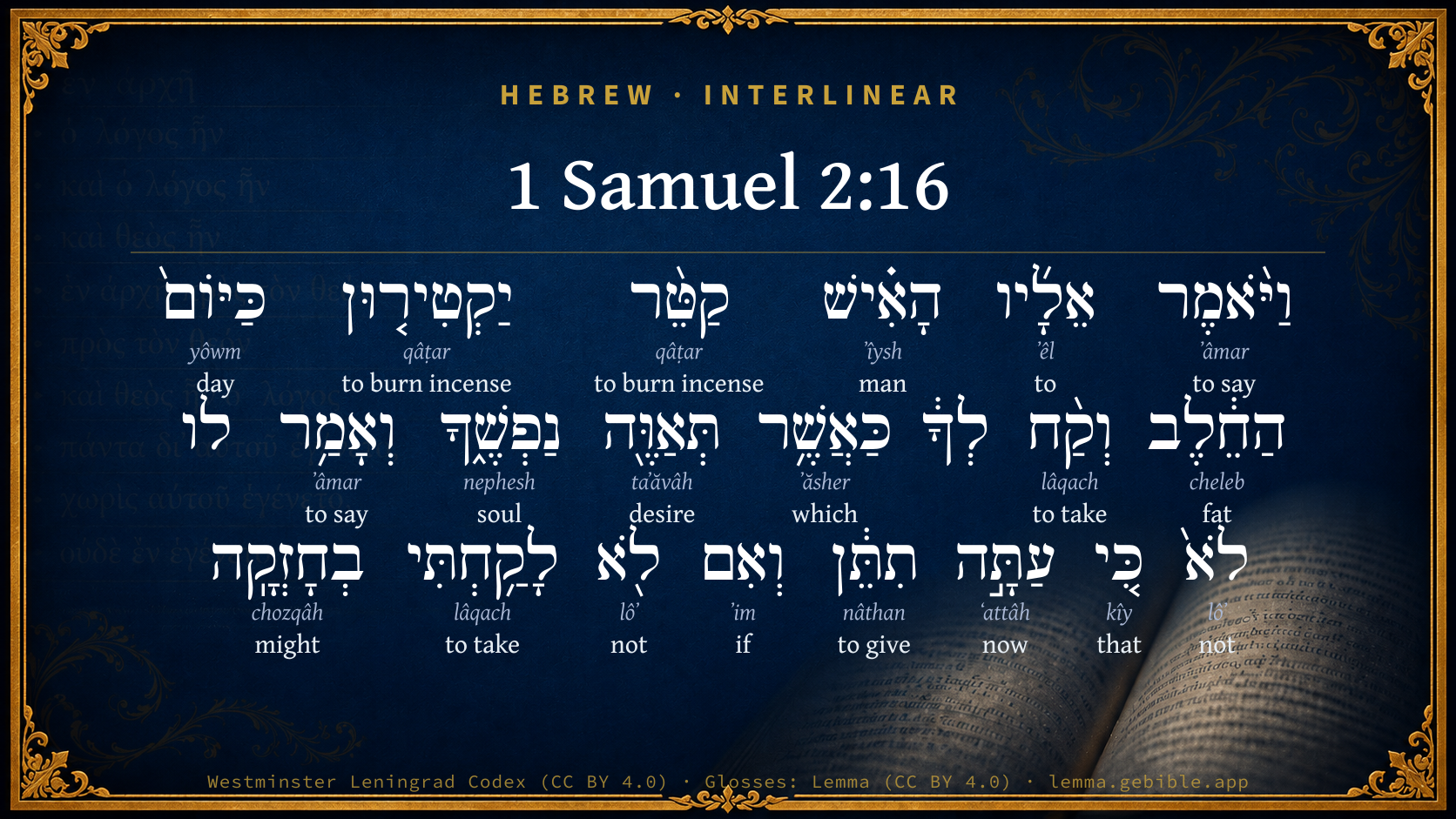
1 Samuel 2:16

Hebrew (Westminster Leningrad Codex) 1 Samuel 2:16 appears in the Hebrew Old Testament. The text above is from the Westminster Leningrad Codex. Each word links to its Strong’s number, a concise gloss, and parsing drawn from the Open Scriptures Hebrew Bible morphology. Click any word for its full Brown-Driver-Briggs (BDB) entry.
Download image
Cite this verse

1 Samuel 2:16 (World English Bible). Public Domain. Lemma interlinear Bible study tool, https://lemma.gebible.app/v/1-samuel/2/16.

Show BibTeX & RIS
BibTeX
RIS
English Translation
If the man said to him, They will surely burn the fat first, and then take as much as your soul desires; then he would say, No, but you shall give it me now: and if not, I will take it by force.
World English Bible · Public Domain
Download a study sheet

One document with this verse’s original text, its word-by-word gloss line, the meaning frame, cross-references with their text, attributed commentary, and full source and license credits — printable, and it pastes into notes with its structure intact.

This verse Autodidact and up

Study sheet (.html) Plain text (.txt)

A passage Seminary Student

Up to 50 verses in one chapter. A passage sheet keeps up to 6 commentary sources and 12 cross-references per verse, in the order this page ranks them, and says so on the sheet whenever that leaves anything out. Ask for a single verse and you get the Autodidact verse sheet above.

Everything on this page stays free to read, with no account — the sheet is a download of what is already on screen, not access to it.

Want to remove ads? Support Godless Engineer
Compare translations 3

The same verse in 3 English versions, stacked beneath the original-language interlinear above. Click any original word for its lexicon entry.

Each is an independent rendering of the whole verse — the interlinear is not word-aligned to these translations.

Highlighted words mark where these versions differ — a whole-verse word diff, not a word-by-word alignment.

  • World English Bible Public Domain
    If the man said to him, They will surely burn the fat first, and then take as much as your soul desires; then he would say, No, but you shall give it me now: and if not, I will take it by force.
  • King James Version Public Domain
    And if any man said unto him, Let them not fail to burn the fat presently, and then take as much as thy soul desireth; then he would answer him, Nay; but thou shalt give it me now: and if not, I will take it by force.
  • unfoldingWord Literal Text CC BY-SA 4.0
    And the man would say to him, “Burning, let them burn the fat as the day, then take for yourself what your soul desires.” But he would say, “No, but you shall give now, and if not, I will take by force.”

unfoldingWord Literal Text — © unfoldingWord, licensed CC BY-SA 4.0. Word-aligned USFM3 via Door43 (git.door43.org/unfoldingWord/en_ult).

Versions to compare (up to 4)

3 of 4 selected

Show all 18 translations

Every available English version of this verse, each an independent rendering of the whole verse.

  • World English Bible Public Domain
    If the man said to him, They will surely burn the fat first, and then take as much as your soul desires; then he would say, No, but you shall give it me now: and if not, I will take it by force.
  • Berean Standard Bible Public Domain
    And if any man said to him, “The fat must be burned first; then you may take whatever you want,” the servant would reply, “No, you must give it to me right now. If you refuse, I will take it by force!”
  • Majority Standard Bible Public Domain
    And if any man said to him, “The fat must be burned first; then you may take whatever you want,” the servant would reply, “No, you must give it to me right now. If you refuse, I will take it by force!”
  • King James Version Public Domain
    And if any man said unto him, Let them not fail to burn the fat presently, and then take as much as thy soul desireth; then he would answer him, Nay; but thou shalt give it me now: and if not, I will take it by force.
  • American Standard Version (1901) Public Domain
    And if the man said unto him, They will surely burn the fat first, and then take as much as thy soul desireth; then he would say, Nay, but thou shalt give it me now: and if not, I will take it by force.
  • Revised Version (1885) Public Domain
    And if the man said unto him, They will surely burn the fat presently, and then take as much as thy soul desireth; then he would say, Nay, but thou shalt give it me now: and if not, I will take it by force.
  • Geneva Bible (1599) Public Domain
    And if any man saide vnto him, Let them burne the fatte according to the custome, then take as much as thine heart desireth: then hee would answere, No, but thou shalt giue it nowe: and if thou wilt not, I will take it by force.
  • Douay-Rheims (1899) Public Domain
    And he that sacrificed said to him: Let the fat first be burnt to day according to the custom, and then take as much as thy soul desireth. But he answered and said to him: Not so: but thou shalt give it me now, or else I will take it by force.
  • Young's Literal Translation Public Domain
    and the man saith unto him, `Let them surely make a perfume (as to-day) with the fat, then take to thee as thy soul desireth;' and he hath said to him, `Surely now thou dost give; and if not -- I have taken by strength.'
  • Literal Standard Version CC BY-SA 4.0
    and the man says to him, “Let them surely make incense with the fat according to the [custom] today, then take to yourself as your soul desires”; and he has said to him, “Surely you give now; and if not—I have taken by strength.”
  • Unlocked Literal Bible CC BY-SA 4.0
    If the man said to him, “They must burn the fat first, and then take as much as you want.” Then he would say, “No, you will give it me now; if not, I will take it by force.”
  • unfoldingWord Literal Text CC BY-SA 4.0
    And the man would say to him, “Burning, let them burn the fat as the day, then take for yourself what your soul desires.” But he would say, “No, but you shall give now, and if not, I will take by force.”
  • Darby Bible Public Domain
    If the man said to him, They will immediately burn the fat entire, then take as thy soul desires; he would say [to him], No, but thou shalt give [it] now; and if not, I will take [it] by force.
  • World Messianic Bible Public Domain
    If the man said to him, “Let the fat be burned first, and then take as much as your soul desires;” then he would say, “No, but you shall give it to me now; and if not, I will take it by force.”
  • Webster's Bible Public Domain
    And if any man said to him, Let them not fail to burn the fat presently, and then take as much as thy soul desireth; then he would answer him, No; but thou shalt give it to me now: and if not, I will take it by force.
  • Free Bible Version CC BY-SA 4.0
    The man might answer, “Let me first burn up all the fat, and then you can have as much as you want.” But the priest's servant would reply, “No, you must give it to me now. If you don't, I'll take it by force.”
  • Bible in Basic English Public Domain
    And if the man said to him, First let the fat be burned, then take as much as you will; then the servant would say, No, you are to give it to me now, or I will take it by force.
  • JPS Tanakh (1917) Public Domain
    And if the man said unto him: 'Let the fat be made to smoke first of all, and then take as much as thy soul desireth'; then he would say: 'Nay, but thou shalt give it me now; and if not, I will take it by force.'

Literal Standard Version (2020), Covenant Press — licensed CC BY-SA 4.0. Text via the HelloAO Bible API (eBible.org). Unlocked Literal Bible (unfoldingWord) — licensed CC BY-SA 4.0. Text via the HelloAO Bible API (eBible.org). unfoldingWord Literal Text — © unfoldingWord, licensed CC BY-SA 4.0. Word-aligned USFM3 via Door43 (git.door43.org/unfoldingWord/en_ult). Free Bible Version, Dr. Jonathan Gallagher — licensed CC BY-SA 4.0. Text via the HelloAO Bible API (eBible.org).

Word by word

More ways to search: Search by grammar → Find every occurrence → Compare this word →

Practice this passage: Drill this verse → Learn its vocabulary →

בְחָזְקָֽה
chozqâh
H2394
“in/at · might”
Preposition + Noun, Common, Feminine, Singular, Absolute
Part of Speech
Preposition + Noun
Type
Common
Gender
Feminine
Number
Singular
State
Absolute
Full BDB Definition

Origin: from H2392

TWOT: 636d

force, might, strength, violence
  1. וַיֹּ֨אמֶר ʼâmar H559 “and · to say” Conjunction + Verb, Qal, Sequential Imperfect, 3rd Person, Masculine, Singular
  2. אֵלָ֜יו ʼêl H413 “to · him” Preposition + Suffix, Personal, 3rd Person, Masculine, Singular
  3. הָאִ֗ישׁ ʼîysh H376 “the · man” Particle, Definite Article + Noun, Common, Masculine, Singular, Absolute
  4. קַטֵּ֨ר qâṭar H6999 “to burn incense” Verb, Piel, Infinitive Absolute
  5. יַקְטִיר֤וּן qâṭar H6999 “to burn incense” Verb, Hiphil, Jussive, 3rd Person, Masculine, Plural + Suffix, n
  6. כַּיּוֹם֙ yôwm H3117 “like/as the · day” Preposition, Determined + Noun, Common, Masculine, Singular, Absolute
  7. הַחֵ֔לֶב cheleb H2459 “the · fat” Particle, Definite Article + Noun, Common, Masculine, Singular, Absolute
  8. וְקַ֨ח lâqach H3947 “and · take” Conjunction + Verb, Qal, Imperative, 2nd Person, Masculine, Singular
  9. כַּאֲשֶׁ֥ר ʼăsher H834 “like/as · which” Preposition + Particle, Relative
  10. תְּאַוֶּ֖ה taʼăvâh H8378 “desire” Verb, Piel, Imperfect, 3rd Person, Feminine, Singular
  11. נַפְשֶׁ֑ךָ nephesh H5315 “soul · your” Noun, Common, Both, Singular, Construct + Suffix, Personal, 2nd Person, Masculine, Singular
  12. וְאָמַ֥ר ʼâmar H559 “and · to say” Conjunction + Verb, Qal, Sequential Perfect, 3rd Person, Masculine, Singular
  13. לֹא֙ lôʼ H3808 “not” Particle, Negative
  14. כִּ֚י kîy H3588 “that” Conjunction
  15. עַתָּ֣ה ʻattâh H6258 “now” Adverb
  16. תִתֵּ֔ן nâthan H5414 “to give” Verb, Qal, Imperfect, 2nd Person, Masculine, Singular
  17. וְאִם ʼim H518 “and · if” Conjunction + Conjunction
  18. לֹ֖א lôʼ H3808 “not” Particle, Negative
  19. לָקַ֥חְתִּי lâqach H3947 “to take” Verb, Qal, Perfect, 1st Person, Common, Singular

About this verse

These counts appear in no published source. They are computed here, from the morphology-tagged text and Lemma’s own curated glosses. What Lemma adds →

22
words
16
distinct lemmas
Historical
section

Notable vocabulary

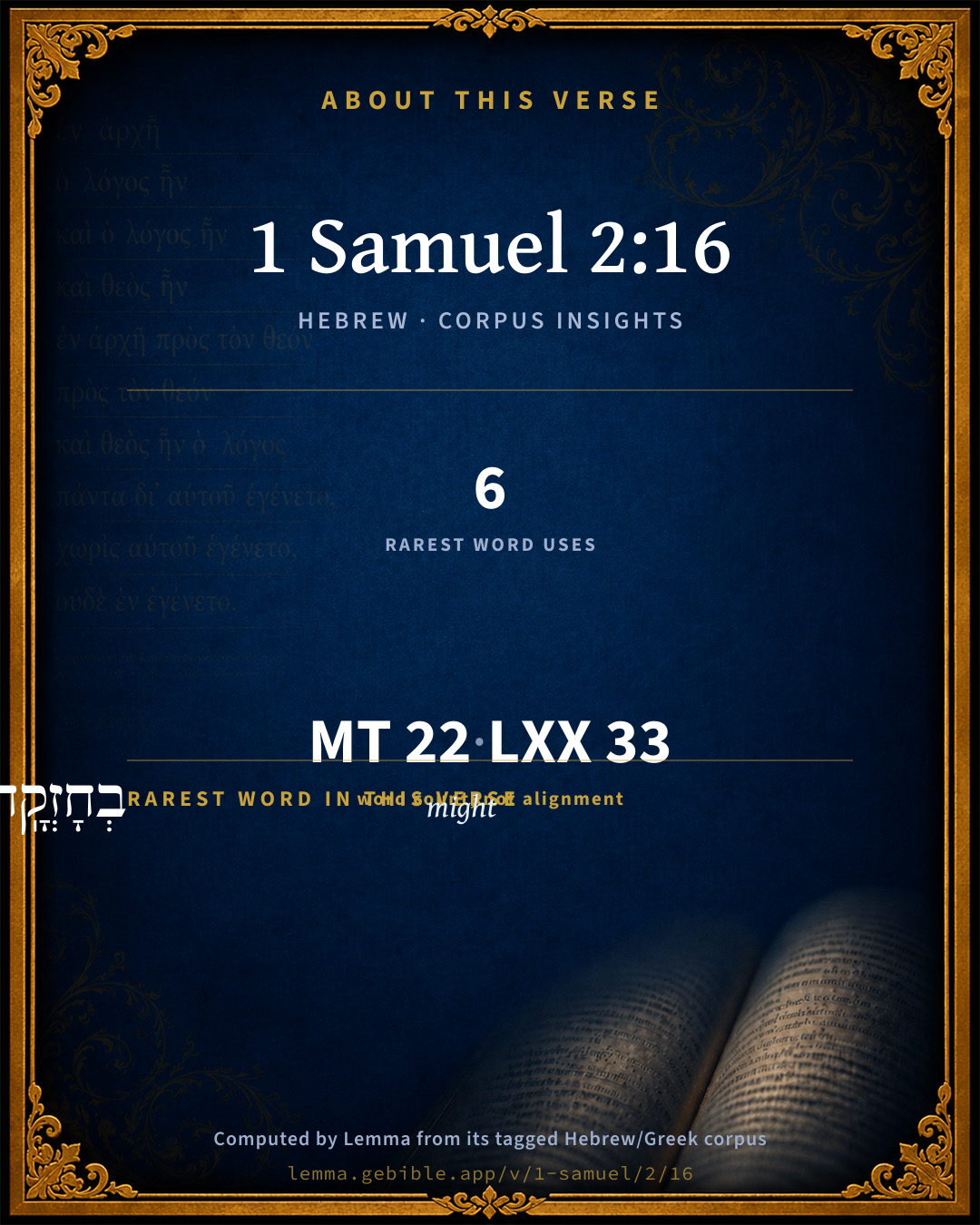
The rarest word here is בְחָזְקָֽה might H2394 — appearing just 6 times in the whole Hebrew Bible.

Shared distinctive vocabulary

בְחָזְקָֽה might H2394 occurs in 6 verses of the Hebrew Bible. Also found in:

Grammatical profile

  • 8 verbs
  • 5 nouns
  • 3 prepositions
  • 2 conjunctions
  • 1 adverb
  • 3 particles

Verb forms

  • וַיֹּ֨אמֶר Qal · Sequential Imperfect
  • קַטֵּ֨ר Piel · Infinitive Absolute
  • יַקְטִיר֤וּן Hiphil · Jussive
  • וְקַ֨ח Qal · Imperative
  • תְּאַוֶּ֖ה Piel · Imperfect
  • וְאָמַ֥ר Qal · Sequential Perfect
  • תִתֵּ֔ן Qal · Imperfect
  • לָקַ֥חְתִּי Qal · Perfect

Repetition

Words recur within this verse — often emphatic in Hebrew:

  • וַיֹּ֨אמֶר to say H559 ×2
  • קַטֵּ֨ר to burn incense H6999 ×2
  • וְקַ֨ח to take H3947 ×2
  • לֹא֙ not H3808 ×2

Hebrew & Septuagint length

In English translation the verse runs 43 words from the Hebrew and 49 from the Septuagint (LXX English) — closely comparable.

A rough comparison of the two English renderings, which tokenize alike — not a word-level alignment.

Word counts can differ between the Hebrew and the Greek without any difference in meaning — e.g. the Hebrew direct-object marker אֵת has no separate Greek word, and Greek often adds the article ὁ.

In the original languages it is 22 Hebrew tokens and 33 Greek tokens — but the two are counted differently (Hebrew bundles its prefixes and suffixes into one token; the Greek is in lemma form), so that isn’t a like-for-like length.

Cross-references

7

Topical passages linked to 1 Samuel 2:16 in the Treasury of Scripture Knowledge — connected by theme and wording, ordered by reader-vote popularity; previews shown in the World English Bible.

  • Leviticus 7:23–25 "Speak to the children of Israel, saying, 'You shall eat no fat, of ox, or sheep, or goat.
  • Leviticus 3:16 The priest shall burn them on the altar: it is the food of the offering made by fire, for a sweet savor; all the fat is Yahweh's.
  • 1 Peter 5:2–3 Shepherd the flock of God which is among you, exercising the oversight, not under compulsion, but voluntarily, not for dishonest gain, but willingly;
  • Judges 18:25 The children of Dan said to him, "Don't let your voice be heard among us, lest angry fellows fall on you, and you lose your life, with the lives of your household."
  • Nehemiah 5:15 But the former governors who were before me were chargeable to the people, and took of them bread and wine, besides forty shekels of silver; yes, even their servants bore rule over the people: but I didn't do so, because of the fear of God.
  • Micah 2:1–2 Woe to those who devise iniquity And work evil on their beds! When the morning is light, they practice it, Because it is in the power of their hand.
  • Micah 3:5 Thus says Yahweh concerning the prophets who lead my people astray; for those who feed their teeth, they proclaim, "Peace!" and whoever doesn't provide for their mouths, they prepare war against him:

Cross-references courtesy of OpenBible.info (CC BY 4.0).

Hebrew and Greek witnesses Masoretic Hebrew ↔ Greek Septuagint

The same verse in the two great witnesses to the Old Testament, shown verse-for-verse.

These are two independent witnesses, not word-aligned to each other, and the Septuagint is shown in lemma (dictionary) form.

Hebrew 1 Samuel 2:16 Masoretic · Westminster Leningrad Codex

וַיֹּ֨אמֶר אֵלָ֜יו הָאִ֗ישׁ קַטֵּ֨ר יַקְטִיר֤וּן כַּיּוֹם֙ הַחֵ֔לֶב וְקַ֨ח לְךָ֔ כַּאֲשֶׁ֥ר תְּאַוֶּ֖ה נַפְשֶׁ֑ךָ וְאָמַ֥ר לו לֹא֙ כִּ֚י עַתָּ֣ה תִתֵּ֔ן וְאִם לֹ֖א לָקַ֥חְתִּי בְחָזְקָֽה

If the man said to him, They will surely burn the fat first, and then take as much as your soul desires; then he would say, No, but you shall give it me now: and if not, I will take it by force.

World English Bible · Public Domain

Greek LXX 1 Samuel 2:16 Septuagint · lemma form

καί λέγω ὁ ἀνήρ ὁ θύω θυμιάω πρῶτος ὡς καταἥκω ὁ στέαρ καί λαμβάνω σεαυτοῦ ἐκ πᾶς ὅς ἐπιθυμέω ὁ ψυχή σύ καί εἶπον οὐ ὅτι νῦν δίδωμι καί ἐάν μή λαμβάνω κραταιῶς

And if the man that sacrificed said, First let the fat be burned, as it is fit, and take for yourself of all things which your soul desires: then he would say, Nay, for you shall give it me now; and if not I will take it by force.

LXX2012 (modern English Septuagint) · Public Domain

Hebrew: Westminster Leningrad Codex (CC BY 4.0). Greek: Septuagint (public domain); English from LXX2012 (modern English Septuagint) (Public Domain). How the Septuagint differs from the Hebrew →

Targum (Aramaic paraphrase)

1

The Targum is the ancient Jewish Aramaic paraphrase of the Hebrew Scriptures — an interpretive translation, not the Hebrew text itself. Onkelos (literal) and Pseudo-Jonathan (expansive) render the Torah, and Jonathan the Prophets. Coverage is partial: where no permissively-licensed English translation exists for a verse, only the Aramaic is shown. This is verse-level text, not a word-by-word alignment to the Hebrew.

  1. Targum Jonathan Prophets (Joshua–Malachi)
    וַאֲמַר לֵיהּ גַבְרָא אוֹרִיךְ עַד דְיִתַּסְקוּן תַּרְבַּיָא וְסַב לָךְ כְּמָא דְרַעֲוָא נַפְשָׁךְ וַאֲמַר לֵיהּ אֲרֵי כְעַן תִּתֵּן וְאִם לָא יִסְבּוּן מִנָךְ בְּעַל כּוֹרְחָךְ:

    (no public-domain English translation for this verse)

    Targum Jonathan — Aramaic: “Mikraot Gedolot” (public domain). English: “Sefaria Community Translation” (CC0 1.0 (public-domain dedication)); “London "Chaldee Paraphrase," 1871” (public domain). Text via Sefaria.

Commentary

Notes on 1 Samuel 2:16 from classic Christian and Jewish commentators (each source and its license shown beneath its notes). The classic Christian expositions comment on the surrounding passage and are grouped to its opening verse, so a note may address several verses; the Jewish commentaries on the Tanakh (Rashi and others) are per-verse, so they appear only where the commentator wrote on this verse.

Lemma curates 59 commentaries, every one of them public domain or Creative Commons licensed, each selected and text-cleaned for this edition rather than reprinted as found. About our sources →

Trapp's Complete Commentary

John Trapp

1Sa 2:16 And [if] any man said unto him, Let them not fail to burn the fat presently, and [then] take [as much] as thy soul desireth; then he would answer him, [Nay]; but thou shalt give [it me] now: and if not, I will take [it] by force.

Ver. 16. Let them not fail to burn the fat presently,] q.d., Let God have his due first; {Lev 3:3-4} but these men took no care to serve at the altar, but only to satisfy their gluttony: their gut was their god.

John Trapp, A Commentary or Exposition upon All the Books of the Old and New Testament (1647–1656) — public domain. Text from a community e-Sword module.

Joseph Benson's Commentary

1Sa 2:16-17. Nay, but thou shalt give it me now, &c. — This was the very height of haughty impiety. That such submissive language did not prevail with them to have so much respect for God, as to permit his portion to be presented to him in the first place, especially as they offered to the priest more than his share afterward, manifested excessive profaneness and contempt of things sacred. To what pitch of wickedness may not a man arrive who has shaken off the fear of God, and all sense of his presence and power! Men abhorred the offering of the Lord — Nothing brings religion so much into contempt with the people as the open profaneness of those that are ministers of it. The validity, however, and efficacy of God’s ordinances, do not depend altogether on the piety of those that minister in them. So that it was a sin in the people to neglect divine institutions because of the wickedness of the priests. But it was a still much greater sin in the priests to give them occasion so to do.

Joseph Benson's Commentary on the Old and New Testaments (1811–1818) — public domain. Text from a community e-Sword module.

Geneva Bible (1599)

Geneva Bible translators

Not passing for their own profit, so that God might be served aright.

Or, Law.

Geneva Bible (1599) marginal notes — public domain. Text via Bolls.life.

Ellicott's Commentary for English Readers

(16) And if not, I will take it by force.—The solemn ritual of the sacrifice was not only transgressed by these covetous, greedy, ministering priests, but the worshippers were compelled by force to yield to these new lawless customs, probably introduced by these sons of the high priest Eli.

A Bible Commentary for English Readers, edited by Charles John Ellicott (1878–1897) — public domain. Text from a community e-Sword module.

The Cambridge Bible for Schools and Colleges

gen. ed. J. J. S. Perowne

16. presently] “Immediately:” the usual meaning of the word in the E. V., e.g. Mat_26:53.

he would answer him, Nay] The correct reading of the Heb. gives “Nay” in place of “him.” Cp. note on 1Sa_2:3.

The Cambridge Bible for Schools and Colleges (gen. ed. J. J. S. Perowne; Cambridge University Press, 1878–1918) — public domain. Text from a community e-Sword module.

John Gill's Exposition

Wherefore the sin of the young men was very great before the Lord,.... That is, the sons of Eli; for they were the ringleaders who set these bad examples, which other priests followed, and therefore the sin is ascribed to them; and which was sadly aggravated by taking what was not their own, and by taking it in a forcible manner, and before the Lord had his part in the offering, and all this done in the tabernacle, in the presence of God; which plainly showed that they had not the fear of God before their eyes, nor any sense of his omniscience and omnipresence, any more than of his holiness and justice:

for men abhorred the offering of the Lord; it was irksome and disagreeable to them to bring their sacrifices, when they saw the law of God was not attended to, and the rules of sacrificing were not observed; such contempt of God, such abuse of sacrifices, such injury done to the sacrificers, and such covetousness and sensuality in the priests, that it even set the people against sacrifices, and made them loath them, and neglect to bring them. And this aggravated the sin of the young men, though the sacrificers were not excused hereby, Sa1 2:24.

John Gill's Exposition of the Whole Bible (1746–1763) — public domain (CC PDM 1.0). Text via the HelloAO Bible API.

Haydock's Catholic Bible Commentary

Desireth. The Laic gives an example of moderation and zeal, to which the priest might well have paid some deference. The former is willing to abandon his goods, provided the honour of God be not neglected. (Haydock)

George Leo Haydock (1774–1849), Haydock's Catholic Family Bible and Commentary, 1859 edition — public domain. Excludes Psalms (Douay-Rheims chapter numbering differs from Protestant) and Deuterocanonical books (Catholic canon only).

Matthew Poole's English Annotations

Take as much as thy soul desireth; we are content to relinquish our parts to thee, only let not God be wronged of his due.

Matthew Poole's English Annotations on the Holy Bible (1683–1685) — public domain. Text from a community e-Sword/MySword module.

Lesson kit

Teaching starters — assembled from the data on this page, not authored interpretation. Every prompt links to the verse data it draws on. Edit before teaching.

1 Samuel, in the Historical, opens this verse with 22 words (16 distinct Hebrew lemmas). Its most distinctive word is chozqâh (“might”). A historical commentator’s framing appears above. Read the whole chapter for the surrounding context.

Discussion questions

  1. How does “might” (chozqâh) shape what this verse is saying?
  2. How does Judges 4:3, which shares the word «might», read alongside this verse?
  3. What does the repetition of “to say” (2× in this one verse) do in this verse?
  4. These translations render this verse differently; the difference is in the English rendering, not the original. What questions does that raise?
  5. «וַיֹּ֨אמֶר» is a Qal Sequential Imperfect verb. How does that grammatical form shape the action described?
  6. Compare how Trapp's Complete Commentary and Joseph Benson's Commentary read this verse. Where do they agree or differ?

Things to notice

Reading settings

Reading text

Shown beneath each verse's original-language words.

Old Testament
Old Testament edition

Read the OT as the Masoretic Hebrew (MT) or the Greek Septuagint (LXX).

English shown for the Greek Septuagint (in the Hebrew ↔ Greek comparison).

Comparing translations? Open the Compare panel on any verse page to stack up to four side by side.