
Esther 6:11

Hebrew (Westminster Leningrad Codex) Esther 6:11 appears in the Hebrew Old Testament. The text above is from the Westminster Leningrad Codex. Each word links to its Strong’s number, a concise gloss, and parsing drawn from the Open Scriptures Hebrew Bible morphology. Click any word for its full Brown-Driver-Briggs (BDB) entry.
Download image
Cite this verse

Esther 6:11 (World English Bible). Public Domain. Lemma interlinear Bible study tool, https://lemma.gebible.app/v/esther/6/11.

Show BibTeX & RIS
BibTeX
RIS
English Translation
Then took Haman the clothing and the horse, and arrayed Mordecai, and caused him to ride through the street of the city, and proclaimed before him, Thus shall it be done to the man whom the king delights to honor.
World English Bible · Public Domain
Download a study sheet

One document with this verse’s original text, its word-by-word gloss line, the meaning frame, cross-references with their text, attributed commentary, and full source and license credits — printable, and it pastes into notes with its structure intact.

This verse Autodidact and up

Study sheet (.html) Plain text (.txt)

A passage Seminary Student

Up to 50 verses in one chapter. A passage sheet keeps up to 6 commentary sources and 12 cross-references per verse, in the order this page ranks them, and says so on the sheet whenever that leaves anything out. Ask for a single verse and you get the Autodidact verse sheet above.

Everything on this page stays free to read, with no account — the sheet is a download of what is already on screen, not access to it.

Want to remove ads? Support Godless Engineer
Compare translations 3

The same verse in 3 English versions, stacked beneath the original-language interlinear above. Click any original word for its lexicon entry.

Each is an independent rendering of the whole verse — the interlinear is not word-aligned to these translations.

Highlighted words mark where these versions differ — a whole-verse word diff, not a word-by-word alignment.

  • World English Bible Public Domain
    Then took Haman the clothing and the horse, and arrayed Mordecai, and caused him to ride through the street of the city, and proclaimed before him, Thus shall it be done to the man whom the king delights to honor.
  • King James Version Public Domain
    Then took Haman the apparel and the horse, and arrayed Mordecai, and brought him on horseback through the street of the city, and proclaimed before him, Thus shall it be done unto the man whom the king delighteth to honour.
  • unfoldingWord Literal Text CC BY-SA 4.0
    And Haman took the garment and the horse, and he clothed Mordecai and caused him to ride in the open place of the city and called out before his face, “Thus shall it be done for the man whom the king delights to honor!”

unfoldingWord Literal Text — © unfoldingWord, licensed CC BY-SA 4.0. Word-aligned USFM3 via Door43 (git.door43.org/unfoldingWord/en_ult).

Versions to compare (up to 4)

3 of 4 selected

Show all 18 translations

Every available English version of this verse, each an independent rendering of the whole verse.

  • World English Bible Public Domain
    Then took Haman the clothing and the horse, and arrayed Mordecai, and caused him to ride through the street of the city, and proclaimed before him, Thus shall it be done to the man whom the king delights to honor.
  • Berean Standard Bible Public Domain
    So Haman took the robe and the horse, arrayed Mordecai, and paraded him through the city square, crying out before him, “This is what is done for the man whom the king is delighted to honor!”
  • Majority Standard Bible Public Domain
    So Haman took the robe and the horse, arrayed Mordecai, and paraded him through the city square, crying out before him, “This is what is done for the man whom the king is delighted to honor!”
  • King James Version Public Domain
    Then took Haman the apparel and the horse, and arrayed Mordecai, and brought him on horseback through the street of the city, and proclaimed before him, Thus shall it be done unto the man whom the king delighteth to honour.
  • American Standard Version (1901) Public Domain
    Then took Haman the apparel and the horse, and arrayed Mordecai, and caused him to ride through the street of the city, and proclaimed before him, Thus shall it be done unto the man whom the king delighteth to honor.
  • Revised Version (1885) Public Domain
    Then took Haman the apparel and the horse, and arrayed Mordecai, and caused him to ride through the street of the city, and proclaimed before him, Thus shall it be done unto the man whom the king delighteth to honour.
  • Geneva Bible (1599) Public Domain
    So Haman tooke the rayment and the horse, and arayed Mordecai, and brought him on horse backe thorowe the streete of the citie, and proclaymed before him, Thus shall it be done to the man whom the King will honour.
  • Douay-Rheims (1899) Public Domain
    So Aman took the robe and the horse, and arraying Mardochai in the street of the city, and setting him on the horse, went before him, and proclaimed: This honour is he worthy of, whom the king hath a mind to honour.
  • Young's Literal Translation Public Domain
    And Haman taketh the clothing, and the horse, and clothed Mordecai, and causeth him to ride in a broad place of the city, and calleth before him, `Thus it is done to the man in whose honour the king hath delighted.'
  • Literal Standard Version CC BY-SA 4.0
    And Haman takes the clothing, and the horse, and clothed Mordecai, and causes him to ride in a broad place of the city, and calls before him, “Thus it is done to the man in whose glory the king has delighted.”
  • Unlocked Literal Bible CC BY-SA 4.0
    Then Haman took the robe and the horse. He dressed Mordecai and led him on the horse through the city streets. He proclaimed before him, “This is what is done for a man whom the king takes pleasure in honoring!”
  • unfoldingWord Literal Text CC BY-SA 4.0
    And Haman took the garment and the horse, and he clothed Mordecai and caused him to ride in the open place of the city and called out before his face, “Thus shall it be done for the man whom the king delights to honor!”
  • Darby Bible Public Domain
    And Haman took the apparel and the horse, and arrayed Mordecai, and caused him to ride through the street of the city, and proclaimed before him, Thus shall it be done to the man whom the king delights to honour!
  • World Messianic Bible Public Domain
    Then Haman took the clothing and the horse, and arrayed Mordecai, and had him ride through the city square, and proclaimed before him, “Thus it shall be done to the man whom the king delights to honor!”
  • Webster's Bible Public Domain
    Then Haman took the apparel and the horse, and arrayed Mordecai, and brought him on horseback through the street of the city, and proclaimed before him, Thus shall it be done to the man whom the king delighteth to honor.
  • Free Bible Version CC BY-SA 4.0
    Haman went and got the robes and the horse. He dressed Mordecai and placed him on the horse, and led him through the streets of the city, shouting before him, “This is what is done for the man the king wishes to honor!”
  • Bible in Basic English Public Domain
    Then Haman took the robes and the horse, and dressing Mordecai in the robes, he made him go on horseback through the streets of the town, crying out before him, So let it be done to the man whom the king has delight in honouring.
  • JPS Tanakh (1917) Public Domain
    Then took Haman the apparel and the horse, and arrayed Mordecai, and caused him to ride through the street of the city, and proclaimed before him: 'Thus shall it be done unto the man whom the king delighteth to honour.'

Literal Standard Version (2020), Covenant Press — licensed CC BY-SA 4.0. Text via the HelloAO Bible API (eBible.org). Unlocked Literal Bible (unfoldingWord) — licensed CC BY-SA 4.0. Text via the HelloAO Bible API (eBible.org). unfoldingWord Literal Text — © unfoldingWord, licensed CC BY-SA 4.0. Word-aligned USFM3 via Door43 (git.door43.org/unfoldingWord/en_ult). Free Bible Version, Dr. Jonathan Gallagher — licensed CC BY-SA 4.0. Text via the HelloAO Bible API (eBible.org).

Word by word

More ways to search: Search by grammar → Find every occurrence → Compare this word →

Practice this passage: Drill this verse → Learn its vocabulary →

בִּיקָרֽוֹ
yᵉqâr
H3366
“in/at · price · his”
Preposition + Noun, Common, Masculine, Singular, Construct + Suffix, Personal, 3rd Person, Masculine, Singular
Part of Speech
Preposition + Noun
Type
Common
Gender
Masculine
Number
Singular
State
Construct
Full BDB Definition

Origin: from H3365

TWOT: 905b

price, value, preciousness, honour, splendour, pomp - preciousness - price - honour, esteem
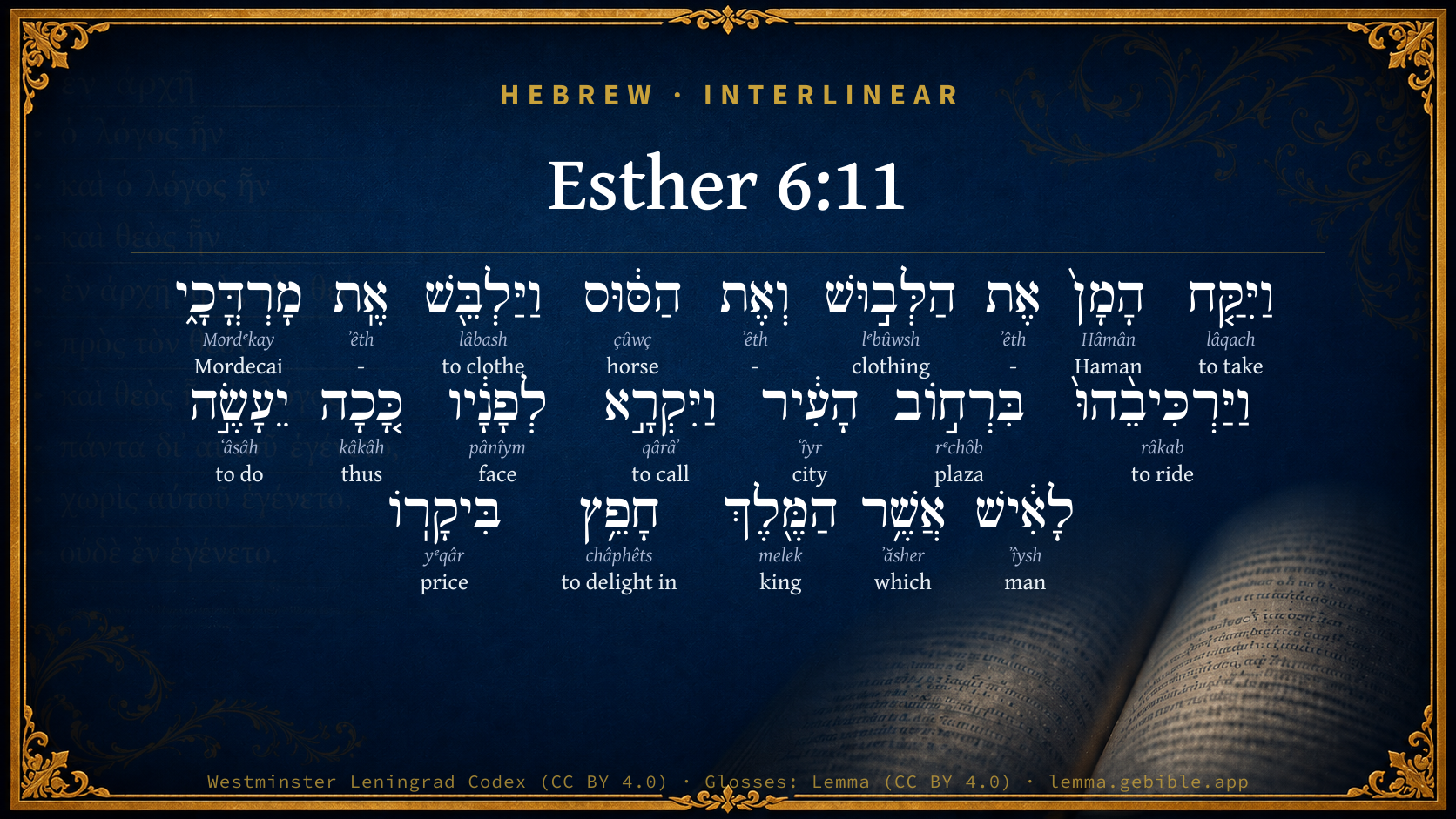
  1. וַיִּקַּ֤ח lâqach H3947 “and · to take” Conjunction + Verb, Qal, Sequential Imperfect, 3rd Person, Masculine, Singular
  2. הָמָן֙ Hâmân H2001 “Haman” Noun, Proper
  3. אֶת ʼêth H853 “-” Particle, Direct Object
  4. הַלְּב֣וּשׁ lᵉbûwsh H3830 “the · clothing” Particle, Definite Article + Noun, Common, Masculine, Singular, Absolute
  5. וְאֶת ʼêth H853 “and · -” Conjunction + Particle, Direct Object
  6. הַסּ֔וּס çûwç H5483 “the · horse” Particle, Definite Article + Noun, Common, Masculine, Singular, Absolute
  7. וַיַּלְבֵּ֖שׁ lâbash H3847 “and · to clothe” Conjunction + Verb, Hiphil, Sequential Imperfect, 3rd Person, Masculine, Singular
  8. אֶֽת ʼêth H853 “-” Particle, Direct Object
  9. מָרְדֳּכָ֑י Mordᵉkay H4782 “Mordecai” Noun, Proper
  10. וַיַּרְכִּיבֵ֨הוּ֙ râkab H7392 “and · to ride · him” Conjunction + Verb, Hiphil, Sequential Imperfect, 3rd Person, Masculine, Singular + Suffix, Personal, 3rd Person, Masculine, Singular
  11. בִּרְח֣וֹב rᵉchôb H7339 “in/at · plaza of” Preposition + Noun, Common, Feminine, Singular, Construct
  12. הָעִ֔יר ʻîyr H5892 “the · city” Particle, Definite Article + Noun, Common, Feminine, Singular, Absolute
  13. וַיִּקְרָ֣א qârâʼ H7121 “and · to call” Conjunction + Verb, Qal, Sequential Imperfect, 3rd Person, Masculine, Singular
  14. לְפָנָ֔יו pânîym H6440 “to/for · face(s) · his” Preposition + Noun, Common, Both, Plural, Construct + Suffix, Personal, 3rd Person, Masculine, Singular
  15. כָּ֚כָה kâkâh H3602 “thus” Adverb
  16. יֵעָשֶׂ֣ה ʻâsâh H6213 “to do” Verb, Niphal, Imperfect, 3rd Person, Masculine, Singular
  17. לָאִ֔ישׁ ʼîysh H376 “to/for the · man” Preposition, Determined + Noun, Common, Masculine, Singular, Absolute
  18. אֲשֶׁ֥ר ʼăsher H834 “which” Particle, Relative
  19. הַמֶּ֖לֶךְ melek H4428 “the · king” Particle, Definite Article + Noun, Common, Masculine, Singular, Absolute
  20. חָפֵ֥ץ châphêts H2654 “to delight in” Verb, Qal, Perfect, 3rd Person, Masculine, Singular

About this verse

These counts appear in no published source. They are computed here, from the morphology-tagged text and Lemma’s own curated glosses. What Lemma adds →

21
words
19
distinct lemmas
Historical
section

Notable vocabulary

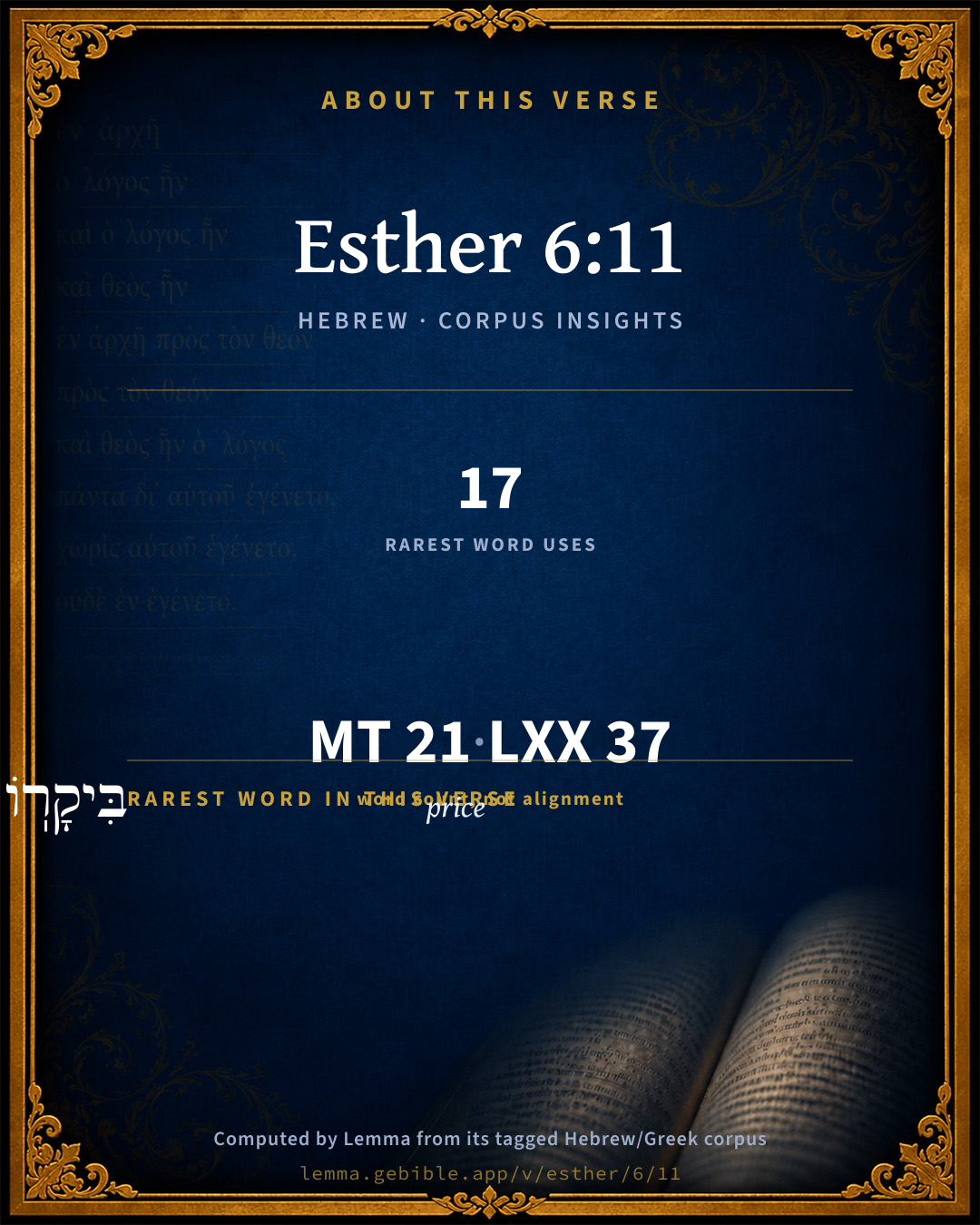
The rarest word here is בִּיקָרֽוֹ price H3366 — appearing just 17 times in the whole Hebrew Bible.

Shared distinctive vocabulary

בִּיקָרֽוֹ price H3366 occurs in 15 verses of the Hebrew Bible. Also found in:

Grammatical profile

  • 6 verbs
  • 10 nouns
  • 1 adverb
  • 4 particles

Verb forms

  • וַיִּקַּ֤ח Qal · Sequential Imperfect
  • וַיַּלְבֵּ֖שׁ Hiphil · Sequential Imperfect
  • וַיַּרְכִּיבֵ֨הוּ֙ Hiphil · Sequential Imperfect
  • וַיִּקְרָ֣א Qal · Sequential Imperfect
  • יֵעָשֶׂ֣ה Niphal · Imperfect
  • חָפֵ֥ץ Qal · Perfect

Hebrew & Septuagint length

In English translation the verse runs 40 words from the Hebrew and 41 from the Septuagint (LXX English) — closely comparable.

A rough comparison of the two English renderings, which tokenize alike — not a word-level alignment.

Word counts can differ between the Hebrew and the Greek without any difference in meaning — e.g. the Hebrew direct-object marker אֵת has no separate Greek word, and Greek often adds the article ὁ.

In the original languages it is 21 Hebrew tokens and 37 Greek tokens — but the two are counted differently (Hebrew bundles its prefixes and suffixes into one token; the Greek is in lemma form), so that isn’t a like-for-like length.

Cross-references

6

Topical passages linked to Esther 6:11 in the Treasury of Scripture Knowledge — connected by theme and wording, ordered by reader-vote popularity; previews shown in the World English Bible.

  • Esther 9:3 All the princes of the provinces, and the satraps, and the governors, and those who did the king's business, helped the Jews; because the fear of Mordecai was fallen on them.
  • Luke 1:52 He has put down princes from their thrones. And has exalted the lowly.
  • Ezra 6:13 Then Tattenai, the governor beyond the River, Shetharbozenai, and their companions, because that Darius the king had sent, did accordingly with all diligence.
  • Esther 8:15 Mordecai went forth from the presence of the king in royal clothing of blue and white, and with a great crown of gold, and with a robe of fine linen and purple: and the city of Shushan shouted and was glad.
  • Isaiah 60:14 The sons of those who afflicted you shall come bending to you; and all those who despised you shall bow themselves down at the soles of your feet; and they shall call you The city of Yahweh, The Zion of the Holy One of Israel.
  • Revelation 3:9 Behold, I give of the synagogue of Satan, of those who say they are Jews, and they are not, but lie. Behold, I will make them to come and worship before your feet, and to know that I have loved you.

Cross-references courtesy of OpenBible.info (CC BY 4.0).

Hebrew and Greek witnesses Masoretic Hebrew ↔ Greek Septuagint

The same verse in the two great witnesses to the Old Testament, shown verse-for-verse.

These are two independent witnesses, not word-aligned to each other, and the Septuagint is shown in lemma (dictionary) form.

Hebrew Esther 6:11 Masoretic · Westminster Leningrad Codex

וַיִּקַּ֤ח הָמָן֙ אֶת הַלְּב֣וּשׁ וְאֶת הַסּ֔וּס וַיַּלְבֵּ֖שׁ אֶֽת מָרְדֳּכָ֑י וַיַּרְכִּיבֵ֨הוּ֙ בִּרְח֣וֹב הָעִ֔יר וַיִּקְרָ֣א לְפָנָ֔יו כָּ֚כָה יֵעָשֶׂ֣ה לָאִ֔ישׁ אֲשֶׁ֥ר הַמֶּ֖לֶךְ חָפֵ֥ץ בִּיקָרֽוֹ

Then took Haman the clothing and the horse, and arrayed Mordecai, and caused him to ride through the street of the city, and proclaimed before him, Thus shall it be done to the man whom the king delights to honor.

World English Bible · Public Domain

Greek LXX Esther 6:11 Septuagint · lemma form

λαμβάνω δέ αμαν ὁ στολή καί ὁ ἵππος καί στολίζω ὁ μαρδοχαῖος καί ἀναβιβάζω αὐτός ἐπί ὁ ἵππος καί διαἔρχομαι διά ὁ πλατεῖα ὁ πόλις καί κηρύσσω λέγω οὕτως εἰμί πᾶς ἄνθρωπος ὅς ὁ βασιλεύς θέλω δοξάζω

So Aman took the robe and the horse, and arrayed Mardochaeus, and mounted him on the horse, and went through the street of the city, and proclaimed, saying, Thus shall it be to every man whom the king wishes to honor.

LXX2012 (modern English Septuagint) · Public Domain

Hebrew: Westminster Leningrad Codex (CC BY 4.0). Greek: Septuagint (public domain); English from LXX2012 (modern English Septuagint) (Public Domain). How the Septuagint differs from the Hebrew →

Commentary

Notes on Esther 6:11 from classic Christian and Jewish commentators (each source and its license shown beneath its notes). The classic Christian expositions comment on the surrounding passage and are grouped to its opening verse, so a note may address several verses; the Jewish commentaries on the Tanakh (Rashi and others) are per-verse, so they appear only where the commentator wrote on this verse.

Lemma curates 59 commentaries, every one of them public domain or Creative Commons licensed, each selected and text-cleaned for this edition rather than reprinted as found. About our sources →

Trapp's Complete Commentary

John Trapp

Est 6:11 Then took Haman the apparel and the horse, and arrayed Mordecai, and brought him on horseback through the street of the city, and proclaimed before him, Thus shall it be done unto the man whom the king delighteth to honour.

Ver. 11. Then took Haman the apparel, &c.] Full sore against stomach be sure, but how could he help it? Thus God compelleth the devil and his limbs sometimes, though against their wills, to serve him as his servants. Canes lingunt ulcers Lazari. Dogs licked the sores of Lazarus, Saul pronounceth David more righteous than he. Judas and Pilate gave testimony to Christ’s innocency. These are the servants of the High God, which show unto us the way of salvation, said the Pythoness concerning Paul and his companions, Act 16:17.

And arrayed Mordecai] Whose heart he could rather have torn out, and eaten it with salt. But courtiers are usually notable dissemblers, cunning politicians, &c. How busy is Haman now about Mordecai to array him, to mount him, and to attend upon him, whom yet he hated, and inwardly cursed to the pit of hell! Cavete ab osculo Iscariotico, ab officio Hamanitico. Beware of the eys of Judas and the office of hamen. Beware of men, Mat 10:17 Josephus telleth us, that when Haman came to do those things to Mordecai, he (thinking that he had mocked him) answered with indignation, Thou most wicked man, dost thou thus insult over the miserable? But when he had told him, that indeed it was the king’s pleasure, he suffered him to do it. But what shall we say to reconcile those cross passions in Ahasuerus? Before he signed that decree of killing all the Jews, he could not but know that a Jew had saved his life; and now, after that he had enacted the slaughter of all the Jews as rebels, he giveth order to honour a Jew as his preserver. It were strange (saith a right reverend writer hereupon, Dr Hall) if great persons, in the multitude of their distractions, should not let fall some incongruities.

And brought him on horseback] Whom before he could not endure to see sitting at the court’s gate. A great trouble it was to Haman to lead Mordecai’s horse, which another man would not have thought so: the moving of a straw troubleth proud flesh, &c.

Through the streets of the city] Where all men were now in an amazement at that sudden glory of Mordecai, and study how to reconcile this day with the thirteenth of Adar.

And proclaimed before him] Not without an honourable mention made of his loyalty and fidelity to the king, the cause of that great honour. This Haman was forced to proclaim, and that on foot, as a servant; when Mordecai, as a prince in his state, was on horseback. It is probable that Haman thought within himself that he should shortly have his penny worths of that vile varlet, whom now he thus far honoured, and that haply ere night yet, at the feast, he might prevail with the king to do by Mordecai as once Xerxes did by his steersman, when he came back with shame and loss from his wars with Greece. Xerxes was forced, saith the history, to flee back in a poor fisher’s boat; which, being over loaded, had sunk all, if the Persians by casting away themselves had not saved the life of their king; the loss of which noble spirits so vexed him, that having given the steersman a golden coronet for preserving his own life, he commanded him to execution as a co-author of the death of his servants.

John Trapp, A Commentary or Exposition upon All the Books of the Old and New Testament (1647–1656) — public domain. Text from a community e-Sword module.

Joseph Benson's Commentary

Est 6:11-12. Then Haman took the apparel — The king’s words undoubtedly produced great commotion in his breast, but he durst not dispute, nor so much as seem to dislike the king’s order; but, though with the greatest regret and reluctance imaginable, brings the apparel, &c, to Mordecai, who, we may suppose, did no more cringe to Haman now than he did before, valuing his counterfeit respects no more than he had valued his concealed malice. And arrayed Mordecai, and brought him on horseback, &c. — It is hard to say which of the two put a greater force upon himself: proud Haman, in giving this honour to Mordecai, or humble Mordecai, in accepting it. Upon one account, no doubt, it was agreeable to Mordecai, as it was an indication of the king’s favour, and gave ground to hope that Esther would prevail for the reversing of the edict against the Jews. Mordecai came again to the king’s gate — To his former place, showing that, as he was not overwhelmed with Haman’s threats, so he was not puffed up with this honour. Besides, he came thither to attend the issue of the business he had most at heart, respecting the Jews; and to be at hand, if need were, to assist or encourage the queen, which he was now more capable of doing than heretofore he had been. Haman hasted to his house mourning, and having his head covered — In token of his shame and grief for his unexpected disappointment, and for the great honour done to his abhorred adversary, by his own hands, and with his own public disgrace.

Joseph Benson's Commentary on the Old and New Testaments (1811–1818) — public domain. Text from a community e-Sword module.

Jamieson, Fausset & Brown

Robert Jamieson, A. R. Fausset & David Brown

Then Haman took, &c.--This sudden reverse, however painful to Haman as an individual, is particularly characteristic of the Persian manners.

Jamieson, Fausset & Brown — Commentary Critical and Explanatory on the Whole Bible (1871) — public domain (CC PDM 1.0). Text via the HelloAO Bible API.

Ellicott's Commentary for English Readers

(11) Then took Haman . . .—It would be a grim and curious study to analyse Hainan’s feelings at this juncture. Various thoughts were mingled there. Self-reproach, perhaps, that he had so thoughtlessly been the cause of the present display, bitter hatred of his rival now multiplied a thousandfold, and the evident knowledge that the game was played out, and that he was ruined. The more subtle the brain, the more truly must he have known this.

A Bible Commentary for English Readers, edited by Charles John Ellicott (1878–1897) — public domain. Text from a community e-Sword module.

The Cambridge Bible for Schools and Colleges

gen. ed. J. J. S. Perowne

11. Then took Haman etc.] Haman, as the most prominent man in the king’s court, was compelled, through the irony of fate, to carry out to the letter in his enemy’s case the proposals which he had made on his own behalf.

The Cambridge Bible for Schools and Colleges (gen. ed. J. J. S. Perowne; Cambridge University Press, 1878–1918) — public domain. Text from a community e-Sword module.

John Gill's Exposition

Then took Haman the apparel, and the horse,.... The one out of the wardrobe, the other out of the stable, and the crown also no doubt, though no mention is made of it, since the king made no objection to it, yea, commanded that nothing fail of what had been spoken; but this was included in the pomp and state of the led horse: and brought him on horseback through the street of the city; the most grand and public part of it, thus arrayed, and in this state: and proclaimed before him, thus shall it be done to the man whom the king delighteth to honour; See Gill on Est 6:9.

.

Esther 6:12

est 6:12

est 6:12

est 6:12And Mordecai came again to the king's gate,.... To attend his post and office at court; which confirms what has been already hinted, that he was in some office in the court, which this phrase is expressive of, and not a porter at the gate; for it is not probable he should return to such a station, after so much honour had been done him; and much less that he returned to his sackcloth and fasting, as Jarchi and the former Targum; since he might reasonably conclude things were taking a turn in his favour, and that of his people; though as yet he knew not what success Esther had had, to wait for which he returned to court:

but Haman hasted to his house; pushed forward as fast as he could:

mourning; at his sad disappointment:

and having his head covered; through grief and sorrow, confusion and shame; so Demosthenes, being hissed, went home with his head covered (c), as confounded and ashamed to be seen (d).

(c) Plutarch in Demosthene. (d) See more instances in Lively's Chronology of the Persian monarchy, p. 18, 19.

John Gill's Exposition of the Whole Bible (1746–1763) — public domain (CC PDM 1.0). Text via the HelloAO Bible API.

Matthew Poole's English Annotations

He proclaimed this either himself, or by the officer.

Matthew Poole's English Annotations on the Holy Bible (1683–1685) — public domain. Text from a community e-Sword/MySword module.

The Pulpit Commentary

Then took Haman the apparel. It was impossible for Haman to excuse himself; there was no ground on which he could decline the office thrust upon him. Reluctantly, without a word, he performed the king"s bidding.

The Pulpit Commentary (1880–1919), ed. H.D.M. Spence-Jones & Joseph S. Exell — public domain. Text from a community e-Sword module.

Lesson kit

Teaching starters — assembled from the data on this page, not authored interpretation. Every prompt links to the verse data it draws on. Edit before teaching.

Esther, in the Historical, opens this verse with 21 words (19 distinct Hebrew lemmas). Its most distinctive word is yᵉqâr (“price”). A historical commentator’s framing appears above. Read the whole chapter for the surrounding context.

Discussion questions

  1. What does “price” (yᵉqâr) contribute to the verse as a whole?
  2. How does Esther 1:4, which shares the word «price», read alongside this verse?
  3. The translations on this page render this verse differently — a whole-verse word diff, not a word-by-word alignment. What might account for the different wordings?
  4. «וַיִּקַּ֤ח» is a Qal Sequential Imperfect verb. How does that grammatical form shape the action described?
  5. Compare how Trapp's Complete Commentary and Joseph Benson's Commentary read this verse. Where do they agree or differ?

Things to notice

Reading settings

Reading text

Shown beneath each verse's original-language words.

Old Testament
Old Testament edition

Read the OT as the Masoretic Hebrew (MT) or the Greek Septuagint (LXX).

English shown for the Greek Septuagint (in the Hebrew ↔ Greek comparison).

Comparing translations? Open the Compare panel on any verse page to stack up to four side by side.