
Numbers 1:17

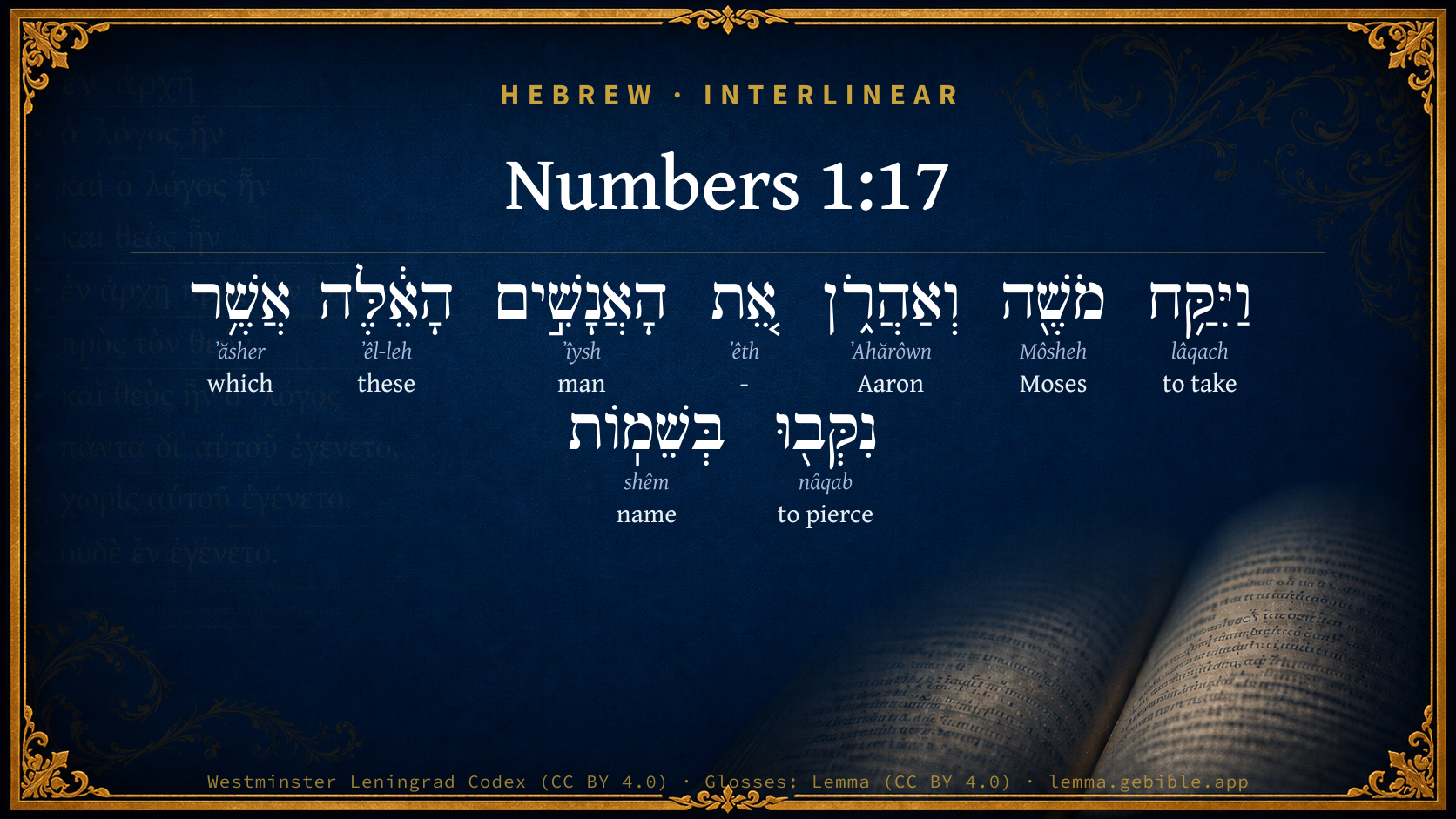
Hebrew (Westminster Leningrad Codex) Numbers 1:17 appears in the Hebrew Old Testament. The text above is from the Westminster Leningrad Codex. Each word links to its Strong’s number, a concise gloss, and parsing drawn from the Open Scriptures Hebrew Bible morphology. Click any word for its full Brown-Driver-Briggs (BDB) entry.
Download image
Cite this verse

Numbers 1:17 (World English Bible). Public Domain. Lemma interlinear Bible study tool, https://lemma.gebible.app/v/numbers/1/17.

Show BibTeX & RIS
BibTeX
RIS
English Translation
Moses and Aaron took these men who are mentioned by name.
World English Bible · Public Domain
Download a study sheet

One document with this verse’s original text, its word-by-word gloss line, the meaning frame, cross-references with their text, attributed commentary, and full source and license credits — printable, and it pastes into notes with its structure intact.

This verse Autodidact and up

Study sheet (.html) Plain text (.txt)

A passage Seminary Student

Up to 50 verses in one chapter. A passage sheet keeps up to 6 commentary sources and 12 cross-references per verse, in the order this page ranks them, and says so on the sheet whenever that leaves anything out. Ask for a single verse and you get the Autodidact verse sheet above.

Everything on this page stays free to read, with no account — the sheet is a download of what is already on screen, not access to it.

Want to remove ads? Support Godless Engineer
Compare translations 3

The same verse in 3 English versions, stacked beneath the original-language interlinear above. Click any original word for its lexicon entry.

Each is an independent rendering of the whole verse — the interlinear is not word-aligned to these translations.

Highlighted words mark where these versions differ — a whole-verse word diff, not a word-by-word alignment.

  • World English Bible Public Domain
    Moses and Aaron took these men who are mentioned by name.
  • King James Version Public Domain
    And Moses and Aaron took these men which are expressed by their names:
  • unfoldingWord Literal Text CC BY-SA 4.0
    And Moses and Aaron took these men, who were designated by names.

unfoldingWord Literal Text — © unfoldingWord, licensed CC BY-SA 4.0. Word-aligned USFM3 via Door43 (git.door43.org/unfoldingWord/en_ult).

Versions to compare (up to 4)

3 of 4 selected

Show all 18 translations

Every available English version of this verse, each an independent rendering of the whole verse.

  • World English Bible Public Domain
    Moses and Aaron took these men who are mentioned by name.
  • Berean Standard Bible Public Domain
    So Moses and Aaron took these men who had been designated by name,
  • Majority Standard Bible Public Domain
    So Moses and Aaron took these men who had been designated by name,
  • King James Version Public Domain
    And Moses and Aaron took these men which are expressed by their names:
  • American Standard Version (1901) Public Domain
    And Moses and Aaron took these men that are mentioned by name:
  • Revised Version (1885) Public Domain
    And Moses and Aaron took these men which are expressed by name:
  • Geneva Bible (1599) Public Domain
    The Moses and Aaron tooke these men which are expressed by their names.
  • Douay-Rheims (1899) Public Domain
    Whom Moses and Aaron took with all the multitude of the common people:
  • Young's Literal Translation Public Domain
    And Moses taketh -- Aaron also -- these men, who were defined by name,
  • Literal Standard Version CC BY-SA 4.0
    And Moses takes—Aaron also—these men, who were defined by name,
  • Unlocked Literal Bible CC BY-SA 4.0
    Moses and Aaron took these men, who were recorded by name,
  • unfoldingWord Literal Text CC BY-SA 4.0
    And Moses and Aaron took these men, who were designated by names.
  • Darby Bible Public Domain
    And Moses and Aaron took these men who are expressed by their names,
  • World Messianic Bible Public Domain
    Moses and Aaron took these men who are mentioned by name.
  • Webster's Bible Public Domain
    And Moses and Aaron took these men who are expressed by their names:
  • Free Bible Version CC BY-SA 4.0
    Moses and Aaron summoned these men who had been selected by name.
  • Bible in Basic English Public Domain
    And Moses and Aaron took these men, marked out by name;
  • JPS Tanakh (1917) Public Domain
    And Moses and Aaron took these men that are pointed out by name.

Literal Standard Version (2020), Covenant Press — licensed CC BY-SA 4.0. Text via the HelloAO Bible API (eBible.org). Unlocked Literal Bible (unfoldingWord) — licensed CC BY-SA 4.0. Text via the HelloAO Bible API (eBible.org). unfoldingWord Literal Text — © unfoldingWord, licensed CC BY-SA 4.0. Word-aligned USFM3 via Door43 (git.door43.org/unfoldingWord/en_ult). Free Bible Version, Dr. Jonathan Gallagher — licensed CC BY-SA 4.0. Text via the HelloAO Bible API (eBible.org).

Word by word

More ways to search: Search by grammar → Find every occurrence → Compare this word →

Practice this passage: Drill this verse → Learn its vocabulary →

About this verse

These counts appear in no published source. They are computed here, from the morphology-tagged text and Lemma’s own curated glosses. What Lemma adds →

9
words
9
distinct lemmas
Pentateuch
section

Notable vocabulary

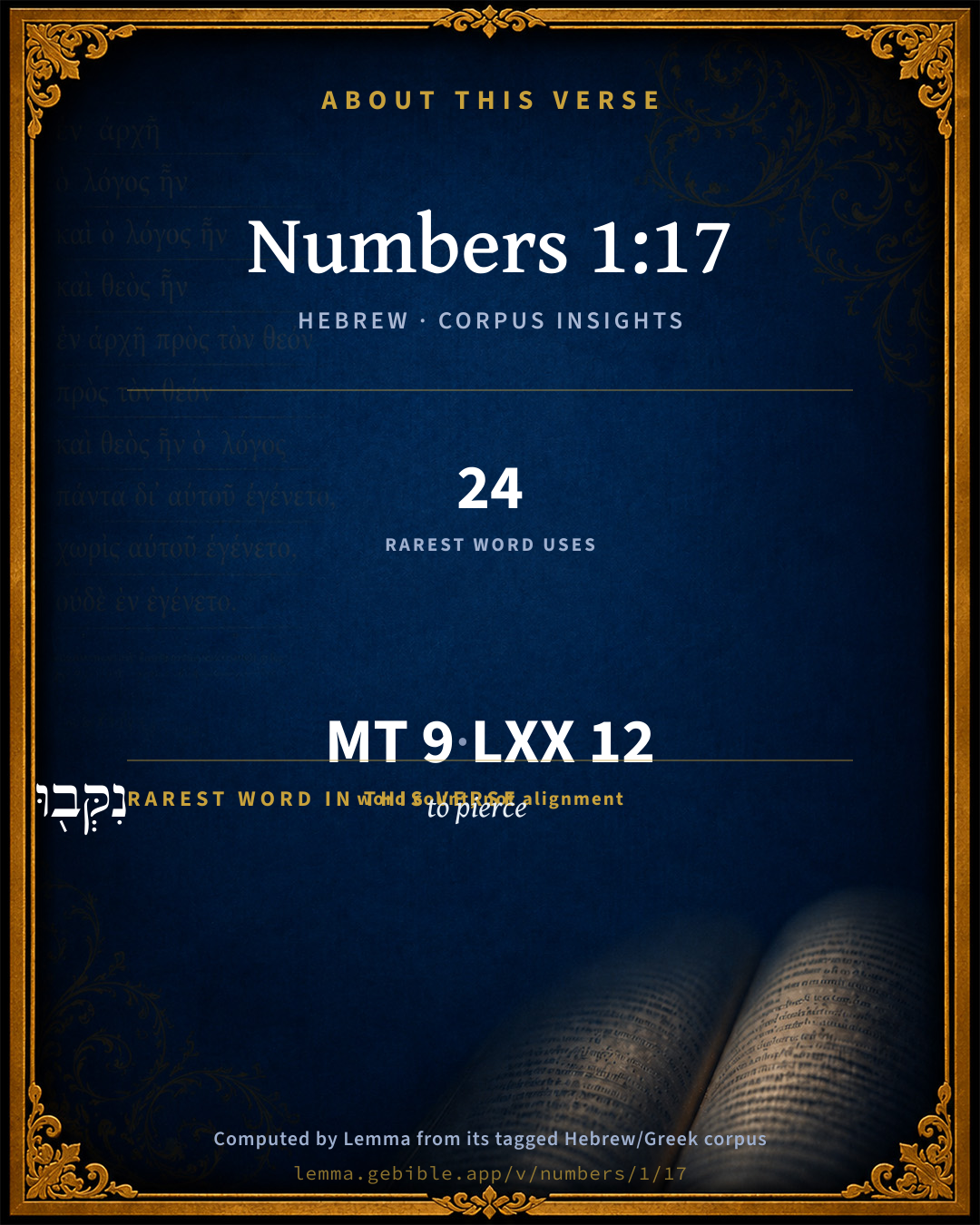
The rarest word here is נִקְּב֖וּ to pierce H5344 — appearing just 24 times in the whole Hebrew Bible.

Shared distinctive vocabulary

נִקְּב֖וּ to pierce H5344 occurs in 23 verses of the Hebrew Bible. Also found in:

Grammatical profile

  • 2 verbs
  • 4 nouns
  • 1 pronoun
  • 2 particles

Verb forms

  • וַיִּקַּ֥ח Qal · Sequential Imperfect
  • נִקְּב֖וּ Niphal · Perfect

Hebrew & Septuagint length

In English translation the verse runs 11 words from the Hebrew and 12 from the Septuagint (LXX English) — closely comparable.

A rough comparison of the two English renderings, which tokenize alike — not a word-level alignment.

Word counts can differ between the Hebrew and the Greek without any difference in meaning — e.g. the Hebrew direct-object marker אֵת has no separate Greek word, and Greek often adds the article ὁ.

In the original languages it is 9 Hebrew tokens and 12 Greek tokens — but the two are counted differently (Hebrew bundles its prefixes and suffixes into one token; the Greek is in lemma form), so that isn’t a like-for-like length.

Cross-references

3

Topical passages linked to Numbers 1:17 in the Treasury of Scripture Knowledge — connected by theme and wording, ordered by reader-vote popularity; previews shown in the World English Bible.

  • Numbers 1:5–15 These are the names of the men who shall stand with you: Of Reuben: Elizur the son of Shedeur.
  • John 10:3 The gatekeeper opens the gate for him, and the sheep listen to his voice. He calls his own sheep by name, and leads them out.
  • Revelation 7:4–17 I heard the number of those who were sealed, one hundred forty-four thousand, sealed out of every tribe of the children of Israel:

Cross-references courtesy of OpenBible.info (CC BY 4.0).

Hebrew and Greek witnesses Masoretic Hebrew ↔ Greek Septuagint

The same verse in the two great witnesses to the Old Testament, shown verse-for-verse.

These are two independent witnesses, not word-aligned to each other, and the Septuagint is shown in lemma (dictionary) form.

Hebrew Numbers 1:17 Masoretic · Westminster Leningrad Codex

וַיִּקַּ֥ח מֹשֶׁ֖ה וְאַהֲרֹ֑ן אֵ֚ת הָאֲנָשִׁ֣ים הָאֵ֔לֶּה אֲשֶׁ֥ר נִקְּב֖וּ בְּשֵׁמֽוֹת

Moses and Aaron took these men who are mentioned by name.

World English Bible · Public Domain

Greek LXX Numbers 1:17 Septuagint · lemma form

καί λαμβάνω μωυσῆς καί ἀαρών ὁ ἀνήρ οὗτος ὁ ἀνακαλέω ἐκ ὄνομα

And Moses and Aaron took these men who were called by name.

LXX2012 (modern English Septuagint) · Public Domain

Hebrew: Westminster Leningrad Codex (CC BY 4.0). Greek: Septuagint (public domain); English from LXX2012 (modern English Septuagint) (Public Domain). How the Septuagint differs from the Hebrew →

Targum (Aramaic paraphrase)

2

The Targum is the ancient Jewish Aramaic paraphrase of the Hebrew Scriptures — an interpretive translation, not the Hebrew text itself. Onkelos (literal) and Pseudo-Jonathan (expansive) render the Torah, and Jonathan the Prophets. Coverage is partial: where no permissively-licensed English translation exists for a verse, only the Aramaic is shown. This is verse-level text, not a word-by-word alignment to the Hebrew.

  1. Targum Onkelos Torah (Genesis–Deuteronomy)
    וּדְבַר משֶׁה וְאַהֲרֹן יָת גֻבְרַיָא הָאִלֵין דִי אִתְפָּרָשׁוּ בִּשְׁמָהָן

    (no public-domain English translation for this verse)

    Targum Onkelos — Aramaic: “Onkelos Genesis” (public domain); “Onkelos Exodus” (public domain); “Onkelos Leviticus” (public domain); “Onkelos Numbers” (public domain); “Onkelos Deuteronomy” (public domain). English: “Sefaria Community Translation” (CC0 1.0 (public-domain dedication)); “J.W. Etheridge. The Targums of Onkelos and Jonathan Ben Uzziel on the Pentateuch. London: Longmans, Green, 1862” (public domain). Text via Sefaria.

  2. Targum Pseudo-Jonathan Torah (Genesis–Deuteronomy)
    וּדְבַר משֶׁה וְאַהֲרן יַת גוּבְרַיָא הָאִלֵין דְאִתְפְּרָשׁוּ בִּשְׁמָהָן

    And Mosheh and Aharon took these men who are expressed by their names:

    Targum Pseudo-Jonathan — Aramaic: “Targum Jonathan on Genesis” (public domain); “Targum Jonathan on Exodus” (public domain); “Targum Jonathan on Leviticus” (public domain); “Targum Jonathan on Numbers” (public domain); “Targum Jonathan on Deuteronomy” (public domain). English: “The Targum of Jonathan ben Uzziel, trans. J. W. Etheridge, London, 1862” (public domain). Text via Sefaria.

Commentary

Notes on Numbers 1:17 from classic Christian and Jewish commentators (each source and its license shown beneath its notes). The classic Christian expositions comment on the surrounding passage and are grouped to its opening verse, so a note may address several verses; the Jewish commentaries on the Tanakh (Rashi and others) are per-verse, so they appear only where the commentator wrote on this verse.

Lemma curates 59 commentaries, every one of them public domain or Creative Commons licensed, each selected and text-cleaned for this edition rather than reprinted as found. About our sources →

Trapp's Complete Commentary

John Trapp

Num 1:17 And Moses and Aaron took these men which are expressed by [their] names:

Ver. 17. Which are expressed by their names.] And they are all excellent good names and very significant; hereby is testified to posterity that they forgat not the name of their God when they were in the iron furnace, but could say, as Psa 44:17, "All this is come upon us, yet have we not forgotten thee; though thou hast sore broken us, in the place of dragons," &c.

John Trapp, A Commentary or Exposition upon All the Books of the Old and New Testament (1647–1656) — public domain. Text from a community e-Sword module.

Tyndale Open Study Notes

Tyndale Open Resources

1:17-46 The tabulation yields the same number of qualified men (603,550) as mentioned in Exod 38:26. Exodus 12:37 and Num 11:21 give an approximate number of 600,000. These numbers have been interpreted in different ways. They might reflect the literal size of this army (cp. Exod 1:9-10); alternatively, the figures might be symbolic, projected backward from a later period, or simply misunderstood in translation. See also study note on Exod 12:37.

Tyndale Open Study Notes — © Tyndale Open Resources, licensed CC BY-SA 4.0. Text via the HelloAO Bible API.

Matthew Henry's Commentary

We have here the speedy execution of the orders given for the numbering of the people. It was begun the same day that the orders were given, The first day of the second month; compare Num 1:18 with Num 1:1. Note, When any work is to be done for God it is good to set about it quickly, while the sense of duty is strong and pressing. And, for aught that appears, it was but one day's work, for many other things were done between this and the twentieth day of this month, when they removed their camp, Num 10:11. Joab was almost ten months numbering the people in David's time (Sa2 24:8); but then they were dispersed, now they lived closely together; then Satan proposed the doing of it, now God commanded it. It was the sooner and more easily done now because it had been done but a little while ago, and they needed but review the old books, with the alterations since made, which probably they had kept an account of as they occurred.

In the particulars here left upon record, we may observe, 1. That the numbers are registered in words at length (as I may say), and not in figures; to every one of the twelve tribes it is repeated, for the greater ceremony and solemnity of the account, that they were numbered by their generations, after their families, by the house of their fathers, according to the number of the names, to show that every tribe took and gave in the account by the same rule and in the same method, though so many hands were employed in it, setting down the genealogy first, to show that their family descended from Israel, then the families themselves in their order, then dividing each family into the houses, or subordinate families, that branched from it, and under these the names of the particular persons, according to the rules of heraldry. Thus every man might know who were his relations or next of kin, on which some laws we have already met with did depend: besides that the nearer any are to us in relation the more ready we should be to do them good. 2. That they all end with hundreds, only Gad with fifty (Num 1:25), but none of the numbers descend to units or tens. Some think it was a special providence that ordered all the tribes just at this time to be even numbers, and no odd or broken numbers among them, to show them that there was something more than ordinary designed in their increase, there being this uncommon in the circumstance of it. It is rather probable that Moses having some time before appointed rulers of hundreds, and rulers of fifties (Exo 18:25), they numbered the people by their respective rulers, which would bring the numbers to even hundreds or fifties. 3. That Judah is the must numerous of them all, more than double to Benjamin and Manasseh, and almost 12,000 more than any other tribe, v. 27. It was Judah whom his brethren must praise because from him Messiah the Prince was to descend; but, because that was a thing at a distance, God did in many ways honour that tribe in the mean time, particularly by the great increase of it, for his sake who was to spring out of Judah (Heb 7:14) in the fulness of time. Judah was to lead the van through the wilderness, and therefore was furnished accordingly with greater strength than any other tribe. 4. Ephraim and Manasseh, the sons of Joseph, are numbered as distinct tribes, and both together made up almost as many as Judah; this was in pursuance of Jacob's adoption of them, by which they were equalled with their uncles Reuben and Simeon, Gen 48:5. It was also the effect of the blessing of Joseph, who was to be a fruitful bough, Gen 49:22. And Ephraim the younger is put first, and is more numerous than Manasseh, for Jacob had crossed hands, and foreseen ten thousands of Ephraim and thousands of Manasseh. The fulfilling of this confirms our faith in the spirit of prophecy with which the patriarchs were endued. 5. When they came down into Egypt Dan had but one son (Gen 46:23), and so his tribe was but one family, Num 26:42. Benjamin had then ten sons (Gen 46:21), yet now the tribe of Dan is almost double in number to that of Benjamin. Note, The increasing and diminishing of families do not always go by probabilities. Some are multiplied greatly, and again are diminished, while others that were poor have families made them like a flock, Psa 107:38, Psa 107:39, Psa 107:41; and see Job 12:23. 6. It is said of each of the tribes that those were numbered who were able to go forth to war, to remind them that they had wars before them, though now they were in peace and met with no opposition. Let not him that girdeth on the harness boast as though he had put it off.

Matthew Henry's Commentary on the Whole Bible (1708–1710) — public domain (CC PDM 1.0). Text via the HelloAO Bible API.

The Cambridge Bible for Schools and Colleges

gen. ed. J. J. S. Perowne

17–46. The numbers ascertained by the census.

There can be no doubt that the numbers given in chs. 1–3 and 26 are purely artificial. Gray (Numbers, pp. 10–15) shews that (1) they are impossible, (2) when compared with each other they yield absurd results, (3) they are inconsistent with numbers given in Hebrew literature earlier than P .

(1) The number of male Israelites of fighting age is put at 603,550, which appears in round numbers as 600,000 in Num_11:21, Exo_12:37. But the fighting men could form hardly more than a quarter of the whole; so that the population would reach a total of some 2¼ millions. The present population of the Sinaitic peninsula is estimated at from 4,000 to 6,000, and a body of over 2 million people could not find subsistence even if dispersed all over the peninsula.

(2) The male first-born numbered 22,273 (Num_3:43); and it is fair to suppose that the number of families in which the first-born child was a female would be about the same, giving a total of some 44,546 families; in which case there was an average of about 50 children to a family.

Again, from Num_3:12 we gather that the ‘first-born’ means the first-born of the mother, not the eldest son of a father who might have several wives. There were, therefore, 44,546 mothers. But this number (assuming that the number of women over 20 years of age was the same as that of the men, i.e. 600,000) involves the extreme improbability that only 1 in 14 women over 20 years of age had any children.

(3) According to Jdg_5:8 the tribes of Benjamin, Ephraim. Manasseh, Naphtali, Zebulun and Issachar yielded only 40,000 persons, i.e. apparently fighting men. But in these six tribes the fighting men were 273,300 at the first census, and 301,000 at the second (Numbers 26).

Again, in Judges 18 it is related that the Danites had no proper territory belonging to them; and therefore 600 armed men (obviously the greater part of the tribe) migrated to the north. But the fighting men of Dan numbered 62,700 at the first census, and 64,400 at the second. See, further, the additional note at the end of the chapter.

The Cambridge Bible for Schools and Colleges (gen. ed. J. J. S. Perowne; Cambridge University Press, 1878–1918) — public domain. Text from a community e-Sword module.

John Gill's Exposition

And Moses and Aaron took these men,.... They doubtless sent for them, and acquainted them with the nomination of them, by the Lord himself, for such a service; and they took them with them to the place where the number of the people was to be taken:

which are expressed by their names: in Num 1:16, and that as declared by the mouth of God himself.

John Gill's Exposition of the Whole Bible (1746–1763) — public domain (CC PDM 1.0). Text via the HelloAO Bible API.

The Pulpit Commentary

THE CENSUS TAKEN (verses Exo_18:25)

Vers. 17-46. God"s army.

We have here, spiritually, the army of the living God numbered and arrayed unto the march and the victory. Consider, therefore

That it would appear, as far as we can gather from the increase in numbers, that none had died since the exodus, save through disobedience and idolatry. Even so, none can perish or be lost from the vast army which has come through the Red Sea of the blood of Christ, save through their own disobedience, through departing in their heart from the living God, and making them other gods. The armies of God do not and cannot decrease by death, by violence, or accident: such things have no dominion over them; only sin can separate from the society of the elect, from the communion of saints.

The Pulpit Commentary (1880–1919), ed. H.D.M. Spence-Jones & Joseph S. Exell — public domain. Text from a community e-Sword module.

Keil & Delitzsch

C. F. Keil & F. Delitzsch

This command was carried out by Moses and Aaron. They took for this purpose the twelve heads of tribes who are pointed out (see at Lev 24:11) by name, and had the whole congregation gathered together by them and enrolled in genealogical tables. התילּד, to announce themselves as born, i.e., to have themselves entered in genealogical registers (books of generations). This entry is called a פּקד, mustering, in Num 1:19, etc. In vv. 20-43 the number is given of those who were mustered of all the different tribes, and in Num 1:44-47 the total of the whole nation, with the exception of the tribe of Levi. "Their generations" (Num 1:20, Num 1:22, Num 1:24, etc.), i.e., those who were begotten by them, so that "the sons of Reuben, Simeon," etc., are mentioned as the fathers from whom the mishpachoth and fathers' houses had sprung. The ל before שׁמעון בּני in Num 1:22, and the following names (in Num 1:24, Num 1:26, etc.), signifies "with regard to" (as in Isa 32:1; Psa 17:4, etc.).

Keil & Delitzsch — Biblical Commentary on the Old Testament (1861–1891) — public domain (CC PDM 1.0). Text via the HelloAO Bible API. (Old Testament only.)

unfoldingWord translationNotes

Door43 World Missions Community

took these men

"gathered these men together"

who were recorded by name

This can be stated in active form. AT: "whose names they had recorded" (See: Active or Passive)

the first day of the second month

This is the second month of the Hebrew calendar. The first day is near the middle of April on Western calendars. See how you translated this in Numbers 1:1. (See: Hebrew Months and Ordinal Numbers)

Then each man ... identified his ancestry. He had to name the clans and families descended from his ancestors

The second sentence means basically the same thing as the first and is added for clarification. (See: Parallelism)

He had to name

Here "name" means to "say." AT: "Each man had to say" (See: Idiom)

translationWords

Moses

Aaron

name

assembly

family

desert

Sinai

Yahweh

command

unfoldingWord translationNotes — © Distant Shores Media and the Door43 World Missions Community, licensed CC BY-SA 4.0. Source: git.door43.org/Door43/en_tn.

Rashi

Rabbi Shlomo Yitzchaki (Rashi)

האנשים האלה [AND MOSES AND AARON] TOOK THESE MEN — these twelve princes.

אשר נקבו WHO WERE MENTIONED to him (Moses) here בשמות BY NAME.

Rashi on the Tanakh — English translations: “The Judaica Press complete Tanach with Rashi, translated by A. J. Rosenberg” (CC BY 4.0); “Pentateuch with Rashi's commentary by M. Rosenbaum and A.M. Silbermann, 1929-1934” (public domain); “The Metsudah Tanach series, Lakewood, N.J” (CC BY 4.0); and “The Book of Joshua, Metsudah Publications, 1997” (CC BY 4.0). Text via Sefaria.

Lesson kit

Teaching starters — assembled from the data on this page, not authored interpretation. Every prompt links to the verse data it draws on. Edit before teaching.

Numbers, in the Pentateuch, opens this verse with 9 words (9 distinct Hebrew lemmas). Its most distinctive word is nâqab (“to pierce”). A historical commentator’s framing appears above. Read the whole chapter for the surrounding context.

Discussion questions

  1. How does “to pierce” (nâqab) shape what this verse is saying?
  2. How does Genesis 30:28, which shares the word «to pierce», read alongside this verse?
  3. The translations on this page render this verse differently — a whole-verse word diff, not a word-by-word alignment. What might account for the different wordings?
  4. «וַיִּקַּ֥ח» is a Qal Sequential Imperfect verb. How does that grammatical form shape the action described?
  5. Compare how Trapp's Complete Commentary and Tyndale Open Study Notes read this verse. Where do they agree or differ?

Things to notice

Reading settings

Reading text

Shown beneath each verse's original-language words.

Old Testament
Old Testament edition

Read the OT as the Masoretic Hebrew (MT) or the Greek Septuagint (LXX).

English shown for the Greek Septuagint (in the Hebrew ↔ Greek comparison).

Comparing translations? Open the Compare panel on any verse page to stack up to four side by side.