
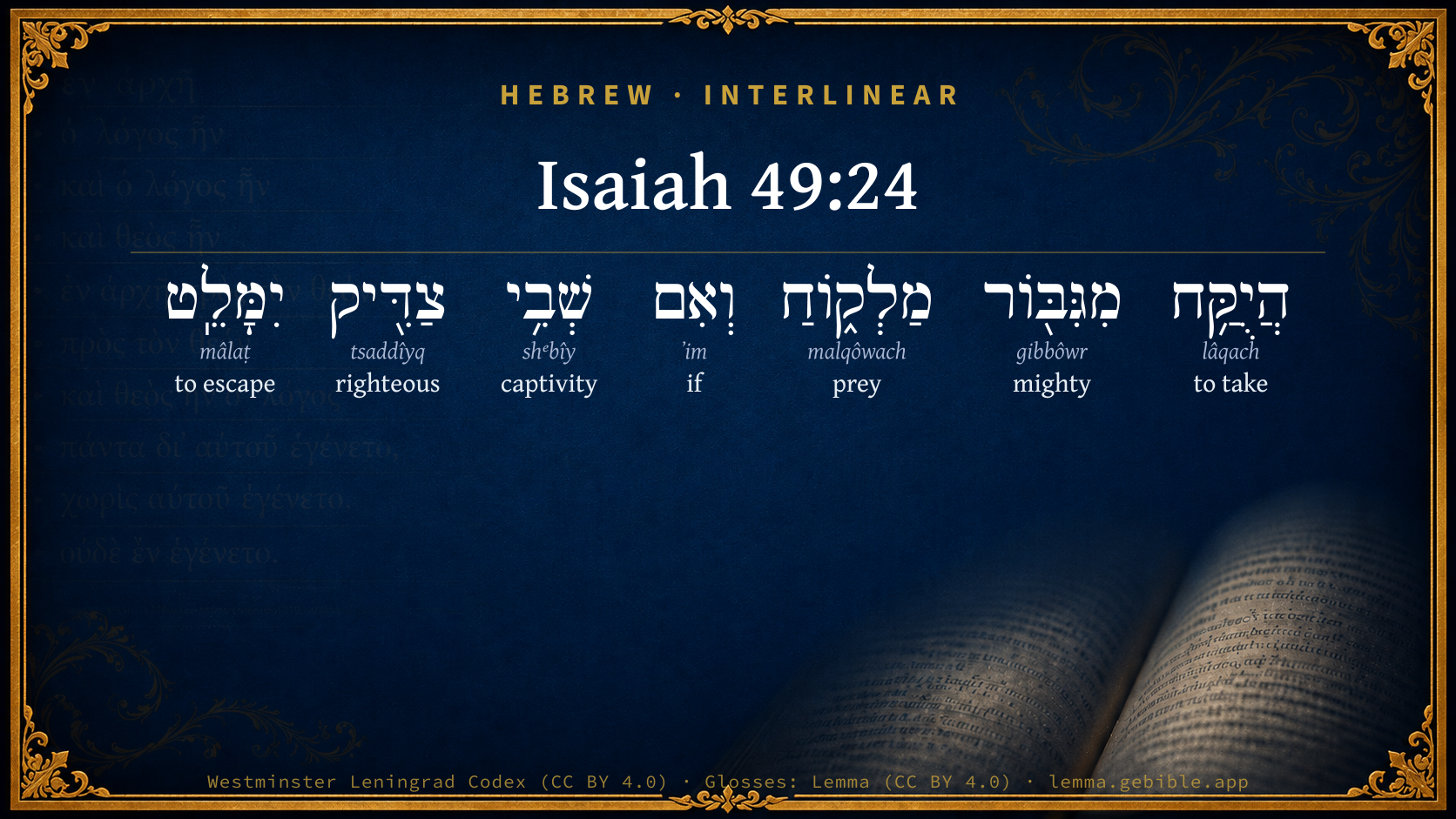
Isaiah 49:24

Hebrew (Westminster Leningrad Codex) Isaiah 49:24 appears in the Hebrew Old Testament. The text above is from the Westminster Leningrad Codex. Each word links to its Strong’s number, a concise gloss, and parsing drawn from the Open Scriptures Hebrew Bible morphology. Click any word for its full Brown-Driver-Briggs (BDB) entry.
Download image
Cite this verse

Isaiah 49:24 (World English Bible). Public Domain. Lemma interlinear Bible study tool, https://lemma.gebible.app/v/isaiah/49/24.

Show BibTeX & RIS
BibTeX
RIS
English Translation
Shall the prey be taken from the mighty, or the lawful captives be delivered?
World English Bible · Public Domain
Download a study sheet

One document with this verse’s original text, its word-by-word gloss line, the meaning frame, cross-references with their text, attributed commentary, and full source and license credits — printable, and it pastes into notes with its structure intact.

This verse Autodidact and up

Study sheet (.html) Plain text (.txt)

A passage Seminary Student

Up to 50 verses in one chapter. A passage sheet keeps up to 6 commentary sources and 12 cross-references per verse, in the order this page ranks them, and says so on the sheet whenever that leaves anything out. Ask for a single verse and you get the Autodidact verse sheet above.

Everything on this page stays free to read, with no account — the sheet is a download of what is already on screen, not access to it.

Want to remove ads? Support Godless Engineer
Compare translations 3

The same verse in 3 English versions, stacked beneath the original-language interlinear above. Click any original word for its lexicon entry.

Each is an independent rendering of the whole verse — the interlinear is not word-aligned to these translations.

Highlighted words mark where these versions differ — a whole-verse word diff, not a word-by-word alignment.

  • World English Bible Public Domain
    Shall the prey be taken from the mighty, or the lawful captives be delivered?
  • King James Version Public Domain
    Shall the prey be taken from the mighty, or the lawful captive delivered?
  • unfoldingWord Literal Text CC BY-SA 4.0
    Will the spoil be taken from a warrior, or if the captive of the righteous will be rescued?

unfoldingWord Literal Text — © unfoldingWord, licensed CC BY-SA 4.0. Word-aligned USFM3 via Door43 (git.door43.org/unfoldingWord/en_ult).

Versions to compare (up to 4)

3 of 4 selected

Show all 18 translations

Every available English version of this verse, each an independent rendering of the whole verse.

  • World English Bible Public Domain
    Shall the prey be taken from the mighty, or the lawful captives be delivered?
  • Berean Standard Bible Public Domain
    Can the plunder be snatched from the mighty, or the captives of a tyrant be delivered?
  • Majority Standard Bible Public Domain
    Can the plunder be snatched from the mighty, or the captives of a tyrant be delivered?
  • King James Version Public Domain
    Shall the prey be taken from the mighty, or the lawful captive delivered?
  • American Standard Version (1901) Public Domain
    Shall the prey be taken from the mighty, or the lawful captives be delivered?
  • Revised Version (1885) Public Domain
    Shall the prey be taken from the mighty, or the lawful captives be delivered?
  • Geneva Bible (1599) Public Domain
    Shall the pray be taken from the mightie? or the iust captiuitie deliuered?
  • Douay-Rheims (1899) Public Domain
    Shall the prey be taken from the strong? or can that which was taken by the mighty be delivered?
  • Young's Literal Translation Public Domain
    Is prey taken from the mighty? And the captive of the righteous delivered?
  • Literal Standard Version CC BY-SA 4.0
    Is prey taken from the mighty? And the captive of the righteous delivered?
  • Unlocked Literal Bible CC BY-SA 4.0
    Can the spoils be taken from the warrior, or captives be rescued from the fierce?
  • unfoldingWord Literal Text CC BY-SA 4.0
    Will the spoil be taken from a warrior, or if the captive of the righteous will be rescued?
  • Darby Bible Public Domain
    Shall the prey be taken from the mighty? and shall he that is rightfully captive be delivered?
  • World Messianic Bible Public Domain
    Shall the plunder be taken from the mighty, or the lawful captives be delivered?
  • Webster's Bible Public Domain
    Shall the prey be taken from the mighty, or the lawful captive delivered?
  • Free Bible Version CC BY-SA 4.0
    Can loot be taken from a warrior? Can prisoners be rescued from a dictator?
  • Bible in Basic English Public Domain
    Will the goods of war be taken from the strong man, or the prisoners of the cruel one be let go?
  • JPS Tanakh (1917) Public Domain
    Shall the prey be taken from the mighty, or the captives of the victorious be delivered?

Literal Standard Version (2020), Covenant Press — licensed CC BY-SA 4.0. Text via the HelloAO Bible API (eBible.org). Unlocked Literal Bible (unfoldingWord) — licensed CC BY-SA 4.0. Text via the HelloAO Bible API (eBible.org). unfoldingWord Literal Text — © unfoldingWord, licensed CC BY-SA 4.0. Word-aligned USFM3 via Door43 (git.door43.org/unfoldingWord/en_ult). Free Bible Version, Dr. Jonathan Gallagher — licensed CC BY-SA 4.0. Text via the HelloAO Bible API (eBible.org).

Word by word

More ways to search: Search by grammar → Find every occurrence → Compare this word →

Practice this passage: Drill this verse → Learn its vocabulary →

About this verse

These counts appear in no published source. They are computed here, from the morphology-tagged text and Lemma’s own curated glosses. What Lemma adds →

7
words
7
distinct lemmas
Prophets
section

Notable vocabulary

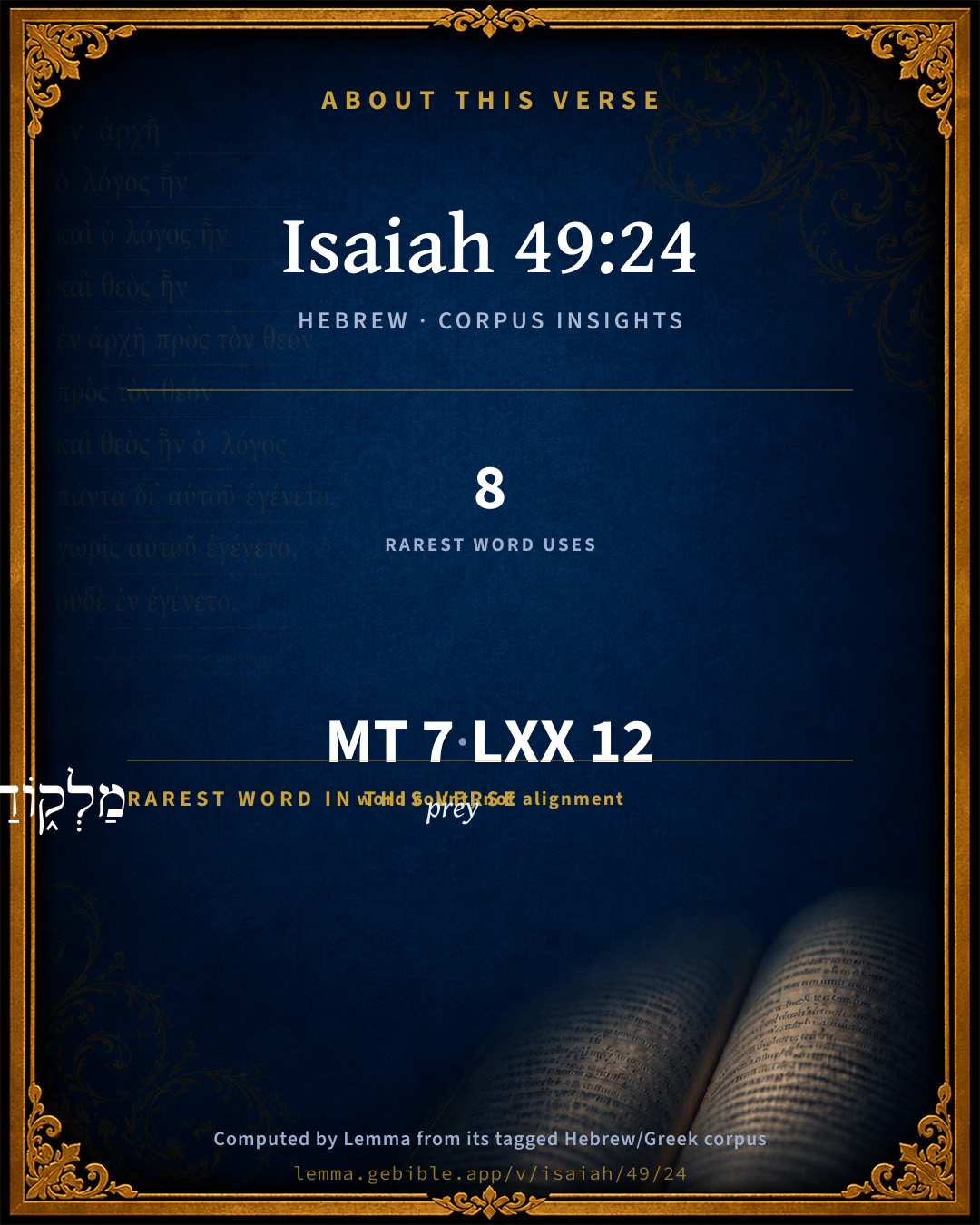
The rarest word here is מַלְק֑וֹחַ prey H4455 — appearing just 8 times in the whole Hebrew Bible.

Shared distinctive vocabulary

מַלְק֑וֹחַ prey H4455 occurs in 8 verses of the Hebrew Bible. Also found in:

Grammatical profile

  • 2 verbs
  • 2 nouns
  • 2 adjectives
  • 1 conjunction

Verb forms

  • הֲיֻקַּ֥ח Pual · Imperfect
  • יִמָּלֵֽט Niphal · Imperfect

Hebrew & Septuagint length

In English translation the verse runs 14 words from the Hebrew and 21 from the Septuagint (LXX English) — the Septuagint runs noticeably longer here. See the side-by-side →

A rough comparison of the two English renderings, which tokenize alike — not a word-level alignment.

Word counts can differ between the Hebrew and the Greek without any difference in meaning — e.g. the Hebrew direct-object marker אֵת has no separate Greek word, and Greek often adds the article ὁ.

In the original languages it is 7 Hebrew tokens and 12 Greek tokens — but the two are counted differently (Hebrew bundles its prefixes and suffixes into one token; the Greek is in lemma form), so that isn’t a like-for-like length.

Cross-references

13

Topical passages linked to Isaiah 49:24 in the Treasury of Scripture Knowledge — connected by theme and wording, ordered by reader-vote popularity; previews shown in the World English Bible.

  • Luke 11:21–22 "When the strong man, fully armed, guards his own dwelling, his goods are safe.
  • Psalms 124:6–7 Blessed be Yahweh, Who has not given us as a prey to their teeth.
  • Matthew 12:29 Or how can one enter into the house of the strong man, and plunder his goods, unless he first bind the strong man? Then he will plunder his house.
  • Ezekiel 37:3 He said to me, Son of man, can these bones live? I answered, Lord Yahweh, you know.
  • Isaiah 42:22 But this is a people robbed and plundered; they are all of them snared in holes, and they are hid in prison-houses: they are for a prey, and none delivers; for a spoil, and none says, Restore.
  • Ezra 9:9 For we are bondservants; yet our God has not forsaken us in our bondage, but has extended loving kindness to us in the sight of the kings of Persia, to give us a reviving, to set up the house of our God, and to repair the ruins of it, and to give us a wall in Judah and in Jerusalem.
  • Ezra 9:13 After all that is come on us for our evil deeds, and for our great guilt, seeing that you our God have punished us less than our iniquities deserve, and have given us such a remnant,
  • Psalms 126:1–3 When Yahweh brought back those who returned to Zion, We were like those who dream.
  • Nehemiah 9:37 It yields much increase to the kings whom you have set over us because of our sins: also they have power over our bodies, and over our cattle, at their pleasure, and we are in great distress.
  • Isaiah 53:12 Therefore will I divide him a portion with the great, and he shall divide the spoil with the strong; because he poured out his soul to death, and was numbered with the transgressors: yet he bore the sin of many, and made intercession for the transgressors.
  • Ezekiel 37:11 Then he said to me, Son of man, these bones are the whole house of Israel: behold, they say, Our bones are dried up, and our hope is lost; we are clean cut off.
  • Nehemiah 9:33 However you are just in all that is come on us; for you have dealt truly, but we have done wickedly;
  • Jeremiah 25:6–9 and don't go after other gods to serve them or worship them, and don't provoke me to anger with the work of your hands; and I will do you no harm.

Cross-references courtesy of OpenBible.info (CC BY 4.0).

Hebrew and Greek witnesses Masoretic Hebrew ↔ Greek Septuagint

The same verse in the two great witnesses to the Old Testament, shown verse-for-verse.

Here the Septuagint runs noticeably longer than the Hebrew — LXX2012 (modern English Septuagint) 21 words vs World English Bible 14. A rough length comparison of the two English translations, not a word-level alignment — read both below.

These are two independent witnesses, not word-aligned to each other, and the Septuagint is shown in lemma (dictionary) form.

Hebrew Isaiah 49:24 Masoretic · Westminster Leningrad Codex

הֲיֻקַּ֥ח מִגִּבּ֖וֹר מַלְק֑וֹחַ וְאִם שְׁבִ֥י צַדִּ֖יק יִמָּלֵֽט

Shall the prey be taken from the mighty, or the lawful captives be delivered?

World English Bible · Public Domain

Greek LXX Isaiah 49:24 Septuagint · lemma form

μή λαμβάνω τις παρά γίγας σκῦλον καί ἐάν αἰχμαλωτεύω τις ἀδίκως σώζω

Will any one take spoils from a giant? and if one should take a man captive unjustly, shall he be delivered?

LXX2012 (modern English Septuagint) · Public Domain

On this verse, Albert Barnes' Notes on the Bible discusses the Septuagint’s reading. Read the note in Commentary ↓

Hebrew: Westminster Leningrad Codex (CC BY 4.0). Greek: Septuagint (public domain); English from LXX2012 (modern English Septuagint) (Public Domain). How the Septuagint differs from the Hebrew →

Targum (Aramaic paraphrase)

1

The Targum is the ancient Jewish Aramaic paraphrase of the Hebrew Scriptures — an interpretive translation, not the Hebrew text itself. Onkelos (literal) and Pseudo-Jonathan (expansive) render the Torah, and Jonathan the Prophets. Coverage is partial: where no permissively-licensed English translation exists for a verse, only the Aramaic is shown. This is verse-level text, not a word-by-word alignment to the Hebrew.

  1. Targum Jonathan Prophets (Joshua–Malachi)
    הֲיִתְנְסֵיב מִגָבָּרָא עֲדִי וְאִם דִשְׁבוֹ זַכָּאִין יִשְׁתַּזֵיב: [ת"א] אֲמָרֵת יְרוּשְׁלֵם הַאֶפְשַׁר דְיִתְנְסֵיב מֵעֵשָׂו רַשִׁיעָא דַאֲמִיר עֲלֵהּ דְצַדִיקַיָא הוּא יִשְׁתֵּיזֵיב:

    Shall the spoil be taken from the mighty, and shall that which the just have taken captive be delivered? [ANOTHER PARAPHRASE — Jerusalem says, Is it possible that the prey shall be taken from Esau the wicked, which he took from me? concerning whom it was said, By thy sword thou shalt live. Or the captive whom Ishmael led captive, concerning whom it has been said, That which belongeth to the righteous shall he deliver?]

    Targum Jonathan — Aramaic: “Mikraot Gedolot” (public domain). English: “Sefaria Community Translation” (CC0 1.0 (public-domain dedication)); “London "Chaldee Paraphrase," 1871” (public domain). Text via Sefaria.

Commentary

Notes on Isaiah 49:24 from classic Christian and Jewish commentators (each source and its license shown beneath its notes). The classic Christian expositions comment on the surrounding passage and are grouped to its opening verse, so a note may address several verses; the Jewish commentaries on the Tanakh (Rashi and others) are per-verse, so they appear only where the commentator wrote on this verse.

Lemma curates 59 commentaries, every one of them public domain or Creative Commons licensed, each selected and text-cleaned for this edition rather than reprinted as found. About our sources →

Matthew Henry's Commentary

Here is, I. An objection started against the promise of the Jews' release out of their captivity in Babylon, suggesting that it was a thing not to be expected; for (Isa 49:24) they were a prey in the hand of the mighty, of such as were then the greatest potentates on earth, and therefore it was not likely they should be rescued by force. Yet that was not all: they were lawful captives; by the law of God, having offended, they were justly delivered into captivity; and by the law of nations, being taken in war, they were justly detained in captivity till they should be ransomed or exchanged. Now this is spoken either, 1. By the enemies, as justifying themselves in their refusal to let them go. They plead both might and right. Proud men think all their own that they can lay their hands on and their title good if they have but the longest sword. Or, 2. By their friends, either in a way of distrust, despairing of the deliverance ("for who is able to deal with those that detain us, either by force of arms or a treaty of peace?"), or in a way of thankfulness, admiring the deliverance. "Who would have thought that ever the prey should be taken from the mighty? Yet it is done." This is applicable to our redemption by Christ. As to Satan, we were a prey in the hand of the mighty, and yet delivered even from him that had the power of death, by him that had the power of life. As to the justice of God, we were lawful captives, and yet delivered by a price of inestimable value.

II. This objection answered by an express promise, and a further promise; for God's promises being all yea, and amen, they may well serve to corroborate one another. 1. Here is an express promise with a non-obstante - notwithstanding to the strength of the enemy (Isa 49:25): "Even the captives of the mighty, though they are mighty, shall be taken away, and it is to no purpose for them to oppose it; and the prey of the terrible, though they are terrible, shall be delivered; and, as they cannot with all their strength outforce, so they cannot with all their impudence outface, the deliverance, and the counsels of God concerning it." The Lord saith thus, who, having all power and all hearts in his hands is able to make his words good. 2. Here is a further promise, showing how, and in what way, God will bring about the deliverance. He will bring judgments upon the oppressors, and so will work salvation for the oppressed: "I will contend with him that contends with thee, will plead thy cause against those that justify themselves in oppressing thee; whoever it be, though but a single person, that contends with thee, he shall know that it is at his peril, and thus I will save thy children." The captives shall be delivered by leading captivity captive, that is, sending those into captivity that had held God's people captive, Rev 13:10. Nay, they shall have blood for blood (Isa 49:26): "I will feed those that oppress thee with their own flesh, and they shall be drunken with their own blood. The proud Babylonians shall become not only an easy, but an acceptable, prey to one another. God will send a dividing spirit among them, and their ruin, which was begun by a foreign invasion, shall be completed by their intestine divisions. They shall bite and devour one another, till they are consumed one of another. They shall greedily and with delight prey upon those that are their own flesh and blood." God can make the oppressors of his church to be their own tormentors and their own destroyers. The New Testament Babylon, having made herself drunk with the blood of the saints, shall have blood given her to drink, for she is worthy. See how cruel men sometimes are to themselves and to one another: indeed those who are so to others are so to themselves, for God's justice and men's revenge will mete to them what they have measured to others. They not only thirst after blood, but drink it so greedily that they are drunken with it, and with as much pleasure as if it were sweet wine. If God had not more mercy on sinners than they would have one upon another were their passions let loose, the world would be soon an Aceldama, nay, a desolation.

III. See what will be the effect of Babylon's ruin: All flesh shall know that I the Lord am thy Saviour. God will make it to appear, to the conviction of all the world, that, though Israel seem lost and cast off, they have a Redeemer, and, though they are made a prey to the mighty, Jacob has a mighty One, who is able to deal with all his enemies. God intends, by the deliverances of his church, both to notify and to magnify his own name.

Matthew Henry's Commentary on the Whole Bible (1708–1710) — public domain (CC PDM 1.0). Text via the HelloAO Bible API.

Adam Clarke's Commentary

Verse 24. Shall the prey be taken from the mighty - "Shall the prey seized by the terrible be rescued"] For צדיק tsaddik, read עריץ arits. A palpable mistake, like that in Isa 42:19. The correction is self-evident from the very terms of the sentence; from the necessity of the strict correspondence in the expressions between the question and the answer made to it, - and it is apparent to the blindest and most prejudiced eye. However, if authority is also necessary, there is that of the Syriac and Vulgate for it; who plainly read עריץ arits, in Isa 49:24 as well as in Isa 49:25, rendering it in the former place by the same word as in the latter. - L.

These two last verses contain a glorious promise of deliverance to the persecuted Church of Christ from the terrible one - Satan, and all his representatives and vicegerents, persecuting antichristian rulers. They shall at last cease from destroying the Church of God, and destroy one another.

Adam Clarke's Commentary on the Bible (1810–1826) — public domain. Text from a community e-Sword/MySword module.

The Cambridge Bible for Schools and Colleges

gen. ed. J. J. S. Perowne

24. from the mighty] from a hero. the lawful captive] lit. the captivity (= captives) of a righteous one. This is the only sense that the phrase will properly bear; all the attempts to construe it otherwise are futile. Many authorities, however, adopt the reading of the Pesh. and Vulg. (עריץ instead of צדיק, as Isa_49:25), and render: “captives of a terrible one.” (1) The verse has generally been considered to be a new utterance of despair on the part of the Israelites, “Can the tyrant be made to disgorge his prey?” (Cheyne),—to which Isa_49:25 gives an affirmative answer. On this view (which is certainly the one that first suggests itself) the substitution of ‘ârîc̣ (terrible) for çaddîq (righteous) seems imperative, since the latter expression could not possibly be applied to the Chaldæans. To suppose that by the “hero” and the “righteous one” Cyrus is meant is at variance with the whole tenor of the prophecy (Isa_41:25, Isa_44:28, Isa_45:1 ff.). (2) Dillmann on the other hand holds that the reference in Isa_49:24 is to Jehovah, who Himself asks if any power can deprive Him of His lawful captives, the Israelites. The answer to be supplied is, “No”; and this is confirmed by Isa_49:25 : “For even the captives of a (human) hero may be delivered, yet will I (the Almighty) contend with” &c. This is not altogether natural; the antithesis of the divine hero in Isa_49:24 and a human hero in Isa_49:25 being indicated by nothing in the words. (3) A simpler view is that question and answer are related as in Isa_49:14; the question stating a supposition in the highest degree improbable (though still conceivable), and the answer conceding the possibility in order the more strongly to assert that the idea cannot be entertained with regard to Jehovah. The sense might be paraphrased as follows: “Can the captives of a mighty man be rescued from his grasp? Yes, the captives of the mighty may be delivered, but I will (victoriously) maintain thy cause against thy enemies” &c. (so, apparently, Duhm). In this case also it is better to read ‘ârîç, which may be used in a neutral sense as in Jer_20:11 (of Jehovah). The image of Israel as the prey of Jehovah has a certain resemblance to that of the lion and his prey in ch. Isa_31:4.

24–26. The emancipation of Israel is here regarded as having to be effected by force, and Jehovah pledges His omnipotence to the task. The bright picture of Isa_49:22 does not touch the gravest difficulty of the situation, the formidable power and settled hostility of Babylon.

The Cambridge Bible for Schools and Colleges (gen. ed. J. J. S. Perowne; Cambridge University Press, 1878–1918) — public domain. Text from a community e-Sword module.

Trapp's Complete Commentary

John Trapp

Isa 49:24 Shall the prey be taken from the mighty, or the lawful captive delivered?

Ver. 24. Shall the prey be taken from the mighty?] Not unless he be out matched and over mastered. The heathens were wont to ask, Who can wring a club out of Hercules’s hand, or a lightening bolt out of Jove’s? The captive Jews here seem to ask, Who can deliver us from the Babylonians, who have both might and right for them? for we are their lawful captives, and we see not how we can be set at liberty. Thus they thought at least, if they spoke not as much, not looking at all to the power and faithfulness of God, sed ad praesentium rerum spectra, ac hostium potentiam. Those that look downward on the rushing and roaring streams of miseries and troubles which run so swiftly under them, shall be sure to be taken with a giddiness, &c., but such as steadfastly fasten on the power and promise of God all-sufficient, shall be established.

John Trapp, A Commentary or Exposition upon All the Books of the Old and New Testament (1647–1656) — public domain. Text from a community e-Sword module.

The Biblical Illustrator

Joseph S. Exell

Isa_49:24-25

Shall the prey be taken from the mighty?

--

Deliverance from bondage and death

I. THE STATE OF FALLEN MAN IS ONE OF MISERY AND BONDAGE.

1. Misery because he is the prey of a mighty tyrant, the devil.

2. Bondage because he is the slave of a terrible master, death.

II. JESUS CAN SET US FREE, FOR HE HAS CONQUERED. Jesus has been the Great Emancipator of men. (T. Bates, M. A.)

Shall the prey be taken from the mighty?

I. WHO ARE THE MIGHTY, AND WHO ARE THE PREY? The immortal souls of men are the prey, and all the combined powers of darkness are the mighty.

II. HOW SHALL THE PREY BE TAKEN FROM THE MIGHTY? Nothing short of the almighty power of God is calculated to effect this great and important work. But God is almighty, and God is infinitely able and infinitely willing to rescue the helpless sons of men. Our Lord Jesus Christ is that great and glorious Being who gave, whilst here below, signal manifestations of His power to take the prey from the mighty.

III. A MOST DELIGHTFUL AND ENCOURAGING PROMISE. I will contend with him who contendeth with thee, and I will save thy children. At all times, in every season of trial and difficulty. Let the enemies of God learn an important lesson: Woe to him that striveth with his Maker! He will save His Church under all the trials and temptations, the dangers and difficulties of human life. Are the immortal souls of men the prey? and are the powers of darkness the mighty? What does the ungodly man think of this? (T. Freeman.)

The adversary and his defeat

I. THE WEAPONS AND RESOURCES OF THE ENEMY.

1. Idolatry.

2. Imposture. Mohammedanism.

3. Papal superstition.

4. The despotic governments of the earth.

5. Crime in its varied forms.

6. A more liberal sort of religion which shall keep the opposition in countenance, and enable them to wield the name and institutions of Christianity against Christianity, sustained by such as live in pleasure, and will not bow the knee to Christ.

7. The corruption of the purity of revivals of religion.

8. The sword. Can such varied and mighty resistance to the truth be overcome? Can the earth be enlightened? Can the nations be disenthralled? Yes!

II. HOW SHALL EVENTS SO DESIRABLE BE ACCOMPLISHED?

1. By the judgments of heaven.

2. By the universal propagation of the Gospel.

3. By frequent and, at last, general revivals of religion.

4. By the special influence of the Holy Spirit.

5. By a new and unparalleled vigour of Christian enterprise. But what can be done? There must be in the Church of God--

(1) More faith.

(2) More intense love for Christ.

(3) More decided action.

(4) More courage.

(5) Efforts to increase the number and power of evangelical

Churches.

(6) Special effort to secure to the rising generation an education free from the influence of bad example, and more decidedly evangelical.

(7) The vigour of charitable effort must be greatly increased.

(8) The jealousies of Christians must yield.

(9) We must guard against the dangers peculiar to a state of religious prosperity.

Conclusion--Will any take side against the cause of Christ? It will be a fearful experiment! (Lyman Beecher, D. D.)

The prey taken from the mighty

Apply the text--

I. LITERALLY--to Israels release from Babylon.

II. SPIRITUALLY--to mans redemption by Christ.

III. EXPERIMENTALLY--to the Christian's deliverance from sin.

IV. PROSPECTIVELY--to the blessed resurrection from the dead promised to the people of God. (S. Thodey.)

The Biblical Illustrator, edited by Joseph S. Exell (c. 1880s–1900s) — public domain. Text from a community e-Sword module.

Joseph Benson's Commentary

Isa 49:24-26. Shall the prey be taken from the mighty — Here an objection is started against the forementioned promises, probably, 1st, Against the promise of the release of the Jews from their captivity in Babylon, suggesting that it was a thing not to be expected: for, Isa 49:24, they were a prey in the hands of the mighty, of such as were then the greatest potentates of the earth; and, therefore, it was not likely they should be rescued by force; yet that was not all, they were lawful captives. By the law of God, having offended, they were justly delivered into captivity. And by the law of nations, being taken in war, they were justly detained in captivity till they should be ransomed or exchanged. So here was a double, or rather, treble impediment to their deliverance; the great power of the enemy, which kept them in bondage, and the justice of God, and the usage of nations, which pleaded against them. And yet their deliverance, however improbable, was effected by the mercy and power of God. But this passage, as appears from the context, has a further reference: it respects the deliverance of God’s church and people from their spiritual as well as temporal enemies. “God had promised very great and excellent things to his church; but to a person seriously considering the state thereof, and comparing it with the power of his enemies, and particularly its chief enemy, Satan, who held the nations in the darkness of ignorance and superstition, a doubt would naturally arise, whether it could possibly be that this prey, so long possessed by Satan, could be rescued from him, so that he might be driven from his strong fort, and the rulers of the world, held in subjection by him, might be delivered from their servitude. Isaiah resolves this doubt of the church, and teaches that it should certainly come to pass that Satan, this mighty one, should be driven from his fort, his captives delivered, (Isa 49:25,) and the adversaries of the church perish by their mutual slaughter of each other.” Thus Vitringa, who observes that Isa 49:26, I will feed them that oppress thee with their own flesh, &c., is to be “understood metaphorically, and refers to the intestine wars, by which princes and people, armed to their mutual destruction, plunge their destroying swords in each other’s bowels, and, as it were, feed upon each other’s flesh and blood.” See Isa 9:20; Zec 11:9; Rev 16:6. They shall be drunken with their own blood as with new wine — I will make thine enemies destroy one another, and that greedily, and with delight. This prophecy was remarkably fulfilled in the time of the Roman emperor, Dioclesian, to which it is thought by some particularly to refer.

Joseph Benson's Commentary on the Old and New Testaments (1811–1818) — public domain. Text from a community e-Sword module.

The Preacher's Complete Homiletical Commentary

Joseph S. Exell (gen. ed.)

THE PREY TAKEN FROM THE MIGHTY

Isa_49:24-26. Shall the prey be taken from the mighty? &c.

The history of God’s love to His people is a ground of encouragement and hope to the Church in all aftertime, because God, human nature, and the power and influence of religion are always the same. The text turns upon the difficulty of conveying hope and comfort to disconsolate minds. The prophet had been giving to the disconsolate glorious promises of the future restoration of the Church (Isa_49:18-23), but he was met by the difficulty of their inability to believe that those promises could be fulfilled. They asked, thinking that only an unfavourable answer could be given to their question, “Shall the prey,” &c. Mark the confidence of the prophet’s answer, “But thus saith the Lord,” &c. Various lawful, instructive, and encouraging uses may be made of our text.

I. Apply the text literally to Israel’s release from Babylon. The captives saw great and apparently insuperable difficulties in the way of their restoration. The news seemed too good to be true. There was the great strength of the Babylonian empire, and their unbelief argues, “Shall the prey be taken from the mighty?” There was the fact that they were a conquered people, and that their enemies, according to the usages of war, had an accredited right to hold them in subjection. “Shall the lawful captive be delivered?” [1520] Then they had no alliances, and no hold upon the political sympathies of foreign nations; and lastly, there was their own incapacity of self-belief, their wives and children being with them in the power of the enemy, as so many hostages for their good conduct.

[1520] “The lawful captive” has been rendered “the captive of the strong” (Herd.), of the stern or severe (Schult., Rosenm.), of the victorious (Mich., Beck), of the terrible, by a conjectural change of reading (Hitz., Lowth, Knob., Ewald), righteous captives, i.e., exiled Jews (Symm., Jareh., Aben Ezra, Hitz., Hahn), the plunder of the righteous, i.e., taken from them (Ges., Maurer, Umbreil). But the received version (Stier) gives the true meaning, “the captive of one who has a rightful claim to keep another in bondage.” There is a climax, seldom noticed, in the reply; and a threefold gradation, of a simply rightful, a powerful, and a terrible conqueror; of one who has a just claim, one who has also power to maintain it, and one whose power is so terrible that resistance seems hopeless. Shall the prey of the mighty be taken away, or even a captive justly claimed, though by one less mighty, be delivered? Not in the common course of things, or by human justice alone. But God’s grace has a higher law, and even more than this shall be done: the prey of the most terrible among Zion’s adversaries shall be delivered.—Birks.

Note how amply the promises of the text meet these sources of discouragement. It is answered by a “Thus saith the Lord,” i.e., hopeless as the case may seem to you, all the difficulties shall give way when I interpose. “Even the captives of the mighty shall be taken away,” &c.; “though they be a nation strong and powerful, ye shall be rescued from their hands, for I will oppose My strength and wisdom to theirs, and the resources of My providence to all the pride of their power.” God Himself would come down into the field as their champion: “I will contend,” &c. Nay, more: He promises to make the ruin of the foe conspicuous as the deliverance of His friends. “I will feed them that oppress thee with their own flesh, and they shall be drunken with their own blood, as sweet wine;” i.e., He would cause them to destroy one another with as much eagerness as half-famished men fall upon a well-furnished table; they shall hasten to that banquet of blood with as much fervour as men hasten to a banquet of wine. The historian tells us that on the night in which Babylon was taken many of the Chaldeans fell off from Belshazzar and joined the standard of Cyrus; they were themselves most forward in surprising the city, and showing the way into the king’s palace, where they slew him and all his attendants. Thus the promise of the text was fulfilled by the overthrow of the reigning government, and the introduction of a new dynasty to the throne. So completely was this done, that the captives were as much overpowered by the greatness of their deliverance as they had before been confounded by the depth of the calamity (Psa_126:1).

Learn, then, how fully God can make good His promises, and disperse the worst fears of His people. “The Lord can clear the darkest skies.” And He does it with as much tenderness as power (Isa_49:15). The captives feared more for their beloved families than for themselves, as you do for yours, and the promise respects them: “And I will save thy children.”

II. Apply it spiritually to man’s redemption by Christ. To the convicted sinner, human redemption has often seemed incompatible with the inalienable claims of Divine justice, which seem to demand that the punishment of the transgressors should take its course. God cannot connive at sin; and the law we have broken is holy, just, and good, as necessary to the happiness of the universe as it is essential to the glory of God; a law too good to be repealed, too sacred to be trifled with; the abrogation of it would dethrone the Deity, and pour anarchy through all the worlds He has made (H. E. I. 3157, 3188). How then shall the great dilemma which sin has introduced be met? If mercy triumphs, justice is tarnished; if justice prevail, man is overthrown for ever. Mere power has no force in regard to moral questions; it cannot make right wrong, or wrong right. To solve this question was a task for Omniscience: God dealt with it, and through Scripture has made known to us its solution (Isa_53:5-6; Rom_3:19-26, &c.; H. E. I. 375–382, 396). Justice triumphs in the death of Christ, and mercy triumphs in the pardon of penitent sinners through Him. The very idea of redemption turns upon this point. It means the buying back again of lost and forfeited good, by a compensative arrangement between the parties. In ancient times the lives of prisoners taken in war were held to be at the disposal of the conqueror, and the acceptance of a stipulated ransom was the established mode of buying back the lives and liberty of the prisoners. The law of God, with all the forces of the universe behind it, must be in the end the conqueror of all who rebel against it, and in the Gospel we are told that the ransom-price was the death of Christ, who gave Himself for us and suffered in our stead (1Pe_1:18). The ransom was sufficient (H. E. I. 377–381).

III. Apply the text experimentally to the Christian’s deliverance from sin.

1. Jesus not only made atonement for our sins; He at the same time contended with and overcame our worst enemies. Man was the willing servant of the powers of darkness; not a forced captive, but a ready subject of Satan. But, by dying, Jesus overcame him who had dominion over our race (Heb_4:14-15; Eph_4:8). He literally made good the promise, “I will contend with him that contendeth with thee, and I will save thy children.”

2. In converting grace, the triumph is the same; and in the experience of the penitent sinner it is continually renewed (Luk_4:18; Luk_11:20-22). Christ’s people are pardoned and delivered from the power of sin in all its forms; in every conflict He gives them victory, and He will do so to the end (Rom_6:14; Rom_8:37; H. E. I. 1099, 1106, 1112–1119).

IV. Apply it prospectively to the blessed resurrection from the dead promised to the people of God.—Samuel Thodey.

Both in providence and grace, “man’s extremity is God’s opportunity.” Of this, the Jews needed to be reminded. They had been taken into captivity, and were detained there for the punishment of their sins. They had been assured that God would deliver them in due time, but the difficulties in the way of the fulfilment of that promise seemed so insuperable, that they despairingly asked, “Shall the prey be taken from the mighty, or the lawful captive delivered?” To this question Isaiah was authorised confidently to give a reassuring reply (Isa_49:25).

I. To this question there was an answer in the deliverance of the Jewish people from the tyranny of Egypt. The history of what God did for their fathers should have prevented the Jews in Babylon from asking this question. But in every new extremity men are prone to forget the history of the past.

II. There was an answer to this question in the deliverance of the people of God from their captivity in Babylon. It seemed impossible, but it was accomplished, and in precisely the manner that God had predicted. These things were written for our learning!

III. There was an answer to this question in the great work of human redemption effected by Christ on the Cross. That seemed the hour of Satan’s victory; it was the hour of his defeat (Col_2:14-15).

IV. There are answers to this question in the conversion of sinners by the preaching of the Gospel. The glorious work of emancipation still goes on (Luk_4:18; 2Co_10:4).

V. There will be an answer to this question when our Redeemer returns with power and great glory. Then death and the grave shall be compelled to give up their prey; and death and hell shall be “cast into the lake of fire.”—W. Dransfield: Forty-six Short Sermons, pp. 239–264.

I. The enemy to be encountered. Satan, an enemy that is mighty and terrible.

1. In the nature of his influence. On the intellectual and moral man—the immortal soul.

2. In the number of his agents. A legion against one.

3. In the extent of his territory.

II. The captives he retains.

1. Those who are born where he reigns unrivalled. Idolatrous countries.

2. Those who yield to his sway, though deliverance is at hand. Pharisees. Hardened sinners.

III. The prospect of deliverance.

1. The price of their redemption is provided.

2. The agent that can make it effective.

3. The means are in operation to make the deliverance known.

4. Specimens of triumph already obtained.

IV. The means to be employed.

1. Fervent and importunate prayer.

2. Free and extensive diffusion of the charter of liberty—“The Word of God.”—Studies for the Pulpit, part ii. p. 308.

RESOURCES OF THE ADVERSARY, AND MEANS OF THEIR DESTRUCTION

(Missionary Sermon.)

Isa_49:24-25. Thus saith the Lord, &c.

The Scriptures teach that sin commenced its reign on earth under the auspices of a mighty fallen spirit; and that he, having seduced mankind from their allegiance to God, has constantly maintained his bad eminence overthem. They also teach, that the Son of God has interposed to destroy the works of this spirit; and that He will accomplish the object; that the power of Satan shall be broken, and the whole world be restored to loyalty and the favour of heaven. Other passages allude to the success with which the enemy of God has fortified his cause; to its final overthrow; and to the exultation and joy with which the event will fill earth and heaven (chap. Isa_53:12; Luk_11:21-22; Rev_11:15; Rev_19:5-6). An alienated world requires more moral power for its restoration than that of simple law, which proved insufficient to maintain its allegiance. It requires a new moral influence, so introduced and applied as to corroborate law, and strengthen the loyalty of all the good, while rebels are reconciled and pardoned. Consider—

I. THE WEAPONS AND RESOURCES OF THE ENEMY.

1. At the head of opposition to the Gospel, in numerical power, must be placed idolatry. To banish from the earth all knowledge of God and His government, and substitute a worship composed of lust and blood, seems most desirable to the great adversary, where circumstances allow it to be done; and this he has achieved in respect to about six hundred millions of the human family.

2. Imposture. This was introduced by Mahomed. It was a system accommodated to the condition of a mingled population, composed of Pagans, Jews, and nominal Christians, all in a state of great ignorance and deep moral debasement.

3. Papal superstition. This has been, and is still, the master-piece of that wisdom which is from beneath; concentrating the bad influence of all past systems. Popery is a system where science and ignorance, refinement and barbarism, wisdom and stupidity, taste and animalism, mistaken zeal and malignant enmity, may sanctimoniously pour out their virulence against the Gospel, and cry “Hosanna!” while they go forth to shed the blood and to wear out the patience of the saints.

4. The despotic governments of the earth.

5. Crime in its varied forms. A vast amount of capital is embarked in enterprises which, directly or indirectly, war against morality. All this, when the spirit of Christianity shall prevail, will be contraband, and be withdrawn.

6. A more liberal sort of religion which shall keep the opposition in countenance, and enable them to wield the name and institutions of Christianity against Christianity—including so much truth as may serve to beguile, but so little as cannot avail to save—sustained by such as live in pleasure, and will not bow the knee to Christ.

7. The corruption of the purity of revivals of religion. Terrible, by the power of revivals, as an army with banners, the victory of the Church is secure, unless fanaticism can be substituted for pure-religion, and her compact masses be broken and scattered by the commotion of unhallowed passions within. In this manner was the glory of the Reformation eclipsed, and vital religion, in the time of Cromwell, made a scoff and a by-word. The same attempt was made in New England early in the days of our fathers. It was repeated in the time of White-field and the immortal Edwards, with lamentable, though with but partial success.

8. All these great divisions of systematic opposition to the Gospel have, where circumstances allowed, been supplemented by the sword. Christianity, in her first attempt to disenthrall the world, met the storms of ten persecutions, protracted through a period of three hundred years.

And now, can such varied and mighty resistance to the truth be overcome? Can the earth be enlightened? Can the nations be disenthralled? Can the whole creation, which has groaned and travailed together in pain until now, be brought out of bondage into glorious liberty? Yes; all this can be done, and will be done. Our next inquiry then is,

II. HOW SHALL EVENTS SO DESIRABLE BE ACCOMPLISHED?

1. By the judgments of heaven, in which the Son of man will come upon the strong man armed and take away his armour.

2. By the universal propagation of the Gospel; before the light of which, idolatry, imposture, and superstition, will retreat abashed.

3. By frequent, and at last, general revivals of religion; giving resistless power to the Gospel, as it is preached to every creature.

4. By the special influence of the Holy Spirit. The simple presence of Christianity would no more convert the heathen, than it converts those where it already exists. Were every family on earth now blessed with a Bible and a pastor, these, without the effusion of the Spirit, would not maintain upon the earth an uncorrupt, nominal Christianity for one hundred years.

5. By a new and unparalleled vigour of Christian enterprise. Until then, the Church will have been the assailed party, and stood upon the defensive; but thenceforth the word of command will not be “Stand,” but “March.” The gates of the holy city will be thrown open; the tide of war will be rolled upon the enemy; and one shall chase a thousand, and two put ten thousand to flight. The means and efforts for evangelising the world must correspond, however, with the magnitude of the result. The idea that God will convert the heathen in His own good time, and that Christians have nothing to do but to pray and devoutly wait, is found in no canonical book. From the beginning the cause of God on earth has been maintained and carried forward only by the most heroic exertion. Christianity, even in the age of miracles, was not propagated but by stupendous efforts. And it is only by a revival of primitive zeal and enterprise that the glorious things spoken of the city of our God can be accomplished.

But what can be done? There must be in the church of God—

1. More faith.

2. More intense love for Christ.

3. More decided action.

4. More courage.

5. New and more vigorous efforts to increase the number and power of evangelical churches in our lands.

6. Special effort is required to secure to the rising generation an education free from the influence of bad example, and more decidedly evangelical.

7. The vigour of charitable effort must be greatly increased.

8. The jealousies of Christians who are united substantially in their views of evangelical doctrine and religion, and who are divided only by localities, and rites, and forms, must yield, and give place to the glorious exigencies of the present day.

9. We must guard against the dangers peculiar to a state of religious prosperity.

CONCLUSION.—Will any of you, in this glorious day, take side against the cause of Christ? It will be a fearful experiment. And woe unto him who contendeth with his Maker!—Lyman Beecher, D.D.: Missionary Enterprise, pp. 121–142. (Boston Edition.)

THE SAFETY OF THE CHURCH

Isa_49:25. And all flesh shall know, &c.

I. God is the protector of the Church, and no weapons formed against her shall prosper. The efforts which have been made to destroy the Church of God have been vain. Israel in Egypt, in the wilderness, in Babylon, and under Antiochus Epiphanes. The early persecutions of the Christians in Judea, in the Roman Empire. The persecution of the Waldenses in Switzerland; of the Huguenots in France; and of the Reformers in England. “The gates of hell shall not prevail against her” (H. E. I. 1246–1251).

II. The Church’s enemies shall be distracted in their counsels, and left to anarchy and overthrow. God will fill the ranks of His foes with confusion, and suffer them to be torn and distracted with internal strifes.

III. The Church shall rise resplendent from all her persecutions, and shall prosper ultimately, just in proportion to their efforts to destroy it. The effect of all shall be the diffusion of the Gospel among all nations, and to bring all men to acknowledge that He who thus protects His Church is the true and only God—the Saviour, the Redeemer, the mighty One of Jacob.—Adapted from Barnes’ Commentary.

SALVATION FOR THE LITTLE ONES

Isa_49:25. I will save thy children.

This promise of salvation for the children has made the heart of many a pious parent thrill with delight. “The father of the righteous shall greatly rejoice.” In fact, worldly and even wicked parents are often glad to see their children religious. They admire and approve in them that religion which they know, to their sorrow, they are neglecting themselves. If an appeal were made to the adult members of an ordinary congregation as to whether a minister ought to urge religion upon the attention of children, all as with one voice would respond, “By all means try to save the little ones.” This blessed promise, “I will save thy children,” will be regarded by such as one of the most precious in the Bible.

I. TO WHOM THIS PRECIOUS PROMISE IS MADE. The verses which cluster around it possess more than common interest. They depict scenes radiant with the glory of Zion’s successes and triumphs. In the midst of all these glorious triumphs, this heart-cheering promise comes in, “and I will save thy children.”

Viewing those words in the light thrown upon them by these surroundings, may we not safely say, This is a part of the heritage of God’s Church? And are we not to expect that the Lord will fulfil His promise in a special manner at a time when His church is reviving and multiplying? Is not the salvation of the children here placed before us as the crowning glory of Christ’s Church, when she is in the full tide of her prosperity? Is it not made to you, and on behalf of your children?

Let each pious parent at once put in his claim, “Lord, Thou hast specially promised to save my children; now fulfil Thy gracious word. Let me see them holy, useful, and happy here; let me hereafter meet them in heaven. According to Thy word, I look for this. While I pray, watch, and work for the salvation of my children, I am expecting Thee to verify the truth of Thy promise and to save them.” Those parents who connect with this spirit of prayerful expectation a godly and winsome example, will soon see their children happy in God.

II. LET US TRY TO REALISE, IF WE CAN, ITS FULL IMPORT. The word “save,” when linked to the souls of our children, is indeed “a gem of purest ray serene.” Its price is above rubies. Who can fathom its import? And who can rightly realise the terrible antithesis, one’s child unsaved? capable of conversion, old enough to understand and experience real religion, and yet UNSAVED! Illustrate the spiritual condition of such. [1523]

[1523] Let us picture to our minds a child very poor, dreadfully diseased, and miserably enslaved. Every right-hearted parent is distressed to see his child poor, clad in rags, bedded on straw, pale and pinched with hunger. Add to poverty, disease: the rosy bloom has disappeared from the cheek. The little frame is wasting to a skeleton. Life is a burden, and the grave is opening to entomb your fondest hopes. Add to poverty and disease, slavery: your child the property of another, who claims him as his own and subjects him to all the degradation and misery of a galling servitude! What would be your feelings as a parent had you a child in such circumstances as these? Methinks it would be enough to make your life a burden. Have you a child unsaved? Then is he not poor? miserably poor? Has not sin robbed him of peace and purity? Does it not threaten to rob him of heaven and hope? Is not your unsaved child diseased? full of the leprosy of sin? sick unto death? Does not Satan bind his captive soul “fast in his slavish chains?” Is he not held in the most cruel bondage by the worst of tyrants? You know that all this is true, that it is no over-coloured picture. In fact, it is only part of the truth. Your unsaved child is under sentence of death. “The soul that sinneth, it shall die.” That sentence might be executed by Divine justice at any moment. What then is to become of your poor, diseased, enslaved, and doomed child?—Page.

Save! Nothing less than the unsearchable riches of Christ. Health for the soul, complete liberty from the bondage of sin, “the glorious liberty of the children of God.” These four letters SAVE include “the gift of God,” which is “eternal life through Jesus Christ our Lord.”

This promise specially belongs to God’s own people. Does not this furnish one of the strongest reasons why unconverted parents should seek religion? How sacred and solemn is the parental relationship! Every child is a fallen, though a redeemed, sinner; and each will be saved or lost for ever. Yet how few unsaved parents think of the eternal ruin that thus threatens their own children.—G. A. Page.

The Preacher's Complete Homiletical Commentary (gen. ed. Joseph S. Exell; Funk & Wagnalls, c. 1892) — public domain (pre-1929). A full-Bible homiletical/sermon-outline anthology covering 65 of 66 books (2 John is absent from the source module). Text from a community e-Sword module.

Keil & Delitzsch

C. F. Keil & F. Delitzsch

There follows now a sceptical question prompted by weakness of faith; and the divine reply. The question, Isa 49:24 : "Can the booty indeed be wrested from a giant, or will the captive host of the righteous escape?" The question is logically one, and only divided rhetorically into two (Ges. 153, 2). The giant, or gigantically strong one, is the Chaldean. Knobel, in opposition to Hitzig, who supposes the Persian to be referred to, points very properly to Isa 51:12-13, and Isa 52:5. He is mistaken, however, in thinking that we must read עריץ שׁבי in Isa 49:24, as Ewald does after the Syriac and Jerome, on account of the parallelism. The exiles are called shebhı̄ tsaddı̄q, not, however, as captives wrested from the righteous (the congregation of the righteous), as Meier thinks, taking tsaddı̄q as the gen. obj.; still less as captives carried off by the righteous one, i.e., the Chaldean, for the Chaldean, even regarded as the accomplisher of the righteous judgment of God, is not tsaddı̄q, but "wicked" (Hab 1:13); but merely as a host of captives consisting of righteous men (Hitzig). The divine answer, Isa 49:25, Isa 49:26 : "Yea, thus saith Jehovah, Even the captive hosts of a giant are wrested from him, and the booty of a tyrant escapes: and I will make war upon him that warreth with thee, and I will bring salvation to thy children. And I feed them that pain thee with their own flesh; and they shall be drunken with their own blood, as if with new wine; and all flesh sees that I Jehovah am thy Saviour, and that thy Redeemer is the Mighty One of Jacob." We might take the kı̄ in Isa 49:25 as a simple affirmative, but it is really to be taken as preceded by a tacit intermediate thought. Rosenmller's explanation is the correct one: "that which is hardly credible shall take place, for thus hath Jehovah said." He has also given the true interpretation of gam: "although this really seems incredible, yet I will give it effect." Ewald, on the contrary, has quite missed the sense of Isa 49:24, Isa 49:25, which he gives as follows: "The booty in men which a hero has taken in war, may indeed be taken from him again; but Jehovah will never let the booty that He takes from the Chaldean (viz., Israel) be wrested from Him again." This is inadmissible, for the simple reason that it presupposes the emendation עריץ שׁבי עריץ noita; and this 'ârı̄ts is quite unsuitable, partly because it would be Jehovah to whom the case supposed referred, and still more, because the correspondence in character between Isa 49:24 and Isa 49:14 is thereby destroyed. The gibbōr and 'ârı̄ts is called יריבך in Isa 49:25, with direct reference to Zion. This is a noun formed from the future, like Jareb in Hos 5:13 and Hos 10:6 - a name chosen as the distinctive epithet of the Asiatic emperor (probably a name signifying "king Fighting-cock"). The self-laceration threatened against the Chaldean empire recals to mind Isa 9:19-20, and Zac 11:9, and has as revolting a sound as Num 23:24 and Zac 9:15 -passages which Daumer and Ghillany understand in the cannibal sense which they appear to have, whereas what they understand literally is merely a hyperbolical figure. Moreover, it must not be forgotten that the Old Testament church was a nation, and that the spirit of revelation in the Old Testament assumed the national form, which it afterwards shattered to pieces. Knobel points to the revolt of the Hyrcanians and several satraps, who fought on the side of Cyrus against their former rulers (Cyrop. iv 2, 6, v. 1-3). All this will be subservient to that salvation and redemption, which form the historical aim of Jehovah and the irresistible work of the Mighty One of Jacob. The name of God which we meet with here, viz., the Mighty One of Jacob, only occurs again in Isa 1:24, and shows who is the author of the prophecy which is concluded here. The first half set forth, in the servant of Jehovah, the mediator of Israel's restoration and of the conversion of the heathen, and closed with an appeal to the heaven and the earth to rejoice with the ransomed church. The second half (Isa 49:14-26) rebukes the despondency of Zion, which fancies itself forgotten of Jehovah, by pointing to Jehovah's more than maternal love, and the superabundant blessing to be expected from Him. It also rebukes the doubts of Zion as to the possibility of such a redemption, by pointing to the faithfulness and omnipotence of the God of Israel, who will cause the exiles to be wrested from the Chaldean, and their tormentors to devour one another. The following chapter commences a fresh train of ideas.

Keil & Delitzsch — Biblical Commentary on the Old Testament (1861–1891) — public domain (CC PDM 1.0). Text via the HelloAO Bible API. (Old Testament only.)

Tyndale Open Study Notes

Tyndale Open Resources

49:24 Who can snatch . . . Who can demand: The people considered it nearly impossible that they would be rescued from their oppressors.

Tyndale Open Study Notes — © Tyndale Open Resources, licensed CC BY-SA 4.0. Text via the HelloAO Bible API.

Geneva Bible (1599)

Geneva Bible translators

He maketh this as an objection, as though the Chaldeans were strong, and had them in just possession.

Geneva Bible (1599) marginal notes — public domain. Text via Bolls.life.

Jamieson, Fausset & Brown

Robert Jamieson, A. R. Fausset & David Brown

the prey--Israel, long a prey to mighty Gentile nations, whose oppression of her shall reach its highest point under Antichrist (Dan 11:36-37, Dan 11:41, Dan 11:45).

lawful captive--the Jews justly consigned for their sins (Isa 50:1) as captives to the foe. Secondarily, Satan and Death are "the mighty" conquerors of man, upon whom his sin give them their "lawful" claim. Christ answers that claim for the sinners, and so the captive is set free (Job 19:25; Job 14:14; Mat 12:29; Hos 6:2, where Isa 49:4 shows the primary reference is to Israel's restoration, to which the resurrection corresponds; Isa 26:19; Eph 4:8; Heb 2:14-15). Others not so well translate, "the captives taken from among the just Israelites."

Jamieson, Fausset & Brown — Commentary Critical and Explanatory on the Whole Bible (1871) — public domain (CC PDM 1.0). Text via the HelloAO Bible API.

Ellicott's Commentary for English Readers

(24) Shall the prey be taken . . .?—The question is asked by Zion in her little faith. The next phrase, “lawful captive,” literally “captive of righteousness,” may mean, (1) as in the Authorised version a captive whom the conqueror had a right to take, or (2) one who was righteous and yet had been given into captivity. Neither meaning is quite satisfactory. A conjectural emendation gives the captives of the terrible one, which fits in with the parallelism of the next verse.

A Bible Commentary for English Readers, edited by Charles John Ellicott (1878–1897) — public domain. Text from a community e-Sword module.

John Gill's Exposition

Shall the prey be taken from the mighty,.... This is an objection to the accomplishment of what is predicted and promised above, taken from the power of the enemy, and his right to detain the people; and are either the words of the nations among whom the Jews were, according to Kimchi, boasting of, and presuming upon, and opposing to what is said, both their might and right, to keep the people in their own hands, bidding as it were defiance to any to attempt to take them from them; or the words of the prophet, in the name of the people, as Aben Ezra, objecting to their deliverance, doubting the effecting of it, or admiring at it: it may be applied to the taking of the Lord's people out of the hands of Satan, who may be said to be "mighty" or "strong", as he appears to be from his nature, a spirit; from his names, the strong man armed, a roaring lion, the great red dragon, leviathan, the piercing serpent, &c.; and from his power and dominion over the evil angels, and over men, both their bodies and souls; and to whom the Lord's own people are a "prey", while they are in a state of nature, as all mankind, and every unconverted man, be; a difficult thing it is to take any out of his hands, and a wonder of grace it is when it is done:

or the lawful captive delivered? justly and lawfully taken captive in war, as the Jews were by the Babylonians: or, "the captivity of the righteous be delivered" (t); that is, either the righteous who were taken captives; or those that took them, who were so in their opinion, at least with respect to the taking of them, doing, as they judged, what was lawful and just. The people of God are in their state of nature led by Satan at his will, and are lawful captives in the judgment of him, and his principalities; and are in reality taken in war by him, and not only led captive by him at his will, but with their own will, and are justly given up unto him. Perhaps all this may be better referred to the people of God being a prey to the Romish antichrist, and detained as a lawful captive by him, and to the difficult and wonderful deliverance of them from him in the latter day; see Rev 13:4. The Targum interprets this and the following verse of the captives of Esau and Ishmael, by whom seem to be meant the Pope and Turk.

(t) "et an captivitas justi evadet", Montanus; "vel liberabitur", Munster; "captiva turba justi", Vitringa. And by the righteous Gussetius (Ebr. Comment. p. 709.) understands God the Father, who is righteous as a judge, exercising vindictive justice; and from him another person delivers us, namely, God the Son, the Messiah. A sense truly evangelical.

John Gill's Exposition of the Whole Bible (1746–1763) — public domain (CC PDM 1.0). Text via the HelloAO Bible API.

Albert Barnes' Notes on the Bible

Shall the prey be taken from the mighty? - This seems to be the language of Zion. It is not exactly the language of incredulity; it is the language of amazement and wonder. God had made great promises. He had promised a restoration of the captive Jews to their own land, and of their complete deliverance from the power of the Chaldeans. He had still further promised that the blessings of the true religion should be extended to the Gentiles, and that kings and queens should come and show the profoundest adoration for God and for his cause. With amazement and wonder at the greatness of these promises, with a full view of the difficulties to be surmounted, Zion asks here how it can be accomplished. It would involve the work of taking the prey from a mighty conqueror, and delivering the captive from the hand of the strong and the terrible - a work which had not been usually done.

Or the lawful captive delivered? - Margin, ‘The captivity of the just.’ Lowth reads this, ‘Shall the prey seized by the terrible be rescued?’ So Noyes. Lowth says of the present Hebrew text, that the reading is a ‘palpable mistake;’ and that instead of צדיק tsadiyq (“the just”), the meaning should be עריץ ‛ârı̂yts (“the terrible”). Jerome so read it, and renders it, A robusto - ‘The prey taken by the strong.’ So the Syriac reads it. The Septuagint renders it, ‘If anyone is taken captive unjustly (ἀδίκως adikōs), shall he be saved?’ But there is no authority from the manuscripts for changing the present reading of the Hebrew text; and it is not necessary. The word ‘just,’ here may either refer to the fact that the just were taken captive, and to the difficulty of rescuing them; or perhaps, as Rosenmuller suggests, it may be taken in the sense of severe, or rigid, standing opposed to benignity or mercy, and thus may be synonymous with severity and harshness; and the meaning may be that it was difficult to rescue a captive from the hands of those who had no clemency or benignity, such as was Babylon. Grotius understands it of those who were taken captive in a just war, or by the rights of war. But the connection rather demands that we should interpret it of those who were made captive by those who were indisposed to clemency, and who were severe and rigid in their treatment of their prisoners. The idea is, that it was difficult or almost impossible to rescue captives from such hands, and that therefore it was a matter of wonder and amazement that that could be accomplished which God here promises.

Albert Barnes' Notes on the Bible (1834–1885) — public domain. Text from a community e-Sword/MySword module.

Haydock's Catholic Bible Commentary

Strong. Can I force the Babylonians to yield? Surely, and the devil also, Luke xi. 21. --- Mighty. Hebrew, "just," in lawful war. Septuagint, "unjustly."

George Leo Haydock (1774–1849), Haydock's Catholic Family Bible and Commentary, 1859 edition — public domain. Excludes Psalms (Douay-Rheims chapter numbering differs from Protestant) and Deuterocanonical books (Catholic canon only).

Matthew Poole's English Annotations

Shall the prey be taken from the mighty? here he starteth an objection against the forementioned promises: How can God’s church be delivered, when she is become a prey to, and is in the hands of, her most potent enemies?

Or the lawful captive delivered? he who was taken captive in a just war, as God’s people might in some sort be said to be, because God himself had delivered them into their enemy’s hands, and that justly for their sins. So here is a double impediment to their deliverance out of their corporal and spiritual bondage; the great power of the enemy which kept them in bondage, and the justice of God, which pleads against them and against their deliverance.

Matthew Poole's English Annotations on the Holy Bible (1683–1685) — public domain. Text from a community e-Sword/MySword module.

Whedon's Commentary on the Bible

Daniel D. Whedon

24-26. Shall the prey be taken from the mighty — An objection is logically started, but in the interest of Zion, and to remove the last ground of fear. Through the prophet, God has promised the most marvellous things. From an earthly view they seem impossible. Can it be possible, it is asked, to take captives out of the clutches of mighty ones and bring them to Zion?

Terrible — Literally, giants in oppression and tyranny; the “terrible” of the text. Already almighty Jehovah has arranged this. Every contender with him in respect to Zion will but overdo his case. “Terrible” he may think himself, and so seem to men of weak faith; but he shall be as the “terrible” one of Assyria, (chap. xiv,) overwhelmed with revilings in sheol — the underworld — on the walls whereof only the weak shadow of his giantship could be found. Contenders of such sort, terrible and cruel, and permitted to be unconquerable for a mere day, are sent by Jehovah to their doom of discords and internal strifes, wherein they gorge on each other’s flesh and blood, and by the law of retribution precipitate themselves to inevitable self ruin. Such seems to be the meaning of Isa_49:25-26.

Daniel D. Whedon (gen. ed.), Commentary on the Old and New Testaments (1874–1909) — public domain. Text from a community e-Sword module.

The Pulpit Commentary

Shall the prey be taken, etc.? The incredulous among the exiles thought it well-nigh impossible that Babylon should be forced to disgorge her prey the captives whose labours were so valuable to her. Babylon was mighty. By the laws of war she had a rightful claim to her captives. How was she to be induced or compelled to give them up?

The Pulpit Commentary (1880–1919), ed. H.D.M. Spence-Jones & Joseph S. Exell — public domain. Text from a community e-Sword module.

John Wesley's Explanatory Notes

Shall the prey - Here is a double impediment to their deliverance, the power of the enemy who kept them in bondage, and the justice of God which pleads against their deliverance.

John Wesley, Explanatory Notes Upon the Whole Bible (1754–1765) — public domain. Text via the GEBible commentary corpus.

J. A. Alexander on Isaiah

Joseph Addison Alexander

“Shall the prey be taken from the mighty, and shall the captivity of the righteous be delivered?” This verse suggests a difficulty in the way of the fulfillment of the promise. The words here translated prey and captivity are combined likewise elsewhere to describe whatever can be taken in war, including prisoners and booty (Num 31:11-12; Num 31:27; Num 31:32). The latter, though properly an abstract, is continually used as a collective term for captives. Its combination here with righteousness has perplexed interpreters. The English Version gives it the sense of ‘lawful captive’, (i.e., one who has been lawfully enslaved, or one who deserves to be a captive). The simplest and most obvious construction of the words is that which makes them mean the captives of a righteous conqueror. The argument may then be stated thus: Shall the captives even of a righteous conqueror be freed in such a case? How much more the captives of an unjust oppressor!

Joseph Addison Alexander, The Prophecies of Isaiah (1846–1847; New York: Scribner, 1870–1878) — public domain. Text from a community e-Sword module.

unfoldingWord translationNotes

Door43 World Missions Community

General Information:

Yahweh continues speaking to Zion as if it were a woman. (See: Personification)

Can the spoils be taken from the warrior, or captives be rescued from the fierce?

Isaiah uses a question to express the difficulty of taking anything from a mighty soldier or a very strong warrior. This can be stated in active form. AT: "A person cannot take the spoils from a warrior or rescue captives from fierce soldiers." (See: Rhetorical Question and Active or Passive)

spoils

valuable items taken from the losers in a battle

the captives will be taken away from the warrior, and spoils will be rescued

Yahweh says that he will do what is usually impossible for people to do. This can be stated in active form. AT: "I will take the captives from the warrior, and I will rescue the spoils" (See: Active or Passive)

I will ... save your children

Yahweh speaks of the people who will inhabit Zion as if they were the city's children. (See: Metaphor)

translationWords

captive

Yahweh

adversary

save

children

unfoldingWord translationNotes — © Distant Shores Media and the Door43 World Missions Community, licensed CC BY-SA 4.0. Source: git.door43.org/Door43/en_tn.

Rashi

Rabbi Shlomo Yitzchaki (Rashi)

Shall prey be taken from a mighty warrior You think that it is impossible to take from Esau those captured from Jacob the righteous one.

Rashi on the Tanakh — English translations: “The Judaica Press complete Tanach with Rashi, translated by A. J. Rosenberg” (CC BY 4.0); “Pentateuch with Rashi's commentary by M. Rosenbaum and A.M. Silbermann, 1929-1934” (public domain); “The Metsudah Tanach series, Lakewood, N.J” (CC BY 4.0); and “The Book of Joshua, Metsudah Publications, 1997” (CC BY 4.0). Text via Sefaria.

Ibn Ezra

Rabbi Abraham ibn Ezra

Shall the prey, etc. These words are put into the mouth of Israel by the prophet. How is it possible, the people ask, that Israel should be delivered from the power of the heathen nations?

המלקח The prey, which he has taken, that is, the captives.

ואם שבי צדיק ימלט Or shall the righteous captive be delivered, because of his righteousness, after having been taken by the mighty.

Ibn Ezra on the Tanakh — English translations: “Sefaria Community Translation” (CC0 1.0 (public-domain dedication)); “Yalkut, Sifsei Chachomim Chumash, Metsudah Publications, 2009” (CC BY 4.0); and “Commentary of Ibn Ezra on Isaiah - trans. by M. Friedlander, 1873” (public domain). Text via Sefaria.

Lesson kit

Teaching starters — assembled from the data on this page, not authored interpretation. Every prompt links to the verse data it draws on. Edit before teaching.

Isaiah, in the Prophets, opens this verse with 7 words (7 distinct Hebrew lemmas). Its most distinctive word is malqôwach (“prey”). The Greek Septuagint runs longer here. A historical commentator’s framing appears above. Read the whole chapter for the surrounding context.

Discussion questions

  1. The word malqôwach carries the sense “prey.” How does it shape the verse?
  2. Numbers 31:11 shares the word «prey» with this verse. How do the two illuminate each other?
  3. Compared with the Hebrew, the Septuagint runs longer here. What questions does that raise?
  4. These translations render this verse differently; the difference is in the English rendering, not the original. What questions does that raise?
  5. The verb «הֲיֻקַּ֥ח» is Pual Imperfect. How does its form color the action?
  6. Reading how Matthew Henry's Commentary and Adam Clarke's Commentary read this verse, where do the two commentators agree and where do they part?

Things to notice

Reading settings

Reading text

Shown beneath each verse's original-language words.

Old Testament
Old Testament edition

Read the OT as the Masoretic Hebrew (MT) or the Greek Septuagint (LXX).

English shown for the Greek Septuagint (in the Hebrew ↔ Greek comparison).

Comparing translations? Open the Compare panel on any verse page to stack up to four side by side.