
2 Samuel 13:19

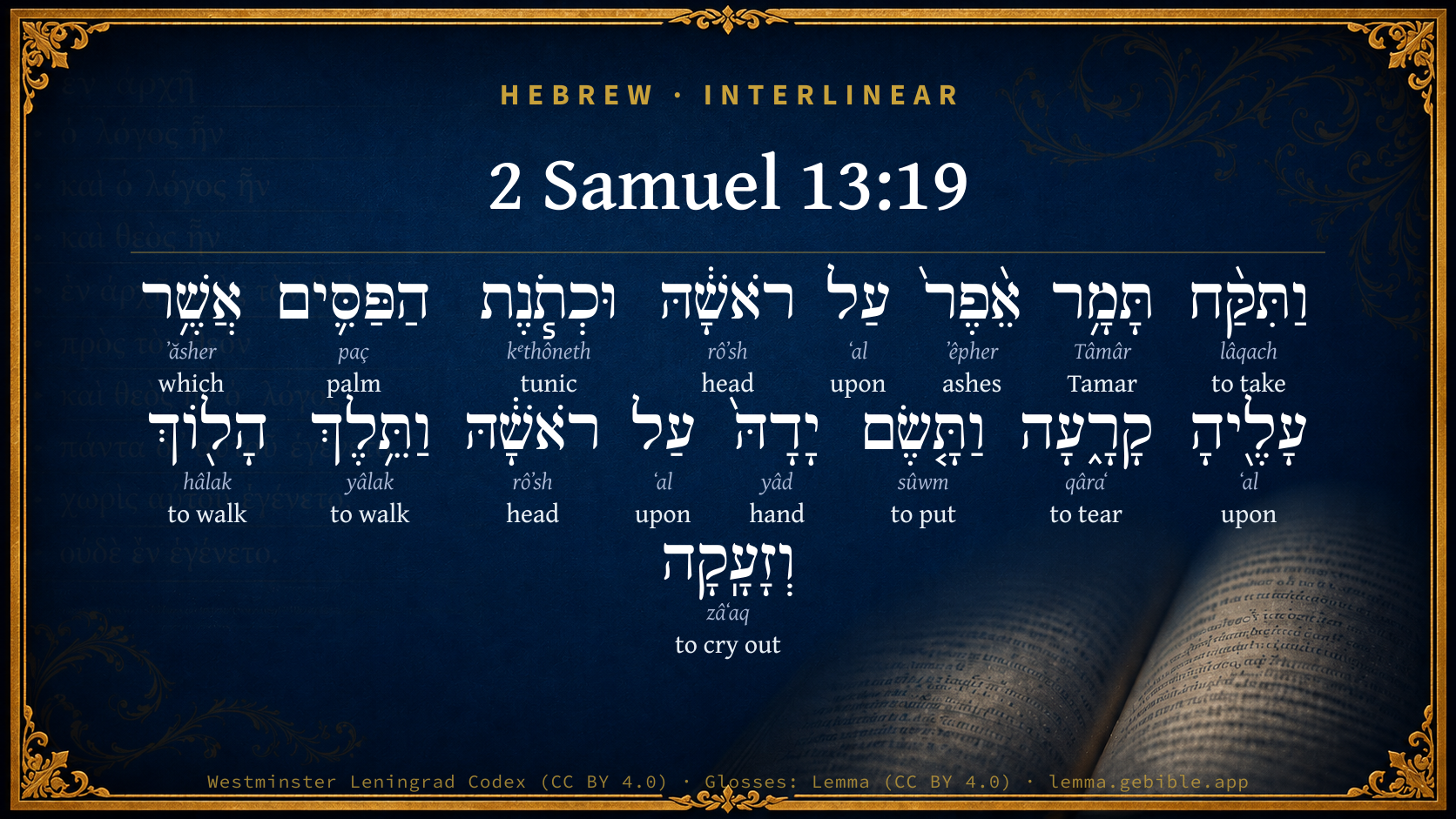
Hebrew (Westminster Leningrad Codex) 2 Samuel 13:19 appears in the Hebrew Old Testament. The text above is from the Westminster Leningrad Codex. Each word links to its Strong’s number, a concise gloss, and parsing drawn from the Open Scriptures Hebrew Bible morphology. Click any word for its full Brown-Driver-Briggs (BDB) entry.
Download image
Cite this verse

2 Samuel 13:19 (World English Bible). Public Domain. Lemma interlinear Bible study tool, https://lemma.gebible.app/v/2-samuel/13/19.

Show BibTeX & RIS
BibTeX
RIS
English Translation
Tamar put ashes on her head, and tore her garment of various colors that was on her; and she laid her hand on her head, and went her way, crying aloud as she went.
World English Bible · Public Domain
Download a study sheet

One document with this verse’s original text, its word-by-word gloss line, the meaning frame, cross-references with their text, attributed commentary, and full source and license credits — printable, and it pastes into notes with its structure intact.

This verse Autodidact and up

Study sheet (.html) Plain text (.txt)

A passage Seminary Student

Up to 50 verses in one chapter. A passage sheet keeps up to 6 commentary sources and 12 cross-references per verse, in the order this page ranks them, and says so on the sheet whenever that leaves anything out. Ask for a single verse and you get the Autodidact verse sheet above.

Everything on this page stays free to read, with no account — the sheet is a download of what is already on screen, not access to it.

Want to remove ads? Support Godless Engineer
Compare translations 3

The same verse in 3 English versions, stacked beneath the original-language interlinear above. Click any original word for its lexicon entry.

Each is an independent rendering of the whole verse — the interlinear is not word-aligned to these translations.

Highlighted words mark where these versions differ — a whole-verse word diff, not a word-by-word alignment.

  • World English Bible Public Domain
    Tamar put ashes on her head, and tore her garment of various colors that was on her; and she laid her hand on her head, and went her way, crying aloud as she went.
  • King James Version Public Domain
    And Tamar put ashes on her head, and rent her garment of divers colors that was on her, and laid her hand on her head, and went on crying.
  • unfoldingWord Literal Text CC BY-SA 4.0
    And Tamar put ashes on her head, and she tore the long robe that on her, and she put her hand on her head, and she went, going and she cried out.

unfoldingWord Literal Text — © unfoldingWord, licensed CC BY-SA 4.0. Word-aligned USFM3 via Door43 (git.door43.org/unfoldingWord/en_ult).

Versions to compare (up to 4)

3 of 4 selected

Show all 18 translations

Every available English version of this verse, each an independent rendering of the whole verse.

  • World English Bible Public Domain
    Tamar put ashes on her head, and tore her garment of various colors that was on her; and she laid her hand on her head, and went her way, crying aloud as she went.
  • Berean Standard Bible Public Domain
    And Tamar put ashes on her head and tore her robe. And putting her hand on her head, she went away crying bitterly.
  • Majority Standard Bible Public Domain
    And Tamar put ashes on her head and tore her robe. And putting her hand on her head, she went away crying aloud.
  • King James Version Public Domain
    And Tamar put ashes on her head, and rent her garment of divers colors that was on her, and laid her hand on her head, and went on crying.
  • American Standard Version (1901) Public Domain
    And Tamar put ashes on her head, and rent her garment of divers colors that was on her; and she laid her hand on her head, and went her way, crying aloud as she went.
  • Revised Version (1885) Public Domain
    And Tamar put ashes on her head, and rent her garment of divers colours that was on her; and she laid her hand on her head, and went her way, crying aloud as she went.
  • Geneva Bible (1599) Public Domain
    And Tamar put ashes on her head and rent the garment of diuers colours which was on her, and layde her hand on her head, and went her way crying.
  • Douay-Rheims (1899) Public Domain
    And she put ashes on her head, and rent her long robe and laid her hands upon her head, and went on crying.
  • Young's Literal Translation Public Domain
    And Tamar taketh ashes for her head, and the long coat that `is' on her she hath rent, and putteth her hand on her head, and goeth, going on and crying;
  • Literal Standard Version CC BY-SA 4.0
    And Tamar takes ashes for her head, and has torn the long coat that [is] on her, and puts her hand on her head, and goes, going on and crying;
  • Unlocked Literal Bible CC BY-SA 4.0
    Tamar put ashes on her head and tore her robe. She put her hands on her head and walked away, crying aloud as she went.
  • unfoldingWord Literal Text CC BY-SA 4.0
    And Tamar put ashes on her head, and she tore the long robe that on her, and she put her hand on her head, and she went, going and she cried out.
  • Darby Bible Public Domain
    And Tamar put ashes on her head, and rent her vest of many colours which was on her, and laid her hand on her head, and went away, crying out as she went.
  • World Messianic Bible Public Domain
    Tamar put ashes on her head, and tore her garment of various colors that was on her; and she laid her hand on her head and went her way, crying aloud as she went.
  • Webster's Bible Public Domain
    And Tamar put ashes on her head, and rent her garment of divers colors that was on her, and laid her hand on her head, and went on crying.
  • Free Bible Version CC BY-SA 4.0
    Tamar put ashes on her head and tore her long robe. She put her hands on her head, and she went away crying loudly.
  • Bible in Basic English Public Domain
    And Tamar, in her grief, put dust on her head; and she put her hand on her head and went away crying loudly.
  • JPS Tanakh (1917) Public Domain
    And Tamar put ashes on her head, and rent her garment of many colours that was on her; and she laid her hand on her head, and went her way, crying aloud as she went.

Literal Standard Version (2020), Covenant Press — licensed CC BY-SA 4.0. Text via the HelloAO Bible API (eBible.org). Unlocked Literal Bible (unfoldingWord) — licensed CC BY-SA 4.0. Text via the HelloAO Bible API (eBible.org). unfoldingWord Literal Text — © unfoldingWord, licensed CC BY-SA 4.0. Word-aligned USFM3 via Door43 (git.door43.org/unfoldingWord/en_ult). Free Bible Version, Dr. Jonathan Gallagher — licensed CC BY-SA 4.0. Text via the HelloAO Bible API (eBible.org).

Word by word

More ways to search: Search by grammar → Find every occurrence → Compare this word →

Practice this passage: Drill this verse → Learn its vocabulary →

הַפַּסִּ֛ים
paç
H6446
“the · palms”
Particle, Definite Article + Noun, Common, Masculine, Plural, Absolute
Part of Speech
Particle + Noun
Type
Common
Gender
Masculine
Number
Plural
State
Absolute
Full BDB Definition

Origin: from H6461

TWOT: 1789a

flat (of the hand or foot), palm, sole - of the tunic reaching to palms and soles (figuratively)
  1. וַתִּקַּ֨ח lâqach H3947 “and · to take” Conjunction + Verb, Qal, Sequential Imperfect, 3rd Person, Feminine, Singular
  2. תָּמָ֥ר Tâmâr H8559 “Tamar” Noun, Proper
  3. אֵ֨פֶר֙ ʼêpher H665 “ashes” Noun, Common, Masculine, Singular, Absolute
  4. עַל ʻal H5921 “upon” Preposition
  5. רֹאשָׁ֔הּ rôʼsh H7218 “head · her” Noun, Common, Masculine, Singular, Construct + Suffix, Personal, 3rd Person, Feminine, Singular
  6. וּכְתֹ֧נֶת kᵉthôneth H3801 “and · tunic of” Conjunction + Noun, Common, Feminine, Singular, Construct
  7. אֲשֶׁ֥ר ʼăsher H834 “which” Particle, Relative
  8. עָלֶ֖יהָ ʻal H5921 “upon · her” Preposition + Suffix, Personal, 3rd Person, Feminine, Singular
  9. קָרָ֑עָה qâraʻ H7167 “to tear” Verb, Qal, Perfect, 3rd Person, Feminine, Singular
  10. וַתָּ֤שֶׂם sûwm H7760 “and · to put” Conjunction + Verb, Qal, Sequential Imperfect, 3rd Person, Feminine, Singular
  11. יָדָהּ֙ yâd H3027 “hand · her” Noun, Common, Both, Singular, Construct + Suffix, Personal, 3rd Person, Feminine, Singular
  12. עַל ʻal H5921 “upon” Preposition
  13. רֹאשָׁ֔הּ rôʼsh H7218 “head · her” Noun, Common, Masculine, Singular, Construct + Suffix, Personal, 3rd Person, Feminine, Singular
  14. וַתֵּ֥לֶךְ yâlak H3212 “and · to walk” Conjunction + Verb, Qal, Sequential Imperfect, 3rd Person, Feminine, Singular
  15. הָל֖וֹךְ hâlak H1980 “to walk” Verb, Qal, Infinitive Absolute
  16. וְזָעָֽקָה zâʻaq H2199 “and · to cry out” Conjunction + Verb, Qal, Sequential Perfect, 3rd Person, Feminine, Singular

About this verse

These counts appear in no published source. They are computed here, from the morphology-tagged text and Lemma’s own curated glosses. What Lemma adds →

17
words
14
distinct lemmas
Historical
section

Notable vocabulary

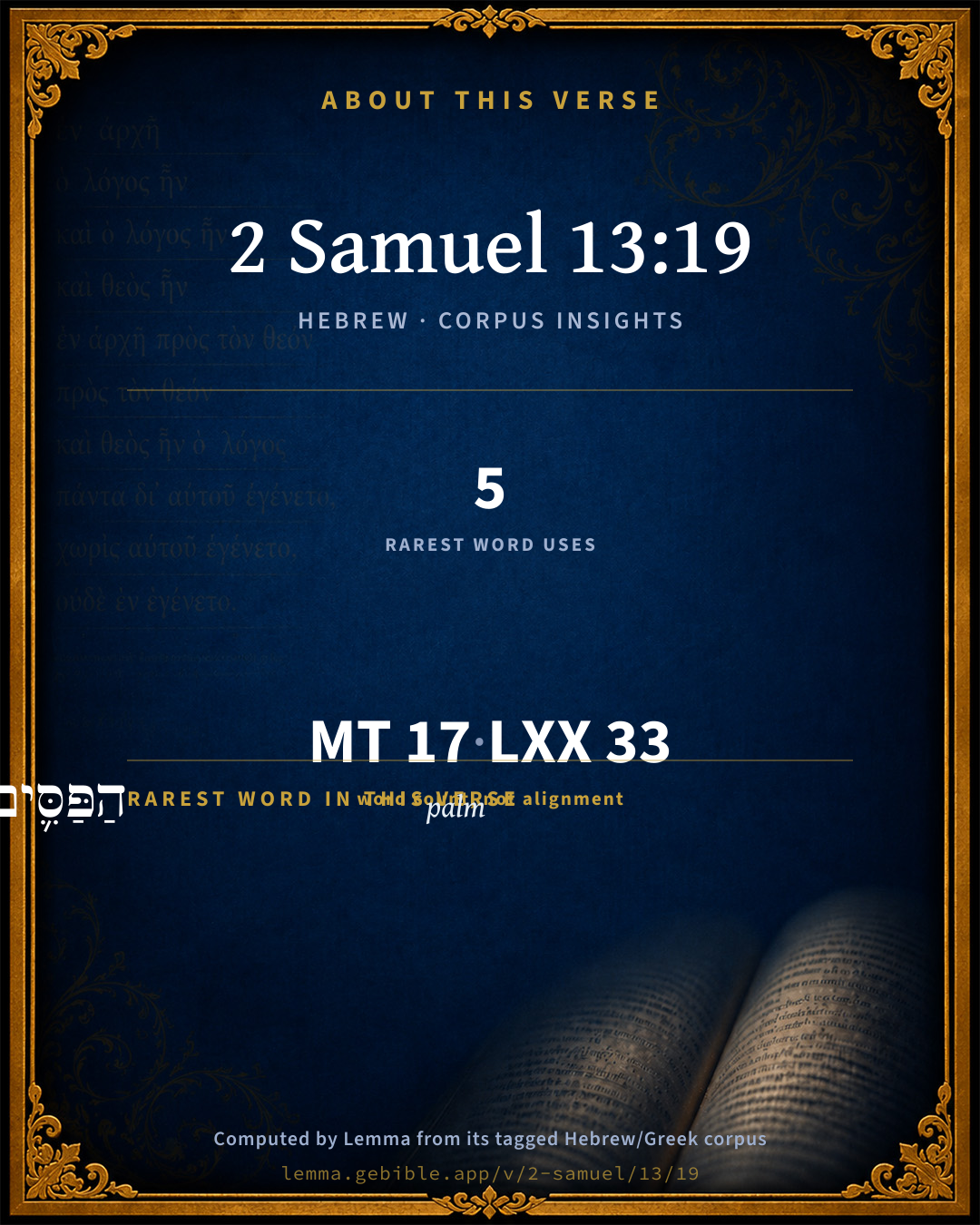
The rarest word here is הַפַּסִּ֛ים palm H6446 — appearing just 5 times in the whole Hebrew Bible.

Shared distinctive vocabulary

הַפַּסִּ֛ים palm H6446 occurs in 5 verses of the Hebrew Bible. Also found in:

Grammatical profile

  • 6 verbs
  • 7 nouns
  • 3 prepositions
  • 1 particle

Verb forms

  • וַתִּקַּ֨ח Qal · Sequential Imperfect
  • קָרָ֑עָה Qal · Perfect
  • וַתָּ֤שֶׂם Qal · Sequential Imperfect
  • וַתֵּ֥לֶךְ Qal · Sequential Imperfect
  • הָל֖וֹךְ Qal · Infinitive Absolute
  • וְזָעָֽקָה Qal · Sequential Perfect

Repetition

Words recur within this verse — often emphatic in Hebrew:

  • עַל upon H5921 ×3
  • רֹאשָׁ֔הּ head H7218 ×2

Hebrew & Septuagint length

In English translation the verse runs 34 words from the Hebrew and 32 from the Septuagint (LXX English) — closely comparable.

A rough comparison of the two English renderings, which tokenize alike — not a word-level alignment.

Word counts can differ between the Hebrew and the Greek without any difference in meaning — e.g. the Hebrew direct-object marker אֵת has no separate Greek word, and Greek often adds the article ὁ.

In the original languages it is 17 Hebrew tokens and 33 Greek tokens — but the two are counted differently (Hebrew bundles its prefixes and suffixes into one token; the Greek is in lemma form), so that isn’t a like-for-like length.

Cross-references

8

Topical passages linked to 2 Samuel 13:19 in the Treasury of Scripture Knowledge — connected by theme and wording, ordered by reader-vote popularity; previews shown in the World English Bible.

  • Joshua 7:6 Joshua tore his clothes, and fell to the earth on his face before the ark of Yahweh until the evening, he and the elders of Israel; and they put dust on their heads.
  • Jeremiah 2:37 From there also shall you go forth, with your hands on your head: for Yahweh has rejected those in whom you trust, and you shall not prosper with them.
  • 2 Samuel 1:2 it happened on the third day, that behold, a man came out of the camp from Saul, with his clothes torn, and earth on his head: and so it was, when he came to David, that he fell to the earth, and did obeisance.
  • 2 Samuel 1:11 Then David took hold on his clothes, and tore them; and likewise all the men who were with him:
  • 1 Samuel 4:12 There ran a man of Benjamin out of the army, and came to Shiloh the same day, with his clothes torn, and with earth on his head.
  • Esther 4:1 Now when Mordecai knew all that was done, Mordecai tore his clothes, and put on sackcloth with ashes, and went out into the midst of the city, and cried with a loud and a bitter cry;
  • Job 2:12 When they lifted up their eyes from a distance, and didn't recognize him, they raised their voices, and wept; and they each tore his robe, and sprinkled dust on their heads toward the sky.
  • Job 42:6 Therefore I abhor myself, And repent in dust and ashes."

Cross-references courtesy of OpenBible.info (CC BY 4.0).

Hebrew and Greek witnesses Masoretic Hebrew ↔ Greek Septuagint

The same verse in the two great witnesses to the Old Testament, shown verse-for-verse.

These are two independent witnesses, not word-aligned to each other, and the Septuagint is shown in lemma (dictionary) form.

Hebrew 2 Samuel 13:19 Masoretic · Westminster Leningrad Codex

וַתִּקַּ֨ח תָּמָ֥ר אֵ֨פֶר֙ עַל רֹאשָׁ֔הּ וּכְתֹ֧נֶת הַפַּסִּ֛ים אֲשֶׁ֥ר עָלֶ֖יהָ קָרָ֑עָה וַתָּ֤שֶׂם יָדָהּ֙ עַל רֹאשָׁ֔הּ וַתֵּ֥לֶךְ הָל֖וֹךְ וְזָעָֽקָה

Tamar put ashes on her head, and tore her garment of various colors that was on her; and she laid her hand on her head, and went her way, crying aloud as she went.

World English Bible · Public Domain

Greek LXX 2 Samuel 13:19 Septuagint · lemma form

καί λαμβάνω θημαρ σποδός καί ἐπιτίθημι ἐπί ὁ κεφαλή αὐτός καί ὁ χιτών ὁ καρπωτόν ὁ ἐπί αὐτός διαῥήγνυμι καί ἐπιτίθημι ὁ χείρ αὐτός ἐπί ὁ κεφαλή αὐτός καί πορεύομαι πορεύομαι καί κράζω

And Themar took ashes, and put them on her head; and she tore the variegated garment that was upon her: and she laid her hands on her head, and went crying continually.

LXX2012 (modern English Septuagint) · Public Domain

Hebrew: Westminster Leningrad Codex (CC BY 4.0). Greek: Septuagint (public domain); English from LXX2012 (modern English Septuagint) (Public Domain). How the Septuagint differs from the Hebrew →

Targum (Aramaic paraphrase)

1

The Targum is the ancient Jewish Aramaic paraphrase of the Hebrew Scriptures — an interpretive translation, not the Hebrew text itself. Onkelos (literal) and Pseudo-Jonathan (expansive) render the Torah, and Jonathan the Prophets. Coverage is partial: where no permissively-licensed English translation exists for a verse, only the Aramaic is shown. This is verse-level text, not a word-by-word alignment to the Hebrew.

  1. Targum Jonathan Prophets (Joshua–Malachi)
    וּנְסִיבַת תָּמָר קִטְמָא עַל רֵישָׁהּ וְכִתּוּנָא דְפַסֵי דַעֲלָה בְּזַעַת וְשַׁוִיאַת יְדָהּ עַל רֵישָׁהּ וַאֲזָלַת מֵיזַל וּצְוָחַת:

    (no public-domain English translation for this verse)

    Targum Jonathan — Aramaic: “Mikraot Gedolot” (public domain). English: “Sefaria Community Translation” (CC0 1.0 (public-domain dedication)); “London "Chaldee Paraphrase," 1871” (public domain). Text via Sefaria.

Commentary

Notes on 2 Samuel 13:19 from classic Christian and Jewish commentators (each source and its license shown beneath its notes). The classic Christian expositions comment on the surrounding passage and are grouped to its opening verse, so a note may address several verses; the Jewish commentaries on the Tanakh (Rashi and others) are per-verse, so they appear only where the commentator wrote on this verse.

Lemma curates 59 commentaries, every one of them public domain or Creative Commons licensed, each selected and text-cleaned for this edition rather than reprinted as found. About our sources →

Trapp's Complete Commentary

John Trapp

2Sa 13:19 And Tamar put ashes on her head, and rent her garment of divers colours that [was] on her, and laid her hand on her head, and went on crying.

Ver. 19. And Tamar put ashes on her head.] Most grievously bewailing in the open street the loss of her virginity; exclaiming against Amnon, as Chrysostom thinketh, and saying that he had ravished her, lest she should be thought to have been put away as a whore.

And rent her garment of divers colours] To show that her virginity had been by force rent from her.

And laid her hand on her head.] To cover her face, that seat of shamefacedness. See Jer 2:37.

And went on crying.] She cried not out before, that she might have been rescued: but now, like one grown desperate, as not caring what became of her, she made known by her crying what abuse she had suffered.

John Trapp, A Commentary or Exposition upon All the Books of the Old and New Testament (1647–1656) — public domain. Text from a community e-Sword module.

Joseph Benson's Commentary

2Sa 13:19. Tamar put ashes upon her head — To signify her grief for some calamity which had befallen her, and what that was, concurring circumstances easily discovered. And laid her hand on her head — In token of shame and sorrow, as if she were unable to show her face. And went on crying — To manifest her abhorrence of the fact, and that it was not done by her consent.

Joseph Benson's Commentary on the Old and New Testaments (1811–1818) — public domain. Text from a community e-Sword module.

Tyndale Open Study Notes

Tyndale Open Resources

13:19 Tamar tore her robe to symbolize the violation of her virginity and honor and to mourn the death of her future (13:16). • Ashes represented death; sitting amid ashes or putting ashes on one’s head were signs of mourning (Esth 4:1-3; Job 42:6; Dan 9:3; Jon 3:6).

Tyndale Open Study Notes — © Tyndale Open Resources, licensed CC BY-SA 4.0. Text via the HelloAO Bible API.

Jamieson, Fausset & Brown

Robert Jamieson, A. R. Fausset & David Brown

Tamar put ashes on her head, and rent her garment of divers colours . . . laid her hand on her head, and went on crying--that is, sobbing. Oriental manners would probably see nothing beyond a strong sense of the injury she had sustained, if Tamar actually rent her garments. But, as her veil is not mentioned, it is probable that Amnon had turned her out of doors without it, and she raised her hand with the design to conceal her face. By these signs, especially the rending of her distinguishing robe, Absalom at once conjectured what had taken place. Recommending her to be silent about it and not publish her own and her family's dishonor, he gave no inkling of his angry feelings to Amnon. But all the while he was in secret "nursing his wrath to keep it warm," and only "biding his time" to avenge his sister's wrongs, and by the removal of the heir-apparent perhaps further also his ambitious designs.

Jamieson, Fausset & Brown — Commentary Critical and Explanatory on the Whole Bible (1871) — public domain (CC PDM 1.0). Text via the HelloAO Bible API.

Ellicott's Commentary for English Readers

(19) Went on crying.—Literally, went going and cried; i.e., as she went away she cried aloud. Tamar put on every external mark of the deep grief within; and this was not only fitting in itself, but was a proper means to obtain justice for her wrongs.

A Bible Commentary for English Readers, edited by Charles John Ellicott (1878–1897) — public domain. Text from a community e-Sword module.

The Cambridge Bible for Schools and Colleges

gen. ed. J. J. S. Perowne

19. And Tamar put ashes, &c.] The ashes and the torn garments (1Sa_4:12; Est_4:1), and the hands clasped above the head (Jer_2:37), were all marks of grief and shame.

went on crying] Went away shrieking as she went; not lamenting with silent tears, but with loud passionate shrieks and wailing.

The Cambridge Bible for Schools and Colleges (gen. ed. J. J. S. Perowne; Cambridge University Press, 1878–1918) — public domain. Text from a community e-Sword module.

John Gill's Exposition

And Tamar put ashes on her head,.... In token of sorrow and distress; see Jos 7:6,

and rent her garment of divers colours that was on her; signifying that her virginity was rent from her in a forcible manner, or that she was ravished:

and laid her hand on her head; through grief and shame; see Jer 2:37,

and went on crying; from Amnon's house to her brother Absalom's, as one abused and injured.

John Gill's Exposition of the Whole Bible (1746–1763) — public domain (CC PDM 1.0). Text via the HelloAO Bible API.

Albert Barnes' Notes on the Bible

Laid her hand on her head - To hold on the ashes (see the marginal references).

Went on crying - i. e. “went away, crying out as she went.”

Albert Barnes' Notes on the Bible (1834–1885) — public domain. Text from a community e-Sword/MySword module.

Haydock's Catholic Bible Commentary

Head, as if to hide her face, Ezechiel xxvii. 30., and Jeremias ii. 37. So Mezentius: "Canitiem immundo deformat pulvere et ambas

Ad Cœlum tendit palmas."----- (Virgil, Æneid x.) See Homer, Iliad 2. (Calmet)

--- Crying, that no one might think she had consented. (Menochius) --- She probably went directly to her brother’s house, and related the affair to him; or he met her in this condition. (Salien)

George Leo Haydock (1774–1849), Haydock's Catholic Family Bible and Commentary, 1859 edition — public domain. Excludes Psalms (Douay-Rheims chapter numbering differs from Protestant) and Deuterocanonical books (Catholic canon only).

Matthew Poole's English Annotations

Put ashes on her head, and rent her garment; to signify her grief for some calamity which had befallen her, and what that was concurring circumstances did easily discover.

Laid her hand on her head, in token of grief and shame, as if she were unable and ashamed to show her face. See Jer 2:37.

Went on crying, to manifest her abhorrency of the fact, and that it was not done by her consent.

Matthew Poole's English Annotations on the Holy Bible (1683–1685) — public domain. Text from a community e-Sword/MySword module.

Whedon's Commentary on the Bible

Daniel D. Whedon

19. Ashes on her head… rent her garment… hand on her head — Signs of humiliation, agony, and despair. See references.

Went on crying — Screaming aloud through the streets of the city, frantic over the disgrace and violence she had so cruelly received.

Daniel D. Whedon (gen. ed.), Commentary on the Old and New Testaments (1874–1909) — public domain. Text from a community e-Sword module.

The Pulpit Commentary

Tamar put ashes. There was no concealment of her wrong, but, thrust out of the inner chamber into which Amnon had enticed her (ver. 10), she cast ashes upon her head from the very fire which she had just used in cooking, and, rending her garment, hastened away with her hand on her head, and with cries of lamentation. If David had foreseen this sad sight when giving way to his passion for Bathsheba, he would have felt that sin is indeed "folly," and that its pleasure is followed by shame and bitter anguish.

The Pulpit Commentary (1880–1919), ed. H.D.M. Spence-Jones & Joseph S. Exell — public domain. Text from a community e-Sword module.

John Wesley's Explanatory Notes

Put ashes - To signify her grief for some calamity which had befallen her, and what that was, concurring circumstances easily discovered. Head - In token of grief and shame, as if she were unable and ashamed to shew her face. Crying - To manifest her abhorrency of the fact, and that it was not done by her consent.

John Wesley, Explanatory Notes Upon the Whole Bible (1754–1765) — public domain. Text via the GEBible commentary corpus.

Lesson kit

Teaching starters — assembled from the data on this page, not authored interpretation. Every prompt links to the verse data it draws on. Edit before teaching.

2 Samuel, in the Historical, opens this verse with 17 words (14 distinct Hebrew lemmas). Its most distinctive word is paç (“palm”). A historical commentator’s framing appears above. Read the whole chapter for the surrounding context.

Discussion questions

  1. What does “palm” (paç) contribute to the verse as a whole?
  2. How does Genesis 37:3, which shares the word «palm», read alongside this verse?
  3. What does the repetition of “upon” (3× in this one verse) do in this verse?
  4. These translations render this verse differently; the difference is in the English rendering, not the original. What questions does that raise?
  5. «וַתִּקַּ֨ח» is a Qal Sequential Imperfect verb. How does that grammatical form shape the action described?
  6. Compare how Trapp's Complete Commentary and Joseph Benson's Commentary read this verse. Where do they agree or differ?

Things to notice

Reading settings

Reading text

Shown beneath each verse's original-language words.

Old Testament
Old Testament edition

Read the OT as the Masoretic Hebrew (MT) or the Greek Septuagint (LXX).

English shown for the Greek Septuagint (in the Hebrew ↔ Greek comparison).

Comparing translations? Open the Compare panel on any verse page to stack up to four side by side.