Judges 3:6

Hebrew (Westminster Leningrad Codex) Judges 3:6 appears in the Hebrew Old Testament. The text above is from the Westminster Leningrad Codex. Each word links to its Strong’s number, a concise gloss, and parsing drawn from the Open Scriptures Hebrew Bible morphology. Click any word for its full Brown-Driver-Briggs (BDB) entry.
Download image
Cite this verse

Judges 3:6 (World English Bible). Public Domain. Lemma interlinear Bible study tool, https://lemma.gebible.app/v/judges/3/6.

Show BibTeX & RIS
BibTeX
RIS
English Translation
and they took their daughters to be their wives, and gave their own daughters to their sons and served their gods.
World English Bible · Public Domain
Download a study sheet

One document with this verse’s original text, its word-by-word gloss line, the meaning frame, cross-references with their text, attributed commentary, and full source and license credits — printable, and it pastes into notes with its structure intact.

This verse Autodidact and up

Study sheet (.html) Plain text (.txt)

A passage Seminary Student

Up to 50 verses in one chapter. A passage sheet keeps up to 6 commentary sources and 12 cross-references per verse, in the order this page ranks them, and says so on the sheet whenever that leaves anything out. Ask for a single verse and you get the Autodidact verse sheet above.

Everything on this page stays free to read, with no account — the sheet is a download of what is already on screen, not access to it.

Want to remove ads? Support Godless Engineer
Compare translations 3

The same verse in 3 English versions, stacked beneath the original-language interlinear above. Click any original word for its lexicon entry.

Each is an independent rendering of the whole verse — the interlinear is not word-aligned to these translations.

Highlighted words mark where these versions differ — a whole-verse word diff, not a word-by-word alignment.

  • World English Bible Public Domain
    and they took their daughters to be their wives, and gave their own daughters to their sons and served their gods.
  • King James Version Public Domain
    And they took their daughters to be their wives, and gave their daughters to their sons, and served their gods.
  • unfoldingWord Literal Text CC BY-SA 4.0
    And they took their daughters for themselves as wives, and they gave their daughters to their sons, and they served their gods.

unfoldingWord Literal Text — © unfoldingWord, licensed CC BY-SA 4.0. Word-aligned USFM3 via Door43 (git.door43.org/unfoldingWord/en_ult).

Versions to compare (up to 4)

3 of 4 selected

Show all 18 translations

Every available English version of this verse, each an independent rendering of the whole verse.

  • World English Bible Public Domain
    and they took their daughters to be their wives, and gave their own daughters to their sons and served their gods.
  • Berean Standard Bible Public Domain
    And they took the daughters of these people in marriage, gave their own daughters to their sons, and served their gods.
  • Majority Standard Bible Public Domain
    And they took the daughters of these people in marriage, gave their own daughters to their sons, and served their gods.
  • King James Version Public Domain
    And they took their daughters to be their wives, and gave their daughters to their sons, and served their gods.
  • American Standard Version (1901) Public Domain
    and they took their daughters to be their wives, and gave their own daughters to their sons and served their gods.
  • Revised Version (1885) Public Domain
    and they took their daughters to be their wives, and gave their own daughters to their sons, and served their gods.
  • Geneva Bible (1599) Public Domain
    And they tooke their daughters to bee their wiues, and gaue their daughters to their sonnes, and serued their gods.
  • Douay-Rheims (1899) Public Domain
    And they took their daughters to wives, and they gave their own daughters to their sons, and they served their gods.
  • Young's Literal Translation Public Domain
    and take their daughters to them for wives, and their daughters have given to their sons, and they serve their gods;
  • Literal Standard Version CC BY-SA 4.0
    and take their daughters to them for wives, and have given their daughters to their sons, and they serve their gods;
  • Unlocked Literal Bible CC BY-SA 4.0
    Their daughters they took to be their wives, and their own daughters they gave to their sons, and they served their gods.
  • unfoldingWord Literal Text CC BY-SA 4.0
    And they took their daughters for themselves as wives, and they gave their daughters to their sons, and they served their gods.
  • Darby Bible Public Domain
    and they took their daughters to themselves for wives, and their own daughters they gave to their sons; and they served their gods.
  • World Messianic Bible Public Domain
    They took their daughters to be their wives, and gave their own daughters to their sons and served their gods.
  • Webster's Bible Public Domain
    And they took their daughters to be their wives, and gave their daughters to their sons, and served their gods.
  • Free Bible Version CC BY-SA 4.0
    The Israelites intermarried with them, marrying their daughters, giving their own daughters to their sons, and worshiped their gods.
  • Bible in Basic English Public Domain
    And they took as wives the daughters of these nations and gave their daughters to their sons, and became servants to their gods.
  • JPS Tanakh (1917) Public Domain
    and they took their daughters to be their wives, and gave their own daughters to their sons, and served their gods.

Literal Standard Version (2020), Covenant Press — licensed CC BY-SA 4.0. Text via the HelloAO Bible API (eBible.org). Unlocked Literal Bible (unfoldingWord) — licensed CC BY-SA 4.0. Text via the HelloAO Bible API (eBible.org). unfoldingWord Literal Text — © unfoldingWord, licensed CC BY-SA 4.0. Word-aligned USFM3 via Door43 (git.door43.org/unfoldingWord/en_ult). Free Bible Version, Dr. Jonathan Gallagher — licensed CC BY-SA 4.0. Text via the HelloAO Bible API (eBible.org).

Word by word

More ways to search: Search by grammar → Find every occurrence → Compare this word →

Practice this passage: Drill this verse → Learn its vocabulary →

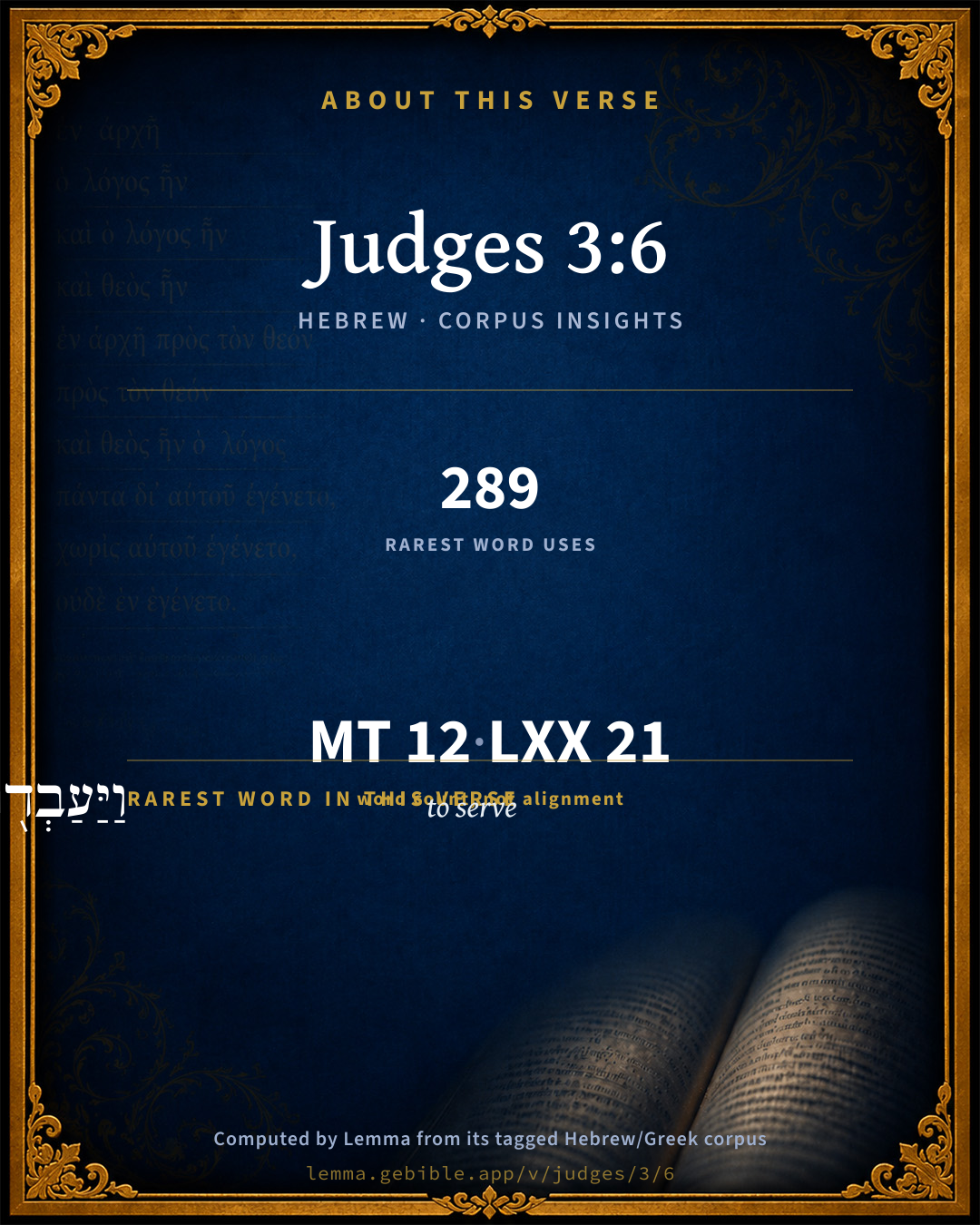
וַיַּעַבְד֖וּ
ʻâbad
H5647
“and · to serve”
Conjunction + Verb, Qal, Sequential Imperfect, 3rd Person, Masculine, Plural
Part of Speech
Conjunction + Verb
Stem
Qal
Form
Sequential Imperfect
Person
3rd Person
Gender
Masculine
Number
Plural
Full BDB Definition

Origin: a primitive root

TWOT: 1553

to work, serve - (Qal) - to labour, work, do work - to work for another, serve another by labour - to serve as subjects - to serve (God) - to serve (with Levitical service) - (Niphal) - to be worked, be tilled (of land) - to make oneself a servant - (Pual) to be worked - (Hiphil) - to compel to labour or work, cause to labour, cause to serve - to cause to serve as subjects - (Hophal) to be led or enticed to serve
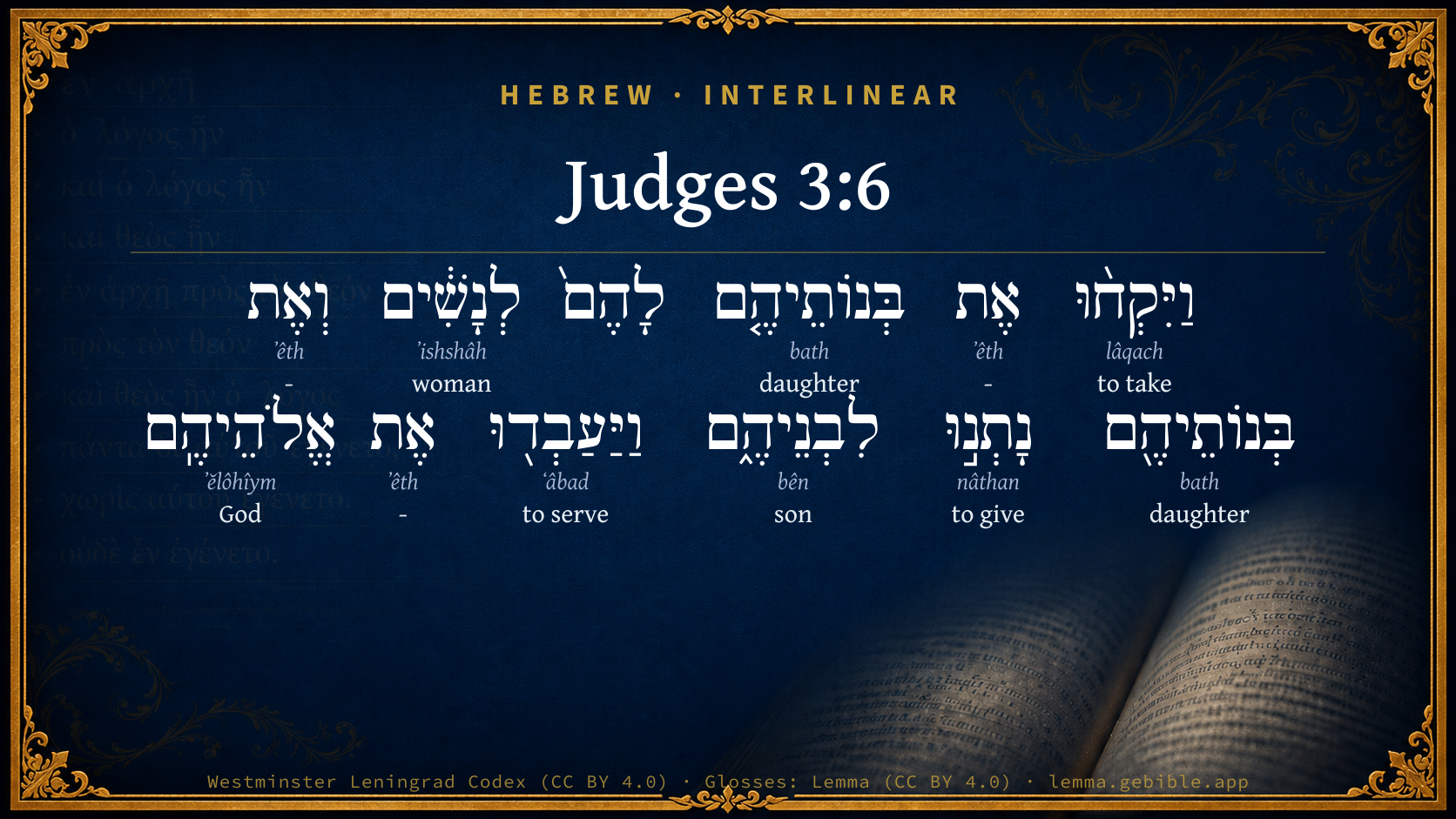
  1. וַיִּקְח֨וּ lâqach H3947 “and · to take” Conjunction + Verb, Qal, Sequential Imperfect, 3rd Person, Masculine, Plural
  2. אֶת ʼêth H853 “-” Particle, Direct Object
  3. בְּנוֹתֵיהֶ֤ם bath H1323 “daughters · their” Noun, Common, Feminine, Plural, Construct + Suffix, Personal, 3rd Person, Masculine, Plural
  4. לְנָשִׁ֔ים ʼishshâh H802 “to/for · women” Preposition + Noun, Common, Feminine, Plural, Absolute
  5. וְאֶת ʼêth H853 “and · -” Conjunction + Particle, Direct Object
  6. בְּנוֹתֵיהֶ֖ם bath H1323 “daughters · their” Noun, Common, Feminine, Plural, Construct + Suffix, Personal, 3rd Person, Masculine, Plural
  7. נָתְנ֣וּ nâthan H5414 “to give” Verb, Qal, Perfect, 3rd Person, Common, Plural
  8. לִבְנֵיהֶ֑ם bên H1121 “to/for · sons · their” Preposition + Noun, Common, Masculine, Plural, Construct + Suffix, Personal, 3rd Person, Masculine, Plural
  9. אֶת ʼêth H853 “-” Particle, Direct Object
  10. אֱלֹהֵיהֶֽם ʼĕlôhîym H430 “God(s) · their” Noun, Common, Masculine, Plural, Construct + Suffix, Personal, 3rd Person, Masculine, Plural

About this verse

These counts appear in no published source. They are computed here, from the morphology-tagged text and Lemma’s own curated glosses. What Lemma adds →

12
words
8
distinct lemmas
Historical
section

Grammatical profile

  • 3 verbs
  • 5 nouns
  • 1 preposition
  • 3 particles

Verb forms

  • וַיִּקְח֨וּ Qal · Sequential Imperfect
  • נָתְנ֣וּ Qal · Perfect
  • וַיַּעַבְד֖וּ Qal · Sequential Imperfect

Repetition

A word recurs within this verse — often emphatic in Hebrew:

  • בְּנוֹתֵיהֶ֤ם daughter H1323 ×2

Hebrew & Septuagint length

In English translation the verse runs 21 words from the Hebrew and 21 from the Septuagint (LXX English) — the same length.

A rough comparison of the two English renderings, which tokenize alike — not a word-level alignment.

Word counts can differ between the Hebrew and the Greek without any difference in meaning — e.g. the Hebrew direct-object marker אֵת has no separate Greek word, and Greek often adds the article ὁ.

In the original languages it is 12 Hebrew tokens and 21 Greek tokens — but the two are counted differently (Hebrew bundles its prefixes and suffixes into one token; the Greek is in lemma form), so that isn’t a like-for-like length.

Cross-references

6

Topical passages linked to Judges 3:6 in the Treasury of Scripture Knowledge — connected by theme and wording, ordered by reader-vote popularity; previews shown in the World English Bible.

  • Exodus 34:16 and you take of their daughters to your sons, and their daughters play the prostitute after their gods, and make your sons play the prostitute after their gods.
  • Deuteronomy 7:3–4 neither shall you make marriages with them; your daughter you shall not give to his son, nor his daughter shall you take to your son.
  • 1 Kings 11:1–5 Now king Solomon loved many foreign women, together with the daughter of Pharaoh, women of the Moabites, Ammonites, Edomites, Sidonians, and Hittites;
  • Ezra 9:11–12 which you have commanded by your servants the prophets, saying, The land, to which you go to possess it, is an unclean land through the uncleanness of the peoples of the lands, through their abominations, which have filled it from one end to another with their filthiness:
  • Nehemiah 13:23–27 In those days also saw I the Jews who had married women of Ashdod, of Ammon, [and] of Moab:
  • Ezekiel 16:3 and say, Thus says the Lord Yahweh to Jerusalem: Your birth and your birth is of the land of the Canaanite; the Amorite was your father, and your mother was a Hittite.

Cross-references courtesy of OpenBible.info (CC BY 4.0).

Hebrew and Greek witnesses Masoretic Hebrew ↔ Greek Septuagint

The same verse in the two great witnesses to the Old Testament, shown verse-for-verse.

These are two independent witnesses, not word-aligned to each other, and the Septuagint is shown in lemma (dictionary) form.

Hebrew Judges 3:6 Masoretic · Westminster Leningrad Codex

וַיִּקְח֨וּ אֶת בְּנוֹתֵיהֶ֤ם לָהֶם֙ לְנָשִׁ֔ים וְאֶת בְּנוֹתֵיהֶ֖ם נָתְנ֣וּ לִבְנֵיהֶ֑ם וַיַּעַבְד֖וּ אֶת אֱלֹהֵיהֶֽם

and they took their daughters to be their wives, and gave their own daughters to their sons and served their gods.

World English Bible · Public Domain

Greek LXX Judges 3:6 Septuagint · lemma form

καί λαμβάνω ὁ θυγάτηρ αὐτός ἑαυτοῦ εἰς γυνή καί ὁ θυγάτηρ αὐτός δίδωμι ὁ υἱός αὐτός καί λατρεύω ὁ θεός αὐτός

And they took their daughters for wives to themselves, and they gave their daughters to their sons, and served their gods.

LXX2012 (modern English Septuagint) · Public Domain

Hebrew: Westminster Leningrad Codex (CC BY 4.0). Greek: Septuagint (public domain); English from LXX2012 (modern English Septuagint) (Public Domain). How the Septuagint differs from the Hebrew →

Targum (Aramaic paraphrase)

1

The Targum is the ancient Jewish Aramaic paraphrase of the Hebrew Scriptures — an interpretive translation, not the Hebrew text itself. Onkelos (literal) and Pseudo-Jonathan (expansive) render the Torah, and Jonathan the Prophets. Coverage is partial: where no permissively-licensed English translation exists for a verse, only the Aramaic is shown. This is verse-level text, not a word-by-word alignment to the Hebrew.

  1. Targum Jonathan Prophets (Joshua–Malachi)
    וּנְסִיבוּ יַת בְּנָתֵיהוֹן לְהוֹן לִנְשִׁין וְיַת בְּנַתְהוֹן יְהִיבוּ לִבְנֵיהוֹן וּפְלַחוּ יַת טַעֲוַתְהוֹן:

    (no public-domain English translation for this verse)

    Targum Jonathan — Aramaic: “Mikraot Gedolot” (public domain). English: “Sefaria Community Translation” (CC0 1.0 (public-domain dedication)); “London "Chaldee Paraphrase," 1871” (public domain). Text via Sefaria.

Commentary

Notes on Judges 3:6 from classic Christian and Jewish commentators (each source and its license shown beneath its notes). The classic Christian expositions comment on the surrounding passage and are grouped to its opening verse, so a note may address several verses; the Jewish commentaries on the Tanakh (Rashi and others) are per-verse, so they appear only where the commentator wrote on this verse.

Lemma curates 59 commentaries, every one of them public domain or Creative Commons licensed, each selected and text-cleaned for this edition rather than reprinted as found. About our sources →

Trapp's Complete Commentary

John Trapp

Jdg 3:6 And they took their daughters to be their wives, and gave their daughters to their sons, and served their gods.

Ver. 6. And served their gods.] See Neh 13:26. {See Trapp on "Neh 13:26"}

John Trapp, A Commentary or Exposition upon All the Books of the Old and New Testament (1647–1656) — public domain. Text from a community e-Sword module.

The Biblical Illustrator

Joseph S. Exell

Jdg_3:6-7

Served their Gods . . . forgat the Lord, and served Baalim and the groves.

The downward course of sin

I. The form of their sin. One of omission (Jdg_2:2).

1. No sin of omission is ever small.

(1) It slights Gods authority.

(2) It implies alienation of heart from God.

(3) There is no fear of God before the eyes.

2. Sins of omission may become indefinitely great.

II. The tendency of sin to multiply itself.

1. No sin stands alone.

2. The root-sin here was failure to exterminate the Canaanites.

3. It led to their dwelling among the idolators.

4. Their intermarrying with the ungodly.

5. Their worship of false gods.

6. The facility with which they made the change.

III. The deplorable end to which their evil course led.

1. There was entire abandonment of God as their God. Sin is a great--

(1) Spoiler;

(2) madness.

2. There was sinking down to the level of heathen worship and heathen practices. (J. P. Millar.)

The Biblical Illustrator, edited by Joseph S. Exell (c. 1880s–1900s) — public domain. Text from a community e-Sword module.

Joseph Benson's Commentary

Jdg 3:6-7. They took their daughters, and served their gods — Were drawn to idolatry by the persuasions and examples of their yoke-fellows. And served Baalim and the groves — Or, Baalim in groves; that is, false gods, or rather their images, set up under shady trees, contrary to the command given Exo 34:13. Some expositors, however, think the meaning is, Baalim and Ashtaroth; for by the addition of a single letter, the Hebrew word rendered groves, will be Ashtaroth, and the greater part of the versions so render it, understanding thereby goddesses, as distinguished from Baalim or lords. It must be acknowledged, however, that the trees themselves, which composed those shady retreats in which they placed their idols, and which were consecrated to their honour, were accounted sacred by the ancient pagans, and held in great veneration. They decorated them with ribands and lights, made vows to them, and hung the spoils of their enemies upon them: insomuch that it was customary for travellers to stop, when they were to pass by them, and approach them with veneration and religious awe, as if they had been the habitation of some god.

Joseph Benson's Commentary on the Old and New Testaments (1811–1818) — public domain. Text from a community e-Sword module.

Geneva Bible (1599)

Geneva Bible translators

Contrary to God’s commandment, Deut. 3:7.

Geneva Bible (1599) marginal notes — public domain. Text via Bolls.life.

Adam Clarke's Commentary

Verse 6. And they took their daughters] They formed matrimonial alliances with those proscribed nations, served their idols, and thus became one with them in politics and religion.

Adam Clarke's Commentary on the Bible (1810–1826) — public domain. Text from a community e-Sword/MySword module.

Ellicott's Commentary for English Readers

(6) And they took their daughters.—This beginning of intermarriages shows that we are now a generation removed from the days of Joshua. Such marriages had been forbidden in Deu_7:3. but are not among the sins denounced by the Angel-messenger at Bochim (Jdg_2:1).

A Bible Commentary for English Readers, edited by Charles John Ellicott (1878–1897) — public domain. Text from a community e-Sword module.

The Cambridge Bible for Schools and Colleges

gen. ed. J. J. S. Perowne

6. they took their daughters] Cf. Gen_34:9; Gen_34:16; Exo_34:16; Deu_7:3. According to the ideas of the ancient world, it was impossible for the Israelites to maintain any religious exclusiveness when they intermarried with the heathen nations (cf. Jdg_2:1 b–3); the connubium carried with it an alliance of religion and worship, as for instance in the case of Solomon, 1Ki_11:1 ff. The source of these two verses is disputed. If the connexion suggested above is correct, they may be assigned to E, though they shew no signs distinctive of that school.

The Cambridge Bible for Schools and Colleges (gen. ed. J. J. S. Perowne; Cambridge University Press, 1878–1918) — public domain. Text from a community e-Sword module.

John Gill's Exposition

And they took their daughters to be their wives, and gave their daughters to their sons,.... The Israelites intermarried with the inhabitants of the land, contrary to the express command of God, Deu 7:3; whereby they confounded their families, debased their blood, and were ensnared into idolatry, as follows: perhaps to these unlawful marriages, in their first settlement in the land of Canaan, reference is had in Eze 16:3, "thy father was an Amorite and thy mother an Hittite"; an Amorite marrying a daughter of Israel, and an Israelitish man an Hittite woman:

and served their gods; this was the natural consequence of their intermarriages, which the Lord foresaw, and therefore cautioned them against them, Exo 34:15.

John Gill's Exposition of the Whole Bible (1746–1763) — public domain (CC PDM 1.0). Text via the HelloAO Bible API.

Albert Barnes' Notes on the Bible

See Jdg 2:2 note.

Albert Barnes' Notes on the Bible (1834–1885) — public domain. Text from a community e-Sword/MySword module.

Haydock's Catholic Bible Commentary

Gods. This was the fatal consequence which God had foretold, Deuteronomy vii. 4. (Haydock)

George Leo Haydock (1774–1849), Haydock's Catholic Family Bible and Commentary, 1859 edition — public domain. Excludes Psalms (Douay-Rheims chapter numbering differs from Protestant) and Deuterocanonical books (Catholic canon only).

Matthew Poole's English Annotations

Were drawn to idolatry by the persuasions and examples of their yoke-fellows, through the just judgment of God, punishing their sinful marriages by giving them up to idolatry.

Matthew Poole's English Annotations on the Holy Bible (1683–1685) — public domain. Text from a community e-Sword/MySword module.

Whedon's Commentary on the Bible

Daniel D. Whedon

6. And they took their daughters — So that marriages and mixing of blood threatened to render Israel homogeneous in blood and paganism with the doomed nations.

Daniel D. Whedon (gen. ed.), Commentary on the Old and New Testaments (1874–1909) — public domain. Text from a community e-Sword module.

The Pulpit Commentary

They took their daughters, etc. Here is a further downward step in the disobedience of the Israelites. Intermarriage with the Canaanite nations had been expressly forbidden, (Exo_34:15, 16 Deu 7:3Jo Deu_23:12) and the reason of the prohibition clearly stated, and for some time after Joshua"s death no such marriages appear to have been contracted. But now the fatal step was taken, and the predicted consequence immediately ensued: "they served their gods; they forgat the Lord their God, and served the Baalim and the Asheroth."

The Pulpit Commentary (1880–1919), ed. H.D.M. Spence-Jones & Joseph S. Exell — public domain. Text from a community e-Sword module.

John Wesley's Explanatory Notes

Served their gods - Were drawn to idolatry by the persuasions and examples of their yoke-fellows.

John Wesley, Explanatory Notes Upon the Whole Bible (1754–1765) — public domain. Text via the GEBible commentary corpus.

Lesson kit

Teaching starters — assembled from the data on this page, not authored interpretation. Every prompt links to the verse data it draws on. Edit before teaching.

Judges, in the Historical, opens this verse with 12 words (8 distinct Hebrew lemmas). Its most distinctive word is ʻâbad (“to serve”). A historical commentator’s framing appears above. Read the whole chapter for the surrounding context.

Discussion questions

  1. How does “to serve” (ʻâbad) shape what this verse is saying?
  2. How does Exodus 34:16, which shares this passage’s theme, read alongside this verse?
  3. What does the repetition of “daughter” (2× in this one verse) do in this verse?
  4. The translations on this page render this verse differently — a whole-verse word diff, not a word-by-word alignment. What might account for the different wordings?
  5. «וַיִּקְח֨וּ» is a Qal Sequential Imperfect verb. How does that grammatical form shape the action described?
  6. Compare how Trapp's Complete Commentary and The Biblical Illustrator read this verse. Where do they agree or differ?

Things to notice

Reading settings

Reading text

Shown beneath each verse's original-language words.

Old Testament
Old Testament edition

Read the OT as the Masoretic Hebrew (MT) or the Greek Septuagint (LXX).

English shown for the Greek Septuagint (in the Hebrew ↔ Greek comparison).

Comparing translations? Open the Compare panel on any verse page to stack up to four side by side.