Deuteronomy 32:2

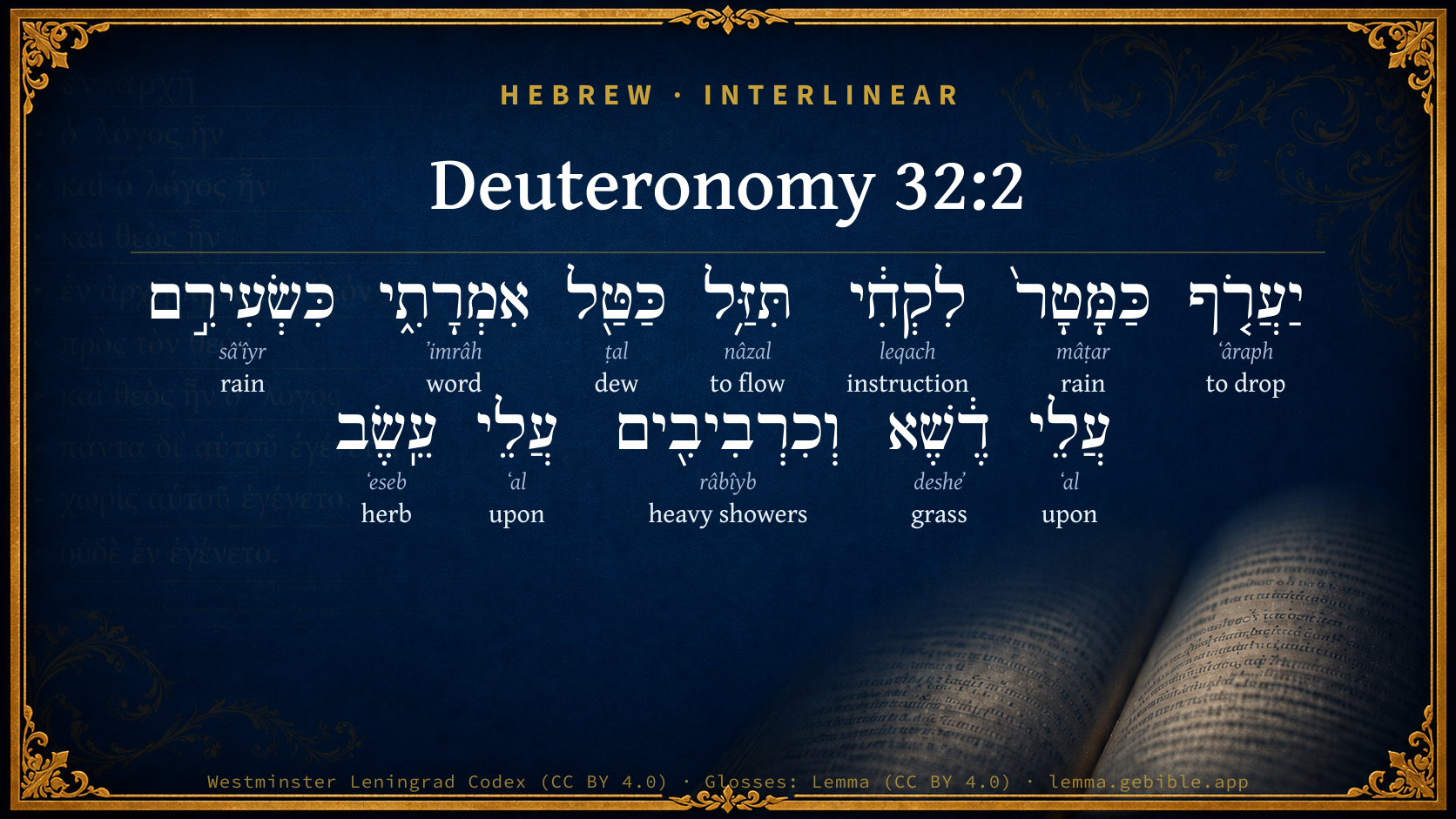
Hebrew (Westminster Leningrad Codex) Deuteronomy 32:2 appears in the Hebrew Old Testament. The text above is from the Westminster Leningrad Codex. Each word links to its Strong’s number, a concise gloss, and parsing drawn from the Open Scriptures Hebrew Bible morphology. Click any word for its full Brown-Driver-Briggs (BDB) entry.
Download image
Cite this verse

Deuteronomy 32:2 (World English Bible). Public Domain. Lemma interlinear Bible study tool, https://lemma.gebible.app/v/deuteronomy/32/2.

Show BibTeX & RIS
BibTeX
RIS
English Translation
My doctrine shall drop as the rain; My speech shall condense as the dew, As the small rain on the tender grass, As the showers on the herb.
World English Bible · Public Domain
Highlights
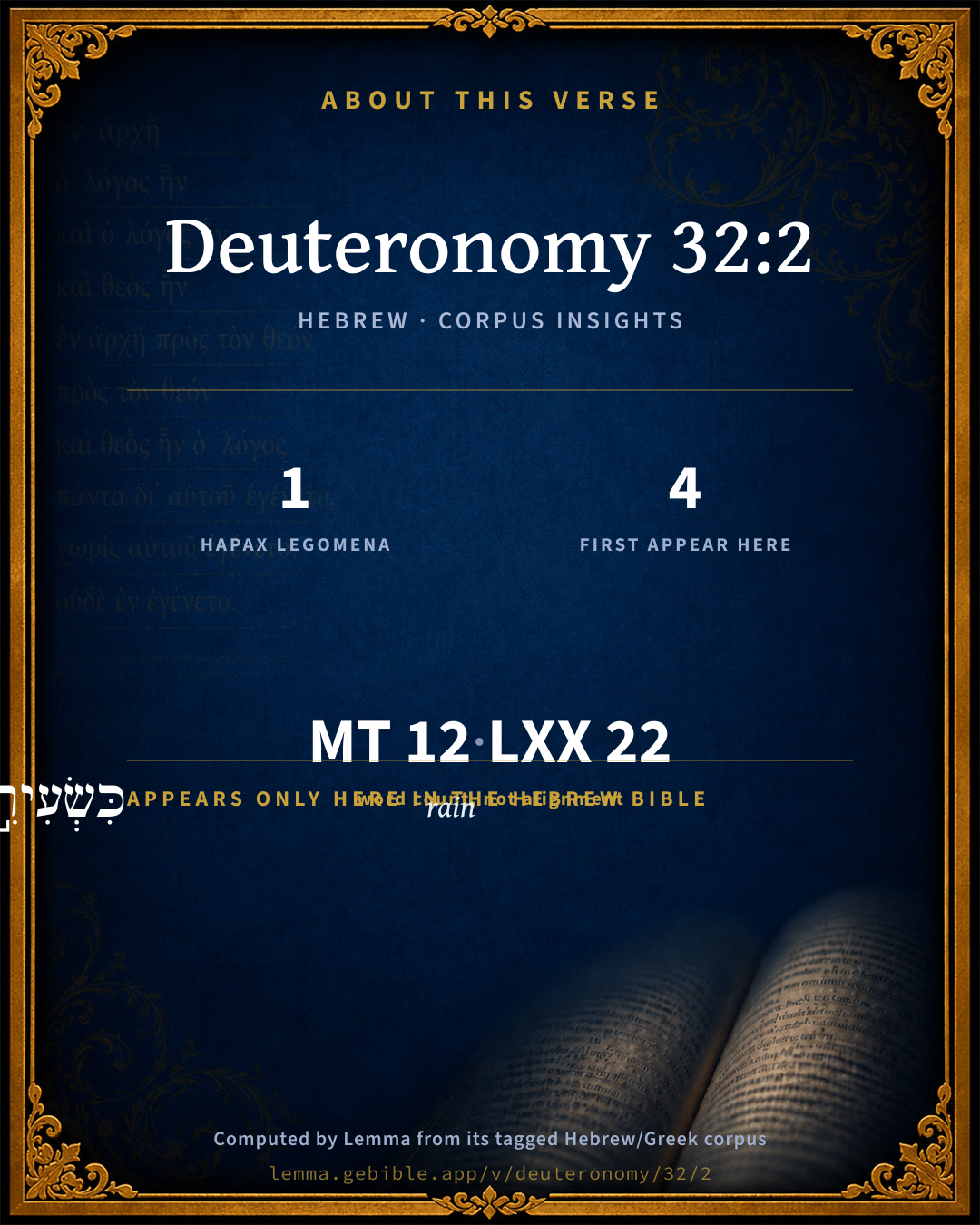
  • 1 hapax legomenon — only here in the Hebrew Bible
  • 4 first appearances in the Hebrew Bible
Full analysis ↓
Download a study sheet

One document with this verse’s original text, its word-by-word gloss line, the meaning frame, cross-references with their text, attributed commentary, and full source and license credits — printable, and it pastes into notes with its structure intact.

This verse Autodidact and up

Study sheet (.html) Plain text (.txt)

A passage Seminary Student

Up to 50 verses in one chapter. A passage sheet keeps up to 6 commentary sources and 12 cross-references per verse, in the order this page ranks them, and says so on the sheet whenever that leaves anything out. Ask for a single verse and you get the Autodidact verse sheet above.

Everything on this page stays free to read, with no account — the sheet is a download of what is already on screen, not access to it.

Want to remove ads? Support Godless Engineer
Compare translations 3

The same verse in 3 English versions, stacked beneath the original-language interlinear above. Click any original word for its lexicon entry.

Each is an independent rendering of the whole verse — the interlinear is not word-aligned to these translations.

Highlighted words mark where these versions differ — a whole-verse word diff, not a word-by-word alignment.

  • World English Bible Public Domain
    My doctrine shall drop as the rain; My speech shall condense as the dew, As the small rain on the tender grass, As the showers on the herb.
  • King James Version Public Domain
    My doctrine shall drop as the rain, my speech shall distil as the dew, as the small rain upon the tender herb, and as the showers upon the grass:
  • unfoldingWord Literal Text CC BY-SA 4.0
    Let my teaching drop like rain, my saying mist like dew, like sprinkling on the green, and like downpours on the grass. ts\*

unfoldingWord Literal Text — © unfoldingWord, licensed CC BY-SA 4.0. Word-aligned USFM3 via Door43 (git.door43.org/unfoldingWord/en_ult).

Versions to compare (up to 4)

3 of 4 selected

Show all 18 translations

Every available English version of this verse, each an independent rendering of the whole verse.

  • World English Bible Public Domain
    My doctrine shall drop as the rain; My speech shall condense as the dew, As the small rain on the tender grass, As the showers on the herb.
  • Berean Standard Bible Public Domain
    Let my teaching fall like rain and my speech settle like dew, like gentle rain on new grass, like showers on tender plants.
  • Majority Standard Bible Public Domain
    Let my teaching fall like rain and my speech settle like dew, like gentle rain on new grass, like showers on tender plants.
  • King James Version Public Domain
    My doctrine shall drop as the rain, my speech shall distil as the dew, as the small rain upon the tender herb, and as the showers upon the grass:
  • American Standard Version (1901) Public Domain
    My doctrine shall drop as the rain; My speech shall distil as the dew, As the small rain upon the tender grass, And as the showers upon the herb.
  • Revised Version (1885) Public Domain
    My doctrine shall drop as the rain, My speech shall distil as the dew; As the small rain upon the tender grass, And as the showers upon the herb:
  • Geneva Bible (1599) Public Domain
    My doctrine shall drop as the raine, and my speach shall stil as the dew, as the showre vpon the herbes, and as the great raine vpon the grasse.
  • Douay-Rheims (1899) Public Domain
    Let my doctrine gather as the rain, let my speech distil as the dew, as a shower upon the herb, and as drops upon the grass.
  • Young's Literal Translation Public Domain
    Drop as rain doth My doctrine; Flow as dew doth My sayings; As storms on the tender grass, And as showers on the herb,
  • Literal Standard Version CC BY-SA 4.0
    My doctrine drops as rain; My sayings flow as dew; As storms on the tender grass, || And as showers on the herb,
  • Unlocked Literal Bible CC BY-SA 4.0
    Let my teaching drop down like the rain, let my speech distill like the dew, like the gentle rain on the tender grass, and like the showers on the plants.
  • unfoldingWord Literal Text CC BY-SA 4.0
    Let my teaching drop like rain, my saying mist like dew, like sprinkling on the green, and like downpours on the grass. ts\*
  • Darby Bible Public Domain
    My doctrine shall drop as rain, My speech flow down as dew, As small rain upon the tender herb, And as showers on the grass.
  • World Messianic Bible Public Domain
    My doctrine will drop as the rain. My speech will condense as the dew, as the misty rain on the tender grass, as the showers on the herb.
  • Webster's Bible Public Domain
    My doctrine shall drop as the rain, my speech shall distill as the dew, as the small rain upon the tender herb, and as the showers upon the grass:
  • Free Bible Version CC BY-SA 4.0
    May my teaching fall gently like the rain; may my words drop lightly like the dew, like soft rain on new grass, like spring showers on growing plants.
  • Bible in Basic English Public Domain
    My teaching is dropping like rain, coming down like dew on the fields; like rain on the young grass and showers on the garden plants:
  • JPS Tanakh (1917) Public Domain
    My doctrine shall drop as the rain, my speech shall distil as the dew; as the small rain upon the tender grass, and as the showers upon the herb.

Literal Standard Version (2020), Covenant Press — licensed CC BY-SA 4.0. Text via the HelloAO Bible API (eBible.org). Unlocked Literal Bible (unfoldingWord) — licensed CC BY-SA 4.0. Text via the HelloAO Bible API (eBible.org). unfoldingWord Literal Text — © unfoldingWord, licensed CC BY-SA 4.0. Word-aligned USFM3 via Door43 (git.door43.org/unfoldingWord/en_ult). Free Bible Version, Dr. Jonathan Gallagher — licensed CC BY-SA 4.0. Text via the HelloAO Bible API (eBible.org).

Word by word

More ways to search: Search by grammar → Find every occurrence → Compare this word →

Practice this passage: Drill this verse → Learn its vocabulary →

כִּשְׂעִירִ֣ם
sâʻîyr
H8164
“like/as · rain showers”
Preposition + Noun, Common, Masculine, Plural, Absolute
Part of Speech
Preposition + Noun
Type
Common
Gender
Masculine
Number
Plural
State
Absolute
Full BDB Definition

Origin: formed the same as H8163

TWOT: 2277a

raindrops, rain showers
  1. יַעֲרֹ֤ף ʻâraph H6201 “to drop” Verb, Qal, Imperfect, 3rd Person, Masculine, Singular
  2. כַּמָּטָר֙ mâṭar H4306 “like/as the · rain” Preposition, Determined + Noun, Common, Masculine, Singular, Absolute
  3. לִקְחִ֔י leqach H3948 “instruction · my” Noun, Common, Masculine, Singular, Construct + Suffix, Personal, 1st Person, Common, Singular
  4. תִּזַּ֥ל nâzal H5140 “to flow” Verb, Qal, Imperfect, 3rd Person, Feminine, Singular
  5. כַּטַּ֖ל ṭal H2919 “like/as the · dew” Preposition, Determined + Noun, Common, Masculine, Singular, Absolute
  6. אִמְרָתִ֑י ʼimrâh H565 “word · my” Noun, Common, Feminine, Singular, Construct + Suffix, Personal, 1st Person, Common, Singular
  7. עֲלֵי ʻal H5921 “upon” Preposition
  8. דֶ֔שֶׁא desheʼ H1877 “grass” Noun, Common, Masculine, Singular, Absolute
  9. וְכִרְבִיבִ֖ים râbîyb H7241 “and · like/as · heavy showers” Conjunction + Preposition + Noun, Common, Masculine, Plural, Absolute
  10. עֲלֵי ʻal H5921 “upon” Preposition
  11. עֵֽשֶׂב ʻeseb H6212 “herb” Noun, Common, Masculine, Singular, Absolute

About this verse

These counts appear in no published source. They are computed here, from the morphology-tagged text and Lemma’s own curated glosses. What Lemma adds →

12
words
11
distinct lemmas
Pentateuch
section

Notable vocabulary

1 hapax legomenon — a word that appears only here in the entire Hebrew Bible:

  • כִּשְׂעִירִ֣ם rain H8164

First appearance in Scripture

These words make their first canonical appearance in the Hebrew Bible here:

  • יַעֲרֹ֤ף to drop H6201
  • לִקְחִ֔י instruction H3948
  • כִּשְׂעִירִ֣ם rain H8164
  • וְכִרְבִיבִ֖ים heavy showers H7241

Shared distinctive vocabulary

יַעֲרֹ֤ף to drop H6201 occurs in 2 verses of the Hebrew Bible. Also found in:

Grammatical profile

  • 2 verbs
  • 8 nouns
  • 2 prepositions

Verb forms

  • יַעֲרֹ֤ף Qal · Imperfect
  • תִּזַּ֥ל Qal · Imperfect

Repetition

A word recurs within this verse — often emphatic in Hebrew:

  • עֲלֵי upon H5921 ×2

Hebrew & Septuagint length

In English translation the verse runs 28 words from the Hebrew and 28 from the Septuagint (LXX English) — the same length.

A rough comparison of the two English renderings, which tokenize alike — not a word-level alignment.

Word counts can differ between the Hebrew and the Greek without any difference in meaning — e.g. the Hebrew direct-object marker אֵת has no separate Greek word, and Greek often adds the article ὁ.

In the original languages it is 12 Hebrew tokens and 22 Greek tokens — but the two are counted differently (Hebrew bundles its prefixes and suffixes into one token; the Greek is in lemma form), so that isn’t a like-for-like length.

Cross-references

10

Topical passages linked to Deuteronomy 32:2 in the Treasury of Scripture Knowledge — connected by theme and wording, ordered by reader-vote popularity; previews shown in the World English Bible.

  • Isaiah 55:10–11 For as the rain comes down and the snow from the sky, and doesn't return there, but waters the earth, and makes it bring forth and bud, and gives seed to the sower and bread to the eater;
  • Psalms 72:6 He will come down like rain on the mown grass, As showers that water the earth.
  • Micah 5:7 The remnant of Jacob will be in the midst of many peoples, Like dew from Yahweh, Like showers on the grass, That don't wait for man, Nor wait for the sons of men.
  • Job 29:22–23 After my words they didn't speak again; My speech fell on them.
  • Hosea 14:5 I will be like the dew to Israel. He will blossom like the lily, And send down his roots like Lebanon.
  • 2 Samuel 23:4 [He shall be] as the light of the morning, when the sun rises, A morning without clouds, [When] the tender grass [springs] out of the earth, Through clear shining after rain.
  • Hosea 6:4 "Ephraim, what shall I do to you? Judah, what shall I do to you? For your love is like a morning cloud, And like the dew that disappears early.
  • 1 Corinthians 3:6–8 I planted. Apollos watered. But God gave the increase.
  • Hebrews 6:7 For the land which has drunk the rain that comes often on it, and brings forth a crop suitable for them for whose sake it is also tilled, receives blessing from God;
  • Zechariah 10:1 Ask of Yahweh rain in the spring time, Yahweh who makes storm clouds, And he gives rain showers to everyone for the plants in the field.

Cross-references courtesy of OpenBible.info (CC BY 4.0).

Hebrew and Greek witnesses Masoretic Hebrew ↔ Greek Septuagint

The same verse in the two great witnesses to the Old Testament, shown verse-for-verse.

These are two independent witnesses, not word-aligned to each other, and the Septuagint is shown in lemma (dictionary) form.

Hebrew Deuteronomy 32:2 Masoretic · Westminster Leningrad Codex

יַעֲרֹ֤ף כַּמָּטָר֙ לִקְחִ֔י תִּזַּ֥ל כַּטַּ֖ל אִמְרָתִ֑י כִּשְׂעִירִ֣ם עֲלֵי דֶ֔שֶׁא וְכִרְבִיבִ֖ים עֲלֵי עֵֽשֶׂב

My doctrine shall drop as the rain; My speech shall condense as the dew, As the small rain on the tender grass, As the showers on the herb.

World English Bible · Public Domain

Greek LXX Deuteronomy 32:2 Septuagint · lemma form

προςδοκάω ὡς ὑετός ὁ ἀπόφθεγμα ἐγώ καί καταβαίνω ὡς δρόσος ὁ ῥῆμα ἐγώ ὡσεί ὄμβρος ἐπί ἄγρωστις καί ὡσεί νιφετός ἐπί χόρτος

Let my speech be looked for as the rain, and my words come down as dew, as the shower upon the herbage, and as snow upon the grass.

LXX2012 (modern English Septuagint) · Public Domain

On this verse, Adam Clarke's Commentary discusses the Septuagint’s reading. Read the note in Commentary ↓

Hebrew: Westminster Leningrad Codex (CC BY 4.0). Greek: Septuagint (public domain); English from LXX2012 (modern English Septuagint) (Public Domain). How the Septuagint differs from the Hebrew →

Targum (Aramaic paraphrase)

2

The Targum is the ancient Jewish Aramaic paraphrase of the Hebrew Scriptures — an interpretive translation, not the Hebrew text itself. Onkelos (literal) and Pseudo-Jonathan (expansive) render the Torah, and Jonathan the Prophets. Coverage is partial: where no permissively-licensed English translation exists for a verse, only the Aramaic is shown. This is verse-level text, not a word-by-word alignment to the Hebrew.

  1. Targum Onkelos Torah (Genesis–Deuteronomy)
    יְבַסַם כְּמִטְרָא אוּלְפָּנִי יִתְקַבַּל כְּטַלָא מֵימְרִי כְּרוּחֵי מִטְרָא דְנָשְׁבִין עַל דִתְאָה וְכִרְסִיסֵי מַלְקוֹשָׁא דִי עַל עִשְׂבָּא

    (no public-domain English translation for this verse)

    Targum Onkelos — Aramaic: “Onkelos Genesis” (public domain); “Onkelos Exodus” (public domain); “Onkelos Leviticus” (public domain); “Onkelos Numbers” (public domain); “Onkelos Deuteronomy” (public domain). English: “Sefaria Community Translation” (CC0 1.0 (public-domain dedication)); “J.W. Etheridge. The Targums of Onkelos and Jonathan Ben Uzziel on the Pentateuch. London: Longmans, Green, 1862” (public domain). Text via Sefaria.

  2. Targum Pseudo-Jonathan Torah (Genesis–Deuteronomy)
    יִנְקוֹף עַל מְרוֹדַיָא הֵיךְ מִטְרָא סַפְּחָא אוּלְפָנִי וְתִתְקַבֵּל בְּרַעֲוָא עַל מְקַבְּלֵי אוּלְפָנָא הֵיךְ טַלָא מְמַלְלֵי דִילִי כִּרְבִיעִית רוּחֵי מִיטְרָא דְמִינַתְבִין עַל דִתְאִין בְּיֶרַח מַרְחֶשְׁוָון וְכַרְסִיסִין לְקוֹשִׁין דִמְרַוִוין צִמְחוֹנֵי אַרְעָא בְּיַרְחָא דְנִיסָן

    My doctrine shall smite the rebellious like heavy rain; but shall be enjoyed with pleasantness by those who receive instruction, as the dew: my words shall be like the downfalling rain of the wind that breathes upon the grass in the month of Marchesvan, and as the droppings of the latter rain which water the springing herbage of the earth in Nisan.

    Targum Pseudo-Jonathan — Aramaic: “Targum Jonathan on Genesis” (public domain); “Targum Jonathan on Exodus” (public domain); “Targum Jonathan on Leviticus” (public domain); “Targum Jonathan on Numbers” (public domain); “Targum Jonathan on Deuteronomy” (public domain). English: “The Targum of Jonathan ben Uzziel, trans. J. W. Etheridge, London, 1862” (public domain). Text via Sefaria.

Commentary

Notes on Deuteronomy 32:2 from classic Christian and Jewish commentators (each source and its license shown beneath its notes). The classic Christian expositions comment on the surrounding passage and are grouped to its opening verse, so a note may address several verses; the Jewish commentaries on the Tanakh (Rashi and others) are per-verse, so they appear only where the commentator wrote on this verse.

Lemma curates 59 commentaries, every one of them public domain or Creative Commons licensed, each selected and text-cleaned for this edition rather than reprinted as found. About our sources →

Trapp's Complete Commentary

John Trapp

Deu 32:2 My doctrine shall drop as the rain, my speech shall distil as the dew, as the small rain upon the tender herb, and as the showers upon the grass:

Ver. 2. My doctrine.] Heb., My taking or winning doctrine: according to that in Pro 11:30. "He that winneth" (Heb., taketh) "souls" - as fowlers do birds - "is wise."

Shall drop as the rain.] Drop; not dash: and as the rain, not as the storm, or as the spout, as they call it at sea. Evangelizatum, non maledictum missus es, said Oecolampadins to Farellus, an excellent, but a too earnest preacher. And such a one, say some, was Mr Perkins in his younger time, able almost to make his hearers’ hearts fall down, and their hairs to stand upright. The word damn he would pronounce with such an emphasis, as left a doleful echo in his auditors’ ears a good while after. True it is, that preachers should take the same liberty to cry down sins that men take to commit them. Peccata tanta severitate arguebat, saith one of Chrysostom, acsi ipse etiam per iniuriam laesus esset: but yet moderation must be used, and instruction drop meal distilled, that it may soak and sink, and so soften the heart that all grace may abound, &c. Such sweet droppers were Mr Bradford, Mr Dod, Dr Sibbs,

Oυ και απο γλωττης μελιτος γλυκιων ρεεν αυδη.

John Trapp, A Commentary or Exposition upon All the Books of the Old and New Testament (1647–1656) — public domain. Text from a community e-Sword module.

Joseph Benson's Commentary

Deu 32:2. My doctrine shall drop as the rain — As nothing is more grateful to the thirsty earth than gentle showers, so there cannot be any thing more acceptable to those who are desirous of knowing the divine will than the revelation of it. And as the dew and rain gently falling soften and refresh the earth, producing both verdure and fertility; so my doctrine, or the words I am going to speak, if received into people’s minds in faith and love, will cause them to grow in grace and goodness, and produce the fruits of righteousness. Or it may be rendered, Let my doctrine drop, &c. Accordingly the learned Bishop Patrick understands this as a prayer, that his words, which were sent from heaven to them, might sink into their hearts and soften them, as the rain doth the earth, and so make them fruitful in obedience.

Joseph Benson's Commentary on the Old and New Testaments (1811–1818) — public domain. Text from a community e-Sword module.

Tyndale Open Study Notes

Tyndale Open Resources

32:2 like rain . . . like dew: This simile shows the refreshing gentleness of Moses’ teaching. It should produce the fruit of obedience in the hearts of God’s people.

Tyndale Open Study Notes — © Tyndale Open Resources, licensed CC BY-SA 4.0. Text via the HelloAO Bible API.

Geneva Bible (1599)

Geneva Bible translators

He desireth that he may speak to God’s glory, and that the people, as the green grass, may receive the dew of his doctrine.

Geneva Bible (1599) marginal notes — public domain. Text via Bolls.life.

Jamieson, Fausset & Brown

Robert Jamieson, A. R. Fausset & David Brown

My doctrine shall drop, &c.--The language may justly be taken as uttered in the form of a wish or prayer, and the comparison of wholesome instruction to the pure, gentle, and insinuating influence of rain or dew, is frequently made by the sacred writers (Isa 5:6; Isa 55:10-11).

Jamieson, Fausset & Brown — Commentary Critical and Explanatory on the Whole Bible (1871) — public domain (CC PDM 1.0). Text via the HelloAO Bible API.

Adam Clarke's Commentary

Verse 2. My doctrine] לקחי likchi, from לקח lakach, to take, carry away; to attract or gain over the heart by eloquence or persuasive speech. Hence the Septuagint translate the word αποφθεγμα, an apophthegm, a sententious and weighty saying, for the regulation of the moral conduct such, properly, are the sayings in this inimitable ode.

Shall drop as the rain] It shall come drop by drop as the shower, beginning slowly and distinctly, but increasing more and more till the plenitude of righteousness is poured down, and the whole canon of Divine revelation completed.

My speech shall distil as the dew] אמרתי imrathi; my familiar, friendly, and affectionate speeches shall descend gently and softly, on the ear and the heart, as the dew, moistening and refreshing all around. In hot regions dew is often a substitute for rain, without it there could be no fertility, especially in those places where rain seldom falls. And in such places only can the metaphor here used be felt in its perfection. Homer uses a similar figure when speaking of the eloquence of Ulysses; he says, Il. iii., ver. 221: -

Αλλ' ὁτε δη ῥοπα τε μεγαλην εκ στηθεος ἱει,

Και επεα νιφαδεσσιν εοικοτα χειμεριῃσιν -

"But when he speaks what elocution flows!

Soft as the fleeces of descending snows."

On the manner in which dew is produced, philosophers are not yet agreed. It was long supposed to descend, and to differ only from rain as less from more; but the experiments of a French chemist seemed to prove that dew ascended in light thin vapours, and that, meeting with a colder region of the air, it became condensed and fell down upon the earth. Other recent experiments, though they have not entirely invalidated the former, have rendered the doctrine of the ascent of dew doubtful. Though we know nothing certain as to the manner of its production, yet we know that the thing exists, and that it is essentially useful. So much we know of the sayings of our God, and the blessed effects produced by them: God hath spoken, and the entering in of his words gives light and life. See Clarke on Ge 2:6.

As the small rain] שעירם seirim, from שער saar, to be rough or tempestuous; sweeping showers, accompanied with a strong gale of wind.

And as the showers] רביבים rebibim, from רבה rabah to multiply, to increase greatly; shower after shower, or rather a continual rain, whose drops are multiplied beyond calculation, upon the earth; alluding perhaps to the rainy seasons in the East, or to those early and latter rains so essentially necessary for the vegetation and perfection of the grain.

No doubt these various expressions point out that great variety in the word or revelation of God whereby it is suited to every place, occasion, person, and state; being "profitable for doctrine, reproof, and edification in righteousness." Hence the apostle says that GOD, at sundry times and in divers manners, spake in time past unto the fathers by the prophets, and in these last times has spoken unto us by his Son; Heb 1:1-2. By every prophet, evangelist, and apostle, God speaks a particular language; all is his doctrine, his great system of instruction, for the information and salvation of the souls of men. But some portions are like the sweeping showers, in which the tempest of God's wrath appears against sinners. Others are like the incessant showers of gentle rain, preparing the soil for the germination of the grain, and causing it to take root. And others still are like the dew, mildly and gently insinuating convictions, persuasions, reproofs, and consolations. The preacher of righteousness who wishes to handle this word profitably, must attend closely to those distinctions, that he may rightly divide the word of truth, and give each of his hearers his portion of the bread of life in due season.

Adam Clarke's Commentary on the Bible (1810–1826) — public domain. Text from a community e-Sword/MySword module.

Ellicott's Commentary for English Readers

(2) My doctrine.—Or, my learning, that which I receive—a not very common, but beautiful expression in the Hebrew. Everything that comes down from the “Father of lights” is handed on by one heavenly messenger to another, until it falls upon the heart of man, in just that form in which he can best receive it. The Son of God says,” My doctrine is not Mine, but His that sent Me.” “I speak that which I have seen with my Father.” Of the Holy Spirit He says, “He shall receive of Mine and shall show it unto you.” The apostles speak “in words which the Holy Ghost teacheth.” The parallels of the verse appear to be these:—My learning shall drop as the rain; My speech shall distil as the dew, as the sweeping showers upon the tender herb, as the multitude of drops upon the grass. The “small rain” of the Authorised Version points to a different and probably untenable derivation of the Hebrew word. The rain is more definite than the dew, and therefore the first word in the second half of the verse should be stronger than the second, and not vice versâ. The tender herb just sprouting can bear heavier showers than the grown grass.

A Bible Commentary for English Readers, edited by Charles John Ellicott (1878–1897) — public domain. Text from a community e-Sword module.

The Cambridge Bible for Schools and Colleges

gen. ed. J. J. S. Perowne

2. My doctrine] Lit. my taking, what I have received and take to men, my message; cp. St Paul 1Co_11:23, ἐγὼ γὰρ παρέλαβον ἀπὸ τοῦ κυρίου ὃ καὶ παρέδωκα ὑμῖν. Or alternatively, what I have apprehended or learned; so commonly in the Wisdom literature for instruction or learning, Pro_1:5; Pro_4:2; Pro_9:9 (cp. Isa_29:24), but also for apprehensibleness, persuasiveness, Pro_16:21; Pro_16:23.

My speech] Sam., LXX, Syr. prefix and.

small rain] Heb. se.îrîm, only here (therefore Lag. emends to resîsîm rain-drops or fine rain, Son_5:2). Translate mist. The word may be connected with se‘ar, hair (Ar. sha‘ir, ‘to be hairy’), as the Scot. haar and Lincolnshire harr = ‘sea-mist’ are connected with ‘hair.’ Musil, however, says that certain Arab tribes who connect the successive winter-rains with different stars or constellations, call the fourth of the series esh-She‘ri or She‘ra, meaning ‘the Sirius-rain.’

tender grass] Heb. dĕshĕ, fresh young grass.

showers] Heb. rebîbîm,—lit. lavish or frequent showers; Ar. rababa, ‘much water.’

Thus the Song strikes its keynote—the note to which it returns in the end after its indictment of the people—of quickening and refreshing power for the tender hopes of Israel after the long drought of their captivity. Others think that the figure includes that of a heating and sweeping rain for the rebellious (so a Chaldee para-phrast), as if it were meant that the Song would be a savour of life unto life to some, but of death unto death to others. This is not borne out by the terms of this v.

The Cambridge Bible for Schools and Colleges (gen. ed. J. J. S. Perowne; Cambridge University Press, 1878–1918) — public domain. Text from a community e-Sword module.

John Gill's Exposition

My doctrine shall drop as the rain, my speech shall distil as the dew,.... Which some, as Aben Ezra, take to be a prayer or wish, that the doctrine spoken by him might fall upon men like rain and dew on the earth, penetrate into their hearts, and influence them, and produce good effects there; but the words rather seem to be a prophecy of what would be: and by his "doctrine" and "speech", which signify the same thing, is meant, not his law, which was fiery, this cooling, like rain and dew; that was like a storm, this as a gentle rain; that was terrible, this desirable; that was distressing, this refreshing, this no other than the Gospel, the speech of God, the doctrine of Christ, the doctrine of grace, and mercy through him, and of life and salvation by him: it has its name from a word, which signifies to "receive" (f); for it was received from God by Moses, and by the prophets after him, by Christ himself, as Mediator, and by the apostles from him, and is worthy of the acceptation of all: this is comparable to "rain", because, like that, it comes from heaven, is the gift of God, tarries not for man, but comes without any desert of man, and often without his desire; falls by divine direction in places and on persons, as the Lord's will and pleasure is, and that in great plenty, with a fulness of spiritual blessings, and precious promises; and for its effects, it cools the conscience, filled with fiery wrath and indignation, moistens and softens the hard heart, like the dry and parched earth, refreshes and revives the drooping spirit, and makes barren souls fruitful in grace and good works: and it is like "dew", which also is from heaven, and of God, fell in the night of the world; and as that falls in a temperate air, so this, when the stormy dispensation of the law was over; and though but a small thing in the eyes of the world, is of great influence, the power of God unto salvation, very grateful and delightful, and of great moment and importance; hereby the love and favour of God is diffused, the blessings of grace dispensed, the heavenly manna communicated, and the Spirit and his graces received: and this, like rain and dew, "drops" and "distils" silently, not in a noisy manner as the law; insensibly, falling on persons at an unawares, in great abundance, like the drops of rain and dew; and effectually, working in all that believe: dew was a symbol of doctrine with the Egyptians (g): this is further illustrated:

as the small rain upon the tender herb, and as the showers upon the grass: the first of those words for "rain", according to Jarchi, has the signification of a stormy wind, but that seems to contradict the gentle dropping and distilling of it; rather it signifies "hairs" (h), and denotes, as our version, the smallness of the rain, being as small, thin, and light as hairs; and the latter word (i) has the signification of millions and thousands, there being such vast, numbers as those in a shower of rain: the "tender herb" and "grass" may denote the multitude of persons to whom the Gospel would come, and be made useful; and may describe sensible sinners, tender consciences, such as are weak in themselves, with whom it is the day of small things, are newborn babes, little children; who are just springing up in grace, as among the grass, and as willows by the water courses: now all this is said by Moses, to recommend his doctrine, as well as what follows.

(f) a "accepit". (g) Hor. Hieroglyph. l. 1. c. 26. (h) a "pilus", Lev. xiii. 10. (i) a "multum", see Psal. cxliv. 13.

John Gill's Exposition of the Whole Bible (1746–1763) — public domain (CC PDM 1.0). Text via the HelloAO Bible API.

Haydock's Catholic Bible Commentary

Gather, as rain does from vapours; (Menochius) so let the sum of what I have taught you be collected into this short canticle, and penetrate your hearts. (Haydock) --- Chaldean, "may my discourse be as delightful as the rain." Septuagint, "may my apophthegm (or sententious discourse, Calmet) be expected with earnestness, like rain," when the soil is thirsty. (Haydock) --- Preachers are compared to clouds, and their speech to rain, Isaias lx. 8., and Ecclesiasticus xxxix. 4. --- Drops. Some explain this and the former term in the original, of "a stormy and vehement shower," while others attach this idea only to the last part of the sentence. (Calmet) --- The lawgiver wishes to engage the hearts of his audience by mildness, though he is forced also to thunder, in order to rouse their attention, ver. 15. (Haydock) --- Sound doctrine produces much fruit in good dispositions, as rain causeth the seed to push forth which has been sown in an excellent soil. (Worthington)

George Leo Haydock (1774–1849), Haydock's Catholic Family Bible and Commentary, 1859 edition — public domain. Excludes Psalms (Douay-Rheims chapter numbering differs from Protestant) and Deuterocanonical books (Catholic canon only).

Matthew Poole's English Annotations

Look what effect rain and dew have upon herbs and grass, which they make fresh and fragrant and growing, the same effect I may justly expect and hope that my discourse will have upon your hearts, i.e. to make them soft and pliable and fruitful. Or this may be a prayer, Let my doctrine drop, &c. Oh that it might do so, that my discourse might not be lost upon you, but be profitable to you! the future tense of the indicative mood being put for the imperative mood, as is usual.

Matthew Poole's English Annotations on the Holy Bible (1683–1685) — public domain. Text from a community e-Sword/MySword module.

Whedon's Commentary on the Bible

Daniel D. Whedon

2. My doctrine shall drop as the rain — This may be rendered,

Let my doctrine drop as the rain,

And my words fall as the dew.

Daniel D. Whedon (gen. ed.), Commentary on the Old and New Testaments (1874–1909) — public domain. Text from a community e-Sword module.

The Pulpit Commentary

My doctrine shall drop as the rain. The Hebrew verb herel, Deu_33:28 is properly rendered by" drop;" it expresses the gentle falling of a genial shower or the soft distillation of dew. The clause is best taken imperatively, as it is by the LXX, the Vulgate, and Onkelos: Let my doctrine drop as the rain, let my speech distil, etc. The point of comparison hero is not the quickening, fructifying, vivifying influence of the rain and dew, so much as the effective force of these agents as sent from heaven to produce results. So might his doctrine come with power into the minds of his hearers. Doctrine (hq from jql to take); that which takes one, (Pro_7:21, "fair speech," By which one is captivated) or which one takes or receives, viz. instruction (Pro_4:2; Isa_29:24) Small rain; gentle showers, such as conduce to the growing of herbs. The Hebrew word ( primarily means hairs, and is hare used of rain coming down in thin streams like hair. Showers; heavy rain ( from bbr to be much or many, equal to multitude of drops).

The Pulpit Commentary (1880–1919), ed. H.D.M. Spence-Jones & Joseph S. Exell — public domain. Text from a community e-Sword module.

John Wesley's Explanatory Notes

As the rain - Look what effect rain and dew have upon herbs and grass which they make fresh and fragrant and growing, the same effect may my discourse have upon your hearts, that is, to make them soft and pliable and fruitful.

John Wesley, Explanatory Notes Upon the Whole Bible (1754–1765) — public domain. Text via the GEBible commentary corpus.

Rashi

Rabbi Shlomo Yitzchaki (Rashi)

יערף כמטר לקחי MY DOCTRINE DROPPETH AS RAIN — This is the evidence that ye will have to give: that in your presence I declare that the Torah which I gave to Israel (לקחי) is life to the world as the rain which is life to the world (cf. Sifrei Devarim 306:17) — even as the heavens drop down dew and rain.

יערף means, IT DROPS. Similar is (Psalms 65:12) “[And thy paths] drop fatness” (ירעפון, where רעף = ערף); (Deuteronomy 33:28) “[also his heavens] shall drop down (יערפו) dew”.

תזל כטל IT FLOWS AS THE DEW in which everybody rejoices. He adds this because rain involves annoyance to some people, as, for instance, to those on a journey, or a man whose pit (the pit into which the wine flows when the grapes are being pressed) is full of wine (which thus becomes spoiled) (Sifrei Devarim 306:17).

כשעירים — This word has the same meaning as in (Psalms 148:8) “stormy (סערה) wind” (the ס and ש interchanging), as the Targum has it: כרוחי מטרא “like winds that bring rain”. How is it with the winds? They strengthen the herbage and promote their growth! So, too, the words of the Torah promote the moral growth of those who study them (Sifrei Devarim 306:18).

וכרביבים — these are DROPS OF RAIN. It seems to me that it (the rain) is called רביב because it shoots down like an arrow, just as you say, (i.e. just as the text reads) (Genesis 21:20) “A shooter (רבה) with the bow”.

דשא — herbaries in old French. English herbage — the vesture of the ground when it is covered with vegetation (greens).

עשב HERB — a single stalk is called עשב and similarly each species of herbs by itself is called עשב (whilst דשא denotes vegetation in general). (Cf. Rashi on Genesis 1:11 and Note thereon).

Rashi on the Tanakh — English translations: “The Judaica Press complete Tanach with Rashi, translated by A. J. Rosenberg” (CC BY 4.0); “Pentateuch with Rashi's commentary by M. Rosenbaum and A.M. Silbermann, 1929-1934” (public domain); “The Metsudah Tanach series, Lakewood, N.J” (CC BY 4.0); and “The Book of Joshua, Metsudah Publications, 1997” (CC BY 4.0). Text via Sefaria.

Ramban (Nachmanides)

Rabbi Moshe ben Nachman (Ramban / Nachmanides)

He states My doctrine shall drop as the rain, for that which he took from the heavens [i.e., the Written Torah] and His commandment upon the earth [i.e., the Oral Torah] shall drop upon Israel and distill upon them like dew. When I shall call the name of the Eternal in the heavens ascribe ye greatness to our G-d on earth — and he is speaking to all Israel [for it is they who are on earth]. Similarly, the “stone” of Joshua alludes to this earth, for from thence is the Shepherd, the Stone of Israel., in my Hebrew edition pp. 273-274. I have already explained it., in my Hebrew edition pp. 273-274. So also, The stone which the builders rejected has become the chief corner-stone. This is the Eternal’s doing etc. Therefore, Joshua said, Behold, this stone shall be a witness against us. And so also, For behold the stone that I have laid before Joshua; upon one stone are seven facets etc. The student learned in the mysteries of the Cabala will understand.

Ramban (Nachmanides) on the Tanakh — English translation: “Commentary on the Torah by Ramban (Nachmanides). Translated and annotated by Charles B. Chavel. New York, Shilo Pub. House, 1971-1976” (CC BY 4.0). Text via Sefaria.

Lesson kit

Teaching starters — assembled from the data on this page, not authored interpretation. Every prompt links to the verse data it draws on. Edit before teaching.

Deuteronomy, in the Pentateuch, opens this verse with 12 words (11 distinct Hebrew lemmas). Its most distinctive word is sâʻîyr (“rain”). A historical commentator’s framing appears above. Read the whole chapter for the surrounding context.

Discussion questions

  1. The word sâʻîyr carries the sense “rain.” How does it shape the verse?
  2. This verse holds 1 word here found nowhere else in the Hebrew Bible. What might the rare word draw attention to?
  3. 4 words here appear for the first time in Scripture. What is being introduced at this debut?
  4. Deuteronomy 33:28 shares the word «to drop» with this verse. How do the two illuminate each other?
  5. “upon” occurs 2× in this one verse. What is the effect of the repetition?
  6. These translations render this verse differently; the difference is in the English rendering, not the original. What questions does that raise?
  7. The verb «יַעֲרֹ֤ף» is Qal Imperfect. How does its form color the action?
  8. Reading how Trapp's Complete Commentary and Joseph Benson's Commentary read this verse, where do the two commentators agree and where do they part?

Things to notice

  • 1 word in this verse appears nowhere else in the Hebrew Bible.
  • 4 words make their first canonical appearance in Scripture here.
  • This verse counts 12 Hebrew ↔ 22 Greek words.
  • These translations choose different wording for 19 words in this verse.
  • “upon” occurs 2× in this single verse.

Reading settings

Reading text

Shown beneath each verse's original-language words.

Old Testament
Old Testament edition

Read the OT as the Masoretic Hebrew (MT) or the Greek Septuagint (LXX).

English shown for the Greek Septuagint (in the Hebrew ↔ Greek comparison).

Comparing translations? Open the Compare panel on any verse page to stack up to four side by side.