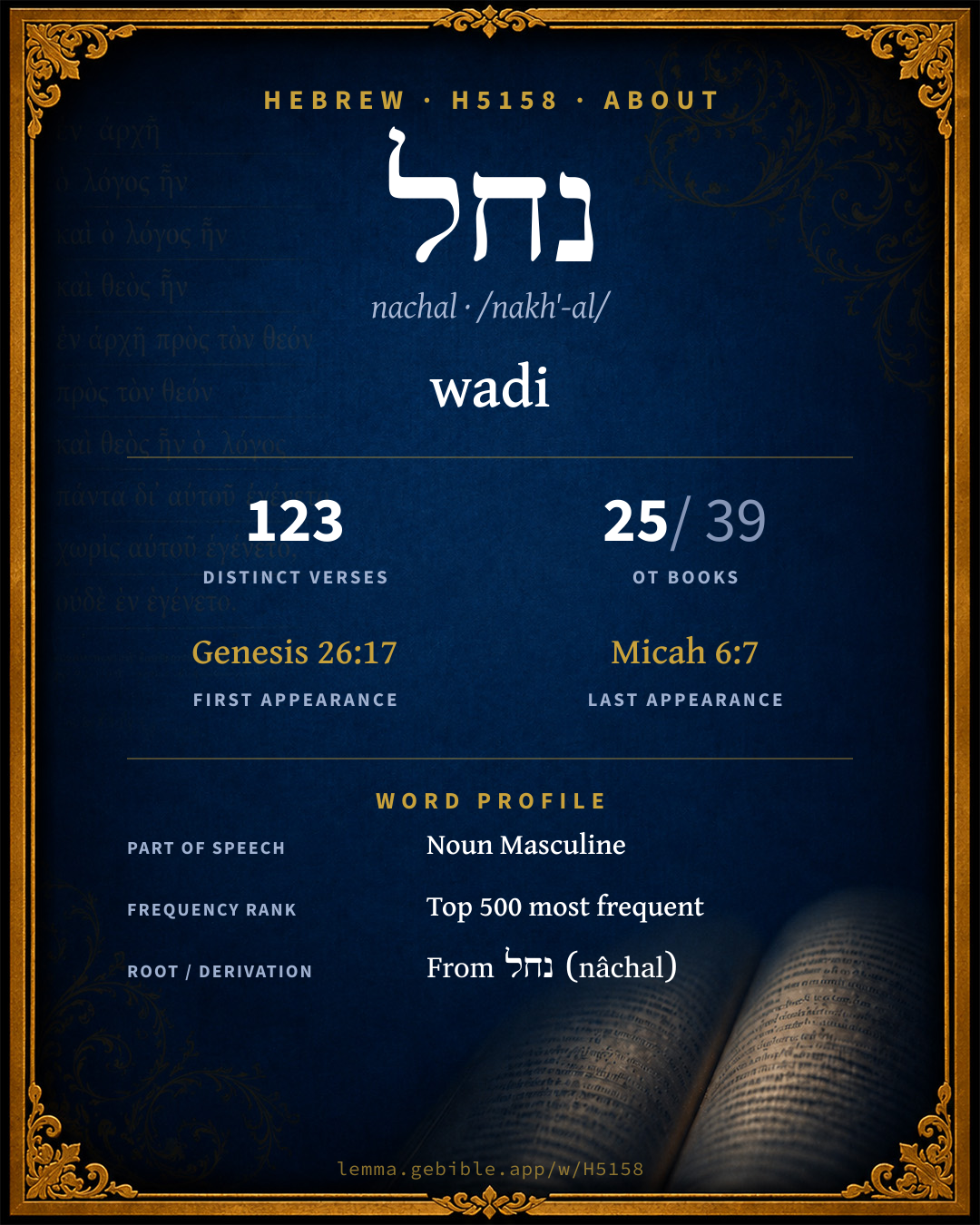
נַ֫חַל
wadi
also: torrent, valley, torrent-valley fuller range ↓
Full lexicon entry — Brown-Driver-Briggs (BDB)
From Brown-Driver-Briggs (BDB)
Where this word appears
See every Construct-state word in the Hebrew Bible →
Grammar key — what these labels mean
Part of speech
- Noun
- A naming word — a person, place, thing, or idea.
Noun type
- Common
- A common noun — a general class of person, place, or thing (“king,” “city,” “water”), not a specific name.
- Proper
- A name of a specific person, place, or people (e.g. Abraham, Zion, Israel).
State
- Construct
- A noun bound to a following noun in a possessive / “of” relationship (the construct chain).
- Absolute
- The independent form of a noun, not bound to a following word.
Gender
- Masculine
- Grammatically masculine.
Number
- Singular
- One.
- Plural
- More than one (in Hebrew, generally three or more).
- Dual
- Exactly two — for natural pairs and some measures of time.
Grammatical forms
- Noun, Common, Masculine, Singular, Construct 58 times (41%)
- Noun, Common, Masculine, Singular, Absolute 53 times (38%)
- Noun, Common, Masculine, Plural, Absolute 16 times (11%)
- Noun, Common, Masculine, Plural, Construct 11 times (8%)
- Noun, Proper 2 times (1%)
- Noun, Common, Masculine, Dual, Absolute 1 time (1%)
Parsed forms decoded from the imported morphology (morphhb / Westminster Leningrad Codex — WLC text public domain, morphhb tagging CC BY 4.0), counted across 141 parsed occurrences — not distinct verses.
Every verse where H5158 appears — 123 distinct verses across 25 books. Click any verse to open its interlinear word-by-word view. Verse text shown in the World English Bible for context — . Each verse’s Hebrew form is shown with its reference; the English is not keyword-highlighted, since the data carries no word-level English alignment. Use “Compare translations” on any verse to read it across multiple English versions. This concordance covers the Hebrew Bible; Septuagint (Greek Old Testament) occurrences are not indexed here.
Genesis 3 verses
- Genesis 26:17 בְּ/נַֽחַל prep + n c ms cs Isaac departed from there, encamped in the valley of Gerar, and lived there.
- Genesis 26:19 בַּ/נָּ֑חַל prep det + n c ms Isaac's servants dug in the valley, and found there a well of springing water.
- Genesis 32:23 הַ/נָּ֑חַל ptcl def.art + n c ms He took them, and sent them over the stream, and sent over that which he had.
Leviticus 3 verses
- Leviticus 11:9 וּ/בַ/נְּחָלִ֖ים conj + prep det + n c mp These you may eat of all that are in the waters: whatever has fins and scales in the waters, in the seas, and in the rivers, that you may eat.
- Leviticus 11:10 וּ/בַ/נְּחָלִ֔ים conj + prep det + n c mp All that don't have fins and scales in the seas, and in the rivers, of all that move in the waters, and of all the living creatures that are in the waters, they are an abomination to you,
- Leviticus 23:40 נָ֑חַל n c ms You shall take on the first day the fruit of goodly trees, branches of palm trees, and boughs of thick trees, and willows of the brook; and you shall rejoice before Yahweh your God seven days.
Numbers 8 verses
- Numbers 13:23 נַ֣חַל n c ms cs They came to the valley of Eshcol, and cut down from there a branch with one cluster of grapes, and they bore it on a staff between two; [they brought] also of the pomegranates, and of the figs.
- Numbers 13:24 נַ֣חַל n c ms cs That place was called the valley of Eshcol, because of the cluster which the children of Israel cut down from there.
- Numbers 21:12 בְּ/נַ֥חַל prep + n c ms cs From there they traveled, and encamped in the valley of Zered.
- Numbers 21:14 הַ/נְּחָלִ֖ים ptcl def.art + n c mp Therefore it is said in the book of the Wars of Yahweh, Vaheb in Suphah, The valleys of the Arnon,
- Numbers 21:15 הַ/נְּחָלִ֔ים ptcl def.art + n c mp The slope of the valleys That inclines toward the dwelling of Ar, Leans on the border of Moab.
- Numbers 24:6 כִּ/נְחָלִ֣ים prep + n c mp As valleys are they spread forth, As gardens by the river-side, As lign-aloes which Yahweh has planted, As cedar trees beside the waters.
- Numbers 32:9 נַ֣חַל n c ms cs For when they went up to the valley of Eshcol, and saw the land, they discouraged the heart of the children of Israel, that they should not go into the land which Yahweh had given them.
- Numbers 34:5 נַ֣חְלָ/ה n c ms cs + sfx h and the border shall turn about from Azmon to the brook of Egypt, and the goings out of it shall be at the sea.
Deuteronomy 15 verses
- Deuteronomy 1:24 נַ֣חַל n c ms cs and they turned and went up into the hill-country, and came to the valley of Eshcol, and spied it out.
- Deuteronomy 2:13 נַ֣חַל נַ֥חַל n c ms cs n c ms cs Now rise up, and get you over the brook Zered. We went over the brook Zered.
- Deuteronomy 2:14 נַ֣חַל n c ms cs The days in which we came from Kadesh-barnea, until we were come over the brook Zered, were thirty-eight years; until all the generation of the men of war were consumed from the midst of the camp, as Yahweh swore to them.
- Deuteronomy 2:24 נַ֣חַל n c ms cs Rise up, take your journey, and pass over the valley of the Arnon: behold, I have given into your hand Sihon the Amorite, king of Heshbon, and his land; begin to possess it, and contend with him in battle.
- Deuteronomy 2:36 נַ֨חַל בַּ/נַּ֨חַל֙ n c ms cs prep det + n c ms From Aroer, which is on the edge of the valley of the Arnon, and [from] the city that is in the valley, even to Gilead, there was not a city too high for us; Yahweh our God delivered up all before us:
- Deuteronomy 2:37 נַ֤חַל n c ms cs only to the land of the children of Ammon you didn't come near; all the side of the river Jabbok, and the cities of the hill-country, and wherever Yahweh our God forbade us.
- Deuteronomy 3:8 מִ/נַּ֥חַל prep + n c ms cs We took the land at that time out of the hand of the two kings of the Amorites who were beyond the Jordan, from the valley of the Arnon to Mount Hermon;
- Deuteronomy 3:12 נַ֣חַל n c ms cs This land we took in possession at that time: from Aroer, which is by the valley of the Arnon, and half the hill-country of Gilead, and the cities of it, gave I to the Reubenites and to the Gadites:
- Deuteronomy 3:16 נַ֣חַל הַ/נַּ֖חַל הַ/נַּ֔חַל n c ms cs ptcl def.art + n c ms ptcl def.art + n c ms To the Reubenites and to the Gadites I gave from Gilead even to the valley of the Arnon, the middle of the valley, and the border [of it], even to the river Jabbok, which is the border of the children of Ammon;
- Deuteronomy 4:48 נַ֧חַל n c ms cs from Aroer, which is on the edge of the valley of the Arnon, even to Mount Sion (the same is Hermon),
- Deuteronomy 8:7 נַ֣חֲלֵי n c mp cs For Yahweh your God brings you into a good land, a land of brooks of water, of springs and springs, flowing forth in valleys and hills;
- Deuteronomy 9:21 הַ/נַּ֖חַל ptcl def.art + n c ms I took your sin, the calf which you had made, and burnt it with fire, and stamped it, grinding it very small, until it was as fine as dust: and I cast the dust of it into the brook that descended out of the mountain.
- Deuteronomy 10:7 נַ֥חֲלֵי n c mp cs From there they traveled to Gudgodah; and from Gudgodah to Jotbathah, a land of brooks of water.
- Deuteronomy 21:4 נַ֣חַל בַּ/נָּֽחַל n c ms prep det + n c ms and the elders of that city shall bring down the heifer to a valley with running water, which is neither plowed nor sown, and shall break the heifer's neck there in the valley.
- Deuteronomy 21:6 בַ/נָּֽחַל prep det + n c ms All the elders of that city, who are nearest to the slain man, shall wash their hands over the heifer whose neck was broken in the valley;
Joshua 10 verses
- Joshua 12:1 מִ/נַּ֤חַל prep + n c ms cs Now these are the kings of the land, whom the children of Israel struck, and possessed their land beyond the Jordan toward the sunrise, from the valley of the Arnon to Mount Hermon, and all the Arabah eastward:
- Joshua 12:2 נַ֨חַל הַ/נַּ֨חַל֙ הַ/נַּ֔חַל n c ms cs ptcl def.art + n c ms ptcl def.art + n c ms Sihon king of the Amorites, who lived in Heshbon, and ruled from Aroer, which is on the edge of the valley of the Arnon, and [the city that is in] the middle of the valley, and half Gilead, even to the river Jabbok, the border of the children of Ammon;
- Joshua 13:9 נַ֨חַל הַ/נַּ֛חַל n c ms cs ptcl def.art + n c ms from Aroer, that is on the edge of the valley of the Arnon, and the city that is in the middle of the valley, and all the plain of Medeba to Dibon;
- Joshua 13:16 נַ֨חַל הַ/נַּ֛חַל n c ms cs ptcl def.art + n c ms Their border was from Aroer, that is on the edge of the valley of the Arnon, and the city that is in the middle of the valley, and all the plain by Medeba;
- Joshua 15:4 נַ֣חַל n c ms cs and it passed along to Azmon, and went out at the brook of Egypt; and the goings out of the border were at the sea: this shall be your south border.
- Joshua 15:7 לַ/נָּ֑חַל prep det + n c ms and the border went up to Debir from the valley of Achor, and so northward, looking toward Gilgal, that is over against the ascent of Adummim, which is on the south side of the river; and the border passed along to the waters of En Shemesh, and the goings out of it were at En Rogel;
- Joshua 15:47 נַ֣חַל n c ms cs Ashdod, its towns and its villages; Gaza, its towns and its villages; to the brook of Egypt, and the great sea, and the border [of it].
- Joshua 16:8 נַ֣חַל n c ms cs From Tappuah the border went along westward to the brook of Kanah; and the goings out of it were at the sea. This is the inheritance of the tribe of the children of Ephraim according to their families;
- Joshua 17:9 נַ֨חַל לַ/נַּ֗חַל לַ/נַּ֔חַל n c ms cs prep det + n c ms prep det + n c ms The border went down to the brook of Kanah, southward of the brook: these cities belonged to Ephraim among the cities of Manasseh: and the border of Manasseh was on the north side of the brook, and the goings out of it were at the sea:
- Joshua 19:11 הַ/נַּ֔חַל ptcl def.art + n c ms and their border went up westward, even to Maralah, and reached to Dabbesheth; and it reached to the brook that is before Jokneam;
Judges 4 verses
- Judges 4:7 נַ֣חַל n c ms cs I will draw to you, to the river Kishon, Sisera, the captain of Jabin's army, with his chariots and his multitude; and I will deliver him into your hand.
- Judges 4:13 נַ֥חַל n c ms cs Sisera gathered together all his chariots, even nine hundred chariots of iron, and all the people who were with him, from Harosheth of the Gentiles, to the river Kishon.
- Judges 5:21 נַ֤חַל נַ֥חַל נַ֣חַל n c ms cs n c ms cs n c ms cs The river Kishon swept them away, That ancient river, the river Kishon. My soul, march on with strength.
- Judges 16:4 בְּ/נַ֣חַל prep + n c ms cs It came to pass afterward, that he loved a woman in the valley of Sorek, whose name was Delilah.
1 Samuel 5 verses
- 1 Samuel 15:5 בַּ/נָּֽחַל prep det + n c ms Saul came to the city of Amalek, and laid wait in the valley.
- 1 Samuel 17:40 הַ/נַּ֡חַל ptcl def.art + n c ms He took his staff in his hand, and chose him five smooth stones out of the brook, and put them in the shepherd's bag which he had, even in his wallet; and his sling was in his hand: and he drew near to the Philistine.
- 1 Samuel 30:9 נַ֣חַל n c ms cs So David went, he and the six hundred men who were with him, and came to the brook Besor, where those who were left behind stayed.
- 1 Samuel 30:10 נַ֥חַל n c ms cs But David pursued, he and four hundred men; for two hundred stayed behind, who were so faint that they couldn't go over the brook Besor.
- 1 Samuel 30:21 בְּ/נַ֣חַל prep + n c ms cs David came to the two hundred men, who were so faint that they could not follow David, whom also they had made to abide at the brook Besor; and they went forth to meet David, and to meet the people who were with him: and when David came near to the people, he greeted them.
2 Samuel 5 verses
- 2 Samuel 15:23 בְּ/נַ֣חַל prep + n c ms cs All the country wept with a loud voice, and all the people passed over: the king also himself passed over the brook Kidron, and all the people passed over, toward the way of the wilderness.
- 2 Samuel 17:13 הַ/נַּ֔חַל ptcl def.art + n c ms Moreover, if he be gotten into a city, then shall all Israel bring ropes to that city, and we will draw it into the river, until there not be one small stone found there.
- 2 Samuel 22:5 נַחֲלֵ֥י n c mp cs For the waves of death compassed me; The floods of ungodliness made me afraid:
- 2 Samuel 23:30 מִ/נַּ֥חֲלֵי prep + n c mp cs Benaiah a Pirathonite, Hiddai of the brooks of Gaash.
- 2 Samuel 24:5 הַ/נַּ֥חַל ptcl def.art + n c ms They passed over the Jordan, and encamped in Aroer, on the right side of the city that is in the middle of the valley of Gad, and to Jazer:
1 Kings 10 verses
- 1 Kings 2:37 נַ֣חַל n c ms cs For on the day you go out, and pass over the brook Kidron, know you for certain that you shall surely die: your blood shall be on your own head.
- 1 Kings 8:65 נַ֣חַל n c ms cs So Solomon held the feast at that time, and all Israel with him, a great assembly, from the entrance of Hamath to the brook of Egypt, before Yahweh our God, seven days and seven days, even fourteen days.
- 1 Kings 15:13 בְּ/נַ֥חַל prep + n c ms cs Also Maacah his mother he removed from being queen, because she had made an abominable image for an Asherah; and Asa cut down her image, and burnt it at the brook Kidron.
- 1 Kings 17:3 בְּ/נַ֣חַל prep + n c ms cs Get you hence, and turn you eastward, and hide yourself by the brook Cherith, that is before the Jordan.
- 1 Kings 17:4 מֵ/הַ/נַּ֣חַל prep + ptcl def.art + n c ms It shall be, that you shall drink of the brook; and I have commanded the ravens to feed you there.
- 1 Kings 17:5 בְּ/נַ֣חַל prep + n c ms cs So he went and did according to the word of Yahweh; for he went and lived by the brook Cherith, that is before the Jordan.
- 1 Kings 17:6 הַ/נַּ֖חַל ptcl def.art + n c ms The ravens brought him bread and flesh in the morning, and bread and flesh in the evening; and he drank of the brook.
- 1 Kings 17:7 הַ/נָּ֑חַל ptcl def.art + n c ms It happened after a while, that the brook dried up, because there was no rain in the land.
- 1 Kings 18:5 הַ/נְּחָלִ֑ים ptcl def.art + n c mp Ahab said to Obadiah, Go through the land, to all the springs of water, and to all the brooks: peradventure we may find grass and save the horses and mules alive, that we not lose all the animals.
- 1 Kings 18:40 נַ֣חַל n c ms cs and Elijah said to them, Take the prophets of Baal; don't let one of them escape. They took them; and Elijah brought them down to the brook Kishon, and killed them there.
2 Kings 6 verses
- 2 Kings 3:16 הַ/נַּ֥חַל ptcl def.art + n c ms He said, Thus says Yahweh, Make this valley full of trenches.
- 2 Kings 3:17 וְ/הַ/נַּ֥חַל conj + ptcl def.art + n c ms For thus says Yahweh, You shall not see wind, neither shall you see rain; yet that valley shall be filled with water, and you shall drink, both you and your cattle and your animals.
- 2 Kings 10:33 נַ֣חַל n c ms cs from the Jordan eastward, all the land of Gilead, the Gadites, and the Reubenites, and the Manassites, from Aroer, which is by the valley of the Arnon, even Gilead and Bashan.
- 2 Kings 23:6 נַ֣חַל בְּ/נַ֥חַל n c ms cs prep + n c ms cs He brought out the Asherah from the house of Yahweh, outside of Jerusalem, to the brook Kidron, and burned it at the brook Kidron, and beat it to dust, and cast the dust of it on the graves of the common people.
- 2 Kings 23:12 נַ֥חַל n c ms cs The altars that were on the roof of the upper chamber of Ahaz, which the kings of Judah had made, and the altars which Manasseh had made in the two courts of the house of Yahweh, did the king break down, and beat [them] down from there, and cast the dust of them into the brook Kidron.
- 2 Kings 24:7 מִ/נַּ֤חַל prep + n c ms cs The king of Egypt didn't come again out of his land any more; for the king of Babylon had taken, from the brook of Egypt to the river Euphrates, all that pertained to the king of Egypt.
1 Chronicles 1 verse
2 Chronicles 7 verses
- 2 Chronicles 7:8 נַ֥חַל n c ms cs So Solomon held the feast at that time seven days, and all Israel with him, a very great assembly, from the entrance of Hamath to the brook of Egypt.
- 2 Chronicles 15:16 בְּ/נַ֥חַל prep + n c ms cs Also Maacah, the mother of Asa the king, he removed from being queen, because she had made an abominable image for an Asherah; and Asa cut down her image, and made dust of it, and burnt it at the brook Kidron.
- 2 Chronicles 20:16 הַ/נַּ֔חַל ptcl def.art + n c ms Tomorrow go you down against them: behold, they come up by the ascent of Ziz; and you shall find them at the end of the valley, before the wilderness of Jeruel.
- 2 Chronicles 29:16 לְ/נַֽחַל prep + n c ms cs The priests went in to the inner part of the house of Yahweh, to cleanse it, and brought out all the uncleanness that they found in the temple of Yahweh into the court of the house of Yahweh. The Levites took it, to carry it out abroad to the brook Kidron.
- 2 Chronicles 30:14 לְ/נַ֥חַל prep + n c ms cs They arose and took away the altars that were in Jerusalem, and all the altars for incense took they away, and cast them into the brook Kidron.
- 2 Chronicles 32:4 הַ/נַּ֛חַל ptcl def.art + n c ms So there was gathered much people together, and they stopped all the springs, and the brook that flowed through the midst of the land, saying, Why should the kings of Assyria come, and find much water?
- 2 Chronicles 33:14 בַּ/נַּ֜חַל prep det + n c ms Now after this he built an outer wall to the city of David, on the west side of Gihon, in the valley, even to the entrance at the fish gate; and he compassed Ophel about [with it], and raised it up to a very great height: and he put valiant captains in all the fortified cities of Judah.
Nehemiah 1 verse
Job 7 verses
- Job 6:15 נָ֑חַל נְחָלִ֣ים n c ms n c mp My brothers have dealt deceitfully as a brook, As the channel of brooks that pass away;
- Job 20:17 נַ֝חֲלֵ֗י n c mp cs He shall not look at the rivers, The flowing streams of honey and butter.
- Job 21:33 נָ֥חַל n c ms The clods of the valley shall be sweet to him. All men shall draw after him, As there were innumerable before him.
- Job 22:24 נְחָלִ֣ים n c mp Lay your treasure in the dust, The gold of Ophir among the stones of the brooks.
- Job 28:4 נַ֨חַל n c ms He breaks open a shaft away from where people live. They are forgotten by the foot. They hang far from men, they swing back and forth.
- Job 30:6 נְחָלִ֣ים n c mp So that they dwell in frightful valleys, And in holes of the earth and of the rocks.
- Job 40:22 נָֽחַל n c ms The lotuses cover him with their shade. The willows of the brook surround him.
Psalms 8 verses
- Psalms 18:4 וְֽ/נַחֲלֵ֖י conj + n c mp cs The cords of death surrounded me. The floods of ungodliness made me afraid.
- Psalms 36:8 וְ/נַ֖חַל conj + n c ms cs They shall be abundantly satisfied with the abundance of your house. You will make them drink of the river of your pleasures.
- Psalms 74:15 וָ/נָ֑חַל conj + n c ms You opened up spring and stream. You dried up mighty rivers.
- Psalms 78:20 וּ/נְחָלִ֪ים conj + n c mp Behold, he struck the rock, so that waters gushed out, Streams overflowed. Can he give bread also? Will he provide flesh for his people?"
- Psalms 83:9 בְּ/נַ֣חַל prep + n c ms cs Do to them as you did to Midian, As to Sisera, as to Jabin, at the river Kishon;
- Psalms 104:10 בַּ/נְּחָלִ֑ים prep det + n c mp He sends forth springs into the valleys. They run among the mountains.
- Psalms 110:7 מִ֭/נַּחַל prep + n c ms He will drink of the brook in the way; Therefore he will lift up his head.
- Psalms 124:4 נַ֗֜חְלָ/ה n c ms + sfx h Then the waters would have overwhelmed us, The stream would have gone over our soul;
Proverbs 2 verses
Ecclesiastes 1 verse
Song of Solomon 1 verse
Isaiah 11 verses
- Isaiah 7:19 בְּ/נַחֲלֵ֣י prep + n c mp cs They shall come, and shall all rest in the desolate valleys, in the clefts of the rocks, on all thorn-hedges, and on all pastures.
- Isaiah 11:15 נְחָלִ֔ים n c mp Yahweh will utterly destroy the tongue of the Egyptian sea; and with his scorching wind will he wave his hand over the River, and will strike it into seven streams, and cause men to march over in sandals.
- Isaiah 15:7 נַ֥חַל n c ms cs Therefore the abundance they have gotten, and that which they have laid up, shall they carry away over the brook of the willows.
- Isaiah 27:12 נַ֣חַל n c ms cs It shall happen in that day, that Yahweh will beat off [his fruit] from the flood of the River to the brook of Egypt; and you shall be gathered one by one, you children of Israel.
- Isaiah 30:28 כְּ/נַ֤חַל prep + n c ms and his breath is as an overflowing stream, that reaches even to the neck, to sift the nations with the sieve of destruction: and a bridle that causes to err [shall be] in the jaws of the peoples.
- Isaiah 30:33 כְּ/נַ֣חַל prep + n c ms cs For a Topheth is prepared of old; yes, for the king it is made ready; he has made it deep and large; the pile of it is fire and much wood; the breath of Yahweh, like a stream of sulfur, does kindle it.
- Isaiah 34:9 נְחָלֶ֨י/הָ֙ n c mp cs + sfx pers 3fs The streams of [Edom] shall be turned into pitch, and the dust of it into sulfur, and the land of it shall become burning pitch.
- Isaiah 35:6 וּ/נְחָלִ֖ים conj + n c mp Then shall the lame man leap as a hart, and the tongue of the mute shall sing; for in the wilderness shall waters break out, and streams in the desert.
- Isaiah 57:5 בַּ/נְּחָלִ֔ים prep det + n c mp you who inflame yourselves among the oaks, under every green tree; who kill the children in the valleys, under the clefts of the rocks?
- Isaiah 57:6 נַ֣חַל n c ms Among the smooth [stones] of the valley is your portion; they, they are your lot; even to them have you poured a drink-offering, you have offered an offering. Shall I be appeased for these things?
- Isaiah 66:12 וּ/כְ/נַ֧חַל conj + prep + n c ms For thus says Yahweh, Behold, I will extend peace to her like a river, and the glory of the nations like an overflowing stream: and you shall suck [of it]; you shall be borne on the side, and shall be dandled on the knees.
Jeremiah 3 verses
- Jeremiah 31:9 נַ֣חֲלֵי n c mp cs They shall come with weeping; and with petitions will I lead them: I will cause them to walk by rivers of waters, in a straight way in which they shall not stumble; for I am a father to Israel, and Ephraim is my firstborn.
- Jeremiah 31:40 נַ֨חַל n c ms cs The whole valley of the dead bodies and of the ashes, and all the fields to the brook Kidron, to the corner of the horse gate toward the east, shall be holy to Yahweh; it shall not be plucked up, nor thrown down any more forever.
- Jeremiah 47:2 לְ/נַ֣חַל prep + n c ms Thus says Yahweh: Behold, waters rise up out of the north, and shall become an overflowing stream, and shall overflow the land and all that is therein, the city and those who dwell therein; and the men shall cry, and all the inhabitants of the land shall wail.
Lamentations 1 verse
Ezekiel 7 verses
- Ezekiel 47:5 נַ֕חַל נַ֖חַל n c ms n c ms Afterward he measured one thousand; [and it was] a river that I could not pass through; for the waters were risen, waters to swim in, a river that could not be passed through.
- Ezekiel 47:6 הַ/נָּֽחַל ptcl def.art + n c ms He said to me, Son of man, have you seen [this]? Then he brought me, and caused me to return to the bank of the river.
- Ezekiel 47:7 הַ/נַּ֔חַל ptcl def.art + n c ms Now when I had returned, behold, on the bank of the river were very many trees on the one side and on the other.
- Ezekiel 47:9 נַחֲלַ֨יִם֙ הַ/נָּֽחַל n c md ptcl def.art + n c ms It shall happen, that every living creature which swarms, in every place where the rivers come, shall live; and there shall be a very great multitude of fish; for these waters are come there, and [the waters of the sea] shall be healed, and everything shall live wherever the river comes.
- Ezekiel 47:12 הַ/נַּ֣חַל ptcl def.art + n c ms By the river on the bank of it, on this side and on that side, shall grow every tree for food, whose leaf shall not wither, neither shall the fruit of it fail: it shall bring forth new fruit every month, because the waters of it issue out of the sanctuary; and the fruit of it shall be for food, and the leaf of it for healing.
- Ezekiel 47:19 נַחֲלָ֖ה n Proper The south side southward shall be from Tamar as far as the waters of Meriboth Kadesh, to the brook [of Egypt], to the great sea. This is the south side southward.
- Ezekiel 48:28 נַחֲלָ֖ה n Proper By the border of Gad, at the south side southward, the border shall be even from Tamar to the waters of Meribath Kadesh, to the brook [of Egypt], to the great sea.
Joel 1 verse
Amos 2 verses
- Amos 5:24 כְּ/נַ֥חַל prep + n c ms But let justice roll on like rivers, And righteousness like a mighty stream.
- Amos 6:14 נַ֥חַל n c ms cs For, behold, I will raise up against you a nation, house of Israel," Says Yahweh, the God of hosts; "And they will afflict you from the entrance of Hamath to the brook of the Arabah."
Micah 1 verse
About this entry
At a glance — auto-summarized from this page’s data, not written by a person. Every figure links to its source below. This summary describes the numbers; it doesn’t interpret them.
נחל (nachal) is a Hebrew noun most often rendered “wadi.” Translators differ — “river” in the King James Version, then “valley” (Berean Standard Bible) and “wadi of” (unfoldingWord Literal Text), as the renderings breakdown shows. It turns up in 123 verses across 25 books, a common footprint. It first appears in Genesis 26:17. It also covers “torrent”, “valley”, and “torrent-valley”, alongside “wadi” — see its full sense range. The sections below give every sense, occurrence, and version rendering.
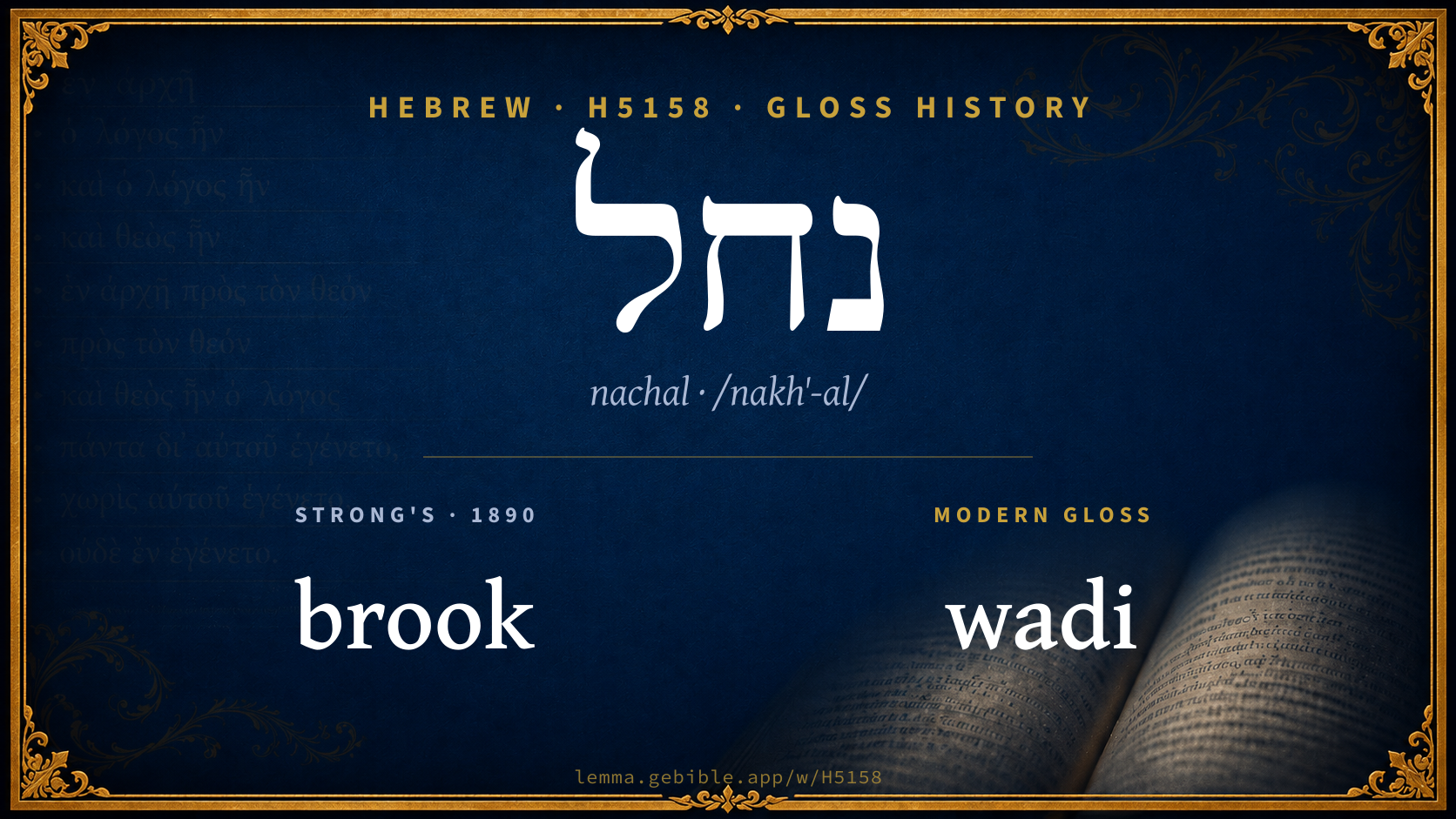
Gloss history
Strong's 1890 vs modern scholarship
About this word
Strong's H5158 catalogs a Hebrew word from the Hebrew Old Testament.
These counts are not copied from any lexicon or concordance. They are computed here, from the morphology-tagged Hebrew Old Testament. What Lemma adds →
- 123
- distinct verses
- The word appears in 123 distinct verses.
- 25 / 39
- OT books
- The word appears in 25 of 39 Old Testament books.
- #318
- by frequency
- Top 500 most frequent Hebrew words (rank 318 of 8,640 Hebrew words by occurrence).
View all 123 occurrences in the concordance →
Most concentrated in
- Deuteronomy 15 verses 12%
- Isaiah 11 verses 9%
- Joshua 10 verses 8%
By section of the Old Testament
By traditional corpus
Conventional, traditional groupings — biblical authorship is debated, so this is a traditional corpus grouping, not an authorship claim. Each share is this word’s portion of its verses in that division of the Hebrew canon. Each figure is a share of the word’s 123 distinct verses.
- Prophets (Nevi'im) 65 verses · 53%
- Torah (Pentateuch) 29 verses · 24%
- Writings (Ketuvim) 29 verses · 24%
How translations render this word
Counts come from each version’s own published word-to-Strong’s tagging or interlinear alignment — an approximate guide to how each version renders this word, not a word-level alignment the data otherwise carries. Because each total is that version’s own tagged count, the per-version totals vary from one another and need not match the appearance or distinct-verse counts above. These counts may also differ from a printed concordance because Lemma counts each distinctly tagged rendering and does not collapse phrase taggings into a single head-word total. This is a fixed set of word-tagged versions (KJV, ASV, BSB, ULT) and does not change with the reading translation you choose elsewhere. Each version’s license is shown beside its name below (and on Sources).
BDB lists this Strong’s number as 3 distinct words (homographs). Each count above pools all of them and is not split by sense — see the Senses section below. A low-frequency rendering may belong to a different one of those words, not the primary meaning.
- King James Version†: River 41×, Brook 35×, Valley 18×
- American Standard Version†: Brook 40×, Valley 32×, River 12×
- Berean Standard Bible†: Valley 49×, Brook 26×, River 16×
- unfoldingWord Literal Text†: Wadi of 31×, Wadi 28×, Valley 10×
King James Version Public Domain
Renders H5158 across 141† tagged occurrences — most commonly:
Plus 12 renderings that appear only once — usually multi-word phrases or single function words the recovered tagging swept in, not distinct renderings.
American Standard Version Public Domain
Renders H5158 across 138† tagged occurrences — most commonly:
Plus 23 renderings that appear only once — usually multi-word phrases or single function words the recovered tagging swept in, not distinct renderings.
Berean Standard Bible Public Domain
Renders H5158 across 138† tagged occurrences — most commonly:
Plus other, less common renderings. Plus 13 renderings that appear only once — usually multi-word phrases or single function words the recovered tagging swept in, not distinct renderings. Not rendered by a distinct English word in 3 further occurrences.
unfoldingWord Literal Text CC BY-SA 4.0
Renders H5158 across 145† tagged occurrences — most commonly:
Plus other, less common renderings. Plus 23 renderings that appear only once — usually multi-word phrases or single function words the recovered tagging swept in, not distinct renderings.
13 senses and sub-senses in the full BDB
What do BDB’s symbols mean?
BDB uses these scholarly abbreviations:
| Symbol | Meaning |
|---|---|
| 𝔊 | the Septuagint (the ancient Greek translation, LXX) |
| 𝔙 | the Vulgate (the Latin translation) |
| 𝔖 | the Syriac version (the Peshitta) |
| 𝔗 | the Targum (the Aramaic translation) |
| ψ | the Psalms |
| √ | root (the underlying root or stem) |
| ‖ | parallel passage (a synonymous or contrasted parallel) |
| † | the dagger: every passage where the word occurs is cited |
The 13 senses and sub-senses the full Brown-Driver-Briggs lexicon distinguishes for this word, in lexicon order (not ranked by frequency), with BDB’s own verbatim wording and sub-sense lettering. Shown in Hebrew script with BDB’s own scholarly abbreviations. The condensed entry is in the Lexicon Entry tab. See also the Forms in the corpus table below.
נחל I possession, property, inheritance (orig. gift
- 1. property:
- a. in Canaan given by י׳ to Israel, †נחלת ישׂראל Ju 20:6; †נ׳ יעקב Is 58:14, especially †אֲשֶׁר נֹתֵן לְךָ נַחֲלָה Dt 4:21; 15:4; 19:10; 20:16; 21:23; 24:4; 25:19; 26:1 (all D); הנחלה אשׁר הנחלתי את עמי Je 12:14. e.g. Judges 20:6
- b. distrib. among tribes: נתן נ׳ לְ Nu 16:14; 36:2 Jos 14:3 (restore לְ), 17:4, 14; 19:49 (all P); נתן לנ׳ לְ Dt 29:7 Jos 11:23; 14:13 (all D2); נָֽחֲלוּ נחלה Jos 17:6 (J); תֵּחָלֵק בנ׳ Nu 26:53, 56 (P); נפל בנחלה Nu 34:2 (P), Ju 18:1 Ez 47:22; הפיל בנ׳ Jos 13:6; 23:4 (D2), Ez 45:1; 47:22, also v 29 (Co reads ב for מ). e.g. Numbers 16:14
- c. nations as possession of the people, ψ 111:6; of the king 2:8. e.g. Psalms 111:6
- d. Levites have no property in the land Nu 18:23, 24 Dt 10:9; 12:12; their possession is י׳ Nu 18:20 (P); י׳ הוּא נחלתו Dt 10:9; 18:2 Jos 13:14, 33 (all D); the tithes Nu 18:21, 24, 26 (P). e.g. Numbers 18:23
- e. †י׳ takes Isr. as his property, 1 S 10:1 1 K 8:53 2 K 21:14 Is 19:25 Mi 7:18 ψ 33:12; 68:10; 106:5; עם נחלה Dt 4:20 (D2); עַמְּךָ וְנַחֲלָֽתְךָ Dt 9:26, 29 (D), 1 K 8:51; ‖ עַם Is 47:6 Jo 2:17; 4:2 Mi 7:14 ψ 28:9; 78:62, 71; 94:5, 14; 106:40; נחלת י׳ 1 S 26:19 2 S 20:19; 21:3; נ׳ אלהים 2 S 14:16; יעקב חבל נ׳ Dt 32:9; שׁבט נ׳ Je 10:16 = 51:19, ψ 74:2; שׁבטי נ׳ Is 63:17; also, the holy mt. Ex 15:17 (song), temple Je 12:7 ψ 79:1, land Je 2:7; 12:8, 9; 16:18; 50:11. e.g. 1 Samuel 10:1
- 2. portion, share:
- a. assigned by God, Is 54:17 ψ 37:18; 127:3; elsewhere ‖ חֵלָק Jb 20:29; 27:13; 31:2. e.g. Isaiah 54:17
- b. by choice, ‖ חֵלֶק, לא נ׳ לנו בבן ישׁי 2 S 20:1 we have no share in the son of Jesse = 1 K 12:16 = 2 Ch 10:16. e.g. 2 Samuel 20:1
- 3. inheritance (45 times) חֵלָק וְנַחֲלָה בְּבֵית אָבִינוּ Gn 31:14 (E) portion or inheritance in the house of our father; העביר נ׳ לְ Nu 27:7, 8 (P) cause the inheritance to pass unto; נתן נ׳ לְ Nu 27:9, 10, 11 (P), Jb 42:15; †נחלת אבוה Nu 36:3, 8 1 K 21:3, 4 Pr 19:14; נ׳ לבניו תהיה Ez 46:16. e.g. Genesis 31:14
נחל II
- 1. torrent, of rushing water in narrow channel Ju 5:21(×3); 4:7, 13 ψ 83:10 (all of קִישֹׁן, q.v.); mountain torrent Dt 9:21 (cf. Ex 32:20); so Am 5:24 (sim. of righteousness); הַנּ׳ הַשּׁוֹטֵף 2 Ch 32:4 (‖ מַעְיָנוֹת); נֶהְפְּכוּ נ׳ לְזֶפֶת Is 34:9; sim. of tears La 2:18; hyperb. נ׳־שָׁ֑מֶן Mi 6:7 torrents of oil, cf. of honey and curd Jb 20:17 (‖ פְּלַגּוֹת, נְהָרִים); fig. נ׳ בְלִיַּעַל 2 S 22:5 torrents of worthlessness (‖ מִשְׁבְּרֵי מָ֫וֶת, = ψ 18:5; נ׳ שׁוֹטֵף sim. of glory of nations Is 66:12, fig. of invaders Je 47:2 (‖ מַיִס), or foes ψ 124:4 (נַ֫חְלָה, v. supr.); 1 K 17:4, 6 (for drinking), drying up in summer v 7 (יָבֵשׁ; all of Elijah’s stream כְּרִית, q.v.); for drinking also ψ 110:7, and (fig.) נ׳ עֲדָנֶיךָ 36:9; Jb 6:15(×2) (אֲפִיק נְחָלִים; in sim.); of water bursting from rock ψ 78:20 (שָׁטַף, ‖ מַיִם), cf. 74:15 (+ מַעְיָן); fig. of מְקוֹר חָכְמָה Pr 18:4 (נ׳ נֹבֵעַ; ‖ מַיִם עֲמֻקִים); more gen. = stream, brook, river (chiefly late) Is 11:15 (divisions of river, נָהָר), in desert 35:6 (‖ מַיִם), Je 31:9 (נַחֲלֵי מַיִם), Ez 47:5(×2), 9b (all del. Co), v 6, 7, 9a (read הַנַּחַל, v. supr.) v 12; containing fish, etc. Lv 11:9, 10 (‖ מַיִם, יַמִּים), Ec 1:7(×2); fig. of רוּחַ י׳ Is 30:28 (נ׳ שׁוֹטֵף), 30:33 (נ׳ גָּפְרִית). e.g. Judges 5:21
- 2. Torrent-valley, wady, as stream-bed 1 S 17:40 Ne 2:15 Is 57:6; with torrent flowing through it, נ׳ אֵיתָן Dt 21:4(×2), 6, אֶרֶץ נַחֲלֵי מַיִם Dt 8:7 (‖ עֲיָנֹת וּתְהֹמֹת יֹצְאִים בַּבִּקְעָה), cf. 10:7, 1 K 18:5 (‖ מַעְיְנֵי הַמַּיִם), ψ 104:10; abode of Elijah 1 K 17:3, 5 (cf. v 4, 6, 7 supr.); עֹרְבֵי נ׳ Pr 30:17 (cf. 1 K 17:4, 6); נ׳ הַבַּתּוֹת Is 7:19 as home of bees; fertile, נ׳ אֶשְׁכֹּל Nu 13:23, 24 (E); אִבֵּי הַנּ׳ Ct 6:11; עַרְבֵי־נ׳ poplars of the wady Lv 23:40 (H), Jb 40:22; נ׳ עֲרָבִים Is 15:7; needing water Gn 26:17 (נ׳ גְּרָר), v 19 (J), cf. 2 K 3:16, 17; place for refuse, ruins, etc. 2 S 17:13; poet. aslso as wild, remote ravine Jb 30:6, cf. בְּצוּר הַנְּחָלִים 22:24; place of child-sacrifice Is 57:5; burial-place Jb 21:33 (רִגְבֵי נ׳).—Nu 24:6 v. ii. נַ֫חַל. Particular wadys designate localities נ׳ קִישׁוֹן 1 K 18:40. אַרִנוֹן Nu 21:14 (E), Dt 2:24, 36(×2); 3:8, 12, 16(×2); 4:48 Jos 12:1, 2(×2), 13:9(×2) (all D), v 16(×2) (P), 2 K 10:33; אֶשְׁכֹּל Nu 32:9 (J), Dt 1:24; בְּשׂוֹר 1 S 30:9, 10, 21; גָּד 2 S 24:5; זֶרֶד Nu 21:12 (E), Dt 2:13(×2), 14; יַבֹּק Gn 32:24 (J), Dt 2:37; 3:16 Jos 12:2 (all D); קִדְרוֹן 2 S 15:23 1 K 2:37; 15:13 2 K 23:6(×2), 12 2 Ch 15:16; 29:16; 30:14 Je 31:40; קָנָה Jos 16:8; 17:9(×3) (all P); שׂוֹרֵק Ju 16:4; נ׳ הַשִּׁטִּים Jo 4:18; נ׳ מִצְרַיִם is SW. limit of Pal. (Assyrian naḫal [mat] Muṣri, DlPar 310 SchrCOT Nu 34:5) Nu 34:5 (P), Jos 15:4 (D), v 47 (P), 1 K 8:65 2 K 24:7 2 Ch 7:8 Is 27:12, + (om. מצרים) Ez 47:19; 48:28 (v. supr.); so read also poss. Am 6:14 (v. עֲרָבָה: usually identified with Wâdy el-Arîsh; on Wkl’s different view, v. reff. sub מִצְרַיִם ad fin.); on identif. of נ׳ Jos 15:7; 19:11 (both P), 2 S 23:30 = 1 Ch 11:32, 2 Ch 20:16; 33:14, v. Comm.; אֶשֶׁד הַנְּחָלִים Nu 21:15, v. אֶשֶׁד. e.g. 1 Samuel 17:40
- 3. Miner’s shaft, פָּרַץ נ׳ Jb 28:4. e.g. Job 28:4
נחל III [m.] perhaps palm-tree (Arabic نَخْلٌ, n. unit. نَخْلَةٌ
Senses from the full Brown-Driver-Briggs lexicon (Brown, Driver, Briggs; Oxford 1906 — public domain), digitized via Sefaria, supplemented by the OpenScriptures HebrewLexicon (CC BY 4.0). Full attribution on Sources.
Word origin
I. n.f. possession, property, inheritance (orig. gift; NH = BH);—נ׳ Nu 18:23 +; נַחֲלָת ψ 16:6 (Ges§ 80 g), read נַחֲלָתִי Ew SS We Köii 1, 425; cstr. נַחֲלַת Jos 13:23; sf. נַחֲלָתִי Ru 4:6; נַחֲלַתְכֶם ψ 105:11; pl. נְחָלוֹת Is 49:8, נְחָלֹת Jos 19:51;—
I. n.m. 2 K 3:16 torrent, torrent-valley, wady (Ecclus 40:13, 16; NH id.; stream (rare); 𝔗 נַחְלָא, Syriac ܢܰܚܠܴܐ = BH; Assyrian naḫlu = BH; LagBN 140 Anm. thinks Νεῖλος may be from Νεέλ = נַחַל pronounced נִחִל; on נ׳ in Sab. n.pr.loc., v. HalRev. Sémit. iv. (1896), 80, 1. 14);—abs. נ׳ Gn 32:24 +, נַ֫חְלָה ψ 124;4; cstr. נַהַל Gn 26:17 +; c. ה loc. Nu 34:5; so read also Ez 47:19; 48:28 (where MT נַחֲלָ֫ה; v. Thes); du. נַחֲלַיִם Ez 47:9, but read הַנַּחַל 𝔊 𝔗 𝔖 𝔙 Co Berthol; pl. נְחָלִים Nu 21:4 +; נַחֲלֵי Dt 8:7 +; sf. נְחָלֶיהָ Is 34:9;—
II. n.[m.] perhaps palm-tree (Arabic نَخْلٌ, n. unit. نَخْلَةٌ; v. PerlesJQ, July, 1899, 688);— only pl. abs., כִּנְחָלִים נִטָּ֑יוּ Nu 24:6 like palm-trees, which are stretched out, spread out (as to foliage). So Perlesl.c., who compares כערבי נחל Ecclus 50:12, 𝔊 ὡς στελέχη φοινίκων.
— Brown-Driver-Briggs (Oxford 1906, public domain), digitized via Sefaria, supplemented by the OpenScriptures HebrewLexicon (CC BY 4.0). See Sources.
Derived from נחל (nâchal) (H5157) — to inherit.
Jastrow Dictionary
A second Hebrew/Aramaic lexicon for comparison, covering Aramaic and post-biblical (Talmudic, Targumic, Midrashic) usage that the biblical-Hebrew BDB does not. Matched by lemma rather than by Strong’s number, so a lemma may carry more than one Jastrow headword (shown separately below), and the entries cover usage well beyond the Bible.
נַחַל
- wady, river-bed, ravine, stream. Sabb. 56ᵇ (ref. to I Sam. XV, 5) על עסקי נ׳ (he was discussing) the subject of naḥal (Deut. XXI, 4), i.e. the regard due to human lives. Cant. R. to I, 2 עד שנעשה כנ׳ נובע until he (through his erudition) becomes like a bubbling stream; a. e.—Pl. נְחָלִים, נְחָלִין. Ib. מה מים … ונעשין נ׳ נ׳ as waters come down in drops and grow to be torrents; Midr. Till. to Ps. I. Ber. 1Ber. 16ᵃ (ref. to Num. XXIV, 6) מה נ׳ … אף אהלים וכ׳ as the waters of streams raise man from uncleanness to cleanness, so do the tents (of learning) &c.; a. fr. e.g. 1 Samuel 15:5
נַחַל ²
- Targ. Gen. XXVI, 19. Targ. Num. XIII, 24. Targ. Ps. LXXIV, 15; a. fr.—[Targ. Is. XXXVIII, 12 נְחַל, v. נְוַול III.]—Pl. נַחֲלִין, נַחֲלַיָּא, נַחֲלֵי. Targ. Deut. VIII, 7. Targ. Koh. I, 7. Targ. Prov. VIII, 26 (h. text חוצות); a. e.
נָחַל
- , q. v.) to inherit. B. Bath. VIII, 1 יש נוֹחֲלִין ומַנְחִילִין there are such relations as inherit from and eventually transmit to one another (e. g. father and son); ויש נוחלין ולא מנחילין and some inherit, but (when they die) do not transmit their estate to those whose natural heirs they would have been (e. g. son and mother). Kidd. I, 10 ונוֹחֵל את הארץ and shall inherit the land (of life everlasting). Sifré Num. 133 יודע … שהבנות נוֹחֲלוֹת Moses knew that daughters (in the absence of sons) are legal heirs. Midr. Till. to Ps. V, beg. (ref. to Num. XXI, 19) משנָחֲלוּ ע"ז בא עליהם וכ׳ when they adopted idolatry, the angel of death came upon them. Ib. נחלו להק"בה לאלוה והוא נ׳ וכ׳ they adopted the Lord as God, and he adopted them as a people; ib. ממתנה נָחַלְתִּי לאל through the gift (of the well in the desert) I adopted God; מתוך שנתן לי הקב"ה הבאר נחלתי אותו (ed. Bub.) because the Lord gave me the well as a gift, I adopted him; Erub. 54ᵃ וכיון שניתנה לו במתנה נְחָלוֹ אל and since it (the Law) is given him as a gift, the Lord claims him as his own; a. fr. e.g. Numbers 21:19
- to transmit by legal succession; to give in possession. B. Bath. l. c., v. supra. Tosef. B. Mets. XI, 32, a. fr. שעל מנת כן ה׳ וכ׳ for Joshua gave possession of the land with such provisions (restricting the rights of ownership). Ukts. III, 12 עתיד הקב"ה להַנְחִיל וכ׳ (Snh. 100ᵃ ליתן) the Lord will in the hereafter give every righteous man possession of &c. B. Bath. 114ᵇ אין הבן יורש את אמו בקבר להנחיל וכ׳ a son in the grave does not succeed his mother so as to transmit his estate to his paternal brothers; a. fr.
A Dictionary of the Targumim, the Talmud Babli and Yerushalmi, and the Midrashic Literature (Marcus Jastrow; London, Luzac, 1903) — Public Domain. Digitized via Sefaria. Digitized via Sefaria. Full attribution on Sources.
Forms in the corpus
The 75 distinct written forms H5158 takes in the Hebrew Bible, most frequent first — each parse links to that state’s occurrences in the concordance. Hebrew forms include their vowel points and cantillation, so a single lemma takes many written forms.
The 60 most common forms are shown; 15 rarer forms follow in the full concordance.
Same root — word family
Other BDB entries built from the same root as H5158, grouped by Strong’s listed origin. These share a root / origin per the lexicon — not necessarily a shared meaning. Each links to that word’s own entry.
Derives from
Shares the same root
Proper names from this root
People and places named from this root — a name, not an additional meaning of the word.
Compare all same-root words → 1 of the same-root words is a proper name (a person or place). They share a root, not necessarily a meaning.
Septuagint verse parallels
This word appears in 118 verses that also exist in the Greek Old Testament (Septuagint), out of the 123 Hebrew verses it occurs in. You can read those verses in Greek by switching the Old Testament edition to the Septuagint.
Read these verses in the Septuagint
- Genesis 26:17
- Leviticus 11:9
- Numbers 13:23
- Deuteronomy 1:24
- Joshua 12:1
- Judges 4:7
- 1 Samuel 15:5
- 2 Samuel 15:23
- 1 Kings 2:37
- 2 Kings 3:16
- 1 Chronicles 11:32
- 2 Chronicles 7:8
This is a verse-level parallel only — the same verses exist in both the Hebrew and Greek Old Testaments. No word-level Hebrew↔Greek correspondence is claimed: the data carries no such alignment, so no Greek word is shown as this Hebrew word’s translation. Coverage is not total — the Septuagint omits the deuterocanon and renumbers the Psalms, so some Hebrew verses have no direct Greek parallel.