
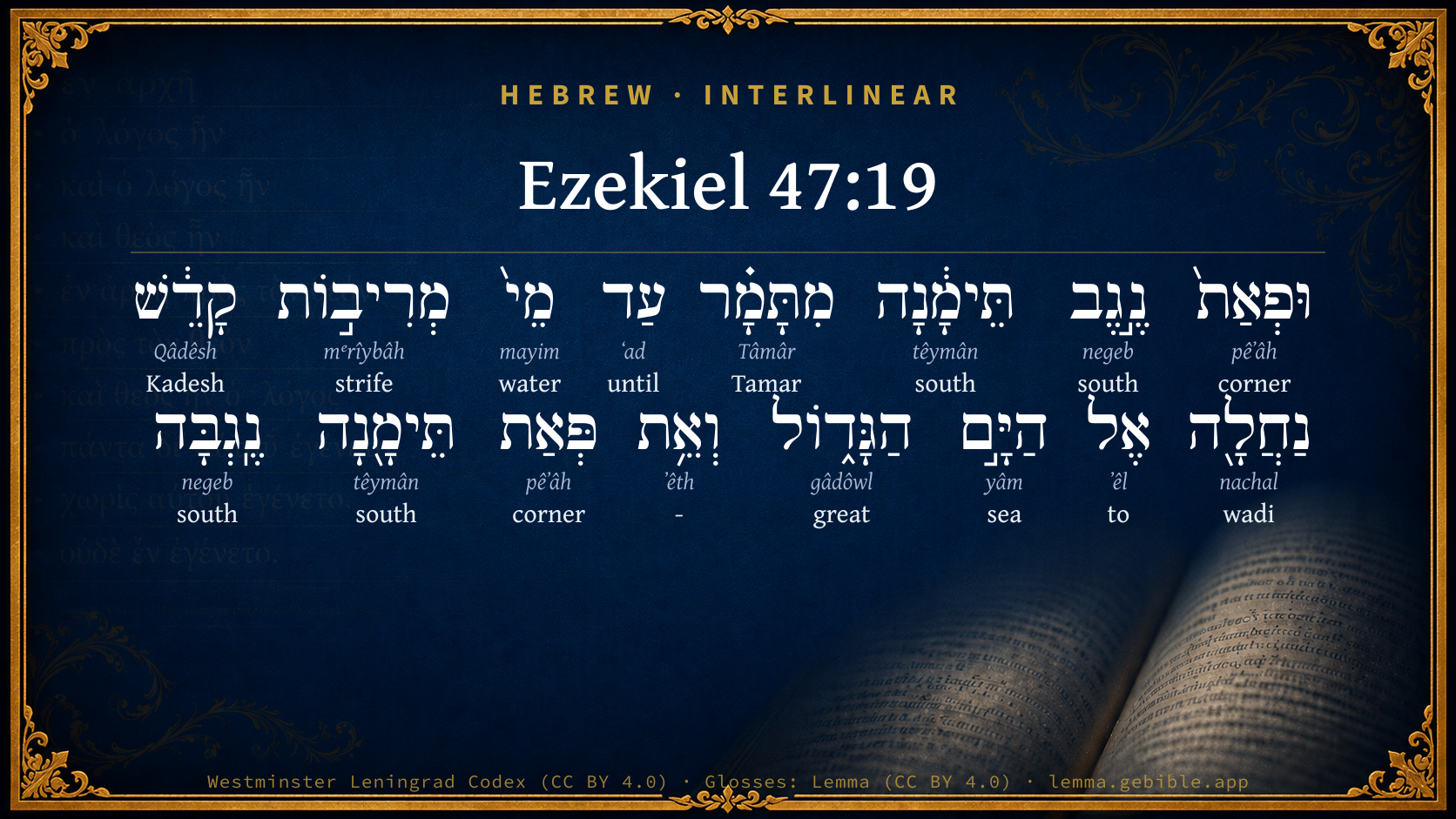
Ezekiel 47:19

Hebrew (Westminster Leningrad Codex) Ezekiel 47:19 appears in the Hebrew Old Testament. The text above is from the Westminster Leningrad Codex. Each word links to its Strong’s number, a concise gloss, and parsing drawn from the Open Scriptures Hebrew Bible morphology. Click any word for its full Brown-Driver-Briggs (BDB) entry.
Download image
Cite this verse

Ezekiel 47:19 (World English Bible). Public Domain. Lemma interlinear Bible study tool, https://lemma.gebible.app/v/ezekiel/47/19.

Show BibTeX & RIS
BibTeX
RIS
English Translation
The south side southward shall be from Tamar as far as the waters of Meriboth Kadesh, to the brook [of Egypt], to the great sea. This is the south side southward.
World English Bible · Public Domain
Download a study sheet

One document with this verse’s original text, its word-by-word gloss line, the meaning frame, cross-references with their text, attributed commentary, and full source and license credits — printable, and it pastes into notes with its structure intact.

This verse Autodidact and up

Study sheet (.html) Plain text (.txt)

A passage Seminary Student

Up to 50 verses in one chapter. A passage sheet keeps up to 6 commentary sources and 12 cross-references per verse, in the order this page ranks them, and says so on the sheet whenever that leaves anything out. Ask for a single verse and you get the Autodidact verse sheet above.

Everything on this page stays free to read, with no account — the sheet is a download of what is already on screen, not access to it.

Want to remove ads? Support Godless Engineer
Compare translations 3

The same verse in 3 English versions, stacked beneath the original-language interlinear above. Click any original word for its lexicon entry.

Each is an independent rendering of the whole verse — the interlinear is not word-aligned to these translations.

Highlighted words mark where these versions differ — a whole-verse word diff, not a word-by-word alignment.

  • World English Bible Public Domain
    The south side southward shall be from Tamar as far as the waters of Meriboth Kadesh, to the brook [of Egypt], to the great sea. This is the south side southward.
  • King James Version Public Domain
    And the south side southward, from Tamar even to the waters of strife in Kadesh, the river to the great sea. And this is the south side southward.
  • unfoldingWord Literal Text CC BY-SA 4.0
    Then on the south side the boundary will run from Tamar as far as the waters of Meribah Kadesh, then along the brook of Egypt to the Great Sea. This will be the boundary on the south side.

unfoldingWord Literal Text — © unfoldingWord, licensed CC BY-SA 4.0. Word-aligned USFM3 via Door43 (git.door43.org/unfoldingWord/en_ult).

Versions to compare (up to 4)

3 of 4 selected

Show all 18 translations

Every available English version of this verse, each an independent rendering of the whole verse.

  • World English Bible Public Domain
    The south side southward shall be from Tamar as far as the waters of Meriboth Kadesh, to the brook [of Egypt], to the great sea. This is the south side southward.
  • Berean Standard Bible Public Domain
    On the south side it will run from Tamar to the waters of Meribath-kadesh, and along the Brook of Egypt to the Great Sea. This will be the southern boundary.
  • Majority Standard Bible Public Domain
    On the south side it will run from Tamar to the waters of Meribath-kadesh, and along the Brook of Egypt to the Great Sea. This will be the southern boundary.
  • King James Version Public Domain
    And the south side southward, from Tamar even to the waters of strife in Kadesh, the river to the great sea. And this is the south side southward.
  • American Standard Version (1901) Public Domain
    And the south side southward shall be from Tamar as far as the waters of Meriboth-kadesh, to the brook `of Egypt', unto the great sea. This is the south side southward.
  • Revised Version (1885) Public Domain
    And the south side southward shall be from Tamar as far as the waters of Meriboth-kadesh, to the brook of Egypt, unto the great sea. This is the south side southward.
  • Geneva Bible (1599) Public Domain
    And the Southside shalbe towarde Teman from Tamar to the waters of Meriboth in Kadesh, and the riuer to the maine sea: so shalbe the South part towarde Teman.
  • Douay-Rheims (1899) Public Domain
    And the south side southward is from Thamar even to the waters of contradiction of Cades: and the torrent even to the great sea: and this is the south side southward.
  • Young's Literal Translation Public Domain
    `And the south quarter southward `is' from Tamar unto the waters of Meriboth-Kadesh, the stream unto the great sea: and `this is' the south quarter southward.
  • Literal Standard Version CC BY-SA 4.0
    And the south quarter southward [is] from Tamar to the waters of Meriboth-Kadesh, the stream to the Great Sea: and [this is] the south quarter southward.
  • Unlocked Literal Bible CC BY-SA 4.0
    Then on the south side the boundary will run from Tamar as far as the waters of Meribah Kadesh, then along the brook of Egypt to the Great Sea. This will be the boundary on the south side.
  • unfoldingWord Literal Text CC BY-SA 4.0
    Then on the south side the boundary will run from Tamar as far as the waters of Meribah Kadesh, then along the brook of Egypt to the Great Sea. This will be the boundary on the south side.
  • Darby Bible Public Domain
    -- And the south side southward, from Tamar to the waters of Meribah-Kadesh, by the torrent, unto the great sea: this is the south side southward.
  • World Messianic Bible Public Domain
    “The south side southward shall be from Tamar as far as the waters of Meriboth Kadesh, to the brook, to the great sea. This is the south side southward.
  • Webster's Bible Public Domain
    And the south side southward, from Tamar even to the waters of strife in Kadesh, the river to the great sea. And this is the south side southward.
  • Free Bible Version CC BY-SA 4.0
    The southern boundary runs from Tamar to the waters of Meribath-kadesh, then along the Wadi of Egypt to the Mediterranean Sea. This is the southern boundary.
  • Bible in Basic English Public Domain
    And the south side to the south will be from Tamar as far as the waters of Meribath-kadesh, to the stream of Egypt, to the Great Sea. This is the south side, on the south.
  • JPS Tanakh (1917) Public Domain
    And the south side southward shall be from Tamar as far as the waters of Meriboth-kadesh, to the Brook, unto the Great Sea. This is the south side southward.

Literal Standard Version (2020), Covenant Press — licensed CC BY-SA 4.0. Text via the HelloAO Bible API (eBible.org). Unlocked Literal Bible (unfoldingWord) — licensed CC BY-SA 4.0. Text via the HelloAO Bible API (eBible.org). unfoldingWord Literal Text — © unfoldingWord, licensed CC BY-SA 4.0. Word-aligned USFM3 via Door43 (git.door43.org/unfoldingWord/en_ult). Free Bible Version, Dr. Jonathan Gallagher — licensed CC BY-SA 4.0. Text via the HelloAO Bible API (eBible.org).

Word by word

More ways to search: Search by grammar → Find every occurrence → Compare this word →

Practice this passage: Drill this verse → Learn its vocabulary →

מְרִיב֣וֹת
mᵉrîybâh
H4808
“strife”
Noun, Proper
Part of Speech
Noun
Type
Proper
Full BDB Definition

Origin: from H7378

TWOT: 2159c

strife, contention
  1. וּפְאַת֙ pêʼâh H6285 “and · corner of” Conjunction + Noun, Common, Feminine, Singular, Construct
  2. נֶ֣גֶב negeb H5045 “south” Noun, Common, Masculine, Singular, Absolute
  3. תֵּימָ֔נָה têymân H8486 “south · toward” Noun, Common, Feminine, Singular, Absolute + Suffix, Demonstrative
  4. מִתָּמָ֗ר Tâmâr H8559 “from · Tamar” Preposition + Noun, Proper
  5. עַד ʻad H5704 “until” Preposition
  6. מֵי֙ mayim H4325 “water(s) of” Noun, Common, Masculine, Plural, Construct
  7. קָדֵ֔שׁ Qâdêsh H6946 “Kadesh” Noun, Proper
  8. נַחֲלָ֖ה nachal H5158 “wadi” Noun, Proper
  9. אֶל ʼêl H413 “to” Preposition
  10. הַיָּ֣ם yâm H3220 “the · sea” Particle, Definite Article + Noun, Common, Masculine, Singular, Absolute
  11. הַגָּד֑וֹל gâdôwl H1419 “the · great” Particle, Definite Article + Adjective, Adjective, Masculine, Singular, Absolute
  12. וְאֵ֥ת ʼêth H853 “and · -” Conjunction + Particle, Direct Object
  13. פְּאַת pêʼâh H6285 “corner of” Noun, Common, Feminine, Singular, Construct
  14. תֵּימָ֖נָה têymân H8486 “south · toward” Noun, Common, Feminine, Singular, Absolute + Suffix, Demonstrative
  15. נֶֽגְבָּה negeb H5045 “south · toward” Noun, Common, Masculine, Singular, Absolute + Suffix, Demonstrative

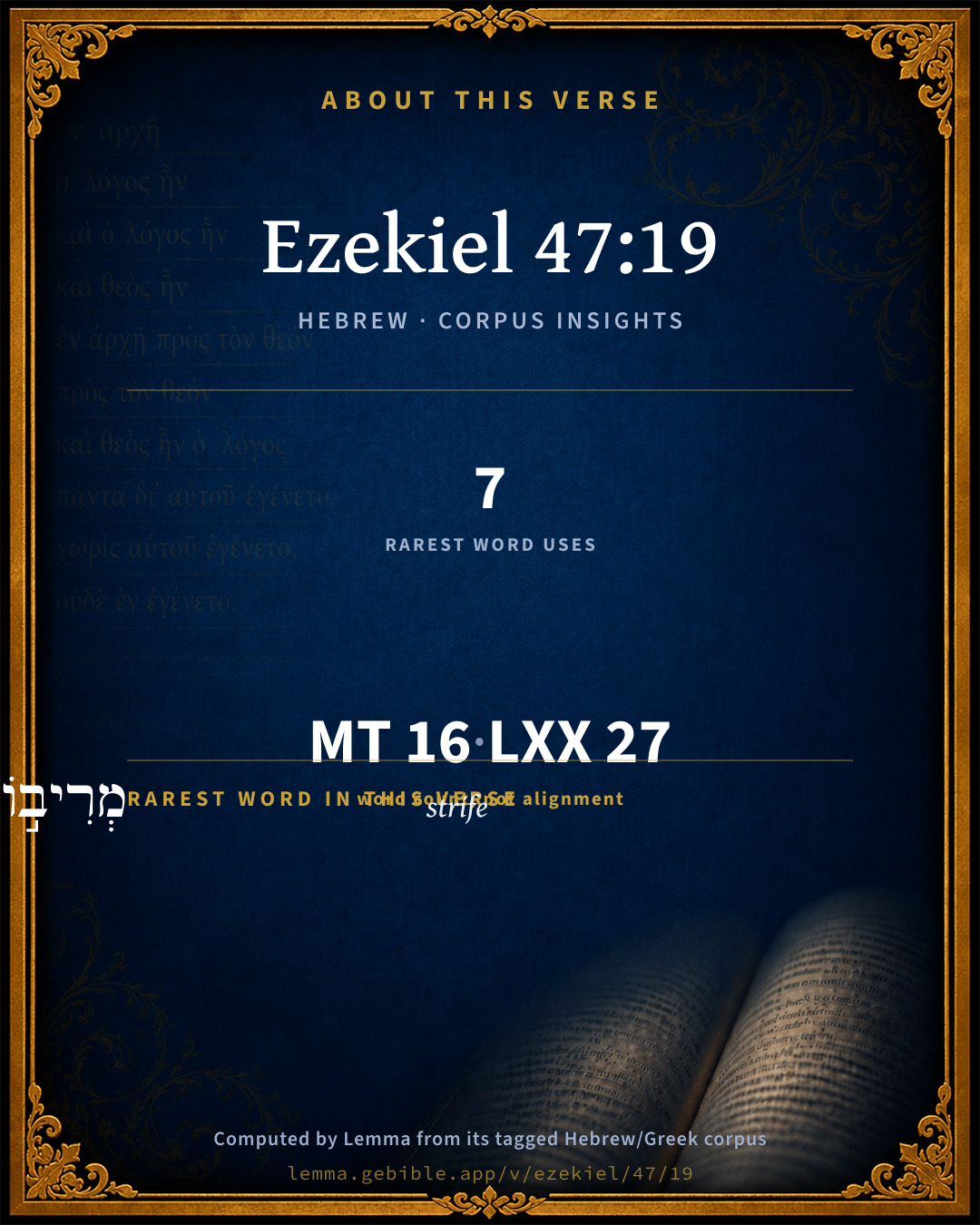
About this verse

These counts appear in no published source. They are computed here, from the morphology-tagged text and Lemma’s own curated glosses. What Lemma adds →

16
words
13
distinct lemmas
Prophets
section

Notable vocabulary

The rarest word here is מְרִיב֣וֹת strife H4808 — appearing just 7 times in the whole Hebrew Bible.

Shared distinctive vocabulary

מְרִיב֣וֹת strife H4808 occurs in 7 verses of the Hebrew Bible. Also found in:

Grammatical profile

  • 12 nouns
  • 1 adjective
  • 2 prepositions
  • 1 particle

Repetition

Words recur within this verse — often emphatic in Hebrew:

  • וּפְאַת֙ corner H6285 ×2
  • נֶ֣גֶב south H5045 ×2
  • תֵּימָ֔נָה south H8486 ×2

Hebrew & Septuagint length

In English translation the verse runs 31 words from the Hebrew and 33 from the Septuagint (LXX English) — closely comparable.

A rough comparison of the two English renderings, which tokenize alike — not a word-level alignment.

Word counts can differ between the Hebrew and the Greek without any difference in meaning — e.g. the Hebrew direct-object marker אֵת has no separate Greek word, and Greek often adds the article ὁ.

In the original languages it is 16 Hebrew tokens and 27 Greek tokens — but the two are counted differently (Hebrew bundles its prefixes and suffixes into one token; the Greek is in lemma form), so that isn’t a like-for-like length.

Cross-references

8

Topical passages linked to Ezekiel 47:19 in the Treasury of Scripture Knowledge — connected by theme and wording, ordered by reader-vote popularity; previews shown in the World English Bible.

  • Deuteronomy 32:51 because you trespassed against me in the midst of the children of Israel at the waters of Meribah of Kadesh, in the wilderness of Zin; because you didn't sanctify me in the midst of the children of Israel.
  • Ezekiel 48:28 By the border of Gad, at the south side southward, the border shall be even from Tamar to the waters of Meribath Kadesh, to the brook [of Egypt], to the great sea.
  • Numbers 20:13 These are the waters of Meribah; because the children of Israel strove with Yahweh, and he was sanctified in them.
  • Numbers 34:5 and the border shall turn about from Azmon to the brook of Egypt, and the goings out of it shall be at the sea.
  • Deuteronomy 33:8 Of Levi he said, Your Thummim and your Urim are with your godly one, Whom you did prove at Massah, With whom you did strive at the waters of Meribah;
  • Psalms 81:7 You called in trouble, and I delivered you. I answered you in the secret place of thunder. I tested you at the waters of Meribah." Selah.
  • Isaiah 27:12 It shall happen in that day, that Yahweh will beat off [his fruit] from the flood of the River to the brook of Egypt; and you shall be gathered one by one, you children of Israel.
  • Joshua 12:3 and the Arabah to the sea of Chinneroth, eastward, and to the sea of the Arabah, even the Salt Sea, eastward, the way to Beth-jeshimoth; and on the south, under the slopes of Pisgah:

Cross-references courtesy of OpenBible.info (CC BY 4.0).

Hebrew and Greek witnesses Masoretic Hebrew ↔ Greek Septuagint

The same verse in the two great witnesses to the Old Testament, shown verse-for-verse.

These are two independent witnesses, not word-aligned to each other, and the Septuagint is shown in lemma (dictionary) form.

Hebrew Ezekiel 47:19 Masoretic · Westminster Leningrad Codex

וּפְאַת֙ נֶ֣גֶב תֵּימָ֔נָה מִתָּמָ֗ר עַד מֵי֙ מְרִיב֣וֹת קָדֵ֔שׁ נַחֲלָ֖ה אֶל הַיָּ֣ם הַגָּד֑וֹל וְאֵ֥ת פְּאַת תֵּימָ֖נָה נֶֽגְבָּה

The south side southward shall be from Tamar as far as the waters of Meriboth Kadesh, to the brook [of Egypt], to the great sea. This is the south side southward.

World English Bible · Public Domain

Greek LXX Ezekiel 47:19 Septuagint · lemma form

καί ὁ πρός νότος καί λίψ ἀπό θαιμαν καί φοινικών ἕως ὕδωρ μαριμωθ καδης παρα ἐκτείνω ἐπί ὁ θάλασσα ὁ μέγας οὗτος ὁ μέρος νότος καί λίψ

And the southern and south-western coasts are from Thaeman and the city of palm-trees, to the water of Marimoth Cadem, reaching forth to the great sea. This part is the south and southwest.

LXX2012 (modern English Septuagint) · Public Domain

Hebrew: Westminster Leningrad Codex (CC BY 4.0). Greek: Septuagint (public domain); English from LXX2012 (modern English Septuagint) (Public Domain). How the Septuagint differs from the Hebrew →

Targum (Aramaic paraphrase)

1

The Targum is the ancient Jewish Aramaic paraphrase of the Hebrew Scriptures — an interpretive translation, not the Hebrew text itself. Onkelos (literal) and Pseudo-Jonathan (expansive) render the Torah, and Jonathan the Prophets. Coverage is partial: where no permissively-licensed English translation exists for a verse, only the Aramaic is shown. This is verse-level text, not a word-by-word alignment to the Hebrew.

  1. Targum Jonathan Prophets (Joshua–Malachi)
    וְרוּחַ עִבַּר דָרוֹמָא מִירִיחוֹ עַד מֵי מַצוּת רְקָם אַחֲסָנָא לְיַמָא רַבָּא וְיַת רוּחַ דָרוֹמָא דְדָרוֹמָא:

    (no public-domain English translation for this verse)

    Targum Jonathan — Aramaic: “Mikraot Gedolot” (public domain). English: “Sefaria Community Translation” (CC0 1.0 (public-domain dedication)); “London "Chaldee Paraphrase," 1871” (public domain). Text via Sefaria.

Commentary

Notes on Ezekiel 47:19 from classic Christian and Jewish commentators (each source and its license shown beneath its notes). The classic Christian expositions comment on the surrounding passage and are grouped to its opening verse, so a note may address several verses; the Jewish commentaries on the Tanakh (Rashi and others) are per-verse, so they appear only where the commentator wrote on this verse.

Lemma curates 59 commentaries, every one of them public domain or Creative Commons licensed, each selected and text-cleaned for this edition rather than reprinted as found. About our sources →

Trapp's Complete Commentary

John Trapp

Eze 47:19 And the south side southward, from Tamar [even] to the waters of strife [in] Kadesh, the river to the great sea. And [this is] the south side southward.

Ver. 19. From Tamar.] Hazazon Tamar, {a} which was near the sea of Sodom. {Eze 47:10}

In Kadesh.] Not in Rephidim. {Exo 17:7}

{a} This was Palmyra, afterwards Adrianople.

John Trapp, A Commentary or Exposition upon All the Books of the Old and New Testament (1647–1656) — public domain. Text from a community e-Sword module.

Joseph Benson's Commentary

Eze 47:19. And the south side southward — The southern frontier shall be from En-gedi, called Hazazon-tamar, 2Ch 20:2, to the waters of Meribah, or strife, in Kadesh, in the south limit of Judah, and from thence to the river of Egypt, namely, Besor, which runs into the sea not far from Gaza.

Joseph Benson's Commentary on the Old and New Testaments (1811–1818) — public domain. Text from a community e-Sword module.

Geneva Bible (1599)

Geneva Bible translators

Or, strife.

Geneva Bible (1599) marginal notes — public domain. Text via Bolls.life.

Jamieson, Fausset & Brown

Robert Jamieson, A. R. Fausset & David Brown

Tamar--not Tadmor in the desert, but Tamar, the last town of Judea, by the Dead Sea. Meaning "palm tree"; so called from palm trees abounding near it.

Jamieson, Fausset & Brown — Commentary Critical and Explanatory on the Whole Bible (1871) — public domain (CC PDM 1.0). Text via the HelloAO Bible API.

Adam Clarke's Commentary

Verse 19. Tamar] Called Hazazon Tamar, or Engedi, 2Ch 20:2.

The river] Besor, which runs into the sea near Gaza.

Adam Clarke's Commentary on the Bible (1810–1826) — public domain. Text from a community e-Sword/MySword module.

Ellicott's Commentary for English Readers

(19) From Tamar even to the waters of strife.—The southern border, as given in Num_34:3-5, is identical with that described here, as far as the two can be compared. Tamar has been identified with Kurnub, a ruined village some twenty-five miles west of the southern end of the Dead Sea; but as the old boundary certainly went far to the south of this and as the next place mentioned is Kadesh, about thirty miles nearly south from the Dead Sea, the Tamar here meant is more probably some place not yet identified. Kadesh, known from the “waters of strife” as Meribah (Num_20:3-14), is called Kadesh-barnea in Num_34:4. It has been identified by Robinson with the Ain-el-Weibeh, about thirty miles slightly west of south from the Dead Sea. Its exact situation, however, is somewhat doubtful.

The river to the great sea.—Literally, riverward to the great sea. From Kadesh the boundary was to strike across the mountainous desert to what is often called in Scripture “the river of Egypt,” and was anciently known as the Rhinocolura, now called the Wady-el-Arish. It followed this to the Mediterranean. The length of the southern boundary, following the curve of the Rhinocolura, must have been nearly 100 miles, or about eighty-seven miles from east to west.

A Bible Commentary for English Readers, edited by Charles John Ellicott (1878–1897) — public domain. Text from a community e-Sword module.

The Cambridge Bible for Schools and Colleges

gen. ed. J. J. S. Perowne

19. The southern boundary. Read: “and the southside southward: from Tamar on to the waters of Meriboth-Kadesh, to the brook (of Egypt), and unto the great sea; this is the south side southward.” The delimitation on the S. is more fully described Num_34:3-5; Jos_15:1-4. There Kadesh is called Kadesh-Barnea, here Meriboth Kadesh (elsewhere Meribah), i.e. waters of strife of Kadesh, Num_27:14. The brook of Egypt is the Wady el Arish. The line striking this brook follows its course to the sea.

The Cambridge Bible for Schools and Colleges (gen. ed. J. J. S. Perowne; Cambridge University Press, 1878–1918) — public domain. Text from a community e-Sword module.

John Gill's Exposition

And the south side southward from Tamar,.... Not Jericho, as the Targum, Jarchi, and Kimchi, called by this name from the palm trees which grew near it; according to Jerom, this is Palmyra, so called for the same reason; but it is rather Engedi, called Hazazontamar, Ch2 20:2, the line of the southern border began here, and went on,

even to the waters of strife in Kadesh; to the waters of Meribah in Kadesh; so called, from the strivings of the children of Israel with the Lord there, Num 20:1,

the river to the great sea; it proceeded by the river of Egypt, the river Sihor, the Nile, which is before Egypt, Jos 13:3 and so on to the Mediterranean sea:

and this is the south side southward; the south side of the land, and the southern border of it.

John Gill's Exposition of the Whole Bible (1746–1763) — public domain (CC PDM 1.0). Text via the HelloAO Bible API.

Albert Barnes' Notes on the Bible

The south border (compare Num 34:4) commences with “Tamar,” probably a village near the southern end of the Dead Sea. The word means “palm-tree;” and is given to more than one city in the holy land.

The river to the great sea - literally, “riverward to the great sea.” By the “river” is meant the torrent-stream entering the Mediterranean near “Rhinocolura” (El Arish).

Albert Barnes' Notes on the Bible (1834–1885) — public domain. Text from a community e-Sword/MySword module.

Haydock's Catholic Bible Commentary

Thamar. Engaddi is sometimes understood: but it lay near Jericho, as this (Calmet) Thamar was to the south of the Dead Sea. (Ptolemy) --- Torrent, Besor. (Haydock)

George Leo Haydock (1774–1849), Haydock's Catholic Family Bible and Commentary, 1859 edition — public domain. Excludes Psalms (Douay-Rheims chapter numbering differs from Protestant) and Deuterocanonical books (Catholic canon only).

Matthew Poole's English Annotations

The south side shall begin at that point which first vergeth southward from the east sea toward Tamar, which is near En-gedi, and known by the addition Hazezon-tamar; and so some place the lake of Sodom, that the greatest part will be this southern frontier.

To the waters of strife; from Tamar a line drawn to Meribah in Kadesh, of which Num 20:13; 27:14.

The river, called the river of Egypt, was on the south of Judah, and lay directly in the way to Egypt from Jerusalem.

To the great sea; to the south-west part of the Mediterranean Sea near Gaza. This is the southern frontier.

Matthew Poole's English Annotations on the Holy Bible (1683–1685) — public domain. Text from a community e-Sword/MySword module.

Whedon's Commentary on the Bible

Daniel D. Whedon

19. “And the south side southward shall be from Tamar as far as the waters of Meriboth-kadesh, to the brook of Egypt, unto the great sea (R.V.; compare Num_27:14; Num_34:3-5; Jos_15:1-4). The Wady-el-Arish was called the “brook of Egypt.” (See Num_34:5, and map facing page 232.)

Daniel D. Whedon (gen. ed.), Commentary on the Old and New Testaments (1874–1909) — public domain. Text from a community e-Sword module.

The Pulpit Commentary

The south boundary. This should begin where the east boundary terminated, viz. at Tamar, "Palm tree." Different from Hazezon-Tamar, or Engedi (ver. 10; 2Ch_20:2) which lay too far up the west side of the sea, Tamar can hardly be identified either with the Tamar 1Ki_9:18 near Tadmor in the wilderness, or with the Thamara (Qamara) of Eusebius between Hebron and Elath, supposed by Robinson ("Bibl. Rea," it 616, 622) to he Kurnub, six hours south of Milh, towards the pass of Es-Sufah, since this was too distant from the Dead Sea The most plausible conjecture is that Tamar was "a village near the southern end of the Dead Sea" (Currey). Proceeding westward, the southern boundary should reach to the waters of strife in Kadesh; better, to the waters of Meribotk Kadesh. These were in the Desert of Sin, near Kadesh-Barnea, (Num_20:1-13) which, again, was on the road from Hebron to Egypt. (Gen_16:14) The exact site, however, of Kadesh-Barnea is matter of dispute; Rowland and Keil find it in the spring Ain Kades, at the north-west corner of the mountain-land of Azazimeh, which stretches on the south of Palestine from the south-south-west to the north-north-east, and forms the watershed Between the Mediterranean and the Arabah valley. Delitzsch and Conder seek it in the neighborhood of the Wady-el-Jemen, on the south-east side of the above watershed, and on the road from Mount Hot. Robinson ("Bibl. Rea," 2:582) discovers it in Ain-el-Weibeh, not far from Petra. A writer (Sin., Smend?) in Riehm ("Handworterbuch des Biblischen Alterthums," art. "Kades") pleads for a site on the west side of the Azazimeh plateau, and in the vicinity of the road by Shur to Egypt. Leaving Kadesh, the boundary should continue to the river, or, brook, of Egypt, and thence extend to the great sea, or Mediterranean. The punctuation of hl; j) makes the word signify "lot," must be changed into hl; jn, so as to mean "river," since the reference manifestly is to the torrent of Egypt, the Wady-el-Arish , on the borders of Palestine and Egypt, which enters the Mediterranean near Rhinocorura (JRinokoroura). in Num_34:5 it is called the river of Egypt. And this is the south side southward (see on ver. 17). The correspondence between this line and that of the earlier chart (Num_34:4, Num_34:5) is once more apparent.

The Pulpit Commentary (1880–1919), ed. H.D.M. Spence-Jones & Joseph S. Exell — public domain. Text from a community e-Sword module.

John Wesley's Explanatory Notes

The river - Called the river of Egypt, lay directly in the way to Egypt from Jerusalem. The great sea - To the southwest part of the Mediterranean sea near Gaza.

John Wesley, Explanatory Notes Upon the Whole Bible (1754–1765) — public domain. Text via the GEBible commentary corpus.

Rashi

Rabbi Shlomo Yitzchaki (Rashi)

from Tamar From Jericho, which is the city of date palms, (Deut. 33:3), and so did Jonathan render it.

until the water of Meriboth Kadesh that is the desert of Zin. (Num 27:14)

to the stream [that falls] into the Great Sea And from there the border proceeds until the stream of Egypt, which falls into the Great Sea in the southwestern corner. Moses, too, delineated the southern boundary in this way, from the desert of Zin alongside Edom, and he proceeds and counts until (ibid. 34:5): “from Atzmon to the stream of Egypt, and its ends shall be at the sea.” [Accordingly,] נַחֲלָה stated here is like לַנַחַל, to the stream. I found it, however, translated [by Jonathan] as אַחֲסָנָא, an inheritance, and were it not for the fact that the accent is on the last syllable, and [that] the Masorah states that there is no other instance in which the accent is on the first syllable, I would have said that it is an error, and that Jonathan did not translate it that way, only erring readers.

Rashi on the Tanakh — English translations: “The Judaica Press complete Tanach with Rashi, translated by A. J. Rosenberg” (CC BY 4.0); “Pentateuch with Rashi's commentary by M. Rosenbaum and A.M. Silbermann, 1929-1934” (public domain); “The Metsudah Tanach series, Lakewood, N.J” (CC BY 4.0); and “The Book of Joshua, Metsudah Publications, 1997” (CC BY 4.0). Text via Sefaria.

Lesson kit

Teaching starters — assembled from the data on this page, not authored interpretation. Every prompt links to the verse data it draws on. Edit before teaching.

Ezekiel, in the Prophets, opens this verse with 16 words (13 distinct Hebrew lemmas). Its most distinctive word is mᵉrîybâh (“strife”). A historical commentator’s framing appears above. Read the whole chapter for the surrounding context.

Discussion questions

  1. The word mᵉrîybâh carries the sense “strife.” How does it shape the verse?
  2. Genesis 13:8 shares the word «strife» with this verse. How do the two illuminate each other?
  3. “corner” occurs 2× in this one verse. What is the effect of the repetition?
  4. The translations on this page render this verse differently — a whole-verse word diff, not a word-by-word alignment. What might account for the different wordings?
  5. Reading how Trapp's Complete Commentary and Joseph Benson's Commentary read this verse, where do the two commentators agree and where do they part?

Things to notice

Reading settings

Reading text

Shown beneath each verse's original-language words.

Old Testament
Old Testament edition

Read the OT as the Masoretic Hebrew (MT) or the Greek Septuagint (LXX).

English shown for the Greek Septuagint (in the Hebrew ↔ Greek comparison).

Comparing translations? Open the Compare panel on any verse page to stack up to four side by side.