Job 21:33

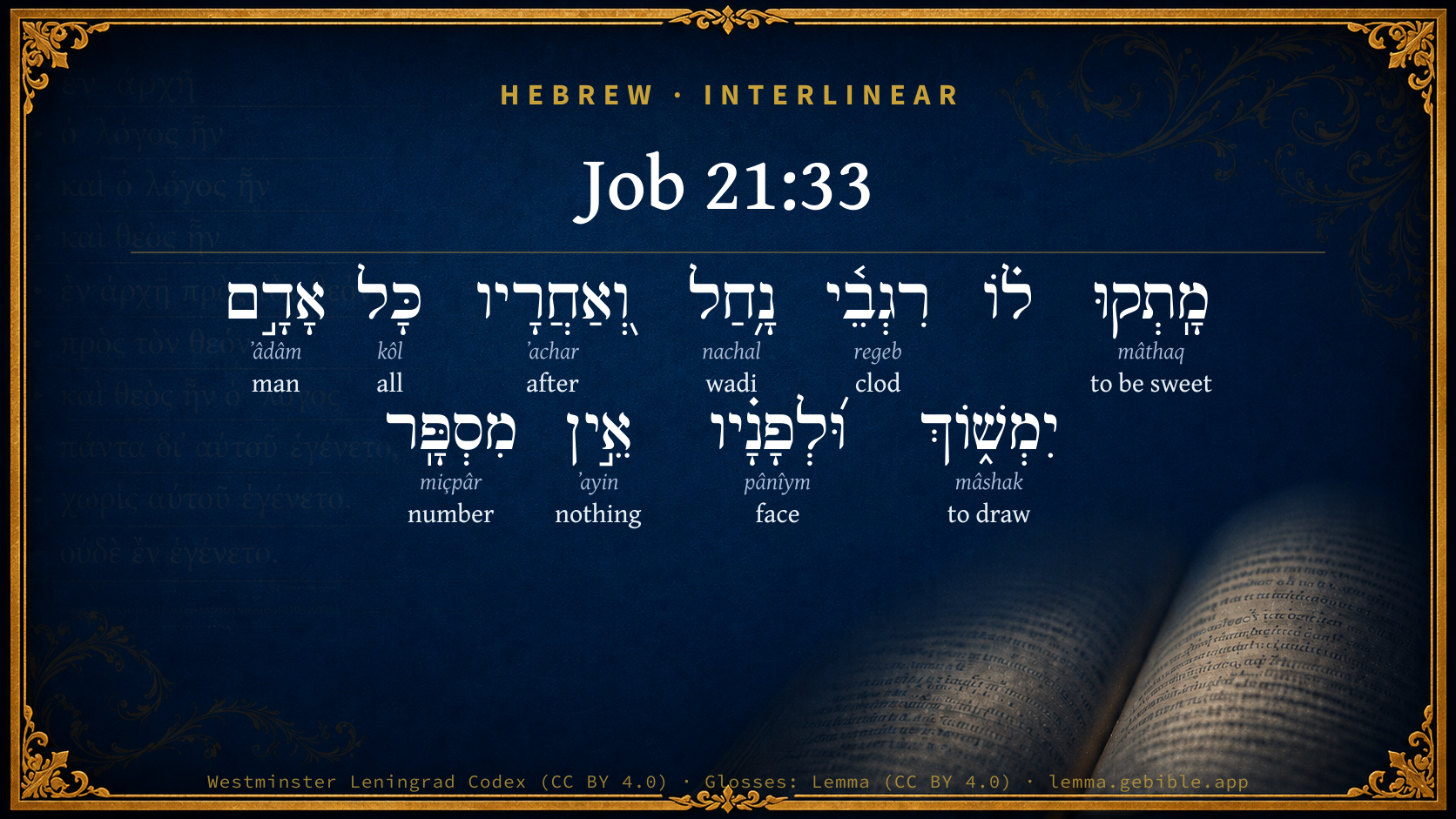
Hebrew (Westminster Leningrad Codex) Job 21:33 appears in the Hebrew Old Testament. The text above is from the Westminster Leningrad Codex. Each word links to its Strong’s number, a concise gloss, and parsing drawn from the Open Scriptures Hebrew Bible morphology. Click any word for its full Brown-Driver-Briggs (BDB) entry.
Download image
Cite this verse

Job 21:33 (World English Bible). Public Domain. Lemma interlinear Bible study tool, https://lemma.gebible.app/v/job/21/33.

Show BibTeX & RIS
BibTeX
RIS
English Translation
The clods of the valley shall be sweet to him. All men shall draw after him, As there were innumerable before him.
World English Bible · Public Domain
Highlights
  • 1 first appearance in the Hebrew Bible
Full analysis ↓
Download a study sheet

One document with this verse’s original text, its word-by-word gloss line, the meaning frame, cross-references with their text, attributed commentary, and full source and license credits — printable, and it pastes into notes with its structure intact.

This verse Autodidact and up

Study sheet (.html) Plain text (.txt)

A passage Seminary Student

Up to 50 verses in one chapter. A passage sheet keeps up to 6 commentary sources and 12 cross-references per verse, in the order this page ranks them, and says so on the sheet whenever that leaves anything out. Ask for a single verse and you get the Autodidact verse sheet above.

Everything on this page stays free to read, with no account — the sheet is a download of what is already on screen, not access to it.

Want to remove ads? Support Godless Engineer
Compare translations 3

The same verse in 3 English versions, stacked beneath the original-language interlinear above. Click any original word for its lexicon entry.

Each is an independent rendering of the whole verse — the interlinear is not word-aligned to these translations.

Highlighted words mark where these versions differ — a whole-verse word diff, not a word-by-word alignment.

  • World English Bible Public Domain
    The clods of the valley shall be sweet to him. All men shall draw after him, As there were innumerable before him.
  • King James Version Public Domain
    The clods of the valley shall be sweet unto him, and every man shall draw after him, as there are innumerable before him.
  • unfoldingWord Literal Text CC BY-SA 4.0
    The clods of the torrent will be sweet to him, and every man will extend after him, and to his face there is not numbering.

unfoldingWord Literal Text — © unfoldingWord, licensed CC BY-SA 4.0. Word-aligned USFM3 via Door43 (git.door43.org/unfoldingWord/en_ult).

Versions to compare (up to 4)

3 of 4 selected

Show all 18 translations

Every available English version of this verse, each an independent rendering of the whole verse.

  • World English Bible Public Domain
    The clods of the valley shall be sweet to him. All men shall draw after him, As there were innumerable before him.
  • Berean Standard Bible Public Domain
    The clods of the valley are sweet to him; everyone follows behind him, and those before him are without number.
  • Majority Standard Bible Public Domain
    The clods of the valley are sweet to him; everyone follows behind him, and those before him are without number.
  • King James Version Public Domain
    The clods of the valley shall be sweet unto him, and every man shall draw after him, as there are innumerable before him.
  • American Standard Version (1901) Public Domain
    The clods of the valley shall be sweet unto him, And all men shall draw after him, As there were innumerable before him.
  • Revised Version (1885) Public Domain
    The clods of the valley shall be sweet unto him, and all men shall draw after him, as there were innumerable before him.
  • Geneva Bible (1599) Public Domain
    The slimie valley shalbe sweete vnto him, and euery man shall draw after him, as before him there were innumerable.
  • Douay-Rheims (1899) Public Domain
    He hath been acceptable to the gravel of Cocytus, and he shall draw every man after him, and there are innumerable before him.
  • Young's Literal Translation Public Domain
    Sweet to him have been the clods of the valley, And after him every man he draweth, And before him there is no numbering.
  • Literal Standard Version CC BY-SA 4.0
    The clods of the valley have been sweet to him, || And he draws every man after him, || And there is no numbering before him.
  • Unlocked Literal Bible CC BY-SA 4.0
    The clods of the valley will be sweet to him; all people will follow after him, as there were innumerable people before him.
  • unfoldingWord Literal Text CC BY-SA 4.0
    The clods of the torrent will be sweet to him, and every man will extend after him, and to his face there is not numbering.
  • Darby Bible Public Domain
    The clods of the valley are sweet unto him; and every man followeth suit after him, as there were innumerable before him.
  • World Messianic Bible Public Domain
    The clods of the valley will be sweet to him. All men will draw after him, as there were innumerable before him.
  • Webster's Bible Public Domain
    The clods of the valley will be sweet to him, and every man will draw after him, as there are innumerable before him.
  • Free Bible Version CC BY-SA 4.0
    Everyone attends their funeral service; a huge procession of people comes to pay their last respects.
  • Bible in Basic English Public Domain
    The earth of the valley covering his bones is sweet to him, and all men come after him, as there were unnumbered before him.
  • JPS Tanakh (1917) Public Domain
    The clods of the valley are sweet unto him, and all men draw after him, as there were innumerable before him.

Literal Standard Version (2020), Covenant Press — licensed CC BY-SA 4.0. Text via the HelloAO Bible API (eBible.org). Unlocked Literal Bible (unfoldingWord) — licensed CC BY-SA 4.0. Text via the HelloAO Bible API (eBible.org). unfoldingWord Literal Text — © unfoldingWord, licensed CC BY-SA 4.0. Word-aligned USFM3 via Door43 (git.door43.org/unfoldingWord/en_ult). Free Bible Version, Dr. Jonathan Gallagher — licensed CC BY-SA 4.0. Text via the HelloAO Bible API (eBible.org).

Word by word

More ways to search: Search by grammar → Find every occurrence → Compare this word →

Practice this passage: Drill this verse → Learn its vocabulary →

רִגְבֵ֫י
regeb
H7263
“clods of”
Noun, Common, Masculine, Plural, Construct
Part of Speech
Noun
Type
Common
Gender
Masculine
Number
Plural
State
Construct
Full BDB Definition

Origin: from an unused root meaning to pile together

TWOT: 2111a

clod (of earth)
  1. מָֽתְקוּ mâthaq H4985 “to be sweet” Verb, Qal, Perfect, 3rd Person, Common, Plural
  2. נָ֥חַל nachal H5158 “wadi” Noun, Common, Masculine, Singular, Absolute
  3. וְ֭אַחֲרָיו ʼachar H310 “and · after · him” Conjunction + Preposition + Suffix, Personal, 3rd Person, Masculine, Singular
  4. כָּל kôl H3605 “all of” Noun, Common, Masculine, Singular, Construct
  5. אָדָ֣ם ʼâdâm H120 “man” Noun, Common, Masculine, Singular, Absolute
  6. יִמְשׁ֑וֹךְ mâshak H4900 “to draw” Verb, Qal, Imperfect, 3rd Person, Masculine, Singular
  7. וּ֝לְפָנָ֗יו pânîym H6440 “and · to/for · face(s) · his” Conjunction + Preposition + Noun, Common, Both, Plural, Construct + Suffix, Personal, 3rd Person, Masculine, Singular
  8. אֵ֣ין ʼayin H369 “nothing” Particle, Negative
  9. מִסְפָּֽר miçpâr H4557 “number” Noun, Common, Masculine, Singular, Absolute

About this verse

These counts appear in no published source. They are computed here, from the morphology-tagged text and Lemma’s own curated glosses. What Lemma adds →

11
words
10
distinct lemmas
Wisdom
section

Notable vocabulary

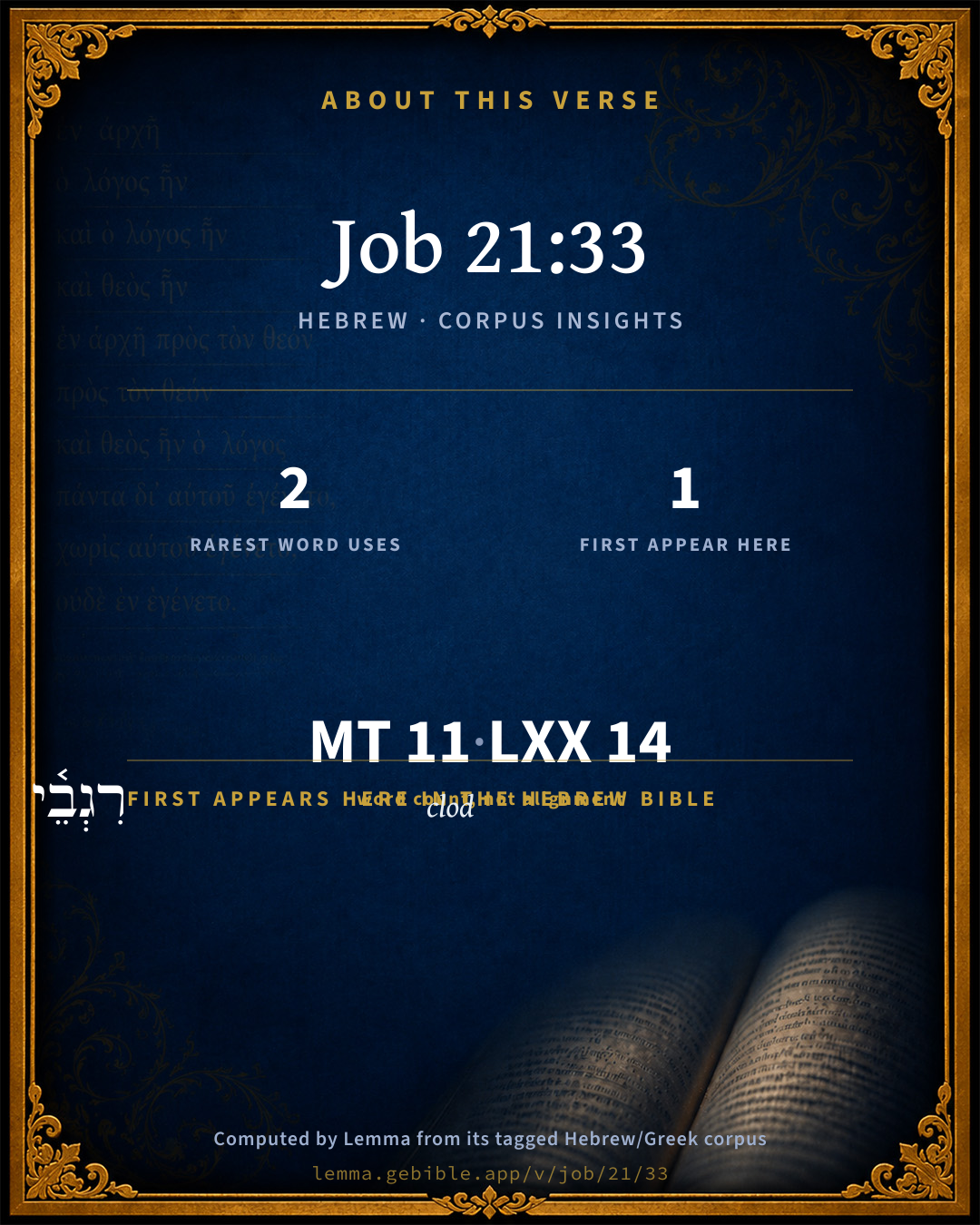
The rarest word here is רִגְבֵ֫י clod H7263 — appearing just 2 times in the whole Hebrew Bible.

First appearance in Scripture

This word makes its first canonical appearance in the Hebrew Bible here:

  • רִגְבֵ֫י clod H7263

Shared distinctive vocabulary

רִגְבֵ֫י clod H7263 occurs in 2 verses of the Hebrew Bible. Also found in:

Grammatical profile

  • 2 verbs
  • 6 nouns
  • 2 prepositions
  • 1 particle

Verb forms

  • מָֽתְקוּ Qal · Perfect
  • יִמְשׁ֑וֹךְ Qal · Imperfect

Hebrew & Septuagint length

In English translation the verse runs 22 words from the Hebrew and 24 from the Septuagint (LXX English) — closely comparable.

A rough comparison of the two English renderings, which tokenize alike — not a word-level alignment.

Word counts can differ between the Hebrew and the Greek without any difference in meaning — e.g. the Hebrew direct-object marker אֵת has no separate Greek word, and Greek often adds the article ὁ.

In the original languages it is 11 Hebrew tokens and 14 Greek tokens — but the two are counted differently (Hebrew bundles its prefixes and suffixes into one token; the Greek is in lemma form), so that isn’t a like-for-like length.

Cross-references

10

Topical passages linked to Job 21:33 in the Treasury of Scripture Knowledge — connected by theme and wording, ordered by reader-vote popularity; previews shown in the World English Bible.

  • Hebrews 9:27 Inasmuch as it is appointed for men to die once, and after this, judgment,
  • Job 24:24 They are exalted; yet a little while, and they are gone. Yes, they are brought low, they are taken out of the way as all others, And are cut off as the tops of the ears of grain.
  • Job 30:23 For I know that you will bring me to death, To the house appointed for all living.
  • Genesis 3:19 By the sweat of your face will you eat bread until you return to the ground, for out of it you were taken. For you are dust, and to dust you shall return."
  • Job 3:17–19 There the wicked cease from troubling; There the weary are at rest.
  • Job 3:22 Who rejoice exceedingly, Are glad, when they can find the grave?
  • Job 17:16 Shall it go down with me to the gates of Sheol, Or descend together into the dust?"
  • Ecclesiastes 1:4 One generation goes, and another generation comes; but the earth remains forever.
  • Ecclesiastes 8:8 There is no man who has power over the spirit to contain the spirit; neither does he have power over the day of death. There is no discharge in war; neither shall wickedness deliver those who practice it.
  • Ecclesiastes 12:7 And the dust returns to the earth as it was, And the spirit returns to God who gave it.

Cross-references courtesy of OpenBible.info (CC BY 4.0).

Hebrew and Greek witnesses Masoretic Hebrew ↔ Greek Septuagint

The same verse in the two great witnesses to the Old Testament, shown verse-for-verse.

These are two independent witnesses, not word-aligned to each other, and the Septuagint is shown in lemma (dictionary) form.

Hebrew Job 21:33 Masoretic · Westminster Leningrad Codex

מָֽתְקוּ ל֗וֹ רִגְבֵ֫י נָ֥חַל וְ֭אַחֲרָיו כָּל אָדָ֣ם יִמְשׁ֑וֹךְ וּ֝לְפָנָ֗יו אֵ֣ין מִסְפָּֽר

The clods of the valley shall be sweet to him. All men shall draw after him, As there were innumerable before him.

World English Bible · Public Domain

Greek LXX Job 21:33 Septuagint · lemma form

γλυκαίνω αὐτός χάλιξ χειμάρρους καί ὀπίσω αὐτός πᾶς ἄνθρωπος ἀποἔρχομαι καί ἔμπροσθεν αὐτός ἀναρίθμητος

The stones of the valley have been sweet to him, and every man shall depart after him, and there are innumerable ones before him.

LXX2012 (modern English Septuagint) · Public Domain

On this verse, Haydock's Catholic Bible Commentary discusses the Septuagint’s reading. Read the note in Commentary ↓

Hebrew: Westminster Leningrad Codex (CC BY 4.0). Greek: Septuagint (public domain); English from LXX2012 (modern English Septuagint) (Public Domain). How the Septuagint differs from the Hebrew →

Commentary

Notes on Job 21:33 from classic Christian and Jewish commentators (each source and its license shown beneath its notes). The classic Christian expositions comment on the surrounding passage and are grouped to its opening verse, so a note may address several verses; the Jewish commentaries on the Tanakh (Rashi and others) are per-verse, so they appear only where the commentator wrote on this verse.

Lemma curates 59 commentaries, every one of them public domain or Creative Commons licensed, each selected and text-cleaned for this edition rather than reprinted as found. About our sources →

Trapp's Complete Commentary

John Trapp

Job 21:33 The clods of the valley shall be sweet unto him, and every man shall draw after him, as [there are] innumerable before him.

Ver. 33. The clods of the valley shall be sweet unto him] Here he saith the same as before, but more poetically, and is variously rendered. The Vulgate, alluding to an old poetical fable, readeth it thus, He shall be sweet to the sand of Cocytus, which is feigned to be one of the rivers of hell, or an infernal lake, so called from the moan there made by damned ghosts, who should be glad of his arrival there. Hell from beneath is moved for him to meet him at his coming, as it is said of the Assyrian tyrant, Isa 14:9. Others better expound it thus, He shall taste so much bitterness while he treads upon the clods of the earth, that the clods under the earth shall be reckoned sweet unto him. And oh, how well pleased would he be if he might for ever lie hidden there, and never rise up again to come to judgment! And as it is with one wicked man departed, so it is with all ether, whether they died before, or shall die after (Caten. Graec.).

John Trapp, A Commentary or Exposition upon All the Books of the Old and New Testament (1647–1656) — public domain. Text from a community e-Sword module.

Joseph Benson's Commentary

Job 21:33. The clods of the valley — Or, the grave, which is low and deep like a valley; shall be sweet unto him — He shall sweetly rest in his grave, free from all cares, and fears, and troubles, Job 3:17-18. Every man shall draw after him — Hebrew, He shall draw every man after him, into the grave; all that live after him, whether good or bad, shall follow him to the grave, shall die as he did. So he fares no worse herein than all mankind. He is figuratively said to draw them, because they come after him, as if they were drawn by his example. “There he lies,” says Bishop Patrick, “quietly in the earth, and no one disturbs his ashes: he suffers nothing but what all men shall do after him, as innumerable have done before him.”

Joseph Benson's Commentary on the Old and New Testaments (1811–1818) — public domain. Text from a community e-Sword module.

Tyndale Open Study Notes

Tyndale Open Resources

21:33 the earth gives sweet repose: Job viewed death as a relief (3:17-18).

Tyndale Open Study Notes — © Tyndale Open Resources, licensed CC BY-SA 4.0. Text via the HelloAO Bible API.

Geneva Bible (1599)

Geneva Bible translators

He shall be glad to lie in a slimy pit, which before could not be content with a royal palace.

Geneva Bible (1599) marginal notes — public domain. Text via Bolls.life.

Jamieson, Fausset & Brown

Robert Jamieson, A. R. Fausset & David Brown

As the classic saying has it, "The earth is light upon him." His repose shall be "sweet."

draw--follow. He shall share the common lot of mortals; no worse off than they (Heb 9:27). UMBREIT not so well (for it is not true of "every man"). "Most men follow in his bad steps, as countless such preceded him."

Jamieson, Fausset & Brown — Commentary Critical and Explanatory on the Whole Bible (1871) — public domain (CC PDM 1.0). Text via the HelloAO Bible API.

Adam Clarke's Commentary

Verse 33. The clods of the valley shall be sweet unto him] Perhaps there is an allusion here to the Asiatic mode of interment for princes, saints, and nobles: a well-watered valley was chosen for the tomb, where a perpetual spring might be secured. This was intended to be the emblem of a resurrection, or of a future life; and to conceal as much as possible the disgrace of the rotting carcass.

Every man shall draw after him] There seem to be two allusions intended here:

1. To death, the common lot of all. Millions have gone before him to the tomb; and כל אדם col adam, all men, shall follow him: all past generations have died, all succeeding generations shall die also.

2. To pompous funeral processions; multitudes preceding, and multitudes following, the corpse.

Adam Clarke's Commentary on the Bible (1810–1826) — public domain. Text from a community e-Sword/MySword module.

Ellicott's Commentary for English Readers

(33) The clods of the valley shall be sweet unto him.—Death is robbed of its repulsiveness and horror, seeing that all will be glad to join in his funeral procession, and after him all men will draw (in endless procession), and before him they will be without number.

A Bible Commentary for English Readers, edited by Charles John Ellicott (1878–1897) — public domain. Text from a community e-Sword module.

The Cambridge Bible for Schools and Colleges

gen. ed. J. J. S. Perowne

33. After life’s fever he sleeps well. Eurip. Alces. 462,

κούφα σοι

χθὼν ἐπάνω πέσειε γύναι.

Sit tibi terra levis, Light fall the dust upon thee.

draw after him] The prosperous wicked man has innumerable successors and imitators, just as he was preceded by countless others whom he resembled, Ecc_4:15-16.

The Cambridge Bible for Schools and Colleges (gen. ed. J. J. S. Perowne; Cambridge University Press, 1878–1918) — public domain. Text from a community e-Sword module.

John Gill's Exposition

How then comfort ye me in vain,.... This is the conclusion Job draws from the above observations: his friends came to comfort him, and they took methods for it, as they thought, but miserable comforters were they all; what they administered for comfort was in vain, and to no purpose; nor could any be expected from them, on the plan upon which they proceeded; they suggested he was a bad man, because of his afflictions, and they exhorted him to repentance and reformation, and then promised him happiness and prosperity upon it; which could not be expected, as appeared from the face of things in Providence; since, according to the above instances and proofs, wicked men enjoy prosperity, and good men had usually a great share of adversity:

seeing in your answers there remaineth falsehood; all their replies to Job were filled with these intimations and suggestions, that wicked men were only and always afflicted; or if they were at any time in prosperity, it was but for a little while; that good men were seldom or never afflicted, at least as Job was, or but a little afflicted, and for a little while: now Job had proved the contrary to all this, and therefore no consolation could be hoped for from men that held such tenets; comfort only springs from truth, and not falsehood; a man that speaks the truths, or delivers out the truths of God's word, he speaks to comfort and edification; but he that brings nothing but error and falsehood can never be the means and instrument of true solid comfort to any. Job having thus fully proved his point, and confuted the notions of his friends, it might have been thought they would have sat down in silence, and made no further answer; but Eliphaz rises up a third time, and makes a reply, as follows.

Next: Job Chapter 22

John Gill's Exposition of the Whole Bible (1746–1763) — public domain (CC PDM 1.0). Text via the HelloAO Bible API.

Albert Barnes' Notes on the Bible

The clods of the valley shall be sweet unto him - That is, he shall lie as calmly as others in the grave. The language here is taken from that delusion of which we all partake when we reflect on death. We think of “ourselves” in the grave, and it is almost impossible to divest our minds of the idea, that we shall be conscious there, and be capable of understanding our condition. The idea here is, that the person who was thus buried, might be sensible of the quiet of his abode, and enjoy, in some measure, the honors of the beautiful or splendid tomb, in which he was buried, and the anxious care of his friends. So we “think” of our friends, though we do not often “express” it. The dear child that is placed in the dark vault, or that is covered up in the ground - we feel as if we could not have him there. We insensibly shudder, as if “he” might be conscious of the darkness and chilliness, and “a part” of our trial arises from this delusion. So felt the American savage - expressing the emotions of the heart, which, in other cases, are often concealed. “At the bottom of a grave, the melting snows had left a little water; and the sight of it chilled and saddened his imagination. ‘You have no compassion for my poor brother’ - such was the reproach of an Algonquin - ‘the air is pleasant, and the sun so cheering, and yet you do not remove the snow from the grave, to warm him a little,’ and he knew no contentment until it was done.” - Bancroft’s History, U. S. iii. 294, 295. The same feeling is expressed by Fingal over the grave of Gaul:

Prepare, ye children of musical strings,

The bed of Gaul, and his sun-beam by him;

Where may be seen his resting place from afar

Which branches high overshadow,

Under the wing of the oak of greenest flourish,

Of quickest growth, and most durable form,

Which will shoot forth its leaves to the breeze of the shower,

While the heath around is still withered.

Its leaves, from the extremity of the land,

Shall be seen by the birds in Summer;

And each bird shall perch, as it arrives,

On a sprig of its verdant branch;

Gaul in this mist shall hear the cheerful note,

While the virgins are singing of Evirchoma.

Thus, also, Knolles (History of the Turks, p. 332) remarks of the Sultan Muted II, that “after his death, his son raised the siege, and returned back to Adrianople. He caused the dead to be buried with great solemnity in the Western suburbs of Broosa, in a chapel without a roof, in accordance with the express desire of the Sultan, in order that the mercy and blessing of God might descend on him, that the sun and the moon might shine on his grave, and the rain and the dew of heaven fall upon it.” Rosenmuller’s Alte u. neue Morgenland, “in loc.” The word “clods” here, is rendered “stones” by Prof. Lee, but the more general interpretation is that of “sods,” or “clods.” The word is used only here, and in Job 38:38, where it is also rendered clods. The word “valley” (נחל nachal) means usually a stream, brook, or rivulet, and then a valley where such a brook runs. Notes Job 6:15. It is not improbable that such valleys were chosen as burial places, from the custom of planting shrubs and flowers around a grave, because they would flourish best there. The valley of Jehoshaphat, near Jerusalem, was long occupied as a burial place.

And every man shall draw after him - Some suppose that this means, that he shall share the common lot of mortals - that innumerable multitudes have gone there before him - and that succeeding generations shall follow to the same place appointed for all the living. “Noyes.” Others, however, suppose that this refers to a funeral procession and that the meaning is, that all the world is drawn out after him, and that an innumerable multitude precedes him when he is buried. Others, again, suppose it means, that his example shall attract many to follow and adopt his practices, as many have done before him in imitating similar characters. “Lee.” It is clear, that there is some notion of honor, respect, or pomp in the language; and it seems to me more likely that the meaning is, that he would draw out every body to go to the place where he was buried, that they might look on it, and thus honor him. What multitudes would go to look on the grave of Alexander the Great! How many have gone to look on the place where Caesar fell! How many have gone, and will go, to look on the place where Nelson or Napoleon is buried! This, I think, is the idea here, that the man who should thus die, would draw great numbers to the place where he was buried, and that before him, or in his presence, there was an innumerable multitude, so greatly would he be honored.

Albert Barnes' Notes on the Bible (1834–1885) — public domain. Text from a community e-Sword/MySword module.

Haydock's Catholic Bible Commentary

Acceptable to the gravel of Cocytus. The Hebrew word, which St. Jerome has here rendered by the name Cocytus, (which the poets represent as a river in hell) signifies a valley or a torrent: and in this place, is taken for the low region of death, and hell: which willingly, as it were, receives the wicked at their death: who are ushered in by innumerable others that have gone before them; and are followed by multitudes above number. (Challoner) --- Isaias (xiv. 9.) and Ezechiel (xxxii. 21.) describe the splendid reception in hell of the kings of Babylon and of Egypt, nearly in the same manner as Job does that of any sinner who has lived in prosperity, chap. xxxviii. 17. He gives life to the whole creation, in the true spirit of poetry. (Calmet) --- The rich man is represented as tenderly embraced by his mother earth; (chap. i. 21.; Haydock) the very stones and turf press lightly upon him; as the ancients prayed, Sit tibi terra levis. Hebrew, "the stones or clods of the torrent (Calmet) shall be sweet to him, and he," &c. (Haydock) --- St. Jerome has chosen to mention a particular river, instead of the general term nel, "a torrent or vale," to intimate that Job is speaking of the state after death. --- Cocytus is a branch of the Styx, a river of Arcadia, of a noxious quality, which the poets have place in hell. (Pineda) --- Septuagint, "The pebbles of the torrent became sweet to him, and in his train every man shall come, and unnumbered men before him." Alexandrian manuscript has "men of number;" the two first letters of Greek: anarithmetoi being omitted. (Haydock) --- The Church reads in her office for St. Stephen, Lapides torrentis illi dulces fuerunt: ipsum sequuntur omnes animæ justæ. Many explain this passage of Job as a menace. The wicked have carried their insolence so far as to (Calmet) give orders to (Haydock) be buried with the utmost pomp: but in the other world, they shall be thrown ignominiously among the other dead. (St. Gregory, &c.) (Calmet) --- They were little moved with the thought of death, as it was common to all. But what will they think of eternal misery? (Haydock)

George Leo Haydock (1774–1849), Haydock's Catholic Family Bible and Commentary, 1859 edition — public domain. Excludes Psalms (Douay-Rheims chapter numbering differs from Protestant) and Deuterocanonical books (Catholic canon only).

Matthew Poole's English Annotations

Of the valley, i.e. of the grave, which is low and deep like a valley.

Shall be sweet unto him; he shall sweetly rest in his grave, free from all cares, and fears, and troubles, Job 3:17,18.

Every man shall draw after him, Heb. he shall draw every man after him, to wit, into the grave; i.e. all that live after him, whether good or bad, shall follow him into the grave, i.e. shall die as he did. So he fares no worse herein than all mankind. He is figuratively said to draw them, because they come after him, as if they were drawn by his example.

Matthew Poole's English Annotations on the Holy Bible (1683–1685) — public domain. Text from a community e-Sword/MySword module.

Whedon's Commentary on the Bible

Daniel D. Whedon

33. The valley — With the ancients, vallies (for instance that of Jehoshaphat) were favourite buryingplaces for the dead. It was a common wish among friends that the earth might be light upon their graves. Thus, Terra sit super ossa levis. (Catullus.) His grave shall be one of perennial freshness, and his godless life a magnetic power to draw multitudes into the way of evil.

Every man shall draw after him — He has a great following, either in the common fate of mortality or in his funereal procession; or, as others say, and more properly, in his wickedness of life.

Daniel D. Whedon (gen. ed.), Commentary on the Old and New Testaments (1874–1909) — public domain. Text from a community e-Sword module.

The Pulpit Commentary

The clods of the valley shall be sweet unto him. In his mausoleum, by the side of the running stream, the very clods of the valley, wherein his tomb is placed, shall be sweet and pleasant to him death thus losing half its terrors. And all men shall draw after him. Some explain this of the lengthy funeral procession which follows his corpse to the grave, and take the next clause of the multitude, not forming part of the procession, who gather together at the tomb beforehand, waiting to see the obsequies; but, as Rosenmuller remarks, this explanation seems precluded by the previous mention of the funeral procession (ver. 32), besides being otherwise unsatisfactory. The real reference is probably to the common topic of consolation implied in the "Omnes eodem cogimur" of Horace. He is happy in his death, or at any rate not unhappy, seeing that he only suffers the common fate. He will draw after him all future men, who will likewise inevitably perish, just as there are innumerable before him, who have travelled the same read and reached the same resting-place.

The Pulpit Commentary (1880–1919), ed. H.D.M. Spence-Jones & Joseph S. Exell — public domain. Text from a community e-Sword module.

John Wesley's Explanatory Notes

Valley - Of the grave, which is low and deep like a valley. Sweet - He shall sweetly rest in his grave. Draw - Hebrew. he shall draw every man after him, into the grave, all that live after him, whether good or bad, shall follow him to the grave, shall die as he did. So he fares no worse herein than all mankind. He is figuratively said to draw them, because they come after him, as if they were drawn by his example.

John Wesley, Explanatory Notes Upon the Whole Bible (1754–1765) — public domain. Text via the GEBible commentary corpus.

Rashi

Rabbi Shlomo Yitzchaki (Rashi)

clods balast in French (which the sailors bring into the holds of the ships in order to weigh them down.)

as there were innumerable ones before him Those who draw after the same way. All these devices you think against me.

Rashi on the Tanakh — English translations: “The Judaica Press complete Tanach with Rashi, translated by A. J. Rosenberg” (CC BY 4.0); “Pentateuch with Rashi's commentary by M. Rosenbaum and A.M. Silbermann, 1929-1934” (public domain); “The Metsudah Tanach series, Lakewood, N.J” (CC BY 4.0); and “The Book of Joshua, Metsudah Publications, 1997” (CC BY 4.0). Text via Sefaria.

Lesson kit

Teaching starters — assembled from the data on this page, not authored interpretation. Every prompt links to the verse data it draws on. Edit before teaching.

Job, in the Wisdom, opens this verse with 11 words (10 distinct Hebrew lemmas). Its most distinctive word is regeb (“clod”). A historical commentator’s framing appears above. Read the whole chapter for the surrounding context.

Discussion questions

  1. How does “clod” (regeb) shape what this verse is saying?
  2. The word “clod” first appears here in Scripture. What is being introduced at this debut?
  3. Job 38:38 shares the word «clod» with this verse. How do the two illuminate each other?
  4. The translations on this page render this verse differently — a whole-verse word diff, not a word-by-word alignment. What might account for the different wordings?
  5. The verb «מָֽתְקוּ» is Qal Perfect. How does its form color the action?
  6. Reading how Trapp's Complete Commentary and Joseph Benson's Commentary read this verse, where do the two commentators agree and where do they part?

Things to notice

Reading settings

Reading text

Shown beneath each verse's original-language words.

Old Testament
Old Testament edition

Read the OT as the Masoretic Hebrew (MT) or the Greek Septuagint (LXX).

English shown for the Greek Septuagint (in the Hebrew ↔ Greek comparison).

Comparing translations? Open the Compare panel on any verse page to stack up to four side by side.