Isaiah 7:19

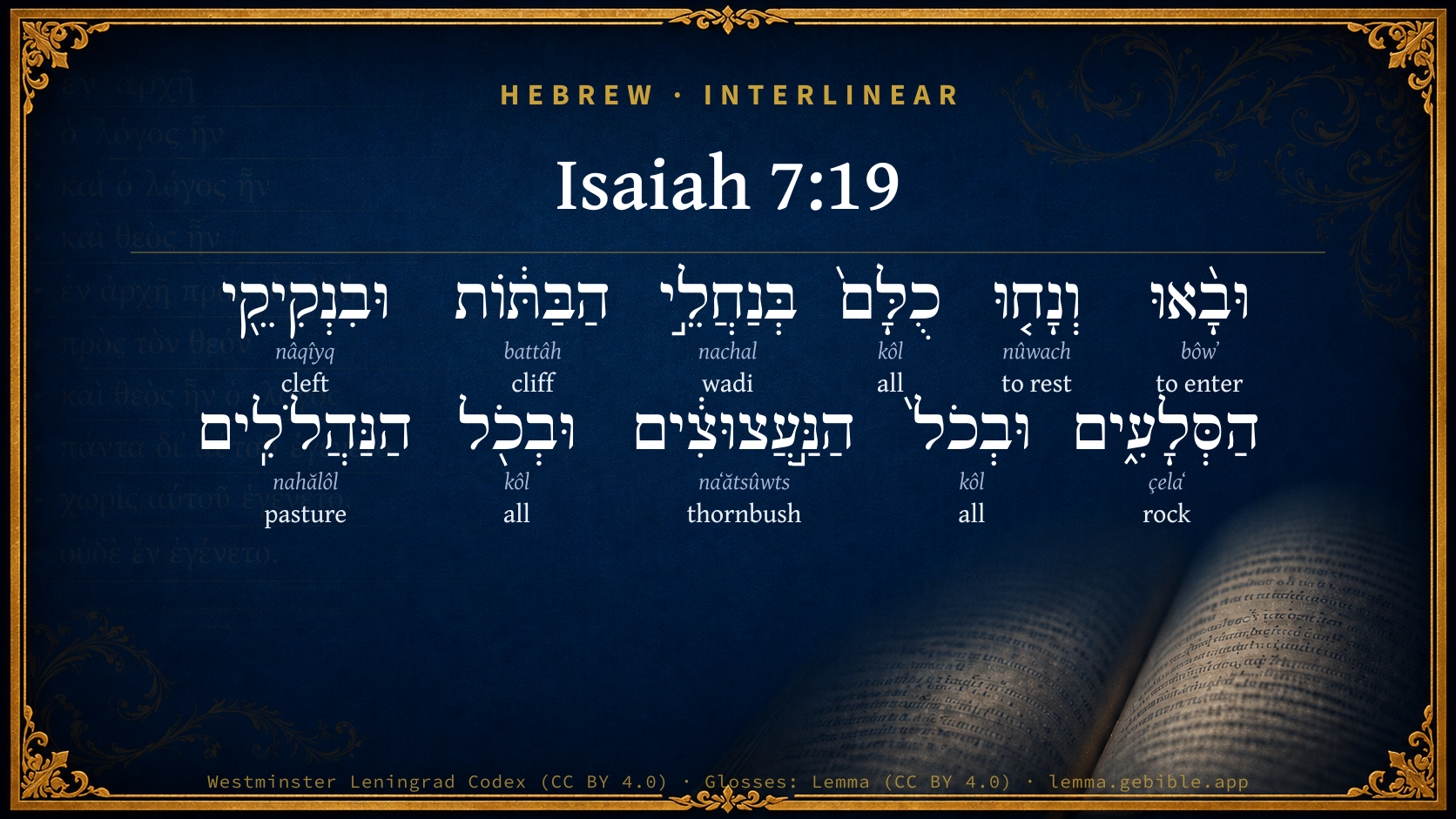
Hebrew (Westminster Leningrad Codex) Isaiah 7:19 appears in the Hebrew Old Testament. The text above is from the Westminster Leningrad Codex. Each word links to its Strong’s number, a concise gloss, and parsing drawn from the Open Scriptures Hebrew Bible morphology. Click any word for its full Brown-Driver-Briggs (BDB) entry.
Download image
Cite this verse

Isaiah 7:19 (World English Bible). Public Domain. Lemma interlinear Bible study tool, https://lemma.gebible.app/v/isaiah/7/19.

Show BibTeX & RIS
BibTeX
RIS
English Translation
They shall come, and shall all rest in the desolate valleys, in the clefts of the rocks, on all thorn-hedges, and on all pastures.
World English Bible · Public Domain
Highlights
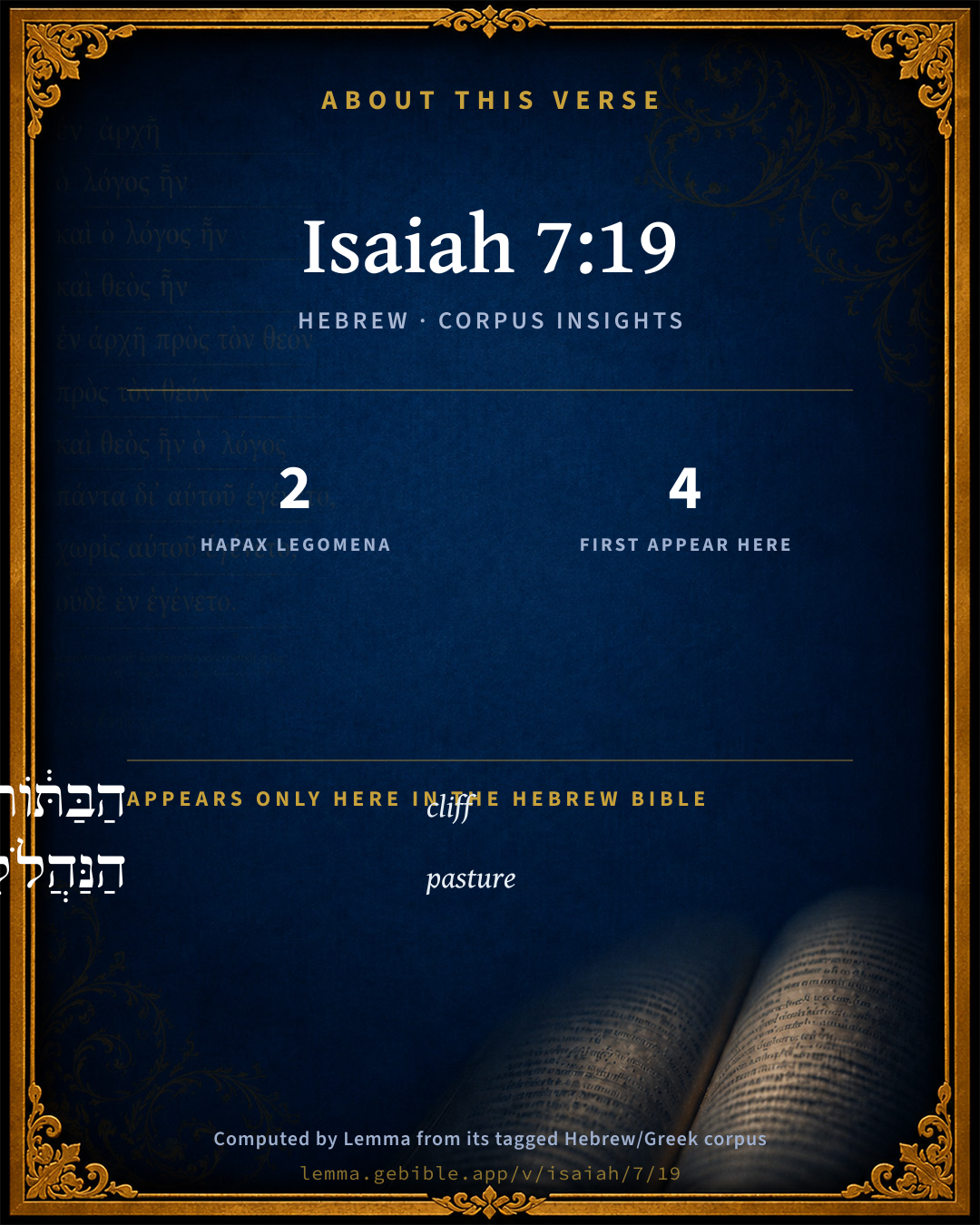
  • 2 hapax legomena — only here in the Hebrew Bible
  • 4 first appearances in the Hebrew Bible
Full analysis ↓
Download a study sheet

One document with this verse’s original text, its word-by-word gloss line, the meaning frame, cross-references with their text, attributed commentary, and full source and license credits — printable, and it pastes into notes with its structure intact.

This verse Autodidact and up

Study sheet (.html) Plain text (.txt)

A passage Seminary Student

Up to 50 verses in one chapter. A passage sheet keeps up to 6 commentary sources and 12 cross-references per verse, in the order this page ranks them, and says so on the sheet whenever that leaves anything out. Ask for a single verse and you get the Autodidact verse sheet above.

Everything on this page stays free to read, with no account — the sheet is a download of what is already on screen, not access to it.

Want to remove ads? Support Godless Engineer
Compare translations 3

The same verse in 3 English versions, stacked beneath the original-language interlinear above. Click any original word for its lexicon entry.

Each is an independent rendering of the whole verse — the interlinear is not word-aligned to these translations.

Highlighted words mark where these versions differ — a whole-verse word diff, not a word-by-word alignment.

  • World English Bible Public Domain
    They shall come, and shall all rest in the desolate valleys, in the clefts of the rocks, on all thorn-hedges, and on all pastures.
  • King James Version Public Domain
    And they shall come, and shall rest all of them in the desolate valleys, and in the holes of the rocks, and upon all thorns, and upon all bushes.
  • unfoldingWord Literal Text CC BY-SA 4.0
    And they will come, and they will settle down, all of them, in the valleys of desolation and in the clefts of the rocks and in all of the thornbushes and in all of the watering holes.

unfoldingWord Literal Text — © unfoldingWord, licensed CC BY-SA 4.0. Word-aligned USFM3 via Door43 (git.door43.org/unfoldingWord/en_ult).

Versions to compare (up to 4)

3 of 4 selected

Show all 18 translations

Every available English version of this verse, each an independent rendering of the whole verse.

  • World English Bible Public Domain
    They shall come, and shall all rest in the desolate valleys, in the clefts of the rocks, on all thorn-hedges, and on all pastures.
  • Berean Standard Bible Public Domain
    And they will all come and settle in the steep ravines and clefts of the rocks, in all the thornbushes and watering holes.
  • Majority Standard Bible Public Domain
    And they will all come and settle in the steep ravines and clefts of the rocks, in all the thornbushes and watering holes.
  • King James Version Public Domain
    And they shall come, and shall rest all of them in the desolate valleys, and in the holes of the rocks, and upon all thorns, and upon all bushes.
  • American Standard Version (1901) Public Domain
    And they shall come, and shall rest all of them in the desolate valleys, and in the clefts of the rocks, and upon all thorn-hedges, and upon all pastures.
  • Revised Version (1885) Public Domain
    And they shall come, and shall rest all of them in the desolate valleys, and in the holes of the rocks, and upon all thorns, and upon all pastures.
  • Geneva Bible (1599) Public Domain
    And they shall come and shall light all in the desolate valleys, and in the holes of the rockes, and vpon all thorny places, and vpon all bushy places.
  • Douay-Rheims (1899) Public Domain
    And they shall come, and shall all of them rest in the torrents of the valleys, and in the holes of the rocks, and upon all places set with shrubs, and in all hollow places.
  • Young's Literal Translation Public Domain
    And they have come, and rested all of them in the desolate valleys, And in holes of the rocks, and on all the thorns, And on all the commendable things.
  • Literal Standard Version CC BY-SA 4.0
    And they have come, and all of them rested in the desolate valleys, || And in holes of the rocks, and on all the thorns, || And on all the commendable things.
  • Unlocked Literal Bible CC BY-SA 4.0
    They will all come and settle down into all the gorges, into the clefts of the rocks, on all the thornbushes, and onto all the pastures.
  • unfoldingWord Literal Text CC BY-SA 4.0
    And they will come, and they will settle down, all of them, in the valleys of desolation and in the clefts of the rocks and in all of the thornbushes and in all of the watering holes.
  • Darby Bible Public Domain
    and they shall come and settle all of them in the desolate valleys, and in the holes of the rocks, and on all thorn-bushes, and on all the pastures.
  • World Messianic Bible Public Domain
    They shall come, and shall all rest in the desolate valleys, in the clefts of the rocks, on all thorn hedges, and on all pastures.
  • Webster's Bible Public Domain
    And they shall come, and shall rest all of them in the desolate valleys, and in the holes of the rocks, and upon all thorns, and upon all bushes.
  • Free Bible Version CC BY-SA 4.0
    They will all come and descend on the steep valleys and rock crevices, on all the thorn bushes and waterholes.
  • Bible in Basic English Public Domain
    And they will come, covering all the waste valleys, and the holes of the rocks, and the thorns, and all the watering-places.
  • JPS Tanakh (1917) Public Domain
    And they shall come, and shall rest all of them in the rugged valleys, and in the holes of the rocks, and upon all thorns, and upon all brambles.

Literal Standard Version (2020), Covenant Press — licensed CC BY-SA 4.0. Text via the HelloAO Bible API (eBible.org). Unlocked Literal Bible (unfoldingWord) — licensed CC BY-SA 4.0. Text via the HelloAO Bible API (eBible.org). unfoldingWord Literal Text — © unfoldingWord, licensed CC BY-SA 4.0. Word-aligned USFM3 via Door43 (git.door43.org/unfoldingWord/en_ult). Free Bible Version, Dr. Jonathan Gallagher — licensed CC BY-SA 4.0. Text via the HelloAO Bible API (eBible.org).

Word by word

More ways to search: Search by grammar → Find every occurrence → Compare this word →

Practice this passage: Drill this verse → Learn its vocabulary →

הַבַּתּ֔וֹת
battâh
H1327
“the · cliffs”
Particle, Definite Article + Noun, Common, Feminine, Plural, Absolute
Part of Speech
Particle + Noun
Type
Common
Gender
Feminine
Number
Plural
State
Absolute
Full BDB Definition

Origin: from an unused root (meaning to break in pieces)

TWOT: 298b

cliff, precipice, steep
  1. וּבָ֨אוּ bôwʼ H935 “and · to enter” Conjunction + Verb, Qal, Sequential Perfect, 3rd Person, Common, Plural
  2. וְנָח֤וּ nûwach H5117 “and · to rest” Conjunction + Verb, Qal, Sequential Perfect, 3rd Person, Common, Plural
  3. כֻלָּם֙ kôl H3605 “all · their” Noun, Common, Masculine, Singular, Construct + Suffix, Personal, 3rd Person, Masculine, Plural
  4. בְּנַחֲלֵ֣י nachal H5158 “in/at · wadis of” Preposition + Noun, Common, Masculine, Plural, Construct
  5. וּבִנְקִיקֵ֖י nâqîyq H5357 “and · in/at · clefts of” Conjunction + Preposition + Noun, Common, Masculine, Plural, Construct
  6. הַסְּלָעִ֑ים çelaʻ H5553 “the · rocks” Particle, Definite Article + Noun, Common, Masculine, Plural, Absolute
  7. וּבְכֹל֙ kôl H3605 “and · in/at · all of” Conjunction + Preposition + Noun, Common, Masculine, Singular, Construct
  8. הַנַּ֣עֲצוּצִ֔ים naʻătsûwts H5285 “the · thornbushes” Particle, Definite Article + Noun, Common, Masculine, Plural, Absolute
  9. וּבְכֹ֖ל kôl H3605 “and · in/at · all of” Conjunction + Preposition + Noun, Common, Masculine, Singular, Construct
  10. הַנַּהֲלֹלִֽים nahălôl H5097 “the · pastures” Particle, Definite Article + Noun, Common, Masculine, Plural, Absolute

About this verse

These counts appear in no published source. They are computed here, from the morphology-tagged text and Lemma’s own curated glosses. What Lemma adds →

11
words
9
distinct lemmas
Prophets
section

Notable vocabulary

2 hapax legomena — words that appear only here in the entire Hebrew Bible:

  • הַבַּתּ֔וֹת cliff H1327
  • הַנַּהֲלֹלִֽים pasture H5097

First appearance in Scripture

These words make their first canonical appearance in the Hebrew Bible here:

  • הַבַּתּ֔וֹת cliff H1327
  • וּבִנְקִיקֵ֖י cleft H5357
  • הַנַּ֣עֲצוּצִ֔ים thornbush H5285
  • הַנַּהֲלֹלִֽים pasture H5097

Shared distinctive vocabulary

הַנַּ֣עֲצוּצִ֔ים thornbush H5285 occurs in 2 verses of the Hebrew Bible. Also found in:

Grammatical profile

  • 2 verbs
  • 9 nouns

Verb forms

  • וּבָ֨אוּ Qal · Sequential Perfect
  • וְנָח֤וּ Qal · Sequential Perfect

Repetition

A word recurs within this verse — often emphatic in Hebrew:

  • כֻלָּם֙ all H3605 ×3

Hebrew & Septuagint length

In English translation the verse runs 24 words from the Hebrew and 26 from the Septuagint (LXX English) — closely comparable.

A rough comparison of the two English renderings, which tokenize alike — not a word-level alignment.

Word counts can differ between the Hebrew and the Greek without any difference in meaning — e.g. the Hebrew direct-object marker אֵת has no separate Greek word, and Greek often adds the article ὁ.

Cross-references

5

Topical passages linked to Isaiah 7:19 in the Treasury of Scripture Knowledge — connected by theme and wording, ordered by reader-vote popularity; previews shown in the World English Bible.

  • Isaiah 2:19 Men shall go into the caves of the rocks, And into the holes of the earth, From before the terror of Yahweh, And from the glory of his majesty, When he arises to shake the earth mightily.
  • Jeremiah 16:16 Behold, I will send for many fishermen, says Yahweh, and they shall fish them up; and afterward I will send for many hunters, and they shall hunt them from every mountain, and from every hill, and out of the clefts of the rocks.
  • 2 Chronicles 33:11 Therefore Yahweh brought on them the captains of the host of the king of Assyria, who took Manasseh in chains, and bound him with fetters, and carried him to Babylon.
  • Isaiah 2:21 To go into the caverns of the rocks, And into the clefts of the ragged rocks, From before the terror of Yahweh, And from the glory of his majesty, When he arises to shake the earth mightily.
  • Micah 7:17 They will lick the dust like a serpent. Like crawling things of the earth they shall come trembling out of their dens. They will come with fear to Yahweh our God, And will be afraid because of you.

Cross-references courtesy of OpenBible.info (CC BY 4.0).

Hebrew and Greek witnesses Masoretic Hebrew ↔ Greek Septuagint

The same verse in the two great witnesses to the Old Testament, shown verse-for-verse.

These are two independent witnesses, not word-aligned to each other, and the Septuagint is shown in lemma (dictionary) form.

Hebrew Isaiah 7:19 Masoretic · Westminster Leningrad Codex

וּבָ֨אוּ וְנָח֤וּ כֻלָּם֙ בְּנַחֲלֵ֣י הַבַּתּ֔וֹת וּבִנְקִיקֵ֖י הַסְּלָעִ֑ים וּבְכֹל֙ הַנַּ֣עֲצוּצִ֔ים וּבְכֹ֖ל הַנַּהֲלֹלִֽים

They shall come, and shall all rest in the desolate valleys, in the clefts of the rocks, on all thorn-hedges, and on all pastures.

World English Bible · Public Domain

Greek LXX Isaiah 7:19 Septuagint · lemma form

καί ἔρχομαι πᾶς καί ἀναπαύω ἐν ὁ φάραγξ ὁ χώρα καί ἐν ὁ τρώγλν ὁ πέτρος καί εἰς ὁ σπήλαιον καί εἰς πᾶς ῥαγάς καί ἐν πᾶς ξύλον

And they all shall enter into the clefts of the land, and into the holes of the rocks, and into the caves, and into every ravine.

LXX2012 (modern English Septuagint) · Public Domain

On this verse, Adam Clarke's Commentary discusses the Septuagint’s reading. Read the note in Commentary ↓

Hebrew: Westminster Leningrad Codex (CC BY 4.0). Greek: Septuagint (public domain); English from LXX2012 (modern English Septuagint) (Public Domain). How the Septuagint differs from the Hebrew →

Targum (Aramaic paraphrase)

1

The Targum is the ancient Jewish Aramaic paraphrase of the Hebrew Scriptures — an interpretive translation, not the Hebrew text itself. Onkelos (literal) and Pseudo-Jonathan (expansive) render the Torah, and Jonathan the Prophets. Coverage is partial: where no permissively-licensed English translation exists for a verse, only the Aramaic is shown. This is verse-level text, not a word-by-word alignment to the Hebrew.

  1. Targum Jonathan Prophets (Joshua–Malachi)
    וְיֵיתוּן וְיִשְׁרוּן כּוּלְהוֹן בִּרְחוֹבֵי קִרְוַיָא וּבִשְׁקִיפֵי כֵיפַיָא וּבְכֹל מַדְבְּרֵי נַעֲצוּצַיָא וּבְכֹל בָּתֵּי תוּשְׁבְּחָתָא:

    And they shall all of them come and dwell in the streets of the cities, and in the clefts of the rocks, and in all deserts full of thorn-hedges, and in all houses of praise.

    Targum Jonathan — Aramaic: “Mikraot Gedolot” (public domain). English: “Sefaria Community Translation” (CC0 1.0 (public-domain dedication)); “London "Chaldee Paraphrase," 1871” (public domain). Text via Sefaria.

Commentary

Notes on Isaiah 7:19 from classic Christian and Jewish commentators (each source and its license shown beneath its notes). The classic Christian expositions comment on the surrounding passage and are grouped to its opening verse, so a note may address several verses; the Jewish commentaries on the Tanakh (Rashi and others) are per-verse, so they appear only where the commentator wrote on this verse.

Lemma curates 59 commentaries, every one of them public domain or Creative Commons licensed, each selected and text-cleaned for this edition rather than reprinted as found. About our sources →

Trapp's Complete Commentary

John Trapp

Isa 7:19 And they shall come, and shall rest all of them in the desolate valleys, and in the holes of the rocks, and upon all thorns, and upon all bushes.

Ver. 19. And they shall come, and shall rest all of them.] As flies do upon flesh, and as bees upon trees. They shall seize all.

In the desolate valleys, &c.] Hereby is set forth, saith Calvin, that in no lurking place any of the Jews should be secreted or secured from their enemies, but that they shall range about and rage everywhere throughout the whole land. And, because all this is done at a "hiss," the backwardness of Christians is condemned, saith Musculus, who cannot by most earnest preaching of long continuance be brought to do as God requireth them.

John Trapp, A Commentary or Exposition upon All the Books of the Old and New Testament (1647–1656) — public domain. Text from a community e-Sword module.

Tyndale Open Study Notes

Tyndale Open Resources

7:19 Locations such as desolate valleys, caves, and thorny places were places of refuge for the desperate (see 2:10). However, Judah’s enemies would find them there.

Tyndale Open Study Notes — © Tyndale Open Resources, licensed CC BY-SA 4.0. Text via the HelloAO Bible API.

Geneva Bible (1599)

Geneva Bible translators

Signifying, that no place shall be free from them.

Geneva Bible (1599) marginal notes — public domain. Text via Bolls.life.

Jamieson, Fausset & Brown

Robert Jamieson, A. R. Fausset & David Brown

rest--image of flies and bees kept up. The enemy shall overspread the land everywhere, even in "desolate valleys."

thorns--wild, contrasted with "bushes," which were valued and objects of care (see Margin).

Jamieson, Fausset & Brown — Commentary Critical and Explanatory on the Whole Bible (1871) — public domain (CC PDM 1.0). Text via the HelloAO Bible API.

Adam Clarke's Commentary

Verse 19. Holes of the rocks - "Caverns"] So the Septuagint, Syriac, and Vulgate, whence Houbigant supposes the true reading to be הנחללים hannachalolim. One of my oldest MSS. reads הנחלולים hannochalolim.

Adam Clarke's Commentary on the Bible (1810–1826) — public domain. Text from a community e-Sword/MySword module.

Ellicott's Commentary for English Readers

(19) The desolate valleys . . .—The Hebrew adjective has rather the meaning of precipitous or steeply walled, and the noun that of torrent valley, like the Arabic wady. The whole verse is a graphic description of the characteristic features of the scenery of Judah.

A Bible Commentary for English Readers, edited by Charles John Ellicott (1878–1897) — public domain. Text from a community e-Sword module.

The Cambridge Bible for Schools and Colleges

gen. ed. J. J. S. Perowne

19. The figure is kept up. desolate valleys] rather, precipitous ravines (lit. “valleys of precipices”). upon all thorns … bushes] Render: upon all the thorn-bushes (Isa_55:13) and upon all the pastures. These are the places naturally frequented by insects.

The Cambridge Bible for Schools and Colleges (gen. ed. J. J. S. Perowne; Cambridge University Press, 1878–1918) — public domain. Text from a community e-Sword module.

John Gill's Exposition

And they shall come,.... The Egyptian and Assyrian armies, when the Lord calls for them in his providence, and his time is come to make use of them as a scourge to his people:

and shall rest all of them in the desolate valleys: made so by war; this is said in allusion to flies and bees resting on trees and flowers; and signifies that these armies, after long and tedious marches, should all of them, without being diminished by the way, enter the land of Judea, fill all places, and take up their abode there for a while:

and in the holes of the rocks. Kimchi thinks that the former phrase designs cities in valleys, and this fortified cities which are upon rocks:

and upon all thorns, and upon all bushes; in allusion to flies and bees. Kimchi interprets this of unwalled towns and villages. The Targum of the whole verse is,

"and they shall all of them come and dwell in the streets of the cities, and in the clifts of the rocks, and in all deserts full of sedges, and in all houses of praise.''

The sense is, that they should be in all cities, towns, and villages, whether fortified or not, and in all houses of high and low, rich and poor, in cottages and in palaces; there would be no place free from them, nor no escaping out of their hands.

John Gill's Exposition of the Whole Bible (1746–1763) — public domain (CC PDM 1.0). Text via the HelloAO Bible API.

Albert Barnes' Notes on the Bible

And they shall come - The idea in this verse is, that they would spread over the land, and lay it waste. The poetic image of flies and bees is kept up; meaning, that the armies would be so numerous as to occupy and infest all the land.

And shall rest - As bees do. Thus the “locusts” are said to have “rested” in all the land of Egypt; Exo 10:14.

In the desolate valleys - The word translated “valleys” usually means “a valley with a brook,” or a brook itself. The Chaldee translates it, ‘In the streets of cities.’ But the idea is derived from the habits of flies and bees. The meaning is, that they should fill all the land, as innumerable swarms of flies and bees - would settle down everywhere, and would infest or consume everything. Bees, probably, chose situations near to running streams. Virgil, in his directions about selecting a place for an apiary, gives the following among others:

At liquidi fontes, et stagna virentia musco

Adsint, et tennis fugiens per gramina rivus.

Georg. iv. 18, 19.

But there let pools invite with moss arrayed,

Clear fount and rill that purls along the glade.

Sotheby.

In the holes of the rocks - Probably the same image is referred to here. It is well known that in Judea, as well as elsewhere, bees were accustomed to live in the holes or caverns of the rocks. They were very numerous; and the figure here is, that the Assyrians would be numerous as the swarms of bees were in that land, even in the high and inaccessible rocks; compare Isa 2:19-21.

Upon all thorns - The image here is kept up of flies and bees resting on everything. “Thorns” here refer to those trees and shrubs that were of little value; but even on these they would rest.

All bushes - Hebrew ‘All trees that are commendable, or that are to be praised;’ see the margin. The word denotes those shrubs and trees that were objects of “praise;” that is, that were cultivated with great attention and care, in opposition to “thorns” that grew wild, and without cultivation, and that were of little value. The meaning of the passage is, that the land would be invaded in every part, and that everything, valuable or not, would be laid waste.

Albert Barnes' Notes on the Bible (1834–1885) — public domain. Text from a community e-Sword/MySword module.

Matthew Poole's English Annotations

They; the flies, and especially the bees.

Shall rest all of them; they shall have an easy victory; few or none of them shall be slain in the attempt.

The desolate valleys; either,

1. Such as were and had long been desolate. So it signifies the vast numbers of their enemies, which filled all places, both such as were well inhabited, and such as were in a great measure desolate. Or,

2. Such as they found very fruitful, but made them desolate.

The rocks; to which possibly the Israelites fled for refuge.

Bushes; which he mentions, partly because flies and bees use frequently to rest there, and partly to intimate that no place should escape the fury of this enemy.

Matthew Poole's English Annotations on the Holy Bible (1683–1685) — public domain. Text from a community e-Sword/MySword module.

Whedon's Commentary on the Bible

Daniel D. Whedon

19. They shall come — The armies “shall come.”

And shall rest all of them — They will settle down like bees in one part and like flies in another, in precipitous valleys, clefts of rocks, and in all thorn-hedges and pastures. A frightful figure of the different invasions of the armies of the two great countries, Assyria and Egypt. The great highway of these invaders of each other lay on the plain between the Mediterranean sea and the eastern foothills; but all the hill region also is here represented as covered, first by one army then by the other, but chiefly by the Assyrian and finally by the Babylonian armies.

Daniel D. Whedon (gen. ed.), Commentary on the Old and New Testaments (1874–1909) — public domain. Text from a community e-Sword module.

The Pulpit Commentary

And rest; or, settle. In the desolate valleys. Gesenius and Vance Smith translate "the precipitous valleys;" Mr. Cheyne, "the steeply walled valleys." But the cognate word used in Isa_5:6 can only mean "waste," which supports the rendering of the Authorized Version. The exact word used does not occur elsewhere. Upon all bushes; rather, upon all pastures.

The Pulpit Commentary (1880–1919), ed. H.D.M. Spence-Jones & Joseph S. Exell — public domain. Text from a community e-Sword module.

John Wesley's Explanatory Notes

Valleys - Such as they found fruitful, but made desolate. Rocks - To which possibly the Israelites fled for refuge. Bushes - Which he mentions because flies and bees use frequently to rest there; and to intimate, that no place should escape their fury.

John Wesley, Explanatory Notes Upon the Whole Bible (1754–1765) — public domain. Text via the GEBible commentary corpus.

J. A. Alexander on Isaiah

Joseph Addison Alexander

Carrying out the figures of the preceding verse, the Prophet, instead of simply saying that the land shall be infested by foreigners, represents it as completely filled with bees and flies, who are described as settling upon all the places commonly frequented by such insects. “And they come and rest (or settle) all of them in the desolate (or precipitous) valleys, and in the clefts of rocks, and in all thorn-hedges, and in all pastures.” The words seem naturally to express the general notion of a country overrun, infested, filled with foreigners and enemies, not only by military occupation but in other ways.

Joseph Addison Alexander, The Prophecies of Isaiah (1846–1847; New York: Scribner, 1870–1878) — public domain. Text from a community e-Sword module.

Rashi

Rabbi Shlomo Yitzchaki (Rashi)

in the desolate valleys Heb. נַחֲלֵי means valleys, i.e., fallow fields.

and in the clefts of the rocks to ambush. נְקִיקֵי is synonymous with נִקְרוֹתהַצּוּר.

and in the thornbushes the places of the thorns called broces [briars]. And similarly (infra 55:13): “Instead of the thornbush (הנַּעֲצוּץ) the fir tree shall come up.”

the shrines houses of praise [from Jonathan].

Rashi on the Tanakh — English translations: “The Judaica Press complete Tanach with Rashi, translated by A. J. Rosenberg” (CC BY 4.0); “Pentateuch with Rashi's commentary by M. Rosenbaum and A.M. Silbermann, 1929-1934” (public domain); “The Metsudah Tanach series, Lakewood, N.J” (CC BY 4.0); and “The Book of Joshua, Metsudah Publications, 1997” (CC BY 4.0). Text via Sefaria.

Ibn Ezra

Rabbi Abraham ibn Ezra

וְנָחֽוּ And shall rest. Accent on the last syllable; comp. שָֽׂמוּ (Gen. 40:15), וְשָׂמֽוּ (Num. 6:27).

בתות Desolate places. Comp. בתה desolate (5:6).

ובנקיקי And in the holes of. Hapax legomenon; its meaning is found by the context.

נעצוצים Thorns Trees that bear no fruit. Comp. נעצוץ (55:13) thorn.

נהלולים Bushes. Hap. leg.—They will be so many that they will encamp even in uninhabited and desolate places.

Ibn Ezra on the Tanakh — English translations: “Sefaria Community Translation” (CC0 1.0 (public-domain dedication)); “Yalkut, Sifsei Chachomim Chumash, Metsudah Publications, 2009” (CC BY 4.0); and “Commentary of Ibn Ezra on Isaiah - trans. by M. Friedlander, 1873” (public domain). Text via Sefaria.

Lesson kit

Teaching starters — assembled from the data on this page, not authored interpretation. Every prompt links to the verse data it draws on. Edit before teaching.

Isaiah, in the Prophets, opens this verse with 11 words (9 distinct Hebrew lemmas). Its most distinctive word is battâh (“cliff”). A historical commentator’s framing appears above. Read the whole chapter for the surrounding context.

Discussion questions

  1. What does “cliff” (battâh) contribute to the verse as a whole?
  2. This verse holds 2 words here found nowhere else in the Hebrew Bible. What might the rare words draw attention to?
  3. 4 words here appear for the first time in Scripture. What is being introduced at this debut?
  4. Isaiah 55:13 shares the word «thornbush» with this verse. How do the two illuminate each other?
  5. “all” occurs 3× in this one verse. What is the effect of the repetition?
  6. The translations on this page render this verse differently — a whole-verse word diff, not a word-by-word alignment. What might account for the different wordings?
  7. The verb «וּבָ֨אוּ» is Qal Sequential Perfect. How does its form color the action?
  8. Reading how Trapp's Complete Commentary and Tyndale Open Study Notes read this verse, where do the two commentators agree and where do they part?

Things to notice

  • 2 words in this verse appear nowhere else in the Hebrew Bible.
  • 4 words make their first canonical appearance in Scripture here.
  • These translations choose different wording for 16 words in this verse.
  • “all” occurs 3× in this single verse.
  • 9 distinct Hebrew lemmas span 11 words in this verse.

Reading settings

Reading text

Shown beneath each verse's original-language words.

Old Testament
Old Testament edition

Read the OT as the Masoretic Hebrew (MT) or the Greek Septuagint (LXX).

English shown for the Greek Septuagint (in the Hebrew ↔ Greek comparison).

Comparing translations? Open the Compare panel on any verse page to stack up to four side by side.