
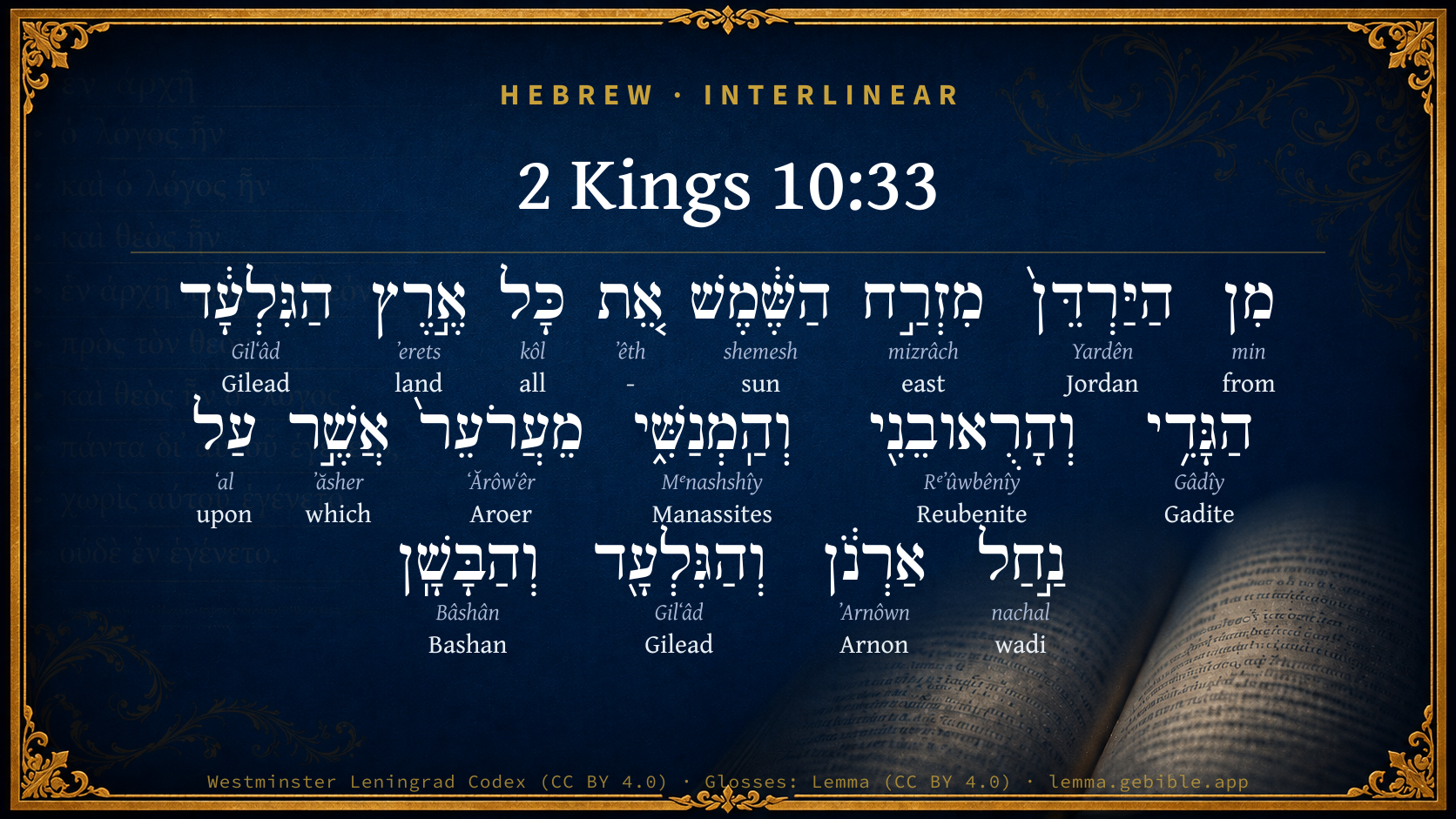
2 Kings 10:33

Hebrew (Westminster Leningrad Codex) 2 Kings 10:33 appears in the Hebrew Old Testament. The text above is from the Westminster Leningrad Codex. Each word links to its Strong’s number, a concise gloss, and parsing drawn from the Open Scriptures Hebrew Bible morphology. Click any word for its full Brown-Driver-Briggs (BDB) entry.
Download image
Cite this verse

2 Kings 10:33 (World English Bible). Public Domain. Lemma interlinear Bible study tool, https://lemma.gebible.app/v/2-kings/10/33.

Show BibTeX & RIS
BibTeX
RIS
English Translation
from the Jordan eastward, all the land of Gilead, the Gadites, and the Reubenites, and the Manassites, from Aroer, which is by the valley of the Arnon, even Gilead and Bashan.
World English Bible · Public Domain
Download a study sheet

One document with this verse’s original text, its word-by-word gloss line, the meaning frame, cross-references with their text, attributed commentary, and full source and license credits — printable, and it pastes into notes with its structure intact.

This verse Autodidact and up

Study sheet (.html) Plain text (.txt)

A passage Seminary Student

Up to 50 verses in one chapter. A passage sheet keeps up to 6 commentary sources and 12 cross-references per verse, in the order this page ranks them, and says so on the sheet whenever that leaves anything out. Ask for a single verse and you get the Autodidact verse sheet above.

Everything on this page stays free to read, with no account — the sheet is a download of what is already on screen, not access to it.

Want to remove ads? Support Godless Engineer
Compare translations 3

The same verse in 3 English versions, stacked beneath the original-language interlinear above. Click any original word for its lexicon entry.

Each is an independent rendering of the whole verse — the interlinear is not word-aligned to these translations.

Highlighted words mark where these versions differ — a whole-verse word diff, not a word-by-word alignment.

  • World English Bible Public Domain
    from the Jordan eastward, all the land of Gilead, the Gadites, and the Reubenites, and the Manassites, from Aroer, which is by the valley of the Arnon, even Gilead and Bashan.
  • King James Version Public Domain
    From Jordan eastward, all the land of Gilead, the Gadites, and the Reubenites, and the Manassites, from Aroer, which is by the river Arnon, even Gilead and Bashan.
  • unfoldingWord Literal Text CC BY-SA 4.0
    from the Jordan from the rising of the sun, all of the land of Gilead, the Gadite and the Reubenite and the Manassite, from Aroer, which near the valley of Arnon, and Gilead and Bashan.

unfoldingWord Literal Text — © unfoldingWord, licensed CC BY-SA 4.0. Word-aligned USFM3 via Door43 (git.door43.org/unfoldingWord/en_ult).

Versions to compare (up to 4)

3 of 4 selected

Show all 18 translations

Every available English version of this verse, each an independent rendering of the whole verse.

  • World English Bible Public Domain
    from the Jordan eastward, all the land of Gilead, the Gadites, and the Reubenites, and the Manassites, from Aroer, which is by the valley of the Arnon, even Gilead and Bashan.
  • Berean Standard Bible Public Domain
    from the Jordan eastward through all the land of Gilead (the region of Gad, Reuben, and Manasseh), and from Aroer by the Arnon Valley through Gilead to Bashan.
  • Majority Standard Bible Public Domain
    from the Jordan eastward through all the land of Gilead (the region of Gad, Reuben, and Manasseh), and from Aroer by the Arnon Valley through Gilead to Bashan.
  • King James Version Public Domain
    From Jordan eastward, all the land of Gilead, the Gadites, and the Reubenites, and the Manassites, from Aroer, which is by the river Arnon, even Gilead and Bashan.
  • American Standard Version (1901) Public Domain
    from the Jordan eastward, all the land of Gilead, the Gadites, and the Reubenites, and the Manassites, from Aroer, which is by the valley of the Arnon, even Gilead and Bashan.
  • Revised Version (1885) Public Domain
    from Jordan eastward, all the land of Gilead, the Gadites, and the Reubenites, and the Manassites, from Aroer, which is by the valley of Arnon, even Gilead and Bashan.
  • Geneva Bible (1599) Public Domain
    From Iorden Eastward, euen all the land of Gilead, the Gadites, and the Reubenites, and them that were of Manasseh, from Aroer (which is by the riuer Arnon) and Gilead and Bashan.
  • Douay-Rheims (1899) Public Domain
    From the Jordan eastward, all the land of Galaad, and Gad, and Ruben, and Manasses, from Aroer, which is upon the torrent Amen, and Galaad, and Basan.
  • Young's Literal Translation Public Domain
    from the Jordan, at the sun-rising, the whole land of Gilead, of the Gadite, and the Reubenite, and the Manassahite (from Aroer, that `is' by the brook Arnon), even Gilead and Bashan.
  • Literal Standard Version CC BY-SA 4.0
    from the Jordan, at the sun-rising: the whole land of Gilead, of the Gadite, and the Reubenite, and the Manassite (from Aroer, that [is] by the Brook of Arnon), even Gilead and Bashan.
  • Unlocked Literal Bible CC BY-SA 4.0
    from the Jordan eastward, all the land of Gilead, the Gadites, and the Reubenites, and the Manassites, from Aroer, which is by the Valley of the Arnon, through Gilead to Bashan.
  • unfoldingWord Literal Text CC BY-SA 4.0
    from the Jordan from the rising of the sun, all of the land of Gilead, the Gadite and the Reubenite and the Manassite, from Aroer, which near the valley of Arnon, and Gilead and Bashan.
  • Darby Bible Public Domain
    from the Jordan eastward, all the land of Gilead, the Gadites, and the Reubenites, and the Manassites, from Aroer, which is by the river Arnon, both Gilead and Bashan.
  • World Messianic Bible Public Domain
    from the Jordan eastward, all the land of Gilead, the Gadites, and the Reubenites, and the Manassites, from Aroer, which is by the valley of the Arnon, even Gilead and Bashan.
  • Webster's Bible Public Domain
    From Jordan eastward, all the land of Gilead, the Gadites, and the Reubenites, and the Manassites, from Aroer, which is by the river Arnon, even Gilead and Bashan.
  • Free Bible Version CC BY-SA 4.0
    east of the Jordan, all the land of Gilead (the region occupied by Gad, Reuben, and Manasseh), and from Aroer through the Arnon Valley up to Gilead and Bashan.
  • Bible in Basic English Public Domain
    East of Jordan, in all the land of Gilead, the Gadites and the Reubenites and the Manassites, from Aroer by the valley of the Arnon, all Gilead and Bashan.
  • JPS Tanakh (1917) Public Domain
    from the Jordan eastward, all the land of Gilead, the Gadites, and the Reubenites, and the Manassites, from Aroer, which is by the valley of Arnon, even Gilead and Bashan.

Literal Standard Version (2020), Covenant Press — licensed CC BY-SA 4.0. Text via the HelloAO Bible API (eBible.org). Unlocked Literal Bible (unfoldingWord) — licensed CC BY-SA 4.0. Text via the HelloAO Bible API (eBible.org). unfoldingWord Literal Text — © unfoldingWord, licensed CC BY-SA 4.0. Word-aligned USFM3 via Door43 (git.door43.org/unfoldingWord/en_ult). Free Bible Version, Dr. Jonathan Gallagher — licensed CC BY-SA 4.0. Text via the HelloAO Bible API (eBible.org).

Word by word

More ways to search: Search by grammar → Find every occurrence → Compare this word →

Practice this passage: Drill this verse → Learn its vocabulary →

וְהַֽמְנַשִּׁ֑י
Mᵉnashshîy
H4520
“and · the · Manassites”
Conjunction + Particle, Definite Article + Noun, Gentilic, Masculine, Singular, Absolute
Part of Speech
Conjunction + Particle + Noun
Type
Gentilic
Gender
Masculine
Number
Singular
State
Absolute
Full BDB Definition

Origin: from H4519

TWOT: None

Manassites = Manasseh " causing to forget" - descendants of Manasseh, son of Joseph and grandson of Jacob - specifically used only of that half that lived east of the Jordan
  1. מִן min H4480 “from” Preposition
  2. הַיַּרְדֵּן֙ Yardên H3383 “the · Jordan” Particle, Definite Article + Noun, Proper
  3. מִזְרַ֣ח mizrâch H4217 “east of” Noun, Common, Masculine, Singular, Construct
  4. הַשֶּׁ֔מֶשׁ shemesh H8121 “the · sun” Particle, Definite Article + Noun, Common, Both, Singular, Absolute
  5. אֵ֚ת ʼêth H853 “-” Particle, Direct Object
  6. כָּל kôl H3605 “all of” Noun, Common, Masculine, Singular, Construct
  7. אֶ֣רֶץ ʼerets H776 “land of” Noun, Common, Both, Singular, Construct
  8. הַגִּלְעָ֔ד Gilʻâd H1568 “the · Gilead” Particle, Definite Article + Noun, Proper
  9. הַגָּדִ֥י Gâdîy H1425 “the · Gadite” Particle, Definite Article + Noun, Gentilic, Masculine, Singular, Absolute
  10. וְהָרֻאובֵנִ֖י Rᵉʼûwbênîy H7206 “and · the · Reubenite” Conjunction + Particle, Definite Article + Noun, Gentilic, Masculine, Singular, Absolute
  11. מֵעֲרֹעֵר֙ ʻĂrôwʻêr H6177 “from · Aroer” Preposition + Noun, Proper
  12. אֲשֶׁ֣ר ʼăsher H834 “which” Particle, Relative
  13. עַל ʻal H5921 “upon” Preposition
  14. נַ֣חַל nachal H5158 “wadi of” Noun, Common, Masculine, Singular, Construct
  15. אַרְנֹ֔ן ʼArnôwn H769 “Arnon” Noun, Proper
  16. וְהַגִּלְעָ֖ד Gilʻâd H1568 “and · the · Gilead” Conjunction + Particle, Definite Article + Noun, Proper
  17. וְהַבָּשָֽׁן Bâshân H1316 “and · the · Bashan” Conjunction + Particle, Definite Article + Noun, Proper

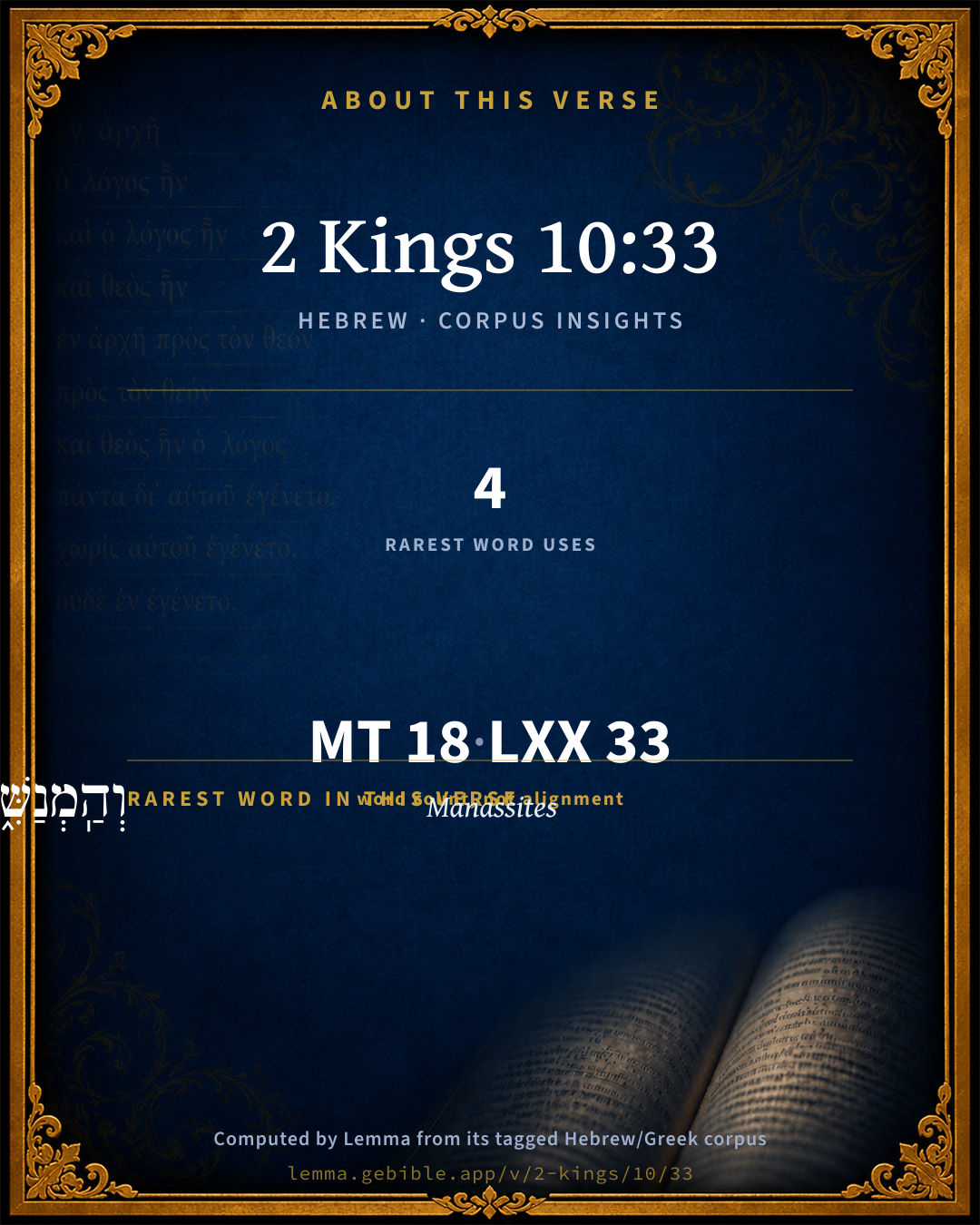
About this verse

These counts appear in no published source. They are computed here, from the morphology-tagged text and Lemma’s own curated glosses. What Lemma adds →

18
words
17
distinct lemmas
Historical
section

Notable vocabulary

The rarest word here is וְהַֽמְנַשִּׁ֑י Manassites H4520 — appearing just 4 times in the whole Hebrew Bible.

Shared distinctive vocabulary

וְהַֽמְנַשִּׁ֑י Manassites H4520 occurs in 4 verses of the Hebrew Bible. Also found in:

Grammatical profile

  • 14 nouns
  • 2 prepositions
  • 2 particles

Repetition

A word recurs within this verse — often emphatic in Hebrew:

  • הַגִּלְעָ֔ד Gilead H1568 ×2

Hebrew & Septuagint length

In English translation the verse runs 31 words from the Hebrew and 37 from the Septuagint (LXX English) — closely comparable.

A rough comparison of the two English renderings, which tokenize alike — not a word-level alignment.

Word counts can differ between the Hebrew and the Greek without any difference in meaning — e.g. the Hebrew direct-object marker אֵת has no separate Greek word, and Greek often adds the article ὁ.

In the original languages it is 18 Hebrew tokens and 33 Greek tokens — but the two are counted differently (Hebrew bundles its prefixes and suffixes into one token; the Greek is in lemma form), so that isn’t a like-for-like length.

Cross-references

5

Topical passages linked to 2 Kings 10:33 in the Treasury of Scripture Knowledge — connected by theme and wording, ordered by reader-vote popularity; previews shown in the World English Bible.

  • Amos 1:3–4 Thus says Yahweh: "For three transgressions of Damascus, yes, for four, I will not turn away its punishment; Because they have threshed Gilead with threshing instruments of iron;
  • Deuteronomy 2:36 From Aroer, which is on the edge of the valley of the Arnon, and [from] the city that is in the valley, even to Gilead, there was not a city too high for us; Yahweh our God delivered up all before us:
  • Numbers 32:33–42 Moses gave to them, even to the children of Gad, and to the children of Reuben, and to the half-tribe of Manasseh the son of Joseph, the kingdom of Sihon king of the Amorites, and the kingdom of Og king of Bashan, the land, according to the cities of it with [their] borders, even the cities of the land round about.
  • Deuteronomy 3:12–17 This land we took in possession at that time: from Aroer, which is by the valley of the Arnon, and half the hill-country of Gilead, and the cities of it, gave I to the Reubenites and to the Gadites:
  • Joshua 13:9–12 from Aroer, that is on the edge of the valley of the Arnon, and the city that is in the middle of the valley, and all the plain of Medeba to Dibon;

Cross-references courtesy of OpenBible.info (CC BY 4.0).

Hebrew and Greek witnesses Masoretic Hebrew ↔ Greek Septuagint

The same verse in the two great witnesses to the Old Testament, shown verse-for-verse.

These are two independent witnesses, not word-aligned to each other, and the Septuagint is shown in lemma (dictionary) form.

Hebrew 2 Kings 10:33 Masoretic · Westminster Leningrad Codex

מִן הַיַּרְדֵּן֙ מִזְרַ֣ח הַשֶּׁ֔מֶשׁ אֵ֚ת כָּל אֶ֣רֶץ הַגִּלְעָ֔ד הַגָּדִ֥י וְהָרֻאובֵנִ֖י וְהַֽמְנַשִּׁ֑י מֵעֲרֹעֵר֙ אֲשֶׁ֣ר עַל נַ֣חַל אַרְנֹ֔ן וְהַגִּלְעָ֖ד וְהַבָּשָֽׁן

from the Jordan eastward, all the land of Gilead, the Gadites, and the Reubenites, and the Manassites, from Aroer, which is by the valley of the Arnon, even Gilead and Bashan.

World English Bible · Public Domain

Greek LXX 2 Kings 10:33 Septuagint · lemma form

ἀπό ὁ ἰορδάνης κατά ἀνατολή ἥλιος πᾶς ὁ γῆ γαλαάδ ὁ γαδδι καί ὁ ρουβην καί ὁ μανασσή ἀπό αροηρ ὅς εἰμί ἐπί ὁ χεῖλος χειμάρρους αρνων καί ὁ γαλαάδ καί ὁ βασαν

from Jordan eastward all the land of Galaad belonging to the Gadites, of Gaddi and that of Ruben, and of Manasses, from Aroer, which is on the brink of the brook of Arnon, and Galaad and Basan.

LXX2012 (modern English Septuagint) · Public Domain

Hebrew: Westminster Leningrad Codex (CC BY 4.0). Greek: Septuagint (public domain); English from LXX2012 (modern English Septuagint) (Public Domain). How the Septuagint differs from the Hebrew →

Targum (Aramaic paraphrase)

1

The Targum is the ancient Jewish Aramaic paraphrase of the Hebrew Scriptures — an interpretive translation, not the Hebrew text itself. Onkelos (literal) and Pseudo-Jonathan (expansive) render the Torah, and Jonathan the Prophets. Coverage is partial: where no permissively-licensed English translation exists for a verse, only the Aramaic is shown. This is verse-level text, not a word-by-word alignment to the Hebrew.

  1. Targum Jonathan Prophets (Joshua–Malachi)
    מִן יַרְדְנָא מַדְנַח שִׁמְשָׁא יַת כָּל אַרְעָא גִלְעָד שִׁבְטָא גָד וְשִׁבְטָא רְאוּבֵן וְשִׁבְטָא דִמְנַשֶׁה מֵעֲרוֹעֵר דְעַל כֵּיף נַחֲלָא דְאַרְנוֹן וְאַרְעָא גִלְעָד וּמַתְנָן:

    (no public-domain English translation for this verse)

    Targum Jonathan — Aramaic: “Mikraot Gedolot” (public domain). English: “Sefaria Community Translation” (CC0 1.0 (public-domain dedication)); “London "Chaldee Paraphrase," 1871” (public domain). Text via Sefaria.

Commentary

Notes on 2 Kings 10:33 from classic Christian and Jewish commentators (each source and its license shown beneath its notes). The classic Christian expositions comment on the surrounding passage and are grouped to its opening verse, so a note may address several verses; the Jewish commentaries on the Tanakh (Rashi and others) are per-verse, so they appear only where the commentator wrote on this verse.

Lemma curates 59 commentaries, every one of them public domain or Creative Commons licensed, each selected and text-cleaned for this edition rather than reprinted as found. About our sources →

Trapp's Complete Commentary

John Trapp

2Ki 10:33 From Jordan eastward, all the land of Gilead, the Gadites, and the Reubenites, and the Manassites, from Aroer, which [is] by the river Arnon, even Gilead and Bashan.

Ver. 33. All the land of Gilead.] A rich and fruitful country: not Ramothgilead only, lately recovered by Joram; but all that region beyond Jordan, held by the Syrians for about sixty years after. {2Ki 14:25}

John Trapp, A Commentary or Exposition upon All the Books of the Old and New Testament (1647–1656) — public domain. Text from a community e-Sword module.

Ellicott's Commentary for English Readers

(33) From Jordan eastward.—This verse defines the border land which Hazael ravaged, and, in fact, occupied. It was the land east of the Jordan, that is to say, all the land of Gilead, which was the territory of Reuben, Gad, and the half tribe of Manasseh.

From Aroer.—Aroer, now ‘Arâ‘îr, on the Arnon, was the southern limit of Gilead, which extended northward to Mount Hermon, and included Bashan. “Even (both) Gilead and Bashan,” is added to make it clear that the whole of the land east of the Jordan, and not merely Gilead in the narrower sense, was conquered by Hazael. These conquests of Hazael were characterised by great barbarity. (Comp. Amo_1:3-5, and Elisha’s prediction of the same, 2Ki_8:12, supra.) Ewald thinks Hazael took advantage of the internal troubles at the outset of the reign to effect his conquests. But a man of Jehu’s energy must soon have established domestic tranquillity.

A Bible Commentary for English Readers, edited by Charles John Ellicott (1878–1897) — public domain. Text from a community e-Sword module.

The Cambridge Bible for Schools and Colleges

gen. ed. J. J. S. Perowne

33. Gilead] This country lay between Bashan on the north, and Moab and Ammon on the south. It was of a mountainous character, and was chosen by the tribes of Reuben, Gad and Manasseh because it was so well adapted for the pasturage of their numerous flocks. These tribes were all included at this time in Hazael’s conquest, and so the phrase ‘cut Israel short’ was fully borne out, for one quarter of the whole ten tribes was thus taken from her.

Aroer] This city was on the south boundary of the tribe of Reuben, which was the southernmost of the three trans-Jordanic tribes. Thus it marks the extreme limit in that direction of the conquests here mentioned, while Bashan marks that on the north. Nothing was left to Israel, east of the Jordan, for Bashan was the northern part of the land assigned to the half tribe of Manasseh.

Arnon] This torrent bed, full of water in the rainy season, but dry in summer, after the character of all the clefts in the east of Jordan, is wrongly described by ‘river’ of A.V. In R.V. it is rendered valley of Arnon. It formed the border between Israel and Moab.

Bashan] This district, which like Gilead was mountainous, lay between Gilead and Mt Hermon. It was well wooded also. ‘The oaks of Bashan’ are frequently mentioned, and so are the cattle, the ‘fat bulls of Bashan’. The loss of such a district must have been very fatal to Israel. After this notice Bashan, which in the early days is often spoken of in connexion with Og, the king whom the Israelites vanquished on entering the land, disappears from the Bible history. Hazael’s conquest was never recovered.

The Cambridge Bible for Schools and Colleges (gen. ed. J. J. S. Perowne; Cambridge University Press, 1878–1918) — public domain. Text from a community e-Sword module.

John Gill's Exposition

And the time that Jehu reigned was twenty and eight years. Which was longer than any king of Israel had reigned.

Next: 2 Kings Chapter 11

John Gill's Exposition of the Whole Bible (1746–1763) — public domain (CC PDM 1.0). Text via the HelloAO Bible API.

Albert Barnes' Notes on the Bible

The loss of the entire trans-Jordanic territory seems to be intended, or at any rate its complete ruin and devastation (compare marginal reference “y”). This was the home of the tribes of Reuben and Gad, and of the half tribe of Manasseh Jos 22:1-9. It was more accessible from Damascus than the region west of the river.

Aroer - There were several places of this name. The one here mentioned is the most famous (compare Deu 2:36 note).

Even Gilead and Bashan - The writer had previously called the whole territory “Gilead;” now he distinguishes it, more accurately, into Gilead, the southern, and Bashan, the northern region 1Ki 4:13, 1Ki 4:19.

Albert Barnes' Notes on the Bible (1834–1885) — public domain. Text from a community e-Sword/MySword module.

Haydock's Catholic Bible Commentary

Aroer. See Josue xiii. 25. This was a most severe scourge, (Menochius) as all the eastern tribes were lost to Israel. (Haydock)

George Leo Haydock (1774–1849), Haydock's Catholic Family Bible and Commentary, 1859 edition — public domain. Excludes Psalms (Douay-Rheims chapter numbering differs from Protestant) and Deuterocanonical books (Catholic canon only).

Matthew Poole's English Annotations

From Jordan eastward, to wit, from the land of Canaan.

Matthew Poole's English Annotations on the Holy Bible (1683–1685) — public domain. Text from a community e-Sword/MySword module.

Whedon's Commentary on the Bible

Daniel D. Whedon

33. From Jordan eastward — This exposed frontier, occupied by the tribes of Reuben, Gad, and Manasseh, was the first to fall into the hands of foreigners. They were more nomadic, and, from constant contact with the neighbouring nations, lost the more rapidly their sympathy with the western tribes. Hazael smote and subjugated them, but Pul and Tiglath-pileser carried them away into captivity. See 1Ch_5:25-26.

Daniel D. Whedon (gen. ed.), Commentary on the Old and New Testaments (1874–1909) — public domain. Text from a community e-Sword module.

The Pulpit Commentary

From Jordan eastward. The territory west of the Jordan was not attacked at this time. Hazael"s expeditious were directed against the trans-Jordanic region, the seats of the three tribes of Reuben, Gad, and Manasseh. This tract was far easier of access than the other, and was more tempting, being the richest part of Palestine. The region comprised all the land of Gileadi.e. the more southern region, reaching from the borders of Moab on the south to the Hieromax or Sheriat-el-Mandhur upon the north, the proper land of the Gadites, and the Reubenites, and a portion of the Manassites together with Bashan, the more northern region, which belonged wholly to Manassehfrom Aroer (now Arair), which is by the river Arnon the Wady-el-Mojeb, which was the boundary between Israel and Moab, (Num_21:13, Num_21:24) both in the earlier and (Isa_16:2) in the later timeseven Gilead and Bashan. There is other evidence, besides this, that Hazael was one of the most warlike of the Syrian kings. We find him, on the Black Obelisk of Shalmaneser II, mentioned as a stubborn adversary of the Assyrian arms. In the seventeenth campaign of Shalmaneser, a great battle was fought between the two monarchs. Hazael brought into the field more than twelve hundred chariots, but was defeated, and obliged to retreat, his camp falling into the hands of the enemy ("Records of the Past," vol. 5. p. 84). Four years later Shalmaneser invaded Hazael"s territory, and took, according to his own account (ibid., p. 35), four cities or fortresses belonging to him. He does not claim, however, to have made him a tributary; and By his later annals it is evident that he avoided further contest, preferring to turn his arms in other directions. (On Hazael"s campaign in Philistia, and designs against Jerusalem, see the comment upon (2Ki_12:17, 2Ki_12:18)

The Pulpit Commentary (1880–1919), ed. H.D.M. Spence-Jones & Joseph S. Exell — public domain. Text from a community e-Sword module.

Lesson kit

Teaching starters — assembled from the data on this page, not authored interpretation. Every prompt links to the verse data it draws on. Edit before teaching.

2 Kings, in the Historical, opens this verse with 18 words (17 distinct Hebrew lemmas). Its most distinctive word is Mᵉnashshîy (“Manassites”). A historical commentator’s framing appears above. Read the whole chapter for the surrounding context.

Discussion questions

  1. What does “Manassites” (Mᵉnashshîy) contribute to the verse as a whole?
  2. How does Deuteronomy 4:43, which shares the word «Manassites», read alongside this verse?
  3. What does the repetition of “Gilead” (2× in this one verse) do in this verse?
  4. These translations render this verse differently; the difference is in the English rendering, not the original. What questions does that raise?
  5. Compare how Trapp's Complete Commentary and Ellicott's Commentary for English Readers read this verse. Where do they agree or differ?

Things to notice

Reading settings

Reading text

Shown beneath each verse's original-language words.

Old Testament
Old Testament edition

Read the OT as the Masoretic Hebrew (MT) or the Greek Septuagint (LXX).

English shown for the Greek Septuagint (in the Hebrew ↔ Greek comparison).

Comparing translations? Open the Compare panel on any verse page to stack up to four side by side.