
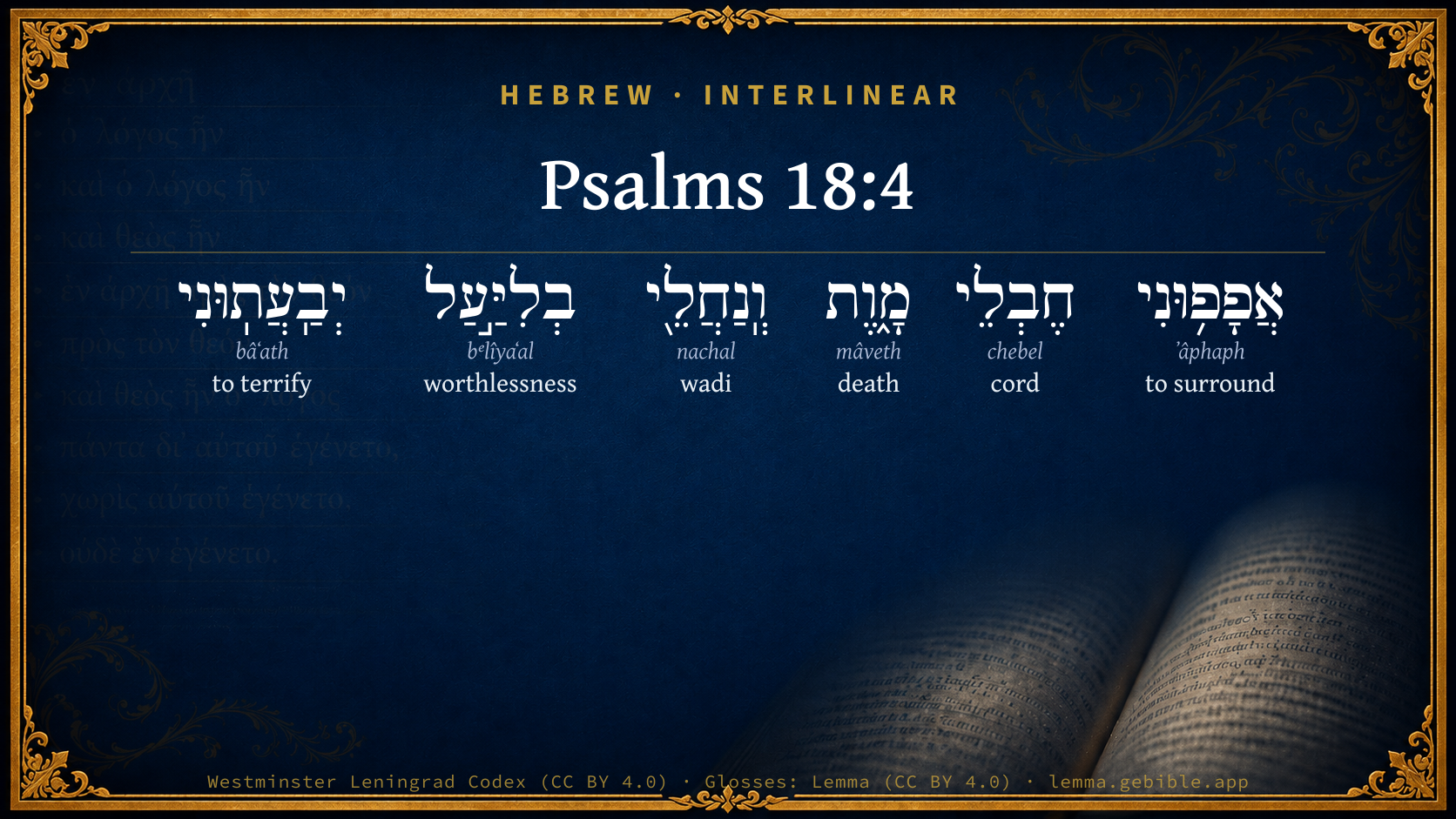
Psalms 18:4

Hebrew (Westminster Leningrad Codex) Psalms 18:4 appears in the Hebrew Old Testament. The text above is from the Westminster Leningrad Codex. Each word links to its Strong’s number, a concise gloss, and parsing drawn from the Open Scriptures Hebrew Bible morphology. Click any word for its full Brown-Driver-Briggs (BDB) entry.
Download image
Cite this verse

Psalms 18:4 (World English Bible). Public Domain. Lemma interlinear Bible study tool, https://lemma.gebible.app/v/psalms/18/4.

Show BibTeX & RIS
BibTeX
RIS
English Translation
The cords of death surrounded me. The floods of ungodliness made me afraid.
World English Bible · Public Domain
Download a study sheet

One document with this verse’s original text, its word-by-word gloss line, the meaning frame, cross-references with their text, attributed commentary, and full source and license credits — printable, and it pastes into notes with its structure intact.

This verse Autodidact and up

Study sheet (.html) Plain text (.txt)

A passage Seminary Student

Up to 50 verses in one chapter. A passage sheet keeps up to 6 commentary sources and 12 cross-references per verse, in the order this page ranks them, and says so on the sheet whenever that leaves anything out. Ask for a single verse and you get the Autodidact verse sheet above.

Everything on this page stays free to read, with no account — the sheet is a download of what is already on screen, not access to it.

Want to remove ads? Support Godless Engineer
Compare translations 3

The same verse in 3 English versions, stacked beneath the original-language interlinear above. Click any original word for its lexicon entry.

Each is an independent rendering of the whole verse — the interlinear is not word-aligned to these translations.

Highlighted words mark where these versions differ — a whole-verse word diff, not a word-by-word alignment.

  • World English Bible Public Domain
    The cords of death surrounded me. The floods of ungodliness made me afraid.
  • King James Version Public Domain
    The sorrows of death compassed me, and the floods of ungodly men made me afraid.
  • unfoldingWord Literal Text CC BY-SA 4.0
    The cords of death encompassed me, and the torrents of wickedness terrified me.

unfoldingWord Literal Text — © unfoldingWord, licensed CC BY-SA 4.0. Word-aligned USFM3 via Door43 (git.door43.org/unfoldingWord/en_ult).

Versions to compare (up to 4)

3 of 4 selected

Show all 18 translations

Every available English version of this verse, each an independent rendering of the whole verse.

  • World English Bible Public Domain
    The cords of death surrounded me. The floods of ungodliness made me afraid.
  • Berean Standard Bible Public Domain
    The cords of death encompassed me; the torrents of chaos overwhelmed me.
  • Majority Standard Bible Public Domain
    The cords of death encompassed me; the torrents of chaos overwhelmed me.
  • King James Version Public Domain
    The sorrows of death compassed me, and the floods of ungodly men made me afraid.
  • American Standard Version (1901) Public Domain
    The cords of death compassed me, And the floods of ungodliness made me afraid.
  • Revised Version (1885) Public Domain
    The cords of death compassed me, and the floods of ungodliness made me afraid.
  • Geneva Bible (1599) Public Domain
    The sorowes of death compassed me, and the floods of wickednes made me afraide.
  • Douay-Rheims (1899) Public Domain
    Praising I will call upon the Lord: and I shall be saved from my enemies.
  • Young's Literal Translation Public Domain
    Compassed me have cords of death, And streams of the worthless make me afraid.
  • Literal Standard Version CC BY-SA 4.0
    Cords of death have surrounded me, || And streams of the worthless make me afraid.
  • Unlocked Literal Bible CC BY-SA 4.0
    The cords of death surrounded me, and the rushing waters of worthlessness overwhelmed me.
  • unfoldingWord Literal Text CC BY-SA 4.0
    The cords of death encompassed me, and the torrents of wickedness terrified me.
  • Darby Bible Public Domain
    The bands of death encompassed me, and torrents of Belial made me afraid.
  • World Messianic Bible Public Domain
    The cords of death surrounded me. The floods of ungodliness made me afraid.
  • Webster's Bible Public Domain
    \\18:3\\I will call upon the LORD, who is worthy to be praised: so shall I be saved from my enemies.
  • Free Bible Version CC BY-SA 4.0
    Ropes of death encircled me, surging waters of destruction flooded over me;
  • Bible in Basic English Public Domain
    The cords of death were round me, and the seas of evil put me in fear.
  • JPS Tanakh (1917) Public Domain
    (18-5) The cords of Death compassed me, and the floods of Belial assailed me.

Literal Standard Version (2020), Covenant Press — licensed CC BY-SA 4.0. Text via the HelloAO Bible API (eBible.org). Unlocked Literal Bible (unfoldingWord) — licensed CC BY-SA 4.0. Text via the HelloAO Bible API (eBible.org). unfoldingWord Literal Text — © unfoldingWord, licensed CC BY-SA 4.0. Word-aligned USFM3 via Door43 (git.door43.org/unfoldingWord/en_ult). Free Bible Version, Dr. Jonathan Gallagher — licensed CC BY-SA 4.0. Text via the HelloAO Bible API (eBible.org).

Word by word

More ways to search: Search by grammar → Find every occurrence → Compare this word →

Practice this passage: Drill this verse → Learn its vocabulary →

About this verse

These counts appear in no published source. They are computed here, from the morphology-tagged text and Lemma’s own curated glosses. What Lemma adds →

6
words
6
distinct lemmas
Wisdom
section

Notable vocabulary

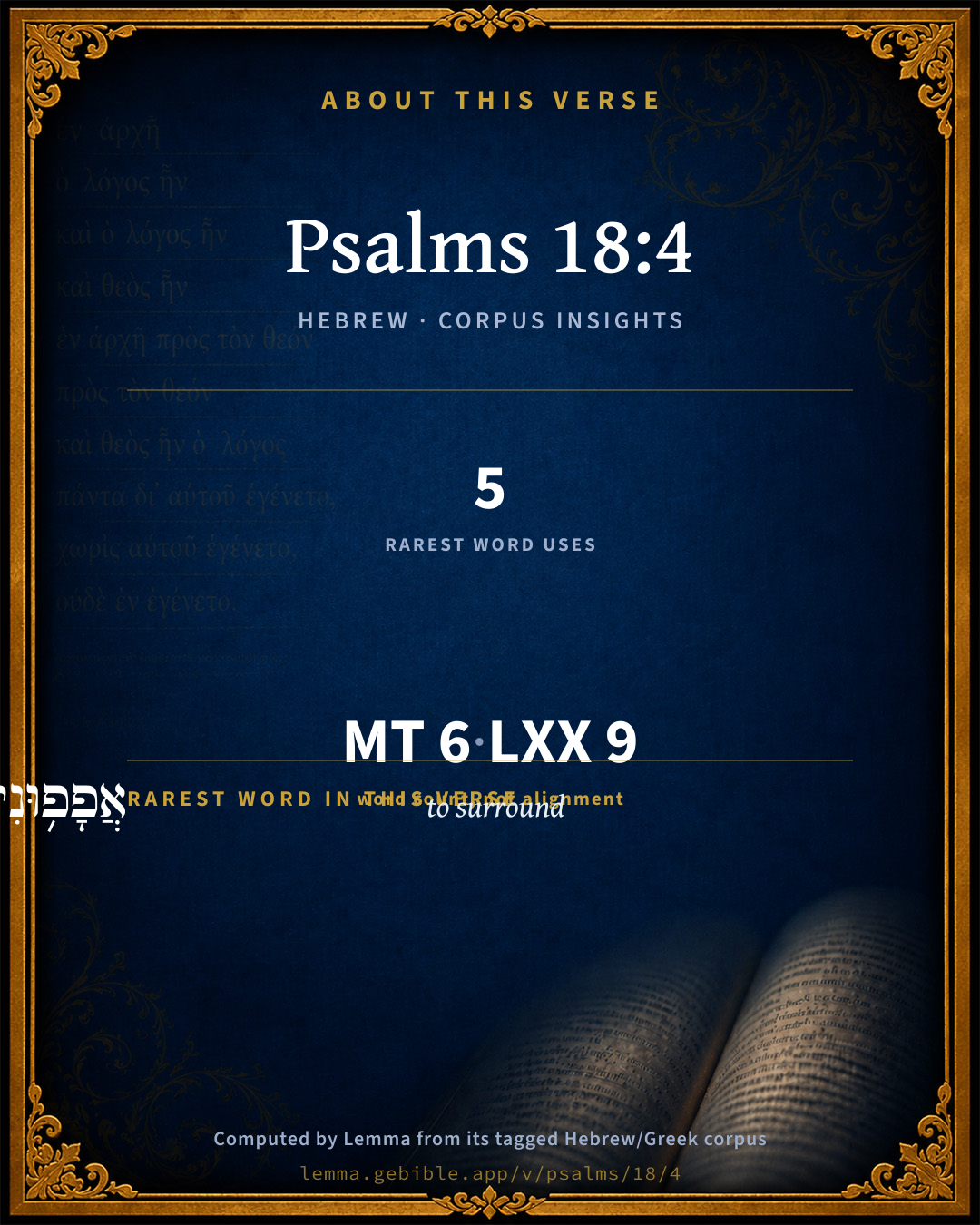
The rarest word here is אֲפָפ֥וּנִי to surround H661 — appearing just 5 times in the whole Hebrew Bible.

Shared distinctive vocabulary

אֲפָפ֥וּנִי to surround H661 occurs in 5 verses of the Hebrew Bible. Also found in:

Grammatical profile

  • 2 verbs
  • 4 nouns

Verb forms

  • אֲפָפ֥וּנִי Qal · Perfect
  • יְבַֽעֲתֽוּנִי Piel · Imperfect

Hebrew & Septuagint length

In English translation the verse runs 13 words from the Hebrew and 14 from the Septuagint (LXX English) — closely comparable.

A rough comparison of the two English renderings, which tokenize alike — not a word-level alignment.

Word counts can differ between the Hebrew and the Greek without any difference in meaning — e.g. the Hebrew direct-object marker אֵת has no separate Greek word, and Greek often adds the article ὁ.

In the original languages it is 6 Hebrew tokens and 9 Greek tokens — but the two are counted differently (Hebrew bundles its prefixes and suffixes into one token; the Greek is in lemma form), so that isn’t a like-for-like length.

Cross-references

16

Topical passages linked to Psalms 18:4 in the Treasury of Scripture Knowledge — connected by theme and wording, ordered by reader-vote popularity; previews shown in the World English Bible.

  • Psalms 116:3 The cords of death surrounded me, The pains of Sheol got a hold of me. I found trouble and sorrow.
  • Matthew 27:24–25 So when Pilate saw that nothing was being gained, but rather that a disturbance was starting, he took water, and washed his hands before the multitude, saying, "I am innocent of the blood of this righteous person. You see to it."
  • Mark 14:33–34 He took with him Peter, James, and John, and began to be greatly troubled and distressed.
  • 2 Corinthians 1:9 Yes, we ourselves have had the sentence of death within ourselves, that we should not trust in ourselves, but in God who raises the dead,
  • 2 Samuel 22:5–6 For the waves of death compassed me; The floods of ungodliness made me afraid:
  • Psalms 22:12–13 Many bulls have surrounded me. Strong bulls of Bashan have encircled me.
  • Psalms 22:16 For dogs have surrounded me. A company of evil-doers have enclosed me. They pierced my hands and my feet.
  • Psalms 124:4 Then the waters would have overwhelmed us, The stream would have gone over our soul;
  • Isaiah 53:3–4 He was despised, and rejected by men; a man of suffering, and acquainted with disease: and as one from whom men hide their face he was despised; and we didn't respect him.
  • Jonah 2:2–7 He said, "I called because of my affliction to Yahweh. He answered me. Out of the belly of Sheol I cried. You heard my voice.
  • Matthew 26:47 While he was still speaking, behold, Judas, one of the twelve, came, and with him a great multitude with swords and clubs, from the chief priest and elders of the people.
  • Matthew 27:39–44 Those who passed by blasphemed him, wagging their heads,
  • Isaiah 13:8 and they shall be dismayed; pangs and sorrows shall take hold [of them]; they shall be in pain as a woman in travail: they shall look in amazement one at another; their faces [shall be] faces of flame.
  • Matthew 26:38–39 Then he said to them, "My soul is exceedingly sorrowful, even to death. Stay here, and watch with me."
  • Matthew 26:55 In that hour Jesus said to the multitudes, "Have you come out as against a robber with swords and clubs to seize me? I sat daily in the temple teaching, and you didn't arrest me.
  • Acts 21:30 All the city was moved, and the people ran together. They seized Paul and dragged him out of the temple. Immediately the doors were shut.

Cross-references courtesy of OpenBible.info (CC BY 4.0).

Hebrew and Greek witnesses Masoretic Hebrew ↔ Greek Septuagint

The same verse in the two great witnesses to the Old Testament, shown verse-for-verse.

You’re reading Greek Psalm 17 (Hebrew Psalm 18). The Septuagint counts the superscription, so verse numbers can differ from the Hebrew — chapter-level alignment, not verse-by-verse. Numbering follows Rahlfs.

These are two independent witnesses, not word-aligned to each other, and the Septuagint is shown in lemma (dictionary) form.

Hebrew Psalms 18:4 Masoretic · Westminster Leningrad Codex

אֲפָפ֥וּנִי חֶבְלֵי מָ֑וֶת וְֽנַחֲלֵ֖י בְלִיַּ֣עַל יְבַֽעֲתֽוּנִי

The cords of death surrounded me. The floods of ungodliness made me afraid.

World English Bible · Public Domain

Greek LXX Greek Psalm 17:4 Septuagint · lemma form

αἰνέω ἐπικαλέω κύριος καί ἐκ ὁ ἐχθρός ἐγώ σώζω

The pangs of death compassed me, and the torrents of ungodliness troubled me exceedingly.

LXX2012 (modern English Septuagint) · Public Domain

On this verse, Ellicott's Commentary for English Readers discusses the Septuagint’s reading. Read the note in Commentary ↓

Hebrew: Westminster Leningrad Codex (CC BY 4.0). Greek: Septuagint (public domain); English from LXX2012 (modern English Septuagint) (Public Domain). How the Septuagint differs from the Hebrew →

Commentary

Notes on Psalms 18:4 from classic Christian and Jewish commentators (each source and its license shown beneath its notes). The classic Christian expositions comment on the surrounding passage and are grouped to its opening verse, so a note may address several verses; the Jewish commentaries on the Tanakh (Rashi and others) are per-verse, so they appear only where the commentator wrote on this verse.

Lemma curates 59 commentaries, every one of them public domain or Creative Commons licensed, each selected and text-cleaned for this edition rather than reprinted as found. About our sources →

Trapp's Complete Commentary

John Trapp

Psa 18:4 The sorrows of death compassed me, and the floods of ungodly men made me afraid.

Ver. 4. The sorrows of death compass me] Or, the pangs, pains, throes as of a travailing woman, these environed me, or came thick and threefold upon me, perveniebant usque ad אף even to my face (as the Rabbins descant upon the word), or flew upon me; desperate and deadly dangers assailed me. Medrash. Tillin. Aphaphuni pro gnaphaphuni. The worst of an evil escaped is to be thankfully acknowledged, and highest strains of eloquence therein to be used so that pride be avoided, and the praise of God only aimed at.

And the floods of ungodly men] Heb. of Belial, that is, of Belialists, acted and agitated by the devil; these same tumbling upon him like many and mighty waters, Fluctus fluctum trudit. Torrentes Belial terrebant me.

John Trapp, A Commentary or Exposition upon All the Books of the Old and New Testament (1647–1656) — public domain. Text from a community e-Sword module.

The Biblical Illustrator

Joseph S. Exell

Psa_18:4-6

The sorrows of death compassed me.

Estimating our sorrows

No attempt is here made to diminish the severity of the crisis. Often when a great agony is overpast, the sufferer himself forgets its intensity and is inclined to think that it might have been cured by less ostentatious menus than had been adopted for its pacification. We are seldom critically correct in the recollection of our sorrows. We either unduly magnify them, or we so far modify their intensity as to make any remedial measures look as simple and superficial as possible. David vividly remembered all his afflictive experience. He does not hesitate to speak of that experience in words which are metaphorical, if not romantic, without at all affecting the reality of the trouble through which he had passed. He says, the sorrows of death compassed him. Some have interpreted this expression as birth pangs; others, again, have used the word cords. It has been thought that the figure of the hunter in the next verse, in which we read of the snares of death, fixes the meaning there to be cords. In Samuel, David represents himself as submerged or overwhelmed by the progress or waves of the trouble which had been made to pass over him. Sometimes, indeed, we do not know what real trouble we have been in until we have been removed from it for some distance, and thus enabled that we may also recollect our greatest deliverances. There is no true piety in undervaluing the darkness and the horror through which the soul has passed. Instead of making light of the most tragical experiences of life, we should rather accumulate them, that we may see how wondrous has been the interposition of the Divine hand, and how adequate are the resources of heaven to all the necessities of this mortal condition. Even admitting the words to be metaphorical, they present a vivid picture of what human sorrow may be,--whatever may be rationally imagined may be actually undergone; as to Davids consciousness, what is here stated was a matter of the sternest reality. It should be borne in mind, too, that trouble is a different thing to different men, even when it comes in the same guise and quantity. Much must depend upon temperament. Things animate suffer; things inanimate do not respond to the blow with which they are struck. The poetic temperament is the most suffering of all. According to the sensitiveness of the nature is the terribleness of the stroke which falls upon it. (Joseph Parker, D. D.)

Davids afflictions and fears

We never can be duly thankful to God if we forget the troubles which we have suffered, and the distress of our souls when they were pressing us down. The sorrows of death compassed me, and the floods of ungodly men made me afraid. When Paul speaks of a great deliverance bestowed upon him in Asia, he says that God had delivered him from so great a death. In another passage he protests that he died daily.

I. Of the great distresses and dangers of David. David probably enjoyed such happiness and tranquillity as this evil world can afford before he was anointed by Samuel to be king over Israel; but almost from that time, whilst he was yet in early youth, his troubles commenced. His sore distresses were not at an end when he was advanced to the throne. But the greatest of all his dangers after his advancement to the kingdom was that to which he was exposed by his unnatural son Absalom, and his treacherous counsellor Ahithophel.

II. The consideration of the state of his mind under his troubles.

1. Great sorrow often obtained possession of his soul. My soul is exceeding sorrowful, or encompassed with sorrow even unto death. And as David was an eminent type of that blessed person, his sorrows may be considered as an emblem of those unequalled sorrows which seized on our Redeemer when He was bearing our iniquities. Poverty, exile, reproach, and danger of life are evils which make a deep impression of grief upon the minds of most men, especially when they meet together; and David, though a wise and an holy man, was not exempt from the feelings of human nature. But David was often compelled to dwell amongst men who without cause were his enemies (Psa_56:1-13). And his friends were afraid to perform the offices of friendship. But exile is more distressing to a lover of his country than poverty. It was peculiarly distressing to an Israelite indeed, who could not leave his country without leaving behind him the sanctuary of his God. They have driven me out this day from abiding in the inheritance of the Lord, saying, Go serve other gods. Woe is me that I dwell in Meshech, and sojourn in the tents of Kedar. His heart was broken with reproach whilst he heard the slanders of many. Continual dangers to himself and to his adherents could not fail to fill his mind with great uneasiness. He had indeed promises which assured him of a happy event to himself, but there is no wonder that his faith, of these promises was sometimes shaken. But to his grief for himself, and for his friends, let us add what he felt for his country, for the indignities done to his God, and even for the guilt and misery which his enemies were bringing upon themselves, and we shall see that he drunk deeper than most other men have done in any age of the cup of affliction. He hated and abhorred every false way, and therefore he was pierced with grief at the sight and hearing of that wickedness which everywhere abounded.

2. Great fear often seized upon him. The floods of ungodly men made him afraid. But of whom was he afraid? Did he think that the Lord had forgotten to be gracious, and had in anger shut up His tender mercies? Surely he was a firm believer in the mercy and faithfulness of God. And yet his faith had a great fight to endure. It was sore tried by many enemies and by ham dispensations of providence. In days of great temptation it is very difficult to restrain those corrupt reasonings by which faith is embarrassed. What if he had made God his enemy? He surely deserved to be rebuked in Gods indignation, and chastised in His sore displeasure. God was true to His word, but His faithfulness was not bullied by destroying in the desert that generation which He brought out of Egypt, although they had the promise of entering into Gods rest which would have been fulfilled to them if they had not come short of it through their own unbelief. Such might be the workings of Davids mind at the times when a deep consciousness of guilt, and a terrifying sense of Divine displeasure discomposed his mind, although during the greater part even of the days of tribulation he could glorify God by an unshaken confidence. No man is always himself. David could often say, The Lord is my light and my salvation; whom shall I fear? the strength of my life; of whom shall I be afraid? But at other times he cried out in the agony of his soul, I am cut off from Thine eyes; I am poor and needy, and my heart is wounded within me; I am gone like the shadow when it declineth; I am tossed up and down as the locust.

III. Why God suffered the holy man to be brought into such calamitous situations. May we not reasonably hope, that those men whom God blesses with His special favour will be preserved from those sorrows and fears which are the just portion of the wicked? Can He not by His Divine power, by which He rules over the world, set them high above all their enemies, and fill their mouths at all times with songs of triumph? Undoubtedly he can, and undoubtedly He would do it if He saw that it would tend to their best advantage.

1. His faith was tried and approved. We are called to count it all joy when we fall into divers temptations, knowing this, that the trying of our faith worketh patience. Some remains of unbelief were found in David when his faith was tried as it were by fire (Psa_27:13-14; Psa_118:1-29).

2. His sore afflictions were means for quickening his devotions. Never was there a more fervent supplicant at the throne of grace.

3. He learned from his sore adversities the value of the Word of God. He learned the value of its promises, its precepts, its warning, its histories.

4. Those graces were improved in him by his afflictions, to the exercise of which he was to be called in the days of his prosperity--his humility, his meekness, his humanity and tenderness of heart to the poor and afflicted. David would not have been such an excellent model for kings as he was if he had obtained the throne like his successors, by hereditary right, without passing to it through a great fight of afflictions. The experience of misery taught him to pity and succour the miserable.

5. His great and sore afflictions prepared the way for those marvellous loving kindnesses which inspired him with joy and praise. He would not have spoken so rapturously on many occasions of the salvations wrought for him by the God of his salvation if he had not tasted the bitter dregs of the cup of affliction.

6. He was designed to be an eminent type of our Lord Jesus Christ in his sufferings and in his exaltation. Many of his Psalms speak of the sufferings and glory of Christ under the figure of his own sufferings and glory.

7. The Church in every age was to derive unspeakable benefit from Davids sufferings,

Improvement--

1. Think it not strange that you must endure many chastisements and trials in the world. Are your afflictions equal in number or greatness to Davids?

2. Admire the providence of God. He knows how to execute His purposes by means which seem calculated to defeat them.

3. Be ready to meet with every occurrence in the course of your lives. You do not know what evil shall befall you; but you know that man is born to trouble. Whilst you enjoy peace and quietness, be thankful but not secure. (G. Lawson.)

The floods of ungodly men made me afraid.--

Excessive wickedness destructive to a nation

By the overflowing of ungodliness the holy writer may be presumed to mean an uncommon prevalence of wickedness exceeding its ordinary measure and proportion in the world. The image represents to us impiety grown to the height, of insolence,. regardless of all rules and unrestrained by discipline.

1. Ungodliness may use to such a pitch of insolence as to be without restraint from laws or authority. The truth of fact is apparent from all histories; and it cannot be wondered at that, when the fear of God and the remonstrances of conscience have lost their force, all human authority proves weak and ineffectual. Civil government is ordained for the punishment of evil-doers, and the praise of them that do well, and whenever it is duly executed it promotes and secures the happiness of society; but unless it be assisted, supported, and conducted by religion, all its strength will be but weakness, and all its wisdom folly. If the magistrate be without any restraint flora conscience and religion, the provision of laws will become of little effect. And if the subjects of any community are without any sense of the obligations of conscience and unrestrained by religion, human laws will be found but a weak provision for peace and justice among them.

2. Whenever this is the case there is reason to apprehend the greatest evils in consequence of it. Consider the miserable consequences which even naturally must attend it. When all the wild lusts and passions of corrupt nature are let loose to their several pursuits, unrestrained by Divine and human laws, no person is secured from injury, no property from fraud or rapine. Consider such a land as exposed to the vengeance of an offended God. The natural effects of prevailing impiety are indeed properly inflictions of God, they execute an established rule and constitution of providence, by which it is ordained that all sin should be attended with some immediate punishment. But the justice of God often visits the wicked with some more signal and extraordinary inflictions.

3. What conduct is in duty and prudence required from all who are in view of such a danger.

(1) The ministers of God are by a peculiar call and obligation required to lift up their voice and cry aloud, to warn the people of their transgressions. They are placed as watchmen, and as they that must give account. Besides the special duties of those who are distinguished by a public character, every private subject who has any zeal for the glory of God, or any concern for the welfare of his country, must labour together with them, and according to his station and capacities endeavour to dispel the cloud and divert the impending ruin.

(2) By a resolute application of private reproof and admonition, by a just and open detestation of impiety, and by a vigorous assistance to the magistrate in the assertion of his authority, and the execution of all good laws, to repress the insolence of wicked men, and make the workers of iniquity ashamed.

(3) Upon the whole, everyone who fears God will under so just an apprehension of His judgments set himself with all his strength and with all his might to reduce within bounds the overflowing of ungodliness, and recall the spirit and practice of religion. If this happy effect can be obtained by the united labours and prayers of good men, God will be entreated for the land and turn away His anger from it. (J. Rogers, D. D.)

The Biblical Illustrator, edited by Joseph S. Exell (c. 1880s–1900s) — public domain. Text from a community e-Sword module.

The Treasury of David

Charles H. Spurgeon

Ver. 4-19. In most poetical language the Psalmist now describes his experience of Jehovah's delivering power. Poesy has in all her treasures no gem more lustrous than the sonnet of the following verses; the sorrow, the cry, the descent of the Divine One, and the rescue of the afflicted, are here set to a music worthy of the golden harps. The Messiah our Saviour is evidently, over and beyond David or any other believer, the main and chief subject of this song; and while studying it we have grown more and more sure that every line here has its deepest and profoundest fulfilment in Him; but as we are desirous not to extend our comment beyond moderate bounds, we must leave it with the devout reader to make the very easy application of the passage to our once distressed but now triumphant Lord.

Ver. 4. The sorrows of death compassed me. Death like a cruel conqueror seemed to twist round about him the cords of pain. He was environed and hemmed in with threatening deaths of the most appalling sort. He was like a mariner broken by the storm and driven upon the rocks by dreadful breakers, white as the teeth of death. Sad plight for the man after God's own heart, but thus it is that Jehovah dealeth with his sons.

The floods of ungodly men made me afraid. Torrents of ungodliness threatened to swamp all religion, and to hurry away the godly man's hope as a thing to be scorned and despised; so far was this threat fulfilled, that even the hero who slew Goliath began to be afraid. The most seaworthy bark is sometimes hard put to it when the storm fiend is abroad. The most courageous man, who as a rule hopes for the best, may sometimes fear the worst. Beloved reader, he who pens these lines has known better than most men what this verse means, and feels inclined to weep, and yet to sing, while he writes upon a text so descriptive of his own experience. On the night of the lamentable accident at the Surrey Music Hall, the floods of Belial were let loose, and the subsequent remarks of a large portion of the press were exceedingly malicious and wicked; our soul was afraid as we stood encompassed with the sorrows of death and the blasphemies of the cruel. But oh, what mercy was there in it all, and what honey of goodness was extracted by our Lord out of this lion of affliction! Surely God hath heard me! Art thou in an ill plight? Dear friend, learn thou from our experience to trust in the Lord Jehovah, who forsaketh not his chosen.

Ver. 4. Sorrows of death. It is heaven's peculiar to be the land of the living; all this life is at most but the shadow of death, the gate of death, the sorrows of death, the snares of death, the terrors of death, the chambers of death, the sentence of death, the savour of death, the ministration of death, the way of death. Matthew Griffith, 1634.

Ver. 4. The bands or cords of death encompassed me. It is not very easy to fix the precise meaning of the phrase, "bands" or "cords" of death. It may either be considered as equivalent to "the bands by which the dead are bound, "in which case, to be encircled with the bands of death is just a figurative expression for being dead; or it may be considered as equivalent to the bands in which a person is bound in the prospect of a violent death, and by which his violent death is secured, he being prevented from escaping. It has been supposed by some, that the allusion is to the ancient mode of hunting wild animals. A considerable tract of country was surrounded with strong ropes. The circle was gradually contracted till the object of pursuit was so confined as to become an easy prey to the hunter. These cords were the cords of death, securing the death of the animal. The phrase is applicable to our Lord in both senses; but as "the floods" of wickedness, or the wicked, are represented as making him afraid subsequently to his being encircled with the cords of death, I am disposed to understand it in the latter of these two senses. John Brown.

Ver. 4. The floods. There is no metaphor of more frequent occurrence with the sacred poets, than that which represents dreadful and unexpected calamities under the image of overwhelming waters. This image seems to have been especially familiar with the Hebrews, inasmuch as it was derived from the peculiar habit and nature of their own country. They had continually before their eyes the river Jordan, annually overflowing its banks, when at the approach of summer the snows of Libanus and the neighbouring mountains melted, and, suddenly pouring down in torrents, swelled the current of the river. Besides, the whole country of Palestine, although it was not watered by many perennial streams, was, from the mountainous character of the greater part of it, liable to numerous torrents, which precipitated themselves through the narrow valleys after the periodical rainy seasons. This image, therefore, however known and adopted by other poets, may be considered as particularly familiar, and as it were, domestic with the Hebrews; who accordingly introduced it with greater frequency and freedom. Robert Lowth (Bishop), 1710-1787.

Ver. 4-6. Graphic picture of a distressed soul, and its resorts in the hour of extremity.

Psalms 18:5*

Ver. 4-19. See Psalms on "Ps 19:4" for further information.

Ver. 4-6. Graphic picture of a distressed soul, and its resorts in the hour of extremity.

Ver. 4-19. See Psalms on "Ps 19:4" for further information.

Ver. 4-6. Graphic picture of a distressed soul, and its resorts in the hour of extremity.

Ver. 4-19. See Psalms on "Ps 19:4" for further information.

Ver. 4-19. See Psalms on "Ps 19:4" for further information.

Ver. 4-19. See Psalms on "Ps 18:4" for further information.

Ver. 4-19. See Psalms on "Ps 18:4" for further information.

Ver. 4-19. See Psalms on "Ps 18:4" for further information.

Ver. 4-19. See Psalms on "Ps 18:4" for further information.

Ver. 4-19. See Psalms on "Ps 18:4" for further information.

Ver. 4-19. See Psalms on "Ps 18:4" for further information.

Ver. 4-19. See Psalms on "Ps 18:4" for further information.

Ver. 4-19. See Psalms on "Ps 18:4" for further information.

Ver. 4-19. See Psalms on "Ps 18:4" for further information.

Ver. 4-19. See Psalms on "Ps 18:4" for further information.

Ver. 4-19. See Psalms on "Ps 18:19" for further information.

Charles H. Spurgeon's The Treasury of David (1869–1885) — public domain. Psalms only. Text from a community e-Sword/MySword module.

Joseph Benson's Commentary

Psa 18:4-5. The sorrows of death compassed me — That is, dangerous and deadly troubles. Or, the bands, or cords, of death, as חבלי, cheblee, may be rendered, quæ hominem quasi fune arctissime constringunt, which binds a man most closely, as with a cord, whence the word is used concerning the pains of women in labour. And the floods of ungodly men — Literally, of Belial, as in the margin. Their great multitudes, strength, and violence, broke in upon me like an irresistible flood, carrying all before it, or like a torrent came down upon me as though they would have swept me away by their fury. “Nothing,” says Dr. Delaney, “can be a finer emblem of a host of men, in their several ranks, than the waves of the sea succeeding one another in their natural order.” And when we consider them pressing forward to the destruction of their adversaries, they may be very properly termed waves of death. The sorrows — Or, cords, of hell, or of death, compassed me about — Brought me to the brink of the grave; the snares of death prevented me — Deadly snares came upon me, and almost took hold on me, before I was aware of my danger.

Joseph Benson's Commentary on the Old and New Testaments (1811–1818) — public domain. Text from a community e-Sword module.

J. A. Alexander on Psalms

Joseph Addison Alexander

5. (Psa 18:4). The bands of death have enclosed me, and the streams of worthlessness (or Belial) will (still) affright me From the general acknowledgment contained in Psa 18:1-4, he proceeds to a more particular description of his danger. By bands we are probably to understand the cordage of a net, such as fowlers spread for birds. This is a favourite metaphor with David to denote dangers, and particularly those of an insidious and complicated kind. See below, Psa 116:3. The word Belial properly means worthless, good for nothing. The reference is here to wicked men, whose number and violence are indicated by the figure of torrents, overflowing streams. The use of the future in the last clause shews that the writer, as in many other cases, takes his position in the midst of the event, and views it as partly past and partly future. This bold assumption of an ideal situation greatly adds to the life and vividness of the description.

Joseph Addison Alexander, The Psalms Translated and Explained (1850) — public domain. Text from a community e-Sword module.

Geneva Bible (1599)

Geneva Bible translators

He speaketh of the dangers and malice of his enemies from the which God had delivered him.

Geneva Bible (1599) marginal notes — public domain. Text via Bolls.life.

Jamieson, Fausset & Brown

Robert Jamieson, A. R. Fausset & David Brown

sorrows--literally, "bands as of a net" (Psa 116:3).

floods--denotes "multitude."

Jamieson, Fausset & Brown — Commentary Critical and Explanatory on the Whole Bible (1871) — public domain (CC PDM 1.0). Text via the HelloAO Bible API.

Adam Clarke's Commentary

Verse 4. The sorrows of death compassed me] חבלי מות chebley maveth, the cables or cords of death. He was almost taken in those nets or stratagems by which, if he had been entangled, he would have lost his life. The stratagems to which he refers were those that were intended for his destruction; hence called the cables or cords of death.

The floods of ungodly men] Troops of wicked men were rushing upon him like an irresistible torrent; or like the waves of the sea, one impelling another forward in successive ranks; so that, thinking he must be overwhelmed by them, he was for the moment affrighted; but God turned the torrent aside, and he escaped.

Adam Clarke's Commentary on the Bible (1810–1826) — public domain. Text from a community e-Sword/MySword module.

John Calvin's Commentaries

4. The cords “Death is here personified under the semblance of a mighty conqueror, who binds his vanquished foes in strong fetters.” — Walford.

John Calvin's Commentaries (1540-1563) — public domain. Text from the Calvin Translation Society English edition (1840s-50s) via the Christian Classics Ethereal Library (ccel.org). Calvin's coverage is partial (roughly two-thirds of the Bible); uncommented books and verses are honest gaps, never fabricated. The 19th-century editor's footnotes and remarks are omitted so the notes are faithfully Calvin's own voice.

Ellicott's Commentary for English Readers

(4) The sorrows of death.—The Hebrew word may mean either birth pangs (LXX. and Act_2:24, where see Note, New Testament Commentary), or cords. The figure of the hunter in the next verse, “the snares of death,” determines its meaning there to be cords (see margin). It is best, therefore, to keep the same rendering here: but there can be little doubt that the version in Samuel, breakers, or waves, is the true one, from the parallelism—

“Waves of death compassed me,

And billows of Belial terrified me.”

For Belial, see Deu_13:13. Here the parallelism fixes its meaning, “ruin.” For the ideas of peril and destruction, connected by the Hebrews with waves and floods, comp. Psa_18:16, also Psa_32:6; Psa_42:7; Psa_69:1. Doubtless the tradition of the Flood and of the Red Sea helped to strengthen the apprehensions natural in a country where the river annually overflowed its banks. and where a dry ravine might at any moment become a dangerous flood. The hatred of the sea arose from quite another cause—viz., the dread of it as a highway for invasion.

A Bible Commentary for English Readers, edited by Charles John Ellicott (1878–1897) — public domain. Text from a community e-Sword module.

The Cambridge Bible for Schools and Colleges

gen. ed. J. J. S. Perowne

4. The sorrows of death] Rather, as R.V., The cords of death. But the word has been wrongly introduced here from Psa_18:5, and the true reading should be restored from 2 Sam.: the waves (lit. breakers) of death. This gives a proper parallelism to floods in the next line. But the reading cords must be very ancient, for Psa_116:3 appears to recognise it.

floods of ungodly men] More graphically the original, torrents of destruction, or, ungodliness. Destruction threatened him like a torrent swollen by a sudden storm, and sweeping all before it (Jdg_5:21). The Heb. word belial, lit. worthlessness, may mean destruction, physical mischief, as well as wickedness, moral mischief: and the context points rather to the former sense here. Death, Destruction, and Sheol, are indeed almost personified, as conspiring for his ruin.

4–6. In forcible figures David pictures the extremity of need in which he cried for help, and not in vain. Again and again there had been ‘but a step between him and death.’ (1Sa_20:3.) The perils to which he had been exposed are described as waves and torrents which threatened to engulf him or sweep him away: Sheol and Death are represented as hunters laying wait for his life with nets and snares.

The Cambridge Bible for Schools and Colleges (gen. ed. J. J. S. Perowne; Cambridge University Press, 1878–1918) — public domain. Text from a community e-Sword module.

John Gill's Exposition

The sorrows of hell compassed me about,.... Or "the cords of the grave" (s), under the power of which he was detained for awhile; the allusion may be to the manner of burying among the Jews, who wound up their dead bodies in linen clothes; so that they were as persons bound hand and foot; and thus were they laid in the grave; see Joh 11:44; and so was Christ, till he was raised from the dead, when he showed himself to have the keys of hell and death, and to be no more under their power, or be held by them;

the snares of death prevented me; or "met" or "got before me" (t) the sense is, he was taken in them: this phrase designs the insidious ways and methods which the enemies of Christ took to ensnare him, and take away his life, and in which they succeeded; see Mat 26:4.

(s) "funes sepulchri", Musculus, Gejerus. (t) "praeoccupaverunt me", V. L. "anteverterunt me", Vatablus; "occurrerunt", Cocceius.

John Gill's Exposition of the Whole Bible (1746–1763) — public domain (CC PDM 1.0). Text via the HelloAO Bible API.

Albert Barnes' Notes on the Bible

The sorrows of death compassed me - Surrounded me. That is, he was in imminent danger of death, or in the midst of such pangs and sorrows as are supposed commonly to attend on death. He refers probably to some period in his past life - perhaps in the persecutions of Saul - when he was so beset with troubles and difficulties that it seemed to him that he must die. The word rendered “sorrows” - חבל chebel - means, according to Gesenius, “a cord, a rope,” and hence, “a snare, gin, noose;” and the idea here is, according to Gesenius, that he was taken as it were in the snares of death, or in the bands of death. So Psa 116:3. Our translators, however, and it seems to me more correctly, regarded the word as derived from the same noun differently pointed - הבל chēbel - meaning “writhings, pangs, pains,” as in Isa 66:7; Jer 13:21; Jer 22:23; Hos 13:13; Job 39:3. So the Aramaic Paraphrase, “Pangs as of a woman in childbirth came around me.” So the Vulgate, “dolores.” So the Septuagint, ὠδῖνες ōdines. The corresponding place in 2 Sam. 22 is: “The waves of death.” The word which is used there - משׁבר mishbâr - means properly waves which break upon the shore - “breakers.” See Psa 42:7; Psa 88:7; Jon 2:3. Why the change was made in the psalm it is not possible to determine. Either word denotes a condition of great danger and alarm, as if death was inevitable.

And the floods of ungodly men - Margin, as in Hebrew, “Belial.” The word “Belial” means properly “without use or profit;” and then worthless, abandoned, wicked. It is applied to wicked men as being “worthless” to society, and to all the proper ends of life. Though the term here undoubtedly refers to “wicked” men, yet it refers to them as being worthless or abandoned - low, common, useless to mankind. The word rendered floods - נחל nachal - means in the singular, properly, a stream, brook, rivulet; and then, a torrent, as formed by rain and snow-water in the mountains, Job 6:15. The word used here refers to such men as if they were poured forth in streams and torrents - in such multitudes that the psalmist was likely to be overwhelmed by them, as one would be by floods of water. “Made me afraid.” Made me apprehensive of losing my life. To what particular period of his life he here refers it is impossible now to determine.

Albert Barnes' Notes on the Bible (1834–1885) — public domain. Text from a community e-Sword/MySword module.

Matthew Poole's English Annotations

The sorrows of death, i.e. dangerous and deadly troubles. Or, the bands or cords of death, which had almost seized me, and was putting its bands upon me. Compare Psa 73:4.

The floods of ungodly men; their great multitudes, and strength, and violent assaults, breaking in upon me like a flood.

Matthew Poole's English Annotations on the Holy Bible (1683–1685) — public domain. Text from a community e-Sword/MySword module.

Whedon's Commentary on the Bible

Daniel D. Whedon

4, 5. In these verses he gives a rapid retrospect of the collective years of his persecutions by Saul, his wars, and his exposures. He surveys them with a glance without detail.

Sorrows of death—Better, cords of death.

“Cords,” here, is not the same word as snares, (Psa_18:5,) but means the bond, or leash, by which a captive or victim was held or led, as illustrated in 1Ki_20:31, and note on Psa_116:3, which see.

Floods of ungodly men—Hebrew, floods or torrents of Belial: that is, floods of worthlessness, but, in the concrete, floods of worthless or wicked men. These, like a mad mountain torrent, threatened to sweep him away. It is doubtful whether בליעל, (Belial,) is ever used in the Old Testament as a proper name. It occurs, however, as such once in the New Testament (which shows the Hebrew usage at that time, 2Co_6:15) for Satan, just as evil, with the masculine article, (ο πονηρος,) means “the Evil One,” (see Mat_13:19, et al., and Satan, Psa_109:6.)

Sorrows of hell—Literally, cords of sheol, the latter here used for the grave, and the phrase corresponding to “cords of death” in preceding verse. On sheol, see on Psa_16:10.

Snares of death—Death is here personified, and compared to an arch hunter spreading his snares. The word snare is different from cord in preceding verse, and denotes the spring, or trapnet, possibly the trapstick by which it was set. It was concealed in the path, and, when sprung, enclosed its victim, or caught him by the foot. So Pro_13:14; Pro_14:27. The genitive in all these passages requires us to understand that the object of this leashing and snaring is the death of the victim.

Prevented me—That is, the snares lay before him whichever way he turned.

Daniel D. Whedon (gen. ed.), Commentary on the Old and New Testaments (1874–1909) — public domain. Text from a community e-Sword module.

The Pulpit Commentary

The sorrows of death compassed me. Here begins the narrative of David"s sufferings in the past. sorrows or rather, "the cords of death," he says, "encompassed me," or "coiled around me" (Kay). Death is represented as a hunter, who goes out with nets and cords, encompassing his victims and driving them into the toils. David"s recollection is probably of the time when he was "hunted upon the mountains" by Saul, (1Sa_26:20) and expected continually to be caught and put to death. (1Sa_19:1 1Sa_23:15 1Sa_27:1) And the floods of ungodlymen made me afraid; literally, the torrents of Belial, or of ungodliness. The LXX have ceimarroi, anomiav . Streams of ungodly men, the myrmidons of Saul, cut him off from escape.

The Pulpit Commentary (1880–1919), ed. H.D.M. Spence-Jones & Joseph S. Exell — public domain. Text from a community e-Sword module.

John Wesley's Explanatory Notes

Death - Dangerous and deadly troubles. Floods - Their multitude, and strength, and violent assaults, breaking in upon me like a flood.

John Wesley, Explanatory Notes Upon the Whole Bible (1754–1765) — public domain. Text via the GEBible commentary corpus.

Keil & Delitzsch

C. F. Keil & F. Delitzsch

(Heb.: 18:5-7) In these verses David gathers into one collective figure all the fearful dangers to which he had been exposed during his persecution by Saul, together with the marvellous answers and deliverances he experienced, that which is unseen, which stands in the relation to that which is visible of cause and effect, rendering itself visible to him. David here appears as passive throughout; the hand from out of the clouds seizes him and draws him out of mighty waters: while in the second part of the Psalm, in fellowship with God and under His blessing, he comes forward as a free actor.

The description begins in Psa 18:5 with the danger and the cry for help which is not in vain. The verb אפף according to a tradition not to be doubted (cf. אופן a wheel) signifies to go round, surround, as a poetical synonym of סבב, הקּיף, כּתּר, and not, as one might after the Arabic have thought: to drive, urge. Instead of "the bands of death," the lxx (cf. Act 2:24) renders it ὠδῖνες (constrictive pains) θανάτου; but Psa 18:6 favours the meaning bands, cords, cf. Psa 119:61 (where it is likewise חבלי instead of the הבלי, which one might have expected, Jos 17:5; Job 36:8), death is therefore represented as a hunter with a cord and net, Psa 91:3. בליּעל, compounded of בּלי and יעל (from יעל, ועל, root על), signifies unprofitableness, worthlessness, and in fact both deep-rooted moral corruption and also abysmal destruction (cf. Co2 6:15, Βελίαρ = Βελίαλ as a name of Satan and his kingdom). Rivers of destruction are those, whose engulfing floods lead down to the abyss of destruction (Jon 2:7). Death, Belı̂jáal, and Sheôl are the names of the weird powers, which make use of David's persecutors as their instruments. Futt. in the sense of imperfects alternate with praett. בּעת (= Arab. bgt) signifies to come suddenly upon any one (but compare also Arab. b‛ṯ, to startle, excitare, to alarm), and קדּם, to rush upon; the two words are distinguished from one another like ׬berfallen and anfallen. The היכל out of which Jahve hears is His heavenly dwelling-place, which is both palace and temple, inasmuch as He sits enthroned there, being worshipped by blessed spirits. לפניו belongs to ושׁועתי: my cry which is poured forth before Him (as e.g., in Psa 102:1), for it is tautological if joined with תּבא beside ושׁועתי. Before Jahve's face he made supplication and his prayer urged its way into His ears.

Keil & Delitzsch — Biblical Commentary on the Old Testament (1861–1891) — public domain (CC PDM 1.0). Text via the HelloAO Bible API. (Old Testament only.)

unfoldingWord translationNotes

Door43 World Missions Community

The cords of death surrounded me

David speaks of death as if it were a person who could capture him and bind him with ropes. AT: "I was about to be killed" (See: Metaphor and Personification)

rushing waters of worthlessness

David is as helpless as if he were being carried away by a rushing flood of waters. AT: "I felt completely helpless" (See: Metaphor)

The cords of Sheol surrounded me; the snares of death trapped me

Here "Sheol," the place of the dead, and "death" are spoken of as if they were people who could surround and trap him. These two clauses have similar meanings and the idea is repeated for emphasis. AT: "I felt trapped and thought I was going to die" (See: Personification and Metaphor and Parallelism)

translationWords

die

water

Hades

snare

unfoldingWord translationNotes — © Distant Shores Media and the Door43 World Missions Community, licensed CC BY-SA 4.0. Source: git.door43.org/Door43/en_tn.

Rashi

Rabbi Shlomo Yitzchaki (Rashi)

With praise I call to the lord With praises I call Him and pray before Him constantly, i.e., even before the salvation I praise Him, because I am confident that I will be saved from my enemies.

Rashi on the Tanakh — English translations: “The Judaica Press complete Tanach with Rashi, translated by A. J. Rosenberg” (CC BY 4.0); “Pentateuch with Rashi's commentary by M. Rosenbaum and A.M. Silbermann, 1929-1934” (public domain); “The Metsudah Tanach series, Lakewood, N.J” (CC BY 4.0); and “The Book of Joshua, Metsudah Publications, 1997” (CC BY 4.0). Text via Sefaria.

Lesson kit

Teaching starters — assembled from the data on this page, not authored interpretation. Every prompt links to the verse data it draws on. Edit before teaching.

Psalms, in the Wisdom, opens this verse with 6 words (6 distinct Hebrew lemmas). Its most distinctive word is ʼâphaph (“to surround”). A historical commentator’s framing appears above. Read the whole chapter for the surrounding context.

Discussion questions

  1. The word ʼâphaph carries the sense “to surround.” How does it shape the verse?
  2. How does 2 Samuel 22:5, which shares the word «to surround», read alongside this verse?
  3. These translations render this verse differently; the difference is in the English rendering, not the original. What questions does that raise?
  4. «אֲפָפ֥וּנִי» is a Qal Perfect verb. How does that grammatical form shape the action described?
  5. Compare how Trapp's Complete Commentary and The Biblical Illustrator read this verse. Where do they agree or differ?

Things to notice

Reading settings

Reading text

Shown beneath each verse's original-language words.

Old Testament
Old Testament edition

Read the OT as the Masoretic Hebrew (MT) or the Greek Septuagint (LXX).

English shown for the Greek Septuagint (in the Hebrew ↔ Greek comparison).

Comparing translations? Open the Compare panel on any verse page to stack up to four side by side.