
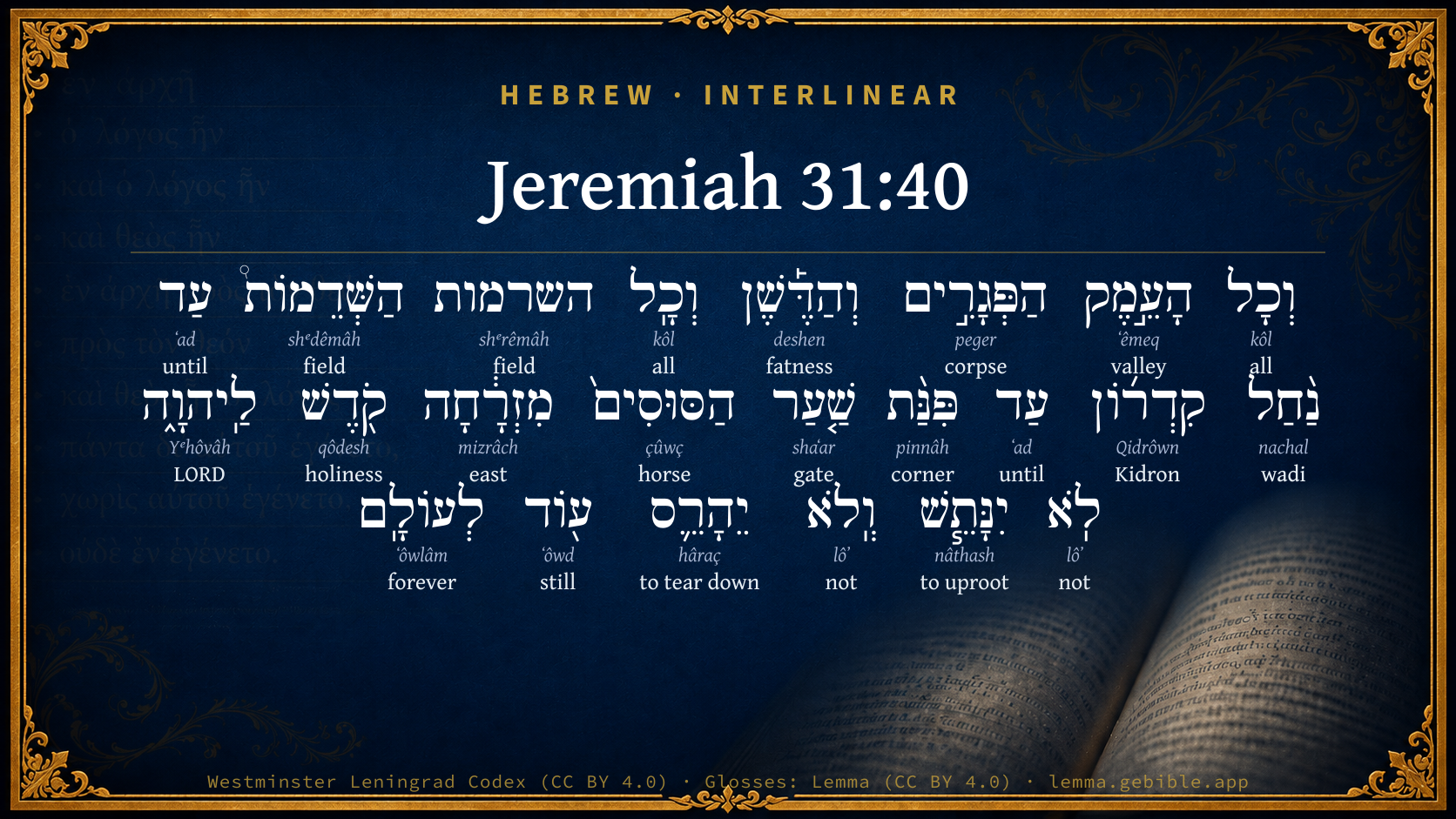
Jeremiah 31:40

Hebrew (Westminster Leningrad Codex) Jeremiah 31:40 appears in the Hebrew Old Testament. The text above is from the Westminster Leningrad Codex. Each word links to its Strong’s number, a concise gloss, and parsing drawn from the Open Scriptures Hebrew Bible morphology. Click any word for its full Brown-Driver-Briggs (BDB) entry.
Download image
Cite this verse

Jeremiah 31:40 (World English Bible). Public Domain. Lemma interlinear Bible study tool, https://lemma.gebible.app/v/jeremiah/31/40.

Show BibTeX & RIS
BibTeX
RIS
English Translation
The whole valley of the dead bodies and of the ashes, and all the fields to the brook Kidron, to the corner of the horse gate toward the east, shall be holy to Yahweh; it shall not be plucked up, nor thrown down any more forever.
World English Bible · Public Domain
Highlights
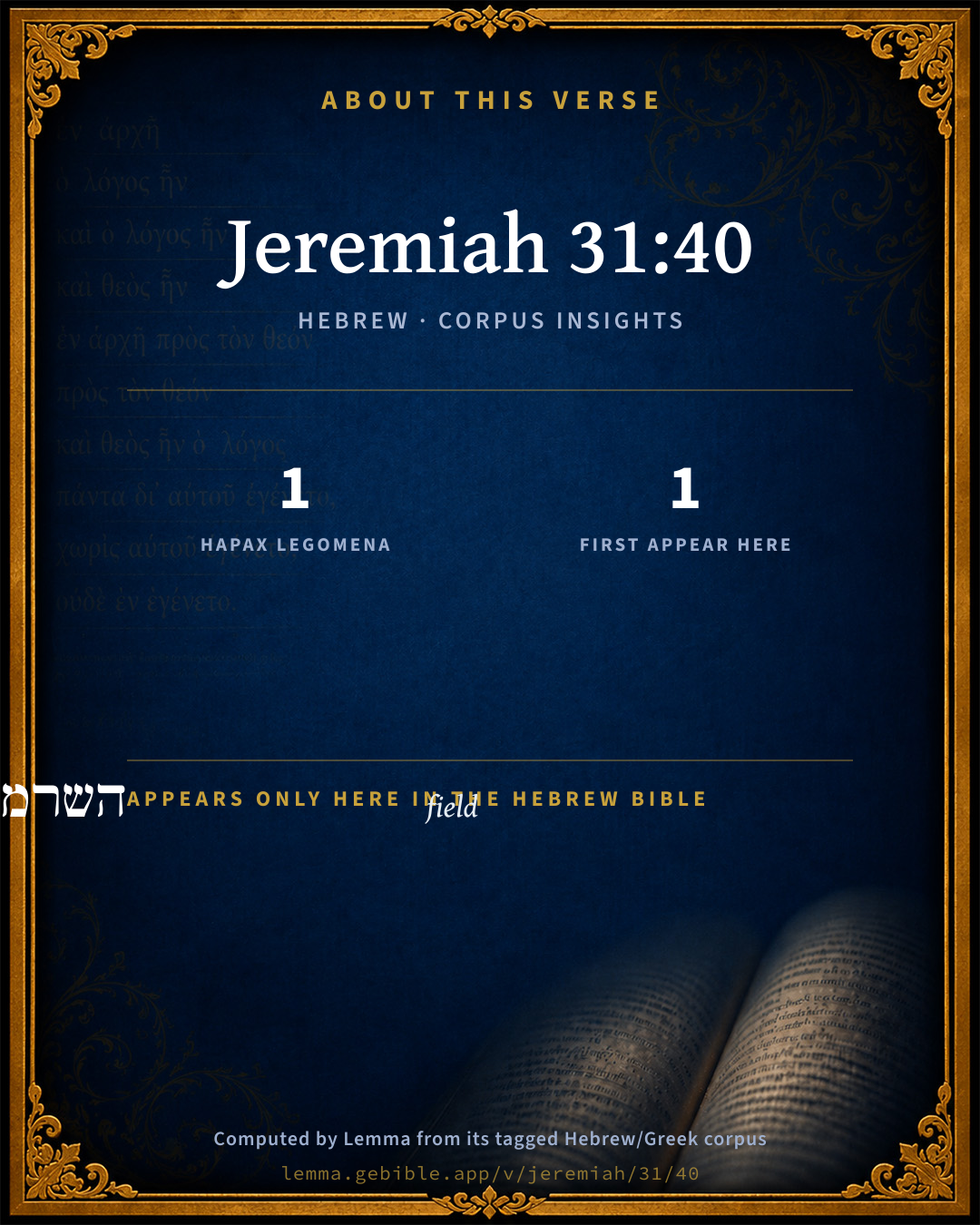
  • 1 hapax legomenon — only here in the Hebrew Bible
  • 1 first appearance in the Hebrew Bible
Full analysis ↓
Download a study sheet

One document with this verse’s original text, its word-by-word gloss line, the meaning frame, cross-references with their text, attributed commentary, and full source and license credits — printable, and it pastes into notes with its structure intact.

This verse Autodidact and up

Study sheet (.html) Plain text (.txt)

A passage Seminary Student

Up to 50 verses in one chapter. A passage sheet keeps up to 6 commentary sources and 12 cross-references per verse, in the order this page ranks them, and says so on the sheet whenever that leaves anything out. Ask for a single verse and you get the Autodidact verse sheet above.

Everything on this page stays free to read, with no account — the sheet is a download of what is already on screen, not access to it.

Want to remove ads? Support Godless Engineer
Compare translations 3

The same verse in 3 English versions, stacked beneath the original-language interlinear above. Click any original word for its lexicon entry.

Each is an independent rendering of the whole verse — the interlinear is not word-aligned to these translations.

Highlighted words mark where these versions differ — a whole-verse word diff, not a word-by-word alignment.

  • World English Bible Public Domain
    The whole valley of the dead bodies and of the ashes, and all the fields to the brook Kidron, to the corner of the horse gate toward the east, shall be holy to Yahweh; it shall not be plucked up, nor thrown down any more forever.
  • King James Version Public Domain
    And the whole valley of the dead bodies, and of the ashes, and all the fields unto the brook of Kidron, unto the corner of the horse gate toward the east, shall be holy unto the LORD; it shall not be plucked up, nor thrown down any more for ever.
  • unfoldingWord Literal Text CC BY-SA 4.0
    The whole valley of the dead bodies and the ashes, and all the terraced fields going out to the Kidron Valley as far as the corner of the Horse Gate on the east, will be set apart for Yahweh. The city will not be pulled up or overthrown again, forever.”

unfoldingWord Literal Text — © unfoldingWord, licensed CC BY-SA 4.0. Word-aligned USFM3 via Door43 (git.door43.org/unfoldingWord/en_ult).

Versions to compare (up to 4)

3 of 4 selected

Show all 18 translations

Every available English version of this verse, each an independent rendering of the whole verse.

  • World English Bible Public Domain
    The whole valley of the dead bodies and of the ashes, and all the fields to the brook Kidron, to the corner of the horse gate toward the east, shall be holy to Yahweh; it shall not be plucked up, nor thrown down any more forever.
  • Berean Standard Bible Public Domain
    The whole valley of the dead bodies and ashes, and all the fields as far as the Kidron Valley, to the corner of the Horse Gate to the east, will be holy to the LORD. It will never again be uprooted or demolished.”
  • Majority Standard Bible Public Domain
    The whole valley of the dead bodies and ashes, and all the fields as far as the Kidron Valley, to the corner of the Horse Gate to the east, will be holy to the LORD. It will never again be uprooted or demolished.”
  • King James Version Public Domain
    And the whole valley of the dead bodies, and of the ashes, and all the fields unto the brook of Kidron, unto the corner of the horse gate toward the east, shall be holy unto the LORD; it shall not be plucked up, nor thrown down any more for ever.
  • American Standard Version (1901) Public Domain
    And the whole valley of the dead bodies and of the ashes, and all the fields unto the brook Kidron, unto the corner of the horse gate toward the east, shall be holy unto Jehovah; it shall not be plucked up, nor thrown down any more for ever.
  • Revised Version (1885) Public Domain
    And the whole valley of the dead bodies, and of the ashes, and all the fields unto the brook Kidron, unto the corner of the horse gate toward the east, shall be holy unto the LORD; it shall not be plucked up, nor thrown down any more for ever.
  • Geneva Bible (1599) Public Domain
    And the whole valley of the dead bodies, and of the ashes, and all the fields vnto the brooke of Kidron, and vnto the corner of the horsegate toward the East, shalbe holy vnto the Lord, neither shall it be plucked vp nor destroyed any more for euer.
  • Douay-Rheims (1899) Public Domain
    Behold the days come, saith the Lord, that the city shall be built to the Lord from the tower of Hanameel even to the gate of the corner.
  • Young's Literal Translation Public Domain
    And all the valley of the carcases and of the ashes, And all the fields unto the brook Kidron, Unto the corner of the horse-gate eastward, `Are' holy to Jehovah, it is not plucked up, Nor is it thrown down any more to the age!
  • Literal Standard Version CC BY-SA 4.0
    And all the valley of the carcasses and of the ashes, || And all the fields to the Brook of Kidron, || To the corner of the Horse Gate eastward, || [Are] holy to YHWH, || It is not plucked up, || Nor is it thrown down anymore for all time!”
  • Unlocked Literal Bible CC BY-SA 4.0
    The whole valley of the dead bodies and the ashes, and all the terraced fields going out to the Kidron Valley as far as the corner of the Horse Gate on the east, will be set apart for Yahweh. The city will not be pulled up or overthrown again, forever.”
  • unfoldingWord Literal Text CC BY-SA 4.0
    The whole valley of the dead bodies and the ashes, and all the terraced fields going out to the Kidron Valley as far as the corner of the Horse Gate on the east, will be set apart for Yahweh. The city will not be pulled up or overthrown again, forever.”
  • Darby Bible Public Domain
    And the whole valley of the dead bodies, and of the ashes, and all the fields unto the torrent Kidron, unto the corner of the horse-gate toward the east, shall be holy unto Jehovah: it shall not be plucked up, nor overthrown any more for ever.
  • World Messianic Bible Public Domain
    The whole valley of the dead bodies and of the ashes, and all the fields to the brook Kidron, to the corner of the horse gate toward the east, will be holy to the LORD. It will not be plucked up or thrown down any more forever.”
  • Webster's Bible Public Domain
    And the whole valley of the dead bodies, and of the ashes, and all the fields to the brook of Kidron, to the corner of the horse-gate towards the east, shall be holy to the LORD; it shall not be plucked up, nor thrown down any more for ever.
  • Free Bible Version CC BY-SA 4.0
    The entire valley, where the dead are buried and the trash is dumped, and all the fields from the Kidron Valley as far as the Horse Gate to the east, will be holy to the Lord. Jerusalem will never again be torn down or destroyed.
  • Bible in Basic English Public Domain
    And all the valley of the dead bodies, and all the field of death as far as the stream Kidron, up to the angle of the horses' doorway to the east, will be holy to the Lord; it will not again be uprooted or overturned for ever.
  • JPS Tanakh (1917) Public Domain
    And the whole valley of the dead bodies, and of the ashes, and all the fields unto the brook Kidron, unto the corner of the horse gate toward the east, shall be holy unto the LORD; it shall not be plucked up, nor thrown down any more for ever.

Literal Standard Version (2020), Covenant Press — licensed CC BY-SA 4.0. Text via the HelloAO Bible API (eBible.org). Unlocked Literal Bible (unfoldingWord) — licensed CC BY-SA 4.0. Text via the HelloAO Bible API (eBible.org). unfoldingWord Literal Text — © unfoldingWord, licensed CC BY-SA 4.0. Word-aligned USFM3 via Door43 (git.door43.org/unfoldingWord/en_ult). Free Bible Version, Dr. Jonathan Gallagher — licensed CC BY-SA 4.0. Text via the HelloAO Bible API (eBible.org).

Word by word

More ways to search: Search by grammar → Find every occurrence → Compare this word →

Practice this passage: Drill this verse → Learn its vocabulary →

השרמות
shᵉrêmâh
H8309
“the · fields”
Particle, Definite Article + Noun, Common, Feminine, Plural, Absolute
Part of Speech
Particle + Noun
Type
Common
Gender
Feminine
Number
Plural
State
Absolute
Full BDB Definition

Origin: probably by an orthographical error for H7709

TWOT: 2334a

field
  1. וְכָל kôl H3605 “and · all of” Conjunction + Noun, Common, Masculine, Singular, Construct
  2. הָעֵ֣מֶק ʻêmeq H6010 “the · valley” Particle, Definite Article + Noun, Common, Masculine, Singular, Absolute
  3. הַפְּגָרִ֣ים peger H6297 “the · corpses” Particle, Definite Article + Noun, Common, Masculine, Plural, Absolute
  4. וְהַדֶּ֡שֶׁן deshen H1880 “and · the · fatness” Conjunction + Particle, Definite Article + Noun, Common, Masculine, Singular, Absolute
  5. וְכָֽל kôl H3605 “and · all of” Conjunction + Noun, Common, Masculine, Singular, Construct
  6. הַשְּׁדֵמוֹת֩ shᵉdêmâh H7709 “the · fields” Particle, Definite Article + Noun, Common, Feminine, Plural, Absolute
  7. עַד ʻad H5704 “until” Preposition
  8. נַ֨חַל nachal H5158 “wadi of” Noun, Common, Masculine, Singular, Construct
  9. קִדְר֜וֹן Qidrôwn H6939 “Kidron” Noun, Proper
  10. עַד ʻad H5704 “until” Preposition
  11. פִּנַּ֨ת pinnâh H6438 “corner of” Noun, Common, Feminine, Singular, Construct
  12. שַׁ֤עַר shaʻar H8179 “gate of” Noun, Common, Masculine, Singular, Construct
  13. הַסּוּסִים֙ çûwç H5483 “the · horses” Particle, Definite Article + Noun, Common, Masculine, Plural, Absolute
  14. מִזְרָ֔חָה mizrâch H4217 “east · toward” Noun, Common, Masculine, Singular, Absolute + Suffix, Demonstrative
  15. קֹ֖דֶשׁ qôdesh H6944 “holiness” Noun, Common, Masculine, Singular, Absolute
  16. לַֽיהוָ֑ה Yᵉhôvâh H3068 “to/for · LORD” Preposition + Noun, Proper
  17. לֹֽא lôʼ H3808 “not” Particle, Negative
  18. יִנָּתֵ֧שׁ nâthash H5428 “to uproot” Verb, Niphal, Imperfect, 3rd Person, Masculine, Singular
  19. וְֽלֹא lôʼ H3808 “and · not” Conjunction + Particle, Negative
  20. יֵהָרֵ֛ס hâraç H2040 “to tear down” Verb, Niphal, Imperfect, 3rd Person, Masculine, Singular
  21. ע֖וֹד ʻôwd H5750 “still” Adverb
  22. לְעוֹלָֽם ʻôwlâm H5769 “to/for · forever” Preposition + Noun, Common, Masculine, Singular, Absolute

About this verse

These counts appear in no published source. They are computed here, from the morphology-tagged text and Lemma’s own curated glosses. What Lemma adds →

23
words
20
distinct lemmas
Prophets
section

Notable vocabulary

1 hapax legomenon — a word that appears only here in the entire Hebrew Bible:

  • השרמות field H8309

First appearance in Scripture

This word makes its first canonical appearance in the Hebrew Bible here:

  • השרמות field H8309

Shared distinctive vocabulary

הַשְּׁדֵמוֹת֩ field H7709 occurs in 6 verses of the Hebrew Bible. Also found in:

Grammatical profile

  • 2 verbs
  • 16 nouns
  • 2 prepositions
  • 1 adverb
  • 2 particles

Verb forms

  • יִנָּתֵ֧שׁ Niphal · Imperfect
  • יֵהָרֵ֛ס Niphal · Imperfect

Repetition

Words recur within this verse — often emphatic in Hebrew:

Cross-references

20

Topical passages linked to Jeremiah 31:40 in the Treasury of Scripture Knowledge — connected by theme and wording, ordered by reader-vote popularity; previews shown in the World English Bible.

  • 2 Samuel 15:23 All the country wept with a loud voice, and all the people passed over: the king also himself passed over the brook Kidron, and all the people passed over, toward the way of the wilderness.
  • Joel 3:17 "So you will know that I am Yahweh, your God, Dwelling in Zion, my holy mountain. Then Jerusalem will be holy, And no strangers will pass through her any more.
  • 2 Kings 11:16 So they made way for her; and she went by the way of the horses' entry to the king's house: and there was she slain.
  • 2 Chronicles 23:15 So they made way for her; and she went to the entrance of the horse gate to the king's house: and they killed her there.
  • John 18:1 When Jesus had spoken these words, he went out with his disciples over the brook Kidron, where was a garden, into which he and his disciples entered.
  • 2 Kings 23:6 He brought out the Asherah from the house of Yahweh, outside of Jerusalem, to the brook Kidron, and burned it at the brook Kidron, and beat it to dust, and cast the dust of it on the graves of the common people.
  • 2 Kings 23:12 The altars that were on the roof of the upper chamber of Ahaz, which the kings of Judah had made, and the altars which Manasseh had made in the two courts of the house of Yahweh, did the king break down, and beat [them] down from there, and cast the dust of them into the brook Kidron.
  • Nehemiah 3:28 Above the horse gate repaired the priests, everyone over against his own house.
  • Zechariah 14:20 In that day there will be on the bells of the horses, "HOLY TO YAHWEH;" and the pots in Yahweh's house will be like the bowls before the altar.
  • Isaiah 51:22 Thus says your Lord Yahweh, and your God who pleads the cause of his people, Behold, I have taken out of your hand the cup of staggering, even the bowl of the cup of my wrath; you shall no more drink it again:
  • Jeremiah 7:31–32 They have built the high places of Topheth, which is in the valley of the son of Hinnom, to burn their sons and their daughters in the fire; which I didn't command, neither came it into my mind.
  • Jeremiah 8:2 and they shall spread them before the sun, and the moon, and all the host of the sky, which they have loved, and which they have served, and after which they have walked, and which they have sought, and which they have worshiped: they shall not be gathered, nor be buried, they shall be for dung on the surface of the earth.
  • Jeremiah 18:7 At what instant I shall speak concerning a nation, and concerning a kingdom, to pluck up and to break down and to destroy it;
  • Jeremiah 19:11–13 and shall tell them, Thus says Yahweh of Hosts: Even so will I break this people and this city, as one breaks a potter's vessel, that can't be made whole again; and they shall bury in Topheth, until there be no place to bury.
  • Jeremiah 32:36 Now therefore thus says Yahweh, the God of Israel, concerning this city, about which you say, It is given into the hand of the king of Babylon by the sword, and by the famine, and by the pestilence:
  • Ezekiel 37:2 He caused me to pass by them round about: and, behold, there were very many in the open valley; and, behold, they were very dry.
  • Ezekiel 37:25 They shall dwell in the land that I have given to Jacob my servant, in which your fathers lived; and they shall dwell therein, they, and their children, and their children's children, forever: and David my servant shall be their prince for ever.
  • Ezekiel 39:29 neither will I hide my face any more from them; for I have poured out my Spirit on the house of Israel, says the Lord Yahweh.
  • Ezekiel 45:1–6 Moreover, when you shall divide by lot the land for inheritance, you shall offer an offering to Yahweh, a holy portion of the land; the length shall be the length of twenty-five thousand [reeds], and the breadth shall be ten thousand: it shall be holy in all the border of it round about.
  • Ezekiel 48:35 It shall be eighteen thousand [reeds] round about: and the name of the city from that day shall be, Yahweh is there.

Cross-references courtesy of OpenBible.info (CC BY 4.0).

Hebrew and Greek witnesses Masoretic Hebrew ↔ Greek Septuagint

The same verse in the two great witnesses to the Old Testament, shown verse-for-verse.

These are two independent witnesses, not word-aligned to each other, and the Septuagint is shown in lemma (dictionary) form.

Hebrew Jeremiah 31:40 Masoretic · Westminster Leningrad Codex

וְכָל הָעֵ֣מֶק הַפְּגָרִ֣ים וְהַדֶּ֡שֶׁן וְכָֽל השרמות הַשְּׁדֵמוֹת֩ עַד נַ֨חַל קִדְר֜וֹן עַד פִּנַּ֨ת שַׁ֤עַר הַסּוּסִים֙ מִזְרָ֔חָה קֹ֖דֶשׁ לַֽיהוָ֑ה לֹֽא יִנָּתֵ֧שׁ וְֽלֹא יֵהָרֵ֛ס ע֖וֹד לְעוֹלָֽם

The whole valley of the dead bodies and of the ashes, and all the fields to the brook Kidron, to the corner of the horse gate toward the east, shall be holy to Yahweh; it shall not be plucked up, nor thrown down any more forever.

World English Bible · Public Domain

Greek LXX Structure differs

In the Septuagint, Jeremiah is about an eighth shorter than the Hebrew and arranges its material differently — the Oracles Against the Nations (Hebrew chapters 46–51) appear in the middle of the Greek book, after 25:13. Because the chapter and verse boundaries do not line up, a verse-for-verse comparison with the Hebrew is not shown.

A verse-for-verse comparison isn’t shown here because the chapters and verses don’t line up. Switch to the LXX edition with the MT / LXX toggle above to read the Greek directly.

Hebrew: Westminster Leningrad Codex (CC BY 4.0). Greek: Septuagint (public domain); English from a public-domain English Septuagint. How the Septuagint differs from the Hebrew →

Targum (Aramaic paraphrase)

1

The Targum is the ancient Jewish Aramaic paraphrase of the Hebrew Scriptures — an interpretive translation, not the Hebrew text itself. Onkelos (literal) and Pseudo-Jonathan (expansive) render the Torah, and Jonathan the Prophets. Coverage is partial: where no permissively-licensed English translation exists for a verse, only the Aramaic is shown. This is verse-level text, not a word-by-word alignment to the Hebrew.

  1. Targum Jonathan Prophets (Joshua–Malachi)
    וְכָל מֵישְׁרָא אֲתַר דִנְפָלוּ תַמָן פִּגְרֵי מַשִׁרְיַת אַתּוּרָאָה וְכָל אֲרִיתָא עַד נַחְלָא דְקִידְרוֹן עַד זָוִית תְּרַע בֵּית רֵיסָא דְמַלְכָּא מַדִינְחָא קוּדְשָׁא קֳדָם יְיָ לָא יִתְעַקֵר וְלָא יִתְפַּגֵר עוֹד לַעֲלָם:

    "And all the straight paths that fell there, the remains of the palaces of the city, and all the foundations to the Nachla of Kidron, to the corner of the house of Reisah d'Malka, the holy kingdom of God, will not be uprooted or scattered anymore for eternity."

    Targum Jonathan — Aramaic: “Mikraot Gedolot” (public domain). English: “Sefaria Community Translation” (CC0 1.0 (public-domain dedication)); “London "Chaldee Paraphrase," 1871” (public domain). Text via Sefaria.

Commentary

Notes on Jeremiah 31:40 from classic Christian and Jewish commentators (each source and its license shown beneath its notes). The classic Christian expositions comment on the surrounding passage and are grouped to its opening verse, so a note may address several verses; the Jewish commentaries on the Tanakh (Rashi and others) are per-verse, so they appear only where the commentator wrote on this verse.

Lemma curates 59 commentaries, every one of them public domain or Creative Commons licensed, each selected and text-cleaned for this edition rather than reprinted as found. About our sources →

Trapp's Complete Commentary

John Trapp

Jer 31:40 And the whole valley of the dead bodies, and of the ashes, and all the fields unto the brook of Kidron, unto the corner of the horse gate toward the east, [shall be] holy unto the LORD; it shall not be plucked up, nor thrown down any more for ever.

Ver. 40. And the whole valley of the dead bodies.] Of Rephaim, say some; of Tophet, say others. See on Jer 31:39.

Shall be holy unto the Lord.] So is the holy Catholic Church, the New Jerusalem which is above especially.

It shall not be plucked up nor thrown down any more for ever.] This cannot be applied to the earthly Jerusalem, which was plucked up and thrown down by the Romans once and again; but especially by Aelius Hadrian the emperor, who laid the whole country waste almost, drove the Jews utterly out of it, set a sow of white marble over the chief gate of Jerusalem in reproach of their religion, and called the city by his own name, Aelia, commanding the Jews not once to look towards it from any tower or hill. It must be therefore meant to be the Church, which cannot be ruined.

John Trapp, A Commentary or Exposition upon All the Books of the Old and New Testament (1647–1656) — public domain. Text from a community e-Sword module.

Tyndale Open Study Notes

Tyndale Open Resources

31:40 Jerusalem will be an eternal holy . . . city, present in the heavenly realm and on the new earth (Rev 21–22). • The graveyard and ash dump were in the valley of Ben-Hinnom (see study note on Jer 7:30-34) on the south side of the city, and the Kidron Valley was on the east (2 Kgs 23:4-6). • The exact location of the Horse Gate on the eastern wall is unknown.

Tyndale Open Study Notes — © Tyndale Open Resources, licensed CC BY-SA 4.0. Text via the HelloAO Bible API.

Jamieson, Fausset & Brown

Robert Jamieson, A. R. Fausset & David Brown

valley of . . . dead--Tophet, where the bodies of malefactors were cast (Isa 30:33), south of the city.

fields . . . Kidron--so Kg2 23:4. Fields in the suburbs reaching as far as Kidron, east of the city.

horse gate--Through it the king's horses were led forth for watering to the brook Kidron (Kg2 11:16; Neh 3:28).

for ever--The city shall not only be spacious, but both "holy to the Lord," that is, freed from all pollutions, and everlasting (Joe 3:17, Joe 3:20; Rev 21:2, Rev 21:10, Rev 21:27).

Next: Jeremiah Chapter 32

Jamieson, Fausset & Brown — Commentary Critical and Explanatory on the Whole Bible (1871) — public domain (CC PDM 1.0). Text via the HelloAO Bible API.

Adam Clarke's Commentary

Verse 40. The whole valley of the dead bodies] The valley of the son of Hinnom.

And all the fields unto the brook of Kidron, unto the corner of the horse-gate toward the east] All these places, the fuller's field, c., shall be consecrated to the Lord, and become a part of this new city so that this will appear to be a city much more extensive than the city of Jerusalem ever was; and to be suited to that time, when the people shall have the law written in their hearts, and God shall have filled the land with the seed of man, and with the seed of beast. Talia saecla currite! "Make speed, ye happy times!"

Adam Clarke's Commentary on the Bible (1810–1826) — public domain. Text from a community e-Sword/MySword module.

John Calvin's Commentaries

He then adds, And the whole valley Some read, “the whole valley shall be holiness to Jehovah:” and it may be suitably taken, that all the places near to the city were to be holy to God; but this verse may be connected with the preceding, as though he said, extended shall be the line to the whole valley of the carcases and of the ashes The word דשן, dashin, means ashes and fatness; but here it is to be taken for ashes; and it is thought that the place was so called, where they were wont to throw the ashes gathered from the altar, after the sacrifices were burnt: as then there was there a great heap of ashes, the place had this name given to it. Another place was also called the place of carcases, because there a host of enemies had been slain by an angel, in the reign of Hezekiah. As then a great and a memorable slaughter had taken place there, it is thought that it received this name, in order that God’s favor might remain known to posterity. If then this name became the monument of God’s favor, Hezekiah, I have no doubt, was the cause of it.

It is then added, and all the regions to the brook Kidron It is probable enough that the places here named were outside of the city, for we know that the brook Kidron was not within the city. Then he adds, to the corner of the gate of the horses It is thought that through this gate went forth the chariots of the king when he wished to exercise his horses. It might have been the market-place for horses. Conjectures only have place here; for no one knows of a certainty whether the king had a place of exercise for his horses. But this gate looked towards the east. He says that all the places would be holiness to Jehovah; and then he promises them a quiet and a perpetual condition, It shall not be cut off nor destroyed any more for ever; for which it is said by Zechariah, “there shall be no more חרם cherim, destruction.”

We now see the design of the Prophet: after having spoken of the return of the people, he adds that the city would again become splendid and large, as it had been; for the land continued in a state of disorder until the restoration of the city, as God had there chosen a habitation for himself. And as the Temple had been built there, it behoved the Israelites, wherever they dwelt, ever to direct their eyes to the Temple and the sanctuary of God, that they might live under his protection. Except, then, the city had been built again, the goodness of God could not have been really enjoyed; for a sort of desolation would have otherwise ever presented itself to the eyes of the people, as the city was as it were the banner under which God protected them. This then is the reason why the Prophet expressly announced this prophecy respecting the future restoration of the city.

Now, when he says that the city would be built to Jehovah, he intimates what was especially expected by the Jews, that that city would again be holy; for if it only flourished in wealth and power like other cities, it would have been but a small comfort to the Israelites. But he points out here a difference between Jerusalem and all heathen cities; for God was, as it were, the architect of that city, as it is said in the Psalms,

“He himself founded it,” (Psalm 87:5)

and further,

“His foundations are on the holy mountains,”

and this ought to be understood of himself. (Psalm 87:1) The meaning is, that God would again care for that city, as the Temple would become as it were his royal throne and earthly sanctuary. At the same time when the Prophet affirms that the extent of the city would not be less than it had been, we see that this prophecy must necessarily be referred to the kingdom of Christ: for though Jerusalem before Christ’s coming was eminent and surrounded by a triple wall, and though it was celebrated through all the East, as even heathen writers say that it excelled every other city, yet it was never accomplished, that the city flourished as under David and Solomon. We must then necessarily come to the spiritual state of the city, and explain the promise as the grace which came through Christ.

But we must especially notice what is said, that it would be holiness to Jehovah, and also that no ruin or destruction would be dreaded any more. Had the condition of the elect people been the same as that of other nations, the promise of restoration would have been small and of no great moment; for it would have been better for them to dwell in exile where they inhabited a pleasant and fertile country. But the Prophet here commends a privilege with which God had favored the children of Abraham above all other nations, when he adopted them as his peculiar people. There is however to be understood an implied contrast between the profanation which then prevailed, and the sanctification which is here promised. The Jews had so polluted the land that it differed nothing from other countries; and God, as Ezekiel says, had thence migrated, (Ezekiel 8:6) and we know that the Temple was called by the prophets the den of robbers, (Jeremiah 7:11) and that the city was also compared to Sodom and Gomorrah. (Isaiah 1:10) Hence the Prophet here promises that the city, with its whole vicinity, would be holy to God, because God would cleanse it from all the defilements by which it had been polluted: and he also claims this as his own work, for to sanctify is a work peculiar to himself.

The promise of perpetual favor is added, as it is also done by Zechariah; for it would not be sufficient to have God’s mercy promised to us for a short time, except its perpetuity were secured. The Prophet then promises now that the course of God’s benefits would be permanent;. The city indeed was again destroyed by Titus, and at length wholly demolished by Adrian; but this fact does not militate against this promise; for as we have said, God gave some taste of his favor in the external aspect of the city until Christ came; but after Christ was manifested, the heavenly Jerusalem became the object to be sought, for all the types and shadows then ceased. The perpetuity then of which the Prophet speaks, is that which corresponds with the character of Christ’s kingdom, and is therefore spiritual. Moreover, this passage teaches us that the Church will be perpetual, and that though God may permit it to be terribly shaken and tossed here and there, there will yet be ever some seed remaining, as long as the sun and the moon shall shine in the heavens, and the order of nature shall continue; so that all the elements, everything we see with our eyes, bear evidence to the perpetuity of the Church, even that it will ever continue: for though Satan and all the world daily threaten its ruin, yet the Lord will in a wonderful manner preserve it to the end, so that it will never perish. This is the import of the passage. Another prophecy follows.

John Calvin's Commentaries (1540-1563) — public domain. Text from the Calvin Translation Society English edition (1840s-50s) via the Christian Classics Ethereal Library (ccel.org). Calvin's coverage is partial (roughly two-thirds of the Bible); uncommented books and verses are honest gaps, never fabricated. The 19th-century editor's footnotes and remarks are omitted so the notes are faithfully Calvin's own voice.

Ellicott's Commentary for English Readers

(40) The whole valley of the dead bodies . . .—We have to think of this city as Jeremiah saw it during the horrors of the siege—the lower part, the “plain” or “valley” of the city, the valley of Hinnom (comp. Jer_19:11), filled with corpses lying unburied in the streets (Lam_2:21; Lam_4:9), the “ashes” of burnt and shattered houses encumbering the streets with their débris, the fields or open spaces that stretched to the Kidron valley, and the “horse-gate” by the king’s palace (2Ki_11:16; 2Ch_23:15; Neh_3:28)—all this now lay before him as a scene of unspeakable desolation; but in his vision of the restored city he sees it all cleansed from whatever was defiling, consecrated to Jehovah, and holy as the precincts of the Temple. It is, perhaps, not without significance in connection with this passage, that when the city was restored, the region above the “horse-gate” was repaired by the priests, who seem to have had their houses in that quarter (Neh_3:28-29). They appear to have been anxious to restore the sanctity of that over which Jeremiah had lamented as desecrated and defiled. The word for “ashes” was a technical one (Lev_6:10-11) for the refuse which remained on the altar after a burnt-offering, and which was to be carried without the camp (Lev_4:12; Lev_6:11). Probably this and the sweepings of the Temple were thrown into the valley of Hinnom.

A Bible Commentary for English Readers, edited by Charles John Ellicott (1878–1897) — public domain. Text from a community e-Sword module.

The Cambridge Bible for Schools and Colleges

gen. ed. J. J. S. Perowne

40. valley of the dead bodies] the valley of Hinnom, into which carcases of criminals and of animals were cast. It was also defiled as the scene of human sacrifices offered to Molech (Jer_7:31, Jer_32:35), and to these the “ashes” also seem to refer. So Dr.

the fields] The MT. gives us alternative readings, exhibiting only the slightest difference in spelling, but one of them unknown outside this passage. The other, to be rendered as in E.VV., is in all probability the original one and is found in a kindred context, 2Ki_23:4.

the horse gate] mentioned Neh_3:28 at the S.E. corner of the Temple courts, 2Ki_11:16 = 2Ch_23:15.

This verse makes the same announcement as to the S. side of Jerusalem as the earlier ones had done for the N. and W. sides, viz. that it should in the future enclose spaces now considered unclean.

The Cambridge Bible for Schools and Colleges (gen. ed. J. J. S. Perowne; Cambridge University Press, 1878–1918) — public domain. Text from a community e-Sword module.

John Gill's Exposition

And the whole valley of the dead bodies, and of the ashes,.... The Targum paraphrases it,

"where the carcasses of the Assyrian army fell;''

Sennacherib's army, destroyed by an angel; and so Jarchi and Kimchi; which latter observes, that the word for "ashes" signifies "fat"; and so may describe the persons then destroyed, who were fat and lusty men: others think, more probably, that the valley of Tophet or Hinnom is here meant; so called, either from the persons that were burnt and sacrificed to Moloch; or from the carcasses of malefactors interred here; and from the ashes of the sacrifices which were brought from the temple, and laid here. This valley lay southwest of the city; it was a ditch at the foot of the mount of Calvary; where, as Monsieur Thevenot (s) says, now stands the chapel of the invention of the cross:

and all the fields unto the brook of Kidron; such as the potters and fullers' fields, which lay to the south of the city, or more to the east, where Kidron was situated:

unto the corner of the horse gate towards the east; and so the compass is fetched round the city to the eastern part of it, from whence it began, even to the tower of Hananeel, which was on the east of this horse gate; see Kg2 11:16. The Targum renders it,

"to the corner of the gate of the house of the king's course;''

supposed to be the gate at which the king's horses went in and out, when led to be watered or exercised:

shall be holy unto the Lord; that is, the whole city in its utmost compass thus rebuilt, yea, even the out parts of it, and those that were defiled with the carcasses of men, and ashes of the burnt offerings. It seems to respect the extensive holiness of the church of God in the latter day; compare with it Zac 14:10;

it shall not be plucked up, nor thrown down any more for ever; which, if understood literally of the city of Jerusalem, can only signify, that it should not be destroyed soon, but should continue a long time; for certain it is, that after it was rebuilt by Zerubbabel, it was plucked up, and thrown down by the Romans, and particularly by Hadrian, who ploughed it up, and built another city, and called it by his own name; but this figuratively rather intends the church of Christ, which is built on him the Rock, and so is immovable; and, like Mount Zion, shall abide for ever.

(s) Travels, par. 1. ch. 39. p. 189.

Next: Jeremiah Chapter 32

John Gill's Exposition of the Whole Bible (1746–1763) — public domain (CC PDM 1.0). Text via the HelloAO Bible API.

Albert Barnes' Notes on the Bible

The whole valley of the dead bodies - Probably some part of the Valley of Ben-Hinnom. Comparing Zec 2:4, the conclusion seems evident that Jeremiah’s words are to be spiritually understood. His city is one that renders holy unto Yahweh what was before unclean. Compare John’s new Jerusalem Rev 21:27.

Albert Barnes' Notes on the Bible (1834–1885) — public domain. Text from a community e-Sword/MySword module.

Haydock's Catholic Bible Commentary

Valley of Hinnom, or Topheth, (chap. vii. 32., and xix. 6.) where Cedron flowed, Zacharias xiv. 4. (Calmet) --- The city was much enlarged on this side, under the Machabees. (Josephus, Jewish Wars vi. 6.) --- Ever. Yet the temple was utterly destroyed by the Romans, so that we must explain this of the Catholic Church, founded on a rock, and proof against the gates of hell, and all the malice of heretics and persecutors, Matthew xvi. 18. (Calmet)

George Leo Haydock (1774–1849), Haydock's Catholic Family Bible and Commentary, 1859 edition — public domain. Excludes Psalms (Douay-Rheims chapter numbering differs from Protestant) and Deuterocanonical books (Catholic canon only).

Matthew Poole's English Annotations

The whole valley of the dead bodies; a valley so called (as some think) from the multitude of Sennacherib’s army slain there; or, (as others think,) from the bodies of malefactors put to death at Golgotha, (which was near,) cast or buried there.

And of the ashes; so called (as is thought) from the ashes of the sacrifices carried thither. Some think that

the horse gate had its name from the king’s horses led out at it. The sum is, the whole city shall be built.

Shall be holy unto the Lord; all these places shall be parts of the holy city, and God’s name shall be sanctified, and he shall be worshipped in them all; and the city for a long time shall abide, and

not be plucked up, nor thrown down; for we know after many years it was plucked up by the Romans. If we interpret the word

for ever of a perpetuity, the church of God must here be understood, against which the gates of hell shall never prevail, as Christ hath promised.

Matthew Poole's English Annotations on the Holy Bible (1683–1685) — public domain. Text from a community e-Sword/MySword module.

The Pulpit Commentary

The southern boundary of the city. The whole valley of the dead bodies, and of the ashes; rather,... even the dead bodies and the ashes. It is assumed by most that Jeremiah means the valley of Hinnom, which, after its defilement by Josiah, (2Ki_23:10) had become a receptacle of rubbish and offal. It is, however, against this view that the word for "valley" is not gai (elsewhere connected with Hinnom), but emek, i.e. "deep lying plain." The "dead bodies" are the corpses of men and animals, destroyed by the judgment of God, and lying unburied; but where, seems uncertain. Ashes. Wood ashes are not here meant, but those of flesh and fat, which remained after the burning of a sacrificial victim. (see Lev_1:16; and comp. Lev_4:12) The horse gate. Mentioned in Neh_3:28. Holy unto the Lord. The unclean spots in the neighbourhood having been transformed. The expression reminds us of Exo_28:36 (the legend on the forefront of the high priest"s mitre).

The Pulpit Commentary (1880–1919), ed. H.D.M. Spence-Jones & Joseph S. Exell — public domain. Text from a community e-Sword module.

John Wesley's Explanatory Notes

The valley - A valley, so called from the multitude of Sennacherib's army slain there. Of the ashes - So called from the ashes of the sacrifices carried thither. Holy - All these places shall be parts of the holy city, and God's name shall be sanctified, and he shall be worshipped in them all. For ever - If we interpret the word for ever of a perpetuity, the church of God must here be understood, against which the gates of hell shall never prevail.

John Wesley, Explanatory Notes Upon the Whole Bible (1754–1765) — public domain. Text via the GEBible commentary corpus.

Rashi

Rabbi Shlomo Yitzchaki (Rashi)

valley of the dead bodies The valley where the bodies of the camp of Sennacherib fell.

and the ash The place where the ashes are poured out, which was outside Jerusalem, they will add to the city and include all this within its walls. Now this prophecy relates to the future, to the final redemption, since it did not take place in the time of the Second Temple.

the fields (Kanpanjje in O.F.) (campagne in Modern French, open country.

Rashi on the Tanakh — English translations: “The Judaica Press complete Tanach with Rashi, translated by A. J. Rosenberg” (CC BY 4.0); “Pentateuch with Rashi's commentary by M. Rosenbaum and A.M. Silbermann, 1929-1934” (public domain); “The Metsudah Tanach series, Lakewood, N.J” (CC BY 4.0); and “The Book of Joshua, Metsudah Publications, 1997” (CC BY 4.0). Text via Sefaria.

Lesson kit

Teaching starters — assembled from the data on this page, not authored interpretation. Every prompt links to the verse data it draws on. Edit before teaching.

Jeremiah, in the Prophets, opens this verse with 23 words (20 distinct Hebrew lemmas). Its most distinctive word is shᵉrêmâh (“field”). A historical commentator’s framing appears above. Read the whole chapter for the surrounding context.

Discussion questions

  1. How does “field” (shᵉrêmâh) shape what this verse is saying?
  2. 1 word here appears nowhere else in the Hebrew Bible. Why might the author reach for such rare wording?
  3. This is the first place “field” appears in Scripture (first appears here). What does its debut here establish?
  4. How does Deuteronomy 32:32, which shares the word «field», read alongside this verse?
  5. What does the repetition of “all” (2× in this one verse) do in this verse?
  6. The translations on this page render this verse differently — a whole-verse word diff, not a word-by-word alignment. What might account for the different wordings?
  7. «יִנָּתֵ֧שׁ» is a Niphal Imperfect verb. How does that grammatical form shape the action described?
  8. Compare how Trapp's Complete Commentary and Tyndale Open Study Notes read this verse. Where do they agree or differ?

Things to notice

  • 1 word in this verse appears nowhere else in the Hebrew Bible.
  • 1 word makes its first canonical appearance in Scripture here.
  • These translations choose different wording for 24 words in this verse.
  • “all” occurs 2× in this single verse.
  • 20 distinct Hebrew lemmas span 23 words in this verse.

Reading settings

Reading text

Shown beneath each verse's original-language words.

Old Testament
Old Testament edition

Read the OT as the Masoretic Hebrew (MT) or the Greek Septuagint (LXX).

English shown for the Greek Septuagint (in the Hebrew ↔ Greek comparison).

Comparing translations? Open the Compare panel on any verse page to stack up to four side by side.